Stanbic Bank
Stanbic Bank
26.8 C
Kampala
Stanbic Bank
Stanbic Bank
Home Blog Page 1681

Cameroon dropped as opponents for Cranes build-up match

The Uganda Cranes players on departure at Entebbe Airport

The Federation of Uganda Football Associations (FUFA) has confirmed changes in the two international friendly matches that Uganda Cranes will play before the 2018 CHAN tournament gets underway in Morocco.

Cameroon, who were to play Uganda in the first friendly game, have been replaced with Guinea, while  Congo Brazzaville remain the Cranes opponents for the second buildup game. Both the matches will be played in Rabat City, Morocco.

Twenty-five players travelled with the team on Wednesday afternoon for the 10 day training camp in Morocco.

After the two build ups, the final team of 23 players will be communicated by the head coach who is working closely with his other technical staff including goalkeeping coach Fred Kajoba and assistant coach Mathias Lule.

At CHAN 2018, Uganda Cranes is in group B alongside Zambia, Cote D’Ivoire and Namibia. They open their campaign against Zambia’s Chipolopolo on January 14.

 Friendly Matches:

 Saturday, January 6, 2018

Uganda Cranes Vs Guinea

Tuesday, January 9, 2018

Uganda Cranes Vs Congo

Stories Continues after ad

Left-handed persons need special consideration

LEFT-HANDED: Former US President Bill Clinton

The President signed the controversial age limit amendment bill into an Act on December 27, 2017. This reminded me of one other anti- discrimination initiative that can be introduced, to specifically cater for the interests of the left handed persons.

Available data indicate that there are 500 million left handers on planet Earth and that at least 20 million people in the United States alone are left handed. Additional data indicates that the three Presidential candidates who ran in the 1992 United States Presidential elections: George Bush, Bill Clinton and Ross Perot were all left handed people.

Interestingly, when I was drafting this opinion a soldier friend remarked that he had not even recognised that most war tools have been manufactured specifically for only right handers.

As a young man, being left handed was a challenge since most instruments I used were designed with the right handed individual in mind. An example is the right-sided arm school desks which presented an obstacle to learning for left handed students from early school through university.

Indeed, every single day left handed school children struggle to succeed in a ‘right handed world’; they meet with obstacles and problems that include using scissors, right-handed arm desks, rulers and even note books. Also, left handed students have a hard time when it comes to sitting at a desk with right handed students because they constantly bump elbows.

Even writing poses a problem for left handed individuals because they always move their hand across what they have just written and this smudges the ink all over the paper, and gets smeared on their hands as well.

In many instances in bar examinations and professional board examinations, left handed people are competing for the limited number of left sided-leaning desks.

Even when left handed examinees access the appropriate desk, they are other problems because left-sided leaning desks are arranged in a manner tending to the left side of lecture halls where you have to crane your neck to see the overhead projectors. This is so because few school administrators, teachers, lecturers, maintenance administrators and furniture buyers take infrastructure bias for granted yet this is a problem that maybe easily solved by better informed Members of Parliament, parents, students, school designers and many others..

Also, manufacturers of guns have discriminated against left handed defence and security officers for they are forced to change to right handedness in order to utilize the right-sided guns.

Unfortunately, some students are told to use the right hand which is weaker, something that that also imperils their hand-to-eye coordination, making them less accurate. This can have disastrous consequences!

Nabendeh Wamoto S.P (0776-658433)

Stories Continues after ad

‘Age Limit Curse’: Ugandans attack Parliament Week activities theme

MAIN CELEBRANT OF PARLIAMENT WEEK: Speaker of Parliament Rebecca Kadaga

The passing and later signing into law the controversial Age Limit Bill by Parliament in December last year left the nation divided, with the sections of the electorate turning their anger towards the supporters of the bill.

The Ugandan Parliament hasn’t been spared the public wrath as evidenced in the postings of many who took to social media to castigate the legislative arm after the Speaker Rebecca Kadaga took to twitter to announce the resumption of parliament week activities on its official twitter handle.

“Parliament is set to hold its annual Parliament Week from 2 1st to 27th January 2018 under the theme, ‘Parliament, the voice of the people’. The event will kick off with a fundraising walk which will be flagged off by speaker Rebecca Kadaga,” the tweet read.

But as soon as the tweet was sent out, Ugandans poured to the social media platform to register their disappointment at the theme of the events, some describing it as a ‘bad joke’ simply aimed at mocking Ugandans.

One of the first people to reply to the tweet was Ronald Ngobi, who lashed out at Parliament for pouring salt on wounds, instead of seeking to reconcile the institution with voters.
He said that the theme is just an insult to him and other Ugandans who feel unfairness noting; “I think whoever crafted the theme was somewhat crafty. I would suggest something like, ‘linking the parliament and citizens’. It would provide reconciliation platform,” Ngobi wrote.

Another twitter user who identified as Conveyer Belt was ‘confused’ by the theme, wondering which ‘voice of people’Parliament is and so was Perry Aritua, who asked for clarification from Parliament on ‘which people’ it meant?
It was the same for twitter user only known as Magie and another Matovu Latib.

Another social media user proposed to have the theme changed to; ‘Parliament-The Voice Of The People At Gun Point. Are you guys serious or you are just having a laugh?”
Munna Maganja replied; “Parliament a voice of the people. This is a big joke.”
On the other hand, Comfort Hakim wants Parliament to ‘leave Ugandans alone’ and asked the institution ‘to pass any laws they so wished’.
While Mwanje Peter and Kinawataka Musoke questioned the relevance of Parliament in Uganda saying the citizens aren’t benefitting from it. The two also said that ‘Uganda has no Parliament but just an institution full of greedy people’.
“The voice of hungry wolves ready to suck innocent Ugandans’ blood,” was Masembe Simon’s reaction to the announcement.

However, it was a one Joshua Mwesigwa who awoke the age limit curse, and demanded Parliament not to waste tax payers’ money cleansing the august house of age limit ghosts.

“After Age Limit, you exposed yourselves. Don’t waste tax payers’ money on a public relations opportunity to wash your dirty linen,” Mwesigwa charged.

Stories Continues after ad

‘Tycoon’ SK Mbuga, wife wanted over defrauding billions from Swedish politician

'Tycoon' SK Mbuga with his fleet of luxurious cars

Whereas socialites Sulaiman Kabangala Mbuga aka ‘SK Mbuga’ and his wife ‘Vivienne Angella Birungi Chebet’ aka Jalia Mbuga  are known to be filthy rich and living luxuriously, the source of their money has always remained a mystery.

ON WEDDING DAY: SK Mbuga and Jalia Mbuga

Well, something like a hint on how the couple got their wealth has come to light: the couple is wanted by Swedish Police for fraud, described by Anna-Lena Tapper of the police’s National Fraud Center as ‘A clear approach to how a Nigerian letter fraud goes’.

SULTAN’S WEDDING: SK Mbuga and Jalia Mbuga on their wedding day

Details of the said fraud linked to the 34-year old Mbuga and his wife Jalia Mbuga first appeared in the Expressen newspaper, and according to documents before a Swedish court, the couple is accused of defrauding over Shs23 billion from a Swedish politician, Sten Heinsoo, aged 71.

‘Now Expressen can tell that the suspicions have led the police to one of Uganda’s most famous jet races – property mogul “SK” Mbuga, 34,’ the newspaper wrote.

The fraud is alleged to have been executed by Ms. Birungi when she reportedly duped Heinsoo into sending her money to ostensibly ferry gold from Uganda to Sweden.

At the time, the two were dating and so, when Ms. Birungi cried for help, Heinsoo allegedly sent her money belonging to his previous employer, the real estate giant Einar Matsson.

Last week, Sten Heinsoo was charged with gross negligence against the principal. Even Ms. Birungi – a Swedish citizen for a few years – was charged with the Stockholm District Court for several cases of gross fraud against Heinsoo.

Sources indicate that SK Mbuga has also previously been detained in probation for reportedly for the same crime.

It is believed that the said money is what the couple used on their luxurious wedding which was held in Kampala in 2016, with sources intimating that it is because the wedding took place shortly after Heinsoo made the last transfer of money to Ms. Birungi.

Thousands of guests attended the event and in advance a Rolls-Royce Phantom and Uganda’s first Ferrari were purchased as ‘wedding cars’.

Mbuga also showered his wife with gifts in the form of a specially-ordered Mercedes-Benz, exclusive jewelry and a Dubai holiday, where they have been living since then.

In February last year, Ms Birungi returned to Sweden. She was arrested – but despite the prosecutor’s request for arrest, the District Court considered that it was possible with a travel ban and notification obligation. They met the requirements until two weeks ago when she departed. Now she is being searched by the Swedish police. “I do not know where she is,” says her lawyer, Sven Severin, and continues.

Ms Birungi immigrated to Sweden from Uganda in 2011 and has been staying in the Stockholm area since then, reports indicate.

In an early hearing, Sten Heinsoo told court that the two met in the church when she worked as a ‘personal assistant’, and eventually they developed a relationship where they ‘fellowshipped’.

By press time it was not possible to reach SK Mbuga as he is reportedly out of the country, in Dubai, United Arab Emirates (UAE).


Stories Continues after ad
Makerere University Visitation Committee: understanding strikes at campus over the years

The Makerere University Administration Block

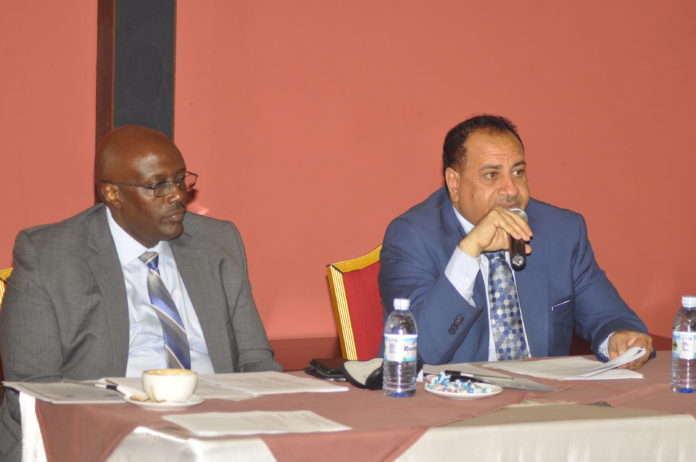
Makerere University has released the report of the Visitation Committee that was appointed by President Yoweri Museveni in 2016 to analyze among others the causes of endemic strikes at the country’s oldest institution of higher learning.

VISITATION COMMITTEE CHAIR: Dr. Abel Rwendeire. (RIP)

According to the 370-page report drafted by a committee that was chaired by Dr. Abel Rwendeire (RIP), Makerere University has had 13 strikes – one in 1976 during Iddi Amin’s reign where students attempted to overthrow the dictatorial regime – and 12 strikes during the Museveni regime from 1990 to 2016.

Makerere University was established in 1922 as a technical institute and constituent college of University of London, and has since then produced some of the country’s finest brains, including three former Presidents: Dr. Apollo Milton Obote, Yusuf Lule and Godfrey Binaisa.

Other notable alumni in recent times include among others Vice Presidents Samson Babi Mululu Kisekka, Specioza Wandira Kazibwe and Prof. Gilbert Balibaseka Bukenya; Prime Ministers Dr. (Kisekka), John Patrick Amama Mbabazi and Dr. Ruhakana Rugunda, Bank of Uganda (BoU) Governor Emmanuel Mutebile; former UN Under Secretary General Olara Otunnu; Democratic Party president Norbert Mao, the leader of the 1990 strike, and former presidential candidate Dr. Warren Kizza Besigye Kifefe.

However, despite such fine brains, over the past 30 years the university has experienced both student and staff strikes largely over complaints about welfare and remuneration, and these have at times led to the institution’s closure, the most recent being in 2016, following which the nine-member Rwendeire Visitation Committee was appointed.

Meanwhile, the report cited among others, governance, financial, academic and student affairs as some of the causes of endemic strikes at the university, and called for the implementation of the recommendations of the Government White Paper on the Report of the Visitation Committee to Public Universities in Uganda, 2008.

According to the Rwendeire Committee, the university also faces ‘human challenges’, arising mostly out of issues like data and information management, something that the committee noted, inevitably leads to ‘gross allegations of malfeasance in academic records management missing and changing students’ marks; unreliable financial and human resource records’.

It is against such a background that the Rwendeire Visitation Committee even failed to establish the exact number of Students and Staff at Makerere University.

Below, the EagleOnline reproduces an abstract chronology of strikes at Makerere University, as summed up by the Rwendeire Visitation Committee

(1) Strikes at Makerere date before independence. The first significant protest was held in 1952. This strike involved a boycott of the dining halls in a demand for better food. The cause was student “welfare”.

(2) During independence, the strikes tended to be ideological. Ideologically-inspired protests in the 1960s became a common feature as students demonstrated against American bombing in northwestern Uganda (a spill-over from conflict in Congo) and the hanging of three African nationalists by the Smith Government in Rhodesia.

(3) A decade later (1976), students plotted, bravely but unsuccessfully, to overthrow the Amin government. This was connected to the ideological orientation that a change of government would possibly come alongside a change of policies and better welfare.

(4) In December 1990, the Student Guild president (Norbert Mao) spearheaded a rejection of a Guild constitution imposed by the Ministry of Education. Even as he put forward a host of economic “survival” issues–the abolition of allowances for books, transportation, and stationery–Mao connected the protests with the government’s costly pursuit of war in the north and its tolerance of corruption.

(5) In 1991, there was another strike caused by welfare and survival reasons. The Government had just scrapped student allowances yet students expected Government to give them free housing, food, stationery, and even pocket money and transport back home.

(6) In May 2005, there was a student demonstration which was caused by administrative challenges which students connected to their welfare. A placard reading: “Ssebuwufu was much better-We want him back”, signified the indirect demand of better welfare. This strike was caused by apparent weaknesses in University Management systems which did not prioritise student issues as compared to what the Ssebuwufu administration had applied.

(7) In November 2006, there was a strike by staff demanding Government to honor a pledge it had made in April 2004 for a salary increase. The cause of this strike was purely related to Staff welfare.

(8) A year later, in November 2007, the University was shut down for up to two months as lecturers laid down their tools and students turned rowdy over failure to study.

(9) In February 2008, Makerere University Students slipped out of a planned strike that was intended to be staged due to continued redundancy, following a strike by Academic Staff. The Students had for one week remained redundant, after their Lecturers went on strike protesting against the lack of adequate teaching materials. Students tried to seek out a peaceful solution to the stalemate between the Lecturers and the Government and resolved to give the conflicting parties a chance to iron out the problem amicably without resorting to violence.

(10) In September 2011, Makerere University was closed hardly two weeks into the new semester when authorities running the country’s oldest University failed to break a deadlock over a strike by Academic Staff who were demanding enhanced pay and clearance of their pension arrears. Fear of a threat by Students to join the weeklong Lecturers’ strike prompted the sudden closure and saw the University campus, from the gate through to the halls of residence, turned into a mini garrison with hundreds of heavily armed police. Lecturers also demanded that top up allowances that University administrators got be scrapped and that Government takes full responsibility of the payroll instead of the now shared salary payment between the University and Ministry of Public Service.

(11) In 2013, there was a strike by Makerere University Staff demanding for a salary increment from Government. Government then made it clear that it did not have the funds. Government then directed the University Council to consider using internally generated funds to provide an incentive to Staff so that they could call off the strike.

(12) In July 2014– there was a morning strike staged by Students over Management’s decision to scrap meals in the halls of residence and the 10 per cent tuition increment policy for the new students. Makerere University Council had scrapped free meals to all students due to the high food prices and the financial squeeze at Uganda’s biggest University. The Council, the Institution’s top governing body, resolved that every student on the Government scholarship scheme should instead be given a daily meal allowance of UGX 2, 000.

(13) In October 2014, Makerere University students went on strike protesting a hike in graduation fees. This strike was again both a survival and welfare issue. The lack of effective consultation by University Management and Council before it was passed appears to have been interpreted by students as being intended to affect their welfare at the University.

(14) In April 2016- Students protested the Institution’s decision to scrap 32 courses. The Report had recommended that 30 degree programmes be merged, 18 be restructured while 21 undergraduate diplomas, 11 undergraduate certificates and three degree programmes be phased out.

(15) Beginning on 1st August 2016, the Non-teaching Staff went on strike demanding their back pay. The strike lasted three weeks and the Government agreed to pay them by the end of October 2016; however, the Government failed to do so.

In November 2016 President Museveni ordered the closure of Makerere due to staff and later Student strikes over unpaid arrears and lack of lectures respectively.


Stories Continues after ad
Desabre names 25 players for camp in Morocco

Players, Allan Kyambadde with Moses Waiswa.

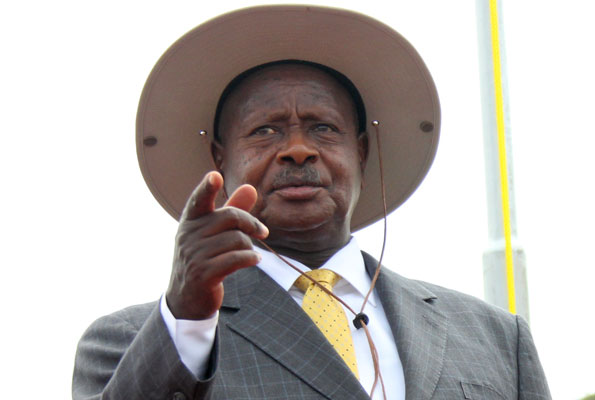
New Uganda Cranes head coach Sebastien Desabre has named 25 players for a 10 day training camp in Rabat, Morocco in preparation for the upcoming CHAN tournament.
There was an early morning training session on Wednesday morning at the Africa Bible University (ABU) play ground before the 25 traveling players were named by the head coach.
The team left on Wednesday afternoon to Morocco in preparation for the Total CHAN 2018 championship.
Cranes will play two international build up matches against Congo Brazzaville and Cameroon in Rabat before the final 23 man team will be named.
Cranes are in the Group B alongside Ivory Coast, Namibia and Zambia. They open their campaign against Zambia Chipolopolo on 14 January.

Delegation to Morocco:
Players:
Goalkeepers: Watenga Isma, Ochan Benjamin and Saidi Keni
Outfield players: Nico Wakiro Wadada,Joseph Nsubuga, Awanyi Timothy, Mustapha Mujuzi, Muwanga Bernard, Muleme Isaac, Madoi Aggrey, Kizza Mustapha, Karisa Milton, Paul Mucurezi, Kyambadde Allan, Batte Seif, Senfuka Rahmat, Lwanga Taddeo, Kasule Abubaker, Waisswa Moses, Saddam Juma, Mutyaba Muzamir, Masiko Tom, Shaban Muhammad, Nsibambi Derrick, Senkatuka Nelson

Officials:
Head of Delegation: Hamid Juma (FUFA Executive Committee Member)
Head coach: Sebastien Desabre
Assistant Coach: Mathias Lule
Goalkeeping coach: Fred Kajoba
Team Doctor: Ronald Kisolo
Physio: Ivan Ssewanyana
Team manager: Joseph Kasana
Media Officer: Ahmed Hussein
Kits Manager: Saidi Lugolobi

Stories Continues after ad
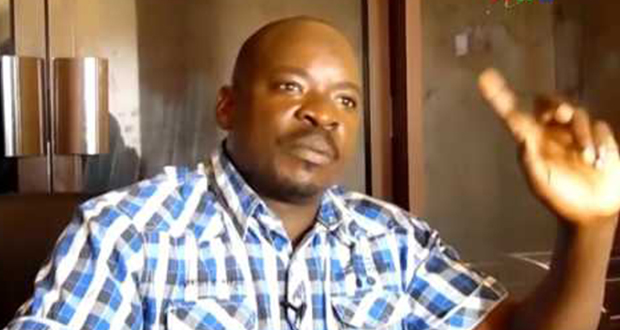
Airtel subscriber base hits 10 million, inches closer to MTN

Airtel Uganda Managing Director V.G. Somasekhar

Airtel Uganda ended 2017 on a good note, this after it closed the subscriber numbers gap with her biggest rival, MTN.

Airtel Uganda Managing Director V.G. Somasekhar, made the disclosure that his company now has over 10 million customers, bringing it closer to MTN that has 11.2 customers.

“We are happy to announce that our customer base has grown to 10 million. This means we have been able to build trust with our valued customers. On behalf of the Airtel family, I would like to thank our Customers, the Government, Regulator as well as partners for their loyalty and contribution to the growth of the Airtel brand over the years. With their support, Airtel is making significant impact on our community and we are happy to be celebrating this with them. At Airtel, we have always been committed to serve, support and provide our customers with innovative products and services. We are humbled by our customers’ trust,” Somasekhar said, adding that the tremendous growth has cemented Airtel’s position as the fastest growing telecom in the country.

He added: “And as we celebrate this milestone we pledge to continue investing heavily towards improving the quality of our service, great customer experience at all our touch points and the overall network expansion across Uganda. Affordability remains a key business deliverable on voice, data and Airtel money services while providing solutions designed to make the real difference in the lives of our customers.”

According to Somasekhar, Airtel’s growth has been fostered by an increase in the uptake of the telecom’s products and services, great partnerships and investment in network expansion across the country.

“The company will continue investing heavily in innovation, great customer experience and network expansion across Uganda,” he added.

Statistics indicate that with 11.2 million customers MTN has the largest market share, followed by Airtel with 10 million subscribers, while in third position is Africell with  2.1 million customers.


Stories Continues after ad
Age limit saga: Kadaga ‘supporters’ storm court

A group of people claiming to be supporters of the Speaker of Parliament Rebecca Kadaga has today stormed Kampala High Court where she was expected to defend herself over allegations of ‘illegally’ suspending six Members of Parliament.

On December 20, 2017, Kadaga suspended Allan Ssewanyana, Ibrahim Ssemujju Nganda, Mubarak Manyangwa, Gerald Karuhanga, Jonathan Odur and Anthony Akol for ‘misbehaving’ during the plenary as the house debated the controversial age limit bill that was assented to by President Yoweri Museveni last year.

Carrying placards inscribed with words like ‘Leave Kadaga Alone’, ‘Kadaga followed the Constitution’, today’s protesters said the Speaker ably guided the House during the age limit bill, and that the decision to suspend the six MPs ‘was the best of all’.

This is not the first time people claiming to be supporters of public figures dragged to court for alleged breach of the law. In May last year, tens of protesters stormed the Makindye Magistrate’s Court, in an attempt to scuttle a case lodged against the Inspector General of Police (IGP) General Kale Kayihura, who had been accused of the torture of supporters of the former Forum for Democratic Change presidential candidate Dr. Kizza Besigye.

Meanwhile, the Speaker did not show up and was instead represented by lawyer Johnson Natuhwera, as High Court judge Margaret Oumo Oguli dismissed and referred the case to the Constitutional Court for interpretation.

In a ruling delivered by Deputy Court Registrar Joyce Kabagye, Justice Oguli said her court lacked the jurisdiction to handle the case.

‘’Article 137 of the Constitution allows for a case to be referred to Constitutional Court for interpretation. I therefore refer this case to Constitutional Court for interpretation’’ she said in her ruling.

But the ruling unsettled the defence team led by Erias Lukwago, who expressed surprise at the ruling saying it was in contravention of the legal procedures and the principles of natural justice.

“I am surprised by Oguli’s ruling; this case had not been heard for the three sittings instead it has been referred to Constitutional Court,” Lukwago said, adding that it was the first time he was experiencing such a decision in the 19 years he has practiced law.

Later, Lukwago said he would meet his clients and the Leader of Opposition to determine the way forward.

Stories Continues after ad

New Year, New travels!

It is finally here! 2018. The long awaited New Year has arrived and with it comes a new sense of hope. The slate has been wiped clean and it’s time for new experiences. Everyone uses this time to make New Year resolutions, things they would like to accomplish and work on through the year. Goals are set and to-do lists are made.

One of the many resolutions most people always promise themselves they will fulfill is to travel. Travelling and discovering new places, experiencing a different scene, culture, food and music can be very exciting. You learn so much and are exposed to a different side of the world each time you decide to travel. Traveling also brings people together, whether it’s families, friends, work groups or complete strangers there is a guarantee that great memories will be created.

In 2017, four of the major highlights for Jumia Travel were the trips across Uganda.  Whether it was the journey to the annual largely celebrated international music festival Nyege Nyege in Jinja or the trip to the beautiful Lake Bunyonyi and Chobe organized by Simples Entertainment or the one day visit to Ssese Island. Seeing the happiness, joy, fun, challenges experienced when on these trips was definitely something to look back on with great pride. As we take stock of the year that was, Jumia Travel is prepared to partner in more travel adventures in 2018.

That being said planning a trip? Trying to make sure that resolution is fulfilled this year? No need for you to look very far Jumia Travel has you covered with several hotel options and the best rates for flights across the world.

HAPPY NEW YEAR MAY 2018 BE NOTHING SHORT OF PROSPEROUS!

Cynthia Tumwine

PR Manager Jumia Food and Travel

Stories Continues after ad

Coach Sam Timbe to join Tusker FC

Ugandan veteran football Coach Sam Timbe

For the third year in a row, 11-time Kenyan Premier League champions Tusker FC will be managed by a Ugandan coach.

According to the reports in Kenya, Sam Timbe is set to be unveiled today as Tusker’s head coach on a two-year deal.

He will replace compatriot George ‘Best’ Nsimbe, who was sacked at the end of the season for a disastrous 2017 campaign that saw the team surrender both the GOtv Shield and the league title to AFC Leopards and Gor Mahia, respectively.

Timbe managed a Kenyan club Sofapaka in August 2013, leading the team to the domestic title in 2014 before quitting after expiry of his contract in August 2015 to rejoin Ugandan side Police.

Tusker won a double in 2016 under Ugandan Paul Nkata but struggled in the 2017 season, finishing a distant sixth with 50 points, 24 behind the champions Gor Mahia.

Stories Continues after ad