Stanbic Bank
Stanbic Bank
25.3 C
Kampala
Stanbic Bank
Stanbic Bank
Home Blog Page 1712

Stanbic donates Shs10m towards improvement of sanitation at Bbira PS

Stanbic Bank staff and those of Bbira PS

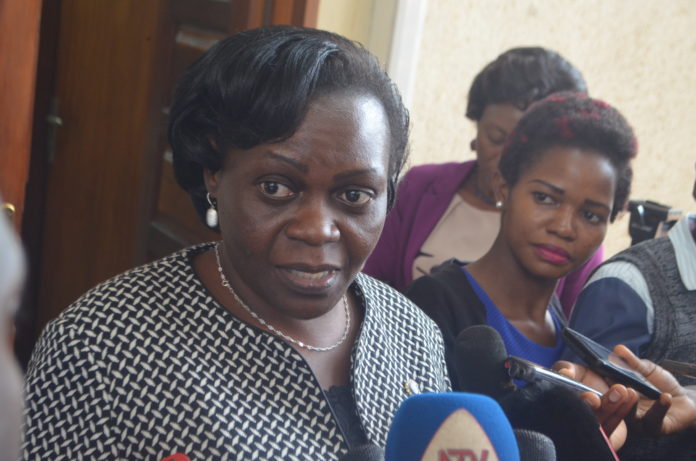
Staff of Stanbic Bank Uganda Operations Division have visited the government-aided Bbira Primary School in Wakiso District and made a Ushs10 million donation towards the construction of a tank to improve water sanitation.

Part of the money will also be used for necessities such as clothes and shoes to improve the welfare of the children, and Patricia Nshemereirwe Musiime, Stanbic Banks Head of Operations, saying education is a pillar in the bank’s Corporate Social Initiative programme.

“A good education can only be achieved through a better and friendly learning environment, sanitation being one of the core elements,” she said, adding: “We believe a fully supported education ecosystem in our communities is enabled not only through the class room but also elements such as safe water and health sanitation which contribute to empowerment and prosperity.”

According to Ms. Musiime, supporting education enables achievement of a universal primary education and in the long run leads to development of the community.

Commenting on the contribution, the schools headmaster, George William Mubiru Salongo said as a government-funded school that receives approximately Shs10 million annually, additional financial support is always welcome.

“We appreciate Stanbic Bank for taking the initiative to support education in all possible aspects, more importantly as we seek to ensure a wholesome education for children,” Mr. Mubiru Salongo said.

He added: We are confident that this contribution will make an extremely huge impact on the schools sanitation by providing easy access to clean water which has been one of our challenges for some time now, he said.

Established in 1930, Bbira Primary School is a government-funded school with a population of 1,054 pupils and a teaching and non-teaching staff of 20.

In 2012, the Water and Sanitation Programme reported that the impact resulting from poor sanitation and hygiene cost the economy of Uganda Shs380 billion (US$ 177 million) per year, or the equivalent of 1.1% of annual Gross Domestic Product (GDP).


Stories Continues after ad

Ways that creating a new business helps your career

If you are one of the many professionals still trapped between jobs by circumstances outside your control, or are about to dump the loser job you have now, you should be actively defining and starting your own business, in parallel with looking for that ideal job. Let me explain why this is a win-win deal, no matter what the outcome.

You have probably secretly always wanted to run your own show, but with an existing job, never took the time to consider a startup. Then there was always the risk of failure, which of course doesn’t apply once your real job is gone. Also, for most of us, not having done it before, we have no idea where or how to start.

Here are my top recommendations on how and why initiating a startup while looking, or about to be looking for a job, is the right thing to do:

No gap in your resume. Instead of an embarrassing gap in your resume for your period out of work, you have an entry for your startup business, showing initiative, leadership, and breadth of experience.

Fun learning experience. It’s more fun tackling the challenges of a startup in between job search activities, than sitting around feeling sorry for yourself and waiting for status callbacks on interviews (which seem to have gone out of style).

Explore finding a business partner. Unless you are a true loner, you need someone like-minded but complementary in skills to help you with the startup plans. It’s always good to have someone to test your ideas, keep your spirits up, and hone your business skills. Now you have a reason for talking to people who may become lifelong friends.

Learn how to incorporate a business. First, pick a name for your company and do the paperwork on starting a Limited Liability Corporation (LLC). Almost anyone can handle this without professional help, and the cost is less than $100 in many states. It shows everyone you are serious, and limits your liability on any mistakes.

Practice developing a business plan. Pick a startup business that you can do for minimal cost, like a services business with the skills you have. With simple software available today, find a domain name and implement your own website. Use social networking and blogging to get your message out. You don’t even need an investor.

Get business cards made. Nothing says you are serious about a business like handing out professional business cards at local events and Chamber of Commerce meetings. Do them on your home computer for a few dollars. Offer to help a couple of customers free, just to get your act together and your presence known.

Have startup efforts to highlight in job interviews. Work your startup efforts into every job interview and application. It will definitely show off your energy and vision, and will make you a more competitive candidate for any role.

Give yourself a choice – job or your own business. Obviously, at some point you will need to decide whether your startup business is better than the job opportunities. That’s good because it’s always nice to have an alternative, rather than feeling that you just have to take the first dead-end job offered.

There are other startup related points I could make here, like joining an existing startup as a “volunteer” for a time, just to learn more about what is required. Also, in most geographies, there are organizations springing up, and university workshops, to mentor people out of work and contemplating a startup. Get some help from them if you need it.

Just remember that problems are really often opportunities in disguise. Don’t miss out on what may be the best opportunity you will have in your lifetime for a new career. Start up now.


Stories Continues after ad

Uganda elected to serve on World Heritage Committee

Kasubi_Tombs. Photo/FHI

Uganda has been elected to serve on the World Heritage Committee at the 21st General Assembly of the State Parties to the World Heritage Convention at the UNESCO Headquarters in Paris.

It is the first time Uganda will be serving as a member of the World Heritage Committee after the assembly of the 193 States Parties to the World Heritage Convention cast their votes in a hotly contested election that saw 12 new members elected on November 14.

The World Heritage Committee is responsible for the implementation of the World Heritage Convention, defines the use of the World Heritage Fund and allocates financial assistance upon requests from States Parties. It has the final say on whether a property is inscribed on the World Heritage List. It examines reports on the state of conservation of inscribed properties and asks States Parties to take action when properties are not being properly managed. It also decides on the inscription or deletion of properties on the List of World Heritage in danger.

There are three UNESCO World Heritage Sites in Uganda, two of them are National Parks, Bwindi Impenetrable Forest National Park and Rwenzori Mountains National Park, the other is a cultural site, Kasubi Tombs (Amasiro), which is presently under reconstruction following a 2013 fire.

The election of the members of the World Heritage Committee are conducted on the basis of the composition of the electoral groups of UNESCO, as determined by the UNESCO General Conference. The groups are composed as follows; Group I is made up of Western European and North American States, Group II comprises of Eastern European States, Group III has the Latin-American and Caribbean States, Group IV comprises of Asian and Pacific States, Group V(a) gathers the African States and Group V(b) for the Arab States.

During this assembly’s session, twelve (12) vacant seats were open for election with two (2) seats for Group I, one (1) seat for Group II, two (2) seats for Group III, two (2) seats for Group IV, zero (0) seats for Group V(a), and zero (0) seats for Group V(b). In addition to those allocated seats, 5 remaining seats were also to be filled through a ballot open to any candidate of any electoral group. Unsuccessful candidates in the ballots for the allocated seats are automatically eligible to stand for election in the ballot for the 5 remaining seats, unless they declare otherwise.

However critical to note, is that there were no vacant seats for group V(a) where Uganda belongs. Uganda therefore was competing for the 5 open seats for any candidate world over, which is more difficult than the electoral group seats.

Uganda went ahead to succeed in the elections in which the following were candidates for the electoral groups; Australia, Bahrain, Bosnia, Herzegovina, Brazil, China, Guatemala, Hungary, Kyrgyzstan, Norway, Saint Kitts and Nevis, and Spain.

The Uganda delegation led by John Chrysostom Miyingo, the Minister of State for Higher Education included the Ambassador of Uganda to France Dr. Richard Nduuhura and officials of the Uganda Embassy in Paris.


Stories Continues after ad

BoU, Crane Bank saga: Uganda’s most expensive litigation since 1962

Lawyer Timothy Masembe Kanyerezi

The ongoing legal dispute between the Bank of Uganda and city tycoon Sudhir Ruparelia over the closure of Crane Bank ( in receivership) might just easily turn out to be the most expensive litigation in Ugandan courts since Independence in 1962, spent by the central bank on legal and ‘management’ costs.
Despite the BoU publicly stating that it has spent only Shs300 million as court filing fees in the ongoing legal dispute, which is now the subject of mediation, information emerging indicates that the central bank has instead spent over four billion shillings, paid to a local law firm Messrs. MMAKS Advocates and two international audit and accounting firms, PriceWaterHouse Coopers (PwC) and Klynveld Peat Marwick Goerdeler (KPMG) in legal and ‘management’ costs, respectively.

Bank of Uganda Executive Director in charge of supervision, Justine Bagyenda.

According to documents seen by this news website, the BoU paid out a total of US$804.094 to law firm Messrs. MMAKS Advocates in December 2016 and May 2017 in respect to Crane Bank, in transactions initiated by Citi Bank in New York, with Barclays Bank PLC in New York as the ‘intermediary institution’ and the BoU as the ‘ordering customer’ referenced as number 099276065. The money was paid in two installments, with the first disbursement of US$166, 796 paid out as ‘professional fees’ on December 14, 2016 under sender’s (Citi Bank) Ref. No. 991FOCT163490002, and the second installment of US$804, 098 disbursed on May 11, 2017 under sender’s (Citi Bank) Ref. No. 991FOCT171310022.

And, according to a ‘Tax Invoice/Debit Note/ Pro forma Invoice’ by MMAKS Advocates dated November 28, 2016 and titled ‘Transaction Advice IRO to take over of Crane Bank Limited’, the law firm sought US$230.000 as ‘professional fees’ at the ‘pre take over stage on the intervention in Crane bank Limited’ (“CBL”), and of the said money the first disbursement of US$166.796 is made reference to, leaving an outstanding balance of US$75, 313.
As for KPMG, in an October 24, 2016 letter to Benedict Sekabira, the BoU Director Commercial Banking, the accounting firm detailed the payments to be made to its four staff members who were to offer ‘technical support’ to the BoU team in respect to the management of Crane Bank after take over.
BoU also came out to deny that they hadn’t paid any money to MMAKS advocates in a press statement, BoU only acknowledged the filing fees.

In the letter titled ‘Letter confirming terms of engagement for provision of technical support to Bank of Uganda team at Crane Bank Limited’, KPMG demanded that it’s three IT Specialists: Moses Kipchirchir, Raymond Mugo and David N Waweru, and one Financial Specialist, Jonah Mwanja, be paid US$800 per day for an unspecified period of time. The figure was later revised downwards to US$650 a day, and according to the specimen signature on the letter referenced B004/bmn/mk and received by Sekabira on October 26, 2016, only one person signed to receive the money on behalf of the four KPMG specialists. In the letter, it is not clear how long the duration of the technical support was. However, in a letter to the Executive Director Supervision dated March 24 KPMG with Kaindi Kalyesula Wilson as the reference person, and through Tax Invoice No. 631F07143 demanded from BoU US$83, 611.33, ‘being Professional fees for the months of November, December and January for support and monitoring at Crane Bank Uganda Limited’.

As for PriceWaterhouse Coopers, on December 6, 2016, the audit firm ‘Tax Invoiced’ BoU US$243.000 under invoice number KLA 36200850, in respect to ‘investigative and forensic review services of ‘Project Nyonyi’, the name adopted by BoU and PwC in respect to the Crane Bank post-closure management. The Invoice was issued against Credit Notes KLA 36200849 and KLA 36200820.

On the same day, PwC issued Tax Invoice no. KLA 36200851, making reference to UgShs286, 650, 000 charges for ‘Progressive fee note of the compilation and agreed upon procedures engagement of Crane Bank Limited as at 20 October, 2016’. Part payment of UgShs200, 655, 000 and the disbursement was made against Credit Notes KLA 36200841 and KLA 36200813.

Further, on December 16, 2016, PwC through Tax Invoice 36200873, made the final fee note demand of UgShs91 million and VAT of 16, 522, 610, bringing the total to UgShs 108, 314, 888.
And early this week, it emerged that the BoU had engaged the services of another law firm, Messrs. Sebalu and Lule Company Advocates, to represent its interest in the imminent mediation, a development that is likely to make the bill shoot up.

Stories Continues after ad

UMEME loses Shs100bn to power thefts annually

Umeme Managing Director, Selestino Babungi at the breakfast media dialogue.

Uganda’s power distributor Umeme loses about Shs100 billion in electricity thefts annually, with Shs10 billion lost in Mbale alone. “Mbale accounts for 10 per cent of the annual losses as a result of power theft and vandalism,” Umeme Chief Operations Officer, Florence Nsubuga, said, while addressing stakeholders and the media at the Golden Tulip Hotel today.

Further, she noted that Umeme’s efforts to bring down illegal connections in Mbale have enabled the company to cut the losses by one billion shillings in the area.

According to Ms Nsubuga, power theft and vandalism of power infrastructure is not a problem for UMEME but a societal problem that needs to be addressed by the leaders and communities.

Giving an example of Mbale, she said UMEME had to engage local leaders and their communities to have illegal connections go down, supplemented by other methods like the use of the police.

In a related development Umeme Managing Director Selestino Babungi has reduced power losses to 17.5 percent in 2017 from 38 per cent in 2005, saving the company some Shs250 billion over 12 years.

According to Mr. Babungi, the reduction in power losses is a result of continuous sensitization campaigns against illegal power connections and vandalism of company infrastructure especially in the Elgon region.

He further says the reduction of power thefts in the country will help to further bring down the unit cost of power in the country, which currently stands at Shs650 for domestic consumers.

Umeme Deputy Managing Director Sam Zzimbe, said the company intends to spend about US$1.5 billion in distribution over the next ten years as the demand for power in the country increases. In the last 12 years, UMEME bosses say the company spent US$500 million in the distribution network.

Some of the projects implemented included with US$500 million include the Moniko Substation (US$ 6.8 million), Tororo Industrial Park (US$ 1.4 million), Medium Voltage Distribution (Kibuli feeder),Construction of interconnection feeders, Rollout of pre-paid metering and automated meter reading systems and expansion of distribution zones and new customer connections to the grid.

UMEME is banking on the near completion of power projects to expand its network, the company officials said. Some of the hydropower projects include the 600MW Karuma hydropower dam, the 183MW Isimba hydropower dam which are at 62 percent and 76 per cent completion rate, respectively.

Mr Babungi says UMEME is well-placed to acquire capital for further investment in the distribution network, disclosing further that the company plans to connect all customers to pre-paid metres (YAKA) by end of the year 2019.

He says UMEME plans to provide power to the 25 industrial parks set up by government across the country for industrial development, adding that recently his team visited Mbale Industrial park on power connection related issues.

UMEME’s further investments come at the time when only 22 per cent of the population is connected to the national electricity grid despite the investment in other sources of power such as solar and thermal plants.

With ongoing investment in the generation capacity through the construction of Karuma, Isimba and other mini hydro stations, which will add over 800MW to the grid, Umeme is at the centre of ensuring effective distribution of this electricity to the end users, while ensuring attainment of the government target of electricity household access to 40 per cent by 2025

Listed on the Uganda Securities Exchange (USE) and on the Nairobi Securities Exchange (NSE), Umeme is the largest electricity distribution company in Uganda, and is mandated to operate, maintain, upgrade and expand the distribution network supply electricity to its customers and to improve efficiency within the electricity distribution system.

The company operates a 20 year electricity distribution concession effective March 2005.

UMEME-Annual-Report-2016.pdf”>UMEME-Annual-Report-2016

Stories Continues after ad

NSSF is rightful owner of Nsimbe land – court

NSSF Managing Director Richard Byarugaba

The development of 830.68 acres of land at Nsimbe and Seeta can now continue following a Mpigi High Court ruling that the National Social Security Fund (NSSF) is the rightful and registered owner of the suit land.

According to NSSF’s Managing Director, Richard Byarugaba, unscrupulous people led by a one Leo Kimalempaka went to the court claiming ownership of the same land, seeking cancellation of the Certificates of Title and an injunction stopping the Fund from utilizing and developing its land.

“The Mpigi High Court ruled that NSSF is the registered proprietor of the land, is in full possession of the land and is in advanced stages of developing the land. Court therefore refused to grant the injunction sought by the applicant,” Mr. Byarugaba said, adding that after the issue now being resolved, the Fund intends to put up a low cost housing estate.

Further, Byarugaba warned that whoever attempts to use unlawful means to take the land will be prosecuted for criminal trespass.

The Nsimbe land is one of NSSF’s real estate projects established for investments to benefit its members.


Stories Continues after ad

New twist in BOU-Crane Bank lawyers’ case

THERE IS NEED FOR PRUDENTIAL EXPENDITURE: BoU Governor Emmanuel Tumusime -Mutebile

City lawyers Timothy Masembe Kanyerezi and David Mpanga are reportedly set to tussle it out with the Bank of Uganda, after their contract to represent the central bank in a case involving Crane Bank (in receivership) and city tycoon Sudhir Ruparelia, was allegedly terminated illegally.

According to sources, the lucrative multi-million shilling contract of Masembe Kanyerezi of MMAKS and Mpanga of AF Mpanga-Bowmans law firms was terminated and reassigned to Messrs. Sebalu, Lule and Company Advocates, without the sanction of the BoU Board of Directors, a situation that the source said might pave the way for a legal showdown between the two parties.

The source further said that the two lawyers were stunned when they went to court to carry on with their assignment in court on Monday, only to be told that the Sebalu, Lule and Company Advocates law firm had been given the new instructions through a contract that is reportedly valued at US$800,000, to represent the BoU in a mediation with Mr. Ruparelia.

By press time efforts to talk to BoU spokesperson Christine Alupo about the reported developments were futile.

Two days ago the EagleOnline broke the story of the ‘termination’ of the BoU contracts with Masembe Kanyerezi and Mpanga, after it emerged that the Central Bank and Mr. Ruparelia had agreed to a mediation, in the dispute regarding the closure of Crane Bank that also involves over US$60 million.

It is worth noting that following the closure of Crane Bank in December 2016 and subsequent retaining of MMAKS by BoU, Mr. Ruparelia dragged the law firm to the Commercial Court, accusing one of its principal partners, Timothy Masembe, of conflict of interest, because his law firm MMAKS had also acted for Crane Bank, where Mr. Ruparelia is a shareholder.

At the time Mr. Ruparelia also opposed the representation of BoU by lawyer David Mpanga, on the same grounds, with the city businessman also accusing the BoU of breaching ‘Confidential Settlement and Release Agreement’ (CSRA) when it sued him.

“I am advised by my lawyers, whose advice I verily believe to be true, that all the money under the CSRA was the strict entitlement of the Bank of Uganda only and Crane Bank Limited (in Receivership) has no right to the $52m or any sum of money under the CSRA as the clause specifically states “that the $60m shall be paid to BOU (Bank of Uganda),” Mr. Ruparelia responded in a depone by his lawyers, Messrs. Kampala Associated Advocates.


Stories Continues after ad

Resign, medics tell health minister Aceng and PS Atwine

UMA chairperson Dr. Ekwaru Obuku

The striking doctors have today called for the resignation of health minister Jane Ruth Aceng and her Permanent Secretary Diana Atwine, accusing the two of failing to offer guidance to the government regarding their pay package.

Two weeks ago the medics under their umbrella organization, the Uganda Medical Association (UMA) opted for industrial action protesting government failure to increase their salaries and improving their working conditions.

Since then government has asked and threatened them to resume their duties, but the doctors have insisted that government first addresses their concerns.

“Medics want Doctor Aceng and Doctor Atwine to resign,” UMA chairperson Dr. Ekwaru Obuku said, as he sought his colleagues’ views during a ‘dialogue’ held at the Uganda Bureau of Statistics.

The ‘dialogue’ was attended by among others health minister Dr. Aceng and her PS Dr. Atwine; the Minister of Finance and Economic Planning Matia Kasaija and his state minister for planning David Bahati,  all of who urged the medics to “be patient for only two weeks” for Parliament to finalize the bill the will regulate comprehensive salary structure of all civil servants.

‘’People are dying; one expectant mother died in Jinja kindly resume your duties,” Minister Kasaija pleaded to no avail.

“We are not children who can just be told what to do; you are only stopping water from falling down but have not stopped the tap from flowing. You have talked to us but you have not solved the problem,” Dr Obuku told the government team.

He added: “We can’t be intimidated about losing jobs because we are prepared to hold onto our demands and ready to take the next step since government vowed to take on ‘Plan B’. You can’t tell us laws because law students push papers and medical workers and interns save lives.”

Dr Obuku challenged the government ‘to be serious’, arguing that poor neighbouring countries like Rwanda and South Sudan pay doctors better. “Why not Uganda?” he wondered, and further challenged the health minister on her assertions that the UMA is not a recognised organization.

“We are illegal as Dr. Aceng said but legitimate; President Museveni was once illegal but because he was legitimate he managed to change the then government,” he said.

“You can do nothing to me because I don’t work for government; I will give it to you straight and that is what I have done. Let’s address the problem and leave Obuku alone, I want to sleep at my home” Dr. Obuku concluded.

Then Workers MP Sam Lyomoki weighed in, saying the government team was ‘powerless’ to negotiate with the striking medics.

“I have never before met such six powerless ministers like ones that have met doctors; they have no solution to the doctors demands,” Lyomoki, who is also a doctor, said.

He then turned to the health minister and her PS, saying: “In an attempt to please their master ‘President Museveni’, the Ministry of Health officials (Dr.Aceng and Dr. Atwine) are disgracing their profession.”

Stories Continues after ad

UPDF musician Sgt Kifulugunyu dead

RIP: Sgt Kifulugunyu

Veteran army serviceman and renowned entertainer, Sergeant Stanley Ssempala aka Sergeant Kifulugunyu has passed on after serving in the army for 43 years.

Kifulugunyu died Tuesday reportedly of an epileptic attack, after he was rushed to hospital using a cart (ekigali) but unfortunately, never made it. His body was taken to his home in Kawempe, and by the time of going to press, little was known about the burial arrangements as the army had not made any announcement regarding his death.

Ironically, at the time of his death aged 74, Sgt. Kifulugunyu, who joined the army in the 1970s, had only managed to land a rank of a Sergeant.

During his time in the army, he is remembered for having been the chief composer of 1986 NRA liberation war songs such as Kino Kyekiseera, Mwoto Nawaaka, Nitasonga and Kibonge among others, songs which played a crucial role to boost morale for then rebel soldiers.

And by the time of his death, he earned a living from the same. He survived by vending his music CDs on foot that he has been hawking all over Kampala and its suburbs.

RIP Sgt Kifulugunyu.


Stories Continues after ad

Kayihura begins new three-year contract as IGP

Transfer of officers

The Inspector General of Police (IGP) Kale Kayihura has begun a new three-year contract that ends in 2020. In a communication to all police units, Gen. Kayihura, whose new contract begun on November 10, implored the officers to remain steadfast as they execute their duties.

Meanwhile, just days after beginning the new contract, IGP Kayihura shuffled a number of senior officers, most of who have just completed a training course at Police Senior Staff College at Bwebajja.

Among changes he made is that of former police spokesperson Assistant Inspector General of Police (AIGP) Asan Kasingye, who he tasked to put in place a team of competent officers in an effort to set up a school for political education for the police.

AIGP Kasingye was replaced by the former spokesperson for Kampala Metropolitan Senior Superintendent of Police (SSP) Emilian Kayima.


Stories Continues after ad