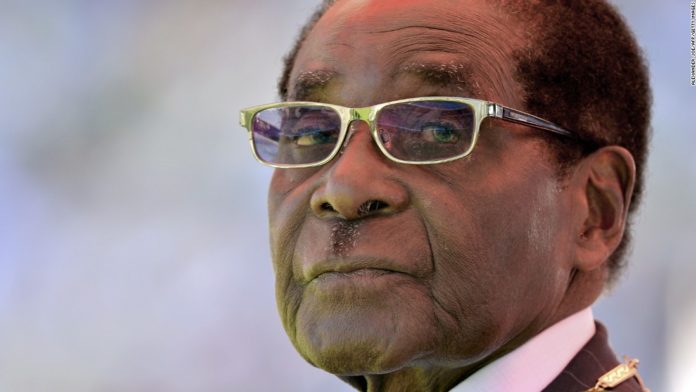
Zimbabwe’s Vice-President Emmerson Mnangagwa has been removed from his post, the country’s information minister says.
Mr Mnangagwa, 75, displayed “traits of disloyalty”, Information Minister Simon Khaya Moyo said.
His removal makes it more likely that President Robert Mugabe’s wife Grace will follow in her husband’s footsteps as leader of Zimbabwe. His party youth and women structures have endorsed her for the post of VP.
She had earlier called on her husband to remove his vice-president.
“Mr Mnangagwa’s conduct in discharge of his duties is inconsistent with the responsibilities,” Information Minister Simon Moyo said.
“The Vice-President has exhibited traits of disloyalty”, he added.
Mr Mnangagwa, a former intelligence chief, had been a leading candidate to succeed President Mugabe.
Mugabe names wife VP as Mnangagwa is sacked
KCB at 10: Uganda assets grow to Shs717bn
Kenya Commercial Bank (KCB) has marked 10 years on the Ugandan market, growing its asset base to Shs717 billion.
Speaking at a dinner for customers held at Kampala Serena Hotel the Deputy Bank of Uganda Governor Dr. Louis Kasekende, commended KCB for supporting development in the country over the years.
“We at the central bank are conscious of the role of financial intermediation provided by the banks like KCB in this market and we don’t take it for granted. In order for business to grow it needs financing and KCB has played that role so well financing some of the most outstanding projects in the market,” Kasekende told guests including the KCB Group CEO, Mr Joshua Oigara and the Bank Board of Directors.
Kasekende also noted that KCB has grown its asset base to Shs717 billion, from Shs59 billion ten years ago with gross loans of up to Shs231 billion issued to date, and reiterated the impact of technology in the financial services sector.
“Financial services providers need to innovate continuously for them to remain competitive in the face of technological advancement,” in the next decade, the whole sector is going to be characterized by adoption of new technologies,” noted Kasekende.
On his part Joram Kiarie, the KCB Bank Uganda MD said: “Today marks a major milestone for us as KCB Bank Uganda as we mark ten years in this market and 120 years since we started out in East Africa. It is a journey that has provided wonderful memories and witnessed the building of useful and lifelong business relationships with our customers.”
KCB Bank Uganda opened its first branch on Commercial Plaza, Kampala Road in November 2007 and has since opened a total of 16 branches, eight of them in Kampala and eight others in major towns around Uganda in Jinja, Mbale, Lira, Gulu, Arua, Hoima, Fort Portal and Mbarara.
The KCB Board Chairman Aga Sekalala Jr said the next ten years will see heavy investment in agency banking as a way of deepening the bank’s presence and relevance in Uganda.
“The next years will see heavy investment in digital platforms as we increasingly create more convenience for our customers but also equally purposeful growth in our retail space through agent banking which we will be launching any time now,” Mr. Sekalala said.
On his part KCB Group CEO Joshua Oigara spoke about the vibrancy of the Uganda market and the bank’s commitment to change lives for a long time to come.
“The financial sector is at the nexus of enabling real transformation of most of our people and the generation to come, as a bank we want to enable and create opportunities, resources and jobs for the next generation,” noted Oigara.
KCB Bank is one of the lenders that have already secured the regulator’s license to carry out Agent banking in Uganda, and has also carried out successful agent banking in Rwanda, Tanzania, Burundi and Kenya.
Meanwhile, KCB Bank Uganda has invested over Shs2.5 billion shillings in communities through its Corporate Social Responsibility arm, the KCB Foundation, which focuses on enterprise development, education, health, environment and humanitarian aid.
Doctors lay down tools over salaries
Patients in Ugandan public hospitals might die from the lack of doctors’ attention following the medics’ decision on Monday to call for nationwide industrial action aimed at forcing government to improve their emoluments and the working conditions.
The doctors under their umbrella organization, the Uganda Medical Association (UMA), laid down their tools, saying they will only attend to emergency cases, as they await government response to their demands.
The new development comes after the medics put government on notice weeks ago, demanding that a doctor be paid Shs48 million per month.
Reacting to the doctors’ demand then, the Director of Health Monitoring Unit (HMU) in the Office of the President, Dr Jackson Ojera Abusu, that UMA had no authenticity to order doctors to strike, as it is not legally recognized by central government.
“The UMA should desist from inciting its members to strike without consultation with the medical and Dental Practitioners Council. In the same vein, UMA should desist from passing off as the official body of doctors mandated by law. UMA should not over step its jurisdiction,” Abusu warned earlier on.
He added: “We would like to state categorically that while we associate with the plight of doctors and have actually been at the forefront in urging the government for better remuneration, we find some of the actions of UMA leadership as grossly misleading, frivolous and undermine public confidence in the health care sector.” Dr. Abusu also reiterated that government cannot afford to pay them the amount demanded.
Apart from the salaries issue, among others, the doctors want government to government increases supply of emergency essential medicines and supplies, recruit more health workers and equip them, give them duty allowances and allow them buy tax free cars and construction materials.
Meanwhile, last week the Uganda Medical Workers Union and the Uganda Nurses and the Midwifery Union said they would not be part of the doctors’ industrial action called over government’s failure to raise their salaries.
The Secretary-General of the Union, Aggrey Sanya, said the doctors’ decision to strike was not conducted through the right the channels.
In the same vein, the chairman of The National Organization of Trade Unions (NOTU) Usher Wilson Owere, also warned the government against dealing with associations rather than the workers’ trade union.
Gashumba granted Shs20m bail
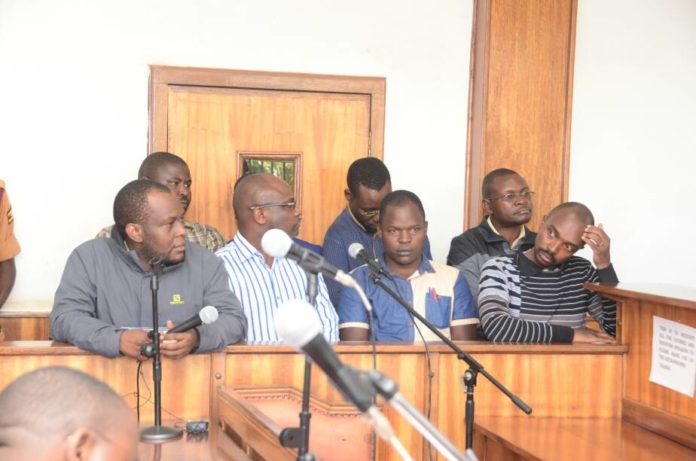
Social activist and political critic Frank Gashumba, his brother Innocent Gashumba and ‘businessman’ Ismail Kiyingi have today been granted bail by the Buganda Road Magistrate’s Court, after spending a week in prison on charges of fraud, impersonation and being in possession of narcotics.

Since officials from the DPP’s office are on strike, the three were granted bail of Shs20 million each, with MP Joseph Sewungu standing as surety.
Last Thursday, Gashumba’s lawyer Denis Nyombi had filed to the Nakawa magistrate’s court to free his client, only for Gashumba to be brought to the Buganda Road court at today 1pm.
Available information indicates that Gashumba, his brother Innocent and Kiyingi, the proprietor of M Safari, were found in possession of identifications, one in the name of Colonel Francis Okello and another one in the name of John Mwine, who is reportedly in charge of military procurement. It is these identifications that the trio was allegedly going to use to pose as officials from the ministries of Defence and Internal Affairs, to con some Dutch businessmen about their prowess in respect to military equipment procurement.
According to investigators, the three who were arrested by officers of the Chieftaincy of Military Intelligence (CMI), were also found in possession of 20 fake stamps and fake apssports, and later detained at the Police Special Investigation Division at Kireka.
Has SG Lumumba dumped NRM?
For about two months now the National Resistance Movement (NRM) Secretary General Justin Kasule Lumumba has been out of the country amid reports that she could have landed a job with a Catholic international charity organisation.
EagleOnline cannot name the Catholic organization which is said to have given Ms Lumumba the job because it has not responded to emails and phone calls of inquiry have not been returned.
Similarly, conflicting accounts as to her whereabouts by senior party officials have not helped much, with NRM publicist Rogers Mulindwa saying the SG is on assignment by the party Chairman Yoweri Museveni, while Dr Tanga Odoi, the chairperson of the NRM electoral commission, who has publicly had a spat with Ms Lumumba before said, in between feats laughter, that the SG is out of the country on medication.
“She told us she is in London for treatment. For now we know she is getting treatment and that’s the little I know. I don’t know if she is doing other things”, Dr. Tanga Odoi said.
On his part Mulindwa said: “Whoever says that (resignation of SG) has a mental problem. Even if it is you, I repeat you have a mental problem. The Secretary General is out of the country on official duty. The Party Chairman sent her and Mr Todwong is now the acting Secretary General.”
Such contrasting accounts that have left room for speculation about the SG’s whereabouts, and this, coupled with Ms. Lumumba’s exclusion from the NRM age limit campaign team that has today started ‘consultative meetings’, has not made matters any better.
The development come amid reports that all is not well at the party headquarters on Plot 10 Kyadondo Road, and that many are worried that the Secretariat which is supposed to keep the party juices flowing is functioning haltingly.
“I can assure you that if President Museveni leaves, NRM will be worse than Kanu in Kenya. It will simply disintegrate because the party leaders thrive on the weakness of the party secretariat which should have been the opposite,” one party official said.
Meanwhile, a source intimated to the EagleOnline that Ms. Lumumba jumped ship after continued frustration from the party including lack of facilitation at the secretariat and endless political intrigue.
The source further said that Ms Lumumba grew ‘frustrated’ after realizing that resigning her parliamentary position, where she was the Bugiri district Woman MP, for a job at the Party Secretariat, was a miscalculation.
“After the presidential campaigns were done, all Lumumba would do was to arrive at Kyadondo Plot 10 in a convoy, and then sit in her office the entire day intermittently sipping on tea and listening to complaints from staff over delayed salaries,” the source said.
“The Secretariat is only active if there is a general election. That’s when
there is money. Most staff don’t even have appointment letters so it was hard for her,” the source added.
By press time it was not possible to speak to Ms. Lumumba.
Why Ugandan doctors are striking
By Dr. Adiga W. Anzo
Ugandans are looking forward to a middle income status by 2020 and to achieve and sustain this goal, the Medical fraternity needs to ensure that collectively we provide the best health care to Ugandans as a crucial contribution towards sustainable economic development.
As a concerned citizen I wish to acknowledge the tremendous effort put by the government of Uganda in trying to make healthcare accessible and affordable to the population of Uganda. The construction and renovation of hospitals countrywide is testimony for even the ‘blind’ man to see and the ‘deaf’ to hear.
However, I believe that the Uganda Medical Association who, since its formation in 1964, has been denied the opportunity for contributing towards health policies. Yet it is the Uganda Medical Association that has propelled the image of Ugandan doctors globally, including the late Dr Margaret Mungherera as President World Medical Association. Other international leaders in the medical profession include Prof. Francis Omaswa, Dr. Patrick Kadama, Dr Edward Kanyesigye and Dr Peter Eriki who have impacted international health workforce policies; Dr Richard Idro, Prof. Pauline Byakika, Prof. Musisi, Dr Sabrina Kitaka, Prof Sarah Kiguli, Prof. James Tuwmine, Prof Florence Mirembe, Prof. Elly Katabira, Prof. Moses Kamya, Prof Nelson Sewankambo all of who have made ground breaking contributions in the area of global health (AIDS, Tuberculosis, Malaria, Nodding Disease, Ebola). Many more super stars are out there ready to make game changer interventions and strategies to tremendously improve the health sector as non-state actors.
Indeed we think this is the right time that as Doctors, we sat on round table and formulate real solutions to poor health services delivery in Uganda; African solutions for African problems. As a build up to middle income status, there are several key decisions which if well taken care off will accelerate our sustainable economic development. Conceptually, there are 6 building blocks for health systems strengthening according to World Health Organisation. Thus improving service delivery; health financing (insurance, cost sharing); human resource for health; access to medicines, vaccines and medical technologies; information use and management; and effective healthcare leadership. It is in this area of leadership that the Uganda Medical Association can make ground breaking contributions focusing on human resource for health and access to medicine and supplies.
It is not news to Ugandans that there is rampant stock out of live saving medical supplies and drugs to enable effective service delivery for the populace. I do agree that there is some degree of theft of drugs, which is being reported by Health Monitoring Unit of State House. However it should be brought to our attention that the leading hindrance to Emergency Medical and Surgical is lack of medical supplies. Frankly, this scenario traumatizes the health caregiver to see a Ugandans “life going”, while they cannot do much to save it. Personally I experience this trauma more often than not, ranging from seeing someone’s uterus (womb) rapture awaiting the relatives to buy supplies like sutures or fluids. Although it is good to have free access to healthcare, such free medical supplies should match the demand on ground which not the case in Uganda.
We propose the government increases supply of emergency essential medicines and supplies required for such intervention to save the life of Ugandans. The adequate medical supply should have good accountability and monitoring to avoid theft and reckless use. As the Uganda Medical Association, we are ready to provide a well-researched, effective and professional corroborative measure to counter pilferage of medicines and supplies.
Another bitter but truth is the healthcare demand of Ugandans is higher than what government can provide without sharing the costs especially for the non-emergency medical conditions. It would be wise to reserve the current supplies for emergency interventions while for elective or non-emergency interventions their purchasing should be cost shared transparently according to the Ministry of Health recommended rate or price list. This strategy would ensure the emergency reserve is not depleted, and Ugandans would be aware of what to expect and demand of for it since community participation is inherently democratic. Ugandan would be prepared that if I go for non-emergency conditions, I have to cost share and demand a receipt for it. This will also eliminate the wrong elements that ask for “under the table” payments or extortion as is happening now.
The Government has continued to neglect its health workforce to the detriment of the service delivery. While the Ugandan health workforce has increased to 78% of the establishment in government hospitals (as per health sector performance report), they are few, demoralized and ill equipped. Apart from going through a strenuous, long periods or difficult training, the Ugandan health workers are not well placed to save the life of Ugandans due to poor equipment and supplies leave alone other motivation like housing and working environment. Yet young Medics have trained for 6 years with some paying tuition fees of over 70 million shillings in private universities. Among the game changer approaches for Uganda are the following:
Implementation of duty facilitation allowances for which the Uganda Medical Association petitioned Parliament in 2016. These well-researched incentives are to facilitate doctors to work for long working hours, weekends and public holidays as well as high-risk engagements such as Ebola epidemic control. The justification lies in the value of the lifesaving work the normal 8 hours of the Public Service standing orders do not apply.
The effective non-monetary incentives tax exemption for cars and construction materials for medics. Medics spend most of their lives in health facilities, and the few who use vehicles use this for taking care of patients including hurrying for emergencies. Today housing for workers is a problem after government sold its property in hospitals. However, mechanisms must be put in place to mitigate fraud and abuse of such a privilege.
Affordable housing for medical workers can ensure medics stay near health facilities during their working years that will make absenteeism a history. VAT exemptions for Medical Workers to allow construction of affordable houses just like for the armed forces.
Postgraduate training of future Doctors is marred with numerous challenges of quality, avoidable hardship such as housing, remuneration and practical supervision. Regularizing Senior House Officers whom the President described as “Modern day slaves” and Medical Internship within the public service standing orders will solve many of the operational problems in training these medics. The need for specialized health care in Uganda is growing exponentially, and the stopgap measure has been to export Ugandans to India, South Africa and the UK. Indeed it makes business sense for government to invest in Specialist medics. An effective policy is urgently needed with full involvement of important stakeholders like Ministry of Health, Uganda Medical Association, Pharmaceutical Society of Uganda and Nurses and Midwives Union.
The writer is the Chair Uganda Medical Association (West Nile Branch)
Email: anzoism2008@gmail.com.
How about we abolish governments and strengthen institutions?
By Andrew Barungi
In early September 2017, the Supreme Court of Kenya annulled the presidential elections held in August. Many celebrated this verdict and were confident that Kenya was progressing democratically. The celebration of the verdict may have come too soon because it did not prevent Kenya’s political problems manifested in clashes and violence before and after the repeat election.
The late 1980s and early 1990s can be described as the “second liberation” in much of Sub-Saharan Africa. Many autocrats were ousted either through the barrel of a gun or the ballot. New and costly Constitutions were written and promulgated.
Many African elites boasted about the new Constitutions in their countries, the number of women participating in politics as well as economic growth. Today, many elites are crying foul about the perceived lack of constitutionalism, violations of human rights and curtailing of civil liberties. Could their conceit after the ‘second liberation’ be responsible for their indignation?
I think some African elites lacked foresight. They assumed that the promulgation of the Constitutions and symbolic verdicts by judiciaries would curb authoritarianism and corruption. Many of these elites complaining about the current democratic deficit used to support the current administrations religiously, because they believed that their countries would be on the ‘Road to Damascus’.
Democracy was not built in one day; it has to be refined periodically. I think many elites were happy with a paper constitution without strong and independent institutions to defend it. Did many elites overlook the role and strength of institutions? Many institutions are weak and fall victim to authoritarianism – a form of government in which the governing body has almost absolute control, typically rules by force and pays little heed to public opinion or the judicial system.
If I can be simplistic, Britain, an industrialized state has no written Constitution, but an unwritten one formed of Acts of Parliament, court judgments and conventions. But one has to acknowledge that Britain has been building institutions since Magna Carta – a charter establishing the rights of English tycoons and free citizens, granted by King John in 1215 and regarded as the basis of civil and political liberty in England.
Belgium, another industrialized state, did not have an elected government for almost 600 days from the early 2010s because the opposing Flemish and Walloons tribes were unable to agree on policy issues and form a governing coalition following national elections. The state was functioning and citizens were getting on with their lives.
Who needs a government if institutions are functional? Again, Belgium has been a state for over 150 years. Isn’t it time African elites advocated for the abolition of governments and suspension of (paper) constitutions, in favour of strengthening institutions so that citizens are not dependent on government?
All is not be lost in Africa though. Incumbent political parties and presidents have lost elections in Ghana and Nigeria, for instance, and human rights and delivery of public services are implemented in Botswana and Namibia. Constitutionalism and delivery of public services can be sustained if citizens demand it and if the powers that be, choose to be a government of the people, by the people, for the people.
The question to the Ugandan and African elites is, is it necessary to spend a lot of money on Constitutions and forming governments when many have failed to deliver services to citizens? May be Africa will have Constitutions and governments that can deliver services to its citizens in the next 100 years when it is industrialized and has a GDP per capita of more than $2,700. Just maybe.
Mr Barungi is a Social Scientist
Cranes, Airtel in Shs10bn sponsorship deal
Airtel telecommunications has today renewed its partnership with Federation of Uganda Football Associations (FUFA) as Uganda Cranes main sponsors.
The telecommunications giants took over from their rivals MTN four years ago in a deal worth over one billion shillings at the time.
The new sponsorship deal is now worth Shs10 billion for a period of four years and FUFA President Eng. Moses Magogo lauded Airtel for the renewal of the partnership at a function that took place at Serena Kampala Hotel.
“I thank Airtel Uganda for this renewal. Coaches, players, referees create the football product which is marketable to the fans and sponsors and regulated by government. This is the biggest sponsorship in the history of this country. It is not about today but the future. Airtel Uganda even supported FUFA in the regional campaigns and the FUFA Awards for two years now. I also thank the government of Uganda for the support throughout the AFCON and World Cup qualification campaigns.” FUFA President, Eng. Magogo said.
Uganda Cranes captain Denis Onyango and his assistant Hassan Wasswa were also present at the function representing the players and saluted the contribution of Airtel Uganda to football right from the grass roots.
Uganda Cranes other sponsors include Nile Breweries Limited, Eco Bank and National Insurance Corporation (NIC).
Meanwhile, the Cranes entered residential camp in preparation for the final 2018 FIFA World Cup Group E away qualifier match against Congo Brazzaville on November 12, 2017.
Tanzania president Magufuli to visit Uganda tomorrow
Tanzanian President John Pombe Joseph Magufuli, will pay a State Visit to Uganda from November 9-11, 2017.
During the visit, Presidents Yoweri Museveni and Magufuli will commission of a One Stop Border Post at Mutukula, lay a cross-border mark-stone at Luzinga Village for the East African Crude Oil Pipeline and address a rally in Kyotera.
The key bilateral issues for consideration during the visit will include cooperation in the transport sector, power projects and Uganda-Tanzania cross border issues. A number of MOUs on cooperation in various fields are also expected to be signed.
The two leaders are also expected to hold a press conference in Masaka on Friday November 10, while the second foundation stone for the East African Crude Oil Pipeline will be laid on November 11, 2017 in Hoima.
President Magufuli’s visit comes at a time when the two countries have stepped up bilateral cooperation in a number of sectors. The 1st Tanzania-Uganda Permanent Joint Commission was held on April 3-5, 2017 in Arusha during which both countries agreed on a number of Memoranda of Understanding (MOUs) and other cooperation frameworks. On July 29, 2017 a Ministerial Session was held in Bukoba on cross-border issues.
The visit is President Magufuli’s second to Uganda, the first being at the swearing-in ceremony of President Museveni in May 2016.
Previously, President Museveni paid a state visit to Tanzania from February 25-26, 2017 and on August 05, 2017, together with President Magufuli, laid the first foundation stone in Tanga for the East African Crude Oil Pipeline.
Bebe Cool survives accident as singer Dizzy is crashed to death

Singer Moses Ssali aka Bebe Cool is thanking his ancestors for saving him from a fatal accident last night in the Kampala suburb of Kireka. The same accident claimed the life of fellow dancehall singer Denis Galiwango aka Dizzy Nuts.
According to a source, the incident took place at 2:00 am outside Club Victoria, where Bebe Cool had been performing.
“As he was leaving, he parked his Hummer along the Jinja-Kampala highway to have a chat with fellow singer Dizzy Nuts who is a former member of Gagamel Entertainment. Suddenly a speeding (Toyota) Harrier car rammed into Bebe Cool’s Hummer, claiming the life of Dizzy Nuts who was standing outside,” the source said.
The source further said the driver of Harrier sped off towards Kampala “that even the police car that was at the venue couldn’t catch up with him.”

Meanwhile, Bebe Cool has denied social media reports that indicated his wife Zuena Kirema had given birth.
“My wife is still well and pregnant,” Bebe Cool posted on his Facebook page.