African Registrars General are meeting in Victoria Falls, Zimbabwe, for the first time to deliberate on how to improve civil registration as part of implementing the civil registration and vital statistics process the continent.
This is in recognition of the fact that the implementation of the African Programme for Accelerated Improvement of the civil registration and vital statistics would not be successfully undertaken by statisticians alone without involving the Registrars General who are responsible for registration of vital events such as births, deaths, marriage, divorce and adoption.
The inaugural meeting of the Registrars, described as historical, proposed the establishment of a “Commission of African Registrars Generals”.
The proposed Commission of African Registrars General will be presented at the 4th conference of ministers responsible for civil registration and vital statistics that will be held December 6-8, 2017 in Mauritania.
Upon endorsement by the ministers, the Economic Commission for Africa (ECA) will be the secretariat of conference of ministers which meets every two years.
Mr. Oliver Chinganya, Director of the African Centre for Statistics, said the gathering of Registrars Generals, the first ever, as a commission will enhance and facilitate the visibility of vital civil registration systems on the continent.
Speaking at the meeting, Mr. Chinganya said the committee was long overdue. He said the committee will help push Africa’s vital civil registration agenda and help to “resolve the scandal of invisibility.’’
The meeting was officially opened by the Victoria Falls Mayor, Mr. Sifiso Mpofu, who urged the Registrars General and others present to come up with effective strategies of elevating vital civil registration to the fore front of development.
“I urge you to fight and make vital civil registration a weapon to protect our population. I plead with you to fight and make vital civil registration a tool for development. Make it a torch bearer to national dignity,” he said.
“Our people should not struggle to acquire national documents. Africa is looking up to you for salvation. It is relying on your expertise and wealth of experience to deliver.”
By 2035, half of Africa’s population will be urban-based, compared to just one third in 1990. This rapid urbanization creates growing challenges in terms of infrastructure and services, but it can also be a driver of industrial development on the continent, under the right policy framework.
The latest Economic Report on Africa by the UN Economic Commission for Africa (ECA), ‘Industrialization and Urbanization for Africa’s Transformation’, makes concrete recommendations for harnessing the rapid urban transition.
During the launch of the report by the ECA in in Kigali Friday, Ms. Giovanie Biha, ECA’s Deputy Executive Secretary, stressed that African urbanization has not been driven by improving agricultural productivity or increased industrial output, as has been the case elsewhere.
“On the contrary it has been dominated by the expansion of the informal sector – often services. To foster enhanced growth and poverty eradication, African countries should put in place industrial policies that will generate the skilled jobs and productivity gains needed for the structural transformation of their economies,” Ms Biha says.
At the same forum Edlam Yemeru, Chief of Urbanization Section at ECA, said there is an urgent need to connect policies and strategies for urban and industrial development for better performing cities and industries.
“Coordinating urban and industrial development is possible by linking economic and spatial policies in the context of national development planning”, said Yemeru
The launch of the 2017 Economic Report on Africa also provided an opportunity to discuss the challenges of industrialization and structural transformation on the continent and for Eastern Africa in particular. In most of the 14 countries covered by the SRO-EA, the share of the manufacturing sector has been stagnant or declining over the past ten years while the services sector has expanded rapidly.
Despite a weak structural transformation process, the long-term growth outlook remains promising in Eastern Africa. The GDP growth rate is estimated at 5.6% in 2017, the same as in 2016. This is down from the exceptional performance of the past five years, with Ethiopia achieving an average annual growth rate of 9.5% and Rwanda 7.2% between 2012 and 2016, but it remains well above the African continent average of 3.1% in 2017.
Andrew Mold, Acting Director of ECA in Eastern Africa, highlighted some of the growth catalysts such as massive investments in infrastructure or dynamism of some service sectors such as trading, finance, and tourism.
However, these increased investments have also started to stretch budgets and structural constraints remain such as weak credit to the private sector or exchange rate volatility, Mr. Mold noted.
As the Uganda government spends billions of shillings in campaigns to bring more foreign investors to the country, some of those here are crying of foul play by making a raft of allegations against the top managers of the Uganda Investment Authority (UIA), the lead agency responsible for investments.
One of the ‘untarmacked’ roads in the Namanve Industrail Park
In August, government on the advice of UIA Board cancelled several leases it had granted to both local and foreign investors in Namanve Industrial Park, and immediately announced it was repossessing the plots lying idle.
The UIA board had held meetings on February 20, 2017 and March 30, 2017 in which they agreed to withdraw the leases, despite investors’ pleas that UIA extends them. The investors, according to the lease terms, were supposed to develop their plots measuring 58.48 acres in total, within five years.
However, sources say that having repossessed the said land, UIA has since embarked on the process of giving it to new investors who, according to government, have money but no land for their projects.
A source told EagleOnline that some of the companies whose leases were cancelled by UIA are stuck with loans they had acquired from commercial banks to start developing their plots.
“Before UIA finally canceled leases, there had been prolonged negotiations between UIA and the affected investors to have their licences renewed but UIA was thinking otherwise,” the source said.
He said that some of the top managers at UIA wanted financial rewards from investors before they could renew their leases, even as the latter had given ‘credible reasons’ as to why they delayed projects. “Some people at UIA wanted ‘kick backs’ though they were not straight forward with the investors. Had some of the affected investors given money to the officials, their leases would have been renewed,” he told EagleOnline Thursday.
The investment and privatisation state minister, Evelyne Anite, when asked Thursday by this reporter as to whether she was aware of the investors’ grievances, briefly took time to respond but later said she has never received any complaints related to corruption at UIA.
“We have put an anti-corruption hotline at UIA and investors should use it when a public official asks for bribes from them,” she said.
She said government remains is committed to fighting corrupt public officials, especially those who frustrate investors.
Some of the investors say much as UIA okayed their ejection from the plots, the regulatory agency had failed to construct access roads, water systems and electricity on some plots, which they say was worsened by a poor drainage system because the area is in the swamp.
“How do you start developing a plot when there is no water on it, no road leading to it,” a disgruntled investor who said he was weighing other options in the EAC region, said.
In August, minister Anite said government had provided water, electricity, roads and other incentives to the industrial park and saw no reason to renew leases of investors who had failed to develop the land as agreed with government. At the time she said 200 other investors were waiting to be given the plots, and added that government wants investors who can provide 200,000 jobs in the industrial park.
Also, according to minister Anite, government is in the process of tarmacking the roads within the park under a proposed Shs500 billion infrastructure project, which factors in well with the affected investors’ claims that some plots had no access.
Meanwhile, another source, speaking on condition of anonymity, said that much as close the cancellation of the leases is said to have been a presidential directive aimed at kicking out ‘speculative investors’, it was ill-advised. “No one has enough capital available all the time. Some people were negotiating loans with the banks before they could begin real work, but UIA could not listen to such,” he said.
Gov’t refusal to guarantee investor loans
In a related development, a top manager at UIA told EagleOnline on phone Friday that that some investors had failed to raise cash for investment on the plots and instead wanted government to guarantee their loans by writing ‘letters of no objection’. This, he said, was unfair to government since the investors at first assured government they had the money to put up industrial plants.
“Government could not guarantee some of the loans because banks could come for government land in case investors failed to pay,” he said, adding that discussions are ongoing to help some of the investors get back land.
The official who spoke via phone on condition of anonymity refuted allegations that UIA officials wanted bribes before they could renew some leases.
“Some investors come in the country with a negative mind, thinking Ugandan officials can be bribed. If indeed we asked for bribes, they should have raised the issue with the police,” he said, emphasising that the investors failed to meet their contractual obligations.
The back and forth engagement comes in the wake of Minister Anite saying in August that the President Yoweri Museveni had given waiver instructions on the US$8,000 premium UIA had levied on the investors to fast-track investments. This, the UIA official said, was an opportunity missed by some investors.
In August Hamza Galiwango, the director of land development at UIA , said 180 land titles given to investors free of charge would be reclaimed in six months if the latter fail to develop them as agreed with government.
At the time Galiwango said there were 85 plots under construction, while 130 repossessed plots were reallocated to new investors by government.
The Speaker of Uganda’s Parliament Rebecca Kadaga, who is the head of the Africa Group
The Inter Parliamentary Union (IPU) has been forced to drop a proposal to debate an item on the rights of homosexuals over objections from the mainly Muslims and African members.
The proposal moved by the IPU Standing Committee on Democracy and Human Rights was meant for consideration during the next Assembly scheduled for March.
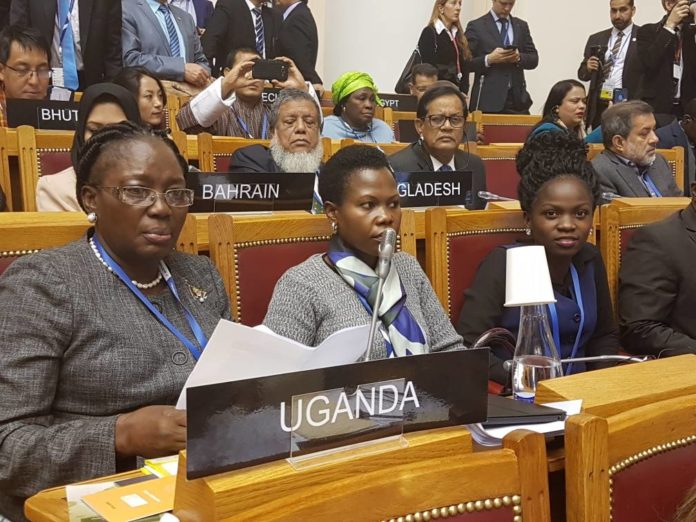
The Speaker of Uganda’s Parliament Rebecca Kadaga, who is the head of the Africa Group which brings together African countries, threatened that the group would keep away from the next meeting if the proposal is allowed.
“On behalf of the Africa Group, I express our reservations about this proposal. It is a highly divisive and led to the breakaway of the Africa Church from the Church of England,” she said, adding: “It should not be part of the agenda. If it happens, Africa Group will not attend.”.
The Committee on Democracy and Human Rights is chaired by Ms. B. Tshireletso (Botswana), who said that the proposal had got overwhelming support in the Committee hence the decision to present it to the Assembly.
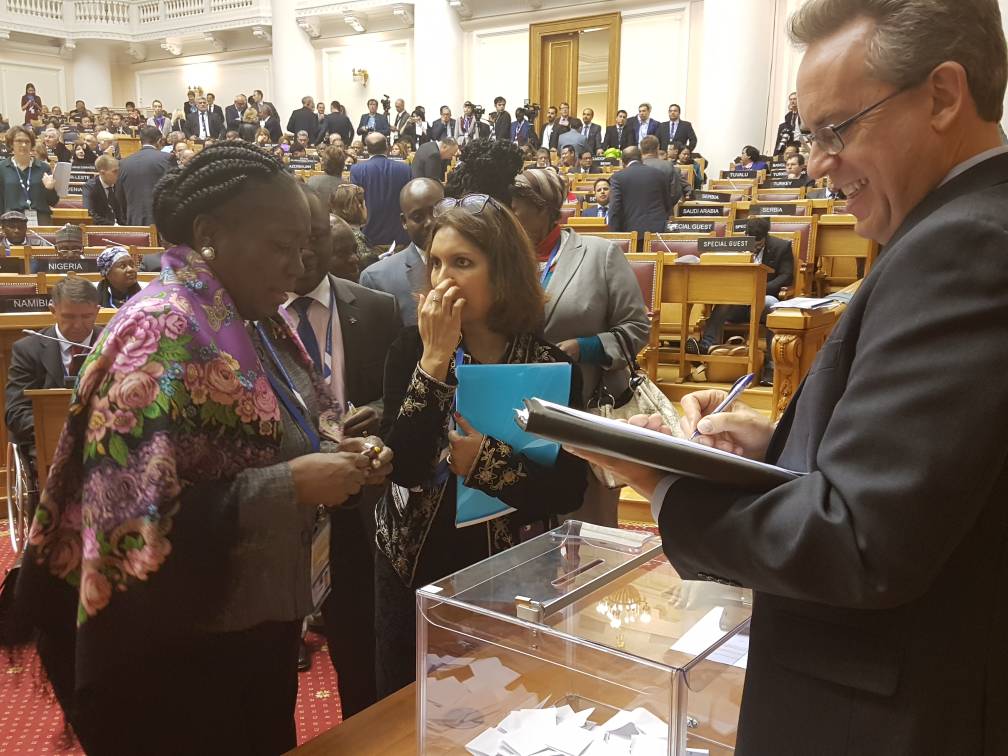
The 137th IPU Assembly and Related Meetings was held in St. Petersburg, Russia, 14th – 18th Oct. 2017.
Legislators from Iran also threatened to stay away from the next meeting. Other legislators from Sudan, Morocco, Benin were against the proposal.
However, even with the objections, the final St. Petersburg Declaration, “underscored the fact that all individuals must be allowed the full enjoyment of their equal and inalienable rights recognized in the Universal Declaration of Human Rights and other international human rights and humanitarian law treaties and standards” including non-discrimination on grounds of sexual orientation.
The Assembly was held under the theme: Promoting cultural pluralism and peace through interfaith and inter-ethnic dialogue.
“National authorities and other key stakeholders must work together to build inclusive societies and combat the dissemination of divisive discourses which can give rise to feelings of insecurity among certain groups and encourage the spread of nationalism, extremism and terrorism,” read part of the Declaration.
The 138th IPU Assembly and Related Meetings will be held in Geneva in March 2018.
Airtel Uganda, Mrs. Remmie Kisakye Kakuru, the Head – Brand and Communication, handing over the cheque to the Awards' organisers
The Federation of Uganda Football Associations (FUFA), this morning, officially launched the 2017 Airtel-FUFA Awards scheduled for December 1, 2017 at Speke Resort hotel, Munyonyo in Kampala, with a Shs100 million boost.
Launched in 2014, the Airtel-FUFA Awards are held every year with the aim of honoring and recognizing Ugandan footballers regardless of their team or club performance. The awards also aim to encourage players to remain disciplined and focused throughout the year.
This year, the awards will see Geoffrey Sserunkuuma, Muzamil Mutyaba and Tadeo Lwanga battle for the top honor, Airtel – FUFA male footballer of the year, while Hasifah Nasuuna, Vannesa Kalungi and Fazila Ikwaput are the nominees for the Airtel – FUFA female footballer of the year.
Speaking on behalf of the FUFA President Eng. Moses Magogo, Rogers Byamukama thanked all the sponsors for their contributions that have been instrumental in planning these awards; specifically, Airtel Uganda for ‘standing with FUFA and believing in Ugandan football’.
“Our objective is to bring these outstanding players to the front, recognize them and award them for their efforts as well as the entertainment throughout the year. This year we will have 11 awards given out,” Byamukama said.
Airtel Uganda, Mrs. Remmie Kisakye Kakuru, the Head – Brand and Communication, who represented her company commended the awards organizing committee for the consistency in holding the awards as well as the media for the job well done in the past and encouraged them to keep it up.
She appealed to the public to vote as many times as possible in the 4 award categories that are SMS based as winners will be chosen according to the votes they received.
“On behalf of Airtel Uganda, I would like to pledge our commitment to continue supporting football in Uganda at all levels,” she concluded, before handing over the cheque to members of the organizing committee.
The 4 sms based awards include the ; Airtel-FUFA Male player of the year, Airtel-FUFA Female player of the year, Fans’ Favorite Ugandan player of the year, Fans favorite player in Other Leagues- outside Uganda. To vote, type FUFA (space) Code of the player and send to 8888.
Bugweri MP Abdu Katuntu addresses the press after the Court of Appeal upheld his victory
The Court of Appeal has today upheld the election of Abdu Katuntu as the Member of Parliament for Bugweri County in Iganga district.
In a judgment read by Deputy Court Registrar Tadeo Asiimwe, the panel of three high court judges, retired Justice Stephen Kavuma, Justice Remmy Kasule and Justice Richard Buteera, dismissed National Resistance Movement candidate Daniel Ibaale’s case and ordered him to pay all costs incurred in the case since 2016, after it was filed in the Jinja High Court.
Last year Jinja High Court Judge Margret Mutonyi dismissed Eng. Ibaale’s case, ruling that he had not adduced satisfactory evidence to pin Katuntu for conniving with the Electoral Commission officials to utter false and defamatory statements as well as deface the petitioner’s posters in the 2016 general election.
A lawyer, Katuntu is one of the longest-serving MPs and heads Parliament’s committee on Statutory Agencies and Enterprises (COSASE).
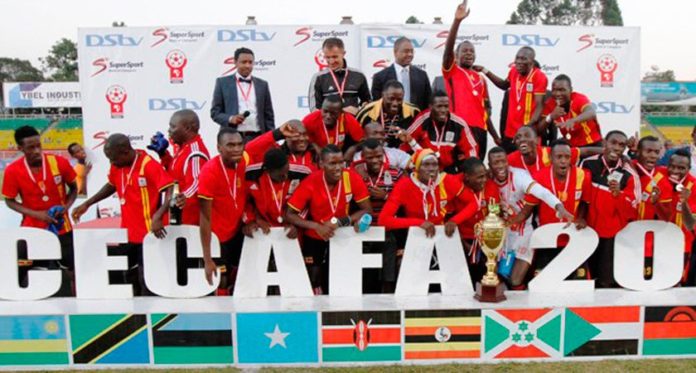
The Confederation of East and Central Africa Football Associations (CECAFA) has confirmed that 12 nations will be taking part in the 2017 Senior Challenge competition, which will be held in Kenya.
Among the participants, will be north Africans Libya and southern Africa nation Zimbabwe, who were invited as guest teams and confirmed their participation.
The two-week event will take place from November 25 to December 9 with matches expected to be staged in Moi Stadium in Kisumu, Nakuru’s Afraha Stadium and Bukhungu Stadium in Kakamega County.
Last year the regional body failed to organize the Senior Challenge Cup after Sudan and Kenya both pulled out of hosting at the last moment.
Uganda Cranes are the defending champions of the CECAFA Senior Challenge Cup after they defeated Rwanda in the last event held in Ethiopia in 2015.
This time the Cranes hope to use the Challenge Cup to prepare the team head of the 2018 Africa Nations Championship (CHAN) that will take place in Morocco.
The two guest nations will join 10 other nations from the CECAFA region which are; holders Uganda, hosts Kenya, Sudan, Rwanda, Tanzania, Burundi, South Sudan, Ethiopia, Zanzibar, Somalia.
The Democratic Party has today sued the Parliamentary Commission seeking for declarations of what happened in Parliament on September 27, when the Speaker Rebecca Kadaga suspended 25 MPs, citing indiscipline.
On the day Kadaga ordered 24 opposition MPs and one National Resistance Movement stalwart, the Water Resources State Minister Ronald Kibuule, not to appear in Parliament for three consecutive sittings after parliament descended into chaos following allegations by Kira Municipality MP Ibrahim Semujju Nganda that Kibuule had sneaked a gun into the parliamentary chambers, in contravention of the rules.
The suspended opposition MPs are against lifting the presidential age limit that is capped at 75 years, with arguments that it is aimed at paving the way for a (Yoweri) Museveni life presidency.
The MPs who were suspended include Ssemujju Nganda, Allan Ssewanyana, Robert Kyagulanyi, Monica Amoding, Sam Lyomoki, Moses Kasibante, Betty Nambooze, Francis Zaake, Ibrahim Kasozi, Nzaavu, Gilbert Olanya, Muhammad Nsereko, Odonga Otto, and Winfred Nuwagaba and Nandala Mafabi.
Others are Medard Lubega Seggona, Joseph Sewungu, Gerald Karuhanga, Gaffa Mbwatekamwa, Florence Namayanja, Moses Kasibante Theodore Sekikubo, Barnabas Tinkasimire and Ms. Osege.
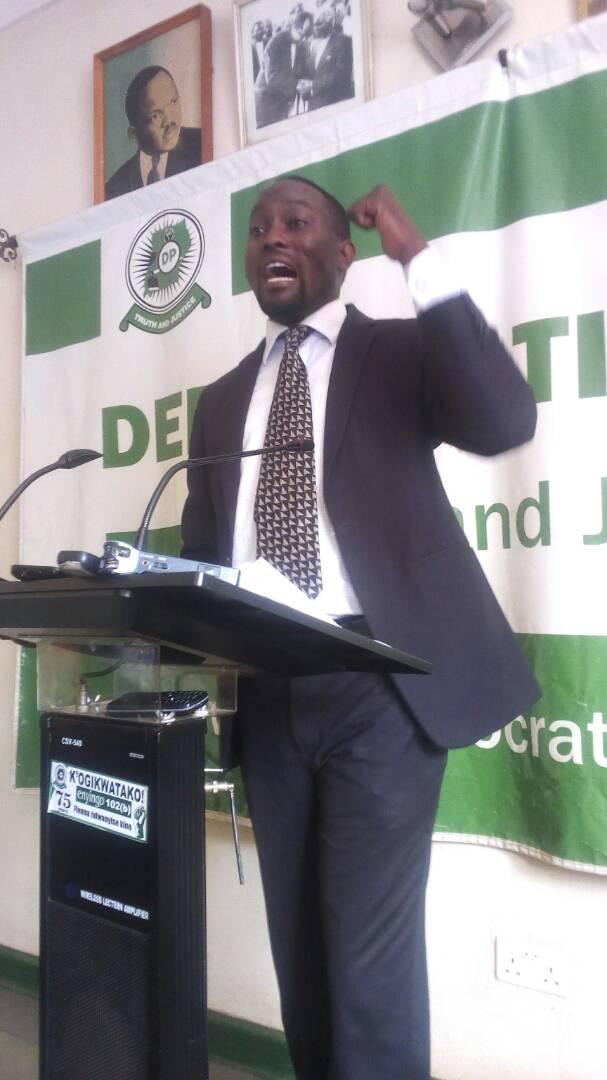
However, according to DP lawyer Alex Wasswa, suspending the legislators for what happened in the previous sitting contravenes with the parliamentary laws and procedures.
“Ejecting them from parliament in that manner was an illegality, Inspector General Police (IGP) Kale Kayihura has no business whatsoever in Parliament,” Wasswa said at the High Court in Kampala.
He also demanded that the Commission explain why the Special Forces Command (SFC) stormed the parliamentary chambers, evicted the opposition MPs and in the process injured Mityana Municipality legislator Francis Zaake Butebi and Soroti Woman MP Angelina Osege..
AWARDED NOBEL PRIZE FOR AGRICULTURE: Akinwumi Adesina, President of the African Development Bank (AfDB)
The World Food Prize is a great motivation which puts the wind behind the sails of what the African Development Bank is doing with its development priorities − the – especially Feed Africa, the President of the Bank, Akinwumi Adesina, has said.
Known as the ‘Nobel Prize for Agriculture’, the World Food Prize was founded by Nobel Peace Prize-winner Norman Borlaug and is considered the foremost international honour recognizing the achievements of individuals who have advanced human development by improving the quality, quantity or availability of food in the world. The Prize is presented each October on or around UN World Food Day that falls on October 16, in a ceremony in the Iowa State capital of Des Moines.
And Adesina, who spoke at a press conference ahead of the ceremony, stressed the need to put technology and information in the hands of farmers and pledged the Bank’s commitment to continue its development work in Africa.
“For me, the World Food Prize is a great honour and recognition for all of the work that I have done for decades of my life. But it also puts wind behind our sail as we now take off to feed Africa, because it is a job that has to be complete,” he stressed.
“Not only must Africa feed itself, it must feed itself with pride. Africa must also unlock the potentials of agriculture, turning agriculture from something that you use for managing poverty, to something that you use for creating wealth.”
He described the mobile phone as the most important tool in the hands of a farmer.
“With it, they will find out information about the market, about weather, and about to access finance,” Adesina said. “They will be able to get information about nutrition for mothers, for instance. That is very important. That was why when I was Minister of Agriculture in Nigeria, we launched this electronic wallet system that allows farmers to access fertilizers, and we reached well over 15 million farmers.”
Awareness and empowerment, he said, could only come through providing information, democratizing the access to information to farmers.
“I have never seen a farmer that wants to be poor,” he said.
In June, the World Food Prize announced African development Bank President Akinwumi A. Adesina as the 2017 Laureate for his work in improving the availability of seed, fertilizer and financing for African farmers, and for laying the foundation for the youth in Africa to engage in agriculture as a profitable business.
Under President Adesina’s leadership, the AfDB is accelerating agricultural development through its Feed Africa Strategy with planned investment of US $24 billion over the next 10 years. The prize also recognizes Adesina’s work over the past two decades with the Rockefeller Foundation, at the Alliance for a Green Revolution in Africa (AGRA), and as Nigeria’s Minister of Agriculture of Agriculture and Rural Development.
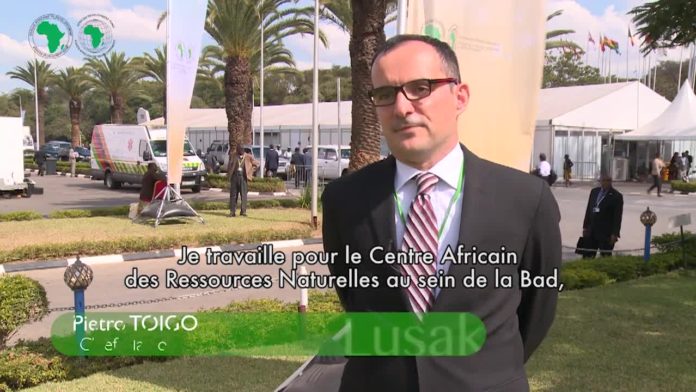
CO-AUTHOR OF REPORT: Pietro Toigo of the AfDB’s African Natural Resources Center
The African Development Bank (AfDB) and OpenOil, a Berlin-based financial analysis firm, have produced the first ever report on how African governments use financial models to manage oil, gas and mining projects as they interface with extractive corporate companies.
The report was launched at the 13th Annual General Meeting of the Intergovernmental Forum on Mining, Minerals, Metals and Sustainable Development (IGF) in Geneva, Switzerland, hours ago.
Over 150 experts and representatives of international development institutions, governments, civil society and extractives companies attended the launch. They included the World Bank, United Nations Environment Programme (UNEP), United Nations Development Programme (UNDP), United Nations Conference on Trade and Development (UNCTAD), Organisation for Economic Co-operation and Development (OECD).
Mining companies and miners’ associations such as Newmont Mining Corporation, AngloGold Ashanti, Anglo American and International Council on Mining and Metals (ICMM) also attended.
The joint report was presented by Pietro Toigo of the AfDB’s African Natural Resources Center and Olumide Abimbola from OpenOil.
“This report is the first of its kind in Africa and we hope that it will stir debate within the continent’s mining sector and contribute to countries getting more out of their mining projects,” the report’s authors say.
The report, ‘Running the Numbers: How African Governments Model Extractive Projects’, analyses the capacity of 19 African resource-rich countries, including Uganda to use financial models, which simulate a simplified version of a real-world project in order to determine their financial benefits to the countries.
AfDB and OpenOil conducted a survey of nearly 50 government officials and hope its results will be utilised to inform policy on extractive activities.
“Financial models are essential throughout the life-cycle of extractive projects,” said Johnny West, Director of OpenOil. “They are not just important during the development of the fiscal regime, but also for the negotiation of fiscal terms with companies, for revenue forecasting, and for auditing and tax-gap analysis.”
The report stresses the need for African governments to make efforts to close the information gap with extractive companies, and shows where there are capacity gaps and how those gaps could be addressed.
The report notes that there is a substantial gap in access to data that are key inputs for financial models in African countries, with the largest gaps in assessing information on capital costs and operating costs of projects.
In addition to the need to build in-house financial modelling capacity, the report suggests that governments need to improve internal business processes and address the large gap that the report shows exist between information available to different agencies, departments and ministries.
The authors of the report say the study will support African countries in realising the full potential of their natural resources. “How are countries supposed to enter into negotiations with extraction companies that use financial models if the governments of such countries are not in possession of the latest and best models to calculate what a potential project is worth?” Toigo asked.
The report also encourages development partners to make capacity building in financial modeling a more significant part of their support to the management of attractive resources. Partners doing so already were encouraged to not just supply financial models as part of isolated technical assistance, but to also invest in equipping government officials with skills to create and use models.