Stanbic Bank
Stanbic Bank
18.9 C
Kampala
Stanbic Bank
Stanbic Bank
Home Blog Page 1738

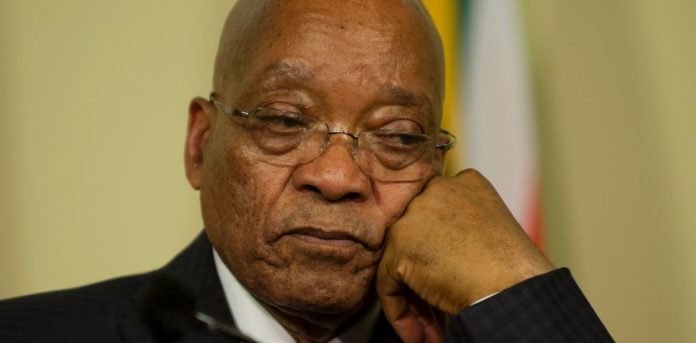
800 charges lined up against Zuma

What next for President Jacob Zuma.

South Africa’s Supreme Court of Appeal has ruled that President Jacob Zuma can face prosecution over almost 800 charges of corruption relating to a 1990s arms deal.

Zuma had lodged a challenge at the court in Bloemfontein after a lower court decided in 2016 to reinstate the charges that were previously discontinued by prosecutors.

“The reasons for discontinuing the prosecution given… do not bear scrutiny,” said Supreme Court judge Eric Leach who read the ruling.

Zuma said he was “disappointed” by the decision.

In a statement from his office, Zuma said he now expects the National Prosecuting Authority (NPA) to consider representations on the case before making the decision to prosecute him.

The statement did not spell out the representations.

Pressure on Zuma

Al Jazeera’s Tania Page, reporting from Bloemfontein, said the case piled further pressure on Zuma who is already facing several scandals.

“Zuma as deputy president was facing corruption charges that were controversially dropped by the then-head of the Prosecuting Authority. The reason he gave at the time was on the basis of secretly recorded phone conversations, which he said suggested political interference in the legal pursuit of then-Deputy President Jacob Zuma,” Page said.

“As a consequence, Zuma was then sacked by then-president Thabo Mbeki. So this has hung over Zuma for many years and has been pursued by the opposition alliance doggedly in court,” she added.

The opposition Democratic Alliance party had sought in 12 court appearances since 2009 to reactivate the charges over controversial post-apartheid military contracts which have dogged Zuma for much of his time in government.

The president, who is accused of corruption, fraud, money-laundering and racketeering, has always insisted he is innocent.

Zuma and other government officials were accused of taking kickbacks from the $5bn purchase of fighter jets, patrol boats and other arms manufactured by five European firms, including British military equipment maker BAE Systems and French company Thales.

Charges were first brought against Zuma in 2005 but dropped by prosecutors in 2009.

Steven Friedman, director of the Centre for the Study of Democracy at the University of Johannesburg, told Al Jazeera it was still unclear if Zuma would be charged as a result of the judgement.

“The impression is that he is going to be charged, but there certainly wasn’t an instruction to prosecute”.

Regarding Zuma’s future, Friedman said that it was now in the hands the ANC over the next three months to decide if they want to remove him.

Francis Antonie, director of Helen Suzman Foundation in Johannesburg, said the judgement was not unexpected but certainly welcome, adding that all eyes were now on the NPA to prosecute Zuma.

“If they don’t take it up, there is the strong likelihood of a private prosecution taking place. There are many organisations talking to each other about taking it up if the NPA fails to do so.”

Speaking to Al Jazeera, David Lewis, director of Corruption Watch, said that while the judgment was a big moment in the struggle to hold the president accountable, it was in no way the end of the road for Zuma.

“Zuma will do everything to avoid prosecution and to make a case for his side of the story.

The current head of the NPA (Shaun Abrahams) is as reluctant to prosecute Zuma as Zuma is reluctant to be prosecuted,” he said.

“It could be used as a way to get rid of Zuma, but whether it will happen is unclear.”


Stories Continues after ad

World Cup: FIFA dismisses Ghana’s complaint against Uganda

Ghana-Uganda match

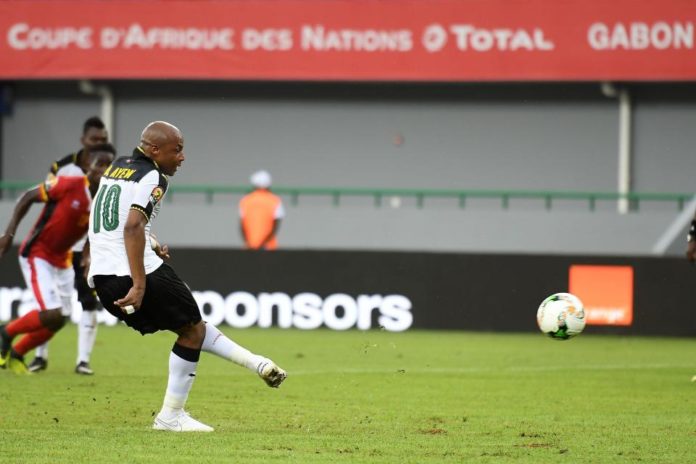
ZURICH — FIFA says it will not act on Ghana’s complaint about refereeing in a World Cup qualifying match last weekend.

The Ghana federation wanted its 0-0 draw in Uganda replayed, and also protested about South African referee Daniel Bennett and his assistants from Seychelles.

Ghana’s failure to win meant Egypt, which beat Republic of Congo 2-1 the next day, advanced to play in Russia.

FIFA says “no proceedings will be opened around the World Cup qualifier match Uganda vs. Ghana.”

Ghana believed two goals were disallowed for incorrect offside decisions. Replays suggested a stoppage-time goal should have counted.

The request followed FIFA last month ordering a replay of a South Africa-Senegal qualifier played last year. Ghanaian referee Joseph Lamptey was later found guilty of fixing and banned for life.

Stories Continues after ad

Police summons Monitor, Red Pepper over Age Limit saga

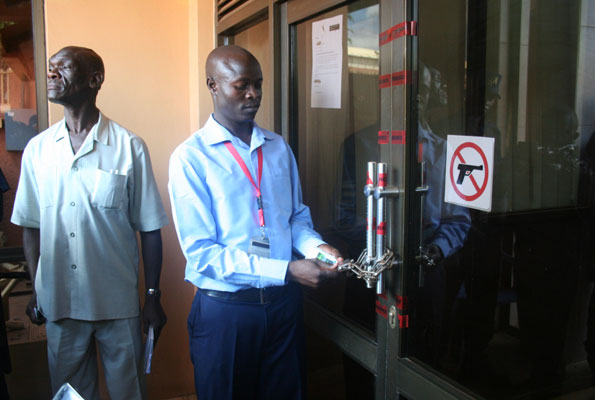
The then Deputy CIID, Mr Geoffrey Musana (L) witnesses as the head of security at Monitor close offices during 2013 siege.

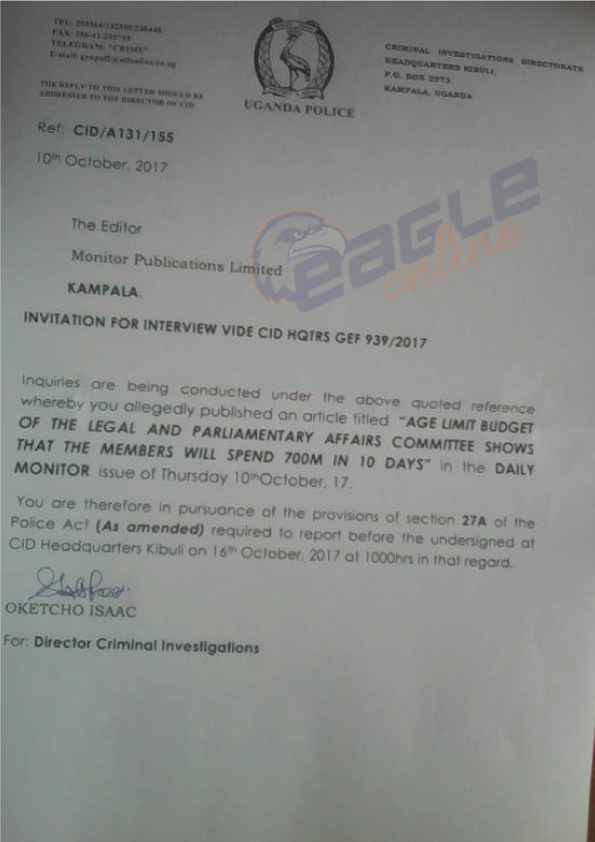
Police have summoned the News Editors of Monitor Publications Limited and that of Red Pepper to appear at CID headquarters in Kibuli on Monday over stories related to Age Limit.

Police say they are conducting an inquiry into a story titled ‘Age limit budget of the legal and parliamentary affairs committee shows that the members will spend Shs700 million in 10 days’. That appeared in the monitor this week

However, in their summons, police does not indicate which charges are preferred on the Editors but instead say it is an interview.

“You are therefore, in pursuance at the provision of section 27A of the police Act (As amended) required to report before the undersigned at CID headquarters Kibuli on October 16, 2017 at 1000hrs in that regard.” Reads the summons signed by a one Isaac Oketcho on behalf of Director Criminal Investigation to Monitor Publications Limited.

However, Mr. Barnard Tabaire, a co-founder and Programmes Director at African Centre for Media Excellency (ACME) says the summons to media houses is part of the wider state plan to silence all those opposed to the Age Limit amendment and also to instill fear among those opposed.

“Obviously it is the strategy to intimidate Members of Parliament opposed and now the media. They have no reason they are pushing it rather to have Museveni running for ever.” Mr Tabaire said

He added “They are using the tools available to see that discussion on the debate is controlled and this is a big issue which they think that the journalists shouldn’t dig up.”

Following the chaos at Parliament prompted by the imminent tabling of a private members bill to lift the presidential age limit that is capped at 75 years, police has continued to issue summons to those opposed to the bill. It all started when they summoned 24 legislators for interrogation at the CID headquarters in Kibuli.

Among the MPs summoned by police, the majority from the opposition include Allan Ssewanyana, Robert Kyagulanyi, Monica Amoding, Sam Lyomoki, Moses Kasibante, Betty Nambooze, Francis Zaake, Ibrahim Kasozi, Nzaavu, Gilbert Olanya, Muhammad Nsereko, Odonga Otto, and Winfred Nuwagaba and Nandala Mafabi. Amog others are Medard Lubega Seggona, Gerald Karuhanga, Gaffa Mbwatekamwa, Florence Nmayanja, Theodore Sekikubo, Barnabas Tinkasimire and Angelina Osege.

Interestingly,  the State Minister for Water and Resources Ronald Kibuule, who reportedly sneaked a gun into the chambers on the first day of the chaos in contravention of the parliamentary rules, was not summoned but instead Nakawa legislator Michael Kabazigurka who was taken to parliament on the will chair was instead summoned.


Stories Continues after ad

NRM rebel MPs thrown out of caucus

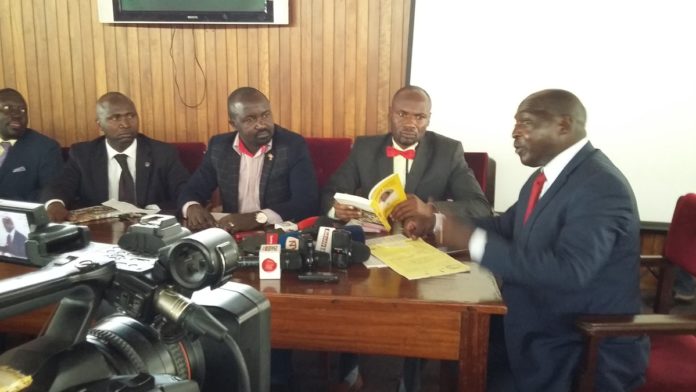
Rebel MPs including Theodore Sekikubo, Patrick Nsamba, John Baptist Nambeshe, Gaffa Mbwatekamwa, Barnabas Tinkasimire address the press

Nine National Resistance Movement (NRM) ‘rebel MPs’ have today been ejected from a party caucus  meeting on the orders on President Yoweri Museveni, who is the NRM Chairman.

Theodore Sekikubo, Patrick Nsamba, John Baptist Nambeshe, Gaffa Mbwatekamwa, Barnabas Tinkasimire, James Kaberuka, Patrick Nsamba, Sylvia Rwabwogo and Winfred Nuwagaba were ordered to leave after NRM Chief Whip Ruth Nankabirwa said they would leak party secrets.

The ejection of the MPs comes on the heels of a move by Igara West legislator Raphael Magyezi tabling a ‘private members bill’ seeking to expunge Article 102(b) of the 1995 Constitution, which sets the presidential age limit at 75 years.

Since then, the 9 ‘rebel MPs’ and all opposition legislators have opposed the move, saying it is aimed at creating a ‘Museveni life presidency’.

“Due to opposition to the private members bill that is aimed at lifting presidential age limit, Nankabirwa read out our names saying that she didn’t feel comfortable sitting with us because we may reveal caucus secrets,” Sekikubo said at a press conference held at Parliament this afternoon.

Sekikubo, who said they have not been summoned by the NRM over indiscipline, adding that the decision was arbitrary.

“We have known Museveni for being tolerant to those with opinions; what they are doing is bad to the country and treacherous to the party,” he added.

According to Nambeshe, the President had summarily dismissed them from NRM, in contravention of the party rules.

“They started with national Constitution and they are now on party Constitution,” he said, adding that Cabinet had abdicated its roles in respect to the age limit debate.

“Since when did Cabinet run away from the duty of this age limit matter and leave it for back-bencher Raphael Magyezi?” he wondered.


Stories Continues after ad

IGG assures URA on declared assets taxes

IGG Irene Mulyagonja

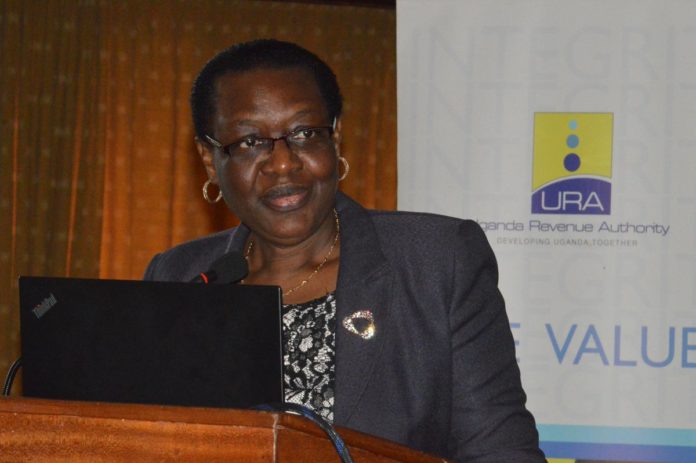
As the Uganda Revenue Authority (URA) lays strategies to collect more taxes, the Inspector General of Government, Irene Mulyagonja, has said that her office will liaise with the national tax collector to ensure that all taxes on declared assets are paid.

Ms Mulyagonja was Friday speaking as guest of honour at the URA Suppliers Integrity Forum in Kampala, held under the theme, ‘Enlighting and Connecting with clients for improved compliance’, organised by URA’s Department of Internal Audit and Compliance.

According to the IGG low salaries, self-interest and suppliers who ‘induce’ officials are some of the causes of corruption in government departments.

Ms Mulyagonja urged local suppliers to desist from corruption tendencies, adding that asset recovery is now part of the punitive measures the IGG enforces to combat corruption in Uganda.

Speaking to delegates at the forum, URA’s Commissioner for Internal Audit and Compliance, Dr. Protais Begumisa, warned their suppliers against ‘cartels’ and attempts to bribe staff. “Let us avoid syndicated corruption,” he said, urging suppliers to be tax compliant.

The Commissioner for Tax Investigations Patrick Mukiibi, shed light on the manifestations of corruption and tax evasion.

Meanwhile, URA in one of its latest statements has urged all employers in the country to ensure that all their staff earning salaries above the threshold Shs235, 000 per month register for tax as dictated by the Tax Procedure Code Act 2014 and the Income Tax Act.

“In order to promote accountability for taxes deducted from employees in accordance with the provisions of Section 116 of the Income Tax Act, all employees liable to tax on their emoluments apply and obtain a TIN (Tax Identification Number) in accordance with the above provisions,” URA says.

Under the law, every employer is required to deduct monthly taxes-Pay As You Earn (PAYE) from liable employees’ salary payments and any other employment benefits, whether monetary or in-kind.

However, the Uganda Peoples Defence Forces, Uganda Police, Uganda Prisons Services and the judges are exempted from PAYE, a decision some people say violates the principle of equity.


Stories Continues after ad

How organic food can be great for natural hair: Lydia Kahuga tells it all

Lydia Kahuga

By Cynthia Tumwine

We are switching up things a little. Everyone enjoys the value of eating different types of food and just on the whole loves and enjoys eating. Today however, we look at how organic foods could be a Naturalistas best friend as they embark on their natural hair journey.

In a fun chat with Co-Founder of Nzuri Textures-Lydia Kahuga who runs the company that is dedicated to #TeamNatural hair among other things with her business partner Rowena Lubowa, she told us that aside from being an avid naturalista, she is a lawyer by day and is also a hair stylist and writer. Her colleague Rowena is also a lawyer and an Entrepreneur.

Lydia says she has been a naturalista all her life. She wore it short during school and started growing it in 2012. “At first the beginning of my natural hair journey was overwhelming, however as time goes on I am glad that there are more natural hair salons and there is generally more information on how to manage natural hair. This is what inspired us to start Nzuri Textures too”

A woman’s hair is her crown, says Lydia, and so many women have mistreated their hair by always plaiting it and not giving it room to breathe, adding chemicals to make it easier to style or applied excessive heat through hot combing which damages the hair. Natural hair can be very easy and affordable to maintain if you are creative.

“Creativity is key, when it comes to styling and the kind of hair products you use”, Lydia says. One important fact to note is that everyone has different a hair texture and therefore different products should be used based on the hair type.

When asked what the best organic products to use for their hair, Lydia recommended;

-Eggs

-Extra Virgin Olive Oil

-Avocado

-Honey

-Shea Butter

-Onion juice

-Coconut Oil

Lydia Kahuga (R) and Rowena Lubowa (L)


The above help with softening, strengthening and moisturizing the hair and most can be gotten on Jumia Food on the Jumia Fresh category which allows you to shop for fresh groceries.

Lastly, Lydia left us with some food for thought, “You are what you eat “ she said, therefore she urged people to try and eat healthy which will in turn result into healthy bouncy hair.

She recommended leafy greens which have minerals that are great for hair growth, Foods rich in Omega3 such as fish, carrots, beans and of course the number one ingredient Water.

For those who find it difficult to stick to a healthy diet due to their busy schedules she proposed supplements as prescribed by the doctor.


Stay Adventurous!

Cynthia Tumwine.

The writer is the PR Manager at Jumia Travel Uganda


Stories Continues after ad

Uganda among Africa’s top 10 financial markets

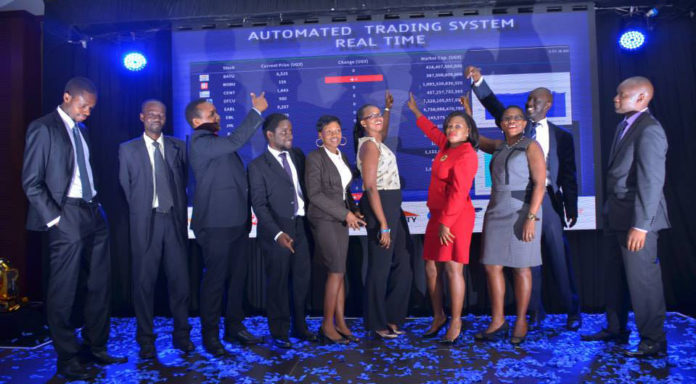
Brokers at the USE automated system

The Barclays Africa Group Financial Markets Index launched yesterday at the World Bank Group in Washington DC shows Uganda is among the top ten in Africa in displaying openness for capital markets transactions and direct investment.

The Index found that South Africa, Mauritius and Botswana are Africa’s leading countries in capital markets transactions openness, respectively.

Uganda, ranked in tenth position, comes after Namibia, Kenya (5th), Nigeria, Ghana, Rwanda (8th) and Zambia (9th), but performed better than Tanzania (11th), Morocco, Ivory Coast, Egypt, Mozambique, Seychelles and Ethiopia.

In the East Africa Community (EAC) grouping, the ranking of the financial markets saw Kenya and Rwanda come ahead of Uganda respectively. Tanzania came behind Uganda while Burundi and South Sudan- the other members of the EAC were not considered for this Index.

The Index established that in the EAC Uganda has good foreign exchange access but low local investor capacity. Kenya, on the other hand has strong contract enforcement but over-cautious regulators, while Rwanda displays high transparency and adherence to standard master agreements. Tanzania has a relatively high market transparency hindered by capital restrictions, while Kenya has the most developed financial market.

Uganda’s financial markets operate on the Uganda Securities Exchange (USE) platform which has 17 companies listed to trade shares. USE, a public limited company, is regulated by the Capital Markets Authority (CMA), whose role among others is to ensure that players on the USE exhibit transparency.

The survey held interviews with 60 top executives from 40 financial institutions operating across the 17 countries, including banks, investors, securities exchanges, regulators, audit and accounting firms, and international financial and development institutions.

The authors of the index say the countries surveyed have performed better than the African average, with GDP growth of 3.8% in 2016 against 2.4% for the continent as a whole. “They have, however, experienced a larger absolute fall since 2013, when growth was 6% overall, against the African average of 4.2%,” they say.

The Index produced by Official Monetary and Financial Institutions Forum (OMFIF) and sponsored by Barclays Africa Group, focuses on six fundamental pillars: Market depth, access to foreign exchange, market transparency and regulation, capacity of local investors, underlying macro opportunities, and the enforceability of international financial agreements.

The report says Africa’s large and dynamic market presents opportunities for growth on the continent. However, it says foreign investment prospects are hampered by underdeveloped financial markets and a lack of legal and regulatory clarity.

“Liquidity, regulation, foreign exchange restrictions and policy choices are the highest area of concern for investors when considering Africa. Whereas product diversity and the speed of transactions are among the highest-performing indicators, the report highlights investor concern about the relevance of African markets on the global financial scene,” it says.

OMFIF focuses on global policy and investment themes –particularly in asset management, capital markets and financial supervision/regulation – relating to central banks, sovereign funds, pension funds, regulators and treasuries. It promotes higher standards, performance-enhancing exchanges between public and private sectors and a better understanding of the world economy, in an atmosphere of mutual trust.

Stories Continues after ad

Kitende SS players get ‘consolation’ in 2017 COPA Coca-Cola Global Cup

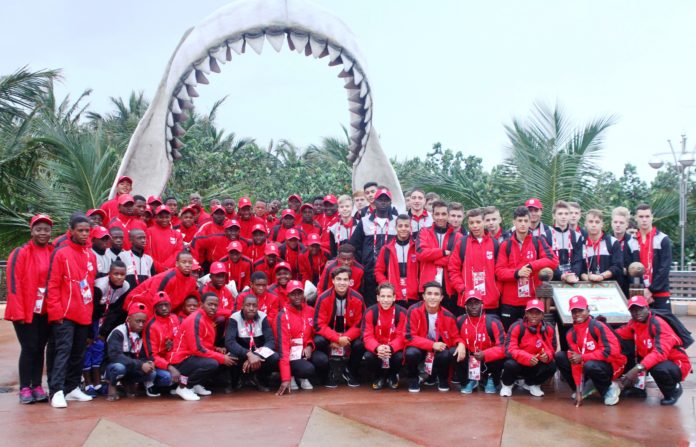
2017 COPA Coca-Cola Global Cup teams with their coaches

Losing to Jinja Secondary School in the COPA Coca-Cola 2017 tournament earlier this year did not deter two St. Mary’s Kitende SS players from reaching the recently concluded COPA Coca-Cola Global Cup championship played in Durban, South Africa.

Pius Ssonko Lutaaya and Joshua Ssentamu, who were part of the team that was fielded for COPA 2017, were selected during the Kenya Secondary Schools Sports Association East Africa games to be part of the team that represented East Africa in the Global Cup.

The East Africa team found the going tough in their opening Group B fixture against South Africa Team 2, losing 6-1. This was followed by a 7-2 defeat to Russia Team 1 in the second group match.

“The tournament has no doubt stretched the players prompting them to do some soul searching about what they want to achieve as players,” commented Peter Mayoyo, the East Africa team coach, after an exciting Day 1 at the COPA Coca-Cola Global Cup in Durban.

Rodney Nzioka, the Coca-Cola Uganda Brand Manager, commended the East Africa team for the masterful display of talent at the tournament.

“Through this platform, we gave two talented players an opportunity to interact with and play against their counterparts from different countries who have been exposed to a different standard of football and despite the fact that they did not win, I commend them for their eagerness to learn and believe that they return better players than when they left,” Mr. Nzioka stated, adding that Coca-Cola Uganda remains dedicated to the continued development of sports in Uganda right from the grassroots.

COPA Coca-Cola Global Cup is a three-day U-15 boys’ and girls’ five-a-side tournament established in Zimbabwe in 1989.

East Africa is a squad made up of players from Kenya, Uganda and Tanzania, whereas WIMA is West Island, Middle Africa, and the squad is made up of players from DRC, Rwanda, Burkina Faso and Ivory Coast.

Tunisia were crowned COPA Coca-Cola Global Cup Under-15 champions after beating Nigeria 7-6 in penalties in the final on Sunday.


Stories Continues after ad

Kampala Serena Hotel named Uganda’s best

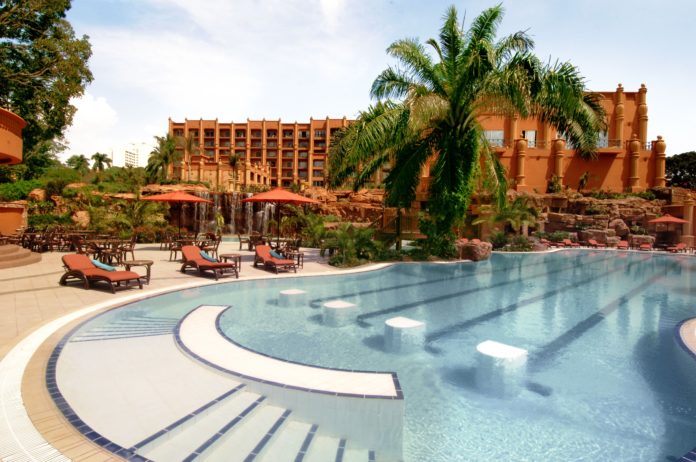
LEADING HOTEL IN UGANDA: The Kampala_Serena_Hotel

Kampala Serena Hotel has been awarded as Uganda’s leading hotel in the World Tourism Awards for Africa held days ago in Rwanda’s capital Kigali, beating the likes of Sheraton Kampala Hotel and others.

Roadtrip Uganda was awarded as leading car rental company in the country, beating several others in the industry.

Presidential Suite at Lake Victoria Serena was selected as the leading hotel suite while the while Nkuringo Bwindi Gorilla Lodge emerged as leading safari lodge. The Sanctuary Gorilla Forest Camp won Uganda’s Leading Tented Safari Camp.

The awards in Kigali saw Rwanda emerge as Africa’s leading tourism destination in the world, with Kigali’s Radisson Blu Hotel and Convention Centre winning three accolades as ‘Africa’s leading conference hotel’, ‘Rwanda’s leading conference hotel’ and ‘Africa’s leading new hotel’.

South Africa had Durban city named Africa’s leading meetings and conferences destination following the upgrade the city underwent ahead of the 2010 World Cup. Saxon Hotel, Villas and Spa won the award for Africa’s leading hotel suite and South Africa’s leading hotel suite.

World Travel Awards Founder and President, Graham E Cooke, said: “We have recognised the leading lights of African tourism tonight and I wish to offer my heartfelt congratulations to all of our winners”.

Kenya Airways won Africa’s Leading Airline and Africa’s Leading Airline – Business Class, while Cape Town International Airport was named Africa’s Leading International Airport.

Winners from the event will proceed to compete in the World Travel Awards Grand Final, to be held in Vietnam on December 10.

Full list for Continent Winners

Leading Airline – Kenya Airways

Leading Airline (Business Class) – Kenya Airways

Leading Airline (Economy Class) – Ethiopian Airlines

Leading Airline Brand – Ethiopian Airlines

Leading Airport – Cape Town International Airport, South Africa

Leading All-Inclusive Resort – Diamonds La Gemma dell’Est, Zanzibar, Tanzania

Leading Beach Destination – Diani Beach, Kenya

Leading Beach Resort – Diamonds La Gemma dell’Est, Zanzibar, Tanzania

Leading Boutique Hotel – Saxon Hotel, Villas and Spa, South Africa

Leading Boutique Hotel Brand Mantis Collection

Leading Business Car Rental Company Avis

Leading Business Hotel Transcorp Hilton Abuja, Nigeria

Leading Business Travel Agency Carlson Wagonlit Travel

Leading Car Rental Company Europcar

Leading Casino Resort The Palazzo Montecasino, South Africa

Leading City Destination – Cape Town, South Africa

Leading City Hotel – Pepperclub Hotel & Spa, South Africa

Leading Conference Hotel – Radisson Blu Hotel & Convention Centre, Kigali, Rwanda

Leading Conservation Company – &Beyond

Leading Cruise Line – Royal Caribbean International

Leading Cruise Port – Port of Mombasa, Kenya

Leading Design Hotel – MannaBay, South Africa

Leading Destination – Rwanda

Leading Destination Management Company – Destination Kenya

Leading Family Resort – Leopard Beach Resort & Spa, Kenya

Leading Game Reserve Brand – Singita Game Reserves

Leading Green Hotel – Nkwichi Lodge, Mozambique

Leading Hotel – Fairmont Mount Kenya Safari Club, Kenya

Leading Hotel Brand – Sarova Hotels, Resorts and Game Lodges

Leading Hotel Residences – Cape Grace, South Africa

Leading Hotel Suite – Nelson Mandela Platinum Suite @ Saxon Hotel, Villas and Spa, South Africa

Leading Inflight Magazine – Sawubona (South African Airways)

Leading Low-Cost Airline – fastjet

Leading Luxury Hotel Villa – Villa Two @ Ellerman House, South Africa

Leading Luxury Island – Thanda Island, Tanzania

Leading Luxury Lodge – Sirikoi, Kenya

Leading Luxury Private Villa – Villa iZulu @ Thanda Safari, South Africa

Leading Luxury Resort – Fairmont Zimbali Resort, South Africa

Leading Luxury Tour Operator – Abercrombie & Kent

Leading Luxury Train – The Blue Train

Leading Meetings & Conference Centre – Durban International Convention Centre, South Africa

Leading Meetings & Conference Destination – Durban, South Africa

Leading MICE Hotel – Mazagan Beach & Golf Resort, Morocco

Leading National Park – Masai Mara National Reserve, Kenya

Leading New Hotel – Radisson Blu Hotel & Convention Centre, Kigali, Rwanda

Leading Online Travel Agency – Flightsite.co.za

Leading Private Game Reserve – Shambala Private Reserve, South Africa

Leading Private Island Resort – &Beyond Mnemba Island Lodge, Zanzibar

Leading Resort – Sun City Resort, South Africa

Leading River Cruise Company – Discover Egypt, Nile Cruises

Leading Safari Company – Rhino Africa

Leading Safari Lodge – Four Seasons Safari Lodge Serengeti, Tanzania

Leading Serviced Apartments – Lawhill Luxury Apartments, South Africa

Leading Sports Resort – Legend Golf & Safari Resort, South Africa

Leading Tented Safari Camp – Finch Hattons, Kenya

Leading Tourist Attraction – Mount Kilimanjaro, Tanzania

Leading Tourist Board – Kenya Tourism Board

Leading Travel Agency – Bonfire Adventures

Leading Travel Club – DreamTrips

Leading Travel Management Company – FCM Travel Solutions

Most Romantic Resort – Anantara Medjumbe Island Resort, Mozambique

Responsible Tourism Award – Nkwichi Lodge


Stories Continues after ad

Six pillars of African growth: Tracking openness and market depth across the region

OMFIF Senior Economist Ben Robinson

By Ben Robinson and Bhavin Patel

In the light of the post-2014 commodity cycle downturn, many African countries have prioritised initiatives to improve their economic governance, increase the sustainability of their fiscal positions, and diversify their economies. One essential consideration for the next stage of Africa’s development is the expansion of its financial markets, which will provide additional growth and funding opportunities to local businesses.

That is the conclusion of the Barclays Africa Group Financial Markets launched today at the World Bank Group-International Monetary Fund annual meetings in Washington D.C. The index, jointly produced with Official Monetary and Financial Institutions Forum (OMFIF), ranks the maturity, openness and accessibility of 17 financial markets in Africa. It is based on both in-depth quantitative data and a new survey of 60 top executives from financial institutions operating across the 17 countries, including banks, investors, securities exchanges, regulators, audit and accounting firms, and international financial and development institutions.

Development of local investor capacity and ability to attract foreign capital are key points of focus. ‘Through expert analysis of the African financial markets, the Africa Financial Markets Index draws global attention to the considerable investment opportunities and uncovers the untapped market potential,’ says Akinwumi Adesina, President of the African Development Bank.

The Index focuses on six fundamental pillars for financial market performance: market depth; access to foreign exchange; market transparency and regulation; capacity of local investors; macroeconomic opportunity, and; enforceability of international financial agreements.

The markets surveyed are; Botswana, Egypt, Ethiopia, Ghana, Ivory Coast, Kenya, Mauritius, Morocco, Mozambique, Namibia, Nigeria, Rwanda, Seychelles, South Africa, Tanzania, Uganda and Zambia.

The countries tracked by the index have performed better than the African average, with GDP growth of 3.8 percent in 2016 against 2.4 percent for the continent as a whole. They have, however, experienced a larger absolute fall since 2013, when growth was 6 percent overall, against the African average of 4.2 percent.

Financial market development offers opportunities for international investors to access fast-growing countries. Some, like Ethiopia, are growing from a low base. Others, particularly oil-exporting economies, are already relatively large and have limited ability for rapid expansion. However, these countries’ focus on developing new industry sectors means some sections of the economy still offer robust growth prospects.

South Africa achieves the highest overall score in the index. It has deep and liquid financial markets and, with low restrictions on capital movement, it attracts investors from throughout the region whose own markets are smaller and offer less diversity of products. However, many of South Africa’s indicators, including GDP growth and export competitiveness, have deteriorated in recent years.

Others are closing the gap. Mauritius and Botswana have strengths in tax and regulation and access to foreign exchange. Kenya and Ghana provide signs of progress. Ivory Coast, with a low overall score, is home to a growing regional bourse, pointing to future improvement. Ethiopia shows the highest GDP growth prospects of the 17 countries – even though it comes bottom of the list in terms of financial market prowess. Conversely, a deteriorating regulatory environment in Namibia, and restrictive rules on foreign exchange in Egypt and Morocco among other countries, are hampering financial markets’ progression.

Investors’ ability to deploy and repatriate their funds easily is essential for the development of deep and liquid capital markets. As the Index makes clear, several countries across the continent are already steering their economies towards greater transparency and stronger regulatory frameworks to improve investor confidence in their financial markets.

As the population of the continent continues to grow at a fast pace, private consumption is contributing an ever greater share of GDP. Combined with public investment, this made the biggest contribution to GDP growth across Africa in 2016. This could provide significant opportunities for attracting foreign investment if financial markets are sufficiently developed. Economic diversification between countries remains uneven, however. Total final consumption grew by 11.5 percent in Ethiopia and 8.2 percent in Ivory Coast in 2016, against a decline of 6 percent in Nigeria.

‘The Index provides countries with valuable insights and tools to improve the state of their financial markets,’ says Maria Ramos, Chief Executive of Barclays Africa Group. ‘By broadening and deepening their understanding of the requirements of local and international investors, Africa’s leaders can develop robust markets – a prime condition for sustainable, inclusive growth.’


Ben Robinson is Senior Economist, and Bhavin Patel is Economist at OMFIF.


Stories Continues after ad