Chris Bwakira, Vice President and Area Business Head, East Africa at Mastercard with Jacqueline Muna Musiitwa, Executive Director at FSD Uganda
Over half of Uganda’s adults are forced to keep their savings at home because of a lack of access to formal financial services, in the process slowing the country’s growth as large numbers of citizens remain in exclusion.
To reverse this trend, Mastercard and Financial Sector Deepening Uganda (FDSU) have partnered to develop financial solutions that will improve the livelihoods of Ugandans and also strengthen the country’s economy.
The partnership, announced during Financial Inclusion Week, will allow Mastercard, including the Mastercard Labs for Financial Inclusion, and FSDU to focus on the key sectors like education, agriculture, trade and health by creating and rolling out secure and simple digital payment solutions.
“Digital payments have played an important role in connecting Ugandans to financial services securely and seamlessly: 53 out of every 100 Ugandan adults have transacted because of mobile money solutions2, for instance, which shows us that the ability to include people in the economy is driven by innovative digital solutions,” said Chris Bwakira, Vice President and Area Business Head, East Africa at Mastercard.
According to Mr. Bwakira, Ugandans have also indicated a healthy appetite for digitalized consumption, mobile in particular.
“Mobile penetration sits at 65 percent and continues to grow rapidly, illustrating that as businesses, we should be targeting solutions that are convenient for citizens and that are easily accessible and available on platforms that they have adopted and use regularly,” Mr. Bwakira said.
According to Mr. Bwakira, Mastercard Labs for Financial Inclusion is working on an education payment project in Uganda, to be followed by an agricultural payments project next year.
Solutions developed by Mastercard and FSD Uganda will seek to close gaps and build on the education pilot, eventually linking to other initiatives in trade and health, which are also core sectors.
Approximately 60 percent of Uganda’s citizens are involved in agriculture, making pioneering tools and solutions in these areas a driver of growth.
The two partners have also committed to focus on meeting objectives in specific areas, most notably in protecting consumers, driving engagement with government surrounding policy, as well as carrying out research and partnering with other critical stakeholders to share knowledge and expertise around financial inclusion.
Other areas of interest include customer education and awareness building aimed primarily at people who have been traditionally excluded from banking and financial services, engagement with the Ugandan government around policies creating a more enabling environment for investment in financial services and information technology.
“Uganda takes building a more inclusive economy extremely seriously, as evidenced in the recently launched National Financial Inclusion Strategy 2017-2022.
Strategic partnerships between organizations with the same values such as FSD Uganda and Mastercard, are an important step on the journey towards creating a country where financial services are accessible, affordable and beneficial to all,” said Jacqueline Muna Musiitwa, Executive Director at FSD Uganda.
Bwakira agreed, adding that a greater roll out and uptake of digital payment solutions will feed into Uganda’s overall National Financial Inclusion Strategy, which runs until 2022 and aims to increase access to formal financial services.
“Addressing the challenges that face ordinary Ugandans, particularly rural and low-income citizens, cannot be solved overnight, but with continued partnerships and the introduction of tools and services that allow more people to access formal financial services, we are making definitive strides in the right direction,” he noted.
Prime Minister Ruhakana Rugunda will mid next week launch the construction of the long-awaited Shs5 billion National ICT Innovation Hub at the Institute of Institute of Information and Communication Technology, Nakawa.
According to a brief, the ground-breaking ceremony for construction of the ICT hub is expected to attract cabinet ministers, officials from telecom companies and leading stakeholders in the ICT sector.
The Government set aside Shs75 billion to support ICT innovators in the country under a five-year National ICT Initiatives Support Programme in the country, with Shs15bn will be available every year.
Mid this year the minister of finance Matia Kasaija provided Shs10 billion to innovators, the brief issued today indicates.
Africa has to deal with the fact that its oil and gas industry continues to face market challenges arising from the low oil price, competition for revenue growth and local talent together with new expectations from investors and regulators.
“Africa’s oil & gas industry is experiencing significant change and upheaval. There are fundamental shifts in companies’ strategies, business models and ways of working,” says Chris Bredenhann, PwC Africa oil and gas advisory leader.
The sustained lower price of oil has been accepted as the new normal in the oil & gas industry with companies putting plans in place to enable a more agile response to commodity price fluctuations in the future. For some, this means a diversification of portfolio, with many considering moves to an energy mix that includes some form of renewables. Despite the challenges, there are a number of opportunities on the African continent.
“The time is opportune for oil & gas companies to take up and utilise advances in technology as an enabler in meeting some of the challenges faced. Instead of playing catch up the rest of the world, we believe that the industry should be ‘learning to leapfrog’ so that they are not only ahead of disruption – they actually cause it,” Bredenhann says.
PwC’s Africa oil and gas review, 2017 analyses what has happened in the last 12 months in the oil & gas industry within the major and emerging markets.
As at the end of 2016, Africa is reported to have had proven natural gas reserves of 503.3 Tcf, up 1% in total gas reserves on the continent. About 90% of African gas production continues to come from Algeria, Nigeria, Egypt and Libya though the overall quantity produced in 2016 reduced by 1.1% down to 208.3 Bcm.
Africa’ share of global oil production has continued its downward trend from the past four years, dropping sharply, moving it down from 9.1% of global output last year to 8.6%.
The challenges in Africa’s oil and gas industry. The top challenges in the oil & gas industry have remained similar to those in previous years with uncertain regulatory frameworks, corruption, and tax requirements remaining in the top six for the past four years. It is notable that financing costs and foreign currency volatility have both become more critical challenges since 2015 when they were ranked eleventh and tenth, respectively.
“It is disheartening that governments are not catching up to demands and calls from oil & gas companies to ensure regulatory certainty to players who are looking to invest in hydrocarbon plays in various African countries,” Bredenhann comments. Upstream regulation in South Africa remains uncertain, with the separation of oil & gas from mining still not achieved in the Mineral and Petroleum Resources Development Act (MPRDA). Other key markets in Africa, such as Nigeria and Tanzania, are also experiencing significant regulatory issues.
Corruption has remained among the top three challenges over the last four years, with numerous instances occurring across the continent. Despite the existence of anti-corruption programmes at government and corporate levels, the effectiveness of such programmes is questionable. In the context of corruption issues, it is not surprising that the costs of finance have risen to third among major challenges for African players. It is likely that the regional issues and uncertainties combined with a constrained wider industry, have led banks and other institutions to be wary of offering favourable financing terms.
The lack of skills development continues to be a problem in Africa, and it is becoming a global challenge in the oil & gas industry overall.
Lower oil prices
Aside from those challenges highlighted by companies, adjusting to the new normal of lower oil prices remains a concern for companies. The oil price has been relatively ‘stable’ through 2017. Having recovered since the January 2016 low, it has typically been trading in the $50-60/bbl range. As the Brent oil price reached close to $60/bbl in September 2017, the market began asking whether ‘lower for longer’ may be over. The demand for oil is picking up, and supply is easing off, suggesting a market rebalancing is underway. However, as we have often seen with global oil prices, nothing is ever certain.
Oil & gas companies cited geopolitics, supply and demand as the three major reasons for the current oil price environment. Looking ahead, respondents expect modest increases in prices over the next two years – with 65% and 52% expecting the price to be in the $51-60/bbl range for 2018 and 2019 respectively.
The changing competitive landscape. In response to many of these challenges, oil & gas companies are looking to alter their strategies and operating models, which has changed the competitive landscape. Companies reported that major changes anticipated or recently experienced in the competitive environment are driven by the growth in alternative fuels, the impact of technology-driven disruption and the need for cost reduction.
Oil and gas companies and growth. Oil and gas companies cited ‘too little investment in developing capabilities’ as the most significant impediment to business growth. This was followed by weak strategy and leadership.
According to PwC research, companies become ‘Fit for Growth’ by doing three things consistently and continuously: they focus on a few differentiating capabilities; they align their cost structure to these capabilities; and they organise their businesses for growth.
According to PwC’s Oil & Gas Review, 75% of companies say that they have reviewed their Africa strategy in the last three years, but they also acknowledge that there are issues with incoherence and a problem with executing it in day-to-day business.
PwC’s Fit for Growth approach emphasises that investment in capabilities that enable the organisation to create unique value for customers is key for sustainable growth.
Survey respondents indicated that they are investing in the development of new or the enhancement of existing capabilities (18%), local content and skills development (14%), infrastructure improvements (13%), and regulatory compliance (12%) over the next three years.
It is notable that cost management as a strategic focus has fallen in importance this year. One-third of respondents indicated that they had no cost-cutting intentions. Just under half of respondents intend to reduce costs by up to 20%.
Achieving sustainability
The need to strategically assess the portfolio of activities oil & gas companies in Africa pursue in order to be sustainable in the drive towards a low-carbon environment is necessary. The review results indicate that M&A and partnerships are key to delivering the intended and repositioned strategies and growth. The minority of respondents were related to an M&A proposition to drive growth, with approximately 30% of respondents being targeted for acquisition and about 40% having targeted an entity themselves. The majority of respondents referred to a partnership proposition with nearly 60% having both been approached or approaching another entity for partnership.
While some oil and gas companies continue to explore opportunities for cost reduction and improved efficiency, consideration is now being given to how they will stay ahead of the competition. Given the perception of slow uptake of digital solutions in the oil & gas industry, it is surprising that nearly a quarter of companies stated that they had implemented some form of digital solution, from production and drilling to mobile solutions.
Leveraging local content
More than 25% of oil and gas companies said that projects had been postponed or delayed by local content policies, and about 15% have relocated or cancelled projects in response to local regulations. About 10% indicated an acceleration of their projects. One-third of respondents think that there are more local companies today that can serve the sector. Just under one-third acknowledge that local skills at the right level are available in their country and 11% said that new players have emerged in upstream as a result of the regulations.
“The oil & gas industry in Africa is riddled with complex challenges and adversity, but with challenge comes opportunity. The opportunity is there for players who are willing to ‘reimagine the possible’ in a future that looks very different to our present.
“It is clear that African oil players must ‘learn to leapfrog’ to remain competitive in the new energy future,” concludes Bredenhann.
SOUNDED WARNING: URA Commissioner General, Doris-Akol
The Uganda Revenue Authority (URA) staff who live lavish lifestyles stand to be investigated as the agency pushes for increased tax revenue collections to beat the Shs15.06 trillion target for the current fiscal year, Commissioner General Doris Akol has warned.
Ms Akol’s warning comes at the time when the latest tax revenue performance report shows that the agency made a deficit in first quarter of financial year 2017/18, collecting Shs3, 147.07 billion against target of Shs 3,279.09 billion.
She says the measure to investigate staff as part of the integrity drive aimed at fighting corruption at URA.
“In the drive to fight corruption, we plan to conduct lifestyle audits on our staff to identify staff living an extravagant lifestyle,” she warns.
According to Ms Akol, some of the staff may be potentially engaged in illegal activities that are ‘soiling’ the integrity and image of the organization.
“I call upon the public to report to us staff that are requesting for bribes while executing their duties,” she said, stating that integrity is one of the core values that staff at URA are supposed to uphold.
“Our staff is expected to act ethically and professional at all times,” she added.
THE URA CG said the measure will help the agency collect tax revenue that could have been lost in case some staff got involved in corruption.
Meanwhile, Ms. Akol said URA carried out investigations to verify the accuracy of declarations by taxpayers between July and September, yielding Shs 21.5 billion in tax revenue. “Areas targeted included fictitious input VAT claims, mis-invoicing, and under declaration of sales,” Ms. Akol said.
She disclosed that URA prosecuted the 63 hard core tax offenders, with the Debt Collection Unit recovering tax deficits of Shs19.85 billion.
In fiscal year 2017/18, URA was given a net revenue target of Shs 15,062.43 billion,
which is Shs1,885.28 billion over and above last year’s target.
And according to Ms Akol, interventions such as continued expansion of tax base, integrity drives, accountability campaigns, improved filing ratios, audit efficiency, customs enforcement and tax investigation among others will help URA achieve the target, notwithstanding the economic challenges.
Jumia Food Uganda: "It's a Friday! Get the best deals
By Cynthia Tumwine
We have been blessed to witness an era where technology can allow us to do so many things with just one click. Today you can send and receive important documents through email or whatsapp from miles away; you can book a hotel from the comfort of your living room on Jumia Travel for example, or even grab a special taxi (cab) in just seconds, all this online.
The new Jumia Food Ad for example has taken the internet by storm and one could say it’s on its way to going viral. Why? Because it shows how the online food service has made life easier for so many people especially the young man trying to impress his date that he can cook!
Cooking is a skill a lot of people underestimate and requires time, an average 5 course meal will take about two hours to make. Of course, there are a also few quick ways to make dishes that can be done in 15 minutes but not the kind you’d want to make on a date, for example like the man in the advert because he aims to impress. Fifteen minute meals are also not the type you would fix for your hungry family as a wife or husband, depending on who the better cook is.
However, many times in this day and age where cooking is not a skill possessed by everyone and both the man and woman work all day, being able to order in occasionally or everyday (for bachelors and students) becomes the easier option.
In addition to saving time, money is also saved. In Kampala driving to a restaurant could take several minutes due to traffic, in that time you’ve burned so much fuel that it would be so much easier and less expensive to just order in. One more thing, if you plan to surprise someone with lunch or dinner, what better way to do it than to have it just show up at their office or home unexpected. Through a quick search of your favourite restaurants just one click and Jumia Food will have the food at your doorstep.
So guys, today let’s say a quick thank you to the new tech era for making life so much easier.
The writer is the PR Manager Jumia Food and Travel
Pope Francis has requested that Roman Catholic priests be given the right to get married.
The request applies to priests in Brazil, and is on the agenda for an upcoming synod (church council) in the Amazon region.
The controversial move would address the critical shortage of men joining the priesthood – but is likely to drive divisions through the church by enraging conservative factions.
A small number of married Roman Catholic priests already exist, including previously married Anglican vicars who have joined the church.
A request to lift the ban on marriage was made by Brazilian bishop Cardinal Claudio Hummes, who reportedly asked the Pope to consider ‘viri probati’, meaning married of great faith, as priests.
Derry priest Father Paddy O’Kane suggested that Pope Francis may move to end celibacy earlier this month, saying there was support amongst the church for the idea.
Fr O’Kane cited Brazilian liberation theologian Leonardo Boff, who said: “The Brazilian bishops, especially the Pope’s own personal friend Cardinal Claudio Hummes, have expressly requested Pope Francis to enable married priest in Brazil to return to pastoral ministry.
“I have recently heard that the Pope wants to fulfill this request – as an experimental, preliminary phase for the moment confined to Brazil.”
Earlier this year the Pope was quoted as saying: ‘We must consider if ‘viri probati’ is a possibility. Then we must determine what tasks they can perform, for example, in remote communities.’
Pope Francis and his predecessor Benedict XVIhave both stated that celibacy is not a matter of inflexible church dogma unlike, and could be debated.
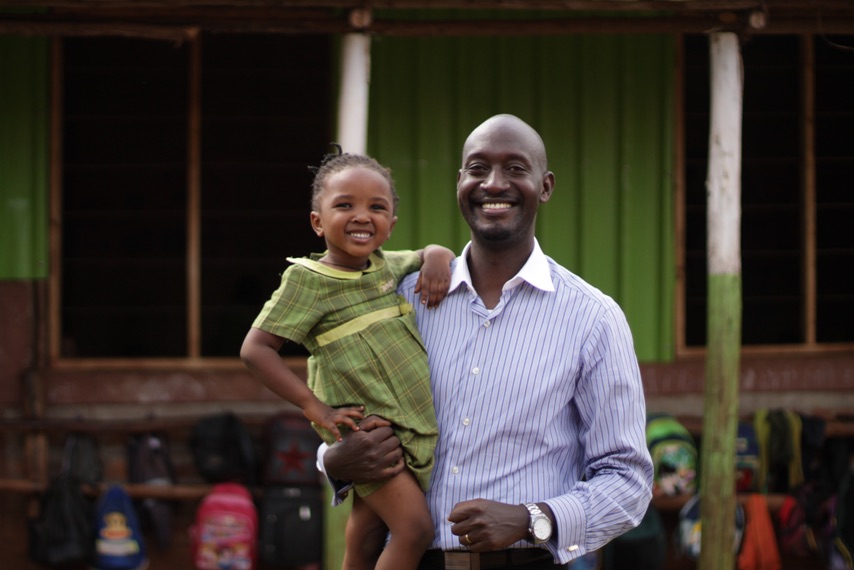
Mr Morrison Rwakakamba of the Bridge International Academies with pupils of Bridge International Academies (BIA).
Mr Morrison Rwakakamba has been an advocate of social change in Uganda, and is one of those who would want government to implement better policies that can deliver the country to the middle income status as outlined in Vision 2020, and also enable it achieve Sustainable Development Goals (SDGs).
Morrison Rwakakamba with a Bridge International pupil
Recently Mr Rwakakamba resigned his job as a Special Presidential Assistant on Research and Information, a resignation that
was a blessing for Bridge International Academies, which appointed him as the new Country Director for Uganda, tasked to steer the schools to greater heights.
However, his resignation still remains a blessing to government because he will offer his views and professional advice that can help grow Uganda’s primary education, where he suggests that teachers been given ‘Service Contracts’.
Eagle Online interfaced with Mr Rwakakamba on a number of issues that are related to Uganda’s education sector. He also tells us why he accepted the new role and what he plans to do for Bridge International Academies as he assumes his new role of Country Director. Below are excerpts:
Qn: To begin with, why did you accept your new job as Country Director of Bridge International Academies?
Ans: First of all, I grew up in an educated family that valued education. My grandfather, Canon Petero Rwabihurwa started the first community school in Rukungiri District, which was then part of former Kigezi. We have been an education household that promoted learning for the disadvantaged children.
Secondly, all my life I have been in education and I believe education remains the greatest transformer. Education is the biggest inheritance a country or parent can bequeath to the children. Having said that, in terms of experience within the education sector, I worked for Twaweza between 2010 and 2013. At Twaweza we were doing a programme called Uwezo. It was always very much at testing the learning capabilities for the children where we conducted the biggest household survey in this country and engaged government on the aspect that we had more children in school but there was less learning.
Since then I have been fascinated by the contribution I can make to make sure that we bridge the gap between more children who are going to school but also to make sure they are receiving quality education learning. Yes, I think I have been an advocate of the education sector and have had a practical experience of knowing what issues are within the classroom.
Qn: You have had some experience in the education sector, what do you bring on table not only for Bridge International Academies but the country at large?
Ans: For the country at large, I hope to leverage what Bridge International Academies is doing to make sure that the disadvantaged children or pupils can access quality education. As you know in this country we have teacher absenteeism rate of 58 percent, which therefore means that children are in school but there are no teachers to teach them. At Bridge International Academies, teacher absenteeism has been reduced to 5 percent because of using technology to promote transparency within management of the classrooms and management of the schools. This is something where Bridge International Academies can partner with government and other multi-stakeholder actors like parents, private sector and faith-based organisations that are very much interested in schools.
I think Bridge International Academies has a valid proposition offer to government and other stakeholders to look at its method of classroom management, focusing on results and others. For example in other countries like Kenya and Liberia where Bridge has been and where Bridge schools have managed to do Primary Leaving Exams, like in Kenya, on average, Bridge pupils scored 74 percent while the national average was at 49 percent. So you can see there is quality , there is high level capability and performance within Bridge schools because of some interventions that are technology driven, that are more teacher – pupil attachment focused; more focused on the child and learning other than access. These are some of those areas where Bridge, government, private sector and faith-based schools can come together to initiate a broad strategy of delivering holistic education which requires participation of all stakeholders, including the parents.
Qn: What do you think is most the major challenge for primary education in Uganda, having participated in some of the educational programmes in the country?
Ans: I think there are two challenges: The first challenge is UPE statistics. When UPE started through the Millennium Development Goals (MDGs) which were much about access, many pupils enrolled without focus on quality. Over a decade eight million kids were enrolled from two million. For me that was a major leap. Right now, the issue for Uganda and Africa as a continent make sure that we harness increased access into quality. That is why we have the Sustainable Development Goal number four which is about inclusive and quality education, combining access or inclusivity for both girls and boys but also ensuring quality education.
The bigger challenge now is how government, parents, private sector and other stakeholders can make sure that actually learning happens in the classroom. The depressing statistic is that eight out of ten kids in Uganda cannot deal with simple arithmetic or be proficient in articulating a sentence. Those are really the major problems and I think the best way to do it is not by saying government you have to do it, it is by saying how can we do partnerships with governments, for example Bridge and other private sector members that are into education, how do we partner with government to make sure that we get all the experiences that we have to improve learning at the classroom level. For me really that is the major challenge.
The other challenge really is on the school dropouts. As primary seven pupils sit for their exams, only 30 percent of those who registred in primary one reached primary seven and we hope that all of them are going to move on to secondary. But you really wonder where the 70 percent are? Where did they go? Why did they drop out? The gap that Bridge and the private sector come to bridge is to really make sure that all those kids whoever they are, if they are disadvantaged and cannot afford to be in school, then Bridge comes with this service offering that even those who don’t have enough resources or are disadvantaged can come to Bridge and access quality education.
Qn: What would say about teacher education: Teachers in Uganda over the years have been blamed for the poor performance of children in primary schools? What remedies do you suggest can help overcome this challenge?
Ans: In the large context of the country we have to expand teacher training to make sure that teachers are trained and retooled into modern technologies of delivering the national curriculum; use of technology to make sure they quickly and timely deliver the lessons. As you know most schools in Uganda don’t finish the syllabus. You find that kids are sitting for exams when whatever they were supposed to learn across the entire space of seven years, only half of the syllabus is completed and not completed also excellently. It is really a major problem. But because schools at Bridge use technology and timing of teachers when they are delivering these lessons, more supervision, more checking-in, more monitoring, more inspection, the lesson plans are very clear, so you find that teachers at Bridge finish the entire national curriculum. I think one of the things to do in the training of teachers is the infusion of technology into classrooms which is going to help teachers finish teaching of the national curriculum for the learners. I think this is a major issue where Bridge can partner with government to see how to make that strategic intervention.
It is very important that teachers are tested all the time. I don’t think it is enough to assume that teachers know what they are teaching. In Liberia you heard that story where almost half of the teachers who were teaching in primary four could not pass primary four exams. And when the Liberian government partnered with Bridge, Bridge made sure that those tests were made and those teachers who could not pass could not be taken on within that framework of government of Liberia and Bridge Academies Education. I think in Uganda those tests should be taken all the time to make sure that teachers who are not delivering are put aside.
The other aspect is that the Ministry of Education should introduce performance contracts for the teachers. The current arrangement where teachers are embedded in public service makes it difficult for the minister of education to terminate them even if they are not performing well. The minister of education has no bandwidth to terminate them because they have public service contracts. To solve this, The ministries of education and public service can make an arrangement to have the capability to renew the system to make sure that the country has teachers who are committed but also competent to do the job.
Qn: What would you say about government policy towards private and community schools? Are they favourable or unfavourable?
Ans: For any country, government is the regulator. By regulator, it means that government should have rules and regulations to make sure that the standards and the environment where kids learn is capable enough to ensure quality education for the kids. It is very important to have standards and it is very important for government to enforce standards. What Bridge is doing, is to make sure collaborates with government to make sure that the standards and the environment in which kids learn are capable enough to ensure quality education for the learners. I don’t have any problem with the policy of government on private education. The important thing is that, that policy should be uniform and that all actors are fulfilling the same standards, including public schools. The standards should be fair and equitable for all actors in the education sector.
Qn: What is your view on government policy to ban coaching of children during school holidays?
Ans: On the issue of coaching, I think the time for school, which is three to four months when kids are full time in school, is enough if it is used punctually. The issue has never been about time but how do you use the time that you have? We have been teacher absenteeism in schools while pupils are present. If teachers were in school, teaching all the time and teaching the right things with right competences, then the issue of coaching would not arise. Coaching for me is a consequence of incompetence in schools.
Qn: As Country Director, where do you see Bridge International Academies in the next five to ten years in relation to government policies?
Ans: I see Bridge making a major contribution. First of all, at a policy level, working with government to expand quality education in the country but also taking on more disadvantaged kids who will be receiving world class and standard education. I am very much optimistic that Bridge International Academy is going to cover a much broad footprint and have more kids learning and enjoying fruits of their work.
In an effort to encourage local businesses to produce good quality products, the Uganda National Bureau of Standards (UNBS) has announced the 2017 Quality Awards.
The awards to be held on November 30, 2017 will recognise local companies whose products have consistently met standards both at national and international level.
Speaking at a press conference to announce the Awards, the UNBS Executive Director Dr. Ben Manyindo, said: “The Quality Awards will recognise local businesses that have demonstrated compliance to our rigorous certification scheme.”
The Quality Awards come at time the when the country is promoting locally-manufactured products under the Buy Uganda, Build Uganda (BUBU) campaign, through which the UNBS is supporting SMEs to ensure that they meet the required standards.
Last financial year, UNBS scaled up its certification activities by issuing 899 certification permits mainly to support SMEs to gain access to regional and international markets.
“Standards are important in ensuring that local products remain competitive both in the local and international markets. Quality products are not only important in ensuring that the customer gets value for money but they also promote both local and international trade thereby contributing to economic growth,” Dr. Manyindo said.
This year, the awards categories will include: The Overall Winner, 1st Runner up, Winner from the Small and Medium Scale Enterprises (SME) and Winner of the Services Award.
The companies identified through the Product Quality Certification Scheme are required to have quality goods in terms of customer safety and also capability of accessing the lucrative regional and international markets.
To attain certification companies have to apply to UNBS and the agency’s quality auditors visit the factory for auditing based on standards applicable to the product. During auditing, samples of the products will be taken for testing in UNBS laboratories. Companies whose products conform to the required quality are awarded the UNBS Quality Mark.
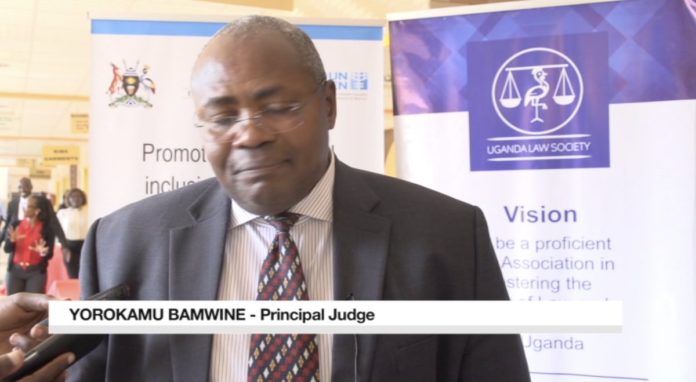
Principal Judge Yokoramu Bamwine has implored government to increase financial support to the judiciary in a bid to overcome backlog of cases.
Speaking to media on the sidelines of the African Peer Review Mechanism (APRM) at the Imperial Royale Hotel in Kampala, Justice Bamwine said the case backlogs are a result of obsolete methods applied by judicial officers and lack of funds to establish more judicial centers in the country.
“Judicial service has to change with the way they (officials) handle cases if we are to make justice a reality and that is what we are working on basing on the innovations that we started in the judiciary,” he said, adding: “Pre-bargaining, mediation of minor claims among other ways will lead to clearance of some issues from courts of law.”
Justice Bamwine noted that the APRM team has heard their challenges, and hoped that solutions would be provided after compilation of their report for improvement of service delivery.
The APRM review comes at a time when judicial officers are on strike following government’s failure to increase their salaries and also improve their welfare.
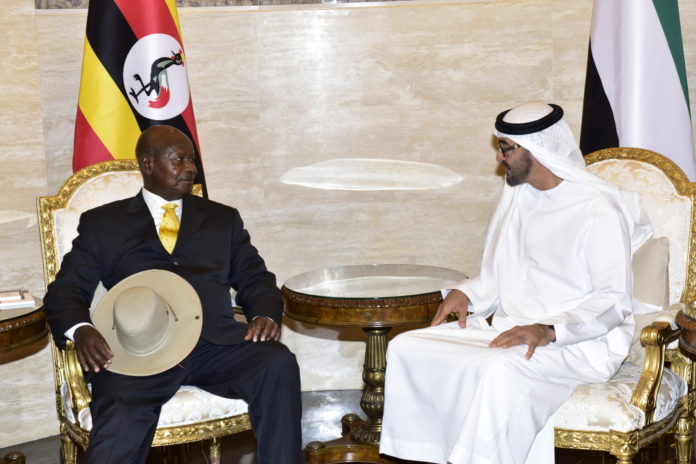
President Yoweri Museveni has met with His Highness Sheikh Mohamed Bin Zayed Al Nahyan, Crown Prince of Abu Dhabi and Deputy Supreme Commander of the UAE Armed Forces
President Yoweri Museveni has met and held bilateral discussions with His Highness Sheikh Mohamed Bin Zayed Al Nahyan, Crown Prince of Abu Dhabi and Deputy Supreme Commander of the UAE Armed Forces at the Al Shatei Palace in Abu Dhabi.
President Museveni meets with His Highness Sheikh Mohamed Bin Zayed Al Nahyan, Crown Prince of Abu Dhabi and Deputy Supreme Commander of the UAE Armed Forces
The President, who is in the United Arab Emirates for a three-day working visit, is also attending the 4th Annual Global Business Forum at the invitation of the Ruler of Dubai who is also the Vice President and Prime Minister of the United Arab Emirates, His Highness Sheik Mohammed Bin Rashid Al Maktoum.
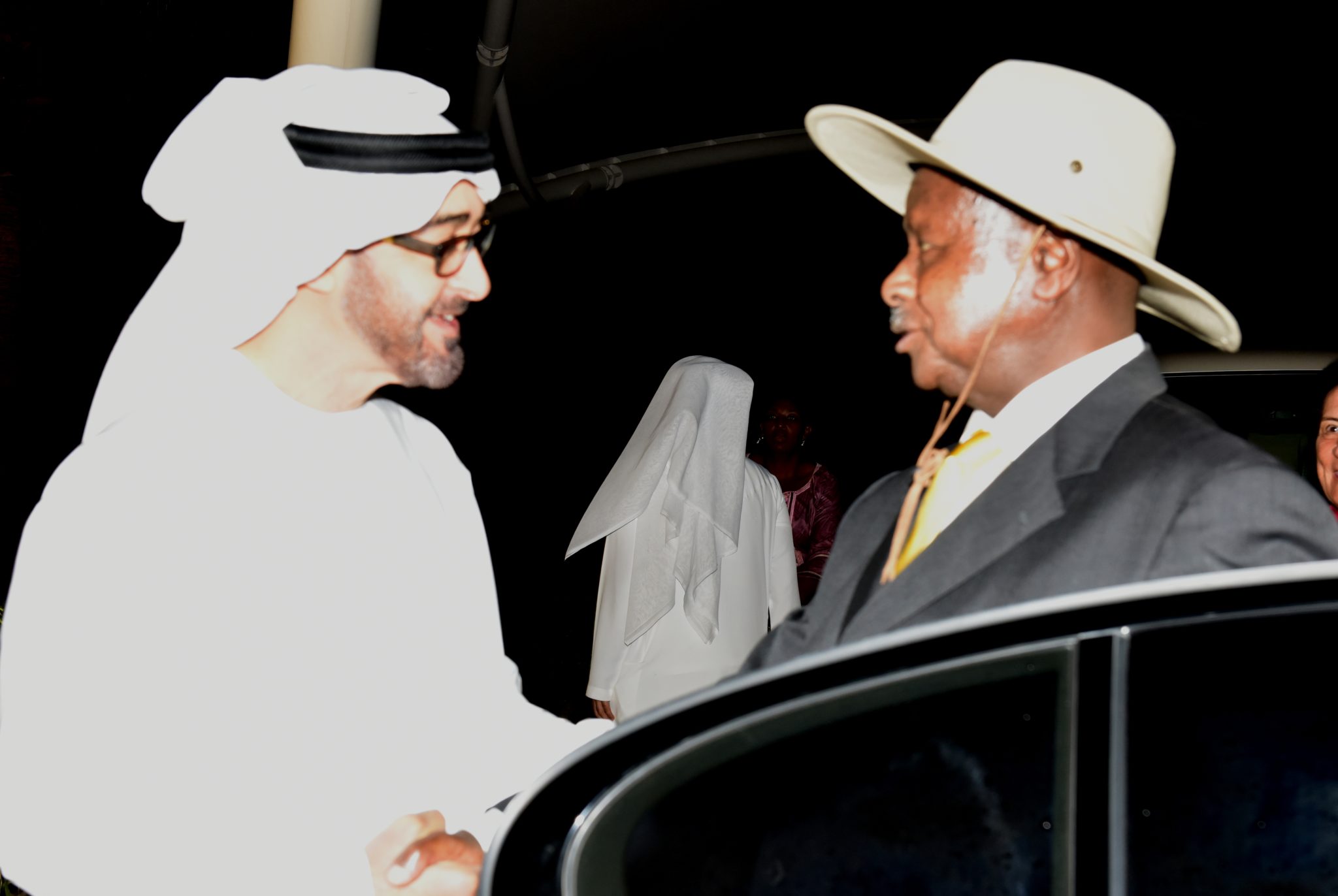
The two leaders who were meeting for the second time following President Museveni’s first visit to Abu Dhabi in 2014 agreed in concrete terms to consolidate their investment and trade agreements.
The two leaders also discussed bilateral relations of co-operation between the two countries and ways of supporting and developing each others’ countries in infrastructure development, economic development, investment, trade, oil, gas and energy.
President Yoweri Museveni invited the Crown Prince to Uganda, an invitation that was accepted.
Sheikh Mohamed welcomed the President and his delegation to Abu Dhabi and said he hoped the meeting will strengthen the relations and cooperation between their two countries.
The two leaders discussed various ways of supporting and developing each other and opportunities and possibilities available to enhance bilateral co-operation.