Stanbic Bank
Stanbic Bank
21.2 C
Kampala
Stanbic Bank
Stanbic Bank
Home Blog Page 1740

CAR UN peacekeepers accused of sexually abusing minor

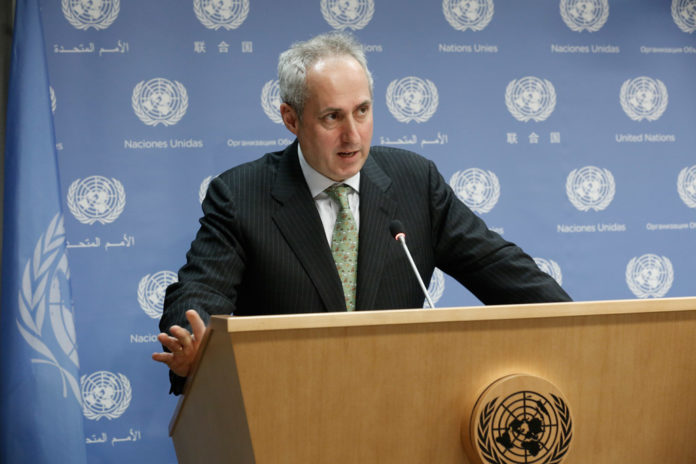
Spokesperson for the Secretary-General, Stéphane Dujarric. UN Photo/Evan Schneider

The United Nations Spokesman Stéphane Dujarric has said that the UN Mission in the Central African Republic (MINUSCA) reported it had received an allegation of sexual abuse of a minor that took place in Bambari by UN peacekeepers.

“The alleged victim was immediately referred to our humanitarian partners on the ground for appropriate medical and psychological assistance,” said the Spokesman, adding that the UN Office of Internal Oversight Services has carried out a verification of information inquiry and preserved evidence, which will lead to the matter being referred to the Member State for further investigation and action.

Last month, during a high-level event on the margins of the UN General Assembly’s annual general debate,  Secretary General António Guterres announced the appointment of Jane Connors as the first-ever UN Victims’ Right Advocate, who, he said would develop system-wide mechanisms and policies to promote reliable gender- and child-sensitive processes for victims and witnesses to file complaints.

He also announced the creation of a ‘Circle of Leadership’ for Heads of State and Government to demonstrate resolve and commitment at the highest political level to eradicate sexual exploitation and abuse.


Stories Continues after ad

Sub-Saharan expenditure on education up sevenfold – WB

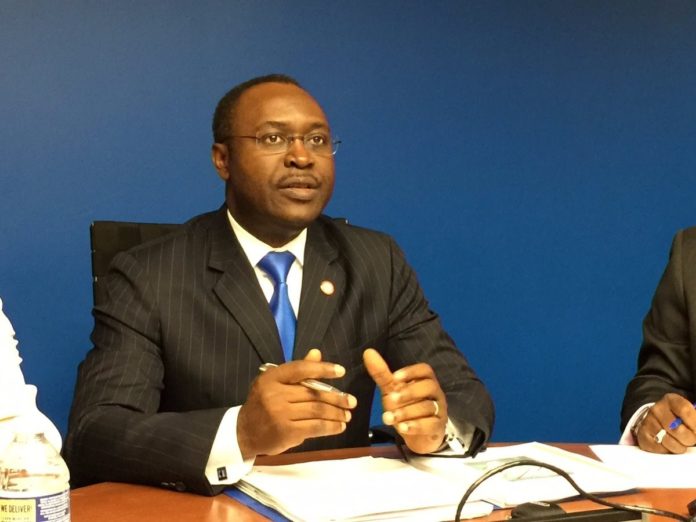
Mr.-Albert-Zeufack-World-Bank’s-Chief-Economist-for-Africa

Countries in Sub-Saharan Africa have invested heavily in skills building, with public expenditure on education increasing sevenfold over the past 30 years, the latest World Bank report – Africa’s Pulse – indicates.

The report released in Kampala yesterday by World Bank’s Economist for Africa Region Albert G. Zeufack, indicates that education absorbs about 15 percent of total public spending and nearly 5 percent of GDP, the largest spending ratios among developing regions.

“There is of course variation across countries, in the range of about 11 to 28 percent of total government spending, and from 2 to 15 percent of GDP In addition to public resources, it is estimated that households contribute around 25 percent of the total national education expenditure,” the report indicates.

Further, according to the report, more children in the region are in school today than ever.

‘Over the past half-century, primary completion rates have more than doubled, while completion of lower secondary has increased more than fivefold,’ the report adds.  Still, the report says, almost one in every three children fails to complete primary school. In most countries, far less than 50 percent of all children complete lower secondary education, the equivalent of middle school in some countries and fewer than 10 percent make it to higher education.

The report notes that although gender gaps in both primary and secondary school have narrowed in most African nations, there remain significantly more girls than boys out of school. In some countries, it says, there are fewer than three girls for every four boys.

It points out that for children in school, learning outcomes have been persistently poor, leading to huge gaps in basic cognitive skills (literacy and numeracy) among children, young people, and adults.  “The literacy rates of the adult population are below 50 percent in many countries, and functional literacy and numeracy are lower.

“Even at recent rates of progress, in the decades to come, the region will continue to fall behind other regions in the world in educational attainment at all levels,” says adding that child stunting rates remain stubbornly high, leading to adverse impacts on all future skill investments.

Meanwhile, according to the report, Sub-Saharan Africa has the youngest population in the world but the region’s working-age group is the least skilled globally, constraining economic prospects.

It states that despite economic growth, declining poverty, and investments in skills-building, too many students in too many countries in Sub-Saharan Africa are not acquiring the foundational skills they need to thrive and prosper in an increasingly competitive global economy.

‘Building the skills—cognitive, socio-emotional, and technical, of today’s workers and those of future generations will be vital for realizing the development potential of the region’, the report states in part.

The report recommends that countries’ skill-building efforts must strive to make spending smarter, to ensure greater efficiency and better outcomes. “But smart investing in skills is more difficult than it looks Sub-Saharan African countries face two difficult choices in balancing their skills portfolios: striking the right balance between overall productivity growth and inclusion, on the one hand, and investing in the skills of the workforces of today and tomorrow, on the other hand. “In both cases, these choices are particularly salient with the use of public resources for skills investments,” it says

To attain both growth and inclusion in the region, the report urges governments to  invest in  strong foundational skills that can close significant gaps in education and training. It says there is need to tackle child stunting and build the literacy, numeracy and socio-emotional skills of children, youths, and adults.

‘This strategy requires focusing on investments in the early years and inputs that matter most for education quality, specifically investing in effective teaching, not merely hiring more teachers or building more buildings.  It requires training that draws on the latest evidence, and creating incentives for the best to become teachers, the report says.

Equal access to quality services

According to the report, particular attention must be paid to ensuring equal access to quality services for the poor and to closing gender gaps, especially in high-inequality contexts. It also requires supporting youth and adults who have missed out on foundational skills. Such support would include interventions that build basic literacy and socioemotional skills among those employed in farm and nonfarm rural activities and low-productivity urban self-employment.

The PPPs

The report calls for renewed public-private partnerships (PPPs), with a strong regulatory role for the state as way of expanding basic education skills. It says support should target demand-driven technical and vocational education and training (TVET), higher education, entrepreneurship, and business training programs tied to catalytic sectors. Such support, the report says, should incentivize more on-the-job training, especially in smaller firms.

It says special attention should be paid to science, technology, engineering, and mathematics (STEM) fields, focusing on the transfer and adoption of technology in economies with an enabling policy environment for these skills investments to pay off.

Economic inclusion

The report says economic inclusion requires investing in labor market training programs focused on disadvantaged youths, and improving the skills of workers in low-productivity activities in urban areas for instance, through informal apprenticeships and comprehensive livelihood programs and agricultural extension services in rural areas.

Adaptability

For adaptability, the report says reforms should be introduced in secondary and tertiary education to delay the tracking of students into technical education and vocational streams, at least until the upper secondary level. In addition, education systems should create effective pathways between academic and technical tracks, and introduce more active and work-based learning practices.

The report urges families to invest and nurture children’s cognitive and socio-emotional development through quality care and parenting, and by engaging with schools to hold them accountable for effective service delivery.

According to the report, the private sector can participate effectively in the provision of services to enhance access and quality, invest in on-the-job training, work with education and training providers to ensure programs are aligned with their needs, and engage in national social dialogue to prioritize skills development and reforms, to create a policy-enabling environment for skills investments to pay off.


Stories Continues after ad

Five top things to consider when picking a hotel room

One of the hotel rooms

By Cynthia Tumwine

  1. Budget When picking a hotel room this is always the first factor to take into consideration. What can you afford? If you are using Jumia Travel for example one way to make sure you do not exceed your budget is by looking at the deals page. Every week they have great discounts that could save you a buck or two. This could also help you get an amazing room without having to break the bank.


  1. Number of guests

Next thing to consider is how many people you are booking for or with. This determines whether you should get a single, a double room, a suite or family room.


  1. Specifications based on preference

Different people have different things they consider important for example size of bathroom, room with a balcony, the room that faces the most scenic view, a room with a television or mini bar.


  1. Amenities

Several facilities are very important in this day and age, most important of them being Wifi especially if it is a business trip. Most people need to be able to stay online to send emails, have skype calls and generally get work done. Other amenities like laundry services, sauna and steam bath and swimming pool.


  1. Distance from reception/Intercom provision

Lastly this is not something people consider and this mostly applies to the walk in customers. However, it is important to be as close to the reception as possible or make sure there is an intercom in the room in case you need something.

Stay Adventurous!

The writer is the PR Manager at Jumia Travel Uganda

Stories Continues after ad

Rugby Cranes retain Africa Men’s Sevens trophy

CELEBRATION: Rugby Cranes at the trophy handover

It was an action packed rugby tournament as the Guinness-sponsored Rugby Cranes Sevens team retained the African trophy, with Adrian Kasito scoring a marvelous try in the  dying minutes of the game to ensure the Ugandans remained champions.

Already having qualified for the 2018 Rugby World Cup in San Francisco, US, the Rugby Cranes were to face Zimbabwe in the finals. The Ugandans needed their classical passing game to beat their opponents on 10-7 and no sooner had Kasito scored his try, than the game ended leaving the Zimbabwe players in tears.

This means that the Rugby Cranes Sevens team also qualifies to play in the HSBC World Sevens series tournaments in Dubai, Cape Town and Hong Kong.

Speaking to media, Uganda Breweries Limited Head of Beers, Estella Muzito said: “We’re ecstatic about the latest achievement by our national team. They showed great zeal and spirit as they fought to retain their trophy. As Guinness, our support for the national team and the sport will continue to grow. The team will be carrying our flag to the Rugby World Cup next year and we will be right there with them all the way. Once again, I would like to congratulate the Uganda Rugby 7s Cranes, the Uganda Rugby Union, and all supporters of Uganda Rugby for a job well done.”

The Rugby Africa Mens Sevens tournament is an annual tournament organized by the African governing body, Rugby Africa that draws together the top playing nations in Africa.

The teams that took part in this year’s tournament are Uganda, Madagascar, Zimbabwe, Senegal, Zambia, Morocco, Tunisia, Botswana and Ghana.

Guinness came into partnership with the Uganda Rugby Union and took on the sponsorship of the national team by contributing Shs200 million to the development of the team and sport. Of the contribution, Shs100 million was made in cash.

The renewed partnership is running for the next three years.


Stories Continues after ad
Otafiire urges prosecutors to return to work

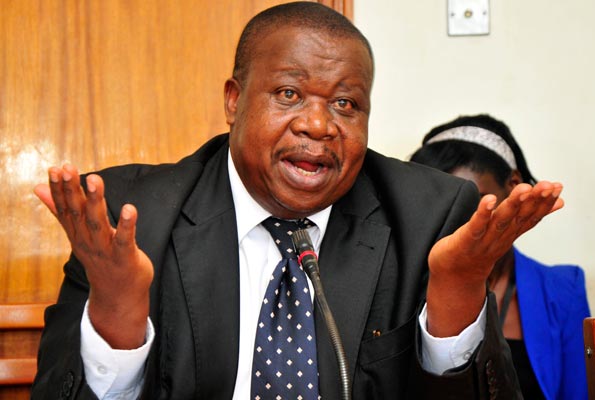
Maj Gen Kahinda Otafiire.

The Minister of Justice and Constitutional Affairs Major General Kahinda Otafiire has appealed to prosecutors to suspend their strike, giving a three-month period in which he said government will respond to their grievances.

Yesterday, the prosecutors, through their umbrella body, the Uganda Association of Prosecutors (UAP) resumed their strike after the elapse of 90 days ultimatum when they voted to suspend industrial action, following government’s pledge to increase their salaries and improve on their working conditions.

In a press statement, Otafiire said Prosecutors aren’t the only government workers waiting for improved payment.

“This matter has to be approached scientifically. My fellow workers go back to work. ’We have seen medics’ strikes, lawyers, teachers, everybody in government service is jittery and they are right,” Maj Gen Otafiire said, adding: “We are all waiting to know how much the government will be paying us, Let us just be patient.”

According to Otafiire, the performance of Uganda’s economy will determine the payment scale of government workers.

“Industrial action is not a new phenomenon, the reason being we have not improved prosecutors and other workers welfare, taxes are not enough,” he added.

Currently, the bill to harmonise worker’s salaries is before parliament and Otafiire said that government will respond to the Prosecutors’ grievances in a period of three months.

Under the current salary structures, the lowest ranking prosecutor earns a gross salary of Shs644, 963 a month while the highest paid prosecutor, at the rank of Senior Principal State Attorney, takes a gross monthly pay of Shs2.1 million. The Deputy DPP is paid Shs2.9 million while Assistant DPP earns Shs2.4 million.


Stories Continues after ad
Age Limit: Magyezi wants committee disbanded

Local Government Minister, Raphael Magyezi

The debate into lifting the presidential age limit 75-year cap has reached a crescendo, with protagonist Raphael Magyezi making fresh demands to have the assigned Committee disbanded.

While addressing journalists this afternoon, a furious Magyezi, the Igara West MP attacked some Committee members for being biased, fearing he may not receive a fair hearing when he appears before the committee.

“The members should have the intuition to say let me reserve my fears and expressions. But if you have come out in the public and you are a member of the Committee, then they should withdraw or let the Committee be reconstituted so that we have an objective Committee,” Magyezi said.

It should be recalled that after tabling the Constitutional Amendment Bill No2 2017, Speaker Rebecca Kadaga referred the Bill for processing to the Legal and Parliamentary Affairs Committee.

The ruling party NRM boasts of 13 MPs, the highest number on the committee, while the Independent MPs are 6, with FDC and Democratic Party MPs have two members each.

But already a number of Members on the Committee have already taken their stand on the Bill with most of the opposition and independent MPs coming out to vehemently oppose lifting of the presidential age limit.

The decision by the Committee to exclude Jackson Kafuuzi from the Committee proceedings, yet he is a member of the Legal Committee, was what sparked off the bickering between the two sides.

The Committee reached this decision after Kafuuzi stood up to second Magyezi’s bill and motion, with the rules barring MPs with personal interest from taking part in Committee proceedings.

However, Magyezi has objected to the decision he also reserves the right not to appear before the same Committee with members biased against his Bill.

“I demand that there is independence of the Committee. I demand neutrality, objectivity, non-bias of the Committee,” Magyezi argued.


Stories Continues after ad

Ugandans in Malaysia celebrate Independence

Uganda’s Ambassador to Malaysia Dorothy Samali Hyuha and other Ugandans cut the cake during celebrations to mark Uganda's 55th Independence Anniversary

Uganda’s Ambassador to Malaysia Dorothy Samali Hyuha, hosted a dinner to celebrate 55th Independence Anniversary at Intercontinental Hotel, Kuala Lumpur, the first such celebration since the mission was established in the Asian economic giant in 2015.

In her speech, Amb. Hyuha welcomed all the guests and urged them to bask in the jubilation mood as Uganda celebrates Independence Day. She introduced this year’s theme “Uganda’s freedom must be anchored in the spirit of hard work, resilience and commitment” stating that, “I am delighted to serve in Malaysia where the Government of Uganda has cordial bilateral relations which have existed for a long time. This long existing relationship and cooperation must be enhanced from strength to strength in economic, commercial and public diplomacy.”

Amb Hyuha stated that she wished to specifically recognize MAPE, Cloud 10 and the tourism sector in Malaysia and thank the business community present who have honoured the invitation and turned up to celebrate with the Embassy;. “You have energized me and our business trajectory between our two sister countries to grow from strength to strength” she said

Addressing the large turn-up of Ugandan diaspora, she said “I am impressed with your active participation in the national event as evidenced here today. Most Ugandan diaspora possess impressive knowledge, skills, talents and financial resources that have already significantly contributed to the host country and home. I encourage all the Uganda Diaspora to register with the Uganda High Commission”

In further  recognition of Diaspora contributions to National Development, she informed the gathering that the Ministry o Foreign Affairs had recently undergone a restructuring exercise which saw the establishment of a Diaspora Services Department.

Speaking at the occasion the Malaysian foreign minister Dato’Sri Anifah Aman said: “I have the honour to extend my warmest congratulations and best wishes to Your Excellency, On this joyous occasion of the 55th Anniversary of the Independence Day of the republic of Uganda. I sincerely hope that our two countries would continue to be engaged in achieving mutually beneficial cooperation, for their well-being and prosperity of our people”.


Stories Continues after ad

Kadaga hails NWSC on tree-planting initiative

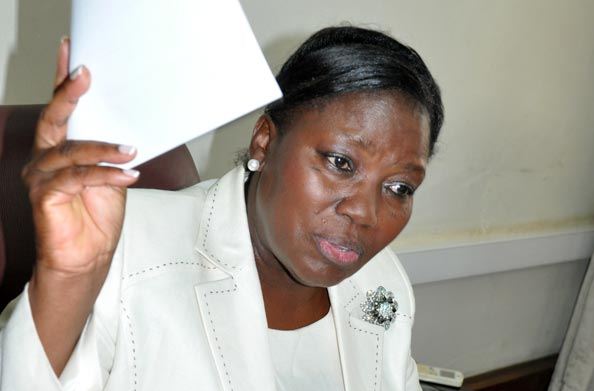
Speaker Rebecca Kadaga.

Speaker Rebecca Kadaga has today implored government institutions and corporations to embark on planting trees to protect and conserve the deteriorating environment.

Speaking at the launch of one million trees campaign at National Water and Sewerage Corporation Resource Centre in Bugolobi, Kadaga said the campaign is aimed at promoting environmental conservation and catchment protection.

In her remarks the speaker vowed to push the ministry of finance to start a ‘Tree Fund’ in the budget for conservation of the environment.

She lauded NWSC for embarking on protecting and conserving as well as providing clean water to millions of Ugandans.

The National Water (Sewerage Corporation) has energized me and it has worked as an example, the Speaker said, and hailed the NWSC managing Director Dr. Eng. Silver Mugisha for the initiatives.

In his speech Eng. Mugisha called for government’s support among non-government organisations and implored them to use social occasions to increase tree cover in Uganda.

Under the theme: ‘The best time to plant a tree is 20 years ago, the second best time is now’, Eng. Mugisha said all the 218 NWSC branches in Uganda are to plant over 2000 trees each.


Stories Continues after ad

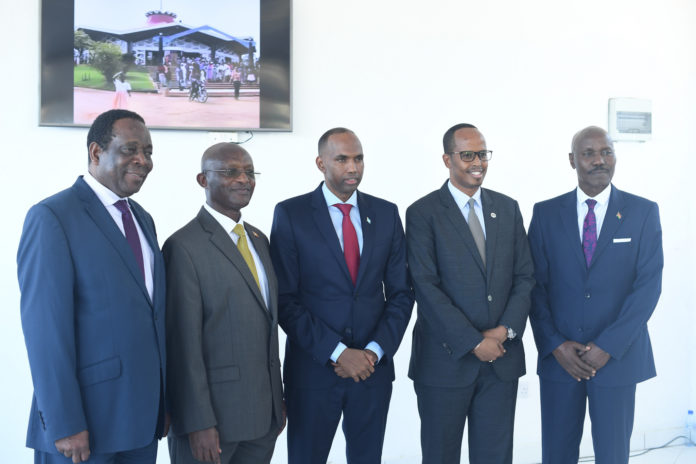
Somali Prime Minister lauds Uganda for enhancing peace

Prime Minister Ali Khayre and AMISOM Force Commander and other guests

Somali Prime Minister Hassan Khayre has commended the Ugandan government for contribution made in ending the decade-long civil war and bringing back hope for peace and security in the horn of Africa country.

Mr. Khayre made the remarks at a ceremony hosted by the Ugandan embassy in Somalia, Monday, to mark 55th Independence Anniversary of the East African Nation. He noted that the two countries had strong historical relations, which had seen them help each other in times of need.

“Uganda led the rallying call to deploy forces to Somalia in 2007. These brave forces, working together with our Somali troops, and other Troop Contributing Countries have facilitated the return of hope for the Somali people; given them an opportunity for freedom and prosperity that they have not experienced for many years,” the Prime Minister stated.

Somalia plunged into civil war in 1991 after the collapse of President Siad Barre’s government, leading to the deaths of hundreds of civilians before the intervention of the United Nations and the African Union.

The ceremony held in Mogadishu was attended by representatives of Troop and Police Contributing Countries in Somalia, United Nation officials and members of the diplomatic corp among others.

The Prime Minister, who was accompanied by senior government officials, paid tribute to all African soldiers who have lost their lives in the quest for peace in Somalia, saying their efforts have not been in vain.

He praised AMISOM for the progress made, including the holding of successful elections and the eventual establishment of an independent government under the leadership of President Mohamed Abdullahi Farmaajo.

Mr. Khayre, however, noted that a lot more needs to be done to ensure the country achieves lasting peace and security.

“While immense gains have been made, a number of tasks still remain.  We ask Uganda and our other African brothers and sisters and AMISOM for your continued support. Your support at this point is very crucial not only to build on our successes so far but also to address the outstanding challenges and build further on the gains we have made together. We know the Mission in Somalia is not without its challenges but we are confident that we will together soldier on,” he added.

The Prime Minister commended Africa’s founding fathers whose sacrifices, he noted, had made it possible for the people not only to rule themselves but also determine their destiny and values.

On his part, the Ugandan Ambassador to Somalia, Major General Nathan Mugisha, congratulated the people and government of Somalia on the gains made in the past years.

Maj. Gen. Mugisha reiterated Uganda’s commitment to continue helping Somalia stabilize by ensuring, among others, training and mentoring of its security forces.

“Uganda congratulates the Federal Government leadership, the Somali National Forces, AMISOM, the people of Somalia and the international community for the hard earned security gains,” the Ambassador said.

Maj. Gen. Mugisha, nonetheless, cautioned that there was need to ensure the sustainability of the achievements made through enhanced support of AMISOM, securing predictable funding and building the Somali National Army and Somali Police.

He appealed to the international community and stakeholders to continue supporting the Somali people, to enable them build on the socio-economic and political progress so far achieved.

Uganda has the highest number of troops in Somalia and was the first country to heed to the international community’s appeal to intervene and help bring back peace and stability in Somalia.


Stories Continues after ad

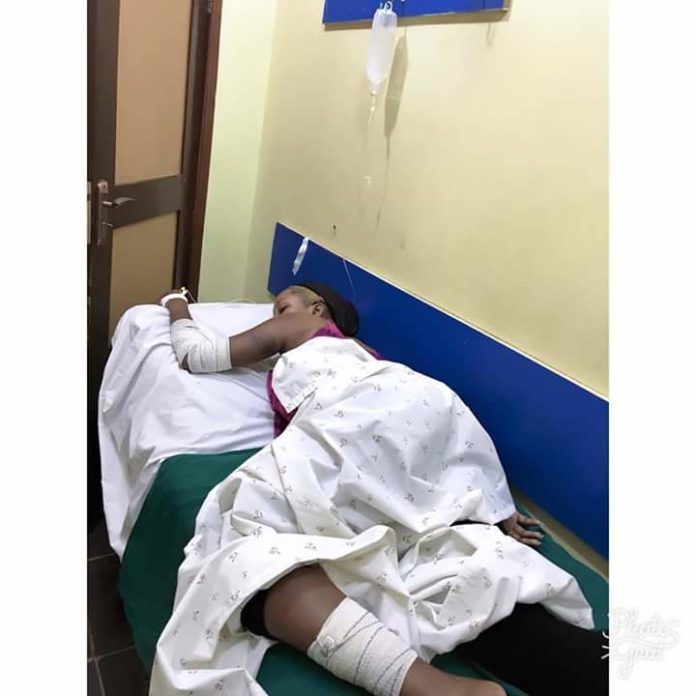
Spice Diana cancels shows, as police plan to charge her for ‘assaulting’ officer

Spice Diana on her hospital bed

Spice Diana has cancelled her upcoming after she was beaten at the KCCA carnival by people she says are policemen.

Speaking from her sickbed, Spice Diana announced that she had cancelled all her upcoming shows because of her current health state.

“Am so sorry to announce that will not be able to perform in some places I am supposed to be because of my condition,” she wrote on social media.

Meanwhile, we have learnt that police has opened up a case against her, accusing her of beating up a police officer.

According to police spokesperson, Emilian Kayima, Spice Diana and her manager assaulted a Police officer on duty after they were refused access to the City Carnival.

It is alleged that following the incident, Spice Diana was arrested and briefly detained at Nkrumah Police post. She was later released on police bond. But on the contrary, Spice Diana says it was police that beat her up.

“Today, after my first performance at the carnival I was beaten so badly and disrespected by ruthless so called police officers and I am nursing wounds.  We give you power to protect us, keep law and order but ts you the same people that go against the law and do vice versa. Why should we be treated like strangers in our own country,” she bemoaned.


Stories Continues after ad