Stanbic Bank
Stanbic Bank
26.7 C
Kampala
Stanbic Bank
Stanbic Bank
Home Blog Page 1742

Mugabe VP loses key ministry in reshuffle

FRONT RUNNER: Zimbabwean President Emerson Mnangagwa

Zimbabwe Vice President Emmerson Mnangagwa has lost oversight of the Justice Ministry, in new changes which have also seen Finance Minister Patrick Chinamasa,  who will lead a new Security Ministry, replaced with Home Affairs Minister Ignatius Chombo.

In a cabinet reshuffle announced by President Robert Mugabe yesterday, 10 cabinet ministers changed posts while two were dropped entirely, with the head of Zimbabwe’s spy agency Happyton Bonyongwe appointed to the justice docket.

The move that included changes at the finance ministry comes against the backdrop of a severe hard currency shortage that has dealt a fresh blow to confidence and investment in the southern African economy, which uses the U.S. dollar.

Chinamasa was appointed finance minister in 2013 after Mugabe was re-elected and his move to head a newly created ministry of cybersecurity, threat detection and mitigation was unexpected.

Chombo, who does not have a finance background, is a staunch Mugabe supporter who comes from the 93-year-old leader’s rural home district. He was a surprise choice for minister of finance.

The new finance minister will have to contend with a serious shortage of foreign currency that has seen U.S. dollar bank balances lose value against cash dollars, fanning a thriving black market.

The worthless Zimbabwe dollar was replaced by the U.S. dollar in 2009, but the economy has struggled over the last 18 months because of a massive domestic shortage of greenbacks.

As a result, cash — especially crisp, new, $100 bills — has enjoyed a steady 10 percent to 20 percent premium over dollars stored electronically in bank accounts — nicknamed “zollars.”

Stories Continues after ad

Exiled DRC opposition leader to return for elections

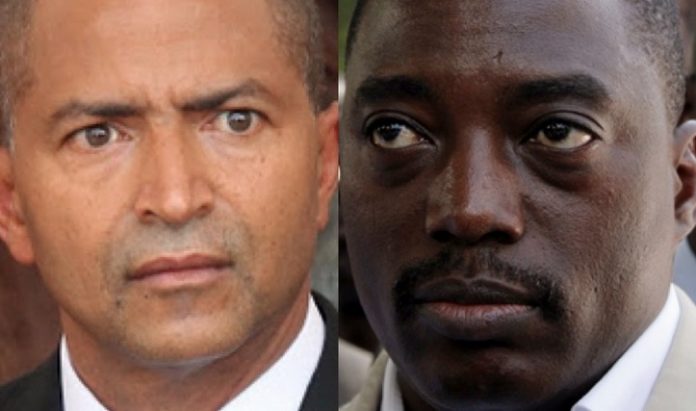
DRC President Joseph Kabila (R) with his challenger for presidency Moise Katumbi (L).

Democratic Republic of Congo opposition leader and presidential hopeful Moise Katumbi said he will return to his homeland in December after more than a year abroad to participate in the country’s delayed elections.

The 52-year-old former governor of Congo’s copper-rich Katanga province plans to challenge President Joseph Kabila’s rule of the Central African country on his return, he said at a conference Monday in London.

Katumbi has previously pledged to return to the country and then failed to make the trip, while one attempt to travel was thwarted when the Congolese authorities refused to clear a plane carrying him. “The only man Kabila is scared about in the country is me,” Katumbi said. “Congo is losing every day, every minute, every second Mr. Kabila is in office. His mandate is finished.”

Kabila, who’s ruled since 2001, was supposed to step down at the end of his constitutionally limited second term in December 2016, but the vote for his replacement has been delayed, sparking protests in which dozens of people have died. Under a political agreement struck Dec. 31, opposition parties accepted that he could remain in office if the vote was held this year.

Congo, Africa’s largest copper producer, has never had a peaceful transfer of power. “If I win the election, I need to change that country, to invite all of the investors to come and help us to build our country,” Katumbi said. “It is the private sector that is going to make Congo strong.”

Stories Continues after ad

Aga Khan emerges top school in Independence swimming gala

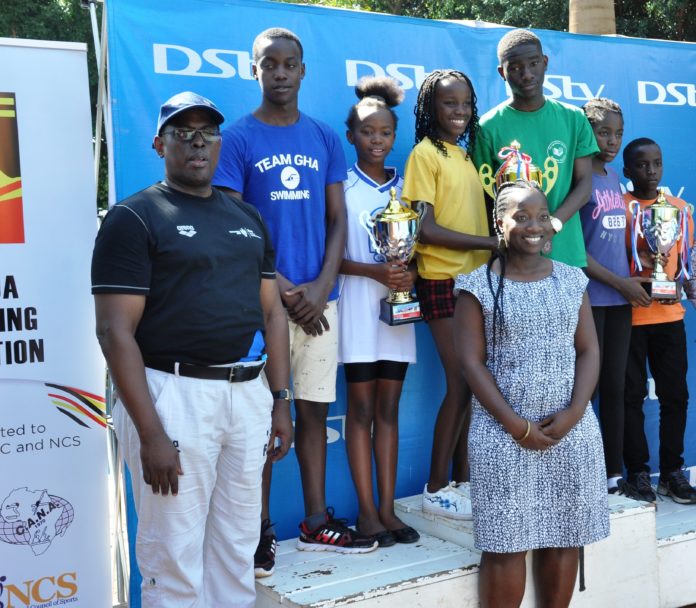
Some of the winners pose for a photograph with the sponsors and USF officials

The Aga Khan School has emerged best in the National Independence Swimming Gala, sponsored by DStv Uganda and the Uganda Swimming Federation.

This two day event hosted at Kampala International School Uganda (KISU), saw about 13 schools closely compete for the top position. The competitors took part in the different swim styles from the 400m relays, 50 meter breaststroke, 200-400 medley relay, 100m fly to 50m freestyle.

Addressing the media, MultiChoice Uganda Public Relations and Communications Manager, Tina Wamala said DStv Uganda had taken keen interest in supporting children in sports.

“We believe in a generation of fully rounded children that don’t only excel in academics but also participate in sports,” Ms. Wamala said, adding: “Swimming has taken centre stage for DStv Uganda because it physically and mentally engages children and it is a fun game.”

Ms. Wamala said DStv Uganda contributed Shs25 million to support the gala, and also thanked the parents and families of the participants for their support. “It has been great seeing them cheering on and the tremendous encouragement given,” she noted.

The Secretary General Uganda Swimming Federation, Moses Mwase, while congratulating the winners, said: “We thank all the participants for taking part in the gala and professionally competing and encouraging each other, you have all made this event remarkable. We congratulate the winners for the excellent exhibition of talent at its best and also encourage those who didn’t win, never to give up and look forward to the coming competitions.”

Results 

Overall Best School: Aga Khan School

3,240 points

2: Green Hill Academy

2,155 points

3: The British School of Kampala 

1,562 points


Stories Continues after ad

Age Limit: Museveni warns opposition on chaos

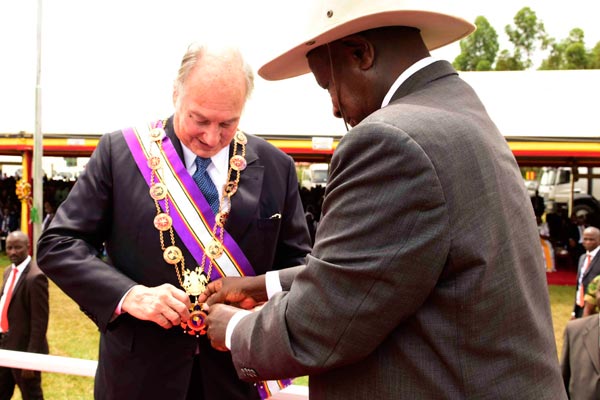
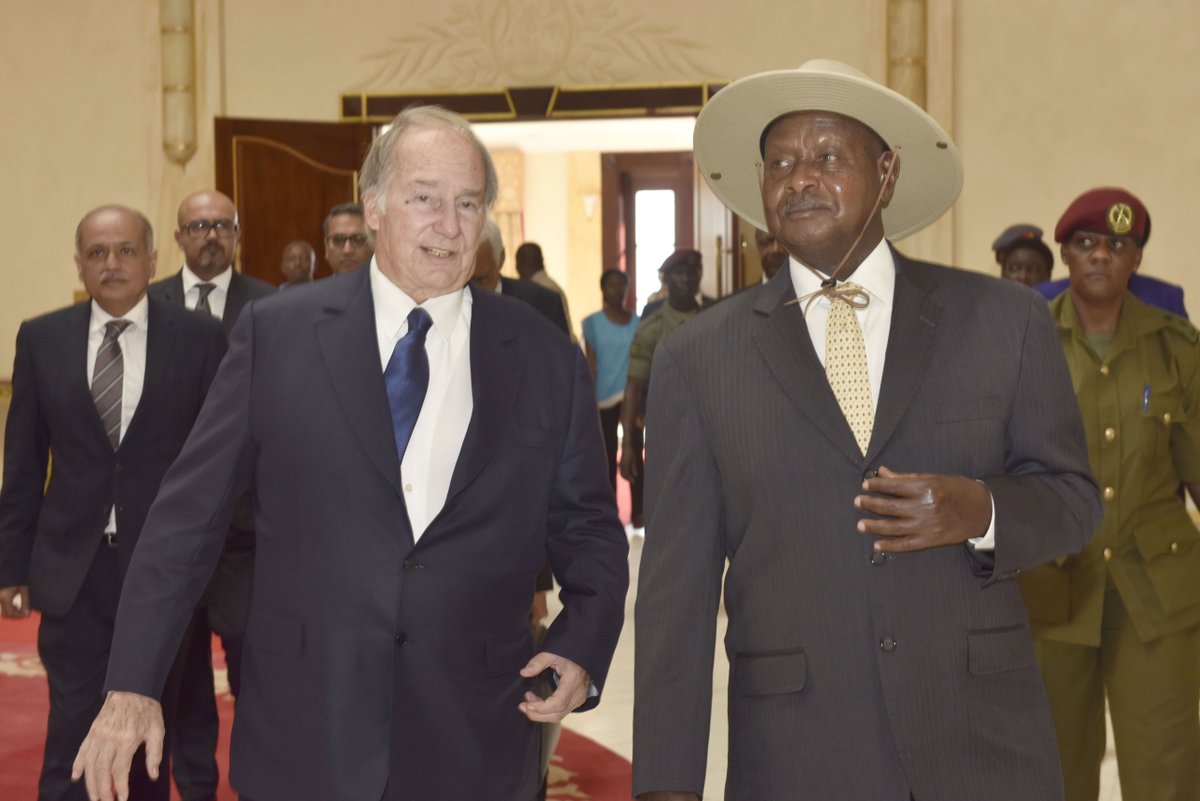
President Yoweri Museveni decorates HH the Aga Khan during the 55th Independence Day celebrations in Bushenyi

President Yoweri Museveni has issued a sharp warning to Ugandans opposed to lifting presidential age limit, saying he will not allow the country to be thrown into chaos.

Museveni noted that the freedom in Uganda was bought with blood adding that it is with the same blood that the country’s peace will be protected if anyone tampered with the ‘peace and security’ Ugandans are enjoying.

He made the remarks this afternoon during the celebrations to mark 55years of Uganda’s independence held in Bushenyi district.

The President took a swipe at those he accused of attempting to distort the peace of Uganda, wondering how they claim to be democratic yet they are the same people who aren’t allowing people with divergent views to express them.

Without directly mentioning any names of individuals or groups, Museveni said; “Uganda’s independence and democracy was bought with blood of our patriots, therefore, nobody will be allowed to undermine it. I want to assure all Ugandans that the NRM government will continue to maintain peace and stability in Uganda.”

Museveni’s statement followed chaotic scenes that marred Parliament on September 27, 2017, after Speaker Rebecca Kadaga suspended 25 legislators for three sittings and plain clothed security operatives swung into action to evict the MPs.

As is norm, the President cited ‘the peace and security’ that was ushered in by his rule, but hastened to acknowledge what he termed a ‘few security spells’ following the women murders in the Entebbe. He however, assured the nation that his government is ‘on top of the game’ to put the crimes to rest.

“There has been a spate of crime but we are getting to bottom of this crime. We have made a lot of arrest and we are getting to that problem of crime,” Museveni said.

The President also called on Ugandans to be grateful for the peace they are currently enjoying, thanks to his leadership.

“But you know crime is different from terrorism and war. I want to assure you, nobody can bring back terrorism and war in Uganda,” said the President.

On how the regime intends to solve the problem, Museveni revealed that government is in plans to introduce ‘new methods’ which he said would be much quicker in terms of getting criminals.

As opposed to other national celebrations that have seen hundreds of medals dished out, this time round only 2 medals were given out.

Among the recipients were spiritual leader His Highness Aga Khan, who expressed gratitude to Museveni for awarding him with the highest civilian honour in Uganda, the Most Excellent Order of the Pearl of Africa, Grand Master medal.

In his speech, the Aga Khan, who has hundreds of investments spread across East Africa, noted that he was looking forward to the future of Uganda in hope, aspiration for better quality of work.

“My institutions have been here and it is my hope they will participate in improving lives for better generation,” he said.

But the medal awarded to businessman Hassan Bassajabalaba is what raised eyebrows, with government justifying the award saying the reportedly scandal-plagued man has contributed to the growth of both the education and health sectors of Uganda.

Meanwhile, Museveni also took a swipe at political leaders in the country, blaming them for seeking cheap popularity, instead of advising the locals into venturing into wealth creation projects.

He explained; “In pursuit of cheap popularity, the political leaders have abandoned their responsibility of guiding the population. I call upon all political leaders to shun pursuit of cheap popularity but promote the ethic of work otherwise many will stay poor.”

The President noted that although the country has made a number of strides in terms of economic transformation, this transformation would have been faster if people were serious about their jobs and businesses.

He particularly pointed out youths who wake up to gamble, playing cards and other games without taking part in any productive work.

After the function, the State Minister for Youth Nakiwala Kiyingi took advantage of the  endear herself to Museveni by parading what she called a group of ‘leaders from Democratic Party’, who had longed to have a photo opportunity with the President.


Stories Continues after ad

KLM donates learning materials to Nakaseke orphans

KLM, the Royal Dutch Airlines led by the country manager Lukia Otema donated learning and leisure materials to orphans in Nakaseke

KLM, the Royal Dutch Airlines led by the Uganda Country Manager Lukia Otema has donated learning and leisure materials to orphans in Nakaseke.

The donations including colourful chairs and toys were made Saturday when the KLM team visited Nakaseke Early Childhood project run by the African Community Centre for Social Sustainability (ACCESS), and while handing over the materials, Ms. Otema commended the organisation for promoting early learning which she said, is the pillar is for a child’s future.

”We are proud of ACCESS and we as KLM; we want to see children nurtured in the best way possible and provided with a conducive learning and playing environment,” Ms. Otema said of the project which started last year and is supporting over 30 children aged between 2-5 years from six villages across Nakaseke, who gather at ACCESS offices every Saturday to learn and play.

ACCESS is a community-based organization in Nakaseke which supports orphans and other vulnerable children through providing healthcare and education/training opportunities and, according to the organisation’s officials, the support rendered by KLM will increase access to early childhood and primary education by engaging parents from the rural areas of Nakaseke.

Early childhood learning is key to the development of a country, and in 2016 the government launched the National Integrated Early Childhood Development policy (NIECD), to address issues regarding childhood development and urged various stakeholders to embrace the initiative.


Stories Continues after ad

The Aga Khan awarded Uganda’s highest civilian honour

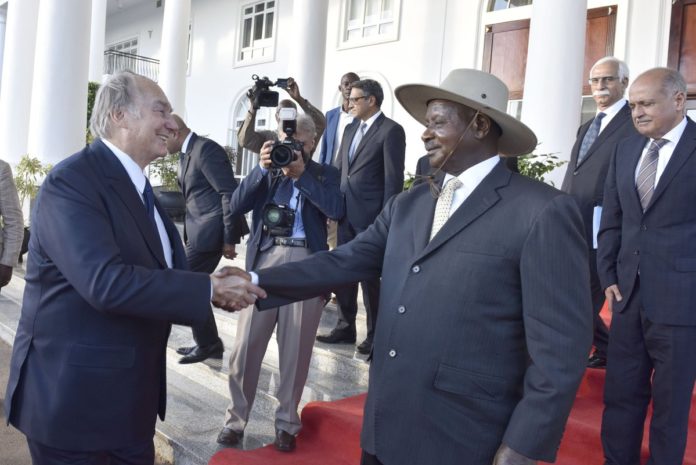
HH Aga Khan shares a light moment with President Yoweri Museveni

His Highness Prince Karim Aga Khan has been awarded the highest civilian honour in Uganda, the Most Excellent Order of the Pearl of Africa, Grand Master medal, in recognition of his exceptional efforts towards economic development in the country.

HH Aga Khan with his host President Yoweri Museveni

The Aga Khan IV, who was a special guest at the 55th Independence Day celebrations, arrived in the country yesterday for a four-day visit that has seen him visit Bushenyi, the venue for this year’s national celebrations.

“I am honoured to celebrate this day with you as you celebrate 55 years of Independence. I wish to thank the President for inviting me; I will carry this day in my thoughts and in my heart until my last day on earth,” the Aga Khan said in a brief speech after being decorated.

At the celebrations held under the theme: ‘Uganda’s freedom must be anchored in the spirit of hard work, resilience and commitment’, President Yoweri Museveni urged Ugandans to fight against massive unemployment. “This country is very rich and we have to make people know how to behave in a modern money economy,” the President said.

He called on political leaders to carryout business awareness programmes and good working ethics for the development of this country.

“A leader who can’t tell people the bitter truth is not worthy of being called a leader,” Museveni said, and vowed to identify new methods of fighting crime.

In a related development, this year only 12 medals have been awarded to outstanding personalities, a huge deviation from the previous years where hundreds of medals were given out.


Stories Continues after ad

EAC universities launch US$100, 000 initiative to fight common diseases

MUK Vice Chancellor Prof. Barnabas Nawangwe.

Two East African universities have launched a new initiative to fund research activities that can help combat diseases with a devastating effect on the local people.

To be run by the schools of health sciences in Makerere University (MUK) and Mount Kenya University (MKU), the joint initiative will facilitate research and development of innovations to address health challenges that are a result of climate change and disease outbreaks such as Ebola, which have a direct impact on the economies of the regional countries.

MUK and MKU have already contributed an initial US$100,000 in seed money towards the initiative, and it is expected that other universities in the region will come onboard. A team of renowned researchers has also been put together to steer the fund and its research activities, mostly those that receive less funding from international donors.

Research focus areas will include non-communicable diseases, neglected tropical diseases, communicable diseases with a high burden, and disabilities in East Africa such as cancer.

The Makerere University Vice-chancellor Prof.Barnabas Nawangwe said the initiative is to provide home-grown solutions to problems facing East Africa.

“That way, our region can spearhead innovations that avert huge economic losses, morbidity and mortality beyond the capacity of the affected regions,” Prof. Nawangwe said

Further, he said that through such collaborations, East African universities will compete with institutions within the region and on the continent, especially in the areas of research and innovation.

“This will create synergy that results in both effective implementation of the institutional mission and … [the establishment of] training centres of excellence that promote quality training and the sharing of best practice,” Prof. Nawangwe said.

Dr Stanley Kangethe, principal investigator at MKU, says East African universities will collaborate in offering joint training and enabling research for undergraduate and postgraduate students through exchange programmes.

“We expect that before the end of this year the other universities will come on board,” Kangethe said, adding that they already advertised for students who want the funds for research.

He added: “The amount contributed by the universities will target the specific research programmes the universities want to jointly collaborate on, but all the funds towards the research will be administered through the two institutions.”

According to Dr. Kangethe,  research proposals submitted by students will be subjected to peer review to ensure that they meet the criteria matching the universities’ standards in the region.

The key aim of the initiative is to stimulate and boost communication, cooperation and partnerships between universities in East Africa, to encourage the exchange of students and faculty, and to develop a twinned curriculum, thus enhancing educational quality and the resources of both institutions.

It will also help to make information on the academic programmes of both colleges available so that students can take full advantage of existing international educational opportunities, and ensure that universities in the region recognise each other as partners in training and research.

In a statement, Prof. Stanley Waudo, vice-chancellor of MKU, said the universities will work together as equal partners towards the improvement of higher education in the region.

“The competitive advantages that will be derived from the partnership between the universities will enhance the visibility, presence, openness and excellence of the two partner institutions,” he said.

The East African region faces the challenge of the double burden of communicable and non-communicable diseases (CDCs), compounded by a shortage in health workers and inadequate access to quality health services by a majority of the population living in rural areas.

The region faces the problem of brain drain especially health personnel who go for green pastures in Southern Africa as well as Europe.


Stories Continues after ad

ERA sets ‘end of year’ power tariffs

Loading power on pre-paid meter. The ERA has released 'End of Year' tariffs

Electricity consumers in Uganda will pay less for a unit of power in the last three months of 2017, a release by the regulator, the Electricity Regulatory Authority (ERA), indicates.

According to ERA, domestic consumers will pay Shs685.6 per unit, which is 1.6 percent less than the base tariff, while commercial consumers will pay Shs619.1 per unit.

The tariff for large industries and extra-large industries is to drop by 2.2 percent to Shs368.1 and Shs364.6, respectively, from the base tariff and, compared to the previous quarter, large industries will pay 0.24 percent less for each unit while extra-large industries are to be charged 0.33 percent less.

‘Electricity in the last quarter will cost 1.83 percent less than the year’s base tariff on a weighted average basis, due to a stronger shilling and weaker global fuel prices,’ the ERA release states in part.

Meanwhile, the tariff for medium industrial consumers dropped 1.7 percent to Shs568, and that of street lighting by 1.5 percent to Shs669.5.


Stories Continues after ad

INDEPENDENCE: Kanyeihamba pays tribute to Obote

LAUDED OBOTE'S CONTRIBUTION TO UGANDA'S INDEPENDENCE: Prof. George Kanyeihamba

Renowned legal scholar and politician Professor George Kanyeihamba has today said that Ugandans should recognise Dr. Milton Obote’s contribution towards Uganda’s attainment of Independence on October 9, 1962.

Apollo Milton Obote swearing in at Kololo on Independence Day on October 9, 1962

Kanyeihamba, a Constitutional Law scholar and one of the key figures that participated in drafting the 1995 Constitution, said Obote’s photo should have graced the front pages of today’s national newspapers as a symbol of remembering the country’s political journey over the last 55 years.

“The child (Uganda) started very healthy with vibrant energy but over the years, it has been starved with no future,” Kanyeihamba, a former Supreme Court Judge, said, adding: “Uganda is living a contradiction of Independence and even recently, it is living a contradiction of National Resistance Movement (NRM).”

“Independence Day celebrations should be aimed at what we remember and what we hope for our children,” Kanyeihamba, who is also an outspoken critic of human rights abuses, said while appearing on a local TV talkshow.

Kanyeihamba, a Museveni supporter-turned-critic, said the President has performed poorly in the respect for human rights.

And, reflecting on the recent ugly scenes in Parliament, where several opposition MPs were roughed up, Kanyeihamba said: “Obote never allowed people to fight and damage Parliament. Some of us have done badly.”

Among the MPs who faced the wrath of security personnel were Betty Nambooze Bakireke (Mukono Municipality); Angelina Osegge (Soroti Woman) and Francis Zaake Butebi (Mityana Municipality).

“Economically President Museveni might have done well, politically, human rights he has done worse than all past presidents,” Kanyeihamba said.

Meanwhile, Kanyeihamba, 78, one of the Ugandan elites who advocate for the retention of the 75-year age limit clause in the Constitution, has said it is time President Museveni retired.

“President Museveni has reached his political ceiling both mentally and physically,” he said, before imploring Ugandans to recognize the President’s contribution to Uganda.


Stories Continues after ad

Africa financial markets index to be released

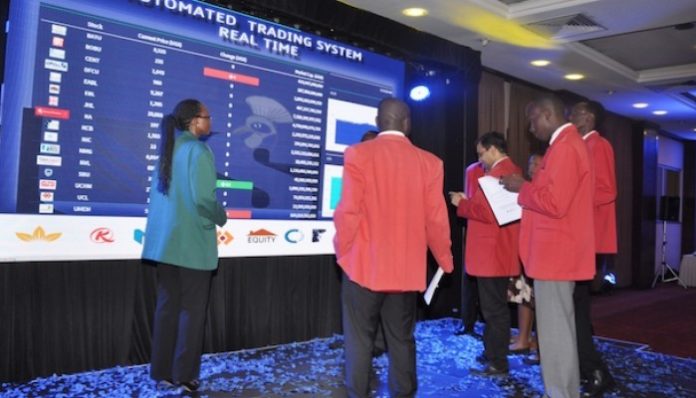
Ugandans at the Uganda Securities Exchange (USE) bourse

Africa’s Financial Markets Index to be released Friday this week, indicates that the continent’s large and dynamic market presents opportunities for growth much as foreign investment prospects are hampered by underdeveloped financial markets and a lack of legal and regulatory clarity.

The report, supported by Barclays Africa Group and to be released in Washington DC, focuses on six pillars including market depth, access to foreign exchange, market transparency and regulation, capacity of local investors, underlying macro opportunities, and the enforceability of international financial agreements.

The Index shares results of a survey conducted with 40 key institutions operating throughout Africa, accumulating their views on market conditions and the regulatory framework of the African economies covered in the report.

‘Liquidity, regulation, foreign exchange restrictions and policy choices are the highest area of concern for investors when considering Africa. Whereas product diversity and the speed of transactions are among the highest-performing indicators, our survey highlights investor concern about the relevance of African markets on the global financial scene’ says Danae Kyriakopoulou, chief economist at Official Monetary and Financial Institutions Forum (OMFIF).

Using a variety of parameters, both qualitative and quantitative, the Africa Financial Markets Index records the openness of countries across the continent to foreign investment. The launch features a presentation of the report by Barclays Africa Group Limited and OMFIF, and key findings will be discussed, followed by a panel discussion.


Stories Continues after ad