FUFA has organised a friendly match for Cranes to help test the technical ability and boost mental strength of the players ahead of the crucial 2018 World cup qualifier against Ghana on Saturday, October 7 in Kampala.
Uganda Cranes will face the national football team of Madagascar on Wednesday, October 4. The team arrived in Uganda last night in with their foreign based players for the tie.
However, the match will be closed from the public and only fans who have purchased the discounted tickets (each sold at 25,000/-) will be able to access the stadium on Wednesday to watch the practice match at Lugogo.
The tickets will also be used to watch the Ghana game and will go off market today evening. The other ticket categories of 30,000/-, 70,000/- and 150,000/- will be on the market Tuesday.
Meanwhile, the Cranes won 2-0 in their recent Northern Regional Tour. Derrick Nsibambi scored the two second half goals against the Northern Region Select team at the Lango Sports Grounds in Lira on Saturday.
Foreign-based Denis Iguma and Ivan Ntege arrived in the country and took part in today’s training session which involved 14 players. Others are expected to arrive during the course of the week.
Players who attended training:
Goalkeepers: Benjamin Ochan and Ismail Watenga
Outfieldplayers: Nicolas Wadada, Denis Iguma, Savio Kabugo, Bernard Muwanga, Isaac Muleme, Timothy Awanyi, Ivan Ntege, Tom Masiko, Muzamir Mutyaba, Tom Masiko, Derrick Nsibambi and Nelson Senkatuka.
URA boss Doris Akol addressing media during Tax Payers Appreciation Week
The Uganda Revenue Authority (URA) has published a book to guide investors that apply to be given tax incentives.
Launching the guidebook during the Taxpayers’ Appreciation Week that was organised by URA, the State Minister for Investment Evelyn Anite urged the business community to use the booklet as a reference point to understand what is required of them to benefit from tax incentives.
The guidebook was launched during the awards ceremony which was the peak of the three-day events at Kololo Independence Grounds, where over 100 ministries, departments and agencies (MDAs) displayed their services for the public as accountability for the taxes they pay.
Twelve outstanding taxpayers got accolades for consistence and compliance in paying taxes, and among them was Kinyara Sugar Works, which remitted sh65.15bn in taxes in the 2016/17 financial year.
Standard Chartered Bank came second, followed by Arua District Local Government.
Mulago Hospital and National Medical Stores (NMS) were named the best exhibitors because they offered free Yellow Fever vaccination, with their stall overwhelmed by thousands of visitors who wanted to be vaccinated, given that the cost of the particular service goes for between Shs80, 000-Shs200, 000, elsewhere.
Other winners included Kisoro District Local Government, BC Beverages, Highland Mineral Water, while Iganga District Local Government emerged the best from the Eastern region.
During the event URA Commissioner General, Doris Akol, said the current 14 percent tax to Gross Domestic Product (GDP) ratio is expected to rise to 17% due to the improving culture of tax compliance.
URA Board Chairman, Dr. Simon Kagugube said the awards are part of the initiatives to encourage taxpayers’ compliance morale.
URA is expected to raise Shs14.5 trillion in financial year 2017/18 to support the Shs29 trillion budget. In financial year 2016/17, Shs12.7 trillion was collected against a target of Shs 13.1 trillion. One of the reasons for the shortfall in revenue collections is failure by some taxpayers to comply.
Trade shows have traditionally been a very popular way to market products, service and business. With advances in social media marketing and Internet technology, the value and benefits of marketing via trade shows comes up. Though technology is changing marketing at a rapid pace, there are several benefits from having an exhibit presence at a trade show. Below are features that make the Uganda International Trade Fair (UGITF) a worthwhile experience as the 25th edition opens on October 3, 2017 in Kampala.
Face-to-face interaction
The first step is to get consumers to your exhibition stall and then connect with them through your products and services, which ensures effective communication. This makes it necessary to have a compelling exhibition as this attracts maximum visitors to your stall. Ultimately, these visitors encourage the face-to-face interaction and utmost consumer engagements. The UGITF gives a platform for your brand and your target audience to interact.
Lead Generation Potential
The UGITF has massive followings and attendance. For example, the previous Trade Fair in 2016 had over 200,000 attendees from more than 30 countries. Each attendee of the trade show is a potential lead waiting to be captured. Asking for contact information during a presentation and getting their business cards are all great ways to get fresh leads in your sales pipeline. Following up with the candidates most likely to buy while the event is still fresh in their mind makes it more impactful.
Build brand proximity
One of the most important features of participating in Uganda International Trade Fair is that it helps in creating brand proximity. With the help of engaging and appealing exhibition stands, you can make your target audience come to your stand and engage in a better way. Once they develop a sense of brand closeness, they automatically connect with your brand. This also helps you in understanding your target audience and their needs better.
Keep an eye in competition and learn anything new
Taking part in a trade fair will make you more experienced. There are many things to learn about your business’s field, other products, new ideas and trends. Take this opportunity to improve your knowledge. You can as well have one of your partners take a look at your competitors’ booths and collect evidence to evaluate your competitiveness.
Introduce a new product
Do you have a new product? Do you want to promote it? Have you already introduced your product on your website? Now the UGITF is an ultimate opportunity to showcase or introduce your product to a bigger audience. With the face to face interaction made possible, the potential customers can be given samples or shown how the product works and you not only get to introduce your product but get instant feedback as well. This helps you to either make adjustments or not basing on the kind of feedback.
Make new connections
The UGITF has for over 24 years been the best chance to meet your connections and also to meet new potential partners or buyers! A number of companies testify to this benefit as these connections build lasting partnerships and boost your clientele thereafter.
Leveled Marketing Field
From locally owned small businesses to multinational corporations, everyone has access to the same attendees at UGITF. It’s almost as simple as paying for your exhibit location space, designing your trade show display booth, promoting your business leading up to the tradeshow and interacting with the audience during the show. Even a relatively unknown business can generate large numbers of sales and leads through trade shows. Certainly this is possible via other marketing channels, but few are as easy to execute as trade shows can be a reason to exhibit.
Use media for your promotion
Trade shows and exhibitions get media coverage so you should be prepared to promote your business through media, either radio or television stations. You can create a video or take photographs and then share them through social media to make a positive feedback for your profile. You should also use any references from media to share to your profile.
Increase in sales
By promoting your products through the media, you have created a positive impression for your company. Therefore exhibiting in the UGITF leads to larger brand awareness, bigger interest for your business and of course it will increase your sales. Remember to use everything in combination with your social network to inform your connections at the same time for your progress.
Always have something to sell at the trade show. It doesn’t matter if you only bring your latest products or have a wide variety of products to choose, the opportunity to generate sales shouldn’t be lost because you didn’t have something for them to buy. Don’t miss out on that sale!
Cost-Effective Networking and Advertising
If you’ve done the pre-show marketing work leading up to the show, the potential that a trade show offers your business can far exceed the investment. Though you might have a larger initial investment to showcase your business at a trade show than other advertising or networking methods, the cost to convert a prospect into a sale is often much lower than other alternatives. With proper research and planning, trade shows are one of the most cost-effective sources of leads and sales possible.
Visitors are in the right mind frame during the show
Unlike cold calling, exhibition visitors are always in the right frame of mind to attend the show. So even when you want to capture the nerve of your audience with your exhibition stand, your customer should be attentive enough to appreciate the exhibition stand designs and effectively gets the message communicated.
Improve your brand image
Having a well-designed website and an impressive profile for you and your company in social networks for b2b is the first step to improve your brand’s image. In the trade fair, you have the chance to prove that your creativity is part of your business. Having a well-designed stall is relevant to your creativity and makes the best impression for your brand. You can also provide some free gifts or samples for visitors for further cement the brand’s image.
In conclusion therefore, the UGITF offers big benefits to businesses of any size. By combining exposure to a large number of potential leads with the ability to interact personally, the trade fair offers an experience for both the business and attendee that other forms of marketing cannot. Though virtual events and other technologies are slowly gaining popularity, few marketing methods compete with the potential of trade shows.
Uganda’s inflation rose slightly to 5.3 percent year-on-year in September, up from 5.2 percent a month earlier, the Uganda Bureau of Statistics (UBOS) said in its latest monthly report released over the weekend. This represents a 0.1 percentage point increase from the previous month.
UBOS in its report said core inflation, which excludes food, electricity and metered water, rose up to 4.2 percent during the period, up from 4.1 percent in August. This was driven by the increase in the prices of services which rose to 4.1 percent compared to 3.3 percent recorded for the year ended August 2017.
The Annual Energy, Fuels and Utilities (EFU) Inflation registered 10.6 percent for the year ending September 2017 compared to 7.8 percent recorded for the year ended August 2017. This was driven by the low supply of charcoal & firewood, whose inflation increased to 15.0 percent for the year ending September 2017 compared to 7.1 percent recorded for the year ended August 2017 .
However, inflation for liquid energy fuels declined to 5.5 percent for the year ending September 2017 compared to 5.7 percent recorded in August 2017.
The Annual food crops inflation declined to 9.6 percent for the year ending September 2017 compared to the 11.7 percent recorded for the year ended August 2017. This was attributed to the decline in the prices of fruits.
Arua registered the highest annual inflation of 9.0 percent in September 2017 compared to 8.9 percent recorded in August 2017. This was attributed to price increases in items such as furnishings, household equipment, clothing and foot wear. Annual inflation was also high in Fort Portal and Gulu due to high prices of food and non-alcoholic beverages.
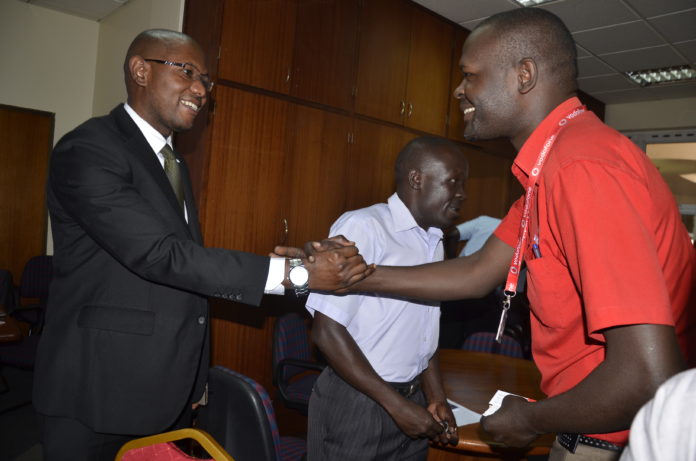
Ronald Kasasa, Head of Business Banking, DFCU Bank sharing a moment with Vodafone Uganda's SME Direct Sales Executive, Abdunasil Wavamuno (right) at a Contractors Sector Meeting in Kampala
Civil Engineers under their umbrella body, Uganda National Association of Building and Civil Engineering Contractors (UNABCEC) have said limited access to loans and insurance is the biggest challenge to their work.
This has been revealed by the organisation’s Executive Director, Daniel Lokong at a meeting for SME companies in the construction sector.
Making a presentation on local contracting in a changing economic environment in Uganda, some of the challenges raised by Lokong included difficulty in accessing loans especially contract loans; insurance of machinery and equipment, specifically delays in receiving compensation for damaged property. This, in turn, causes losses to their businesses, he said.
“The capacity of local firms to implement projects and access project financing is very key in achieving the medium term income status of Ugandans. Local Content realization can effectively be delivered if all engineers in their variant capacities commit their energies and patriotism,” Lokong noted.
The meeting was aimed at understanding the challenges and needs of companies in the sector, in respect to the Top 100 survey.
The Top 100 survey is an initiative of KPMG and the Nation Media Group represented by Daily Monitor in Uganda; it has been conducted since 2009 in Uganda as well as in Kenya and Tanzania.
The purpose of the Top 100 Survey is to identify Uganda’s fastest growing medium sized companies in order to showcase business excellence and highlight some of the country’s most successful entrepreneurship stories.
An open discussion was held, where SMEs shared their challenges which were addressed by the relevant partners in attendance. The challenges that are not addressed at the meeting are shared with the relevant organizations.
Vodafone Uganda, one of the Top 100 partners, was represented by Abdunasil Wavamuno, SME Direct Sales Executive. Other partners represented at the forum were DFCU Bank, Uganda Investment Authority, and ICEA.
After spending nine years in prison for a Las Vegas robbery, the former NFL star walked out of the Lovelock Correctional Institute on Sunday, according to the Nevada Department of Corrections.
Simpson, 70, who served his time at the Lovelock Correctional Facility in Nevada, was granted parole at a hearing in July. The earliest date he was eligible for release was Oct. 1.
Simpson was sentenced to prison following an arrest in 2007 during a botched robbery in Las Vegas, when he led a group of men into a hotel and casino to steal sports memorabilia at gunpoint. The former Buffalo Bills star contended the memorabilia and other personal items belonged to him.
At his parole hearing in July, Simpsons said, “All I want is my property. … I wasn’t there to steal from anybody.”
Simpson reassured the board he would be successful meeting the conditions of his parole before it was granted, saying, “I’m not a guy who lived a criminal life.”
Simpson’s attorney, Malcolm LaVergne, said on Friday that upon his release, Simpson wants to go to Florida, where he can “see his family and hug his family on the outside of prison.”
“He wants to eat seafood, he wants to eat steak,” LaVergne said. “He wants to enjoy the very simple pleasures that he hasn’t enjoyed in nine years.”
Tom Scotto, one of Simpson’s longtime friends, said, “All he wants to do is spend time with his family and friends and his kids. And play a little golf.”
But Scotto added that Simpson won’t be shying away from the public eye.
“We’re not gonna hide,” Scotto said. “He’s gonna do the same things he always did.”
Over 20 years ago, Simpson went on trial for the 1994 killings of his ex-wife Nicole Simpson Brown, and her friend Ron Goldman. On Oct. 3, 1995, at the end of a televised trial that captivated the nation, Simpson was acquitted of all criminal charges.
Simpson was found liable for the killings in a 1997 civil trial. He has always maintained his innocence.
Ron Goldman’s father and sister, Fred and Kim Goldman, said in a statement last week that they will continue pursuing the judgment awarded to them in the civil trial — an amount they say has climbed to $60 million.
WINNER! Kasumba Jinuliire recieving his Mega Masappe money from Airtel Uganda Marketing Director, Indrajeet Singh, during the draw.
With just one week to go, Airtel Uganda surprised subscribers participating in the ongoing Mega Masappe promotion by doubling the number of motor bike and cash winners in the 13th draw.
Unlike previous draws in which 5 lucky subscribers were handed bikes and 5 others were handed Shs1,000,000 each, Saturday’s draw saw 10 winners ride away on brand new bikes and 10 winners take home Shs1,000,000 each.
“It is all about our subscribers,” commented Mr. Indrajeet Singh, the Airtel Uganda Marketing Director, during the prize handover.
“As part of this competition, all our subscribers have managed to win simply by participating – whether it was bonuses on their phones, brand new cars, bikes or cash sums, they have all been winners. Today, we decided to double the winners pool so that we can show our appreciation for the support over the past few months,” Singh added.
Airtel Mega Massape competition was launched at the start of the July and over the past few months, the opt-in promotion has seen thousands of subscribers receive bonuses on hitting their daily targets and more than 100 lucky subscribers take home brand new cars, motorbikes and cash prizes of one million shillings each.
This week, Solome Nakiwala, William Ochen, Tom Wasswa, Joan Katesigwa, Douglas Tamale, John Baptist, Evas Ahimbisibwe, Hassan Lubega, Zulayiha Nabirye and Kasumba Jibuliire were the lucky winners of UGX 1,000,000 each, while Male Kyewa, Christine Nabagwanya, Khasim Mpanga, Patrick Musisi Yiga, Eria Gumisiriza, Alex Serunkuma, Rogers Tumukunde, Philip Muzoora, Mukwaya Mugoya and Claire Nabimanya won brand new motor bikes.
Speaking on behalf of today’s winners, Hassan Lubega, a resident of Mutundwe, thanked Airtel Uganda for the opportunity.
“I have been getting bonuses but I really wanted to also come and win one of these prizes. Today, I am taking home a million shillings. I am very grateful,” he commented.
Mega Masappe promotion subscriber bonus will be given instantly on the achievement of the daily target. For example, if a subscriber’s bonus target is Ushs. 2,000 and they recharge with that Ushs. 2,000, they will receive 100% bonus of the same value under the Voice, SMS & Data split. However, if they recharge with another Ushs. 2,000 on the same day, they will not get a 2nd bonus.
Daily and weekly prizes are given away for the entire duration of the promotion.
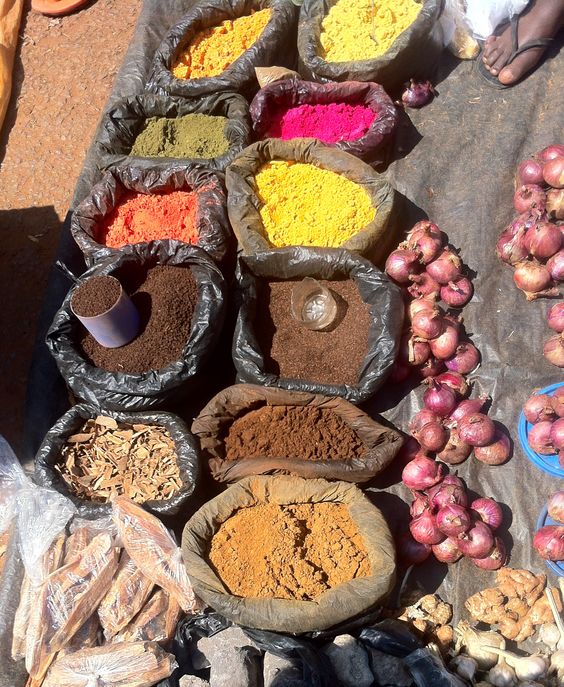
Different types of coloured curry powder sold at a market in Entebbe, Uganda.
The Uganda National Bureau of Standards (UNBS), the body responsible for enforcing public health and safety standards against dangerous and substandard products has warned against fake curry powder on market.
In conjunction with the Uganda Curry Powder Packers and Spice Producers’ Association (UCPSPA), the umbrella organisation of all manufacturers of curry powder in Uganda, the UNBS says that some of the curry powder on market has a rancid taste or musty smell.
“Curry powder shall be ground to such fineness that all of it passes through a sieve of 300 micron (0.300 mm) and nothing remains on the sieve, be free from dirt, fungal growth and insect infestation,” reads a statement by UNBS.
It further states that curry powder shall also be free from added colouring, flavouring substances and preservatives other than salt.
“Curry powder shall be packed in seal tamper-proof clean and sound tinplate or glass container or paper bags properly lined with water proof paper or moisture proof bags made of a material which does not impart any smell and does not react with the curry powder. Curry powder for retail trade shall be packed in containers of net mass of 100 g, 250 g, 500 g 1 000 g, pre-packed by the manufacturer or licensed packer of curry powder.”
UNBS warns that it is such curry powder that will be seized and destroyed.
“UNBS therefore wishes to inform all importers, manufacturers, traders and the general public that any curry powder that does not meet National Standards shall be seized for destruction and such dealers prosecuted in accordance with UNBS Act.”
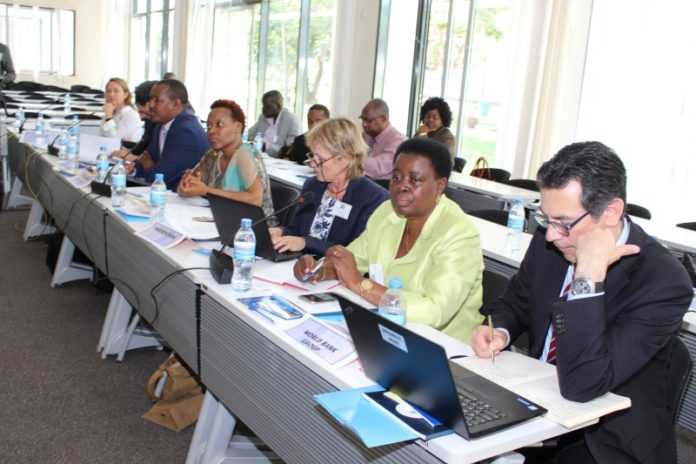
A cross-section of participants who attended the one-day Roundtable Conference on Trade Facilitation at the EAC Headquarters in Arusha, Tanzania
Revenue losses from inefficient border procedures in some African countries are estimated to exceed 5% of the Gross Domestic Product, James Kisaale, an Assistant Commissioner with Uganda Revenue Authority told a Roundtable Conference on Trade Facilitation (TF) in Arusha Tanzania days ago.
Citing a 2013 Organization for Economic Cooperation and Development (OECD) study, Kisaale said that reducing global trade costs by 1% would increase worldwide income by more than US$40 billion, with developing countries being the biggest beneficiaries.
He said the areas that would contribute the most to lowering trade costs in Sub-Saharan Africa were formalities, namely automation, the simplification and harmonisation of documents, and information availability.
Kisaale was speaking during the opening session of the one-day roundtable on trade facilitation which brought together EAC Development Partners as well as Customs and Trade experts from the EAC Secretariat and Partner States’ Ministries of Trade.
The EAC Secretariat organised the Roundtable Conference to review and fast-track the implementation of the World Trade Organization (WTO) Agreement on Trade Facilitation (TFA). The Conference brought together Development Partners who will work with the EAC in the implementation of the TFA.
Opening the roundtable, the EAC Director General-Customs and Trade, Kenneth Bagamuhunda, said that TF was an integral part of the EAC Customs Union Protocol which explicitly provides for reduction in the number and volume of trade documents.
“TF also provides for the adoption of common standards of trade documentation and procedures, coordination and facilitation of trade and transport activities. There is also the reviewing of procedures adopted in international trade and transport facilitation with a view to simplifying and adopting them for use in the EAC,” said Bagamuhunda.
The DG disclosed that an EAC Trade and Facilitation Sub-Committee has been established to, among other things, supervise the implementation of the WTO TFA at regional and national levels.
He said that Regional and National Implementation Plans for the WTO TFA have been finalized and adopted by the Policy organs.
“Amendments of regional laws, regulations and procedures; development of project proposals for resource mobilization, and; sensitization of stakeholders is currently underway,” he added.
He cited the Single Customs Territory (SCT) and the interconnectivity of customs systems among some of the key TFA components that have been implemented by the EAC.
“The SCT provides for the free circulation of goods, reduces cost of doing business, reduces Non-Tariff Barriers, ensures competitiveness, boosts business predictability and promotes investment,” he said, adding that SCT is premised on the use of electronic systems.
Other components already implemented are: the establishment of One-Stop Border Posts; harmonisation of standards, reduction of Non-tariff barriers, and; publication of the EAC Trade and Investment report.
Speaking at the forum, Amb. Arthur Mattli, Switzerland’s Representative to the EAC, said that his country believes that bureaucratic delays and ‘red tapes’ pose an unnecessary and expensive burden for moving goods across borders for traders.
Mattli said the TFA would help developing countries diversify their exports and tap into global value chains.
He disclosed that Switzerland had so far disbursed US$3.5 million as part of its contribution to the TFA’s Trade Facilitation Support Programme, a multi-donor programme of the World Bank Group’s Trade and Competitiveness Global Practice which provides support for countries seeking assistance in aligning their trade practices with the WTO TFA.
“Every country is eligible to receive support under the programme. Eligible countries are expected to have demonstrated a strong commitment to implementing trade facilitation reforms in the areas covered by the WTO TFA. Moreover, the support programme will prioritize assistance to countries with other limited access to other donor support,” said Mattli.
Tourists on Nile River above Uganda’s Murchison Falls
During an evening game drive in Uganda’s Queen Elizabeth National Park, you might be lucky enough to spot a lioness both hunt and kill a buffalo. It is an exciting couple of minutes, never knowing who is going to win—the hungry lioness or the buffalo with the horns. In the northern section of the park, 400km south-west of Kampala, buffalos were safe from lion until three lions crossed from the Ishasha wilderness camp eight years ago, and began to dominate hunting grounds around the Kasenyi crater lake.
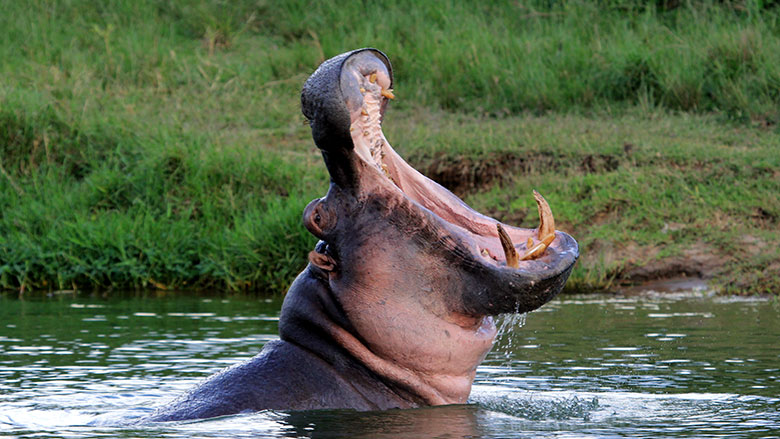
Uganda’s Queen Elizabeth Park is home to many pods of hippo
Uganda is one of a handful of African countries with the “Big Five”—lion, leopard, elephant, black rhinoceros, and the African buffalo. These species are mercifully regarded as among the most difficult of Africa’s wild animals to track or find on foot.
In 2012, Uganda’s Tourism Ministry conducted a World Bank-supported survey of the 1.3 million foreigners who visited Uganda that year. It found that most “visitors” came from other African countries, usually for business, spending only a few days in the country. Most “tourists,” on the other hand, came from Europe (46 percent) and North America (22 percent). They tended to stay longer, for about 14 days, and spent more money—about US$176 per day.
Tourism is now the leading export earner for Uganda, bringing in about US$1.4 billion annually, which is 26 percent of its total foreign exchange earnings and 9.9 percent of its GDP. The sector employs about 520,000 people directly, and one million more indirectly, 70 percent of them women and youth.
Still word-of-mouth
But, until recently, little was being done in the way of promotion for Uganda’s tourist attractions, despite the country rating as one the world’s top ten destinations by industry giants such as Lonely Planet and National Geographic Traveler. The 4 out of every 10 visitors to the Queen Elizabeth park who are non-resident foreigners hear about Uganda and its attractions by word-of-mouth. “They visit because someone they know lived in Uganda and recommended it,” Charles Sempebwa, a tour operator says.
To tap into more of the leisure tourism traffic that flows into Africa, Uganda is moving away from relying solely on word-of-mouth recommendations by spending US$1.5 million with three international, public relations firms. The firms are promoting Uganda as a tourist destination in the United Kingdom and Ireland, North America, and German-speaking Europe.
The campaign, led by the Uganda Tourism Board, is being carried out with financial backing from the World Bank-supported Competitiveness and Enterprise Development Project, which aims to improve the visibility of Uganda’s unique tourism products to attract up to 4 million tourists a year. Some of its support is going toward revamping curricula and training facilities at the Uganda Hotel and Tourism Institute to improve training for the pool of local staff for the hospitality, leisure, and tourism industries.
Marketing a tourist destination
There is also more information about Uganda being provided through media coverage (worth £1.2 million in the British market, and Euro 2 million in other European markets), and through over 1,300 multi-media placements with an audience reach of 990,925,768 in North America.
In June 2016, NatGeo broadcast live content of Uganda’s mountain gorillas. It was watched in more than 10.4 million homes in Britain. This was Uganda’s first tourism campaign in Britain for decades, ironically perhaps, as Britain first sent explorers to Uganda in the mid-nineteenth century. Through it, viewers learned about Uganda’s rare mountain gorillas, now found only in densely forested areas straddling the borders of southwestern Uganda, the Democratic Republic of the Congo, and Rwanda.
Besides gorillas, lion, and buffalo, Uganda has other attractions, too, as a country with one of the world’s highest concentration of different species of birds, as a source of the River Nile, and as a country with Rift Valley lakes and the spectacular Mountains of the Moon (or Ruwenzoris)—a country rich in flora with idyllic islands, safe, vibrant urban centers, and legendary nightlife.
Bookings with tour operators are interpreted as a sign the campaign may be bearing fruit. One operator in Uganda says she has seen bookings up for 2017/18. “We have had more inquiries from German-speaking markets, and more bookings from the Netherlands, Belgium, and Australia,” says the Operations Manager of Matoke Tours, Anne Grodzki.
More tourists should mean more revenue and jobs in Uganda, and more tourists with stories to share.