Stanbic Bank
Stanbic Bank
20.1 C
Kampala
Stanbic Bank
Stanbic Bank
Home Blog Page 1756

Apologise to Ugandans MP Odonga Otto tells minister Anite

Aruu South county legislator Samuel Odong Otto

Aruu county legislator Samuel Odonga Otto has implored the the Finance State Minister for Investment and Privatization Evelyn Anite to apologise to Ugandans over remarks she reportedly made, interpreted to wit that protagonists of lifting the presidential age limit have the backing of the Uganda Peoples Defence Forces (UPDF).

During the plenary chaired by Deputy Speaker Jacob Oulanyah, MP Odonga Otto said Anite should face the disciplinary committee of Parliament to apologize for her statements, also also be suspended from the House.

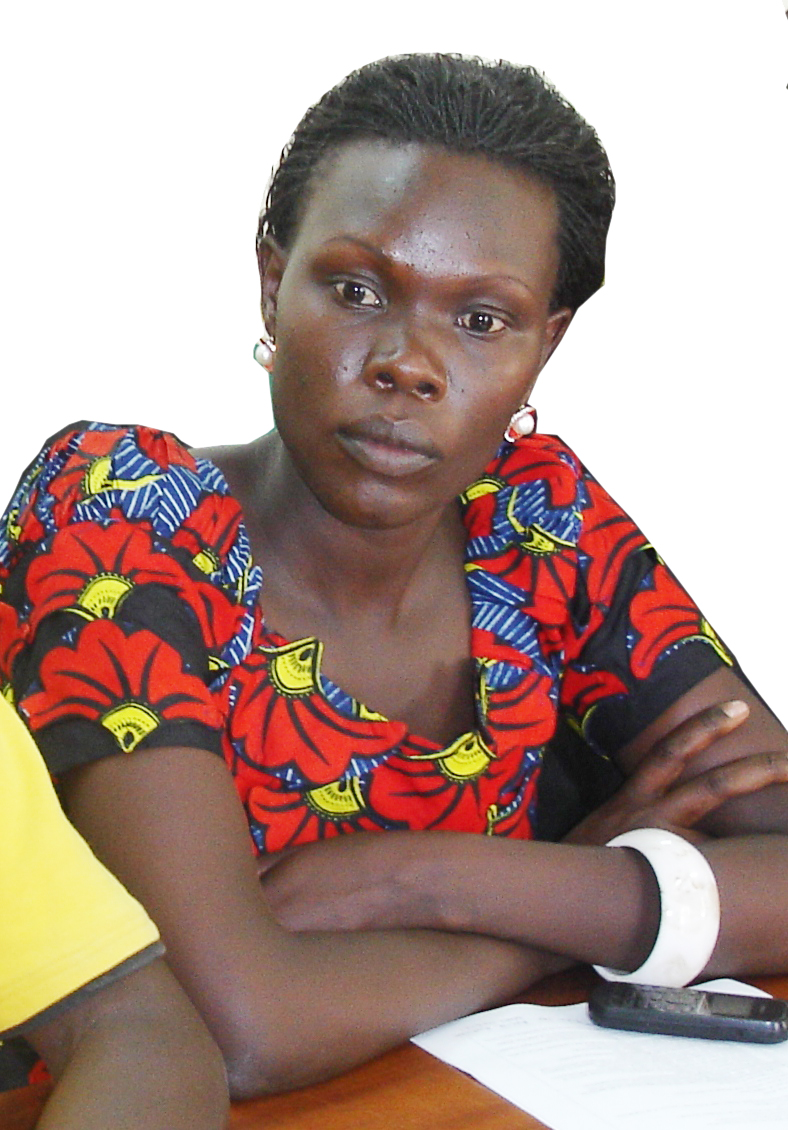
State Minister for Investment and Privatisation Evelyn Anite

Last week Anite, the Woman MP for Koboko, was quoted as saying that the age limit removal protagonists would not succumb to intimidation and would instead, with the backing of the army, continue with plans to initiate the tabling of a private members bill to amend Article 102 (b) of the 1995 Constitution. The move that is supported by majority of the National Resistance Movement (NRM) MPs is seen as aimed at having President Yoweri Museveni, who is the NRM Chairman, rule beyond the constitutional 75 years as enshrined in the 1995 Constitution.

Anite’s remarks have caused a flurry of reactions mostly by opposition MPs and sections of the populace, with the legislators including Odonga Otto baying for the Minister’s blood. “Evelyn Anite should be taken to disciplinary committee and suspended from Parliament for eight years without contesting,” Aruu county MP implored the Deputy Speaker.

But Oulanyah was quick to save Anite from the onslaught, telling Odonga Otto: I have no capacity to suspend a legislator.”

However, the issue had not been put to rest, and given chance the Koboko Woman MP shot back: “Odonga Otto was drunk, it was alcohol which was speaking.” Anite added: “MPs (antagonists) should know that we are the ones in charge; you cannot tell us ‘Tojjiikwatako’ (don’t dare amend article 102 b) when it is our job, It is like telling us not to do our job.”

Meanwhile a private members bill was expected to be tabled during today’s plenary by the Igara West legislator Raphael Magyezi has been deferred, and the Speaker Rebecca Kadaga is expected to pronounce herself on the matter next week.

The development following a closed door consultation meeting between Kadaga and Oulanyah, with the latter reportedly telling his boss that there a lot of petitions challenging the lifting of the presidential age limit cap that stands at 75 years.

Stories Continues after ad

Deputy Speaker Oulanyah defers motion on age limit bill

RIP: Jacob Oulanyah

The Deputy Speaker Jacob Oulanya has deferred tabling of motion seeking to lift the presidential age limit to next week, after holding consultations with Speaker Rebecca Kadaga.

Oulanyah made the disclosure after a closed door meeting the Speaker, who she told that there are several petitions challenging the lifting of the constitutional 75-year cap for eligibility to contest for the presidency.

The age limit debate has caused a lot of public anxiety and tension, with acerbic exchanges between protagonists and antagonists of the bill, and the Parliament being cordoned off by heavily-armed police and military police, backed by armoured vehicles.

“Some legislators were saying that they are going to gym, this is improper, let us maintain calm and process what we need to process,” Oulanyah told the house.

Earlier on Monday police summoned four MPs led by Kampala Central Muhammad Nsereko, Sekikubo and Barnabas Tinkasimire (Buyaga West) and Allan Sewanyana (Makindye East). However only two, Nsereko and Sewanyana, showed up and were later released on bond, with the police later issuing a warrant of arrest for Sekikubo and Tinkasimire.

Lwemiyaga county MP Theodore Sekikubo has said he appear before Criminal Investigations Directorate of Police (CID) at Kibuli for interrogations ‘at any time’ to answer to charges related to ‘offensive communication’.

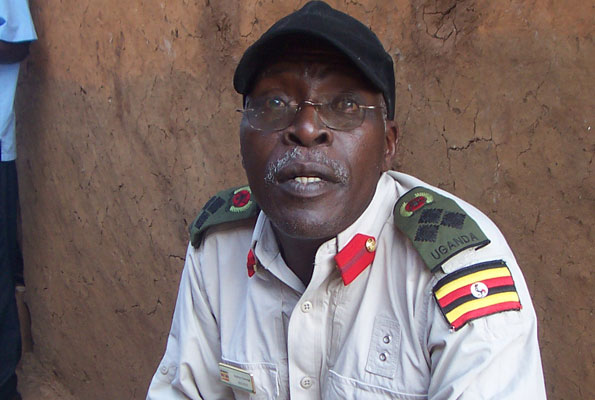
CONTROVERSIAL: Brigadier Kasirye-Gwanga-

Meanwhile, Brigadier (rtd) Kasirye Gwanga today went to Parliament in what observers say was a show of defiance.

“Why are legislators making noise? I served the army for the last 45 years and now I am 65. At 65 years, should I be sidelined?’’ the controversial Brigadier chidingly asked.

He added: “I cannot enter parliament because legislators are crazy, and have not gone ahead to discuss NRM manifesto instead they are on age limit.”

Interestingly, in departure from the topic at hand, Brig. Gwanga thundered: “You came to encroach on my property; I use the diminishing ways to kick you out. I burnt it.”


Stories Continues after ad

Cranes provisional squad for WC qualifier against Ghana named

Mawejje tackles an opponent in the Ghana match during the Afcon

Interim coach Moses Basena has named a squad of 35 players to start preparations for the Uganda Cranes clash against Ghana’s Black Stars in the 2018 FUFA World Cup Qualifiers.

The training will start on Wednesday, September 27 at 4pm at Namboole stadium and the squad will be trimmed based on the arrival of foreign based players in camp. The first leg in Kumasi ended in a goalless draw.

Cranes’ final Group E game will be on November 6 against Congo Brazzaville away from home.

There are five groups of four teams for the African qualification. At the end of this mini-league, the winner of each group will make it to Russia.

Meanwhile, the Cranes will have travel to Lira on September 30 for their regional tour of Northern Uganda as part of the preparations.

The Cranes provisional Squad:

Goalkeepers: Denis Onyango, Benjamin Ochan, Isma Watenga, Tom Ikara

Outfield players: Denis Iguma, Nicholas Wadada, Godfrey Walusimbi, Isaac Muleme, Isaac Isinde, Muwanga Bernard, Hassan Wasswa, Timothy Awany, Tony Mawejje, Geoffrey Kizito, Mutyaba Muzamiru, Masiko Tom, Ivan Ntege, Luwagga Kizito, Karisa Milton, Ochaya Joseph, Okwi Emmanuel, Miya Faruku, Idrisa Lubega, Derick Nsibambi, Nelson Senkatuka, Geoffrey Serunkuma, Kagimu Shafiq Paul Mucureezi, Gadaffi Gardinho, John Adriko, Okot Fred, Ibrahim Kayiwa, Tadeo Lwanga.


2018 FIFA World Cup Qualifier

Uganda Vs Ghana

7th October, 2017

Mandela National Stadium, Namboole (4pm)

Stories Continues after ad

I am not a fugitive, MP Sekikubo tells police

Lwemiyaga MP Theodore Sekikubo

Lwemiyaga county MP Theodore Sekikubo has said he appear before Criminal Investigations Directorate of Police (CID) at Kibuli for interrogations ‘at any time’ to answer to charges related to ‘offensive communication’ in respect to the removal of the 75-year presidential age limit cap enshrined in the 1995 Constitution.

On Monday police summoned four MPs led by Kampala Central Muhammad Nsereko, Sekikubo and Barnabas Tinkasimire (Buyaga West) and Allan Sewanyana (Makindye East). However only two, Nsereko and Sewanyana, showed up and were later released on police bond.

Consequently, yesterday the CID issued an arrest warrant for MPs Sekikubo and Tinkasimire for their failure to appear for interrogation.

But speaking today at Parliament ahead of the contentious tabling of a bill to amend Article 102 (b) of the Constitution remove the age limit cap, Sekikubo said he was not afraid of presenting himself before the police.

“I am not a fugitive; I will appear at CID at any time, they had told me not to access Parliament but I am here,” Sekikubo said in an interview at Parliament.

Meanwhile, MPs Nsereko and Sewanyana who were supposed to report back to CID headquarters this afternoon have also opted out.

“We had to report to the CID today but we have sent our lawyers to inform them that we are not coming,” Nsereko said.

The back and forth actions of the MPs and police come in the wake of National Resistance Movement (NRM) legislators moving to amend Article 102 (b) to lift the age limit cap, ostensibly to pave the way for President Yoweri Museveni to contest in the 2021 elections when he is above 75 years, the constitutional limit as enshrined in the 1995 Constitution.

Yesterday, about 300 NRM endorsed the move, and today Igara West MP Raphael Magyezi is set to table the ‘Private Members Bill’ that will, if passed, see the removal of the 75-year cap.

Stories Continues after ad

Women’s leadership potential in farmer groups is a pathway to agricultural transformation

By Florence Nakazi and Miriam Katunze

Farmer Groups (FGs) constitute a crucial component of a properly functioning agricultural system. They not only offer an opportunity to market agricultural produce, but also offer avenues for farmers to gain skills such as financial acumen, entrepreneurship, decision- making and negotiating. At the same time, FGs enable members to access inputs and remain competitive in dynamic markets.

Uganda has experienced an expansion in the number of available FGs as a result of the National Agricultural Advisory Services (NAADs) intervention in 2001 and the proliferation of Non-Governmental Organisation (NGOs). According to the Agricultural Technology and Agribusiness Advisory Services (ATAAS) database by the Uganda Bureau of Statistics (UBOS), the proportion of households with at least one member subscribing to FGs increased from 20 percent in 2011 to 23 percent in 2014.

The NAADS programme targeted both men and women to reduce the gender imbalance in access and use of agricultural information. As such, there was an increase in the number of FGs comprising of both men and women. By 2014, women and men’s representation in farmer groups stood at 35 percent.

The question at hand is whether the boom in FGs has enabled women to overcome their social and cultural barriers to taking up leadership positions in such groups. In this article, we examine barriers to female participation in leadership positions of FGs and their consequences to agricultural transformation.

Barriers to female participation in leadership of FGs
To the best of our knowledge, information on the status of female participation in leadership positions of FGs is largely absent. This means we are unable to undertake a trends analysis given that we lack a baseline. However there is evidence that suggests that overall few women are participating in leadership positions of FGs in most parts of Uganda.

A recent empirical study of 65 farmer groups in Central Uganda revealed that due to limited and non-standardization of the number of leadership positions in FGs as manifested by an average of 5 positions i.e. chairperson, vice chairperson, secretary, treasurer, auditors women do not participate much. This means that while FGs have constitutions/by-laws that govern them, they remain highly informal- lacking globally recognized positions/standard number of positions in a typical FG. The more positions- the better for women as they have more space to compete but this is not always the case.

Furthermore, the study found that with the exception of the vice chairperson and treasurer positions, females were under represented in almost all the other leadership positions. This suggests women’s limited access to informal political space For instance a lady chairperson led only 35 percent of the groups. Women’s limited participation in key decision making positions like chairperson shows that women bargaining space is still limited, which gives them less say in major decision making processes. Unfortunately, taking the status quo of 5 positions on average in an FG, how much bargaining power does a woman have in the decision making space?

On the other hand, 54 percent of FGs had women as vice chairpersons suggesting that women are shy to speak in public, always under the cover of men and yet this position is synonymous with one as a wife in a home and can therefore be leveraged on by women to make decisions. Furthermore, the over representation of women among the vice-chairperson position may suggest a token appreciation rather than a consideration of women as equal decision makers.

Nonetheless, it is however commendable that 70 percent of FGs had lady treasurers- suggesting that women contribute to financial stewardship of FGs. However, another recent study on Uganda warehouse receipt system also found that women leaders are risk averse when it comes to applying for loans.

As such, taking up some leadership position without taking advantage of the available financial services may not do justice to advancing the women’s cause in agricultural transformation. Nonetheless, increasing women in leadership position even if not as chairpersons can increase their voice and influence over group decision making which builds their confidence and skills. Furthermore, a recent the study showed that while women were traditionally less inclined to information dissemination, a large proportion of FGs have women as information This suggests that women are becoming more empowered in public speaking.

The above patterns in FGs leadership structures can partially be explained by cultural norms within the household and the community that men are perceived to be more knowledgeable and able to make decisions organize group activities and maintain discipline within the group. This could also be explained by the perception held by women suggesting men are better placed to establish contacts with external institutions to amplify their concerns/voices. Cultural norms that limit women’s movements outside the household/community perpetuate a male-dominated political scene.

More so, patriarchal socialization is equally responsible for such structure. FGs led by male chairperson are reluctant to place women on top of their lists, thus limiting women’s chances of getting elected. Yet male leaders can undercut such socialization by championing women in leadership. In addition, the triple role phenomenon is perhaps the biggest barrier to women’s participation in leadership of FGs. The cultural assumption that women are the primary or sole caregivers of children has often been used to exclude women from the public sphere, especially with regard to leadership in groups.

By increasing women’s participation in FGs, we can have a dramatic impact on the competitiveness and growth of the agricultural sector. There is need to establish quotas for participation of women in leadership structures of FGs. This may take the form of setting a minimum percentage of representation for both sexes to ensure a balanced presence of men and women in political and decision-making posts. Some posts should be ring fenced for women while others should be left for direct competition regardless of gender.

These will serve as a catalyst, which nurtures the self-confidence of women from the grassroots level to participation in politics. These quotas should be specified in the FGs constitutions, planning and monitoring systems. We also believe that utilizing the leadership potential of women in FGs can be an effective tool in addressing social norms and empowering rural women. While NAADs requires the provision of inputs through collective action, very little effort has been dedicated to mainstreaming governance structures of FGs. Essentially NAADs should collaborate with Ministry of Trade, Industry and Cooperatives to offer oversight roles in governing of FGs-making them formal. This should be undertaken, bearing in mind that promoting women in leadership provides benefits to FGs especially in financial performance.

The writers are research analysts


Stories Continues after ad

LGRB boss to address continental gaming conference

TO ATTEND SOUTH AFRICA CONFERENCE: Lotteries and Gaming Regulatory Board (LRGB) Chief Executive Officer Edgar Agaba

The Lotteries and Gaming Regulatory Board (LRGB) Chief Executive Officer Edgar Agaba will be one of the keynote speakers at the inaugural Gaming Africa Conference, taking place on October 24 and 25 in Johannesburg, South Africa.

According to a release by the Africa Press Organisation (APO), the conference is a networking opportunity for both the gaming industry and its regulators to share knowledge and best practices.

Other delegates include Lanre Gbajabiamila, Director General, National Lottery Commission of Nigeria, James Mbalwe, Director General, Gaming Board of Tanzania and Jean Claude Mushmire, Head of the Services Industry Development Policy, Rwanda Ministry of Trade and Industry.

With learning modules covering the economy, payment methods, social responsibility, anti-money laundering, investment, public relations, regional roundtables and two master classes from the Totally Gaming Academy, covering Casino Marketing and Sportsbook Management, Gaming Africa has raised the bar in terms of delivering an event dedicated to meet the specific gaming needs of the continent.

Heralding the new event, African gaming expert, Roy Bannister, said: “I anticipate a lot of interest from international visitors looking to get in on the action in a jurisdiction that is pretty hot at the moment. One only needs to look at the trade press to see announcements of deals being done in Africa, new developments and advances in sports betting, payment technologies and mobile growth that is fuelling a lot of excitement about the continent. There is also interest from numerous African regulators wanting to understand how to more effectively regulate their industries, as well as manufacturers looking to place the latest gaming technology on the continent and enable operators to run profitable gaming ventures. Clarion will bring a professionally run gaming event to the African continent, that will draw upon its international expertise and networking capabilities and allow a market crying out for a world class gathering to finally be able to convene on the African continent and, in the process, take the gaming industry to greater heights.”

Curtis Roach, Content Lead for Gaming Africa

Curtis Roach, Content Lead for Gaming Africa said: “It’s fantastic to be working on Gaming Africa as it brings a long-overdue event to arguably the most important and exciting region in the world for the future of gaming. My remit is to produce a forum that inspires, generates active discussion and provides invaluable ideas for delegates to take back to their organisations. Training plays a vital role in raising standards and creating a professional and sustainable industry. To satisfy this, we will be bringing the highly acclaimed ‘Totally Gaming Academy’ master classes to Gaming Africa. Globally recognised experts Arjan Korstjens and Lee Richardson will be flying in to guide delegates through their specialist courses: Casino Marketing Academy, and Sportsbook Management Academy. These are being provided by Clarion Gaming on an entirely complimentary basis – a saving of R15, 000.”

Clarion’s decision to launch Gaming Africa follows requests from major industry players for a quality business-to-business event dedicated to meet the specific gaming needs of the continent.

Stories Continues after ad
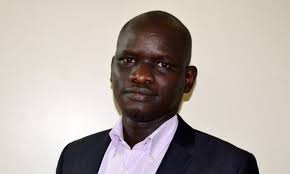
Minister decries inadequate funding for healthcare

Health Minister Dr Jane Ruth Aceng

The Minister of Health Dr. Jane Ruth Aceng has decried government’s failure to fulfill the 15 percent commitment for healthcare funding as a share of national budget.

The Minister’s remarks were contained in a speech read for her by Dr. Diana Atwine, the health ministry Permanent Secretary, during a symposium themed, ‘Financing for Universal Health Coverage (UHC): more Money for Health and more Health for the money’ .

The Symposium held recently at Kampala Serena Hotel, focused on Health Financing for Universal Health Coverage in Low and Middle Income Countries, and brought together many international participants.

And in her speech Dr. Aceng noted that resource constraints had affected the commitment, stressing however, that there must be accountability for resources sent to all health centers.

She said that UHC is only possible if people take responsibility and prevent diseases at household and individual level, citing Kampala as an example where only 1 percent cases of malaria are recorded since residents address the social and environmental causes of disease burdens.

She also urged government to reject donor resources that are not aligned to national health priorities.

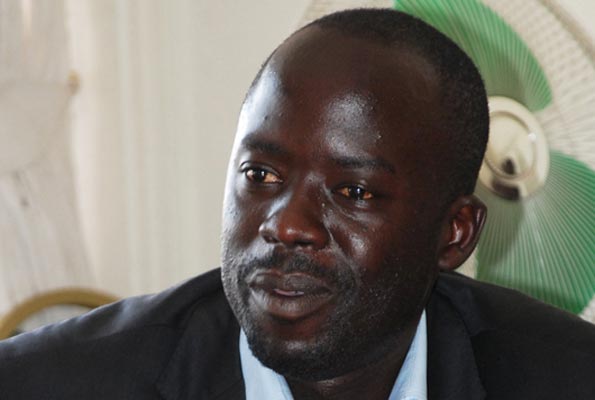
EPRC Researcher Tony Odokonyero

Tony Odokonyero, a research analyst at the Economic Policy Research Centre (EPRC) echoed the Minister’s concerns, noting that inadequate funding for health is prevalent despite renewed government commitment to realize the ambitious goal of UHC as stipulated in the National Development Plan (NDP) and Health Sector Development Plan (HSDP).

“Health sector funding must be improved to realize ambitious health related goals. Besides ameliorating domestic resources for healthcare, this can be possible if the country properly harnesses DAH,” Odokonyero, who was presenting a paper titled ‘Leveraging Development Aid for Health (DAH) to advance Universal Health Coverage’, said.

He also noted that for health foreign aid to effectively support Uganda’s healthcare agenda, it must be aligned to the national health development goal. However, he observed that the biggest challenge with DAH is uncertainty regarding its sustainability, so efforts should be made to harness or maximally utilize it in the interim period, as the government develops or strengthens long-term domestic healthcare financing mechanisms.

Odokonyero further noted that there is poor enforcement of controls particularly around disbursement and that there are often wide variances between health aid commitment and disbursement.

He called for proper and effective utilization of development aid for health in the short run, noting that the existing fiscal space is limited and does not allow for adequate healthcare financing.


Stories Continues after ad

Funding sources for good causes without angels

By Marty Zwilling
Angel investors and venture capitalists don’t make equity investments in nonprofit good causes. The simple reason is that it’s impossible to make money for investors when the goal of the company is to not make money. Yet as an active angel investor, I still get this question on a regular basis, so I’ll try to outline the considerations in common-sense terms.

A nonprofit organization is generally defined as an organization that does not distribute its surplus funds to owners or shareholders, but instead uses them to help pursue its goals. Examples include charitable organizations, trade unions, and public arts organizations. In the US, a nonprofit is technically any company who qualifies as tax exempt through IRS Section 501(c).

Obviously, these companies still need money to get started, or finance growth, just like a for-profit company. What options do they have available to them, since they can’t sell a share of the company (no equity investment)?

Individual and institutional philanthropy. For a nonprofit, bootstrapping is self-funding from donations and fund-raising. The advantage is no time and effort is spent searching and preparing for the other alternatives, and no repayment terms or collateral are required. There is no discussion of equity, or return on investment.
Loans from a bank or other financial institution.
 Non-profits can apply for a bank loan or line-of-credit, just like any other individual or company. However, like anyone else, they will first need some collateral, or someone to guarantee the loan, and some evidence of a viable business, like receivables and inventory.
Personal loans from individuals, employees and board members.
 Personal loans are certainly an option, but should be avoided if possible. As in any company, they can lead to employee problems, or messy legal issues. A nonprofit can also issue bonds to board members and members as a way of borrowing funds from those same people.

Government grants. The grant source often gets overlooked, but it should be a major focus these days when relevant due to the Obama administration initiatives on alternative energy and healthcare. The down side here is that real work is required to put in a winning application, and the award may be a long time in coming.
Private endowments.
 This is a funding source for nonprofits that is made up of gifts and bequests subject to a requirement that the principal be maintained intact and invested to create a source of income for an organization. Endowments are usually limited to a specific area of interest by a philanthropist, and have many qualifications, so be careful.
Bartering services.
 Bartering occurs when you exchange goods or services without exchanging money. An example would be getting free office space by agreeing to be the property manager for the owner. This could work to get you legal or accounting services, but won’t get you cash to pay employee salaries.

Hopefully you can see from this list that the people and processes involved in financing a nonprofit have little in common with angel investors, or the venture capital process. You still start the process with a business plan, but then you look for a philanthropist rather than an investor.

Some nonprofit entrepreneurs think they can skip the whole plan, rather than just the sections on valuation, equity offered, and exit strategy. All other sections, starting with a definition of the problem and the solution, opportunity sizing, business model, competition, executive team, and financial projections, are just as critical for nonprofits as for-profits.

A nonprofit is still a business, maybe even tougher than for-profit to run successfully, so the best angel is a great entrepreneur at the helm for fund-raising, as well as operations. In addition, the best nonprofits turn out to be the angel, rather than require one. That’s a higher calling.

Marty Zwilling is CEO & Founder of Startup Professionals, Inc.


Stories Continues after ad
UPDF Air defence colonel dies in accident

The commander of 201 Brigade in Nakasongola district has died in a motor accident.

Col David Katorogo who was travelling with his family died on Wednesday morning along Mityana-Mubende Highway.

Col. Katorogo was also a lecturer at the Seniour Command and Staff College in Kimaka. A respected air defence officer with a silent demeanor joined the army in late 1980s.

The Police Traffic and Road Safety Directorate Spokesperson, Mr Charles Ssebambulidde has confirmed the death of Col Katorogo who hails from Tooro. He was driving Toyota Landcruiser Reg No: H4DF 970

His wife, son, and the bodyguard Mr Masin Guma have been admitted to Mubende Hospital with injuries.


Stories Continues after ad

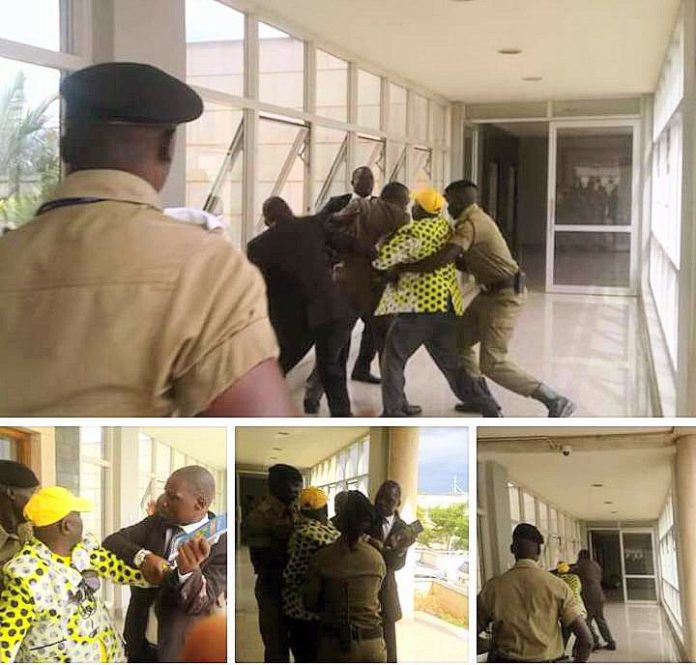
MP Atiku apologises over brawl with Col. Abiriga at Parliament

Scenes of the brawl between MPs Bernard Atiku and Ibrahim Abiriga at Parliament

Ayivu County MP Bernard Atiku has apologised to Ugandans and fellow legislators over ‘misconduct’ at Parliament, following a brawl he had with his Arua Municipality counterpart Col. Ibrahim Abiriga.

Yesterday the two legislators exchanged blows at the entrance of the parliamentary chambers over the controversial lifting of the presidential age limit, ostensibly to pave the way for President Yoweri Museveni to contest for presidency in 2021, when aged over 75.

“I am sorry for whatever happened yesterday, I was dishonorable and unexpected,” Atiku said in an interview at Parliament, adding however, that Abiriga   provoked him.

“I had to reply him in the same behavior,” Atiku said adding that at one time in Arua, Abiriga pulled an AK47 rifle on him.

“From way back Abiriga has been attacking me with strong words. Same thing happened yesterday in the corridors of parliament,” Atiku said, adding: “When you see a mad person throwing stones at you; if you keep running he will continue.”

He further noted that once the debate is open for discussion, they shall engage according to the facts at hand.

The private members bill that is aimed at lifting the presidential cap of 75 years is expected to be tabled tomorrow by the Igara West MP Raphael Magyezi.


Stories Continues after ad