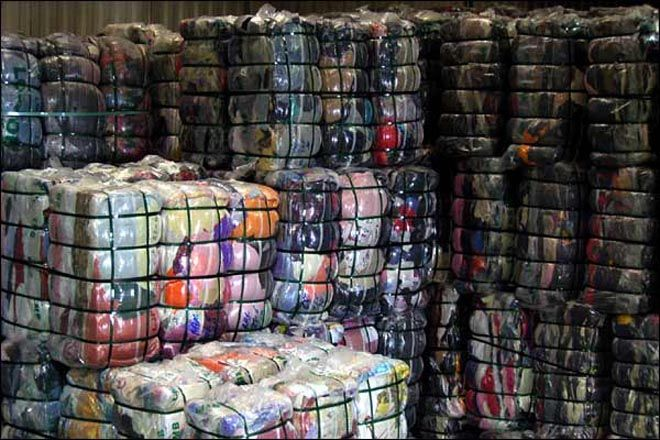
The Uganda National Bureau of Standards (UNBS) has suspended the 15% surcharge for inspecting imported second-hand goods for six months.
The affected second-hand goods are used textile products, footwear and vehicles.
Under the current laws, all used imported vehicles, textiles and footwear must possess a Certificate of Road Worthiness (CRW) from their respective countries of origin. Failure to comply with this requirement results in a 15% surcharge on the Cost, Insurance, and Freight (CIF) value, along with additional Destination Inspection fees.
According to UNBS Executive Director James Kasigwa, during this period of suspension, they will review the Pre-Export Verification of Conformity for Used Commodities charge after receiving many complaints.
“The Uganda National Bureau of Standards (UNBS) has noted the need to put in place a framework to address the challenges met in implementation of US ISO 20245:2017; Cross Border Trade of Second Hand Goods standard,” he said in a statement issued on Tuesday.
“As such, UNBS has waived off the 15% PVoC surcharge for all Used Goods under the General Goods Category except for those products covered under; 1) US EAS 356:2019, Textiles — Requirements for inspection and acceptance of Used Textile products (2nd Edition), 2) US EAS 386:2020, Footwear — Inspection and acceptance criteria for Used Footwear — Requirements (2nd Edition), 3) US 845:2017, Road Vehicles — Requirements for inspection and testing of Used Motor Vehicles for Roadworthiness (2nd edition) /AMD 1:2021,” he added.
Eng Kasigwa said the waiver took effect on October 28,2024 and runs up to April 27,2025. “Consequently, all consignments of used goods shall be subjected to destination inspection during this period. Please note: for used earth moving equipment and used cranes, previous registration and supporting documents shall be required to treat such a consignment as a used commodity,” he added
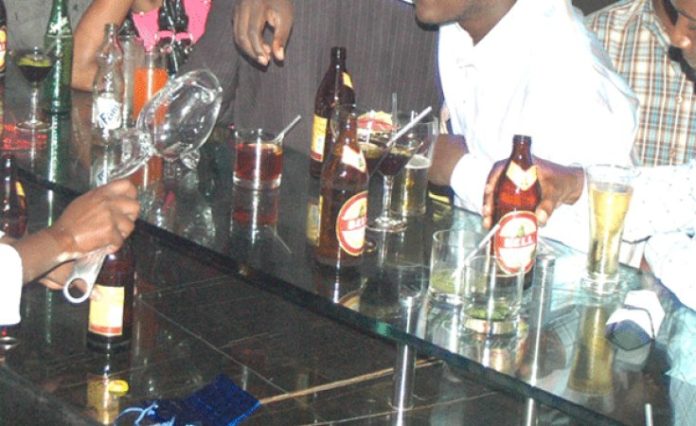
Over the weekend, Frank Mwesigye, a concerned resident, visited Lyakajjula a sub-county in Lyantonde District and was taken aback by the lively, inebriated crowd filling the local bars in the trading center after receiving Parish Development Model (PDM) funds.
“There were people dancing and drinking like it was a holiday. When I asked why, I was told it was because they’d received the PDM money. But these were not the people that the program was meant to support,” he said.
The PDM, an initiative designed to provide financial support to vulnerable households, has instead ended up in the hands of wealthier individuals who already possess assets like 300 acres of land and profitable dairy operations. The funds that could have transformed struggling lives in the community went to those who were least in need.
Mwesigye’s inquiry into the matter revealed an unsettling layer of corruption. “Apparently, getting access to these funds requires ‘connections’ with the area’s PDM coordinator,” he explains.
He adds, “For every million shillings, the coordinator reportedly retains 100,000 as a ‘soda’ to smoothly release the money.”
Mwesigye revealed that the cost of influence has kept the funds from those truly eligible, as evidenced by the fact that only about 1% of intended beneficiaries received their share in Lyakajjula.
Mwesigye’s frustration is palpable as he describes the impact this system has had on his community. He says that residents who were struggling to earn even 100,000 per month were left with nothing.
He adds that the situation in Lyakajjula sub-county, Lyantonde-district is deeply concerning.
“I urge the government to intervene promptly to ensure that the PDM funds truly reach those who need them most. The government should also provide thorough education on how to use the PDM funds and clarify who is supposed to receive them,” he says.
Mwesigye notes that this money is not intended for alcohol but rather for wealth creation and increasing household incomes.
His worry reflects on the way the Anti-corruption has arraigned to the Chief Magistrates’ courts many defaulters of the PDM funds.
The defaulters conspire and defaulters millions of shillings from the beneficiaries of different PDM SACCOS by falsely pretending that the money they were collecting was for PDM activities such as; renting space, buying furniture, printing vouchers, PDM files, appraisals, and photographs among others.
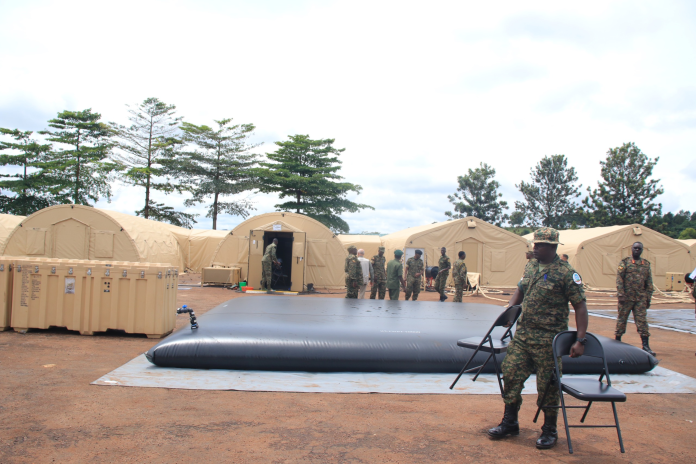
The United States government has donated a fully-equipped level II hospital to the Uganda Peoples’ Defence Forces (UPDF) at the Uganda Rapid Deployment Capability (URDC) Headquarters in Jinja.
Receiving the facility, Commander of the URDC, Brigadier General Peter Gaetano Omola, expressed gratitude to the US government, attributing the gesture to the strong diplomatic ties between the two nations.
“It is a manifestation that our strategic leaders between the two governments are working in harmony for our good,” he remarked.
This donation marks the second level II hospital the US has provided to the UPDF through the African Peacekeeping Rapid Response Partnership (APRRP) program, which began in 2016.
Brigadier General Omola highlighted that the first level II hospital, initially stationed in Bombo for #Covid-19 response, is currently deployed in Mogadishu, supporting UPDF troops in the African Union Transition Mission in Somalia (ATMIS).
The idea, he explained, is for the UPDF to have two level II hospitals: one for training and another for emergency deployments.
Brigadier General Dr Kiyengo, representing Joint Staff Health Services, emphasised the hospital’s advanced equipment for diagnosing and treating patients in areas such as dental, radiology, surgery, X-ray, and eye care.
Dr Joe Bibling, Head of the American experts and manufacturers behind the donation and an Associate Professor in Military and Emergency Medicine at the US Military Medical School, affirmed the program’s purpose to enhance UPDF’s ability to respond to crises across Africa, from natural disasters to peacekeeping. He noted that a level II UN field hospital provides surgical services, an intensive care unit, and general outpatient care, among others.
Uganda, chosen for the donation due to its role as a peacekeeping pillar on the African continent, also received a water treatment plant and incinerator alongside the hospital.
Engineer George William Kiyega is accusing Dfcu bank of fraudulent or illegal transactions that were entered on his land titles.
Kiyega says that in 2009 he gave his land title to Dfcu bank for self-custody, land situated in Bunamwaya plot 7347 block 265 land situated in Kyabago- Kyadondo. He adds that in 2014 he got a project in Soroti and went to the same bank to request for three facilities since it was a legal requirement to furnish a permanent guarantee under UDC which a 10% contract value was.
“The performance guarantee was issued by Dfcu bank, then after the contract had expired and I performed to the satisfaction of the employer,” he said.
A legal battle of 15-year-old client George William Kiyega is now a case study at the law development centre.
He later applied for a second loan of Shs200 million and was given to him under Wills International Engineers and Contractors Limited and another one of Shs220 million and all these facilities were to be secured with land situated at Kyabagabo- Kyadondo. He adds that letters and mortgage documents were signed for proof.
However, to his dismay, he started receiving letters from the bank with notice to sell his land and he detected a sinister move.
“Dfcu wrote to us threatening letters to sell the land on plot 7346 yet I was servicing my loan. When I opened the documents, I observed that there were some fraudulent transactions that I sued the bank,” Kiyega said.
He says when he went to ask for a civil suit, he was ordered to pay Shs210 million within 30 days, which he did through help from his engineer friend.
“I was instructed to pay 50% of the sum which they alleged was outstanding inclusive the Shs73 million which was for the performance guarantee,” he said.
He appealed to the court of appeal and the case was decided in their favor.
“Dfcu bank was ordered again to pay all income balances on plot 7347 and also to pay for the damages on all the fraudulent illegal mortgages,” he added.
Kiyega later wrote to the Bank of Uganda but says his case has never been heard.
The head of communications at Bank of Uganda revealed that they are still monitoring the situation, adding, “We reached out to Dfcu and established that they are working with the customer to address his concerns.”
Kiyega wrote to the Bank of Uganda in protest at the said fraud and forgery allegedly by Dfcu bank, but his matter has been on hold for over a decade now. The Bank of Uganda says they are monitoring negotiations between the two parties.
Dfcu is not new to such controversies, in 2017, it illegally took over and occupied buildings belonging to Meera Investment Limited, it took court orders to chase them and award costs and damages to Meera.
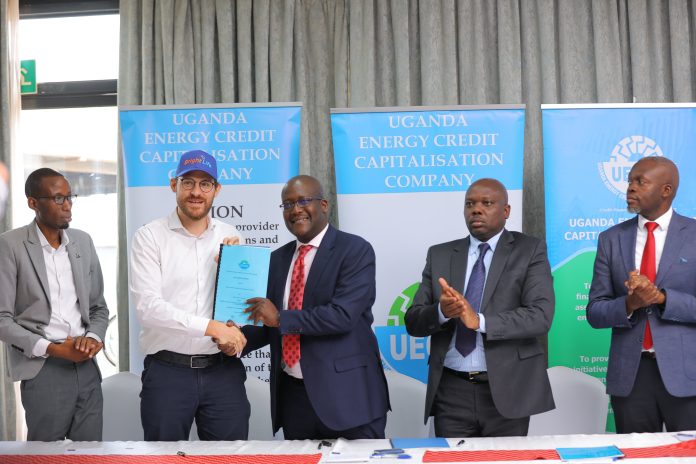
Uganda Energy Credit Capitalisation Company is the Implementing Agency of the Financial Intermediation Component of the Electricity Access Scale up Project (EASP) with a component value of $110 million The project is supported by the World Bank and the Government of Uganda.
The Price Subsidy Program for Clean Energy Technologies (A Results Based Financing Program) is one of the core programs of the project. Under this program, prices for off grid solar systems for lighting and charging, clean cooking solutions and Productive Use of Energy (PUE) as well as Clean Cooking technologies will be significantly discounted to address affordability barrier associated with the upfront cost of acquiring good quality clean energy technologies.
Specifically,
Solar lantern prices will be reduced by 60% and the prices for Solar systems with two lights will be reduced by 50%;
Clean cooking solution prices powered by solar, briquettes, ethanol, biogas and liquefied petroleum gas will be discounted by 30%-50% depending on the technology.
Productive uses of energy equipment such as water pumping, irrigation, refrigeration and cooling, water heating and grain milling will have prices reduced by 60%.
UECCC is partnering with Energy Service Companies and will use market-based approaches to deliver the price subsidies to Ugandans and refugees. The World Bank and UECCC have so far selected eighty-seven (87) Energy Service Companies to participate, and the list continues to grow. The selected companies will have a wide geographical outreach across Uganda and will also be supported to address market entry barriers and make sales in remote areas of Uganda.
The objective of the pre-selection is to ensure that only companies that supply quality products certified by Uganda National Bureau of Standards (UNBS) participate in this program.
Discounted sales operations by the prequalified Energy Service Companies will commence on November 1, 2024. Thereafter, UECCC will undertake country wide regional sensitization and market awareness activities.
Access to the price subsidies will be simple and transparent requiring presentation of a National Identification Card and the ability to pay the price of an eligible product after the government discount. Households will be able to take their products home immediately.
The Original prices and discounted prices for each Participating Energy Service Company will be made public to all Ugandans through various marketing media.
UECCC looks forward to working with all the key stakeholders within the Renewable Energy eco-system for the successful implementation of this important Program that will significantly contribute to the socio-economic transformation of Ugandans.
UECCC is a government of Uganda company set up to catalyse financing for renewable energy projects and increased access to clean and modern energy services.
More specifically, the company was set up to facilitate private sector participation through the provision of catalytic financing instruments and technical assistance to address barriers inhibiting increased access to clean and modern energy services.
The company is well positioned to pool resources from government and development partners and to channel the same to catalyse financing for the development and implementation of RE projects and access programs.
The company then uses the mobilised public resources to leverage private sector participation in the financing of renewable energy projects and access programs.
The company’s interventions are designed to respond to government policies (including the NDP III, NDP IV, & SDG7) and priority programs towards increased access to electricity for lighting, clean cooking and productive uses of energy.
An Oxfordshire woman has been named by police and charged with three modern slavery offences.
Lydia Mugambe, aged 49, of Lyne Road, Kidlington, has been charged with one count of conspiring to do an act to facilitate the commission of a breach of UK immigration law by a non-UK national.
Sources say the lady involved in the slavery charges is former High Court judge in Kampala Lydia Mugambe. She is reported to be studying her PhD in the United Kingdom.
The 49-year-old was also charged with one count of arranging or facilitating travel of another person with a view to exploitation.
Her final charge is one count of requiring a person to perform forced or compulsory labour.
A spokesperson for Thames Valley Police said: “We have charged a woman in connection with a modern slavery investigation in Oxfordshire.
“The charges were authorised by the Crown Prosecution Service and are in connection with a modern slavery investigation involving one victim.”
A trial is set to take place at Oxford Crown Court on Monday, February 10, 2025, listed for three weeks.
Mugambe was charged with the offences on Wednesday, August 7 this year.
The Uganda Law Society (ULS) has recalled its unelected representatives from the Judicial Service Commission (JSC).
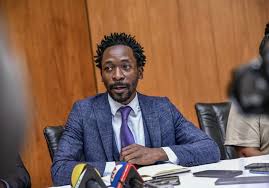
According to Isaac Ssemakadde (picturedabove), President of ULS, the decision is aimed at restoring trust in judicial appointments, ensuring representation that aligns with democratic principles, and addressing public concerns about judicial integrity.
The unelected representatives include Ruth Sebatindira and Norah Matovu Winyi, who have held their roles on the JSC since 2016 without undergoing the election process mandated by ULS regulations.
The recall directive follows a judgement by the High Court in which it challenged the ULS’s appointment practices for its representatives to the JSC and other statutory bodies.
The court found that ULS appointments to these critical roles lacked an electoral mandate, breaching both the 1956 Uganda Law Society Act and the Uganda Law Society (Elections) Regulations of 2016.
This ruling highlighted a critical oversight within the ULS, calling into question the legitimacy of several long-standing appointments and pushing the organisation to confront internal governance issues.
The High Court ruling emphasised that these appointments, made without elections, went against ULS’s democratic requirements, potentially undermining public confidence in the judiciary due to a perceived lack of transparency.
“For our judiciary to serve Ugandans with fairness and integrity, it is paramount that its overseers reflect the collective will of our legal professionals. This recall shows our resolve to hold ourselves to the highest standards of transparency and accountability.” Ssemakadde said
“This recall order is just one part of the ULS’s broader strategy to enhance judicial accountability. Alongside this recall, the ULS has committed to additional reforms within Uganda’s judicial system, with plans to address issues such as merit-based recruitment, public participation in judicial appointments, and thorough vetting processes,” he said.
He said the move has resonated with both legal professionals and the Ugandan public, who have voiced longstanding concerns over judicial transparency and impartiality.
He argued that by returning the power of selection to its membership, the ULS is attempting to re-establish public confidence in the judiciary at a time when trust has eroded due to a perceived lack of transparency in judicial appointments.
The judiciary’s independence and integrity, observers note, are vital to Uganda’s democratic fabric, and the ULS’s actions represent a push toward a more credible and representative judicial oversight body.
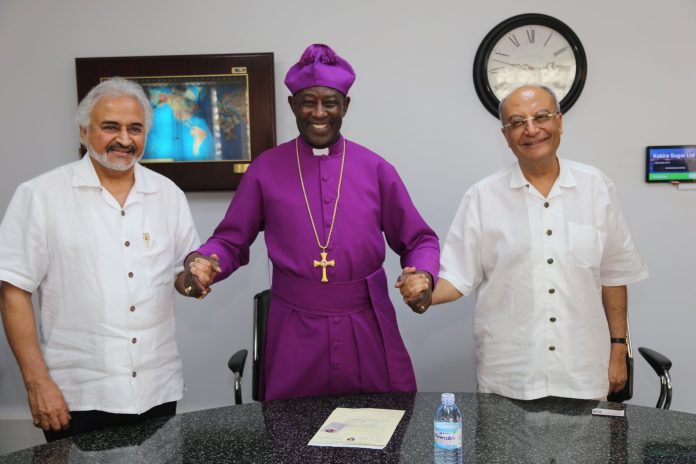
The Archbishop of Church of Uganda, Dr Stephen Samuel Kaziimba Mugalu has commended the Madhivani family, the founders of Kakira Sugar factory for their role in social economic transformation of the country.
Archbishop Kaziimba commended them for supporting the Church in a number of initiatives both within Busoga Diocese where the factory is located and at the Provincial level.
He made the comments yesterday while paying a courtesy visit to the factory in Kakira, Busoga Diocese, where he held a meeting with Management led by Mr. Mayur Madhivani and later toured the operations within the factory.
“Church of Uganda is one of the greatest beneficiaries of their corporate social responsibility. They have shown me a list of churches they support and other projects they want to partner with us.” Archbishop Kaziimba said.
He added, “In 1990 when I was ordained, I was posted to Nakibizi Church of Uganda for four years. I would regularly visit Kakira. Today, the economy is largely connected to Madhivani; Health, Education, Trade, Employment and other sectors.”
Archbishop Kaziimba pledged to invite Bishops of Church of Uganda to visit the factory and discuss strategic partnerships with its Management for better household and community transformation.
Mayur Madhivani, the Joint Group Managing Director decried the moral decay of the neighbouring youth and called for partnership with Church of Uganda to fight against drugs and crime.
“We have done a lot to transform the lives of the people in communities in which we operate. There is still a challenge of some people especially the youth who don’t want to work but want to steal our fuel and other products along the way. Most of these have been addicted to drugs.” Mr. Mayur Madhivani siad.
He added, “We have established schools and community programs to engage them and transform them into better people but many are still in that ungodly lifestyle. We are calling on the Church of Uganda to be our partners in this.”
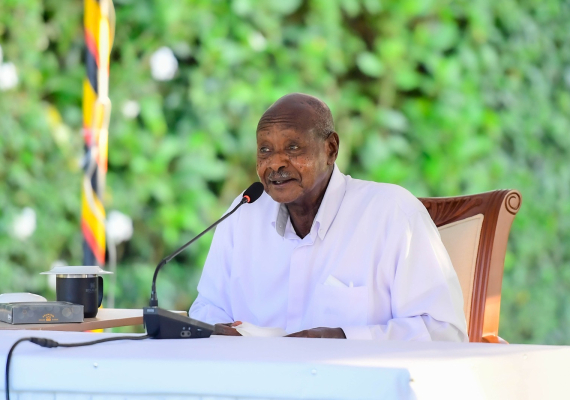
President Yoweri Museveni has taken a strong stance on reducing numerous government agencies and authorities which he describes as “parasitic” and “irrational.”
In an address aimed at clarifying his position on rationalizing these agencies, Museveni argued that Uganda’s ministries are fully capable of handling the tasks currently overseen by redundant agencies.
“Rationalization means doing away with the irrationalities and only doing things that are rational,” Museveni said.
He criticized the historical reliance on a narrow economic model that focused on the 3Cs and 3Ts—coffee, cotton, copper, tea, tobacco, and tourism as a remnant of colonial thinking.
“The NRM will not confine itself to these alone. We are broadening our economy,” he noted, listing over 30 agricultural products from bananas and maize to dairy, fisheries, and even cashew nuts.
Museveni pointed to the recent economic challenges in other parts of the world, particularly the food shortages and high inflation rates triggered by the #Covid-19 pandemic and the Russia-Ukraine war, and highlighted Uganda’s resilience.
“Our inflation rate, at 3% or less, is among the lowest in the world,” he noted, attributing Uganda’s stability to a “broad-spectrum capacity” that includes a range of local products. “While other people in the world are rioting for no food or high food prices, our problem here is low food prices.”
Museveni argued that having a separate agency or authority for each agricultural activity such as coffee, tea, and milk is not only inefficient but also burdensome on the economy due to the added costs of managing these entities. He proposed a more centralized approach, suggesting that technical experts could be grouped within ministries, possibly under a standards department, rather than having separate agencies for each product.
“In this way, you will have safety and quality control, without the baggage of Board members and the other army of administrators,” he said.
Museveni also criticized the leadership of agencies such as the National Agricultural Advisory Services (NAADS), the Uganda Coffee Development Authority (UCDA), and the Dairy Development Authority (DDA), which he believes have failed to understand his “mass-line of prosperity for all.” He introduced Operation Wealth Creation (OWC) to address these gaps, followed by programs like the Parish Development Model (PDM), Emyooga, and youth projects.
“It is criminal for these agencies to interfere with our mandate as the elected leaders of the country to propose adjustments to achieve the goals of socio-economic transformation,” he stated emphatically.
One of his core arguments against agency proliferation was financial. He noted that in 2016/2017, these agencies consumed Shs2.2 trillion, a sum nearly matching the Shs2.6 trillion allocated to ministries.
“The activity-specific agencies that we have been having in a broad-spectrum economy, is a defective formula and not serious,” he added, pointing out that ministries and departments have broader structures and expertise to handle production, quality control, disease management, and value addition for agricultural products.
Museveni drew attention to Uganda’s unique agricultural achievements, attributing some of the progress to individual farmers and Ugandan ingenuity. “Who reared the Ankole cattle that are a global hit? It is us,” he said, proudly mentioning that one of South African President Cyril Ramaphosa’s Ankole bulls was recently sold for Shs370 million ($100,000).
With this directive, Museveni addresses his commitment to a streamlined government focused on service, efficiency, and self-sufficiency, aiming to build a “vertically and horizontally integrated economy” that serves the needs of Uganda’s people.
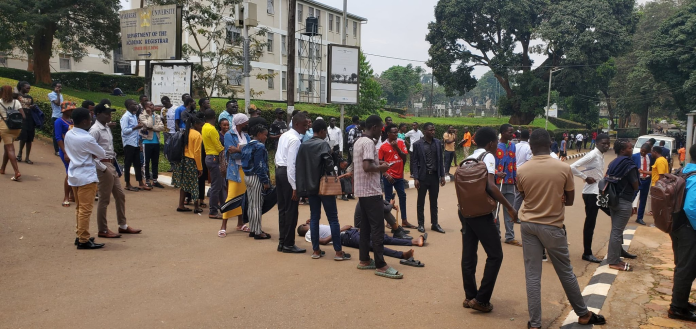
Makerere University students pondering on the next move after government failing to remit food and housing allowances.
Government-sponsored students at Makerere University are facing severe challenges as essential food and housing allowances have gone unpaid for three months, leaving many in starving circumstances.
Numerous students have reportedly been forced to skip meals or have even been expelled from hostels due to unpaid fees. The crisis is escalating, with reports of students collapsing from hunger and needing urgent medical attention.
The university administration cites a budget cut as the cause of the crisis. According to the Bursar, Mr. Evarist Bainomugisha, Makerere University experienced a government-imposed budget reduction of Shs25.9 billion, affecting essential allocations, including those designated for student allowances.
“This is what we have been telling you all along,” Mr. Bainomugisha stated in an audio recording shared with the students.
“The money in the budget was cut by the government… We appealed to [the government] to reinstate that money because it included the money for student allowances. That is the challenge we are receiving. They promised that they are going to reinstate it but there is a process that they have to go through.”
In response, the Dean of Students, Ms. Winnie Kabumbuli, issued a letter contradicting Mr. Bainomugisha’s statements. However, for the students, the confusion only adds to their frustrations as they continue to wait for clarity and support from the university and government bodies.
Pastor Martin Ssempa, an outspoken Makerere alumnus and advocate for student welfare, highlighted the urgency of the situation.
“How can you fund Sh8 billion for the repair of the dilapidated Mary Stuart hall or continue to build the university wall and fail to pay half that amount for the student food and housing allowances?” he questioned.
He criticized the prioritization of infrastructure development over what he termed “critical life-saving priorities.”
Pastor Ssempa further condemned the funding allocations, noting that approximately “95% of the students report missing meals because they don’t have money or can’t afford the food.”
He urged university officials, including the Vice Chancellor Prof. Barnabas Nawangwe and Lorna Magara, Chair of the University Council to consider the immediate needs of the students over long-term infrastructure projects.
He also called on authorities to reevaluate the Shs4,500 daily allowance set in 2015, pointing out its inadequacy in light of current economic conditions. Citing a study by Cassius Omoro, Ssempa noted that the outdated amount covers only “30% of what is needed for daily student survival.”
Pastor Ssempa and other stakeholders are seeking an urgent meeting with university officials to discuss solutions.
“We can do both a physical or virtual meeting. I stand available along with many students, and concerned parents, alumni, and mentors,” he stated.
Speaking to one of the affected students, said that some students were paid full amount of internship allowances though he never disclosed the exact colleges that received and other students have never received any money.
He added that the majority received Shs350, 000 and Shs450, 000 and Shs90, 000 on their bank accounts during the start of the semester.
“There are students who received Shs350, 000 and Shs450, 000 and Shs90, 000 as food allowances and others received money in cash as the administration notified them that they are still clarifying the system. The most affected are those in first years as most say they received only Shs90, 000,” said a student who preferred anonymity.
Another embattled student (girl) in year one decried the delay to receiving the allowances and revealed that she never got in the first batch.
She went to the office of the students’ affairs and was told that she has to wait until the government releases the money to the University; it will then be disbursed to the bank account.
“The man in the students’ affairs office told me that my allowances are not yet paid. But when the government sends us the money we shall pay you that he didn’t tell me in which period. I survive on God’s mercy because I have no job to earn me a living. I only call my mother to send me money and she also doesn’t have much,” she narrated.