Wayne Rooney, the Everton and former Manchester United striker, has announced his resignation from international football, after receiving a call to the England team by coach Gareth Southgate to appear in upcoming World Cup qualifiers against Slovenia and Lithuania.
“It was great Gareth Southgate called me this week to tell me he wanted me back in the England squad for the upcoming matches,” Rooney said in his statement. “I really appreciate that.
“However, having already thought long and hard, I told Gareth that I had now decided to retire for good from international football.
“Playing for England has always been special to me. Every time I was selected as a player or captain was a privilege and I thank everyone who helped me. But I believe now is the time to bow out.”
Rooney also spoke about his decision to return to his boyhood club Everton from Manchester United and how the Merseyside club is going to be his main priority.
“Leaving Manchester United was a tough call, but I know I made the right decision in coming home to Everton,” he said. “Now I want to focus all my energies on helping them be successful.”
Rooney made a total of 119 appearances for the Three Lions, scoring 53 goals, while also captaining the national team on 22 occasions.
Mathew Kanyamunyu leaving the High Court today after his bail application was rejected
High Court judge Yasin Nyanzi has refused to grant bail to jailed murder suspect Mathew Kanyamunyu.
Kanyamunyu, who is accused of killing social worker Kenneth Akena Watmon on November 12 last year, has so far been denied bail for three times. Akena died at Norvik Hospital on November 13.
And in his ruling today Justice Yasin Nyanzi, who presided over the bail application hearing, said Kanyamunyu has right to apply for bail as many times, but not before same judge, under similar circumstances.
Mathew Kanyamunyu, the Executive Director of Quantum Express Logistics, is facing the murder charge with his brother Joseph Kanyamunyu and lady friend Cynthia Munwangali, the latter two who were granted bail on March 27 by Justice Nyanzi.
Previously, Mathew Kanyamunyu had presented Moses Karuhanga, Julius Kanyamunyu, Timothy Tumusiime and Stella Barungi Karuhanga as his sureties, but the state objected to the bail application, arguing that nothing has changed to compel court to change its earlier decision.
US Ambassador to Uganda Deborah Malac, Power Africa Coordinator Andrew Herscowitz and Hon. Irene Muloni, Minister of Energy and Mineral Development, award CEO of CODE Uganda.
The U.S. African Development Foundation (USADF) in collaboration with partners Power Africa and GE has announced the two winners of the 2017 Women in Energy Challenge in Uganda, who will get a combined grant of US$200,000.
The Joint Energy and Environments Projects (JEEP) and Conservation and Development Uganda Limited (CODE) will each be awarded a grant of $100,000 to expand their renewable energy enterprises to reach women beneficiaries in the country, where only 20% of the population is connected to electricity. The Women in Energy Challenge, part of the Off-Grid Energy Challenge, was launched in 2016 by USADF and GE to identify and accelerate enterprises either led by women or benefitting women, and help African entrepreneurs compete in the global economy. The Off-Grid Energy Challenge is a part of Power Africa’s Beyond the Grid initiative, which aims to drive private investment in off-grid and small-scale renewable energy solutions. By funding energy entrepreneurs, USADF is bridging the energy gap for some of Uganda’s most vulnerable populations.
Dr. Maria Bawabya Senkezi, JEEP’s chairwoman, says investing in women entrepreneurs is critical because “women invest money back into the community.”
The US African Development Foundation is the only US agency dedicated entirely to Africa, and solely funding 100% African-owned businesses and African entrepreneurs. USADF aims to promote innovative solutions that increase access to reliable, affordable and sustainable power – particularly for vulnerable populations who will have little to no access to grid power.
“We launched this Women in Energy Challenge to find the best and the brightest female entrepreneurs that are making a difference in bringing electricity to rural communities. We are very pleased to see that these women-led enterprises are showing promise in finding alternative solutions to Uganda’s energy crisis,” says C.D. Glin, USADF President and CEO.
“Providing energy access to Africa’s population is a priority for us,” said Jay Ireland, President & CEO of GE Africa. “The Women in Energy Challenge is one of our commitments towards supporting local entrepreneurs and we are delighted that African women-owned enterprises are solving local challenges.”
In Uganda, where USADF has a $5 million co-funding agreement with the Government of Uganda, USADF has awarded three Off-Grid Challenge grants to energy enterprises. Since 2013, USADF has partnered with GE and Power Africa to fund over 70 off-grid energy companies in nine countries in Africa, and invested over $7 million in Africa’s energy entrepreneurs, which has already resulted in over 20,000 actual connections benefitting over 100,000 people. To learn more about the USADF Off-Grid Energy Challenge.
About the winners:
Joint Energy and Environments Projects (JEEP) is a 100% women-owned enterprise in central Uganda. With a $100,000 grant, it will install 6 green power units in Kalangala district, a remote island district in Lake Victoria. Fishing is the main industry in this island district in Lake Victoria, but commercial ice to preserve fish is both expensive and limited. As a result, a significant amount of fish is lost before it can be sold in the market. The 6 green power units which JEEP establishes will each have solar-powered cold storage facilities for preservation, phone charging and solar home systems for sale, and each will be run by a women’s group trained in bookkeeping. The green power units will each repay a portion of their profits to JEEP to be used to replicate the model throughout the region. This will not only provide local jobs, but will increase incomes for local women.
Conservation and Development Uganda Limited (CODE)is a majority-women owned enterprise in western Uganda where surrounding national parks limit the amount of available firewood, and as a result, women bear the brunt of energy poverty, walking long distances in search of firewood and cooking fuel. Through the grant, CODE will sell an initial 350 Agro-Eco kits using a flexible repayment financing model, which will provide alternative and safer fuel sources. Using a low-cost distribution system using Village Savings and Loan Associations, CODE will collect revenues and expand their business to impact more and more households in the region.
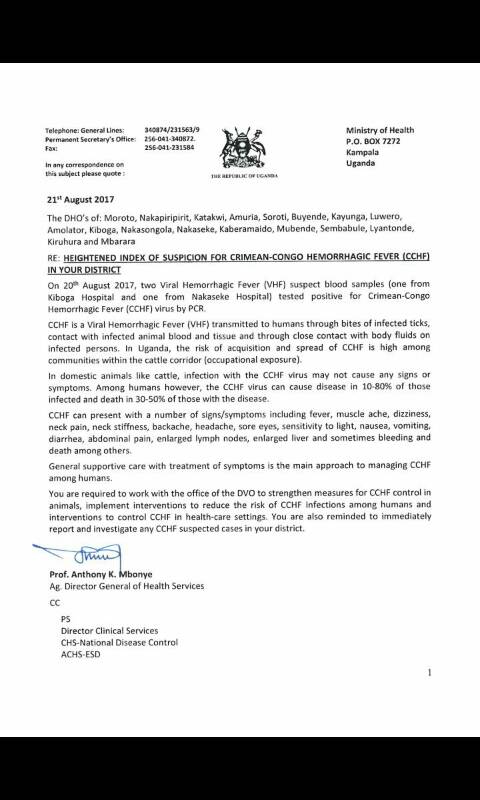
ISSUED WARNING: Prof Anthony Mbonye, the Acting Director General of Health Services
The Acting Director General of Health Services Prof. Anthony Mbonye has written to the District Health Officers of 18 districts in the ‘cattle corridor’, warning them about a possible outbreak of the deadly Crimean Congo Hemorrhagic Fever (CCHF).
The warning letter to the District Health Officers
According to Prof. Mbonye, two positive cases of the Viral Hemorrhagic Fever (VHF) were detected in samples from Nakaseke and Kiboga hospitals on August 20. He said the CCHF can be transmitted from infected animals to humans through tick bites.
The susceptible districts are Amolatar, Moroto, Nakapipirit, Katakwi, Amuria, Soroti, Buyende, Kayunga, Luwero Kiboga and Nakasongola. Others are: Nakaseke, Kabermaido, Mubende, Sembabule, Lyantonde, Kiruhura and Mbarara.
‘You are required to work with the office of the DVO (District Veterinary Officer) to strengthen measures for CCHF control in animals, implement interventions to reduce the risk of CCHF infections among humans and interventions to control CCHF in healthcare settings. You are also reminded to immediately report and investigate any CCHF in your districts,’ Prof. Mbaoye’s letter dated August 21, reads in part.
State Minister for Finance in charge of General Duties David Bahati
State Minister for Finance in charge of General Duties David Bahati has urged Ugandan youth to avoid tendencies that could lead them into corruption. According to the Minister, the Ugandan youth who make up of 78 per cent of the population have energies that they can instead use to prosper.
“Do not be greedy. It is possible to make money at a young age, but through the right process,” Bahati, who was chief guest at a youth conference held today at the Hotel Triangle in Kampala, said.
The conference was held under the theme, ‘African solutions to African problems’. “We Africans must solve our problems, and young people have a key role to play,” Bahati said, and called upon the youth to be innovative especially in ICT, saying the government approved Shs 15 billion towards innovations..
According to Minister Bahati, other than depending on external donors, the government will mobilise domestic resources to fund its activities. “If you’re making your budget as a homestead and you expect 40% to be covered by your neighbor then there is a problem,” the minister illustrated.
Expounding on donor influence in Africa, Minister Bahati said Africans need to make their own laws based on local situations. “We need to have laws that are not influenced by foreigners,” he said.
The Executive Director of Advocates Coalition for Development and Environment (ACODE), Dr Arthur Bainomugisha, while addressing participants at the gathering said Uganda and Africa in general face the challenge of high youth unemployment.
He also said corruption in government was a major setback to Uganda’s development, urging that it can be reduced to minimal levels.
“Corruption is like prostitution and poverty. They can be reduced to a level that does not destroy society,” Bainomugisha said.
Bainomugisha also criticised the World Bank and the International Monetary Fund (IMF) for what he called unfavourable policies towards Africa.
“The World Bank and IMF have terribly misadvised Africa; whenever we are about to get somewhere, they divert us,” he said.
Dr Bainomugisha also urged African leaders to maintain peace and security as way of encouraging investments. “Money hates noise.” We must silence the guns such that when money makes its way to Africa, it finds peace,” he said.
The youth conference was also addressed by other senior personalities from the private sector and the civil society.
The spokesperson of the Tabliq sect Sheikh Siraj Kifampa has criticized the government over the life sentence given to three faithful including their leader Amir Umar Sheikh Kamoga Yunus, for terrorism.
Yesterday, Sheikh Kamoga Yunus together with Sirajje Kawoya, Multa Bukenya and Fahad Bukenya were sentenced to life imprisonment, while Sheik Yusuf Kakande and Fahad Kalungi were sentenced to 30 years in prison by three judges of the International Crimes Division (ICD) of the High Court led by Justice Ezekiel Muhanguzi. The other judges on the panel were Jane Kiggundu and Percy Tuhaise.
Sheikh Kifampa said the four were wrongfully convicted, adding that the government is witch-hunting Muslims.
“The sentence means Islam is still a problem to this country,” Sheikh Kifampa said, adding that “the sentence that was delivered means Uganda is a country which has not reconciled with her people.”
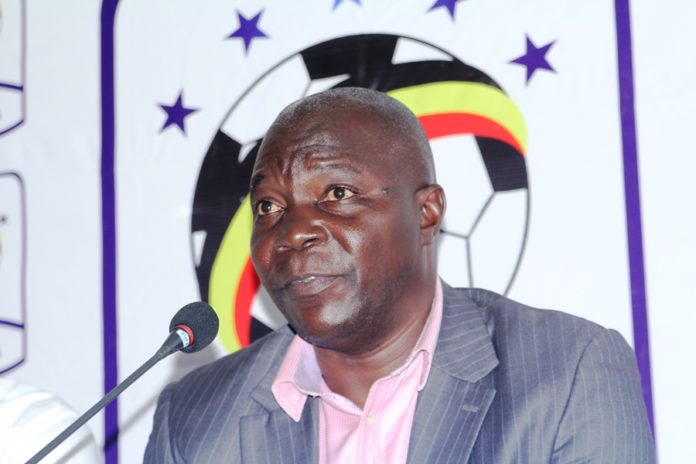
The Uganda Cranes interim coach Moses Basena addressed the media during a press conference held at FUFA House in Mengo, Kampala on Wednesday afternoon, naming 27 players for the upcoming 3rd 2018 World Cup qualification match against Egypt.
According to Basena the players will later be trimmed to 18 players.
Kizito Luwagga returns to the squad after he promised not to play for the national team again if Micho is the coach after the AFCON campaign in January.
The team will continue with the training sessions at Mandela national Stadium, Namboole today evening with the available players. The foreign-based players will join with the team over the weekend.
The first leg will be played on Thursday, 31 August at Mandela National stadium.
This weekend, the team will travel for the national team regional tours in North East (Bukedea).
Previously the Cranes have also visited the Western Region (Mbarara), North East (Soroti), Northern (Gulu), Kitara (Masindi), West Nile (Arua), Buganda region and the Eastern Region (Mbale).
Egypt currently leads Group D with six points, followed by Uganda with four points, Ghana with one point, and Congo with zero points.
Named Team:
Goalkeepers: Dennis Onyango (Mamelodi Sundowns, South Africa), Robert Odongkara (St George, Ethiopia), Ismail Watenga (Vipers), Benjamin Ochan (KCCA)
Defenders: Nico Wakiro Wadada (Vipers), Isaac Muleme (KCCA), Timothy Dennis Awany (KCCA), Murushid Juuko (Simba, Tanzania), Bernard Muwanga (SC Villa Jogoo), Geofrey ‘Jajja Walu’ Walusimbi (Gor Mahia, Kenya), Dennis Iguma (Al Ahed, Lebanon), Paul Musamali (KCCA), Isaac Isinde (Buildcon, Zambia)
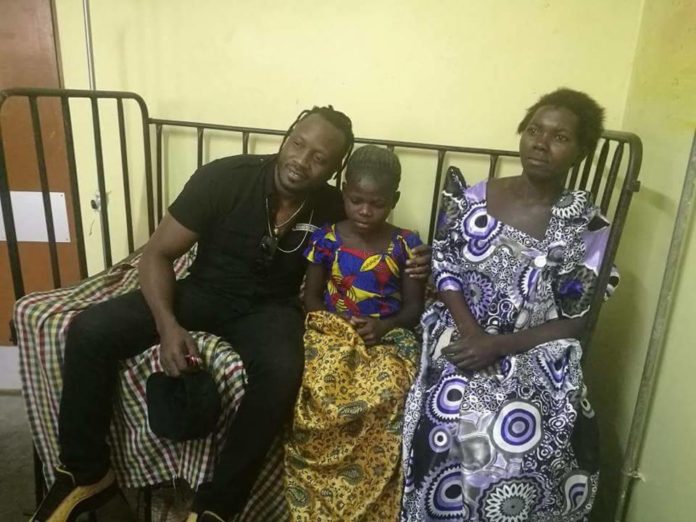
Bebe Cool with 5-year old Brenda Kyazike from Iganga, and the girl's mother
Popularly known for his music, it appears Bebe Cool’s other gift from God is having a big heart. Indeed, not a year passes without the ‘Go Mama’ musician helping those in need.
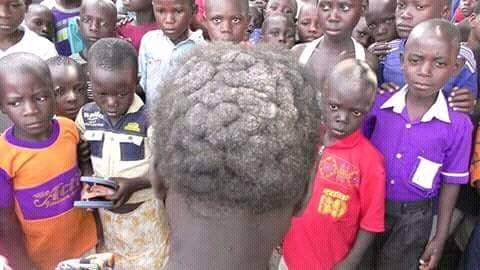
The girl’s medical condition
Well, on the backdrop of helping save baby Kayla, we have learnt that Bebe Cool has taken on an initiative to save another child; 5-year old Brenda Kyazike from Iganga, to get treatment for a rare condition medically known as Cutis Verticis Gyrata.
And two weeks ago Kyazike was brought to Mulago together with her mum by Bebe Cool and it’s the musician who has been footing their bill for the period they have been in hospital.
Kyazike is now set to undergo plastic Surgery at Kiruddu hospital and Bebe Cool has still pledged to pay all the bills.
In the second part of the series on the Uganda Women Entrepreneurship Programme (UWEP), The EagleOnline brings you the success story of the women engaged in Cocoa buying in Bundibugyo.
Women stroll down the hills in droves to Harugale sub county headquarters Bughendera County in Bundibugyo district. They are members of one of the groups that have received funding from the Uganda Women Entrepreneurship Programme (UWEP) and sister programme Youth Livelihood Programme (YLP) to start enterprises of their choice.
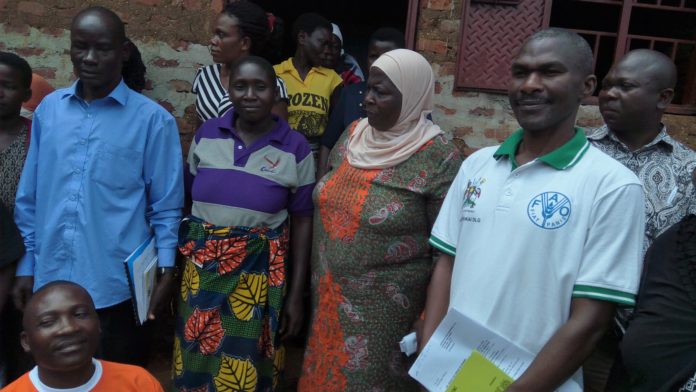
The Minster of Gender Hajat Janat Mukwaya (holding stick) addresses beneficiaries
They gather at the sub county headquarters to welcome the minister of Gender Labour and social development Hajat Janat Balunzi Mukwaya, whose ministry is responsible for the programmes. The minister has been on a performance monitoring visit in the districts of Kasese, Bundibugyo, Kibaale and Kyenjojo, all in Midwestern Uganda.
Like in other parts of the country where the Minister has been on performance monitoring visits, women are always happy to receive and thank her especially because their groups have been funded or are lined up for funding.
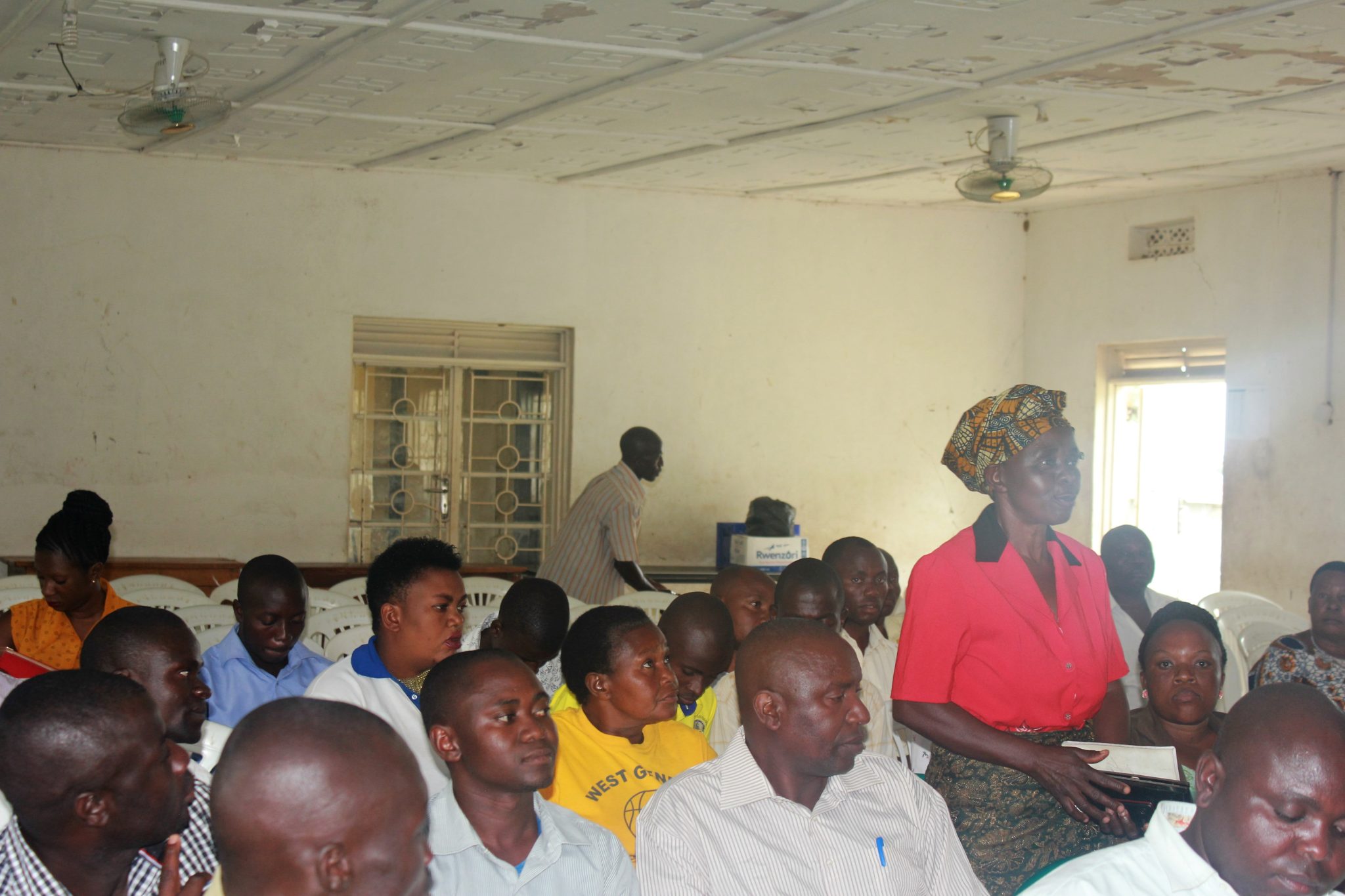
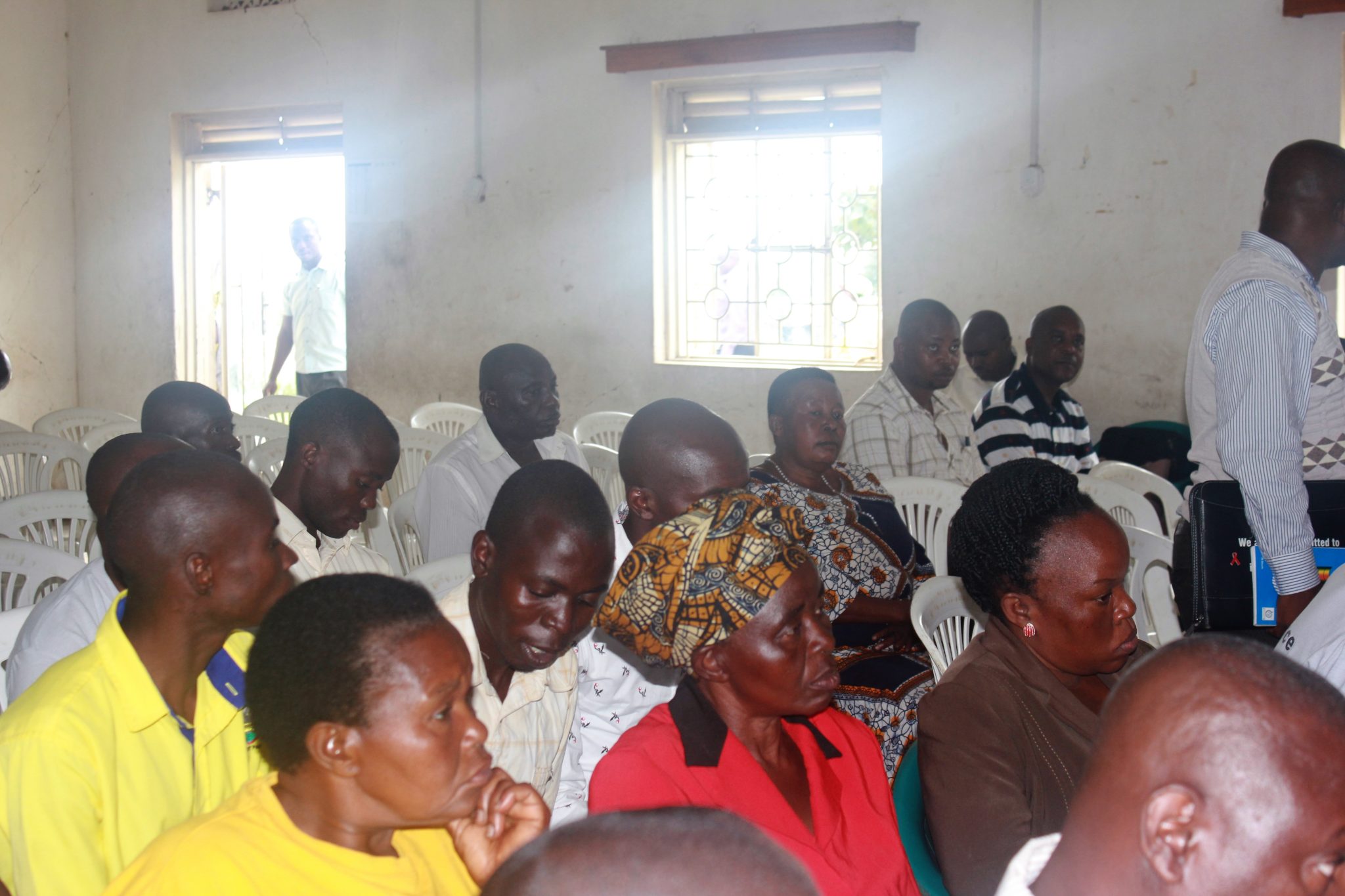
A member makes a contribution on the floor
But at the Harugale sub county meeting, there is this aging woman who will not hide her appreciation that government is finally extending support women to start business. She is not a direct beneficiary of the programmes though. The woman, later identified as Biira Kihire Mukirane, pushes her way to the front and raises her hand: “Honorable minister I am not a member of any of the groups that received funding, but a neighbor to some beneficiary group members,” she says.
There is a bit of silence in the hall with participants wondering about what complaint she is about to make.
“Honorable minister when the beneficiaries get money all of us in the community benefit, they have been buying my produce such as vegetables and I benefit that way. Thank you very much, we are very happy that is why I came,” says Ms. Mukirane.
65 year old Kabugho Dorisi, a member of North Rwenzori Development Initiative Group in Izahura village Bupomboli Parish of Harugari Sub County is all smiles. Her group received five million shillings from the Uganda Women Entrepreneurship Programme and they have since ventured into Cocoa buying.
“I used to suffer a lot but now I can buy some fish; I could not afford that before” says Ms. Kabugho.
Kabugho’s husband passed on and by virtue of being a widow she took charge of the family cocoa plantation but her problem was how to survive between Cocoa seasons which occur only once a year. It was hard, she says, adding that besides being aged she also needed money to pay people to help harvest the crop.
In Bundibugyo its common practice for business people to pay off a Cocoa plantation owner in advance and wait for the harvest. So when her group received money from UWEP they did not look far because Ms. Kabugho was willing and ready to hire out her plantation to the group.
Members of the group listen to a presentation by one of the Ministry officials
Against such a background, Minister Mukwaya says once the women are empowered homes improve.
“Men are always thinking of big things like buying a motorcycles and bicycles etc but things like salt, cooking oil or even onions and fish as in the case of Dorisi will not bother them,” the Minister says.
She also thanked the residents for feeding their children well.
“You know I am also minister for children and I have noticed the children are looking healthy. If a child is not fed well (to 3 years) after that even if you give them a whole chicken you will be wasting time; the damage will have already been done,” says Minister Mukwaya, herself a mother and grandmother
Jacqueline Kunira, another member, is on the road to becoming a house owner at 36 years. For a woman in Bundibugyo that is no mean achievement. The Cocoa business has been booming and indeed there are visible signs if the brick and iron sheet houses on the hills are anything to go by.
Unfortunately, this is not equitably trickling down to the women because most of the Cocoa plantations belong to the men and in effect, the houses accrued from the proceeds.
However, thanks to funding from the Uganda Women Entrepreneurship Programme (UWEP) the women are positioning themselves to tap into the Cocoa wealth.
Indeed, if they cannot own the plantations for now, at least they are able to buy and sell the cocoa to big companies or hire a plantation for some time and get the proceeds.
I recently made a deal with my children that I would reward them if they performed better than they did in previous terms. We agreed that for every subject done, if they scored 90 per cent, I would give each of them Shs20,000 and Shs10,000 for a score between 80-89 per cent.
I didn’t know the gravity of the financial challenge I had put myself into until my four girls told me I owe them about Shs400,000. True to the dare, they had worked hard and scored highly, putting my pockets into unexpected financial loss, albeit my happiness at their performance.
That scenario is akin to the Pay for Performance (P4P) approach that has dominated discussions on how to improve health system performance in Uganda. Under the P4P system, health workers, health facilities or service providers enter an agreement to be paid a specific amount of money upon achieving specified service outputs. Put differently, under this approach, providers are paid according to the amount of work done.
Absenteeism of health workers, low motivation to work, poor quality services, poor attitude towards work and poor customer care, etc., are among the challenges often reported in Uganda’s health system. It is not uncommon for doctors in some health facilities to work two days a week instead of five. Under the P4P system, such doctors would qualify to be paid for only two days.
To qualify for better or higher pay, the healthcare provider must use innovative strategies to attract more clients, such as providing quality service, full-time availability, customer care, etc. This approach is a good mechanism to get the best out of healthcare workers and also offers better value for the money allocated to the health sector.
Pay for Performance is being piloted in a number of districts in Uganda.
I recently had a chat with the District Health Officer of Kibuku District, Dr Ahmed Bhumba. He indicated to me that for 2017/2018, all health facilities in the district will get 60 per cent of their money as budgeted, and 40 per cent will be paid to the facility based on its performance. Performance indicators that will be monitored and measured include maternal deliveries and outpatient attendance.
With P4P, health workers and facilities will pay more attention to data on what activities they are undertaking since it forms the basis for payment.
However, a key challenge may arise from the implementation of P4P. Using the example of my girls, I did fulfill my pledge and paid what I owed them. I didn’t have the time to scrutinize their exam scripts to see if there were issues that needed addressing, however minimal. I trusted their word. But what if they had lied about their performance altogether? Similarly, health facilities may be tempted to manipulate data so that they earn more money. As such, stringent measures of monitoring, supervision and verification of claims before payment, must be made to avoid manipulation and fraud.
It is also important that resources such as electricity, water, theatre and equipment, medicines, etc., are made available in health facilities to ensure functionality and provision of quality service.
The money promised for excellent performance must also be paid in a timely manner so that health workers don’t get demotivated. A culture of trust is crucial in ensuring both sides deliver their part of the bargain.
Elizabeth Ekirapa Kiracho is a health economist – SPEED project, Makerere University School of Public Health.