Stanbic Bank
Stanbic Bank
16.3 C
Kampala
Stanbic Bank
Stanbic Bank
Home Blog Page 1797

DP to drag KCCA to court over death of vendor

Olivia-Basemera-a-single-mother-of-3-street-vendor-drowned-in-Nakivubo-Channel-

The Democratic Party (DP) has threatened to drag the Kampala Capital City Authority (KCCA) to court over the death of Olivia Basemera, a street vendor who met her death after drowning in the Nakivubo Channel while being pursued by KCCA law enforcement officers last Friday.

Addressing the press earlier today, the DP Acting Secretary General Gerald Siranda said the party is set to hire a group of lawyers to take legal action against KCCA if Ms. Basemera’s family is not compensated for her death.

“A single mother of three children, Olivia Basemera has been paying school fees, taxes for every commodity she purchased be it fuel, food, clothes among other commodities,” Dr. Siranda said before castigating KCCA’s law enforcement operations.

An almost similar death incident occurred in November 2014 when a two-year old boy, Ryan Semaganda, was crushed to death by KCCA vehicle at the authority’s premises when his mother had been arrested and arraigned before court for hawking merchandise along Kampala Street.

Under KCCA bye-laws street vending is prohibited and anyone caught in breach is subjected to pay fine or face imprisonment for not more than two months.


Stories Continues after ad

Uganda Cranes face Tanzania’s Azam FC in test match

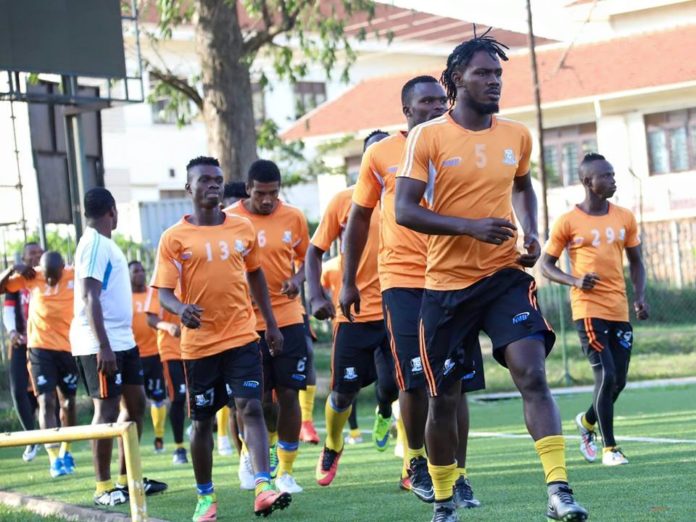
READY: Azam FC squad during training at StarTimes Stadium ant Naguru

As Uganda Cranes continue preparations for the upcoming CHAN 2018 qualification matches against neighbours Rwanda due on August 12 and 18, the national team will play a friendly match with Azam FC of Tanzania today.

Azam Football Club FC is camping in Uganda for a ten-day visit and will also some local teams including Ugandan league champions KCCA FC, URA FC, Arua based club Onduparaka and Sports Club Villa before returning home for the new domestic season.

Meanwhile, the first leg between the Cranes and Rwanda’s Amavubi stars will be played at St. Mary’s stadium in Kitende, while the return leg will be played at Kigali Regional stadium, Kigali. The winner of the encounters is guaranteed a place in the final CHAN tournament that will take place next year in January.

Cranes began new life without tactician Micho Sredjovic and interim coaches Moses Basena and Fred Kajoba are now in charge of the team. Basena and Kajoba had been deputizing Micho and now enter a week since they took over the national team that is shifting its training to the Kitende stadium until the match day on Saturday August 12, 2017.

The CHAN tournament is reserved for players who feature in their respective domestic leagues across Africa, will be staged from January 11 to February 2, 2018 in Kenya.


8 August 2017

Uganda Cranes Vs Azam F.C (Tanzania)

St Mary’s Stadium, Kitende (4 pm)


Available cranes squad:

Goalkeepers: Benjamin Ochan, Ismail Watenga, Tom Ikara and Keni Saidi

Defenders: John Adriko, Bernard Muwanga, Savio Kabugo, Paul Musamali, Isaac Muleme, Nico Wakiro Wadada, Rashid Toha.

Midfielders: Muzamiru Mutyaba, Shafiq Kagimu, Simon Sserunkuma, Erisa Ssekisambu, Deus Bukenya, Tom Masiko, Frank Tumwesigye, Moses Waiswa

Strikers: Nelson Sentakuka, Paul Mucureezi, Derrick Nsibambi, Muhammed Shaban

Stories Continues after ad

DP trains supporters to resist police during countrywide anti-age lifting campaign

DP Acting Secretary General Dr. Gerald Siranda

The Democratic Party (DP) has trained ‘boys to resist police brutality’ during the party’s planned countrywide campaign against lifting of the presidential age limit that is capped at 75 years under the 1995 Constitution.

According to the DP and sections of the populace, there is a plot by the National Resistance Movement (NRM) government to amend Article 102 (b) of the Constitution, in a bid to pave the way for President Yoweri Museveni to rule beyond his constitutional age limit in 2021.

But addressing the press at DP headquarters in Kampala today, the Acting Secretary General Gerald Siranda said Article 102(b) is ‘the only bullet in chamber’ to end ‘Museveni’s monarchism’ and lead to a peaceful transition of power.

He said that as part of the anti-age lifting campaign, members of the DP led by party President Norbert Mao and involved in campaigns in the Central Business District (CBD), were violently arrested and detained by police. He however, said that party officials are not deterred and will head for the Bweyogerere suburb on Thursday, before proceeding to Jinja, eastern Uganda.

“The police is a partisan institution when it comes to political issues; police officers wear catchy uniforms with yellow t- shirts inside,” Mr.  Siranda adding that last week eight DP members were critically injured by police.

“This time we shall not tolerate the acts of incompetent police. Therefore the party has trained boys to confront police in case they disrupt their campaign,” he said and implored President Museveni “to retire after this term and looks after his cows.”

Dr. Siranda also urged political activists to show support to William Ntege aka Kyuma Kya Yesu, who accosted Kassanda MP Simeo Nsubuga, a protagonist for lifting of the age limit, during the Kabaka Ronald Mutebi’s 24th coronation ceremony in Mityana last week.

Kyuma kya Yesu, who is facing assault charges, was arrested on Monday and is currently held in Mubende, where he is expected to be arraigned before court tomorrow.

“Activists should go to Mubende and stand surety for Kyuma kya Yesu who stood in the way against malicious leaders spearheading the lifting of the presidential age limit,” he said, adding that the DP had assigned lawyer Richard Lumu to represent Kyuma kya Yesu.


Stories Continues after ad

Zuma rallies ANC MPs ahead of ‘no confidence’ vote

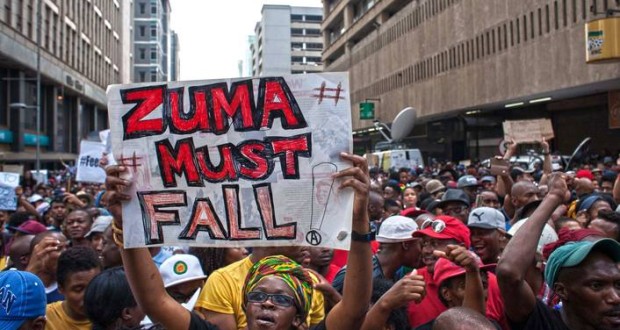
ANTI-ZUMA PROTESTERS! South African protesters against President Jacob Zuma's rule

President Jacob Zuma has made an appearance at the ANC’s caucus meeting in Parliament this morning ahead of the motion of no confidence against him.

Zuma, flanked by bodyguards, used an alternative entrance to enter the Old Assembly chamber where the 249 minus three MPs will meet to discuss the motion.

It will be held via secret ballot in the National Assembly later on Tuesday. The debate will start at 14:00.

It was the same entrance Zuma used to attend the party’s caucus meeting before the previous motion of no confidence back in November.

In what may be seen as a show of force, both Zuma and ANC secretary general Gwede Mantashe were in the meeting on Tuesday.

MPs are expected to be read the riot act on how to vote when they cast their ballots in secret, with chief whip Jackson Mthembu declaring the party line as being firmly against the motion.

ANC MPs must not support the opposition’s motion, he had said on Friday.


Stories Continues after ad

Kenyans go to polls

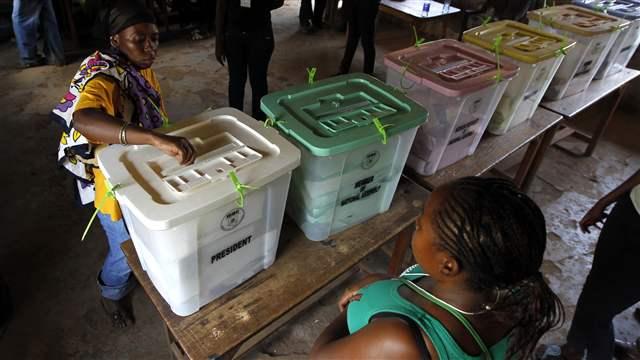
Ballot boxes at an election post in Kenya. The EA country is holding Presidential Elections today.

Kenyans are casting their votes to elect a president and a new parliament following weeks of campaigning and claims of a plot to rig the results.
Polling began at 6.00am and is expected to end at 5.00pm with results to be announced within seven days.
More than 19 million voters have registered to cast their vote in Tuesday’s election in 40,883 polling stations across the country. Polling stations were crowded from the early hours of the day, with some voters queuing from 1am despite chilly weather of 15 Celcius degrees.
President Uhuru Kenyatta, 55, is seeking a second and final five-year term in office and faces stiff competition from an opposition coalition led by veteran politician Raila Odinga.
Odinga, 72, is running for the presidency for the fourth time.

Polling stations were crowded from the early hours of the day, with some voters queuing from 1am, with polls showing the two candidates enjoy similar levels of popularity.
Kenyatta is the son of the country’s founding father, while Odinga is a former prime minister whose father was vice president.
No sitting president has ever lost an election in the East African country of 48 million people.
Five years ago, Kenyatta defeated Odinga, who disputed the results before they were confirmed by the country’s Supreme Court. To win the election outright, either presidential candidate must garner at least 50 percent of the votes, plus one.
The winning candidate must also receive at least 25 percent of the votes in half of Kenya’s 47 counties to prevent a second round of voting. If no candidate receives that, the election will go to a runoff, which would be a first in Kenya’s history.

The election is largely being fought over the economy and the courting of the youth vote. More than half of the registered voters are under the age of 35.

Kenyatta is promising to create more than one million new jobs in the country, which has the second biggest economy in the region. He also said he will reduce the cost of living in a country where 47 percent of the population lives below the poverty line.

Odinga, on the other hand, is promising to fight corruption. Transparency International – the global anti-corruption group ranks Kenya 145 out of 176 in its 2016 corruption index.
Odinga has also said he will create jobs for young people and make the country – which in recent years has experienced droughts – food secure.

In an interview with Al Jazeera earlier this week, Odinga said his party has put in place efforts to stop an alleged plot to tamper with results.
“There are attempts to manipulate the results,” Odinga said. “The only way [Kenyatta’s party] can win this election is by rigging.”

The country descended into violence in 2007 after the opposition, led by Odinga, claimed the election results were rigged in favour of the then incumbent Mwai Kibaki.
More than 1,000 people were killed in post-election violence and some 600,000 were displaced.
Kenyatta, while addressing a campaign rally last week, denied attempts to rig the elections and said the allegations by opposition leaders were a ploy to form a coalition government.


Stories Continues after ad

URA operationalises the Single Customs Territory

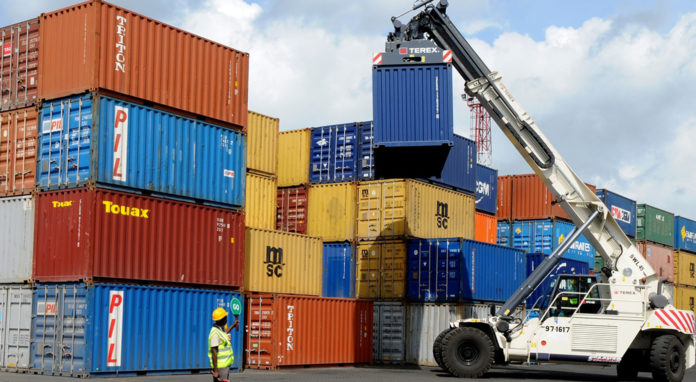
Containers at the Mombasa Port awaiting clearance by Customs

The Uganda Revenue Authority (URA) is now clearing all imports into Uganda through the Mombasa Port using the Single Customs Territory (SCT) platform, a faster process that eases doing business in the East African region.

According to Dicksons Kateshumbwa, the URA Commissioner of Customs, the SCT was effected on July 31, 2017, after the tax body sensitized key stakeholders on what is expected of them as they go through the new procedures.

SCT is described as the stage of full achievement of the customs union, attainable by the removal of duties and other restrictive regulations, or minimization of internal border customs controls on goods moving between partner states with the ultimate realization of free circulation of goods.

The SCT aims at reducing the cost of doing business in the East African region, enhancing application of cross border information and communication technology systems and improving coordination of the private and public sector agencies among others.

According to Kateshumbwa, the clearance of all goods under SCT platform follows the successful roll out of clearance items like fuel, clinkers, wheat grain, bulk crude edible oil, bitumen, rice, sugar, used clothing and used shoes. Others items cleared under the arrangement include; alcoholic drinks, cooking oil, cigarettes, neutral spirit and containerized steel products.

Further, he says the success of the SCT at trial stage enabled URA to extend the coverage to all other goods imported into Uganda through the busy Kenyan port of Mombasa located on the Indian Ocean.

Procedures at the SCT include the single declaration of goods lodged at destination country, payment of taxes and physical verification of goods which done once either at entry point or destination country.

Other procedures include customs submission of declarations electronically, which is then processed by URA prior to release and loading of such goods at the Port of Mombasa.

Under the SCT customs clearing agents are required to execute a regional guarantee bond and register with the Kenya Ports Authority (KPA).


Stories Continues after ad

Insurance lessons Ugandans can learn from the ‘Great Fire of London’

Joel Muhumuza

By Joel Muhumuza

On September 2, 1666, a fire broke out at Thomas Farriner’s Bakery in Pudding Lane in London. What could have been an isolated incident of fire destroying property, eventually led to four days of destruction across the narrow streets of London. The only reprieve came in the form of large scale demolitions of property to prevent the fire from spreading any further.

Subsequently, in the plans for the rebuilding of the city, the architect Sir Christopher Wren, included a site for an insurance office and this reflected the change in opinion of insurance no longer being a matter of convenience but one of urgency. More than 13,000 houses had been destroyed, and an unknown number of lives lost.

That kind of unpleasant imagery seems like the kind of anecdote delivered by an insurance peddler trying to scare you into buying a policy. I apologise for opening with it; I raise it only to make a few observations about our view of insurance.

If we consider the conditions that led to the 1666 fire, we can see that they were not very difficult to identify with the benefit of 20-20 hindsight.

According to reports, many wooden buildings as far as the eye could see had been rendered tinder dry. Narrow streets meant a fair wind could blow a spark from one flammable structure to another. However, people went about their business without a care.

This shows how the human mind is usually focused only on the task at hand. It’s not natural for us to respond with urgency to dangers that might never even happen.

Not only is it not a matter of urgency, it’s upsetting to think about losing property, falling sick or even worse, losing one’s life. We tend to hope for the best and find it difficult to plan for the worst.

The second lesson we can learn from this is risk management. One of the reasons the fire burnt for so long and grew as much as it did is hesitation on the part of the authorities. Prompt action is the surest way to mitigate effects of risk.

Translated to our own lives, perhaps you have already experienced a startling loss, a robbery, a health scare for which you had no insurance cover. Perhaps it’s been a few months and this is behind you but you worry that it might happen again. The best way to manage this is to act now. Speak to an insurer, consult as many as possible and treat it as a means of preventing any further fires from spreading.

The last lesson we learn from the great fire is that prevention is better than cure. Oft used as a cliché’ by doctors and teachers encouraging us to be prepared, this has lasted in our cultural lexicon for a reason.

While insurance companies make advances to raise the insurance penetration in the country from 0.85 per cent to 3 per cent by 2025, the duty to educate comes together with the responsibility to teach people how to minimise the probability of loss.

Many people see insurance as a costly endeavor covering something that might not happen and see that money in opportunity cost terms for instance a car or land  they could have bought. Further complicating this, a KPMG survey conducted in 2016 shows that fraud is a big concern for many insurers in East Africa and Uganda in particular. I think we need to look closely at fraudulent claims. Is it a matter of dubious individuals seeking to gain from the system or a misunderstanding of the basic concepts of insurable interest, utmost good faith, accidental loss, calculable loss and proximate cause?

Unlike credit and savings, insurance’ more easily understood and appreciated financial cousins, insurance doesn’t proffer an immediate benefit, it doesn’t put money in the hands of the user. It is supposed to be a fall back, the way to ensure that when disaster strikes, you’re not taken back to the drawing board. It’s therefore imperative that we talk about it as much as possible, and equip ourselves with the information we need so that all we’ve worked for doesn’t go up in flames and we are left with nothing to start with.

Mr Joel Muhumuza is a Partner Support Specialist, Financial Sector Deepening Uganda. 

Stories Continues after ad

Gov’t to register local gold miners in Mubende district

TO REGISTER MINERS: Minerals Development PS Dr Stephen Isabalija

In a bid to regulate gold mining activities in Kitumbi and Bukuya sub counties in Mubende district, the government is to register all local artisans operating there, the Permanent Secretary in the Ministry of Energy and Mineral Development, Dr Stephen Isabalija, has said.

According to Dr Isabalija, the three-month exercise that will help his ministry to re-organise the mining activities in Mubende and the country at large, comes in the wake of an influx of foreigners sneaking in to extract iron ore and gold.

The PS said that to effectively manage the exercise the ministry will work in partnership with security agencies such as the Uganda Police, the Uganda Peoples Defence Forces as well as the Directorate of Citizenship and Immigration Control under the the Ministry of Internal Affairs.

“Government has established the presence of an influx of people amongst which are foreigners from neighbouring countries and beyond that are involved in illegal mining in Kitumbi and Bukuya sub counties in Mubende district,” Dr Isabalija said in a recent statement.

According to Dr Isabalija, the unregulated activities of the miners negatively affecting the environment, safety and health of the people in the mining areas.

“In addition the presence of foreigners in these areas can result into a security threat to the people of the area and the country at large,” he says.


Stories Continues after ad

ICPAU warns against privatization of the pension industry

Members of the ICPAU at their 25th anniversary celebrations

The Institute of Certified Public Accountants of Uganda (ICPAU), the umbrella organization that brings together professional accountants in Uganda has warned against opening up the pension industry.

Speaking at their 25th anniversary, ICPAU President, Protais Begumisa warned that allowing more players into the pension industry might not be beneficial to the country.

“We don’t entirely support those who think that bringing many more players is going to be beneficial to us. For example, the way it’s stated; if a player comes and doesn’t do well, who suffers; is it the investor or us the savers?” he asked.

“For example you have a certain scheme and its asset base was Shs100billion and by the end of the financial year its tax base has gone down to Shs90billion, so who suffers this loss? … Of course the private player,” he added.

According to Mr. Begumisa, it is better to make amendments to the NSSF Act than allow more players join the industry.

“We think instead of opening up the space and having people who say they can do these things better..we’ve seen it happen in other countries… We had better change the NSSF Act then we can all benefit from this liberalisation.

“The NSSF act needs to be amended so that when we eventually retire, we are sure that there will be adequate cash flow that will cater for all claims that will come to the institution.”

On ICPAU’s Silver Jubilee celebrations, Begumisa unveiled new offices for the institute as well as taking journalists through the 25 year journey of the institute.

He revealed that when they had just began in 1992, the institute registered only ten members annually in its first years. However, the trend changed with time and currently they register hundreds of new members every year.

“We’ve grown as a member based institution from 79 to over 2,800 CPA members today,” Mr Begumisa said.


Stories Continues after ad

Bebe Cool finally has something to smile about

NEAR COMPLETION: Bebe Cool's house

Forget the celebrations that followed musician Bobi Wine’s maverick election to Parliament, finally Gagamel fans of Moses Ssali aka Bebe Cool also have a reason to celebrate!

After close to 20 years of construction, Bebe Cool’s house is near completion, and visiting over the place over the weekend, snoops found the house has already been painted and it’s only inserting doors and designing of the compound left.

Sources say that having been in charge of musicians that performed at President Yoweri Museveni’s campaign rallies last year, Bebe Cool pocketed close to Shs500million. If he did, then he put it to good use.

Meanwhile, in addition to the developments at his house, Bebe Cool has also managed to secure a collabo with US popstar Jason Derulo. He has also collaborated with Kenya’s multi-award winning music group, Sauti Sol. He invested heavily in both projects.

Congs Bebe Cool!


Stories Continues after ad