Stanbic Bank
Stanbic Bank
23.3 C
Kampala
Stanbic Bank
Stanbic Bank
Home Blog Page 1812

‘Pastor’ Mondo Mugisha accused of child neglect

Pastor Mondo Mugisha

Renowned city ‘Pastor’Franklin Mondo Mugisha is currently enmeshed in a child neglect misunderstanding with a one Sarah Naigaga, who says she is the mother of his six-year old child.

Ms. Nagaiga says for a while, Mondo had been looking after the child till recently when he stopped and even refused picking her calls. Apparently, Mondo had pledged to provide for the child as long as she never took it to his church. “He told me he never wanted the kid to be seen by his flock but he would be providing for him and it was okay with me…….” she said.

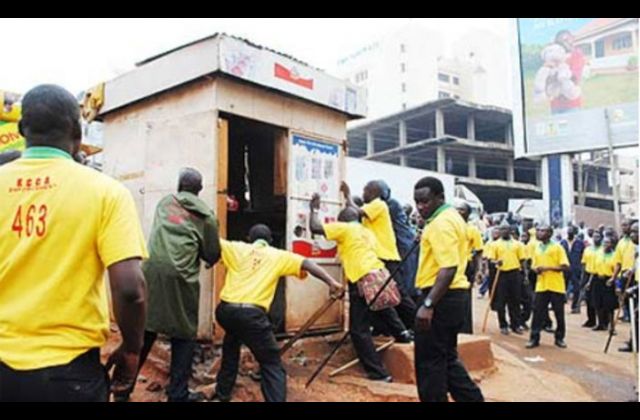
And left with no other option, Naigaga says she went to the church but that unlike the previous times, this time Mondo started beating her up with the help of his bouncers.

“He no longer wants to pick my calls… He blocked all of my phones. Even when I try calling him using other people’s phones, he picks but ends the call as soon as he hears my voice on the other end. Now, how else can I hear from him other than going to (his) church?” Naigaga wondered.

After the alleged beating, Naigaga said police from Wankulukuku was called in and she was arrested on allegations of threatening to burn Mondo’s church.

Naigaga said when she went to report an assault case to Katwe Police Station, she found that a parallel case had already opened up against her by Mondo. He had even expressed doubts about being the father of Naigaga’s child. “If the child is not his, then why did he name the child (after himself)”?

She is now demanding for a DNA test if Mondo insists he is not responsible for fathering the child.

When reached for a comment, Mondo did not pick our calls neither has he returned our message on Facebook where he has been active all day.

Mondo is not the first pastor to be accused of neglecting his children.

‘Pastor’ Augustine Yiga was also taken to court in 2015 when he refused to remit monthly maintenance fee of Shs150,000 to a woman he allegedly raped and fathered a child with as she sought to be prayed for at his church.

Stories Continues after ad

Sugar manufacturers protest Shs10m fine against illegal factories

SUGAR PRODUCTION: Workers at Kakira Sugar Works in Jinja, Eastern Uganda

A proposal by government to slap a fine of Shs10m on individuals who establish sugar mills within a 25km radius of another firm has been rejected by sugar manufacturers, who argue that the charge is ‘very low’.

The companies under their umbrella association, the Uganda Sugar Manufacturers Association (USMA), raised the objection while appearing before MPs of the Parliament Committee of Trade, Tourism and Industry.

The team had appeared before Parliament to present their views on the Sugar Bill 2016, which is aimed at regulating activities of the sugar industry that has been bogged by unstable pries for quite some years.

In their argument, the sugar manufacturers argued that the said penalty is small and want parliament to hike the fine to Shs500m, instead of the Shs10m being proposed in the bill.

Jim Mwine Kabeho, the USMA chairman, who also doubles as Director Madhvani Group, fronted the idea while commenting on Section 13 (2) of the Bill that stipulates that no sugar mill should be set up 25km radius within each other.

According to Mwine, the low supply of sugarcane to companies has left the manufacturers grappling with shortages, limiting their exports.

He has cited out the low harvest from an acre that was initially 35tonnes, but this has since dropped to just 20tons.

Mwine also told MPs that putting sugarcane mills next to each other has created fierce competition among the players, who buy sugarcane at 12 months, yet the required maturity period for sugarcane is 18 months. Due to the practice of harvesting immature sugarcane, Mr. Mwine said, farmers are now losing an average of 4 tonnes of sugar per hectare monthly.

He also revealed that although Ugandans are exposed to the risk of consuming sugar processed from immature sugarcane, which is also the of low yield.

Deliberating about the high sugar prices, Mwine noted that Uganda has the highest price of sugar in the whole world, a trend he blamed on the high sugarcane price charged by the farmers which, at the moment, is Shs175 for each sugarcane.

Once adopted by Parliament, no one will be allowed to establish or operate a sugar mill, jaggery mill or a plant to process the by-products of sugar-cane without a valid license granted for that purpose by the Board.

If found acting in contravention of this particular section, the culprit will be fined Shs10m.

The bill also proposes for the immediate closure of the sugar mill that was established and was operating illegally.

The prosecution of a person under this section doesn’t prevent the Board from licensing the person in accordance with this Act.

The Bill also provides for the establishment of a National Sugar Research Institute that will be mandated with breeding of sugarcane varieties suited for various agro-ecological zones of Uganda.

The Institute will also take on the responsibility of conducting research and nutritional requirements of sugarcane in order to provide recommendations on the appropriate fertilizers.


Stories Continues after ad

UNBS strengthens vehicle inspection standards

Cars in transit to Uganda. Most cars imported into the country are second hand

In an effort to strengthen the inspection procedures of secondhand motor vehicles for road worthiness, the Uganda National Bureau of Standards (UNBS) has issued new standards to be followed.

A technician testing a vehicle for road worthiness

The standard, developed by the agency’s technical committee on transport and communications, specifies safety related performance characteristics.
UNBS Executive Director Dr Ben Manyindo, said the Standard dubbed US845, comes as a response to the growing demand for standard procedures in the inspection of used motor vehicles in Uganda.

He added that the standard now awaits public review for comments until September 5, 2017, after which it will be approved and declared as a national standard by the National Standards Council.

Dr Manyindo said the new standard requires that second hand vehicles are inspected for conformity to Uganda Standards before being exported from the country of origin in what is known as Pre-Export Verification of Conformity (PVoC).  As such, cars are issued with a certificate of roadworthiness to allow them in the country. The certificate is valid for a period of one year, thereby requiring routine inspection for road worthiness on annual basis.

According to Dr Manyindo, the standards provide guidelines to streamline processes and procedures used in inspection of motor vehicles. “Motor vehicle inspectors, garages, and mechanics will find the standards useful for carrying out routine check and inspections of second hand motor vehicles,” Dr. Manyindo said.

Last financial year, the UNBS developed 357 standards which were approved by the National Standards Council.
UNBS manages the processes of standard development and enforcement to ensure consumer protection and to encourage fair trade.

Stories Continues after ad

BREAKING: Orlando Pirates unveil Micho as new head coach

Serbian Sredjovic 'Micho' at the South African club Orlando Pirates

South African club Orlando Pirates have today unveiled former Uganda Cranes Coach Milutin ‘Micho’ Sredojevic as their new head manager.

The Serbian coach replaces Kjell Jonevret who resigned yesterday after failing to turn fortunes around for the six months he had been managing the club.

This is Micho’s second stint at Orlando Pirates, having initially joined in 2006 where he handled 23 games before being shown the door.

He guided the club the 2006 Caf Champions League semifinals, but resigned on the back of a bad domestic record.

In Uganda Micho has been widely praised for making Uganda qualify for the 2017 Africa Cup of Nations in Gabon, the first time in 38 years.


Stories Continues after ad

Poor coffee handling worries Agriculture Minister

Bags of coffee beans for export

Coffee farmers in Uganda are fetching between 70 and 75 per cent on the international market price occasioned by malpractices in the sector, the agriculture minister Vincent Ssempijja has said. According to the minister, the coffee sector in Uganda faces problems of quality deterioration, poor marketing, a challenging regulatory framework and poor infrastructure mainly in the rural areas.

“Due to unscrupulous elements operating at various levels of the coffee value chain, coffee quality malpractices have also increased. This is a danger to our coffee industry both internally and at international level,” Minister Ssempijja says.

The minister fears that the international market could reject Uganda’s coffee if the malpractices are not addressed.” We do not want to face the danger of the international community rejecting Uganda coffee as it did to fish a few years ago,” he said.
The Minister said his ministry will work to improve post-harvest practices including hygiene and sanitary conditions to have Uganda coffee regain its premium quality. Further, the minister says Uganda needs to export high grade premium coffee as well as entering specialty markets by adding value.
“We will continue to sensitize the stakeholders especially the farmers, traders and coffee factory processors to appreciate the benefits of good post-harvest handling, good quality coffee. We will only close the factories, when all other avenues have been exhausted,” he says
The minister said the Uganda Coffee Development Authority (UCDA) recently closed coffee factories in Masaka sub region due to deteriorating standards in handling .

“From Masaka, the exercise will continue to Busoga, Luwero, Mubende as the harvest season proceeds in these sub regions,” he added.
According to UCDA Executive Director, Dr Emmanuel Lyamulemye, the coffee quality has improved as a result of factory closures in Masaka sub region, with farmers now getting better prices for dried coffee rather than the wet coffee which fetches lower prices.
Minister Ssempijja says farmers and traders in districts of Bushenyi, Sheema, Ibanda and Mount Egon districts of Mbale, Bulambuli and Sironko, have employed good harvesting and drying practices. “Most of the coffee cherry is harvested when red ripe and dried on tarpaulins and clean local mats,” Minister Ssempijja notes, calling upon the farmers in those districts to maintain high quality standards.
The minister encourages farmers to employ good husbandry practices in the coffee gardens , by weeding, pruning, mulching and uprooting and burning on spot trees affected by the coffee wilt.
As one of the measure to boost coffee quality farmers must harvest only the red ripe cherry, unripe cherry spoils quality. “It is the farmer’s responsibility to dry the coffee up to the required Moisture Content level before selling,” he says.
Further coffee regulations do not allow trade in coffee that is not yet well dried as it affects quality.
Since 2014, Government has intensified campaigns to give coffee seedlings to farmers increasing from 20 million to the current 200 million seedlings per annum. The minister says government targets to have 300 million seedlings planted per year up to 2018/19 coffee year.
Uganda grows both Arabica and Robusta coffee, mainly through smallholder farmers.

Uganda follows Ethiopia as Africa’s top coffee producers. But Ethiopia consumes most of her coffee domestically, making Uganda Africa’s number one coffee exporter.

Stories Continues after ad

Rugby Cranes team named as Zimbabwe arrive for Saturday tie

Zimbwabwe Rugby team members on arrival at Entebbe International Airport

The 2017 Africa Gold Cup tournament comes to an end on Saturday August 5 with Uganda hosting Zimbabwe, while Senegal will travel to Tunisia in the remaining fixtures.

The Zimbabwean Rugby team today arrived at Entebbe international airport ahead of their final game against the Rugby Cranes at Legends Rugby club, Kampala.

Rugby Cranes head coach John Duncan and his assistant Robert Sseguya named the 23-man squad that will take on Zimbabwe Sables over the weekend.

Some changes were made with Byron Oketayot replacing Ronald Musajja at the blind side flank, Philip Wokorach moves to fly half from full back to cover for the injured Ivan Magomu who will start from the bench and James Odong returns from injury to start at full back.

After two wins against Tunisia and Senegal and a draw against second placed Kenya, the Uganda Rugby Cranes are third in the rankings with 11 points behind 1st placed Namibia and Kenya at 2nd.

The Africa Gold Cup serves as 2019 World Cup qualifiers. It featured Namibia, Kenya, Senegal, Tunisia, Zambia and Zimbabwe and the winner, Namibia are not only being crowned Gold Cup champions but also qualify for the World Cup.

Namibia was crowned champions after defeating Kenya 45-7 in Windhoek, going unbeaten in the competition and retaining the title for the fourth year in a row.

Meanwhile, the 2019 Rugby World Cup takes place in Japan from September 20th to November 2nd and will be played across 12 venues.


Africa Rugby Gold Cup

Uganda Vs. Zimbwabwe

Legends Rugby Ground, Kampala (4:30pm)


The Team List:

  1. Asuman Mugerwa
  2. Alex Mubiru
  3. Brian Odongo-Captain
  4. Charles Uhuru
  5. Mathias Ochwo
  6. Byron Oketayot
  7. Brian Asaba
  8. Scott Oluoch
  9. Aaron Ofoyrwoth
  10. Philip Wokorach
  11. Lawrence Sebuliba
  12. Pius Ogena
  13. Micheal Okorach
  14. Justin Kimono
  15. James Odong
  16. Syrus Watum
  17. Collin Kimbowa
  18. Saul Kivumbi
  19. Robert Aziku
  20. Ronald Musajja
  21. Kevin Makmot
  22. Ivan Magomu
  23. Fred Odur
Stories Continues after ad

CSOs urge government to increase funding for malaria

Children take shelter in a mosquito net as a means of avoiding malaria

A group of Civil Society Organisations (CSOs) in Kampala has urged the government to increase funding to the malaria control programme.
The CSOs say the Malaria Control Program being implemented as part of the Global Fund initiative, has not received sufficient funds from government as outlined in the Uganda Malaria Reduction Strategic Plan, making the objectives of the plan unrealistic.
Records, according to CSOs, show that over 16 million malaria cases were reported at Uganda’s health facilities in 2013 alone, forcing government to launch the Uganda Malaria Reduction Strategy 2014-2020 with specific objectives to fight the malaria pandemic to the lowest levels possible.

Clinically diagnosed malaria is the leading cause of morbidity and mortality in Uganda, accounting for 30-50 percent of outpatient visits at health facilities, 15-20 percent of all hospital admissions, and up to 20 percent of all hospital deaths. 27.2 percent of inpatient deaths among children under five years of age are due to malaria.
Among the objectives to prop the programme, the government intended by the year 2017 to achieve and sustain protection of at least 85 percent of the population through malaria prevention measures, among them the on-going distribution of the insecticide-treated nets (ITNs).
Under the programme, by the year 2018, government also wants to achieve and sustain at least 90 percent of malaria cases in the public and private sectors and community level, with patients receiving prompt treatment according to national guidelines.
However, with the slow pace government is implementing the strategic plan, and the little money it is allocating to the programme, CSOs say not much will be achieved.
To achieve the above targets the strategic plan requires a total funding estimated at US$1.361 billion over the six year period, implying that Uganda needed to invest US$ 226.6 million (Shs793.9 billion) per year, which the CSOs say is almost the entire budget for the Ministry of Health.
The CSOs say the direct costs of malaria in Uganda include a combination of personal and public expenditures on both prevention and treatment of the disease. Personal expenditures, they say, include individual or family spending on ITNs, doctors’ fees, antimalarial drugs, transport to health facilities, and support for the patient and sometimes an accompanying family member during hospital stays.
Public expenditures include spending by government on maintaining health facilities and health care infrastructure, publicly managed vector control, education and research.
The CSOs say that a significant percentage of deaths occur at home and are not reported by any system. According to official reports, Uganda’s high rates of malaria affect young children and pregnant women in rural areas who experience extreme poverty, limited access to healthcare services, and lack of education.
A recent study shows that Uganda spends almost Shs1,200 billion on diagnosing and treating malaria annually, or about Sh40,000 per person. This includes the money spent by the Government, donors, NGOs and private patients.
The Government alone spends sh63 billion per year on fighting malaria, 10 percent of the total health budget.
“Malaria is a preventable disease associated with slow socio-economic development and poverty. The determinants of malaria have roots beyond the health sector and the roles of other sectors need to be harnessed to prevent and control malaria in this country,” the CSOs urge government.
They say that malaria prevention and control programs need to have a multi-sectorial dimension. “The slow pace in reducing the malaria burden in Uganda and the renewed international call for a multi-sectorial action necessitates reforms in Uganda’s efforts to reduce malaria,’ the agitate.
According to Word health Organization , annual economic growth in countries with high malaria transmission has historically been lower than in countries without malaria. Economists believe that malaria is responsible for a growth penalty of up to 1.3 percent per year in some African countries.
According to Ministry of Health, maleria is a major public health problem associated with slow socio-economic development and poverty and the most frequently reported disease at both public and private health facilities in Uganda.
“Malaria has negative health and economic effects, and restricts the productivity of our population. Increased ITN coverage and education, improved access to and delivery of treatment, and emergency control of malaria are essential to control malaria in Uganda,” health officials recommend.

Stories Continues after ad

Archbishop Welby prays with South Sudan refugees in Moyo

A woman wraps Archbishop of Canterbury Justin Welby in a piece of cloth upon his arrival at Mirieyi settlement camp in Adjumani district during his visit to South Sudanese refugees, Uganda August 2, 2017. REUTERS/James Akena

Archbishop of Canterbury Justin Welby, spiritual leader of the world’s Anglicans, prayed on Wednesday with South Sudanese refugees in northern Uganda, home to a nearly million people fleeing a four-year civil war in the world’s youngest nation.

Around 1.8 million people have fled South Sudan since fighting broke out in December 2013, sparking what has become the world’s fastest growing refugee crisis and largest cross-border exodus in Africa since the 1994 Rwandan genocide.

Most have fled south to Uganda, whose open-door refugee policy is now creaking under the sheer weight of numbers in sprawling camps carved out of the bush.

“The Bible tells us that the refugee is specially loved by God,” Welby, leader of the 85-million strong Anglican Communion, said as he joined in prayers in a camp in the northern district of Moyo.

The Archbishop added: “Which means you who are refugees are specially loved by God, that Jesus himself was a refugee and he loves you and he stands with you and the suffering that you have is the suffering that he knows. So I pray for you, I will advocate for you.”

Officials from the United Nations UNHCR refugee agency say $674 million is needed to pay for the basic needs of the refugees this year, but so far only 21 percent of those funds have been secured.

The total number of refugees is due to pass a million in the next week, UNHCR officials said. Nor is there any sign of a let-up in the stream of desperate civilians.

Some days it is only hundreds. On others, it is thousands.

In the camps, refugees are already on half their standard food rations of 12kg of maize a month, and now critical services such as health and education are facing cut-backs, UNHCR officials said.

In Bidi-Bidi, the largest of the refugee camps, 180 South Sudanese died in the first six months of the year, nearly half of them small children.

“We came here to hide ourselves from death,” said 31-year-old Moro Bullen, standing next to a row of 16 freshly dug graves, mounds of rust-red earth arranged in three neat rows. Half of the graves were only a meter long. “We did not come here to die. We came here to be rescued.”

Although the roots of the war lie in the animosity between President Salva Kiir, who hails from South Sudan’s powerful Dinka ethnic group, and his former deputy, Riek Machar, a Nuer, it has splintered into a patchwork of overlapping conflicts.

Machar is under house arrest in South Africa, having fled there last year to seek medical attention, but there has been little let-up in the levels of conflict, especially in the Equatoria region abutting Uganda.

Refugees have told Reuters of towns and villages emptied by government forces, dominated by the Dinka, with men, women and children summarily executed, and their bodies mutilated.

Rights groups have also reported widespread rape and looting that the United Nations says indicates ethnic cleansing. It has also warned of a possible genocide in a country that only came into being in 2011, when South Sudan split from Sudan.

The government has denied the reports, and said its troops are merely conducting operations against rebel militiamen.


Stories Continues after ad

Six killed in Juba-Nimule highway ambush

Uganda troops on the Nimule-Juba highway, getting ready to cross into South Sudan to rescue Ugandans there during the civil war. Photo credit/todayonline.com

At least six people were killed in an attack on a bus convoy traveling between Juba, the capital, and Nimule, on the country’s southern border with Uganda.

Four civilians and two national security service members escorting the convoy were killed, a spokesman for the Sudan People’s Liberation Army (SPLA) said.

The Juba-Nimule road is a major lifeline linking the South Sudanese capital with the East Africa region, via Uganda. The road carries most goods that South Sudanese traders import from Uganda.

Wednesday’s incident was the fifth deadly attack this year along the 200-kilometer stretch of road between Nimule, on the banks of the Nile River, and Juba.

​The SPLA spokesman, Brigadier General Lul Ruai Koang, said one of the buses was hit by a rocket-propelled grenade, and that the attackers also had heavy weapons. He blamed rebels loyal to former First Vice President Riek Machar for the raid, but a spokesman for Machar’s SPLA-In Opposition group denied any involvement.

“The attackers were repulsed,” Koang said. He indicated government forces inflicted an equal number of casualties on the raiders who opened fire on the buses, but details were unclear.

A passenger aboard one of the two buses heading for Juba said ‘a very serious ambush’ broke out after the convoy passed Moli town in Eastern Equatoria province, less than halfway along the route to Juba.

The passenger said he saw three people who had been shot to death, one woman and two men, before the buses turned around and headed back to Moli. Several people with gunshot wounds were taken for treatment to Nimule.

Brig. Koang told VOA he was convinced that rebels loyal to Machar were responsible for the attack. However, the deputy military spokesman for Machar’s SPLA-IO, Colonel Lam Paul Gabriel, was equally certain that his fighters were not involved.

“We do not know exactly who is responsible for that, but we have sent an MI [military intelligence] team in search for the culprit,” Gabriel told South Sudan in Focus. “We are advising our civilians to be careful while traveling on this road.”

He said SPLA-IO forces had received ‘strict orders’ from Machar, making it ‘very clear that civilian vehicles should not be attacked’.

Before Wednesday’s ambush, the most recent attack on the Nimule-Juba road was in June, when 10 people including two senior army officers were killed in a raid on another convoy. That assault was believed to have been carried out by Machar loyalists.

South Sudan has been mired in civil war since the young nation’s first president, Salva Kiir, dismissed his deputy Riek Machar four years ago. After a peace accord was signed in April 2016 and backed by the United States and other Western nations, Machar returned to the capital to share power with Kiir, but the deal fell apart less than three months later, and Machar and his supporters left Juba.

Nearly 2 million residents have fled South Sudan since 2013, in Africa’s largest cross-border flood of refugees since the 1994 Rwandan genocide. The exodus from South Sudan has become one of the world’s worst humanitarian crises, according to aid groups.


Stories Continues after ad

Slain UPDF soldiers’ bodies returned from Somalia

The hearse of the bodies of 12 UPDF soldiers killed in an ambush by Al-Shabaab militants in Somalia on Sunday

A somber mood has engulfed the Entebbe Old Airport this afternoon after the plane carrying the bodies of 12 UPDF soldiers killed in an ambush by Al-Shabaab militants in Somalia on Sunday, touched the ground.

The bodies were received by several UPDF senior officers led by the Deputy Chief of Defence Forces (D/CDF) Lieutenant General Wilson Mbadi and the UPDF Commander of Land Forces (CLF) Major General Peter Elweru.

The bodies were received by several UPDF senior officers that were led by the Deputy Chief of Defence Forces (D/CDF) Lieutenant General Wilson Mbadi and the UPDF Commander of Land Forces (CLF) Major General Peter Elweru.

The plane that returned the 12 bodies of the slain UPDF soldiers

Before being flown back home, the bodies of the fallen soldiers had been at the Mogadishu Level II hospital for management and treatment.

On Monday UPDF spokesperson Brigadier Richard Karemire confirmed that the 12 soldiers were killed, while seven others sustained injuries in an attack at Gorowen between Balumaler and Beladamini in lower Shabelle region, south west of Mogadishu.

Meanwhile, earlier today Brig. Karemire said the remains will be taken to the hospital at army headquarters after which they will be transported to their ancestral homes for burial.

“Our comrades will be flown in today, the remains will be taken to our headquarters and then will be transported to their families,” Brig. Karemire was quoted as saying by local media, adding that the deceased will be accorded burials with full military honours.

Further, Brig. Karemire said the deaths will not deter the UPDF from seeking to accomplish its pacification mission in Somalia.

“We are pan-Africans; when we went in Somalia, we knew this would happen; this is the price we are paying but we don’t need to lose hope,” he said, adding that the Al Shabaab militants had lost ground to launch devastating attacks the peacekeepers.

“We broke the back of al-Shabaab and no doubt about that; when we deployed in Somalia, they were everywhere. Now all the key towns in Somalia were recaptured and they are now under the government of Somali,” Brig, Karemire said.


Stories Continues after ad