Stanbic Bank
Stanbic Bank
17.7 C
Kampala
Stanbic Bank
Stanbic Bank
Home Blog Page 1817

Zari’s kid brother bashed over photo taken on Ivan Semwanga’s grave

Hakeem Hassan seated on the grave of Ivan Semwanga

Socialite Zari Hassan’s only brother, Hakeem Hassan, has emulated his big sister and taken a photograph while seated on Ivan Ssemwanga’s grave.

“Boyi, it’s been 2 months now. Crazy and diff out here without you. Mum came through too, hope you guys are good,” he captioned the photo shared Thursday on social media.

However, unlike Zari’s stunt that earned her sympathy, internet users are not happy with Hakeem’s gimmick, with many coming out to rip him apart over the photo.

Juma Oris NsolonkambweHypocrisy. If they loved him badly in life, they would have stopped Zari spreading her legs because any man would get depressed and illnesses once his baby momma sleeps around with every Tom, Dick and Harry.

Zoker Katumwa: Maybe he should come through too…since things are difficult out here. From the look of things, Diamond Platinumz must be a stingy fellow who doesn’t look out for his brothers in-law.

Jonnah Tusasirwe: It’s crystal clear that this family loved Ivan a lot. I wonder what could have happened to Zari to make her leave him, could it be a witchcraft or what? Just wondering??

However, some sympathized with Hakeem.

Munau Babirye: I really think this young man is real and means everything he says. Ivan had such a huge impact on him and he really misses him. Ono ate tatelanyo kwemulisa, Mutegevumu.

Ivan Ssemwanga, Zari’s ex-boyfriend and a close friend to Hakeem, died in May this year. Sadly, Zari and Hakeem’s mother also died last week, only two months after Semwanga’s death.


Stories Continues after ad
KCCA’s Sserunkuuma joins Zambian side

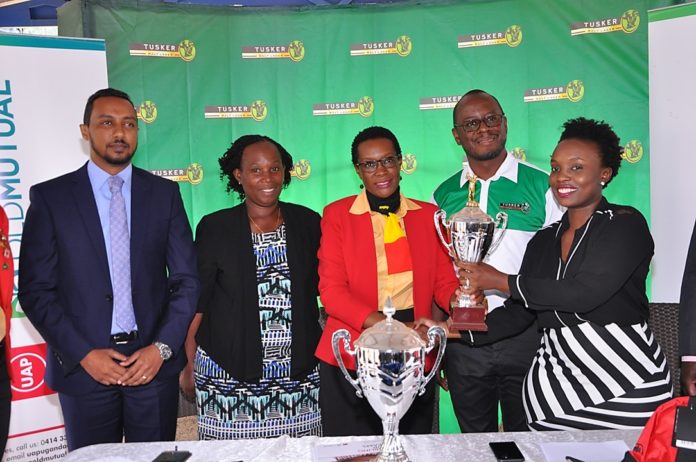
MVP: Geoffrey Serunkuuma is heading South to join Buildcon FC.

Last season’s Uganda Premier League top scorer Geoffrey Sserunkuma leaves KCCA FC for Zambian side Buildcon FC on a one-and-a-half-year deal with an option of contract renewal.

Serunkuuma, who is also the season’s Most valuable Player (MVP), scored 31 goals in all competitions for KCCA FC last season and helped the team win their first ever domestic double (the Azam Uganda premier league and Uganda Cup).

Of the goals 21 were scored in the league, four in the CAF Champions League, two in the CAF Confederation Cup and four in the Uganda Cup.

The Cranes striker is the fourth KCCA player to head south in the last six months after Ivan Ntege joined Botswana outfit Township Rollers; and left back Joseph Ochaya and Herman Wasswa who both joined Lusaka Dynamos in March.

Sserunkuma has also played in Ethiopia with St George and in South Africa with Bloemfontein Celtic, Bidvest Wits and Vasco da Gama.

The 34-year-old also scored the lone goal against Cape Verde as Milutin ‘Micho’ Sredojevic’s side picked three crucial points in their Afcon 2019 qualifying opener.

The Zambian league is becoming a favorite for Ugandan stars with players like Joseph Ochaya and Herman Wasswa at Lusaka Dynamos, while Jimmy Bageya at Napsa Stars and Davis Kasirye are at Zesco United.

Stories Continues after ad

Veteran musician Joe Tabula finally says ‘I do’

I DO: Joe Tabula with his newly-wedded wife display their marriage certificate

Veteran musician popularly known for his works as a music producer, Joe Tabula has finally said ‘I do’ to the love of his life, one Cathy, at a wedding ceremony held Thursday at Saint Matia Mulumba Church in Old Kampala. Only a few invited friends and relatives attended the wedding.

Joe Tabula, his wife and their bridal entourage

Previously, Tabula had been in a relationship with CBS radio presenter Ann Sebunya and one Peace Sanyu, with whom he has three kids.

A music producer, songwriter and instrumentalist currently working with Uganda’s oldest band, The Afrigo Band, Joe Tabula has been in the music industry for close to three decades.

He started out in the mid-90s playing the bass guitar with the Wakawaka band at Sheraton Hotel. From there he joined music production, starting his own studio, BK studio, later registered as Tabula Recording Agency. He has since produced hits for almost all the established musicians in the country, including his own.

Tabula crafted beats including among others, Jose Chameleone’s Kambalangire, Abdul Mulaasi’s Best Man and Ekyeyo, Gerald Kiweewa’s 2003 PAM Award winning Egaali Ekozeeko, Harriet Kisaakye’s Eki Nigeria, and Ragga Dee’s Sissy.

He has also been behind hit songs like Otusuza Mu Ngato, a song that ushered him on the entertainment scene as a musician.


Stories Continues after ad

KCCA, MTN ink Shs1.2b sponsorship deal

DEAL: MTN Uganda Chief Executive Officer Wim Vanhelleputte hands over a dummy cheque to KCCA Executive Director Jennifer Musisi Semakula

KCCA football club has inked a Shs1.2 billion sponsorship deal with MTN Uganda for a period of three years, with Shs430 million on offer every year.

KCCA FC emerged champions of 2016/2017 of the Azam Uganda Premier League after clinching the 12th title, attracting more supporters in and outside the country.

Speaking after announcing the sponsorship deal, MTN Uganda Chief Executive Officer Wim Vanhelleputte and his Chief Marketing Officer Olivier Printout, congratulated KCCA’s Geoffrey Serunkuuma who was voted as 2016-17 Uganda Premier League Footballer of the Year and Mike Mutebi, who was voted the Coach of the Year.

“We continue to innovate and make our customers’ lives a whole lot brighter,” Mr. Vanhelleputte said adding that MTN is an avid supporter of sports in Uganda.

He added: “Together we share the passion of the game, the fondness to our community and the ambition to prosper our city.”

On her part KCCA Executive Director Jennifer Musisi vowed to develop the Startimes Stadium (formerly Philip Omondi stadium) to international standards.

“KCCA FC are champions not only in Uganda but worldwide and we can’t achieve this without partners like MTN,” Ms. Musisi said, before commending MTN for the continued support.

“We celebrate being champions, we pay tribute to the people of Kampala, our home, we honor our founders,” she said, adding the Authority will identify and nurture talent in Uganda to suit the international standards.

Since its establishment in 1963, KCCA FC aka Kasasiro Boys has garnered over 10 titles from all major leagues and championships in Uganda.

Stories Continues after ad

Masindi farmer wins Fourth Airtel Uganda Mega Masappe Car

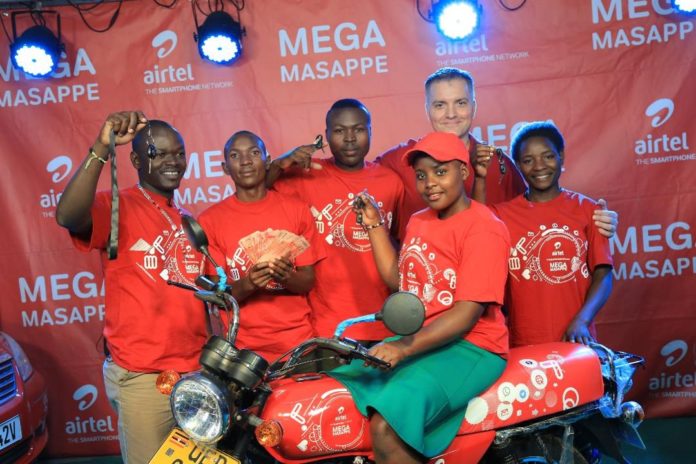
WINNER! Airtel Uganda Customer Services Director, Lynda Nabayinda handing over Shs1million cash to Nawajji Lydia during the Airtel Mega Masappe draw.

Exactly one week after a 19-year-old Fort Portal resident drove back home in a brand new car courtesy of Airtel Mega Masappe, the Smartphone Network has once again excited its subscribers across Uganda by handing over another new car and other exciting prizes including motor cycles and cash in the fourth Airtel Mega Masappe draw.

This week, George Senyonga, a farmer and resident of Masindi, drove home in the brand new Toyota Premio while Edson Musinguzi, Rodney Ronald Mulondo and Edson Tumwine rode off on brand new motor bikes. Lydia Nawajji, Sylvia Nakatte and Mariam Namukuve took home one million shillings each.

Speaking at the prize giving ceremony, the Airtel Uganda Customer Services Director, Lynda Nabayinda Were, thanked the winners and all Airtel Uganda subscribers for taking part in the promotion. She encouraged those who had not won yet to keep hitting their targets.

“I congratulate George as well as all the other winners here today. We introduced this promotion to change the lives of our subscribers by rewarding their loyalty to the Smartphone network,” she said, adding that ‘Mega Masappe’ is a nationwide campaign in which everyone should participate as there are daily and weekly prizes to be won, in addition to the bonus calls, SMS and data bundles that come when one reaches their target,” Ms. Nabayinda.

Launched early this month, Mega Masappe is a 90-day recharge promotion that requires subscribers to opt into it by dialing *162# and selecting option 1 as a one-time opt in, option 2 to check target and option 3 to redeem their data bonus – which will be broken down into Voice, SMS and Data at 50%, 10% and 40% respectively. This bonus however does not apply to social packs, quarterly, annual and free bundles.

As part of the promotion, subscriber bonus is given instantly on the achievement of the daily target. For example, if a subscriber’s bonus target is Ushs. 1,000 and they recharge with that Ushs. 1,000, they will receive 100% bonus of the same value under the Voice, SMS & Data split. However, if they recharge with another Ushs. 1,000 on the same day, they will not get a second bonus.

Daily and weekly prizes are being given away every Friday for the 90-days’ duration of the promotion.


Stories Continues after ad

Parliament probe into BoU activities welcome

Bank of Uganda

The recent probe announced by Parliament into the supervisory and operational competences of Bank of Uganda is a welcome step that will go a long way in finding a lasting solution to the problems facing the banking sector in Uganda.

It is important to note that the banking sector is a very import segment of a country’s lifeline, because its vibrancy is one of the prerequisites for a good environment that helps attract foreign investors, and also helps boost banking by locals, which also in turn helps them develop the confidence to save with the banks.

By law, the Central Bank is mandated to ‘formulate and implement’ monetary policies that ensure economic stability, and any lapse on the part of the BoU in that regard can have dire consequences for the commercial banking sector and the entire economy.

Needless to mention, over the past couple of months the banking sector in Uganda has faced very serious challenges following the closure and boarding off of the Crane Bank, one of the few commercial banks in the country that is owned by indigenous Ugandans.

However, that came against the backdrop of the Crane Bank being voted as one of the best financial institutions in the country; so how was it possible that the same bank turned villain overnight without the BoU realising? This might give rise to a few questions that could be of interest to the Parliamentarians.

  1. Could such glaring anomalies be the result of lacklustre Supervision and Audit on the part of the Central Bank in general?
  2. Are external audits periodically carried out for all commercial banks in the country and if so, by who?

In that respect, the first and most concentrated sting should be directed at the BoU’s Supervision Directorate, the one that is responsible for ensuring that commercial banks and other financial institutions abide by the regulations.

So, needless to say Ugandans, through their representatives, are waiting to be given satisfactory answers  by officials of the BoU (supervision directorate), regarding the unending questions that have dogged the commercial banking sector over the past few years.

Stories Continues after ad

PPPs can help plug Uganda’s annual US$1.4bn infrastructure financing deficit – report

INFRASTRUCTURE DEVELOPMENT: Karuma Dam construction-in-progress.

Public–Private Partnerships (PPPs) are potential stimulators to help raise the money Uganda it needs to fund infrastructure investment and to also improve the lives of ordinary Ugandans.

According to the ninth edition of the Uganda Economic Update, by embracing PPPs, government can shed off part of the baggage that comes with providing infrastructure and other public goods.

“In this, experience shows that the private sector can successfully finance and manage investment in public infrastructure efficiently and profitably to supplement government-led public spending,” the Update says.

The Update also advises government to mobilize domestic currency financing by establishing syndicates of commercial banks and large surplus institutions to finance PPPs, such as pension funds, particularly the National Social Security Fund.

The report further states that Uganda currently has a financing gap of about US$1.4 billion a year for infrastructure investment, but the cost of inefficient infrastructure is also high, estimated at US$300 million a year, due mainly to corruption—especially underpricing—and the sector’s inability to complete projects within budget and on time.
The report indicates that the country’s most successful PPP, the Umeme concession, has distributed electricity more efficiently since March 2005.

For example, the report states that Umeme has increased the collection of sales revenue from 65 percent in March 2017 to 98 percent in June 2017, and also improved people’s access to power in areas within reach of its services.

But, despite its success, the Economic Update notes, the company has been tainted by operational and governance problems. “A parliamentary assessment found irregularities and manipulation in the procurement of the concession, and the power distribution agreement had to be revised to minimize costs to the government,” the report states.

“The success of PPPs depends on the government’s ability to establish a framework with laws, systems, processes, and contracts that promote financially viable PPPs, especially where there are natural monopolies or market failures,” notes Rachel Sebudde, World Bank Senior Economist and lead author of the Update.

“To maximize the benefits of PPPs, the government must allocate sufficient resources to make sure projects are prepared well,” she said days ago in Kampala. She added that the selection of PPP projects should involve analysis to verify that a project is feasible, attractive to the private sector, and provides value for money.

According to the State Minister for Finance, David Bahati, Uganda instituted legal and regulatory reforms, including the PPP Policy Framework in 2010, and the PPP Act, was approved in 2015. However, the ministry is yet to establish institutions to implement these policies.
Based on experience in Uganda and global best practices, the Uganda Economic Update recommends areas of improvement to allow PPPs to achieve their intended objectives:

That government establishes appropriate institutions to put existing legal and policy frameworks into practice. This can be done by building the capacity of the central PPP unit and other contracting authorities to enable them to prepare, appraise, and provide better oversight.


Stories Continues after ad

Museveni orders Mubende artisans out of gold mining areas

Some of the Mubende artisan miners who had gathered for a meeting with a Senior Presidential Aide that aborted last week

About 50,000 artisanal miners in the Mubende District now know they have carry out their activities elsewhere following President Yoweri Museveni’s directive that they vacate an area which Government licensed to investors to start gold exploration.

In a letter dated June 28, 2017 addressed to Members of Parliament from the district, President Museveni directed that those who forced themselves into the areas where the investor had made excavations must leave with immediate effect.

“The investor is there to help us to know whether there is gold and, if so, how much of it. Why should anybody interfere with this?” President Museveni wrote to law makers hailing from the gold-rich district, despite a petition from the miners, seeking to be given a grace period of one year to conclude their activities. Gemstone is the company that wants to start gold mining activities.

Meanwhile, prior to President Museveni’s latest decision to evict the artisans, there had been back and forth negotiations between the artisanal miners, local leaders, investors and key officials from the central government.

The Mubende District Woman Member of Parliament Benny Bugembe Namugwanya confirmed that area MPs authored a petition to the President on June 16, 2017, requesting him to give artisanal miners more time before being evicted.

The leaders also want government to grant location licenses to the artisanal miners who reportedly applied for them early last year in the Directorate of Geological Survey and Mines.
“I agree to give ample time to the artisans in Mubende. That is no problem. The bigger issue is to keep in mind what we talked about in the meeting,” the President said in his one-page letter.
“The ample time we talked about should be in portions that are away from where the investor had gone to work” Museveni added.
The President’s letter is copied to the Vice President Edward Kiwanuka Ssekandi, the Prime Minister Dr Ruhakana Rugunda, the Inspector General of Police (IGP) Gen Kale Kayihura, the Chief of Defence Forces Gen David Muhoozi, the Defence and Veteran affairs minister Adolf Mwesige and Irene Muloni, the Energy and Mineral Development Minister.

However the Bukuya County Member of parliament Dr Michael Bukenya claimed that the Presidential directive seems to be contrary to the President’s stand on artisanal miners which he stated in the 2016 presidential campaigns and the 2017 state of the nation address.
“The president acknowledged artisanal miners and promised that Government would grant them licenses”, says Mr Bukenya. “Instead of Government making steps to regularize the artisanal miners by granting them location licensees, artisanal miners are being threatened with eviction,” Bukenya adds.
He says artisanal mining in his constituency has stimulated economic growth, increased the local purchasing power, prevented rural-urban migration and created employment for thousands of people.
Bukenya says local leaders are seeking audience with the president, security agencies and the Ministry of Energy and Mineral Development to discuss if the president’s eviction order can be halted as artisans prepare to leave the contested gold-rich areas.

In a related development, Mr Ivan Kauma Male, a project coordinator of the Singo Artisanal and Small scale Miners Association (SASMA), said they are shocked by the President’s directive.

“We are in shock that the President can approve the eviction without him coming down to hear our side of the story,” Mr Male said, adding that it is unfair for government to evict thousands of artisanal miners, who he said, are contributing to Uganda’s national development.

Stories Continues after ad

Top Zuma aide named in R700, 000 kickback scandal

AIDE IN KICKBACK SCANDAL: SA President Jacob Zuma

President Jacob Zuma’s top bodyguard and head of the presidential protection service (PPS) unit received a significant cash payment from a supplier of blue lights to the unit to purchase a house in an upmarket golf estate.

Phineas Manthata, owner of the company Instrumentation for Traffic Law Enforcement (ITLE), in 2012 contributed R700 000 towards the purchase by Major-General Muzingaye Mxolisi Dladla and his then partner of a house in the Blue Valley golf estate in Midrand, Gauteng.

Manthata’s company is a major supplier of emergency lights and related products to numerous units and divisions of the South African Police Service (SAPS), including Dladla’s own unit. The PPS is responsible for protecting President Jacob Zuma, and Dladla is viewed as a long-time ally of Zuma.

Dladla and his then partner, Mogotladi Mogano, an official in the Presidency, bought the house for R3.2 million in July 2012, according to deeds records.

The couple secured a bank loan for R2.72 million, meaning they needed to provide a deposit of R480 000 in order for the transaction to go through.

Dladla and Mogano would also have needed at least another R240 000 to cover the transfer fee and related costs, according to a leading estate agency’s online calculator for property transfers. In total, the couple would therefore have been short to the tune of around R720 000.

News24 has established that Manthata came to the couple’s rescue by directly contributing an amount of R700 000 in order for the transaction to be successfully completed.

Manthata, speaking through his attorney, denied any wrongdoing, but refused to respond to our set of detailed queries around the transaction.

“Our client does not intend to respond to your email, and we reserve our client’s rights to expand upon any issues in the appropriate forum and at the appropriate time should it become necessary. Our client denies any allegations and reserves the right to formally reply should same be necessary,” said Andre du Plessis, Manthata’s lawyer.

The SAPS, Dladla and Mogano all failed to respond to queries around the property deal.

Police spokesperson Major-General Sally De Beer, however, did confirm that Manthata’s company was listed as a registered supplier to the SAPS.

“I have been advised by procurement management that there is no contract in place with the company you mention. Any division or province may make use of the services of the supplier on a quotation basis as they are on the central database for suppliers,” said De Beer.

She added that ITLE was added to the SAPS supplier database in January 2005.

De Beer and fellow SAPS spokesperson Brigadier Vishnu Naidoo both refused to respond to queries around SAPS’ expenditure on products procured from Manthata’s company.

“It is our view that the South African Police Service is accountable to Parliament . . . in terms of the Public Finance Management Act. Therefore, we will not provide you with further details on this matter,” said Naidoo.

ITLE’s website, however, makes no secret of the fact that the SAPS and various metro police departments count among the company’s major clients in South Africa.

The website lists “Office of the President & Deputy President (Presidential Protection Unit), Ministers, MEC’s, VIP Protection, Gauteng Provincial Traffic, Johannesburg Metropolitan Police, Ekhurhuleni Metropolitan Police, Tshwane Metropolitan Police, North-West Provincial Traffic [and] various provincial and municipal traffic departments” as ITLE’s core client base in South Africa.

Meanwhile, Both Dladla and Manthata have had a fair amount of media exposure for all the wrong reasons.
A recent #GuptaLeaks report detailed how a Gupta-linked company tried to buy air tickets for Dladla and Mogano to travel to the Maldives, and how Dladla appeared to have been living in a property owned by another Gupta-linked company.

Mogano confirmed that an offer was made for her and Dladla to travel to the islands, but that they did not take the Gupta-linked company up on its offer.

Dladla, who once served as Zuma’s personal bodyguard before Zuma became president, was charged with attempted murder after he had shot at an elderly motorist in Durban in 2008. He was not convicted on the charges.

Dladla was also among a group of Zuma’s bodyguards who were involved in an armed stand-off with the now-disbanded Scorpions anti-corruption unit when the latter in 2005 raided Zuma’s Johannesburg home.

Manthata has also received a fair amount of negative publicity.

In 2013, Manthata and a group of JMPD officers were detained by police in Limpopo after they were caught travelling in private vehicles with blue lights outside of JMPD officers’ jurisdiction, the Saturday Star reported.

The SAPS officers that accosted Manthata and his JMPD escort allegedly found a bundle of cash in one of the vehicles.

The same newspaper also reported in 2011 that Manthata had been travelling around Johannesburg with a blue lights escort consisting of JMPD vehicles and officers.


Stories Continues after ad

Japan defence minister to resign over South Sudan ‘cover-up’

Japan defence minister Tomomi Inada inspecting a guard of honour

Japan’s Defense Minister, Tomomi Inada, along with other military officers are set to resign over alleged claims that her office failed to disclose information about Japanese peacekeepers activities in South Sudan.

The controversy surrounding the expected resignation was triggered by government critics who cited a Japanese law which banned Japanese troops from serving in peacekeeping missions unless parties to the conflict agreed to a peace deal.

Japanese soldiers from the United Nations Mission in South Sudan (UNMISS) are processed by an immigration officer as they withdraw from their mission in South Sudan’s capital Juba, April 17, 2017. REUTERS/Stringer

However, daily activity logs revealed that Japanese peacekeepers recorded events of fighting between South Sudanese government and rebel forces.

Japan pulled its troops out of South Sudan this year after critics accused Japanese Prime Minister Shinzo Abe of illegally expanding military’s role overseas.

In a related development, early this year the Japanese government announced plans to raise the amount of compensation to be paid to the families of Japanese soldiers killed during operations for the UN peacekeeping mission in South Sudan to 90 million yen, up from from 60 million yen .

According to sources, the government found that necessary following its decision to assign Self-Defense Forces personnel new controversial responsibilities—rescuing UN staff and others under attack—during peacekeeping operations in the conflict-mired country.

At the time the Defense Ministry is also reportedly arranged to pay 8,000 yen per day to Ground Self-Defense Force troops who actually perform such duties in South Sudan, sources said.

The 90 million yen compensation is at par with that set for SDF members involved in reconstruction efforts in Iraq, anti-piracy missions off Somalia and the emergency response to the nuclear disaster at the Fukushima Daiichi power plant.


Stories Continues after ad