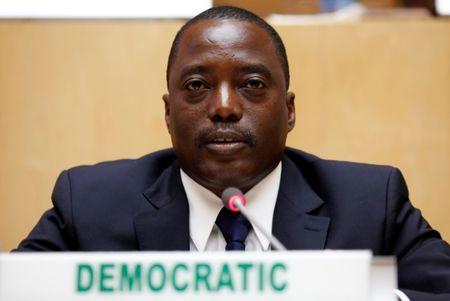
BACKTRACKING ON ELECTIONS? DRC President Joseph Kabila
The Independent National Electoral Commission (CENI) announced in Kinshasa that it was impossible to organize elections this year in the Democratic Republic of Congo (DRC).
“It is impossible to organize the elections in 2017,” the President of the election supervising body, Corneille Nangaa said during a meeting with a delegation of the International Organization of the Francophonie (OIF).
However, he promised to assess the situation with the Government and the National Follow-up Council of the Political Agreement (CNSA), before making any ‘extension decision’.
The political agreement signed on December 31, 2016 between the Government and the Opposition, under the mediation of the country’s Catholic bishops stipulated that the national and provincial, presidential and legislative elections should be organized ‘before the end of 2017’.
DRC President Joseph Kabila is under pressure to relinquish power after his term of office expired late last year.
He however, held on to power, promising to organize elections this year and step down next year.
But in a June interview with German weekly Del Spiegel in Berlin Kabila ‘swallowed’ his words and said he ‘never promised anything’, in regard to holding elections and his stepping down.
And, in February this year his budget Minister Pierre Kangudia had said the DRC could not raise the US$1.8 billion needed to conduct elections in Africa’s second biggest country, which has a population of about 70 million people.
DEAD: deceased Interior Cabinet Secretary Joseph ole Nkaiserry
The Kenyan Cabinet Secretary of the Interior Major General Joseph Kasaine Ole Nkaiserry, has died.
According to a statement by Joseph Kinyua, Kenya’s Chief of Staff and Head of Public Service, the 68-year old Maj. Gen. Nkaiserry, who once served as Kenya’s High Commissioner to Uganda, died a few hours after he was admitted to Karen Hospital for a medical check-up.
‘It is with deep sorrow and shock that we announce the sudden passing on of Interior CS retired General Joseph Nkaissery. Gen. Nkaissery passed on at Karen Hospital in Nairobi a few hours after being admitted for a check-up. The country to be updated as more information becomes available,’ the statement by Kinyua indicates.
Meanwhile, Kenyan President Uhuru Kenyatta has said the country will remain secure despite the death of Maj. Gen. Nkaiserry.
“There shall be no vacuum in securing our country”President Kenyatta, before appointing Dr. Fred Matian’gi to head the security docket in an acting capacity.
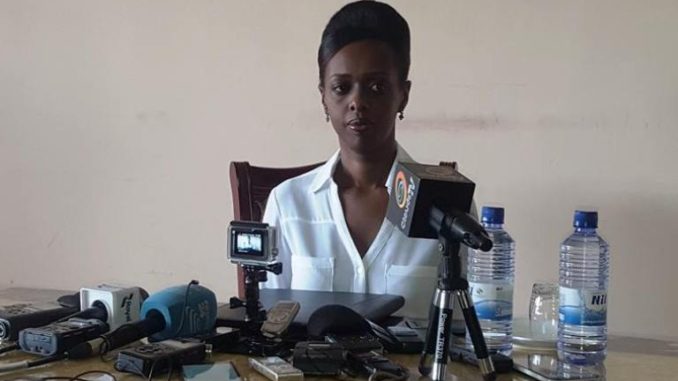
CHARGED: Former presidential aspirant Diana Shima Rwigara
Diane Shima Rwigara, the female candidate who had hitherto generated a lot of debate in regard to the August 4 elections in Rwanda, has been disqualified from contestinbg for the presidency.
Running as an Independent Ms. Rwigara, one of the three candidates disqualified, was told her fate yesterday by the Electoral Commission, which claimed she had failed to garner enough signatures to support her candidature.
But last week Ms Rwigara said that local leaders threatened her supporters while they collected signatures, while the Electoral Commission boss Kalisa Mbanda said she was excluded from the race for submitting signatures of some people who have been long dead and others who belong to a rival political party.
According to electoral laws, independent presidential candidates are required to present 600 signatures, with at least 12 from each of Rwanda’s 30 districts. Others disqualified by the commission are Gilbert Mwenedata and Fred Sekikubo Barafinda.
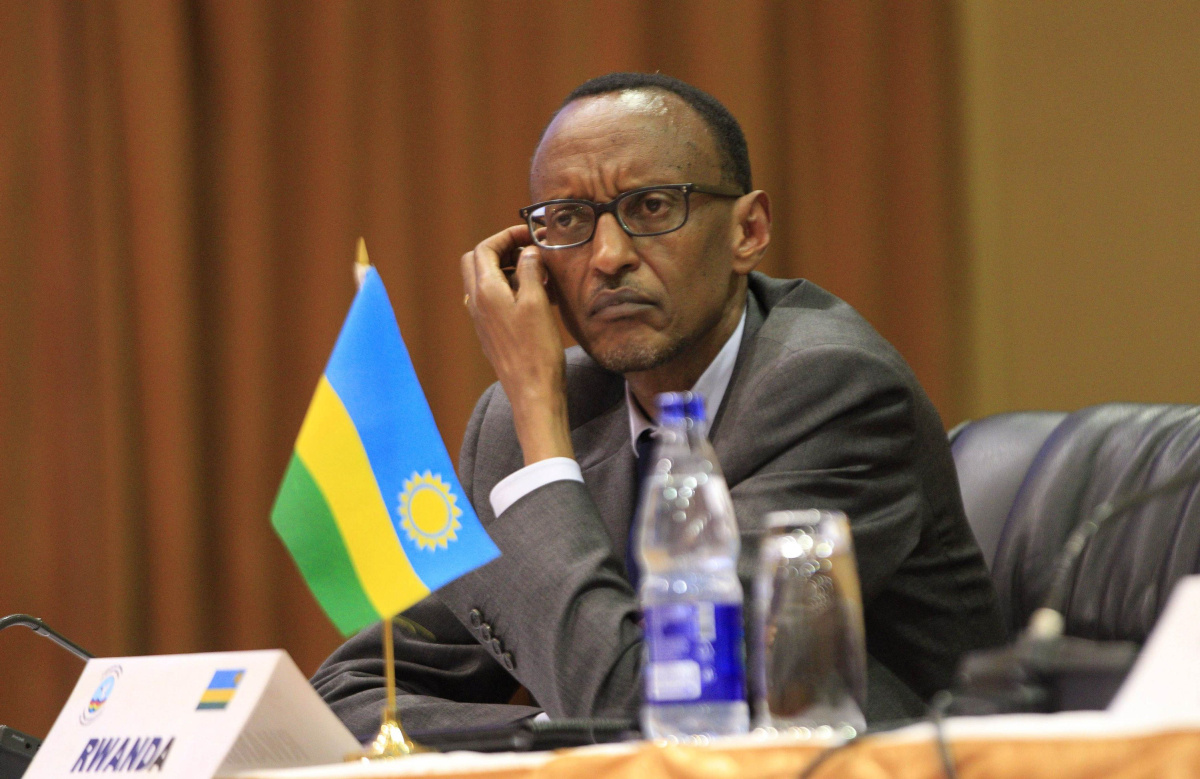
WIDELY EXPECTED TO WIN THE PRESIDENCY: Rwanda President Paul Kagame.
Rwandans go to the polls Aug. 4 and will choose among longtime President Paul Kagame, Frank Habineza of the opposition Democratic Green Party and independent candidate Philippe Mpayimana. Kagame is widely expected to win.
Meanwhile, Amnesty International has charged that the election will be held under a ‘climate of fear’ and repression, adding that the East African nation has seen two decades of often deadly attacks on political opponents, journalists and rights activists. The group called for serious political reforms.
“Since the ruling Rwandan Patriotic Front took power 23 years ago, Rwandans have faced huge, and often deadly, obstacles to participating in public life and voicing criticism of government policy,” said Muthoni Wanyeki, an Amnesty official in East Africa.
Many killings and disappearances have been blamed on the government of Kagame, who has been Rwanda’s de facto leader or elected president since the end of the country’s 1994 genocide.
Kagame is credited with leading Rwanda to stability and impressive economic growth, but critics say he is an authoritarian who is intolerant of legitimate opposition.
Young Somali migrants who were transferred to a detention centre in Al Khoms, Libya, after being rescued from a sinking vessel
A suspected top human trafficker who was arrested in South Sudan as he awaited new arrivals from the Uganda side of the border with the war-troubled country, has been handed over to Somalia for prosecution, according to officials in Mogadishu.
The Somali government says the man, identified as Abdulkadir Omar Abdulle, led a trafficking network in South Sudan that helped smuggle thousands of people across East Africa to Libya, where they awaited a possible journey to Europe.
Abdulle, a Somali citizen in his early 40s, was wanted on charges of trafficking and alleged abuses — including rape and murder — against the people his network was smuggling.
The Somali ambassador to South Sudan, Hussein Haji Ahmed, said that Abdulle ran a network of more than 30 smugglers based in South Sudan.
Abdulle was arrested in South Sudan’s capital of Juba last week. Ahmed said police told him that Abdulle was expecting new arrivals from the border with Uganda when he was captured at one of the secret homes he maintained for the smugglers.
“Police surrounded the house. He tried to jump over the wall, but was captured,” the ambassador said.
Abdulle was flown Thursday to Mogadishu, where Somali authorities took him into custody and are now holding him in a prison run by the National Intelligence and Security Agency.
Suspect ‘wanted for a long time’
“He was wanted for a long time by Interpol police from Somalia and South Sudan, and they have coordinated on his handover,” said the ambassador.
“He was a man who is conscious of his security. He was discreet and has managed to protect himself. When there is an anti-trafficking operation, he goes to a hideout in a border area between Uganda and South Sudan. He hides there.”
Ahmed said police obtained information about the phone Abdulle was using and tracked it, leading to his capture in Juba.
Officials said Abdulle’s network smuggles 600 to 700 people every month. About 90 percent of them are Somalis, most of them trying to leave Somalia due to insecurity and a lack of jobs.
Many of the people being smuggled were subjected to beatings or rape, and were sometimes held hostage for ransom.
The traffickers took videos of the abuses and sent them to the victims’ relatives, to pressure them to send money quickly.
“It’s appalling the kind of treatment women receive in the hands of these traffickers, it’s inhumane,” Ahmed said. “Some of their victims are young people, 13, 14 years old. They suffer unspeakable abuses.”
Asked whether Abdulle will be prosecuted in Somalia or handed over to other countries, Ahmed said the Somali government wants to prosecute him in Somalia pending an investigation.
“We want him for illegal trafficking, we want him for the death of people being smuggled, we want him for forging documents, and we want him for abuses against the young people in South Sudan and Sudan both, and other abuses which happened along the border between South Sudan and Uganda,” he said. “He will face justice in Somalia.”
Three other Somalis suspected of involvement in the trafficking network are being held in Juba, where they are under investigation, Ahmed said.
DURING HAPPIER DAYS: Ghetto men Bobi Wine and Buchaman
Former Fire Base Vice President Bucha Man is plotting to ‘overthrow’ his former boss Bobi Wine as Ghetto President.
We’ve learnt that the ‘Temumatila’ hitmaker is planning to swear in as the new Ghetto president, amid claims that “Bobi Wine is no longer a Ghetto person.”
According to Buchaman, Bobi Wine betrayed his people in the Ghetto when he disrespected his ‘presidential’ post and went for a ‘smaller’ post of MP.
Speaking to the media, Buchaman said he plans to be sworn-in as the new Ghetto president on Tuesday, the same day on which Bobi will be sworn in as an MP.
Meanwhile, this won’t be the first time Ugandans will be seeing parallel swearing in; former presidential candidate Kiiza Besigye has previously also held a parallel swearing in as President, an act that landed him in prison on treason charges.
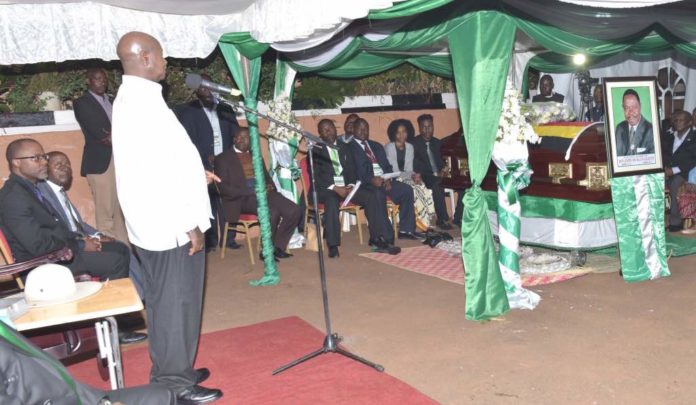
President Yoweri Museveni addresses mourners during a vigil at the late John Ssebaana Kizito's home
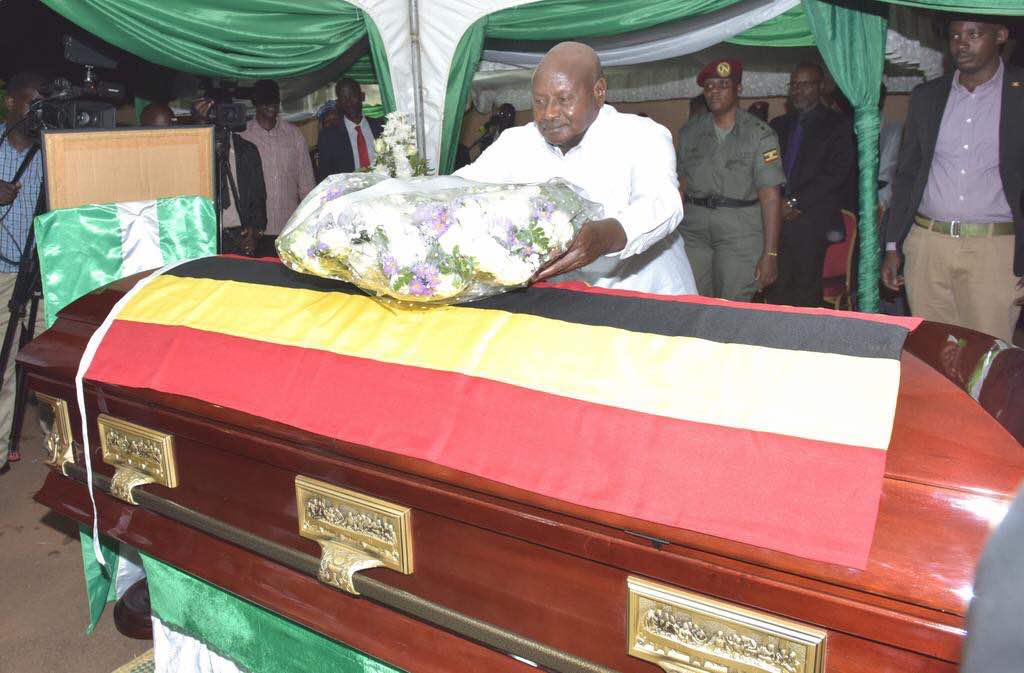
President Yoweri Museveni surprised mourners at the home of the late John Ssebaana Kizito, when he revealed that the deceased and his late father Amos Kaguta were very good friends who even paid little attention to the President when they met.
President Yoweri Museveni laying a wreath on the casket containing the remains of the late John Ssebaana Kizito
“He was a very social person who loved everybody regardless of who they were. He was close to my late father Amos Kaguta. Once, he came with his wife to Nakasero to see Mzee Kaguta, they by-passed me and when I asked, they said they had known each other while I was in the bush,” the President disclosed when he visited the late Ssebaana’s family in Kampala to condole with them and pay last respects.
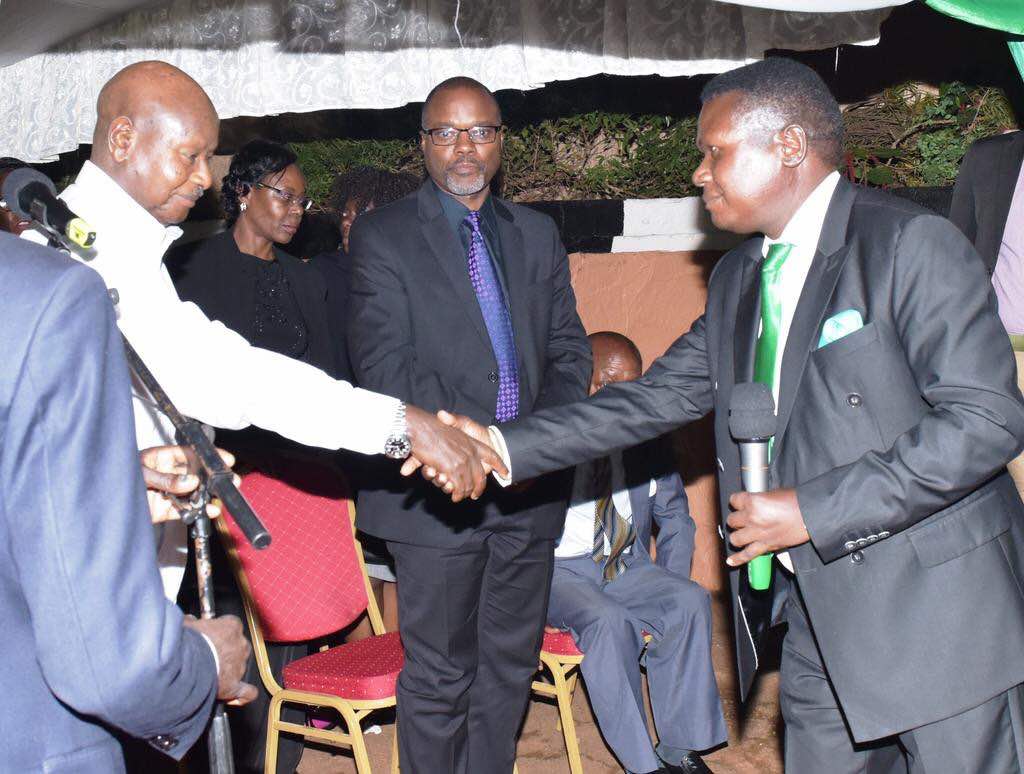
President Yoweri Museveni greets DP President Norbert Mao during the vigil at Ssebaana’s home
Museveni also described the late Ssebaana Kizito, who was once the Democratic Party (DP) President General, as someone who who advocated for non-frictional politics and a ‘very disciplined entrepreneur’.
“I commend him and Paul Kawanga Ssemwogerere for their role in DP, helping shape and change Uganda. Ssebaana was a minister and served this country greatly. May his soul rest in peace,” the President said.
A statesman and entrepreneur of vast connections, John Ssebaana Kizito, served in various cabinet positions and was once Mayor of Kampala. He succumbed to a stroke on July 3 at Nakasero Hospital after spending two weeks in intensive care.
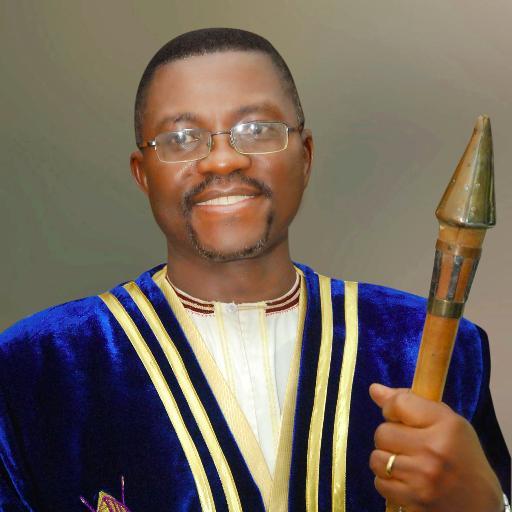
Buganda Katikiro Charles Peter Mayiga has advised political leaders in Uganda to cherish their avowed doctrines and to also respect human rights, ‘just as the late Sebaana Kizito did’.
Speaking at Ssebaana’ Kizitos requiem service held at Namirembe Cathedral earlier today, the Katikiro singled out politicians Democratic Party President General Norbert Mao, his colleague Medard Lubega Ssegona and UPC stalwart Olara Otunnu, urging them to emulate Ssebaana Kizito’s passion for peace and stability in Uganda.
Katikiro Mayiga also praised the late Sebaana Kizito for contributing to the development of the Buganda kingdom, emphasizing the deceased “loved his King and the culture in which he was born.”
“All Buganda kingdom flags will be raised at half must in appreciation of his service to Buganda kingdom and Uganda in general,” the Katikiro said in a condolence message delivered on behalf of Buganda Kingdom.
At the service, the deceased’s son Joseph Kizito, who works with the World Bank in Washington hailed the Democratic Party (where his father served as President General), Statewide Insurance Company (SWICO) and the government of Uganda for recognizing the Ssebaana Kizito’s contribution to the development of Uganda.
An entrepreneur of vast political and business connections, John Ssebaana Kizito, also served in various cabinet positions and once as Mayor of Kampala, succumbed to a stroke on July 3 at Nakasero Hospital after spending two weeks in intensive care.
READY: The Uganda Cranes after their last training session
The Uganda Cranes continue preparations for their CHAN 2018 qualifier match against South Sudan, with the team preparing for the upcoming Western regional tour on Saturday.
The first leg of the CHAN qualifiers will be played on July 14 in Juba while the return leg will take place in Kampala on July 22.
As part of the preparations Cranes coach Sredjovic Micho named a 23-man squad that travelled to Kabale for the Western region tour with the match to take place at the Kabale Municipal Stadium.
The team held its last training session at Namboole stadium, Kampala on Thursday evening before setting off for Kabale on Friday morning.
Previously the Cranes have also visited the Buganda Region (Masaka), North East (Soroti), Northern (Gulu), Kitara (Masindi), West Nile (Arua) and the Eastern Region (Mbale).
Meanwhile, KCCA’s Brian Majwega and Tom Masiko were named to the Cranes team after failing to travel with their club to Tunisia. KCCA play Club Africain tonight in the CAF Confederations Cup.
July 8th 2017 (Regional Tour)
Western Region Vs Uganda Cranes – Kabale Municipal Stadium.
The travelling squad:
Goalkeepers: Isma Watenga, Saidi Keni, Tom Ikara
Defenders: Nico Wakiro Wadada, Deus Bukenya, Nicholas Kasozi, John Adriko, Savio Kabugo, Bernard Muwanga, Rashid Toha, Majwega Brian
Midfielders: Bukenya Lawrence, Method Bassey, Shafiq Kagimu, Tom Matisko, Martin Kizza, Simon Sserunkuma, Milton Karisa, Erisa Ssekisambu
Strikers: Nelson Senkatuka, Shaban Mohamed, Julius Malingumu, Solomon Okwalinga.
TO REWWARD BEST INVESTMENT CLUB: The headquarters of dfcu Bank in Uganda
dfcu Bank, in partnership with NTV Uganda and Price Waterhouse Coopers (PwC) have today launched a nationwide reward campaign targeted at driving a savings and investment culture in Uganda.
The Shs100 million reward campaign, which will run – in part as a TV show competition dubbed ‘Battle for Cash’, was launched at the Kampala Serena Hotel, with the media fraternity having the first hands-on experience.
The dfcu Bank Executive Director and Chief of Business William Sekabembe, said two special categories of women and youth have been included. Clubs with 100% composition of these special groups will apply to enter the competition and into a special category for Women Clubs and Youth increasing their chances of winning.
“We are putting a lot of emphasis on these two categories because we believe they play a major role in the development of communities and Uganda as a whole,” he added.
The ‘Battle for Cash,’ challenge will provide a free platform to Investment Clubs to showcase their success stories over a period of six (6) months.
The best investment club will take the Shs100m prize, while one delegate from each of the 20 selected clubs that will enter the competition will be sponsored to attend a study tour in Nairobi to share experiences, network, and widen their knowledge and contacts. The top seven (7) clubs will also receive free advisory services for a period of one (1) year.
As part of several efforts to promote a savings culture in Uganda, dfcu Bank introduced the Investment Clubs program in 2007 providing a conducive platform to foster group savings. The dfcu Bank program has since grown with over 10,000 Investment Clubs that cut across all segments including students, the professionals, women, youths holding a savings turnover of over UGX 400 billion. Also, clubs that are able to present innovative investment ideas and demonstrate the ability to consistently pool savings towards the realization of their objective for a minimum period of six months will be eligible to enter the competition. They will have the opportunity to showcase their ideas and investment projects on NTV Uganda.
Compared to the countries in the region, Uganda has the lowest savings to GDP ratio, at 13.48 per cent of GDP, with majority of the population ‘un-banked’.
According to the Uganda Bureau of Statistics, only 12% of the population have bank accounts while research shows that Ugandans save less than 5% of their monthly earnings as compared to other East African countries (Kenya 23%; Tanzania 13% Rwanda 18%).
The low savings rates are largely a result of traditional banking remaining out of reach for most due to factors like; inadequate financial services; financial illiteracy; physical distance from banking institutions and high minimum deposit and balance requirements, limiting access to banking services.
But banks have taken huge strides in addressing these shortcomings by recognizing the potential and are introducing resourceful methods of bringing them back into the formal economy by introducing several innovative products and services.
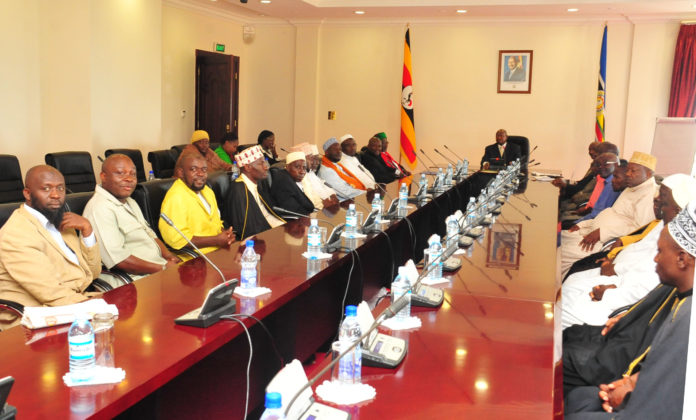
FLASHBACK: President Yoweri Museveni meeting Muslim of the Kibuli faction
Two Muslim-turned-Christian ‘Pastors’ in Kampala have vowed to storm Parliament to protest against the imminent passing of the Islamic Banking Bill that seeks to operationalize Islamic banking services in Uganda.
The group led by ‘Pastor’ Stephen Waiswa of the Bible Evangelism Ministries allege that Islamic Banking is based on the Islamic Sharia’h Law, yet Uganda is not an Islamic country.
“We will go to Parliament and tell the MPs about the dangers of Islamic Banking,” said Pastor Waiswa, a former Muslim who studied in Iran, one of the staunch Islamic countries.
“Islamic Banking is based on Islamic principles which are anti-Christianity,” says Abdul Karim Waligo, another pastor from the same church located near Clock Tower, along Entebbe Road.
According to Pastor Waligo, Islamic banking is a brainchild of Muslim fundamentalists in the Middle East and a subtle way of spreading Islam as a religion to the rest of the world.
“Our Motto says, ‘For God and my country’. I am surprised that government wants to bring Islamic banking to our country,” he adds.
The two pastors made the pronouncement as they addressed gatherers who were attending a public debate between pastors and sheikhs.
Contrary to the pastors’ concerns, proponents of Islamic banking say it paves way for the sharing of net profit/loss and the risk involved in a proportional manner between the lender and the beneficiary.
“If a financier is expecting a claim on profits of a project, it is necessary that he/she should also carry a proportional share of the loss of that project,” an official from Tropical bank says. Tropical Bank is one those local commercial banks that are slated to begin Islamic banking as soon as Parliament clears the related bill.
According to the Bill, willing commercial banks and other financial institutions recognized by the Bank of Uganda will be free to offer the Islamic banking services and products under the system that is already running in Kenya and Tanzania, Uganda’s EAC partners.
Unlike conventional commercial banking, Islamic banking, experts say, does not base loan acquisition on the collateral, the reason why government is interested in having this type of banking, especially at the time when interest rates in the country can only be managed by a few individuals and businesses.
At the presentation of the 2017/18 national budget last month, President Yoweri Museveni said his government would operationalize Islamic banking soon to serve property-less borrowers, stressing that commercial banks had resisted lowering their lending rates.
‘Western’ or conventional financing looks
NOT AVAILABLE FOR COMMENT: One of the most prominent Muslim Parliamentarians Kawempe North MP Latif Ssebaggala
to profit through interest payments and makes the beneficiary completely liable for any risk.
Efforts to contact Kawempe North MP Latif Ssebaggala to give a comment were futile as his known phone contacts were off. A Muslim, Ssebaggala is one of the MPs that vehemently support the bill.
Meanwhile, groups of Muslim and non-Muslim businessmen this reporter talked to are in favour of Islamic banking and are hopeful that it will help them access funding to expand their businesses.
“I have a welding business in Kisenyi which needs funding but our banks have lending conditions that I can’t fulfill. I hope Islamic banking will help me grow my business,” says one Yunus Kitata.
According to Prof. Raj Bhala of the University of Kansas Law School, Islamic finance is a roughly US $3 trillion industry and Islamic financial products are offered in Islamic and non-Islamic countries to Muslim and non-Muslims alike.
But Prof. Bhala says that with so much attention since 9-11, Middle East conflicts, and world-wide terrorism, ‘the nature of Islamic finance is not widely understood despite being successful, and founded on an ethically well-based system’.