Stanbic Bank
Stanbic Bank
24.8 C
Kampala
Stanbic Bank
Stanbic Bank
Home Blog Page 1836

Gorilla trekking sparks growth in Kigezi region

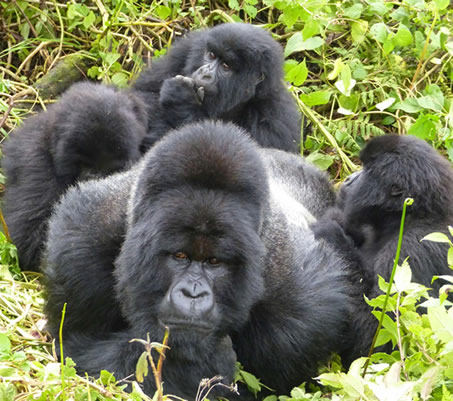
The Silver back-gorillas are a major tourist attraction

Mountain gorilla tourism has contributed billions to the Ugandan economy, helping spur development in the Kigezi sub-region in the south-western part of the country on the border with Rwanda.
Official records show that more than 18,000 gorilla permits are sold annually, with each permit costing Shs2.16 million (US$600), translating into an annual collection of more Shs38 billion.
According to John Justice Tibesigwa, the Bwindi and Mgahinga National Park Acting Conservation Area Manager, mountain gorilla tourism started in 1961 when the area was still a sanctuary.

Tourism, Tibesigwa said, has also enabled the Uganda Wildlife Authority (UWA) to contribute Shs900 million annually to communities around Bwindi-Mgahinga for development projects.
The Bwindi-Mgahinga area has more than 14 gorilla groups and only eight tourists are allowed to visit a gorilla group per day. As of September 2016, the estimated number of mountain gorillas remaining in the world was about 880, with Uganda owning more than half of the primates.
This, as a result, has attracted tourists in the area and has had a spillover effect in terms of service development, especially in hotel and hospitality and the transport sector.
More than 100 hotels and camp sites have been established and provide employment to more than 10,000 people.
Hotels such as Accadia Cottages, Bunyonyi Overland Resort Camp, Entusi, Bushara and Sharp Island Gorilla Lodge, among others are a good addition to the Kigezi tourism.
In the transport sector, an airstrip has been established in Kihiihi, Kanungu District and another is under construction in Rubanda District. The two will be an addition to the already existing Kisoro Airfield.
“Tarmacking Kabale- Kisoro road has also facilitated development. However, government should improve internet connectivity, provide electricity, especially in the national parks,” Ivan Mbabazi Batuma, a member of the Kigezi Tourism Cluster, says.
Other tourism features such as Lake Bunyonyi, Mt Muhavura, and Queen Elizabeth National Park, Batuma says, should be promoted to create alternatives as well as establishing a special desk at border points to handle tourists.
Nicholas Byengoma, the vice chairperson of the Kigezi Tourism Cluster, says whereas government has injected billions of Ugandan shillings into the tourism sector, more needs to be done.
“Encourage the establishment of domestic air transport to ease movement, especially for tourists visiting different destinations,” he says.
Tourism, as already stated, employs more than 10,000 people in the Kigezi sub-region and this, according to Seith Byarugaba, an investor in accommodation, is a big achievement that government should leverage on.
“There is need to habituate other animal species such as chimpanzees, red monkey and birds to diversify,” he says.
Government, Fideli Kanyamunyu, the director of Wagtail Tourism Investments in Kisoro District, believes should return much more to local communities instead of the current 20 per cent.
“… giving us only 20 per cent of the entrance fees, which is only US$40 out of the US$600 should be revised,” he says and appeals to government to consider giving soft loans to community members to improve the quality of their products.
But beyond looking at government, Akankwasa Barirega, the Acting Commissioner for Wildlife Conservation at the Ministry of Tourism and Antiquties, advises local communities and members in the Kigezi Tourism Cluster to be more innovative, especially in regard to creating tourism amenities.
For instance, he says, people should think of establishing facilities such house boats on Lake Bunyonyi, zip lines crossing the interlocking hills, cable cars on Mt Muhavura and hot air balloons, among others.
“You earn a lot because there is a ready market [tourists],” he says.
Silver Baguma, the Vice Chairman of Rubanda District, thinks that stakeholders meetings such as the one held recently, provide good engagement.
However, he argues, for employment opportunities, residents must be given priority consideration.

Stories Continues after ad

MPs order ministries to profile assets in new house regulations

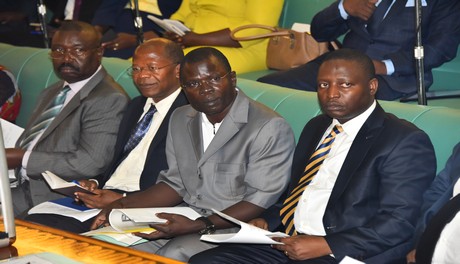
State Minister for Finance David Bahati (R) in parliament yesterday

Government ministries will be required to provide an asset register, vehicle utilisation and their loan portfolios to Parliament every financial year, in a new provision of the Rules of Procedure of Parliament meant to streamline the budgeting process.

While presenting their Ministerial Policy Statements, ministers will also be required to show the actions taken to implement the recommendations of Parliament in respect to the report of the Auditor General of the preceding financial year.

Ministerial Policy Statements set out the performance and plans of ministries and government departments or agencies.

Parliament, presided over by the Deputy Speaker, Jacob Oulanyah, yesterday continued consideration of its Rules of Procedure, also approved amendments of the Rules intended to realign them with the Public Finance Management Act, 2015.

The Committee on Rules, Privileges and Discipline proposed that shadow ministers submit their alternative policy statements to parliament by the 29th day of March every year.

The statement shall also include the annual procurement plan, annual recruitment plan, the cash flow projections; and certificate of gender and equity responsiveness; the achievements of the vote for the previous financial year; annual and three months workplans and outcomes; the objectives, outputs, targets and performance indicators of the workplans.

Nathan Nandala Mafabi (FDC, Budadiri West) said that in order to ascertain how much a ministry is owed, the Policy Statement should also indicate their loan portfolios and domestic arrears.

“We need to add loan portfolios in the ministry, such that we know how much the Ministry received, utilized and its standing,” said Nandala.

The State Minister for Finance, David Bahati, however said that government instead presents a quarterly and annual loan portfolios, arguing that the addition would not add any value.
“We already submit a loan portfolio. Of what value will this amendment add?” said Bahati.

Despite the Minister Bahati’s objections, parliament approved the requirement for government ministries to show their loan portfolios in their policy statements.

Parliament deferred the consideration of amendments to the Rules of Procedure to another sitting.

Stories Continues after ad

BoU supervisory competences to be scrutinised by Parliament

Nathan Nandala Mafabi
FDC Secretary General Nathan Nandala Mafabi

Amid the back and forth arguments between the Bank of Uganda and the now-defunct Crane Bank on the one hand, and city businessman Sudhir Ruparelia on the other hand, legislators has picked interest in the operations of the Central Bank.

According to sources, Nathan Nandala Mafabi, the MP for Budadiri West is set to lead a group of MPs to table a motion in which the supervisory and operational competences of the BoU will come under scrutiny, including the way the issue of the now-defunct Crane Bank is being handled.

By press time it was not possible to establish the exact time MP Nandala Mafabi would move the house over the matter, but the source told the EagleOnline that one of the issues for debate will be the reported squabbling among the Central Bank top officials over the BoU-Crane Bank-Sudhir saga. Also, efforts to contact MP Nandala Mafabi were futile as he did not pick his phone.

It is said that top officials at the BoU are divided over the procedures undertaken by the Central Bank that have led to the current stand-off, with some arguing that the BoU, through its Bank Supervision Directorate headed by Ms. Justine Bagyenda, failed to satisfactorily execute its mandate.

Since then, the BoU has dragged Sudhir to the Commercial Court, demanding the businessman pay about Shs400 billion he allegedly took from Crane Bank, an issue that spiralled out of proportion, drawing in several sectoral players that will now be joined by the Parliamentarians, who have oversight powers over government functioning.

It should be recalled that in the Eighth Parliament MP Nandala Mafabi was the Chairman of Public Accounts Committee (PAC), and during the time helped unearth several financial scams in the government fiscal systems.

Stories Continues after ad

KCCA FC sweeps most honors at 2017 UPL awards

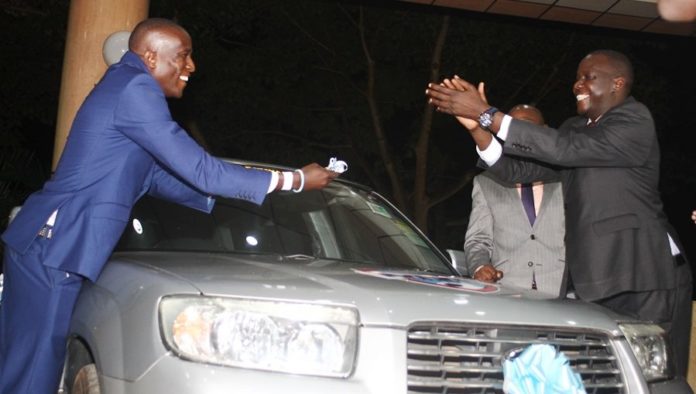
EALA Speaker Dan Fred Kidega hands over the top prize, a Subaru Forester, to MVP Geoffrey Sserunkuuma

Mike Mutebi’s KCCA FC dominated the 2017 Uganda Premier League awards after winning six of the various categories of prizes on offer, crowning a successful year in which the team also became league champions.

KCCA FC walked away with most awards including, MVP, Coach of the year, Fair play team award, Fans’ player of the Year, Top scorer and Young player of the year that was won by nineteen-year-old Allan Okello.

The Lugogo-based club also dominated the Uganda Premier League Best XI with four players (Sserukuuma, Habib Kavuma, Muzamiru Mutyaba and Timothy Awani).

At individual level Geoffrey Sserunkuma won the most awards, Most Valuable Player, top scorer, fans’ player of the year and was also named on the team of the year, taking home four different awards.

The 34-year-old striker drove away the top prize, a Subaru Forester in addition to two million Ugandan shillings, during the prestigious event at Imperial Royal Hotel in Kampala presided over by the Speaker of the East African Legislative Assembly (EALA) Dan Fred Kidega.

The 2017 UPL awards were the 5th edition and are held every end of the season to recognize and reward the best performers from the Uganda Premier League.

Sserunkuuma joins Joseph Ochaya, Miya Farouk, Robert Ssentongo and Brian Umony as the past winners of the top accolade.

Former KCCA left full back Joseph Ochaya, who is currently with Zambia’s Lusaka Dynamos, won the accolade last year.


Summary of the winners:

MVP: Geofrey Sserunkuma (KCCA Football club)

Top Scorer: Geofrey Sserunkuma (KCCA Football Club) – 21 Goals

Fans’ player of the Year: Geoffrey Sserunkuma (KCCA Football Club)

Life time achievers’ award: Patrick Kawooya (RIP) – Former SC Villa President

Young player of the year: Allan Okello (KCCA FC)

Midfielder of the year: Saddam Juma (Express)

Goalkeeper of the Year: Ismail Watenga (Vipers)

Defender of the Year: Halid Lwaliwa (Vipers)

Goalkeeping coach of the Year: Stephen Billy Kiggundu (Vipers)

Coach of the year: Mike Mutebi (KCCA Football Club)

Referee of the year: Alex Munabi

Club Chief Executive Officer (CEO) of the year award:  David Tamale (KCCA football club)

Fair Play Individual of the year – Fredrick Senoga

Fair play team award – KCCA football club

Media (On line): David Isabirye (Kawowo Sports)

Media (Print): John Viannie Nsiimbe (The Observer)

Media (TV): Ismail Dhakaba Kigongo (NTV)

Media (Radio): Phiona Namiiro (Star F.M)

Special Recognition award: Bukedde TV

Media ( Photography): John Batanudde (Red Pepper and Kawowo Sports)

Fans of the year: Onduparaka F.C fans

Team of the year

Ismail Watenga (G.K), Nico Wadada Wakiro, Habibu Kavuma, Halid Lwaliwa, Timothy Awanyi, Tadeo Lwanga, Muzamiru Mutyaba, Juma Saddam Ibrahim, Geofrey Sserunkuma, Shaban Muhammed, Emmanuel Okwi

Coach – Mike Mutebi

Stories Continues after ad

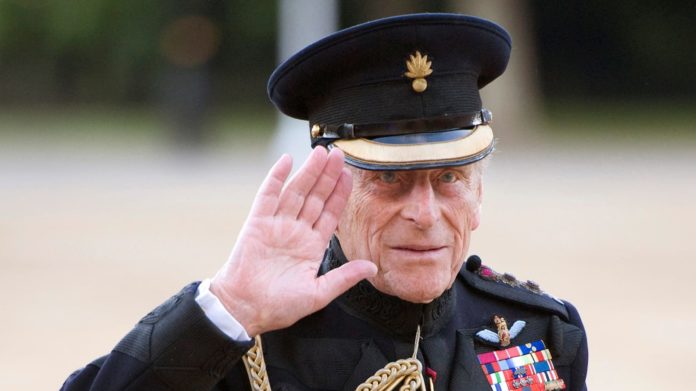
Prince Philip to step down from royal duties

Prince Philip, the Duke of Edinburgh

A curtain will close on the end of an era for the British royal family.

Earlier reports in May revealed that Prince Philip planned to step down from all public duty and effectively end his career in the spotlight, and, now, Buckingham Palace announced that the 96-year-old royal will retire sooner.

A spokesperson confirmed that the Duke of Edinburgh’s last public engagement will take place during the week of August 2, with a final attendance at the Royal Marines’ charity parade in London.

However, the palace promised that we might still see snippets of the prince, who is reportedly stepping down for non health-related reasons, and his wife, Queen Elizabeth II periodically during royal engagements—depending on his fancy.

“[The parade] will bring His Royal Highness’s individual program to a conclusion, although he may choose to attend certain events, alongside the Queen, from time to time,” a royal delegate concluded the statement.

Though, we imagine that Prince Philip will be most likely spending his days as a retired man relaxing with the couple’s incredible corgi brood.

.


Stories Continues after ad

Top DRC warlord surrenders to UN forces

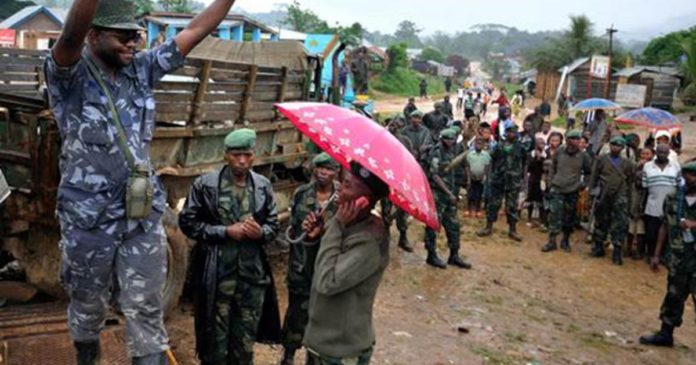
Democratic Republic of Congo's notorious warlord, Ntabo Ntaberi Sheka

One of Democratic Republic of Congo’s most notorious warlords, Ntabo Ntaberi Sheka, wanted for alleged crimes against humanity, surrendered to U.N. peacekeepers on Wednesday, the UN mission in Congo (MONUSCO) said.

Sheka’s militia, Mai-Mai Sheka, is one of a patchwork of armed groups in eastern Congo regularly accused by the United Nations and rights groups of using rape as a weapon of war.

After six years on the run, Sheka surrendered to UN forces in the town of Mutongo in Walikale territory and was transferred to the eastern city of Goma, said MONUSCO spokeswoman Fabienne Pompey.

It was not immediately clear why he had turned himself in.

“He will be handed over to DRC authorities after the regular procedure and checking is done by MONUSCO,” Pompey said.

Despite the 2003 end to years of war in eastern Congo that killed millions, mostly from hunger and disease, dozens of armed groups continue to operate there, exploiting vast mineral reserves and preying on the local population.

According to the United Nations, Sheka’s forces and two other armed groups raped at least 387 civilians between July 30 and August 2, 2010 to punish them for allegedly collaborating with Congolese government forces.

Congolese authorities issued a warrant for Sheka’s arrest in January 2011 but despite joint operations by the Congolese army and UN forces against his group, he remained at large in Walikale’s remote forests.

In 2015, Human Rights Watch said Sheka’s forces had killed at least 70 civilians since the arrest warrant was issued, many of whom were hacked to death by machete and whose body parts were paraded around town as the fighters chanted slurs against rival ethnic groups.


Stories Continues after ad

Local NGO urges gov’t to spend more money on ARVs

Health Minister Dr Jane Ruth Aceng

Government should operationalise the HIV/AIDS Trust Fund established three years ago if it is to fully guard against the persistent ARVs stock-outs, a civil society group-Uganda Debt Network (UDN) has said in its weekly brief.

The Fund was created under the HIV AIDS Prevention and Control Act, 2014. UDN tracks Uganda’s debt management, giving recommendations on how best government can manage its debts.

The group urges that the persistent shortages of ARVs in health facilities can be addressed through proper planning that progressively requires increasing public financing and building capacity of relevant agencies.

Of the US$494 million spent on the procurement of the ARVs in the financial year 2015/16, government of Uganda contributed a paltry US$32 million, the rest coming from development partners such as the Global Fund and UN agencies, UDN says.

In the brief, UDN blames government of Uganda for so much relying on donors to procure drugs and that this limits public investment to address the effects of the pandemic. Relying so much on the donors to procure drugs, UDN says is not sustainable in the long run.
“Indeed on numerous occasions Uganda has found itself in a very tricky situation because of this dependence syndrome. In 2015 there was no stock out because of frontloading by Global Fund,” UDN says in its brief to the media.

UDN further argues that donor dependence on financing HIV/AIDS has prohibited extensive scale-up of HIV programmes at par with global targets, stating that domestic resource mobilization efforts must consider the current constraints in the system  effectively tackle bottlenecks to achieve sustainable financing.
“Whereas the National Development Plan II (NDP II) is very clear on the key interventions on HIV/AIDS, these have not been backed by adequate financing,” the group adds.

Uganda is a signatory to the WHO/UNAIDS 90-90-90 target; (90 percent of all people living with HIV knowing their HIV status; 90 percent of all people with diagnosed HIV infection receiving sustained antiretroviral therapy; 90 percent of all people receiving antiretroviral therapy having viral load suppression by 2020).
It is believed that approximately 1.54 million people are living with HIV/Aids in Uganda. The HIV diagnosis coverage as percentage of People Living with HIV (PLHIV) who knew their status is 69 percent.

The Uganda Status Report on HIV/AIDS (2015/16) indicates that 898,197 people were on Antiretroviral Therapy (ART) by June 2016, from750,896  by December 2014. Treatment coverage for children was raised to over 66 percent from 31 percent in 2014. The test and treat policy and early infant diagnosis are expected to improve this statistic.

Meanwhile the government of Uganda has established a viral load testing lab at the Uganda National Health Laboratory Services which scaled up viral services to all the 112 districts by the year 2016.
“The Ministry of Health planned to have 892,000 people on antiretroviral treatment by the end of this financial year. But right now, the number of people on lifesaving drugs has hit one million, a development that has wedged on stocks in public health,” the group adds.

Last month, President Museveni launched a renewed fight against HIV/AIDS in Uganda with hopes of ending the epidemic by 2030.

Stories Continues after ad

UNBS destroys goods worth Shs900m in Nakasongola

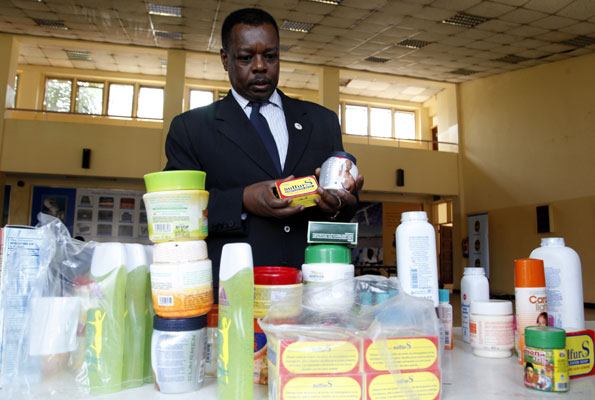
FLASHBACK: UNBS Executive Director Ben Manyindo verifying the quality of cosmetics on Ugandan market. The agency has stepped up the certification drive for manufacturers

The Uganda National Bureau of Standards (UNBS) has intensified the campaign against the sale of fake goods in the country, the latest being the destruction of goods worth Shs900 million at Luweero Industries in Nakasongola District.

The destruction of goods follows countrywide seizures carried out by the UNBS Market Surveillance team and the Criminal Investigations Department of the Uganda Police Force.
The destroyed goods were mainly substandard products which included food stuffs, baby powdered milk, cement, sanitary towels, cosmetics, electronics, steel and steel products, among others.

According to the UNBS Deputy Executive Director in charge of Compliance, Mr. John Paul Musimami, the destruction is part of UNBS’ effort to protect consumers from substandard products. “Substandard products are not only dangerous to the health and wellbeing of consumers, they are also a threat to the economic development of our country,” Mr. Musimami said.

“Our role is to promote fair competition, enhance competitiveness of local industries and protect health and safety of Ugandans and the environment,” he added. The destroyed goods amounting to 4 metric tonnes, the official said, would have otherwise caused increased disease burden and robbed the consumers of their money.

The manufacture or sale of sub-standard products is a criminal offence under the UNBS Act Cap 327, Laws of Uganda.
The UNBS carries out regular market inspections to ensure that traders are selling quality products in right quantities. Any substandard goods found on the market are seized by UNBS Market Surveillance inspectors.

UNBS, last year, inspected 1,090 business outlets and seized goods worth Shs6 billion including solar panels, primary batteries, percolators, sockets, compact fluorescent lamps, tiles, blenders, among others.
“We shall continue to seize substandard products on the market and prosecute traders involved in illicit trade,” Mr. Musimami said, urging the public to report suspicious goods on the market to UNBS.

The UNBS also banned the sale of second hand under garments and beauty products that contain mercury and hydroquinone which are harmful to human health.
However, some of the goods continue to be imported into the Ugandan market by smugglers through porous borders and entry points where UNBS has no presence.
UNBS is responsible for developing and promoting standards and quality of products and services to facilitate fair trade, promote local industries and protect consumers.

Stories Continues after ad

Hospitality: how it can make or break the restaurant and hotel business in Uganda

By Cynthia Tumwine

First off, before we dive deep into how hospitality is a key anchor in the restaurant and hotel business, we should ask ourselves what the true meaning of hospitality is. Google describes it is as ‘the friendly and generous reception and entertainment of guests, visitors, or strangers’.

According to several reports, Uganda has been declared one of the most hospitable countries to visit in the world. Naturally, Ugandans are warm and receive people with open arms which is not necessarily the case all over the world. This can also be seen clearly in how open our country is to tourists, expatriates, and refugees coming from volatile areas of war and general unrest. This aside however, hospitality becomes even more key for stakeholders in the Restaurant and Hotel business because these come into contact with most of these people on a daily basis. This therefore means it has to be practiced more not just because it comes naturally but on a professional basis. In summary, it is an art that needs to be mastered.
Every single day there will be a person that needs to eat or a bed to lay their head after a long trip or work day especially if they are in a foreign country, region or area. Their experience as they eat or rest in the hotel needs to be top notch. Straight from the point of contact that is: from the waiters or waitresses at restaurants, to receptionists at the hotel or even the managers. As long as someone is directly involved with customer service, hospitality should be considered as they carry out their work. Let us look at some of the ways hospitality can be achieved.

  1. A smile costs nothing and helps the customer feel relaxed and welcome.

This means that they will be able to communicate their needs more comfortably, therefore improving the quality of their experience.


  1. Anticipate the needs of the customer

For example in a restaurant, if someone needs the menu as soon as they sit down, or in a hotel if someone needs extra towels or beddings. This helps them to know that the establishment has efficiently trained stuff.

3.         Crisis management and problem solving skills.

These play a big role in how a customer’s experience could go, if for example someone forgets something and needs to purchase it, will you go out of your way to ensure they get it? Payment options in case one method is ineffective or is not working. These are all things that makes the customer’s life much easier knowing you have them covered.

  1. Lastly but very important is attention to detail

In order for a customer to have the best experience, all the services being offered by a hotel or restaurant should be spick and span. For instance, the environment should be clean, and amenities should be in mint condition; which encourages the customer to return.

Hospitality is one of the topics that is going to be addressed at the 5th Annual Uganda Hotels Expo, happening at Hotel Africana from August 4-6, 2017. It is important that this message is emphasized for a better quality experience for the different categories of people that frequent restaurants and hotels in the country. Therefore, for all stakeholders like hotel owners and those responsible for customer service and hospitality this expo will be highly relevant.
Stay Adventurous!
Cynthia Tumwine.
The writer is the PR Manager at Jumia Travel Uganda

Stories Continues after ad

Trump: Transgender people ‘can’t serve’ in US military

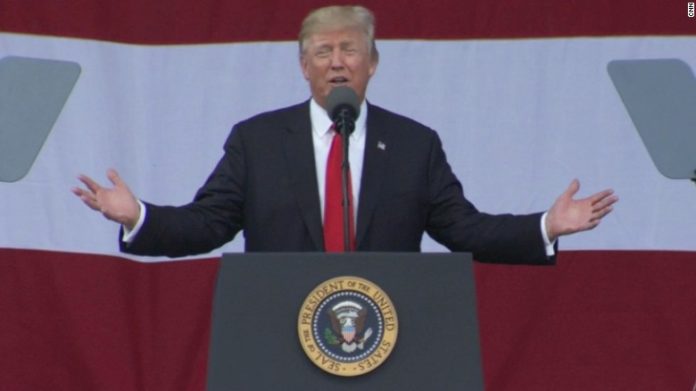
MADE 'SHITHOLE' COMMENT? US President Donald Trump

US President Donald Trump says transgender people cannot serve in “any capacity” in the military.

He tweeted that he had consulted with military experts and cited “tremendous medical costs and disruption”.

The Obama administration decided last year to allow transgender people to serve openly in the military.

But in June, Defence Secretary James Mattis agreed to a six-month delay in the recruitment of transgender people.

The Pentagon said this was to allow the different branches of the military to “review their accession plans and provide input on the impact to the readiness and lethality of our forces”.

Some Republicans have voiced opposition to allowing transgender people to serve at all.

The independent Rand Corporation estimated in 2016 that 2,450 of the 1.2 million active-duty service members are transgender, though some campaigners put the figure higher.

In a series of tweets, Mr Trump said: “After consultation with my Generals and military experts, please be advised that the United States Government will not accept or allow transgender individuals to serve in any capacity in the U.S. Military.

“Our military must be focused on decisive and overwhelming victory and cannot be burdened with the tremendous medical costs and disruption that transgender in the military would entail.”

Critics of Mr Trump’s move are contrasting it with his support for LGBT rights during last year’s election campaign, when he said “I will fight for you”.

The timing of this transgender ban is almost as interesting as the move itself.

Why now? With the Trump administration being buffeted by the Jeff Sessions political death watch, the ongoing multi-prong investigation into the Trump campaign, the healthcare drama in the Senate and the impending Russian sanctions bill, perhaps the administration decided this was a good time to change the subject and rally conservative forces to his side.

Republicans have long used cultural issues as a wedge to divide Democrats and energise evangelicals. As one White House insider acknowledged, this is straight out of that playbook. While Mr Trump campaigned as sympathetic to LGBT rights, he needs the traditional religious conservatives to stay loyal to him now, more than ever.

His populist supporters won’t consider this a top issue, but the president needs more than just his die-hard loyalists in his corner, particularly if he’s going to stoke intraparty discord by continuing to feud with Mr Sessions.

The president’s action will create a furore among liberals and the media commentators whose disdain for the current administration is not a new development. This is a fight the White House will welcome.

While Mr Trump’s decision concerns transgender military personnel, the US military’s ban on openly gay and lesbian servicemen and women – known as “Don’t ask don’t tell” – was lifted in 2011.

Aaron Belkin, director of the Palm Centre, a leading think-tank which studies gender and sexuality in the military, told the BBC that Mr Trump’s decision would force transgender troops to in effect live as gays and lesbians did under “Don’t ask, don’t tell”.

“Don’t ask, don’t tell was a disastrous policy that harmed the military for almost two decades,” Mr Belkin said.

“It’s not clear why the president would want to bring it back now for transgender troops, when all the evidence suggests that inclusive policy benefits the military and discrimination hurts the military.”

LGBTQ campaign group, GLAAD, called Mr Trump’s move “a direct attack on transgender Americans”.

George Takei, equality campaigner and the actor, who played Mr Sulu in Star Trek, accused the president of cruelty and pettiness.

Republican opponents of transgender people serving in the military include Vicky Hartzler, a congresswoman from Missouri, who wants transgender service members honourably discharged.

Others are opposed to the military bearing medical costs associated with transgender recruits, such as gender reassignment.

Trump supporter and political commentator Scott Presler is among those who disagree with the military carrying the cost of such interventions.

While disagreeing with the ban, he added that “generals know more about war than I do.

“I am cognizant that they understand what it takes to go to war… I don’t think this is an attack on the LGBT community.

“I’m mixed, but I have confidence in the guidance that President Trump is receiving,” he said. “I don’t think for a second he’s prejudiced.”


Stories Continues after ad