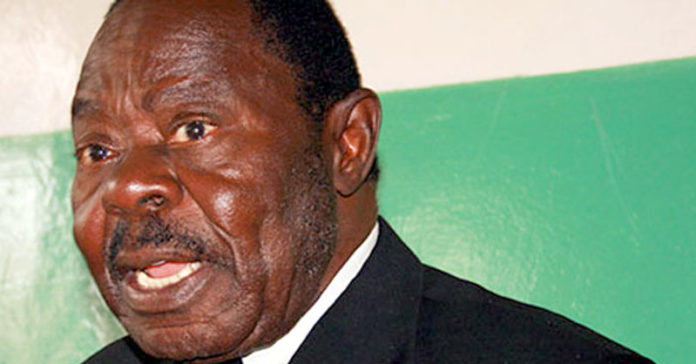
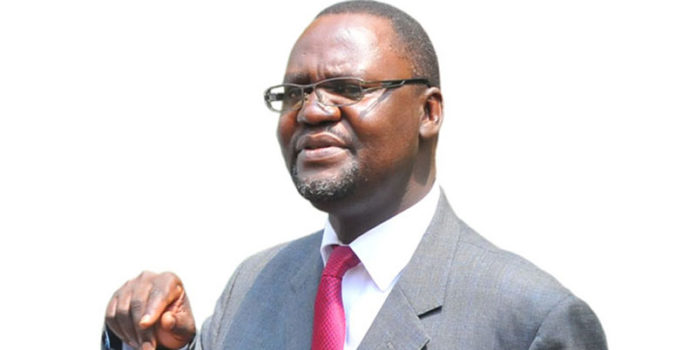
The government has accorded the former Democratic Party (DP) President General John Ssebaana Kizito an official burial in memory of his historical contribution to the development of Uganda before and after Independence.
Ssebaana Kizito succumbed to a stroke at Nakasero Hospital after spending two weeks in intensive care. The stroke affected his brain and his right side of the body.
Meanwhile DP Publicity Secretary Kenneth Paul Kakande, has said the party is mourning and celebrating the life of the late Ssebaana Kizito and has established a burial coordinating committee headed by MP Medadi Lubega Ssegona.
“He initiated a peaceful transition of power from people born before to those born after the Independence,” Kakande said.
Since Independence Ssebaana served in almost all successive governments, and had earlier represented Uganda in the East African Legislative Assembly (EALA) for 10 years starting from 1967 -1977. He also served as Mayor of Kampala.
Ssebaana, the first Ugandan to pursue a master’s degree in arts at the University of Oregon in USA, together with his business associate Joseph William Kiwanuka, set up the first private insurance company in Uganda, known as Statewide Insurance Company of Uganda (SWICO).
Burial arrangements
Today, Ssebaana’s body lay in state in Parliament, after which there will night vigil at his home in Kansanga.
On Friday from 8:00 am there will be a memorial mass led by the Catholic Archbishop of Kampala Dr. Cyprian Kizito Lwanga at Statewide Insurance Company of Uganda (SWICO) headquarters on Sure House along Bombo road, and thereafter a memorial service will be held in his honour at Namirembe Cathedral.
Ssebaana’s cortege will then proceed to Mpande, Kalule Luweero district where he will be laid to rest on Saturday.
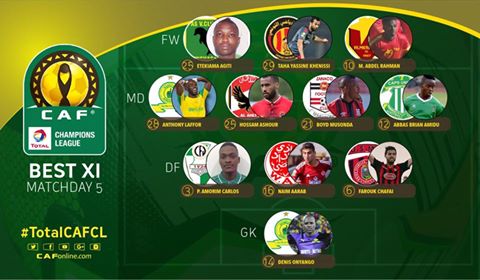
CHOSEN AGAIN: Denis Onyango was named in CAF Champions League Team of the week
Ugandan shot-stopper Dennis Onyango made it to the team of matchday 5 after helping his club Mamelodi Sundowns secure a spot in the quarter final of the CAF Champions league.
This was the second consecutive time the Uganda captain was named on the team of the matchday.
Onyango kept a clean-sheet and managed to make outstanding saves including a penalty from Salahdin Said at the stroke of halftime.
The reigning champions left it late to pick three vital points off Ethiopian champions, Saint George, in a hotly contested duel in a packed Addis Ababa Stadium on Saturday.
The goal was scored by Liberian Anthony Laffor who struck the lone goal of the tie four minutes from time. The result saw the ‘Brazilians’ book a quarter final place alongside Group C leaders Esperance, who held AS Vita 2-2 in Kinshasa.
Sundowns play AS Vita in their last group stage game at home next weekend, while leaders Esperance will host Saint George.
Mamelodi remain focused on their aim for CAF success after missing out on the league to Bidvest Wits by 3 points.
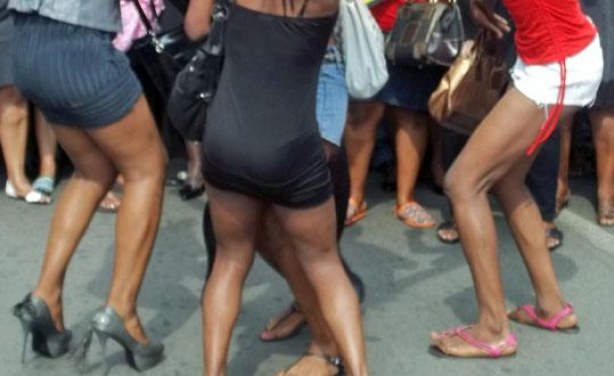
The Ministry of Public Service has issued ‘new guidelines’ to be followed in respect to how officers dress to office, in the process banning miniskirts.
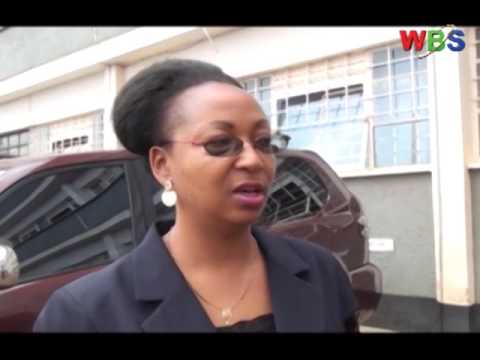
ISSUED DIRECTIVE ON DRESS CODE: Public Service PS Catherine Bitarakwate Musingwire
According to a release titled: ‘Dressing for the non-uniformed officers in the Public Service’, signed by the Permanent Secretary Catherine Bitarakwate Musingwire, indicates that public servants are supposed to ‘dress decently and in the generally acceptable standards in the Uganda Community’.
According to Ms. Musingwire, some Public Servants seem to have negated their responsibility to dress decently.
‘It has however, been observed that public Officers have continued to dress in a manner that does not portray a good image of the service and does not fall in the generally acceptable standards of the Community’.
But quoting Section F-J (a) of the Public Service Standing Orders, 2010, Ms. Musingwire says the provisions therein provide for dress code for females serving in the Public Service. Under the same section F-J (b) provides for the dress code of men.
Among the prohibited issues is ‘a skirt or dress that is not above the knees’; ‘sleeves or transparent dresses’; ‘clothing that does not cover the cleavage’; flat shoes (except on Doctors’ advice); ‘bright-coloured hair’; and ‘tight-fitting dresses’.
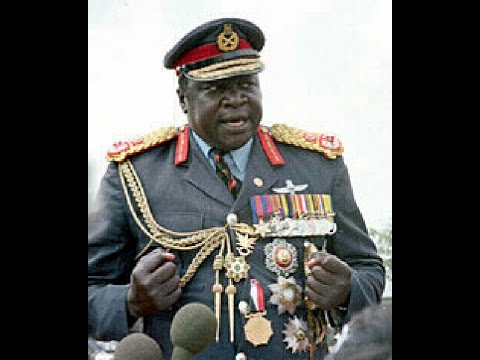
Field Marshal Dr. IDI AMIN DADA
It should be recalled that in the 1970s President Idi Amin banned miniskirts in Uganda, and women found in breach of the directive were occasionally subjected to arrest.
However, with the ‘return to normalcy’ between 1979 and now, most women, even those in public service, have since thrown caution to the wind and dressed in a ‘provocative’ manner, a development that could have led to the directive by the Public Service PS.
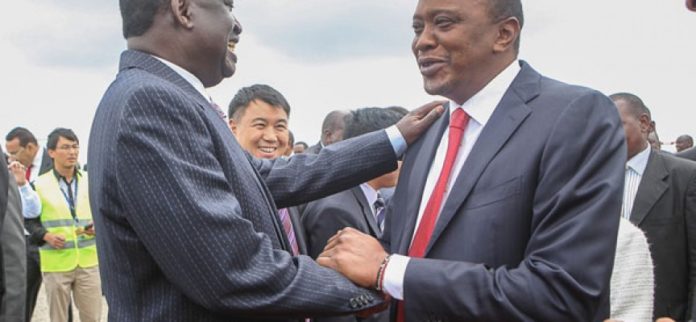
FRIENDS?
Kenyan President Uhuru Kenyatta and Raila Odinga
With Kenya’s general election five weeks away, Human Rights Watch says some communities in the Rift Valley region live in fear of attacks if they vote against the ruling Jubilee party, and some people have left after young men warned them to stay away from polling centers.
The rights organization is calling on authorities to investigate and prosecute those behind the threats and intimidation.
“We also had some direct threat of people telling their colleagues, ‘Let us wait for August 8. We shall see where you will go. We shall be coming for you.’ Those kinds of utterances,” said Human Rights Watch researcher Otisieno Namwaya. “So people are afraid, people are leaving. Some of the families told us they were waiting for the schools to close and they will leave the area.”
The rights agency’s two-week investigation focuses on Naivasha in Nakuru Country, 90 kilometers from the capital, Nairobi. It was one of the areas hardest hit by violence after the 2007 election that was driven, in part, by ethnic divisions.
Kenya’s electoral risk mapping shows 17 counties out of 47 have been identified as conflict-prone areas. Nakuru County is expected to experience election-related violence.
In June, the Interior Ministry opened a command center to respond to terrorism and election violence. Hundreds of officers from security agencies are training around the country to prevent violence tied to the election, with the goal of having a ‘credible, peaceful election’ and stability in the weeks surrounding election day.
But Namwaya says police officers lack the ability to respond if violence erupts in August.
“We did not get the impression the police have done much,” he said. “There were incidences where people were claiming that they have met with police, and there was no response, but we also found that the relationship between the police and the community is not so good.”
Interior spokesperson Mwenda Njoka says security agencies are ready to stop electoral-related violence.
“We have mapped all the country,” Njoka said. “We know we have about 22 areas that we identify as potential hotspots where we have done additional deployment of security officers from various groups, both the civil and the military, in case there is need for military intervention in some areas.”
The head of the European Union Observer Mission, Maietje Schaake, told reporters that election violence is very possible.
“It’s no secret that there are concerns about the possible outbreak of violence,” Schaake said. “This is not inevitable. And it’s clear that it will create a situation where everybody loses. There is responsibility for each and everybody to grant each other the right and safety to vote.”
Kenya’s election is August 8. President Uhuru Kenyatta hopes to win a second term against several challengers, including former Prime Minister Raila Odinga.
Zimbabwean President Robert Mugabe said he was donating US$1 million to the African Union (AU), hoping to set an example for African countries to finance AU programmes and wean it off funding from outside donors.
For years, about 60 percent of AU spending is being financed by donors including the European Union, World Bank and governments of wealthy non-African countries.
Mugabe, who has held power in Zimbabwe since independence from Britain in 1980, has said reliance on foreign funds allows big powers to interfere in the work of the AU.
The 93-year-old Mugabe told an African Union summit in Addis Ababa, Ethiopia, he had auctioned 300 cattle from his personal herd in May to fulfil a promise made to the continental body two years ago.
“Africa needs to finance its own programmes. Institutions like the AU cannot rely on donor funding as the model is not sustainable,” Mugabe said in comments broadcast on Zimbabwe’s state television.
“This humble gesture on Zimbabwe’s part has no universal application but it demonstrates what is possible when people apply their minds to tasks before them.”
The African Union’s 2017 budget is $782 million, increasing from $416.8 million last year. African leaders in July 2016 agreed in principle to charge a 0.2 percent levy on some exports to help finance AU operations.
Zimbabwe, whose economy was devastated by a drought last year, does not disclose its contributions to the AU. The top five African contributors are Algeria, Egypt, Libya, Nigeria and South Africa.
Buganda Road Court Grade One magistrate Gladys Kamasanyu has stayed the hearing of the offensive communication case in which the state accuses social media activist Swaibu Nsamba Gwogyolonga of defaming President Yoweri Museveni.
Appearing before Court, Prosecution alleged that between September 8 and October 26, in an unknown location Nsamba posted offensive communication on Facebook with intent to ‘disturb the peace of the President’. Prosecution further alleges that Nsamba defamed the person of the President in the same Facebook post.
Nsamba was arrested on December 19, 2016 and remanded to Luzira prison on charges of offensive communication and libel contrary to section 25 of the Computer Misuse Act, 2002 and section 179 of the Penal Code Act, respectively.
Non-government organization Unwanted Witness secured Nsamba’s bail on January 3, 2017 and he has since been appearing in court for hearing.
However, on April 20 this year Nsamba, Unwanted Witness Uganda and Human Rights Enforcement Foundation through Rwakafuuzi and Company Advocates, petitioned the constitutional court challenging the constitutionality of section 25 (offensive communication) and its failure to meet regional and international human rights norms and standards.
And in today’s ruling, the Buganda Road Court magistrate said she would not proceed with the hearing until the Constitutional Court pronounces itself on the matter.
However, Nsamba has been asked to continue reporting to court for mentioning of the case and updating court about the progress of the constitutional petition.
MAIN CELEBRANT OF PARLIAMENT WEEK: Speaker of Parliament Rebecca Kadaga
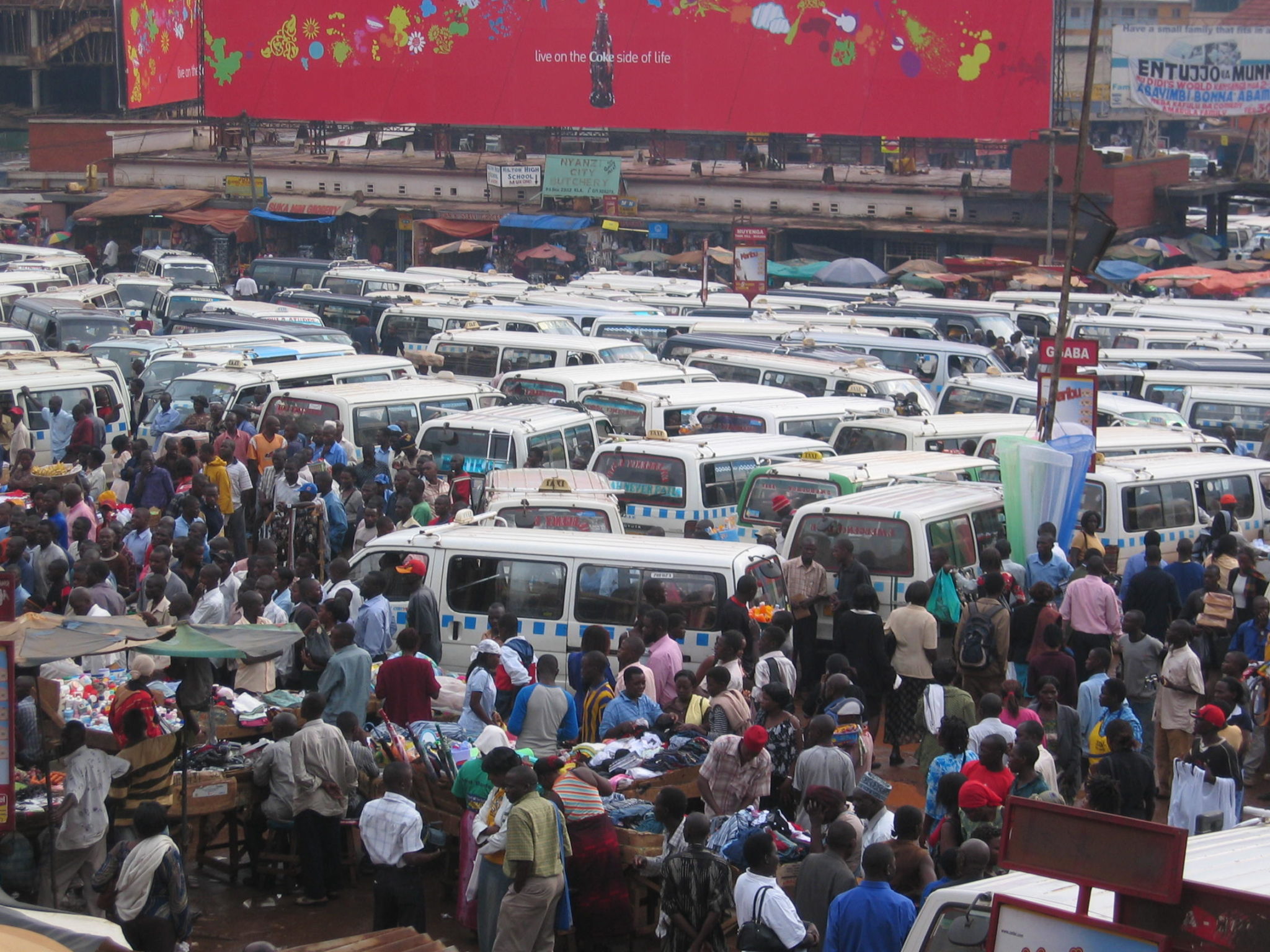
Taxi operators have petitioned the Speaker of Parliament Rebecca Kadaga over the sale of the old taxi park and also demanded for the amendment of the Transport Act.
In their petition, the operators under the leadership of Yasin Ssematimba, criticise the ’unfair manner’ in which negotiations leading to the sale of the premises were made.
The operators say they were left with no choice but seek the intervention of Parliament after failing to get audience from Ministry of Works and Transport, the Kampala Capital City Authority (KCCA) and the Ministry of Local Government.
The operators, who were accompanied by a team of Workers Representatives to Parliament including Margaret Rwabushaija, Arinaitwe Rwakajara, Agnes Kunihira and Charles Bakkabulindi, are also opposed to what they call ‘over taxation’, a charge of Shs28, 000 paid per seat annually.
CENTRE OF DISPUTE: The Old Taxi Park
Further, they argue, the business has been made worse by the proposed Shs103, 000 they are forced to pay in the ongoing vehicle inspection after every six months, saying although the move is welcome, they need the fees to be revised.
The operators also want Parliament to amend the current Transport Act which gives the transport minister power to cancel licenses for motorists if they fail to renew them on time. The provision, Mr Ssematimba said, is unfair.
In response Kadaga promised the furious taxi operators that Parliament will invite them to express their grievances before the Committee of Physical Infrastructure.
The Parliament Committee on Commissions, State Authorities and State Enterprises (COSASE) is set to start investigations into the issues surrounding the occupancy of Centenary Park tomorrow
Chaired by Bugweri County MP, Abdu Katuntu, the Committee was given only ten days to finish the job.
Speaking to Eagle Online, Chairman Katuntu said work should have started last week but some of the officials were not around.
“I should have started last week but these people (The Executive Directors of UNRA and KCCA) were not in the country. So I am starting tomorrow,” he said adding that he will judge ‘how simple or hard the job will be’ after his first meeting.
The investigation came last week on the instruction of the Speaker after the Government Ombudsman, Justice Irene Mulyagonja complained that she did not have powers to investigate the matter.
In her complaint to Parliament, Justice Mulyagonja said that the ping pong between Kampala Capital City Authority (KCCA) and Nalongo Estates Limited has seen three public projects stall yet the Ombudsman’s office doesn’t have the mandate to investigate the matter because Nalongo Estates is a private company.
She also noted that the land conflict at heart of the matter was subjected to both arbitral proceedings before the Centre for Arbitration and Dispute Resolution, and litigation in Commercial Court Division of the High Court. Mr Katuntu says investigations start tomorrow.
The barbecue-lounge in Centenary Park
The conflict
Nalongo Estates Limited, run by Sarah Kizito, wife to former Kampala politician, Godfrey Nyakana, is at logger heads with City Hall over failure to renew the lease to manage Centenary Park.
KCCA has stood its ground, defending its position not to renew Nalongo Estates’ lease for breach of earlier lease provisions, arguing that the lease and management executed with the Kizito expired in May 2016, and that the business lady should have vacated the premises by Dec 31, 2016.
But Kizito has remained defiant despite court orders demanding she hands over the property.
It is alleged that on May 16 2006, the then KCC and Nalongo Estates Limited executed a management agreement to keep the park as a green open/public space.
However, Nalongo Estates reportedly abused KCC trust and constructed temporary structures, leaving KCC with no choice but terminate the contract on June 26, 2012.
Kizito retaliated by dragging KCCA to the Arbitration Tribunal in September 2013, deeming the Authority’s actions illegal with the argument that Nalongo Estates had a running management contract that had not been ‘lawfully’ terminated.
Nalongo Estates won the case and was awarded Shs732.5 million in damages and KCCA attempts to fight further were frustrated in High Court-Commercial Division after the Judge upheld the earlier ruling.
Tax payers were forced to meet the costs on December 16, 2016.
National Water and UNRA’s plan for a flyover
National Water and Sewerage Corporation (NWSC) has already lost approximately Shs1b as agents of Nalongo Estates Ltd claimed ownership of the same land, forcing the contractor to halt works.
NWSC swiftly ran to KCCA seeking answers, and indeed the Authority confirmed that Nalongo Estates had previously been given a management contract to manage the green park for 10 years.
The delays to access the site sqaw the contractor slap a Shs979.9 million fine on the Corporation.
The 31 kilo meter of sewer line upon completion will serve areas of Kololo, Golf Course belt, Serena Hotel, Nakasero and Kitante.
Meanwhile, Umeme also has to relocate a Power Sub-station but the works are yet to kick off due to another fierce fight between KCCA and Nalongo Estates.
Similarly, the Uganda National Roads Authority (UNRA) plans to construct the Kampala Flyover but has pleaded with KCCA not to hand over property to be managed by Nalongo Estates of Sarah Kizito.
In a related development Ms Kizito reportedly sought the help of ‘her friend President Museveni’, protesting the ‘unfair manner in which the matters were handled’.
She accused KCCA’s Jeniffer Musisi of being defiant, noting that despite orders by President Museveni to have her lease renewed, Musisi has failed to soften her stand.
Kizito had reportedly asked President Museveni to order KCCA to unconditionally renew her lease noting: “We are seeking for fairness as a local company owned by hardworking ladies, we are coherent with Government projects and we are looking for a win-win situation.”
STRONG PROPONENT: Dokolo District Woman Member Parliament Cecilia Ogwal
Parliament has re-introduced the Marriage and Divorce Bill for debate and once passed into law, it will govern the institution of marriage, going deeper to regulate the sex activity in the bedrooms of Uganda’s households.
The Bill recognizes the civil, Christian, Hindu, Bahai and customary marriages, but is silent on marriage under the Islam faith.
Dokolo District Woman Member Parliament Cecilia Ogwal says the Bill addresses most of the concerns that were raised to oppose the earlier attempts.
“We have held workshops with different stakeholders, seeking for inputs. “We want this bill to be passed to save women,” she says.
What the Bill says on…
Marriages outside Uganda
The Bill recognizes marriages conducted outside of Uganda except where the marriage is between people of the same sex.
Marriage gifts
The Bill outlaws demands for return of marriage gifts given as bride price/bride wealth, in case of a breakdown of the marriage. It says marriage gifts are not an essential requirement for parties to marry, but under subsection 14 (3) punishes those who demand back the gifts with a fine of Shs480,000 or imprisonment not exceeding one year or both.
Same sex marriages
Despite calls from human rights activists and western donors, the Bill criminalizes same sex marriages and should Parliament enact the law, Uganda is likely to see lesbians and homosexuals migrate to favorable countries where they can officially marry.
Inheriting widows
The Bill forbids men from inheriting widows. “A man shall not marry a widow through the custom or practice of widow inheritance,” Section 13 (2) reads. Those who already inherited widows will have to drop them or else they pay a fine not exceeding Shs480, 000 or one year imprisonment or both.
But government under the same Section 13 (3) opens a window for men to marry widows under recognized types of marriage, probably with the knowledge that young widows despite the loss of their husbands still need to exercise their conjugal rights, more so, for procreation purposes.
Cohabitation
The Bill provides for the rights of cohabitees in sharing property after the termination of cohabitation, much as it is not considered a form of marriage recognized in Uganda. But some MPs and members of the public say cohabitation is an immoral practice which is contrary to customary law and a challenge to the marriage institution. Others think cohabitation should be recognized as a form of marriage.
Conjugal rights
Section 114(1) of the Bill grants spouses in marriage conjugal rights but under (2) it outlines circumstances under which a spouse may deny a partner sexual intercourse. These include poor health, surgery, child birth and the controversial one, when a spouse has reasonable fear that engaging in sexual intercourse is likely to cause physical or psychological injury or harm.
Forced sex
Subsection (3) forbids a spouse to have sex with partners without their consent. Should this happen the offender faces both criminal and civil charges, which on conviction the defendant is fined one hundred and twenty currency notes or gets a jail term of not more than five years or both (criminal liability).
Under Subsection 3(b), if the case turns out to be of civil nature, the offender faces restrictions orders, separation from the spouse and suspension of conjugal rights and but also he/she can be asked to compensate a spouse for the wrong done on her/him.
Subsection (3) is of particular concern to the men. They argue that in marriage the issue of forced sex doesn’t exist and they seem to have the support of religious leaders, who preside over religious marriages.
Evidence of breakdown of marriage
The Bill allows court to administer the irretrievable breakdown of marriage if the respondent is caught in adultery, defilement and sexual perversion which includes bestiality, sodomy, homosexuality and pornography. A change of religion by the respondent is also good ground for court to dissolve the marriage, if the petitioner thinks she/he can’t tolerate it.
first MOVED ORIGINAL BILL: Former State Minister for Gender Lukia Isanga Nakadama
Jactitation of marriage
The Bill punishes any person who falsely claims that he/she is married to a particular person. The lie, on conviction, comes with a fine of Shs480, 000 or a jail sentence not exceeding one year or both. The Bill also allows court to make an order for an injunction against the respondent restraining him/her from making further claims but can also, under Section 165(4), award any other remedy in consideration of the consequences of the offence.
Marriage with person previously married
Section 168 of the Bill slaps a fine of Shs2.4 million on a person who knowingly marries a married person. He/she, on top of paying the fine, can receive a jail sentence not exceeding five years, if court deems so.
Making false declarations for marriage
The Bill doesn’t spare those who falsify documents and statements to benefit from the advantages/services of married people. On conviction the culprit pays Shs2.4 million as fine or imprisonment not exceeding five years or can serve both penalties.
False pretence of impediment to marriage
The Bill also warns people not to make false claims so as to prevent a marriage, stating that on conviction, the offender pays Shs2.4 million or a jail sentence not exceeding five years, or court can make the culprit to serve both penalties.
Personation in marriage
The Bill under Section 173 forbids people to marry under false names. Should this offence occur, the culprit on conviction pays a fine of Shs2.4 million shillings or serves a prison sentence not exceeding five year or both.
Fictitious marriage
To protect individuals, the Bill outlaws fictitious marriages in Uganda. “Any person who undergoes a ceremony of marriage…knowing that the marriage is void on any ground…commits an offence and is liable on conviction to a fine not exceeding one hundred and twenty currency points or imprisonment not exceeding five years or both.”
The Bill introduces new regulations on how marital assets would be distributed after a couple divorces.
Government says the Bill if passed into law will help uphold societal and religious values that form the basis of the institution of marriage.
PUPILS REGISTERED: Rose Seninde, State Minister for Primary Education.
Over one million pupils and students have been registered by the National Identification and Registration Authority (NIRA), with 13, 479 schools receiving registration forms.
The exercise which targets over 10 million pupils and students in government and private schools kicked off on May 29, and all school going children above the age of five are to be availed with National Identity Cards upon the conclusion of registration process.
‘’In the regions where we started first, registration is almost done so we will get all manpower to regions that are yet to start’’ the State Minister for primary Education Rosemary Seninde said in a media briefing at Uganda media Centre.
She said that NIRA teams will combine all schools including those in hard to reach places through outreaches, and emphasized that ‘the registration is free of charge’.
“It’s sufficient for the registration process if only one parent has provided a copy of his or her national ID,” Minister Seninde said, adding that the exercise will also help eradicate ghost learners in schools and ensure effective implementation of government projects.
The Minister also advised all parents to go for registration so as to ease the registration exercise of their children.