Stanbic Bank
Stanbic Bank
21.2 C
Kampala
Stanbic Bank
Stanbic Bank
Home Blog Page 1884

EADB extends Euro 13m agriculture funding facility to Kenya

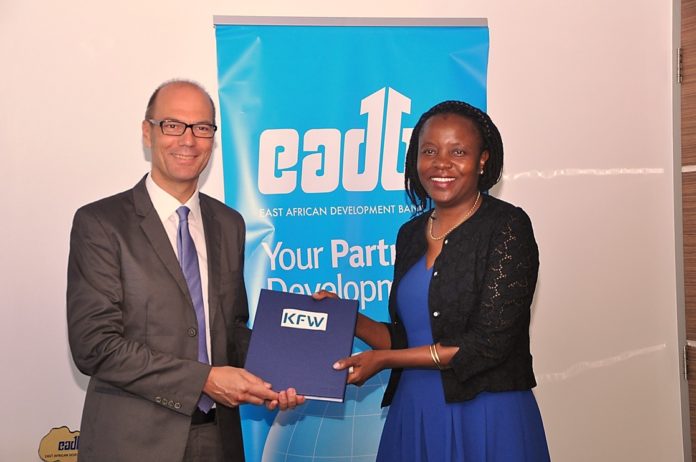
L-R-Oliver-Junger-the-KfW-Development-Bank-Kampala-office-Director-with-Vivienne-Yeda-the-Director-General-of-East-African-Development-Bank

Following success in Uganda, the East African Development Bank (EADB) is extending its agricultural financing loan facility to other East African countries, with Kenya being the next beneficiary, with a Euro13 million facility.

The EADB has entered into a financing agreement with KfW, Frankfurt am Main, Germany, for the ‘Agricultural Financing Kenya’ project which is funded by the German Government as part of the wider ‘One World – No Hunger’ special initiative.

In an announcement made at the East African Development Bank Head Offices in Kampala, Uganda, Vivienne Yeda, the Director General of EADB said EADB and KfW’s ‘Agricultural Financing Kenya’ will cater for the SMEs and farmers along the agricultural value chain in Kenya.

The project has two components; the first component will provide medium – to long-term loans to small and medium sized farmers and SMEs along the agricultural value chain. This will be done via selected partner financial institutions that boast extensive market knowledge; while the second component will constitute technical assistance and will involve training and capacity building measures.

Speaking at the event, Ms. Yeda noted that agriculture is the key source of income among Kenya’s rural population.

“Most of the farmers from rural Kenya are employed in Small and Medium sizes enterprises (SMEs). This program will go a long way to improve food security for the communities while achieving the greater purpose of poverty eradication,” she said.

“It is our belief that the program will give agricultural SMEs in Kenya the opportunity to invest and therefore expand and grow. This will greatly improve agricultural productivity and efficiency in Kenya.  Ultimately, a more efficient Kenyan agricultural sector should boost economic growth, generate employment creation, reduce poverty and increase food security,” Ms. Yeda concluded.

The ‘Agricultural Financing Kenya’ program follows the successful implementation of two similar collaborations between EADB and KfW in Uganda: the ‘Rural Finance Enhancement Program’ and the ‘Agricultural Enhancement Program’.

The two programs follow a similar model and have delivered over EUR20 million (about Shs 77.7b) in financing to SMEs in Ugandan rural areas and along Uganda’s agricultural value chain.


Stories Continues after ad

UNRA is ‘extremely sick’ – COSASE MPs

UNRA-ED Allen Kagina

The Committee on Statutory Authorities and State Enterprises (COSASE) has termed the Uganda National Roads Authority (UNRA) as an ‘extremely sick’ institution and called for ‘close supervision’ over all its activities by the Parliament and the Executive.

The 184-page COSASE report that is due to be tabled in Parliament has so far covered six state agencies namely: UNRA, the Uganda Broadcasting Corporation (UBC); the Uganda Railways Corporation (URC); the National Forestry Authority (NFA); the National Housing and Construction Company (NHCC) and the Rural Electrification Agency (REA).

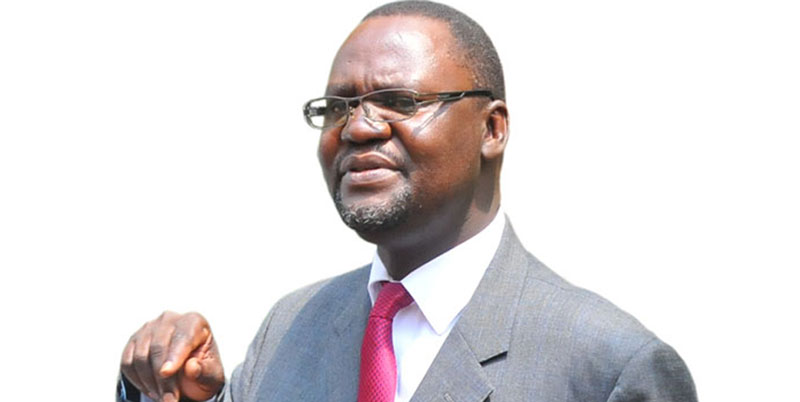
COSASE CHAIR: Bugweri County MP Abdu Katuntu

Interestingly, all the institutions that have been examined are wobbly, rife with corruption and incompetent staff, the committee chaired by Bugweri County MP Abdu Katuntu notes.

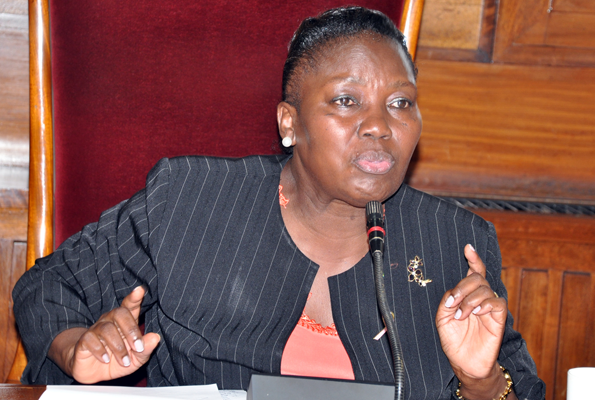
TO TABLE REPORT: The Speaker of Parliament Rebecca Kadaga.

‘For the period under review, this entity (UNRA) can be described as extremely sick. Whatever can go wrong in an institution indeed went wrong in UNRA. Fraud coupled with incompetency was the order of the day. Any achievement was more of an accident than deliberate,’ COSASE, which was reviewing the Auditor General’s reports for 2013/14 and 2014 /15, wrote to Speaker Rebecca Kadaga, about the entity that is headed by Allen Kagina.

UNRA, the roads agency that currently receives over three trillion shillings from government, is being pinned for among other omissions, awarding contracts before appointing Consultants and also for appointing incompetent Consultants, a development the MPs say has led to the mismanagement of almost all projects undertaken by the roads agency.

Other irregularities cited in UNRA involve procurement, compensation of Projects Affected Persons (PAP); payments made to non – contracting parties and poor corporate governance including inadequate planning.

‘Madam Speaker, this was the scandal of the year. A sum of 47, 738, 040, 619 (Forty seven, billion, seven hundred and thirty eight million, forty thousand and six hundred nineteen shillings) was advanced to five Chinese firms as compensation to Projects Affected Persons … they did not … the firms put the funds to their own use,’ the MPs report.

A section of the Entebbe-Kampala Express Highway

Another thorny issue was the procurement process used for the 51.4 kilometre US$480 million Entebbe-Kampala Express Highway, where a kilometer was valued at US$9.3 million, despite the bid for the construction works being ‘unsolicited’.

A section of the damaged Mbale-Tirinyi road at the River Mpologoma bridge

The committee also makes inference to among other thorny issues, the recently-caved in 100km Mbale-Tirinyi road, saying the contractor was given designs for only 10 per cent (10kms) of the construction works.

COSASE also faults the Uganda Police for lackluster approaches in investigating and prosecuting those cited in unscrupulous undertakings in the state agencies and recommends that the Inspectorate of Government (IGG) work closely with the police force (CIID) to bring the culprits to book.

‘It is the committee’s recommendation that the Uganda Police should be more vigilant and act upon the information unearthed which is of a criminal nature,’ the committee members write in the report.

The committee also noted that it managed to recover ‘billions of shillings that had been siphoned out of the country’ and recommended that all other monies lost dubiously be recovered before the law is invited to take its course.

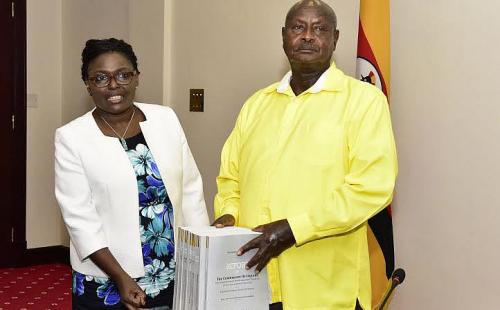
President Yoweri Museveni receives the Commission of Inquiry report of UNRA

Early last year a Commission of Inquiry appointed by President Yoweri Museveni, and headed by Lady Justice Catherine Bamugemereire unearthed a lot of rot in UNRA, reporting that about Shs4 trillion had been lost in shoddy deals at the roads agency.

Prior to Lady Justice Bamugemereire’s findings, four top managers at UNRA including then Acting Executive Director Eng. Ssebugga Kimeze had been sent packing for allegedly awarding the 74-km Mukono- Katosi road to a shadowy company, Eutaw. The then Minister of Works Eng. James Abraham Byandala was also cited in the scam in which the ghost company was paid Shs24.7 billion for no work done.


Stories Continues after ad

‘Desh’ Kananura to know fate next week

ACQUITTED: Andrew Kananura, alias, Desh, in the dock at Buganda Road Court early this year.

Andrew ‘Desh’ Kananura, the proprietor of the Panamera Bar in Ntinda who allegedly killed his employee, will know his fate on April 25.

In September 2012 Kananura, together with four others including his brother Raymond Kananura, allegedly killed Badru Kateregga, accusing him of being in possession of Shs30, 000, money reportedly way above workers were supposed to have while at work.

Desh is out on bail, and has been appearing in court till yesterday, when he was told that he would know his fate next Tuesday.

Meanwhile, the case has dragged on for five years now, with the victim’s parents crying out for justice.

Stories Continues after ad

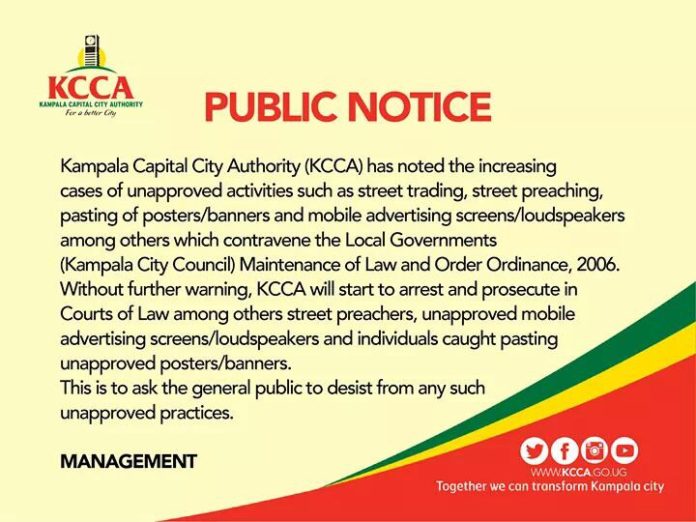
KCCA to arrest street preachers

The KCCA statement announcing the new measures.

The notion that the city of Kampala is a mess is not in doubt. But then there are people who make it messier and the city law enforcement has decided to crack the whip.

KCCA Executive Director Jennifer Musisi Semakula

According to Kampala Capital City Authority (KCCA), effective today it will arrest and prosecute among other groups, street preachers, street traders, unapproved mobile advertisers and those found putting up posters illegally.

Over the past four years, the city has seen a sharp rise in street preachers, with almost every busy junction boasting on between two and five preachers.

Similarly, over the same period the numbers of the other targeted groups have risen rapidly, and today the city is almost one deafening blare, courtesy of ‘road advertisers’.

Stories Continues after ad

UN investigators find 17 new mass graves in DRC

UN High Commissioner of the United Nations (UN) for Human Rights, Zeid Ra'ad al-Hussein. AFP PHOTO / FABRICE COFFRINI (Photo credit/ FABRICE COFFRINI/AFP/Getty Images)

United Nations investigators have found 17 new mass graves in the Democratic Republic of Congo (DRC), in an area that has seen fighting between soldiers and members of a local armed group, according to the UN rights chief.

Zeid Raad Al Hussein, the UN high commissioner for human rights, called the DRC’s government to launch an investigation, threatening that the International Criminal Court (ICC) would do so if authorities failed to take action.

Zeid said in a statement published by his office that he had reports DRC soldiers had dug the graves after clashes with the Kamuina Nsapu militia in the central Kasai region in March.

“At least 74 people, including 30 children, were reported to have been killed by soldiers,” in the clashes, he said, without giving details on the sources of his information.

Most of the victims were said to have been killed in their homes as soldiers went door to door looking for militia members, he added.During a separate incident in the provincial capital of Kananga last month, soldiers were reported to have shot dead at least 40 people and raped women and girls, Zeid said, again without saying who had made the reports.

Fifteen of the newly-confirmed sites are in the town of Tshimbulu, and two in Thsienke, a village near Kananga city.

The findings mean that the UN has now documented 40 mass grave sites and killings of more than 400 people in Kasai Central and Kasai Oriental provinces since last August.

“It is absolutely vital that the government … takes meaningful steps to ensure that there is [an]… independent investigation,” Zeid said.

“Should there be no effective national investigation, I will not hesitate to urge … an investigation by an international mechanism, including the International Criminal Court.”

But the government of the DRC said it would investigate the reports once it saw the evidence.

Lambert Mende, the government spokesman, said the UN team should pass its evidence to the justice department. “Then we will start investigations,” he added.

The government has previously denied that soldiers have used disproportionate force against militia members, who are often armed with machetes and home-made rifles, and said that the militia had dug other mass graves.

Kasai is the focus of the fight against the Kamuina Nsapu militia since August, when security forces killed its leader. The militia has been fighting largely to avenge his death.

The violence has become the most serious threat to President Joseph Kabila, whose decision to stay in power after his mandate ran out in December has stoked lawlessness across the vast central African nation.

The government said last week that it had returned the body of the armed group’s leader to his village, which had been one of the militia’s key demands.

However, it was unclear whether this gesture would sooth tensions after such extensive killings.

The Kamwina Nsapu have been accused of recruiting child soldiers, and of attacking public authorities, schools and churches.

Hundreds of people have been killed and 200,000 displaced, according to the UN.


Stories Continues after ad

Five lessons on why diversity isn’t black and white – it’s gold

TEAMWORK: Employees discuss company strategies

More diverse businesses perform better – it’s a fact. But building a diverse workforce in Africa is not just about ticking the gender and ethnic boxes – it’s about building synergy within diverse teams and cultivating diverse behaviour across the organisation, fortunately, certified Top Employers are getting it right.

Africa’s most sought-after employers are increasingly recognising that diversity is a key driver of performance, recent data has shown. Indeed, the business case for diversity is compelling with an increasing number of global studies, including recent research by McKinsey, demonstrating a clear link between greater diversity and better financial results.

Research conducted on HR policies, strategies and practices of Africa’s certified Top Employers reveals that the overwhelming majority of these companies follow recommended best practice guidelines for managing diversity. “This is crucial because managing diversity successfully is more than just ticking the boxes of ethnicity and gender,” says Billy Elliott, Country Manager: Africa for the Top Employers Institute.

“And when properly understood, diversity is not just black and white – it’s gold. It brings in more revenue, makes for happier customers, and ultimately builds more sustainable businesses.”

According to Elliott, organisations that want to reap the benefits of true diversity must go beyond scratching the surface. “Diversity is a theme companies need to embrace and integrate,” he explains. “It can’t be candy-coated. It’s about much more than what you look like.” A diverse workforce means diverse behaviour, says Elliott – which means employers must engage fully with making it work.

Based on data from the Top Employers Institute annual certification of HR best practice in Africa, Elliott says there are five key lessons in diversity management that can help to set companies apart:

  1. Define and communicate your diversity programme

Eighty six per cent of Africa’s Top Employers have clearly defined and communicated an organisation-wide diversity programme. And 74% of Africa’s Top Employers ensure details of their diversity programme(s) are easily accessible via the intranet or handbooks.

For DHL Express, one of just 10 Global Top Employers and certified in 12 African countries, diversity is a core business imperative. The company relies on diverse teams for more creative problem solving. “We have a number of programmes that emphasise the need to continually develop a more diverse and inclusive workforce to help drive our business forward on the continent.” says Paul Clegg, Vice President Human Resources – Sub-Saharan Africa.

DHL Express has an unparalleled footprint in Africa, one of the most ethnically diverse continents in the world with 3000 distinct ethnic groups and 2000 languages. Elliott believes that Top Employers like DHL Express have a key role to play in facilitating diversity management in the workplace that can play in vital role in building social cohesion.

Legislation differs from country to country, but Clegg says irrespective of the minimum requirements, DHL Express, as a business, places great emphasis on employee engagement. Having motivated people is the first pillar of our global Focus strategy and being an Employer of Choice is 1 of our 3 bottom lines. This demonstrates how seriously we take employee engagement and development at a global level and on the ground in Sub Saharan Africa. We are fortunate to be the most international company in the world, which enables us to give our employees the very best learning and development opportunities. Our diverse network, which spans across 220 countries and territories, provides the opportunity for employees to learn and share experiences in different markets. The value of cross-country, on-the-job learning is immense.

  1. Invest in diversity training

Eighty one per cent of Africa’s Top Employers have trained specific employee groups regarding relevant diversity practices to enable them to build an engaged workforce through authentic and inclusive employee engagement. According to the Global Human Capital Trends report 2015 from Deloitte University, employee engagement is a priority both for HR and for the business and plays a critical role in business performance.

According to Linda Ronnie, Senior Lecturer in HR at the University of Cape Town Graduate School of Business (GSB), employee engagement can provide explicit recognition of personhood which is key to success especially in African organisations where there are diverse cultural and personal needs in play and mutual understanding in the workplace cannot be taken for granted.

A central part of overcoming barriers within a large and diverse workforce such as DHL Express’ is getting everyone on the same page from the start, says Clegg. We have a global cultural change program called Certified International Specialist (CIS), which revolves around four attributes: Speed, Can-Do Attitude, Right First Time and Passion. Everyone from the Global CEO to our couriers have gone through this training programme which reinforces our core competencies. It’s a fully inclusive program which cuts across all diversity indicators and levels of occupation and we consider it to be an important driver of employee engagement and retention, and ultimately business performance.

  1. Measure the results of your diversity programme

Around 70% of Africa’s Top Employers evaluate the impact and effectiveness of their diversity programme regularly.

According to Clegg, participation in the Top Employers Certification Programme is a crucial part of this measurement process. “The Top Employers Institute looks at how we are doing along a number of key metrics. This year, we are aiming to achieve certification in more countries across Sub Saharan Africa than before. A key Top Employer Institute benchmark is driving diversity in all areas.”

DHL Express and other Top Employers in Africa understand that what you measure is what you manage. And they are not alone. In the past few years tech giant Google has gone big on diversity investing $150 million into its own diversity programmes in 2015 alone and also setting up a dedicated diversity-related page designed to make its diversity statistics more public – and triggering other silicon valley companies to do the same.

In an interview with USA Today Nancy Lee, Google’s vice president of people operations, explained that the move was not about altruism. Google wants to secure its own future by establishing itself as a leader in diversity. “The tech industry really understands that the future of our industry means we have to be more inclusive,” Lee says. “We are literally building products for the world. It can’t be this homogeneous.”

  1. Employ people from disadvantaged backgrounds

An impressive 80% of Africa’s Top Employers employ people from disadvantaged backgrounds. The latter refers to groups that do not have optimal chances in the labour market because of their socio-economic situation.

For global beverage company Pernod Ricard, which also has a strong footprint in Africa, current efforts are targeted specifically at increasing diversity at middle and senior management levels. “More than 75% of our external hires are equity hires, in line with our aim to reflect the demographic of the economically active population,” says Andre Muller, Head of Human Resources. “A major challenge in any organisation is getting people at all levels to buy into the concept of diversity and to live it on a day-to-day basis. As to what levels of success we have achieved, we believe this is an ongoing process.  We have set clear objectives and track and monitor our progress in key elements of diversity. Our employee turnover is low (around 6% per year) so we are doing some things right,” he says.

  1. Education and age are diversity too

Just under 40% of Africa’s Top Employers ensure that they monitor and manage the differences in employees’ educational backgrounds. “Creating departments or teams with different educational backgrounds ensures a more diverse way of thinking,” says Elliott. “Employees can approach challenges with different perspectives.”

“A more uniform workforce has a more uniform and a less creative problem solving perspective,” agrees DHL’s Clegg.

Furthermore, says Elliott, over a quarter of African Top Employers have programmes in place to attract, engage and retain older people and 87% of them set out also to employ younger staff, driving greater age diversity.

This too is part of a global trend. A recent study by McDonald’s, for example, found that age diversity made for a happier and more productive workforce. Employees reported that they were up to 10% happier working in a multi-generational environment and that this also resulted in improved customer satisfaction.

“The power of diversity in all its facets is a tremendous business advantage,” concludes Elliott. “It’s something we see gaining momentum in Top Employers across the continent. I believe that the Africa’s history and context has made employers here that much more attuned to the power and possibility of diversity.”


Stories Continues after ad

Sipapa ‘rips Jose Chameleone and Daniella’s marriage apart’

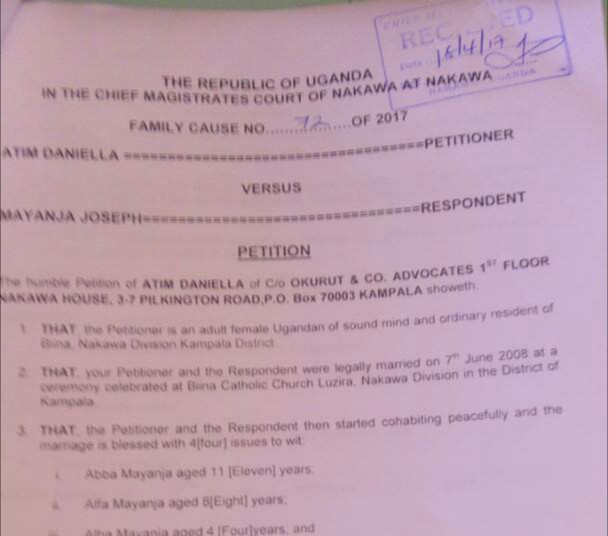
DIVORCE PROCEEDINGS: The divorce application filed by Daniella Mayanja Atim.

Musician Jose Chameleone’s wife Daniella Atim has asked for divorce citing fear for her life amid reports that she is secretly linked to city socialite Charles Oryemu popularly known as Sipapa.

EMBATTLED: Singer Jose Chameleone

In a petition lodged in the Nakawa Chief Magistrate’s Court yesterday, Daniela, through her lawyers Okurut and Company Advocates, accuses Chameleone of being violent for over four years now.

According to court documents, a copy of which is in our possession, Daniela says that all had been well with the couple that is even blessed with four children; Abba Mayanja, 11, Alfa Mayanja, 8, Alba Mayanja, 4 and Amama Mayanja, 3.

HAPPIER TIMES: Jose Chameleone and wife Daniella Mayanja enjoy a happy moment.

However, hell broke loose in 2013 when Chameleone started beating her for no reason every time he returned home, she says, adding that since 2013, she does not sleep at night for fear of being killed by the ‘Valu Valu’ singer who often returns home very drunk.

But despite court acknowledging receiving the divorce application, Chameleone maintains everything between him and his wife is okay.

“What God put together, no man shall put apart! We are not Angels so no one is perfect.  It’s not the times a man falls that matter, it’s his strength to stand again. Love you so much Daniella regardless of what is spreading around we stuck together so they should know. There shall be NO DIVORCE as reported,” he vowed a few hours back.

Initially, the rift between Jose Chameleone and Daniela was exposed a few weeks back by his friend Sipapa, when the latter claimed the couple was no longer staying together.

Apparently this is after Daniela asked for Shs200,000 from Sipapa’s girlfriend. But since she too didn’t have it, she asked Sipapa who then sent the money to her. Chameleone is said to have got wind of this and became suspicious that there was something happening between the two and that’s how Chameleone fell out with both Daniela and Sipapa.

But as soon as the allegations started making rounds, Chameleone came out and maintained the two were still together. In a live Facebook video, he recorded himself handing over flowers to Daniela like to prove everything between the two was well.

Chameleone and Daniella wedded in 2008 at St. James Bbiina, Mutungo a Kampala suburb. Daniella once threatened to divorce Chameleone in 2012 when he allegedly converted to Islam, taking on a name of Mayanja Ghadafi.

Ironically, it turned out his conversion was a stunt to promote his upcoming concert at the time. A section of the public believes Daniela’s impending divorce could be a stunt to promote Chameleone’s upcoming concert dubbed ‘Legend Hit After Hit’.

What’s your take on Daniela’s application for divorce?


Stories Continues after ad
Victoria Beckham gets OBE

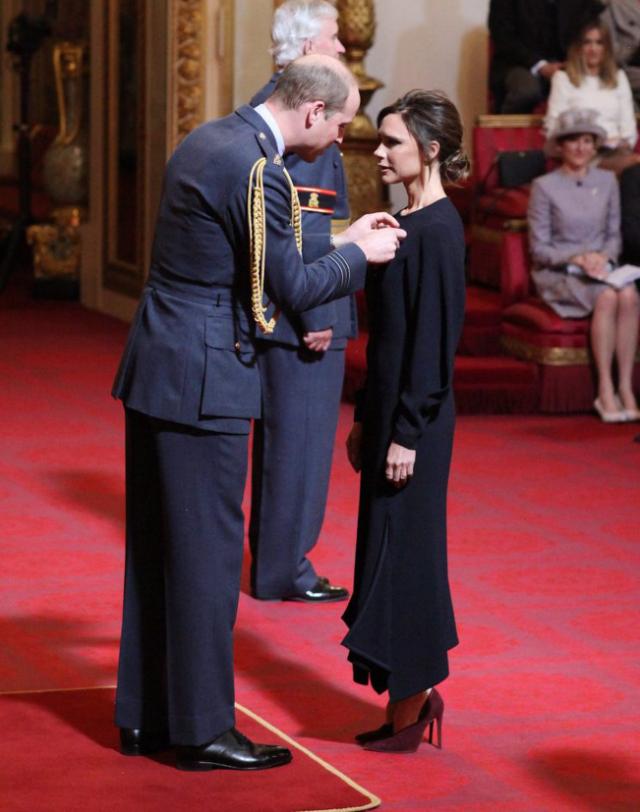
Victoria Beckham being adorned with the OBE by Prince William

Victoria Beckham couldn’t hide her grin as she was awarded an Order of the British Empire (OBE) by Prince William at Buckingham Palace today.

The former Spice Girl, who turned 43 earlier this week, was recognised for her contribution to the fashion industry.

“It was an absolute pleasure to be at Buckingham Palace today,” the designer commented. “I’m proud to be British, honoured and humbled to receive my OBE from the Duke of Cambridge. If you dream big and work hard, you can accomplish great things.”

Victoria’s fashion line debuted at New York Fashion Week in September 2008. Her first collection showed just ten dresses but received rave reviews.

She is now seen as a serious fashion designer and has won numerous awards – namely Best Brand at the 2011 and 2014 British Fashion Awards. Last year, the Victoria Beckham brand made £36 million.

To receive her OBE earlier today, Victoria donned a long-sleeved black dress. It seemed a modest look until the gown’s thigh-high slit was revealed as the designer walked back to the car.

Forgoing her newfound love of flats, Victoria paired the dark dress with a pair of super high purple stilettos.

Her husband, David Beckham, and her parents accompanied her to the ceremony that also saw athlete Jessica Ennis-Hill become a Dame and award-winning actor Mark Rylance receive a knighthood.


Stories Continues after ad

Another former AYA group worker accuses boss of harassment

DONT GAG UGANDANS KAYIHURA TOLD! Woman and human rights activist Miria Matembe.

The former Minister of Ethics and Integrity Miria Matembe has called upon government to reject ‘slavery’ that is allegedly being perpetuated by investors in Uganda.

“Our children are dehumanised and degraded in the Arab countries and now these investors are doing the same in our motherland. They get President Museveni easily and promise to invest in the country, however, they act in the opposite,” Ms Matembe.

Ms. Matembe was speaking at a forum at Human Rights House in Nsambya, convened by human rights activists from Foundation of Human Rights Initiative (FHRI), Uganda Women’s Network (UWONET) and Women’s Democracy Network, addressed by two victims of alleged assault, Jamira Opondo and Allen Nakityo.

ACCUSED OF HARASSMENT: AYA Group boss Muhammad Hamid

Jamirah Opondo, a former employee of the AYA Group that runs the Hilton Hotel in the upscale Nakasero suburb, said her boss Muhammad Hamid used to harass her sexually and physically and also denied her payments.

George Musisi from the Legal Aid explained the progress on Jamirah Opondo’s case, whose files where opened up at Central Police Station (CPS) and Old Kampala Police Station, respectively.

Musisi said the case of salary arrears against the AYA Group is being handled by the KCCA labour offices, while the files from CPS and Old Kampala where merged for easy processing.

“Police requested for one week to have the file ready for the court process to begin,” Musisi said, adding: “in case the police fails to process the case to court we shall proceed to the courts of law without them.”

Earlier, Ms Opondo had told the activists that the police had wanted to thwart her case.

“I never got any assistance from the CPS police as bodyguards of Hamid were sent to look for me and the file nearly disappeared. We at the office already knew that CPS works for our (AYA) boss so my lawyer advised me to open up another case at old Kampala police station,” she said.

Further, she said that when the media published her story, the former Minister of State for labour Henry Kabafunzaki intervened.

“When the Red Pepper run my story I was invited by Hon Herbert Kabafunzaki; he told us that such issues are handled by his office and gave me an appointment on Monday. Unfortunately, he was arrested for bribery thus leaving our case unattended too,” she said.

On her part Nakityo said that while she worked at the Shell Jinja Road, her boss Bazil Noble sexually assaulted for about two years, and that after reporting the matter to the Special Investigations Unit (SIU) was intimidated and instead asked to name ‘her price’.

“When I opened up a case at SIU, I was asked for what I wanted to drop the case. I requested for 100 million as start up a new job; I was promised twenty million and forced to sign by the police lady but only five million was given to me,” Ms. Nakityo said, adding: “I wrote a resignation letter while being forced to settle the case amicably by recording a written agreement.”

According to Ms Nakityo, when she got stuck, she opened up a case at Nakawa court.

At first it was before magistrate Carol Rwagutaga, who later went on maternity when the case was still underway, before it was taken over by Chief Magistrate Sajjabi.

“We were called by Sajjabi who gave a ruling which was read by a different female magistrate and the case was dismissed,” Ms. Nakityo said, adding that her former boss usually taunted her with jibes that his lawyer studied with the magistrate.

“All I ask for is justice,” Ms Nakityo said before Ms Matembe and the Chairperson of UWONET Tezira Jamwa asked police to protect the women who had testified.

“Who is more important between the citizens and the investors like Hamid who was deported from Tanzania,” Ms. Jamwa wondered.

Perry Aritua   from Women’s Democracy Network Uganda called for the passing of the sexual offenses bill, and also for the prioritization of workers’ rights.

Recently, minister Kabafunzaki was sacked by President Yoweri Museveni after he allegedly solicited a bribe from Mr. Hamid, and the former minister is currently facing corruption charges at the Anti-corruption Court in Kololo.

Meanwhile, by press time efforts to contact AYA boss Hamid on his known number mobile phone were futile.


Stories Continues after ad

AIGP Kaweesi murder: Kulambiro residents to name road after him

SCENE OF CRIME: The car in which AIGP Andrew Felix Kaweesi met his death

Easter Monday marked a month since Assistant Inspector General of Police (AIGP) Andrew Felix Kaweesi was assassinated in Kulambiro, a city suburb.

RIP: Deceased Assistant Inspector General of Police (AIGP) Andrew Felix Kaweesi.

Now, residents of Kulambiro have resolved to name the road after him in appreciation of his contribution to the country.

In a village meeting held Sunday at Tuba police post, about 200 meters from Kaweesi’s home, Francis Adiya and Jackson Eruku, the owners of the land next to the spot where he was killed, donated the land to the village to construct ‘any structure’ in honour of the deceased AIGP Kaweesi.

According to the donors of the land, the intended purpose of their donation is for the locals to construct a structure where people will be converging to pray for the late AIGP Kaweesi every March 17, the day on which he was killed.

The locals even named a committee that will oversee the project, and also resolved that Kulambiro Ring Road be renamed Kaweesi Kulambiro Ring Road.

It ought to be remembered that leaders in his birthplace in Lwengo also resolved to name a road and school after him in remembrance of his contribution to the area.

AIGP Kaweesi, his driver Godfrey Wambeewo and his bodyguard Kenneth Erau, were killed on 17th last month in a hail of bullets fired at his car by attackers that are currently being hunted by security agencies.


Stories Continues after ad