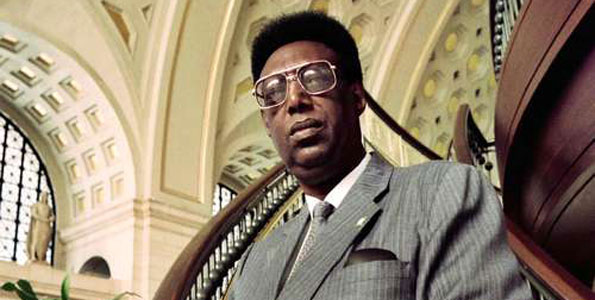
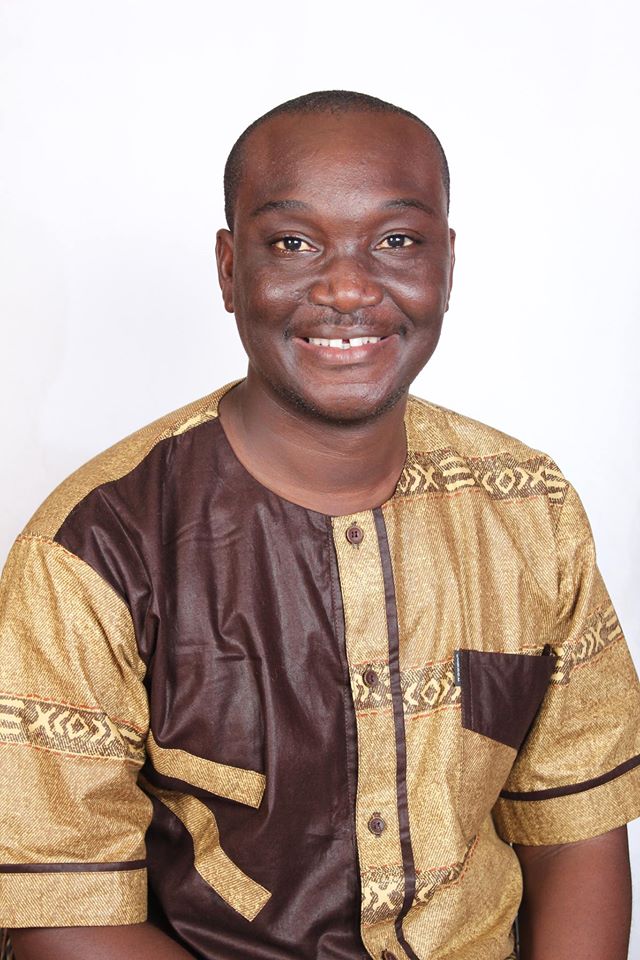
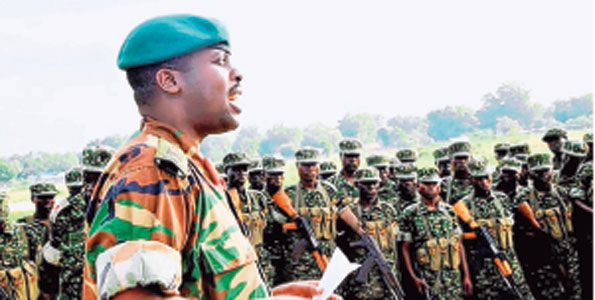
A poster showing some of the artistes that will perform at the ‘People of the Nile’ festival in Kisumu beginning today.
Uganda’s dancehall queen, Cindy Sanyu has been lined up among a long list of artistes from over 10 countries that are set to perform this weekend in Kenya at a festival that has been dubbed ‘People of the Nile’.
Other musicians expected to perform at the event include Kenya’s award-winning group Sauti Sol, Hitmaker Timmy Tdat, Octopizzo, Benga star Makadem and Kidum among others. The Bongo Flava star Ommy Dimpoz from Tanzania and Baby One from Sudan will hit the stage as well.
Set to be hosted in Kisumu, the festival is a three-day event kicking off today till Sunday, with artistes from more than 100 cultures meeting for a mind boggling music, art, dance, culture and food extravaganza.
The participating artistes are from Uganda, Egypt, Ethiopia, Sudan, Tanzania, Burundi, Congo and the melting point of all these rich cultures is Kisumu, Kenya.
The festival, as the name suggests, aims at bringing the various cultures that enjoy the benefits of the Nile River as a ‘timeless lifeline’ and issues like managing the ecosystems and creating harmony among citizens that benefit from River Nile will be discussed at the cocktail session.
“Issues of climate change will be tabled such as prolonged drought and floods which pose a threat to human life. Four of the Nile basin countries are facing severe water scarcity yet populations projections hint to double up in the next thirty or so years,” one of the organisers said.
He added: “The acts involved will leverage each other’s musical and arts strengths while unearthing the unique sounds so diverse. The food will vary from roast meat, smoked beef and fish, matooke, groundnut sauce and all types of culturally prepped meat will be on the menu.”
SMILE OF SUCCESS: John Edwin Danze of Fireworks Brainchild-Burson advertising agency
As we grow older we realise a few things along the way that make us regret ‘growing up so fast’. This is because no one told us that this comes with life and having to face the dastardly thing.
Facing life has really shown most of us ‘millennials’ fire, with some stuck in permanent ‘kawu’ and reminiscing the number of things we took for granted, like our parents care and their countless sacrifices.
Now life has kicked so many of us about to the point we suffer amnesia at such an early age (I think it’s only in Uganda where the youth riot claiming retirement packages whilst still at university). Seriously though, even birthdays cannot be forgotten now thanks to social media apps like Facebook and Twitter. And for crying out loud, I’d forgotten my birthday this year up until I logged in.
The challenges of growing up in the modern day are numerous, with afflictions like unemployment, inflation, drugs and alcohol, all leading to recurring poverty, hunger, unhealthy competition with peers, debt…the list goes on.
So, out of sheer desperation, over the last couple of months I’ve made it a point to interact with the select few who’ve managed to make it in life and thus enjoy the true benefits of the independent life in the hope that they might pass me the anecdote. Mind you these types of individuals are very rare, particularly those who have a background story worth writingabout, and not one that starts off with the usual boring ‘I was lucky’ cliché.
No, those ones I avoided. Instead, I mean those who’ve worked hard and applied all that they have learned to ensure they make it in life. John Edwin Danze is one such person.
Twenty-eight year old Danze is the average Ugandan lad with an affinity for the digital world and its gadgets with a very distinct all-white Colgate ad smile that indicates a fun-educational rapport and tags him as one of the good people. With little to no political affiliations whatsoever, as is often the case with most of us, seeing as the system has failed the youth countless times, Danze is more inclined to discuss the pros and cons of managing Dr. Kizza Besigye’s Facebook account than his stance on democracy.
Nonetheless, this doesnot leave Danze with a great sense of loss as he manages to make up for it by contributing to the quality development of the media industry in Uganda. We’ve seen the recent colorful and energetic Pepsi Sala Puleesa advert featuring local artistes MunG and Nwagi and I think it is safe to say that we have come a long way and vastly improved from our ‘Chai garden tea’, ‘Hedex’ or even ‘Vicks Kingo’ adverts from back in the day.
COLLECTIVE SUCCESS: The Fireworks team shows off the awards won at the just-concluded Public Relations Association of Uganda (PRAU) awards ceremony.
This is all thanks to creative individuals who have taken time, energy and innovation to improve not only the quality of media used by millions in Uganda but also to promote the various platforms that allow and encourage creativity and invention. So, it came as no surprise when Danze and his colleagues at Fireworks-Brainchild Burson dominated the recent PRAU awards, taking with them a number of awards. EagleOnline caught up with Danze for an interview and below are excerpts.
EagleOnline: Congratulations! How do you do it?
(Laughs) I guess its hard work and networks … but I am groomed through struggle so I do not waste opportunity.
Eagle: Are where you are because you had someone help?
Help of course. I also had mob kiboko (caning) and mistakes allowed me to improve. The fact is that I owe so much to my family; friends and God above all, got me here. Also I had to fend for myself especially around campus because my parents retired and I’m the first born son so I had to do my part.
Eagle: Who is Danze? How would you describe yourself?
Danze is really just a guy! (laughs heartily) I think I’m a self-believer, designed by circumstances and fortunate enough to be in the space that I am. I believe in self-expression and ideas especially those from my friends but my life still has a story, I feel I haven’t gotten there. Plus, I dont want to get there alone.
Eagle: Tell us about your work? What is Fireworks? Was it your idea and what do you guys do?
Fireworks is an advertising agency. We deal with public relations, media, creative and client service. In fact we handle Pepsi, Total, NSSF, Centenary Bank, Etihad among other companies here in Uganda. On the second question, no, Fireworks wasn’t my idea, I just work there personally with digital media like social media, web pages, events etc.
Eagle: Have you always worked towards this career path or did it just occur to you eventually?
I like to think it was inevitable because before that I was into art. But then art evolved into digital so I met so many people that work in places that required it. However, managing Sylvia Owori’s public profiles and Global Connections is what really introduced me to the digital world, as well as my love for games and movies which allowed me to explore the digital world some more.
Eagle: I notice you guys deal with major companies here in Kampala. What is it like?
Yes, very high bar. By the time I joined Fireworks I wasn’t that ‘professional’ until after some many boardroom moments and client interactions. I had a very supportive team and of course the correct training thanks to my boss. Also, the culture at Fireworks is that they invest so much in their employees.
Eagle: Fireworks recently scored big at the PRAU awards. Why did you win and which advert made the trick for you?
We have actually won for the last three years and we won because we are a ‘result-oriented’ agency: evidence based strategies and public relations gurus. The campaigns that did it were: Pepsi Uefa champions league, a campaign we did for Crisis Management and #SalaPuleesa for the value added media strategy. I believe we focused on the clients key objectives like sales and conversions; most agencies give good ads, fancy jingles and nice posters but they don’t do campaigns in ways that will effect growth of their brands or consumer love.
Eagle: What is it like making these adverts? Are the artists easy to work with? How much time and energy goes into these things?
It never gets easy. But if you work smart, apply research and the correct strategy especially if it’s been tried and tested or measurable and relevant to your market and the correct processes, you achieve the perfect advert and campaign. Of course, not forgetting the right platforms where to place it.
Eagle: Why would someone with a strong brand say like Coca-Cola still need your contact? How and what do you think PR contributes or has to offer an individual or society in general?
Well… a brand like Coca-Cola would still have the contact because for big brands it’s not a luxury to have an agency, it’s a must. PR contributes to brand awareness, crisis management and communication whether corporate or thematic. PR is basically how your image is presented to your consumers, target audience or other brands.
Eagle: Do you think PR management plays a role in development of any given society?
Yes it does. PR is basically telling your story: How you tell it and how it is received by different audiences through different platforms with effectiveness.
Eagle: Communication is key for development; speaking of which, Kiswahili was passed as one of East African Community’s official languages, so how do you think this will affect business and life here in Uganda?
I don’t think it will affect much; business works in all languages and besides Kiswahili is more or less the East African language after English and our mother tongues. Infact it will create a sense of unity. PR will work in any language, it’s the message you are transmitting through that Swahili that matters.
Eagle: What are some of the challenges you guys encounter on the job?
The tools to use to pull off exceptional campaigns in Uganda are still developing, so the better your tools the better quality of your results. Also, clients killing ideas and not wanting to take risks. Time is another major factor because plans and campaigns need enough time to reach their target audience. These are major issues in almost all agencies and competition is steep so it’s a ‘do or die’ situation. Although the birth of social media made things easier, it also made it harder because now content is consumed at a very high rate so you have to be every creative in order to capture the attention of any consumer in this fast paced world. Social media makes PR become a 24/7 job with so many opinions shared across platforms; a tweet or blog can affect an entire campaign or change the mindset of your consumers; it’s a diverse community now.
Eagle: Social media is a strong tool and can be used for both good and bad, to spread truth or propaganda. What is your take on the Kasese killings and these grotesque images circulating on social media?
Well, I am not that into politics but what I see is unrest and what the rest of the world takes home is that in Uganda there is political turmoil. We can’t stop the content spreading unless they censor it like during the elections.
Eagle: True. Other than PR what else are you involved in?
I am heavily into digital media; I’m just in the PR department because it is in all communication practices. Other than work (Fireworks) I do a lot of youth mentorship where I help those with young ideas as well as do some trainings for small new ideas. I do a lot of gaming and I’m very keen on Cinema under #TalkingMoviesUg where I do movie reviews, promotions etc.
Eagle: I am an avid follower of yours on Facebook and I have realised you make even the simplest of subjects interesting. But here in Uganda we are still lagging far behind when it comes to the digital sphere compared to other nations like Kenya and Nigeria. What do you think is needed here in order for us to get to those standards?
We just need to apply cultures from across the globe. Kenya for instance accepts so many cultures and has a booming tourism industry so it helps a lot. We simply need to be more expressive, research more and participate in global trends.
Eagle: You mentor people; what is the key thing you impart that you feel will motivate them to achieve? And is it the same principle you live by?
I tell them the truth; I tell them how to achieve what they want by showing them ‘how’ instead of telling them what links to visit or what books to read; show them how their businesses can successfully be promoted online.
Eagle: Are you single? Where do you see yourself in a few years from now? What is your ultimate goal?
Not single. I see myself in a better part of my career with my own company and still doing youth empowerment of course.
Eagle: The government is currently telling the youth all about wealth creation. How would you as a PR practitioner help the government go about it?
Like I’d said, I have very little political opinions, actually do all but stay away from them. But for an institution that impacts a nation they need to invest in better PR especially when it comes to response time and crisis management processes. Wealth creation would be better bolstered by actually rethinking the education system and money allocation in youth ventures.
Eagle: Thanks a lot Danze. We really appreciate your time and effort. Is there anyone you would like to thank for helping in your journey to success?
God
Eagle: Okay. Just God?
I mentioned the others in the beginning.
Eagle: Alright. And how can people reach you? What handles or names do you use on social media?
@deejahn on Twitter and Instagram & @danzedeejahn on Facebook and Snapchat.
Eagle: Something else you think the reader out there ought to know?
Well, people should know that until you try you won’t succeed and until you try new things, even those that scare you, you will always remain in the ‘what if phase’.
As we gear up for the Fifteenth Edition of Blankets and Wine Kampala, that is set to take place at its new home – Lugogo Cricket Oval on the 18th December, we take a look at the lineup of acts that will be performing.
The main act of this edition’s Blankets and Wine Kampala will be Alikiba alongside Hiphop boss The Mith, rising star and ‘stage gladiator’ – Jemimah Sanyu, Afro-fusion multi-instrumentalist – Giovanni Kiyingi and celebrated ‘crowd mover’ deejay Nasser Mugoya aka DJ Naselow.
The Tusker Malt Lager-sponsored event that has been organised by House of Deejays, will be the last this year. So, which other better way to end the year in style than with Africa’s top artiste, Alikiba.
This edition of Blankets and Wine Kampala will also see the debut of one of Uganda’s best deejays, DJ Naselow. Famously known for his ‘Jamrock’ movement, DJ Naselow will bring an electrifying feel to the event as he looks to scratch and spin through his playlist of music that he promises will leave everyone on their feet.
DJ Naselow has risen through the decks as he plays music for different crowds; he has been professionally playing music for four years and this has catapulted him to one of the household names when it comes to deejaying.
His never ending love for music turned him into a deejay. According to Naselow, a deejay is a person who manipulates records that are already made or in existence as an art form of entertainment using two turntables and a mixer not to forget a microphone to enable him interact with his or her audience.
Naselow believes that to be a good deejay, one has to do in-depth research and keep updated on the latest music. This also involves constant practice, which is doing regular DJ scratch routines.
He has played at some of the biggest stages in Uganda, notable ones being at the Chronixx, Busy Signal and Konshens concerts.
Although he is mostly known for his reggae and dancehall sets, he says that he is more comfortable playing HipHop and Rn’B as opposed to the other genres. The ‘I Love Dancehall’ star has played at some of the biggest stages and will be adding Blankets and Wine Kampala to the list when he takes to the stage on the December 18 at the Lugogo Cricket Oval.
“Having a deejay of his stature as part of the lineup, gives us something to look forward to because he is a well-known crowd pleaser and we will be looking to dance and move to his playlist as we sip on some ice cold Tusker Malt Lagers.” said Tusker Brand Manager, Alex Tusingwire.
A quarterly picnic style music festival, Blankets and Wine is East Africa’s premier music experience, designed to showcase outstanding musicians in the emerging genres of Afro-based music.
Entrance fee is 100,000 UGX at the Lugogo Cricket Oval and gates open at 12:00pm on December 18, 2016.
Revelers can buy ‘early bird tickets’ by dialing *252# on MTN mobile money or at Definition Stores on Acacia Mall, Garden City, Uganda Wines & Spirits, Kanyana’s Bakery in Kiwatule, PayWay outlets & House of DJs Office in Bugolobi.
A Star Times official poses for a group photograph with a team of ushers.
Nigerian musician WizKid was supposed to be in Uganda last Friday for a concert, courtesy of Star Times. However, the musician didn’t show up to the disappointment of many of his fans who had paid for the show.
When we contacted the Star Times Uganda spokesperson, Christine Nagujja for a comment, our calls went unanswered.
However, just like the fans in Uganda are cursing Star Times, the company’s sister outlet in Nigeria has left the government disappointed following a deal reportedly gone bad.
The Chinese digital television service provider signed a partnership in 2009 with national telecaster, the Nigeria Television Authority (NTA), aimed at increasing content, building a terrestrial wireless digital television system and operating a pay television service.
In return, Star Times was given effective control of the entire NTA infrastructure and a 70% holding in the JVC, with the Nigerian telecaster getting 30%.
However, Nigeria’s Parliament believes the deal was reached at fraudulently, and at the beginning of this month MPs Yusuf Ayo and Chris Emeka Azubogu called for the investigation of Star Times.
“The house notes, with concern the NTA which has provided the entire infrastructure for the joint venture in addition to accepting the responsibility of assisting SCNTL to implement almost all the responsibility in the agreement was allotted only 30% of the shares while SCNTL despite its scant contribution was allotted 70% of the shares,” the MPs averred.
The house is also concerned that the JV agreement is grossly lopsided against the NTA which also ceded the intellectual property of the JV to Star Times “thus endearing a master servant relationship between the NTA and Star Times.”
It continues: “the house is further concerned that some of the staff of the NTA who in the negotiation of the agreement for the NTA are now working for SCNTCL for the implementation of the agreement. And that the Nigerian Government may be losing enormous revenues due to the lopsided and imbalanced nature of the agreement”.
It concludes by mandating the committee on information orientation, ethics and values to investigate the JVA between the Nigerian Television Authority and Star Communications Network Technology Co. Ltd to ascertain whether the interests of Nigeria were well represented.
The committee has only six weeks to report back to house ‘for further legislative action’.
Meanwhile, the developments in Nigeria come at a time when the Zambian Government entered an almost similar arrangement with the Star Times this year, despite public outcry and calls for officials to carry out due diligence on company and the terms of the deal before putting pen to paper.
Star Times is not new to controversy; apart from the WizKid concert that never was, the company was at one time switched off by national broadcast regulator, the Uganda Communications Commission (UCC) over infringement of broadcasting rights.
And in the Democratic Republic of Congo (DRC), its operating license was revoked after the company illegally used the public frequency for its telecasts.
“Young men, in any war it is the victors who tell the story because the vanquished do not have a platform from where they can tell their side,” Joel Kamadhi started off our evening banter at the Mutungo Malwa Group.
Apparently, Kamadhi was drawing the group members into discussions about the Kasese incident in which 62 people including the ‘royal guards’ and government security personnel were reportedly killed, and the subsequent arrest of the ‘Chief’ of the Rwenzururu Omusinga Charles Wesley Mumbere.
According to Kamadhi, almost everyone connected to the Kasese incident had made a comment on the matter apart from Mumbere himself.
“You see, all politicians in Uganda have discussed this issue, with some berating Rwenzururu Chief Mumbere for being obstinate, while others have come up in his defence,” Kamadhi said, adding that “the only platform for Mumbere to tell his side of the story is in court where he is facing murder charges.”
But before he could carry on with his now seemingly-annoying vibe, one of the group members, Yorokamu Bwambale, a Mukonzo, asked Kamadhi: “Why do you call our King a chief?” And, in a quick and witty response Kamadhi said: “Omusinga Mumbere does not have ‘blue blood’”, before taking thr group members through the lengthy history of the Rwenzururu movement, which he also described as “a political organization that was pursuing a separatist rebellion designed to free the Bakonzo and Bamba from the authority of Tooro about five decades before Independence.”
According to Kamadhi, the Bakonzo and Bamba of the Rwenzururu movement declared their secession from Tooro on June 30, 1962, just three months to Uganda’s Independence on October 9, 1962. But according to Kamadhi, the declared secession did not necessarily qualify the areas occupied by the Bakonzo and Bamba, as a kingdom.
‘The founders of the Rwenzururu movement led by Isaya Mukirania, Yeremiya Kawamara and Petero Mupalya were tribal elites and not royals,” Kamadhi told Bwambale. Kamadhi’s statement led the two men into a protracted argument, with Bwambale insisting that “we have a King and kingdom that resulted from a cabinet endorsement in March 2008.”
Kamadhi took advantage of Bwambale’s ‘slip’ and took him back in time to 1993 restoration of Kingdoms, the 1995 Constitution and the subsequent amendments in 2005.
“There is a thin distinction between traditional leaders and cultural leaders, and unless we get to understand that distinction, we won’t get answers to this question,” Kamadhi said, to the chagrin of Bwambale.
He added: “In Uganda, the government fears the traditional leaders and cannot just arrest any of them like it did with Mumbere. For instance, can government arrest Kabaka Mutebi just like that? In any case, do you remember what happened in 2009 when police stopped Katikiro John Baptist Walusimbi of Buganda from going to Kayunga?”
Unrestrained, Kamadhi turned to the manner in which Mumbere was arrested. “By the way, do any of you young men even know that Omusinga Mumbere is a Three Star General? So, how do you send policemen to arrest a General just like that? The last time government effected the arrest of a Four Star General it had to send a Three-Star General,” Kamadhi said before asking: “by the way, when, where and who pipped Mumbere?”
“Anyway, let us leave matters of Generals to Generals,” he resignedly said, as he tried to moot the theme for his next topic of discussion.
But before he could change the topic, another member of the group, Hitler Eregu, a now-reformed former rebel from Teso, chipped in and sarcastically observed that “rebels, or in Mumbere’s case, separatists” who award themselves ranks while still in rebellion barely succeed “because of the intrigue such ranks create in the rebel movement.”
“Look at Yoweri Museveni, after fighting for over 15 years from 1972; he became a General just in 1987! Also, consider Cuba’s Fidel Castro, who became ‘Commander-in-Chief of the military’ in 1959, four years after he started rebellion,” Eregu said, adding: “these rebel leaders just accord themselves tantalising titles like ‘Chairman of the High Command’ (CHC) in Museveni’s case and ‘Commandante’ in Castro’s case.”
With such titles, Eregu added, the rebel leaders assume an aura invincibility before their juniors, making internal rebellion a distant thought for some of the senior rebel officers who may have a bone to pick with the leader.
“Many of you here do not even know that Museveni is called ‘Afande CHC’ by many bush war colleagues,” Eregu said, posing with an aura of supreme knowledge. He then went on to detail those who had accorded themselves ranks, linking them to failure to achieve their stated objectives.
“But you consider those like the self-styled Congolese Generals Wamba Dia Wamba, Laurent Nkunda, Sultani Makenga and Bosco Ntaganda aka ‘The Terminator’, all these have overseen failed rebellions,” Hitler Eregu said, adding: “Even nearer home other failures include self-styled Major General Joseph Kony of the Lord’s Resistance Army (LRA); Field Marshal John Gideon Okello who led a futile rebellion in Zanzibar and Field Marshal Dedan Kimathi who led another futile rebellion in Kenya,” Eregu said.
It was at this point that Kamadhi, who by the way detests interference with his presentations, made a ‘grand return’, changing the topic to electioneering in Africa.
“Young men, one of Africa’s long-serving Presidents called Yahya Jammeh lost the elections in The Gambia, what does this development portend for the continent,” he asked. But before any of us could offer an answer, Kamadhi added that the Ghanaian President John Mahama was facing stiff challenge posed by Nana Akufo-Addo in the presidential race.
“I tell you Jammeh is gone through a free and fair election, and if Addo wins in Ghana, then the electoral commissions of other African countries may have to change their modus operandi; just take a look here in Uganda the elections were contested; in Kenya elections were contested; in Tanzania the elections were also contested,” Kamadhi said, adding: “There is a lot of homework for the Electoral Commissions in the East African region to do.”
It was 10pm and Kamadhi bade us all ‘good night’, promising to give us ‘more bwino’ at the next sitting.
This is a burlesque column that will be running on Friday.
FACILITATOR: Former Tanzanian President Benjamin Mkapa addressing delegates at the just-concluded Inter-Burundi Dialogue
The facilitator for the EAC-led Inter-Burundi Dialogue, former Tanzanian President Benjamin William Mkapa, has set June 2017 as the deadline for the signing of peace agreement in the troubled Central African country.
The revelation is contained in a December 9 release that was issued at the end of Mr Mkapa’s two-day visit to Burundi, where he confered with President Pierre Nkurunziza and other stakeholders on the status of the Dialogue and the way forward.
‘The Facilitator had cordial discussions with President Nkurunziza and shared with him his vision of the interventions to be undertaken in the coming months in fulfillment of the EAC Summit of Heads of State mandate,’ the release states in part.
Among the groups Mr Mkapa consulted with were political parties, the diplomatic community, civil society organizations, women and youth groups, religious leaders and a number of prominent political actors.
In his interactions Mr Mkapa lauded the development partners for their assistance and also implored all the stakeholders to ensure Burundi holds credible elections in 2020.
He however, decried limitations in political space and underscored the need for open and frank deliberations in a bid to improve democracy.
The current impasse is a Burundi problem that must be solved by the Barundi. They must therefore strive to establish common ground for Dialogue,’ the release adds.
Burundi was plunged into a political crisis since April 2015 when President Nkurunziza decided to run for a controversial third term in office that he won.
To date, UN reports indicate that hundreds of people have been killed, more than 250,000 have fled the nation, and thousands more have been arrested and subjected to human rights violations in the country.
IMPEACHED: Former South Korean President Park Geun-hye who was impeached early today, visited Uganda in May and held bilateral talks with her counterpart Yoweri Museveni.
South Korean lawmakers have voted overwhelmingly to impeach President Park Geun-hye over an influence-peddling scandal, setting the stage for her to become the country’s first elected leader to be pushed from office in disgrace.
Ms Geun-hye was in Uganda a few months back and among the people she met was President Yoweri Museveni and the two discussed business and trade opportunities between the two countries.
But today Members of Parliament voted by secret ballot with 234 in favor and 56 opposed, meaning dozens of members of Geun-hye’s own conservative Saenuri Party backed the motion to remove her. At least 200 members of the 300-seat chamber needed to vote for the motion for it to pass.
Seven votes were disqualified, two members abstained and one member did not participate, the parliament speaker said.
The Constitutional Court must decide whether to uphold the motion, a process that could take up to 180 days. Ms Geun-hye’s duties were immediately assumed by Prime Minister Hwang Kyo-ahn on an interim basis.
Park, 64, is accused of colluding with a friend and a former aide, both of whom have been indicted by prosecutors, to pressure big businesses to donate to two foundations set up to back her policy initiatives.
Ms Geun-hye, who is serving a single five-year term that was set to end in February 2018, has denied wrongdoing but apologized for carelessness in her ties with her friend, Choi Soon-sil.
Ms Geun-hye has been under heavy pressure to quit but this week said she would await the court’s ruling on the impeachment vote.
Mass rallies have been held in the capital, Seoul, every Saturday for the past six weeks to press her to quit. Opinion polls show overwhelming public support for her impeachment.
Parliament was closed to the public today on the orders of the Speaker.
Hours before the vote, anti-Geun-hye activists scuffled with police as they tried to drive two tractors up to parliament’s main gate, where more than a 1,000 protesters were gathered.
Police subsequently shut down traffic on a 10-lane highway in front of the parliament’s grounds and blockaded a bridge leading to the area.
Fake entry visas carried by Nigerians travelling to Dubai, the United Arab Emirates, has cost an African carrier, RwandAir, a penalty in excess of US$ 20 million in the last six months.
The fake visas, coupled with fictitious online bookings, are considered as infractions that warrant penalty by international aviation rules guiding the Global Distribution System (GDS), and borne by the conveying airline.
A GDS is a network operated by a company that enables automated transactions between travel service providers (mainly airlines, hotels and car rental companies) and travel agencies. Multiple reservations also attract multiple charges against the airline.
For every passenger that arrives in Dubai without valid visa or forged papers and ultimately turned back at the port of entry, the airline pays a penalty of US$ 30,000 for the Advance Debit Memo (ADM) issued per passenger.
Also, the airline is considering the withdrawal of its new Airbus 330-200 that was recently deployed to the Lagos route over low patronage, as recession is making it difficult to fill the 240-passenger capacity aircraft.
Recall that the Kigali-based airline is one of the foreign carriers making waves on the continent, with heavy reliance on Nigeria for its market. With Nigeria supplying the lion share of its total passenger supply for 2015, the airline had deployed two new A330-200s to the Lagos routes.
Plans were in the offing to bring in the third aircraft this December for the passengers heading to China, India and other countries.A Sales Executive of RwandAir, Henry Aaron, said it was regrettable that the airline had paid US$ 20 million from July till date for the mistakes the airline knows nothing about.
Aaron said the penalty imposed on the airline was due to the “smart activities” of its passengers and their cohorts in Dubai, who are playing all gimmicks to outwit the airline’s clearance to board.
Aaron explained that there are some “smart guys” in Dubai processing working visas for wiling Nigerians. At the point of booking, the visas are genuine, but would have been cancelled from the system and become fake before the passenger reached Dubai airport.
“It is a smart move. Once it is cancelled, the person has no way of entering. As an airline that has carried the passenger on a one-way ticket, for every case like that, we are charged $30,000 for each passenger. I also have to fly the person back to Nigeria for free. That is the problem,” he said.
While the problem is not peculiar to RwandAir, the airline is having more of the effect as a foreign airline and co-competitor on the UAE market. Emirates and other UAE airlines also face similar problems, although at minimal rates, but as home grown airlines, they will always find their way around without paying penalties.
Aaron added that the airline even introduced an Okay-To-Board clause to curb the challenge, but Nigerians still found their way around it. “Okay-To-Board issue simply means that we collect your visa and working permits 48 hours before you board and present them to your employer in Dubai to okay before we allow you board. It is working but our Nigerian guys are so good.
“What they do is that they would look for someone in the organisation, tip the person to issue and monitor the permit without the knowledge of the employer. Some hours before the plane is due to arrive; they would extract the permit and cancel the visa. It becomes a problem for us and we are paying heavily for it,” he said.
The Guardian learnt that the airline, in the last five years of operations in Nigeria, had been having the problem, which escalated this year. The National President of the National Association of Nigerian Travel Agencies (NANTA), Bankole Bernard, said that the challenges faced by RwandAir were unfortunate, but would be addressed when travel agencies and airlines cooperated.
Aaron disclosed that the airline had suffered a lot of losses in the last few months paying ADM to the GDS. “At the end of the day, we don’t really have profit to take home just because we are paying for errors not made by us but by our travel partners that are making the mistake ignorantly. Between July and October, we have been paying close to US$ 20million to various GDSs as penalties,” adding that profit margin in aviation is very slim, as at the best of time, it ranges between four and six per cent.
To cut down on the losses, he said that the airline is introducing US$ 5 on each segment of its online bookings. Lagos-Dubai return ticket for instance, that is, Lagos-Kigali, Kigali-Dubai, Dubai-Kigali and Kagali-Lagos, will all attract US$ 20.
DEPLOYED TO LOGISTICS AND ENGINEERING: Former: CMI boss Brig. Charles Bakahumura
The parliamentary committee investigating the recent Kasese clashes and the top leadership of the army involved in the saga met yesterday. Journalists were barred from the meeting but even then The Daily Monitor somehow got to know what transpired in the meeting through sources.
According to the sources who reportedly attended the meeting, Charles Bakahumura, the Chieftaincy of Military Intelligence (CMI) boss told the Defence and Internal Affairs committee that most of the royal guards found at the detained Rwenzururu King Charles Wesley Mumbere’s palace were Power10 militia.
Power10 aka P10 was a vigilante group for Forum for Democratic Change (FDC) formed during the election campaigns, and its being linked to the clashes, according to many people, is indirectly linking former FDC presidential candidate Dr. Kizza Besigye to the recent Kasese killings.
The Daily Monitor report quoted Bakahumura as saying: “Our findings are that most of the royal guards were recruited from within P10 militia.”
But in what appears to be a reaction to an outcry from FDC supporters, the UPDF through Spokesman Lt. Col. Paddy Ankunda, has come out to deny the statements attributed to Brig. Bakahumura.
“CMI chief has clarified that he never linked P10 to Kasese clashes nor did he deflect questions to the President while meeting MPs,” Lt. Col. Ankunda tweeted today.
“He clearly quotes the number of security persons who were killed and injured but asked to give an account from the palace raid, he referred the committee to the Division Commander (Brig Peter Elwelu),” TheDaily Monitor report quoted a source as saying.
NOMINATED: Vincent Nsubuga aka Mendo or Teacher Mpamire
Fast-rising comedian Vincent Nsubuga popularly known as Mendo or Teacher Mpamire has been nominated in the Africa Youth Awards 2016.
The awards are scheduled to take place in Accra, Ghana and ‘Teacher Mpamire’, arguably the best comedian in the country, has been nominated in the Discovery of the Year Category.
“Am glad to inform you that Teacher Mpamire has again been nominated and shortlisted for the 2016 Africa Youth Awards, (Discovery of the Year) category due to take place in Accra, Ghana!” he confirmed the news.
Launched in 2014, the Africa Youth Awards is a prestige award scheme aimed at appreciating the works of young Africans in Africa and the Diaspora.
The awards scheme was inspired by the lack of recognition for young Africans who have selflessly dedicated their lives to making sure the future of Africa is optimistic.
Voting started yesterday and Teacher Mpamire can be voted for on this link