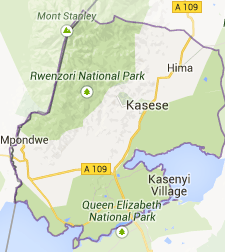
Cholera outbreak confirmed in Kasese district as reports indicate 20 cases have been recorded in several health centres as well as death. Back at the Ministry of Health, officials are in a meeting as they are expected to issue a statement anytime concerning the situation.Reports indicate that the outbreak could be as a result of the high influx of refugees coming from Democratic Republic of Congo into the district.
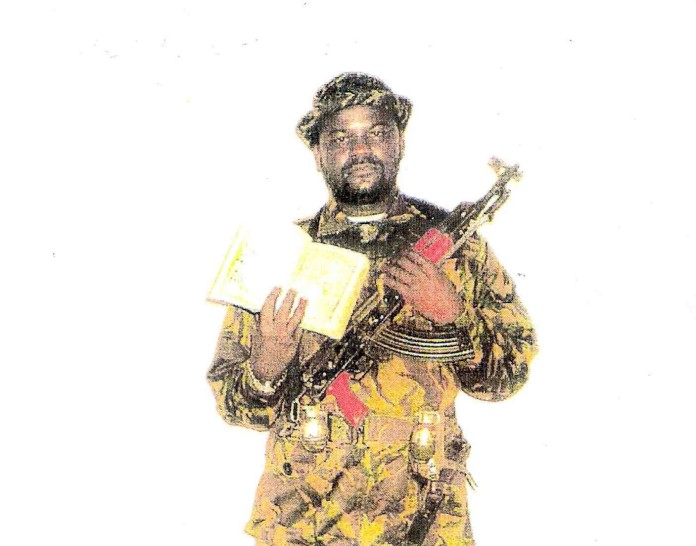
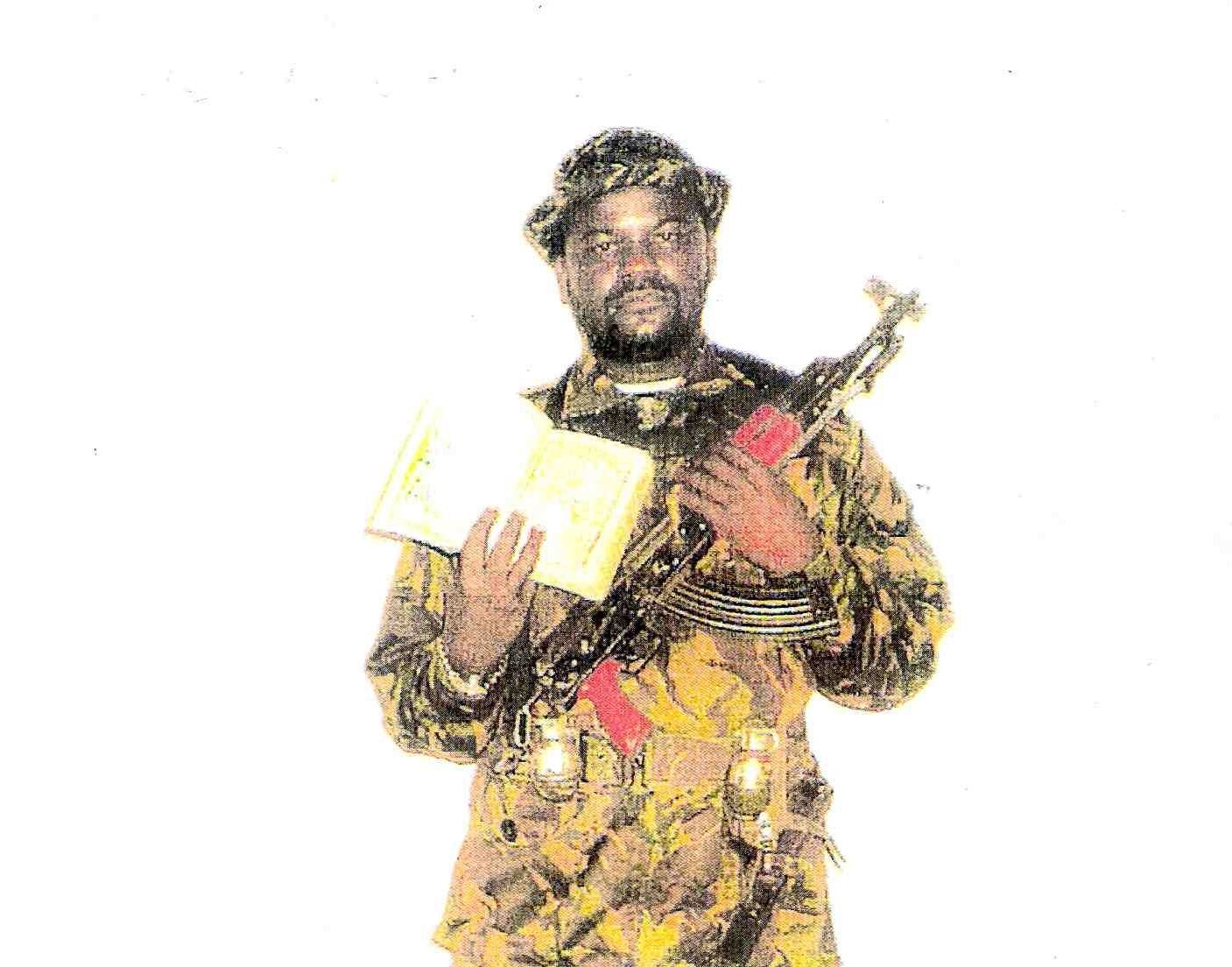
Interpol has confirmed the man arrested in Tanzania three weeks ago is Jamil Mukulu, the rebel leader of Allied Democratic Forces.
Police spokesperson, Fred Enanga said Uganda and Tanzania are now working together to extradite Mr Mukulu who is on Interpol list of wanted criminals.
“Interpol has confirmed he is the one. They have done all tests and they are confident to confirm he is the one,” He said.
There have been conflicting reports on whether he was the one or not.
He has been on the run for 20 years and is wanted for ADF’s role in the killing of 80 students from Kichwamba Technical Institute in Kabarole who were locked in the hostel and burnt to death.
ADF is also blamed for the spate of bomb attacks in Kampala in late 1990s. The rebel group later withdrew to DR Congo where they have been killing civilians. On Tuesday, they killed two UN peacekeepers from Tanzania in Beni, eastern DR Congo, in an attack seen as a revenge against Tanzanians for the arrest of their leader.
Many faces of Jamil Mukulu. He has been using different identities to elude arrest
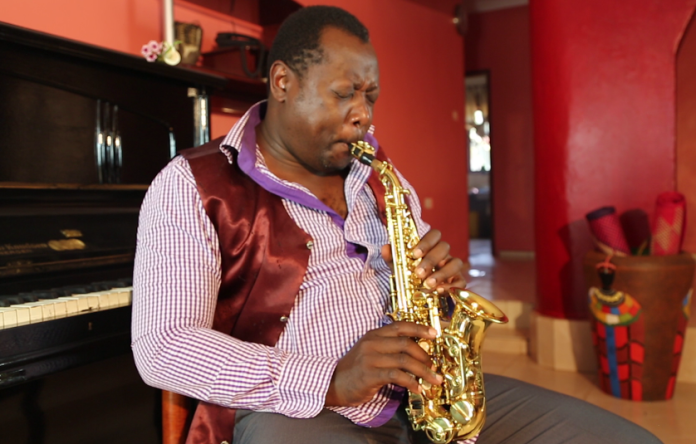
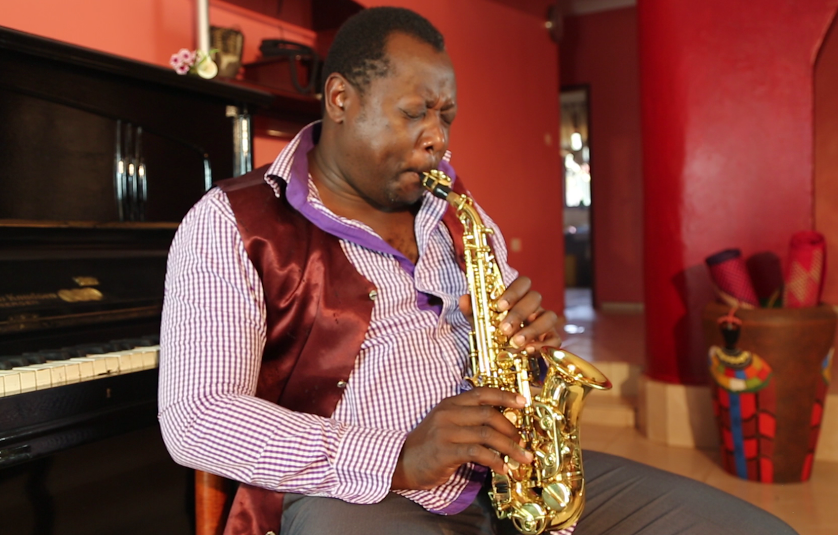
Moods are in high in Kampala as Ugandan gospel musicians are set to perform at the much anticipated seasoned jazz King Isaiah Mbuga’s Mega worship concert.
The concert is to be hosted by King Wesley, lady Bezo and Natal .D on May 16, 2015 at the MTN Arena Lugogo, with anticipated breath-taking performances from Martin Sseku, Jackie Ssenyonjo, Julie Mutesasira, Robin San, New Testament, Brian Lubega, Holy Keane Akili, Dorah K, DJ Ryne, DJ Snick Streets and many more surprise acts.
‘To all my friends and fans I would like to invite you to join me and my fellow minister and friend bishop Isaiah Mbuga, I will be performing your favorite songs’, says Robin san, a gospel musician.
The concert dubbed ‘join the city’ is sponsored by Christ Heart Church, Phaneroo, Spirit FM, Atonga and Hipipo.
EFFECTING CABINET ENDORSEMENT: Lands, Housing and Urban Development minister Betty Amongi.
Kampala-The High Court has today dismissed a case in which Uganda Peoples’ Congress president Olara Otunnu was sued over his legitimacy to lead the party.
The applicants claimed Otunnu didn’t have the authority to execute party activities since his term as party president had expired in early March this year.
Otunnu had been sued together with UPC Secretary General, Fr. Jacinto Ogwal by Oyam South legislature Betty Amongi and her Kole county counterpart Fred Ebil.
But in his ruling Civil Division judge, Justice Steven Musota noted that according to the UPC Constitution Otunnu and his cabinet is still in office legally.
Citing Article.26.2 of the UPC Constitution the judge said, “When this Constitution comes into force, the President elected under the old Constitution serves for a term of seven (7) years and shall continue to hold that office for term not exceeding five (5) years from the time of his/her election.”
The UPC legal advisor Mr. Charles Dalton Opwonya told journalists at a press conference held at the party headquarters that Justice Musota had agreed to most of the issues raised by the respondents.
Speaking cynically Counsel Opwonya said that MPs Amongi and Ebil wanted to calculate every minute of Otunnu’s time as UPC president, something he said, wasn’t applicable.
“Otunnu was mandated to do this and his cabinet, what they wanted is unrealistic, they wanted to do it on the dot,” Mr. Opwonya said.
He also noted that all the party’s organs were functioning properly and there was no reason for running to Court.
“Absurdity is what they are standing onto which the judge could not do,” Counsel Opwonya said adding: “there was already an alternative; you don’t go to Court when there’s an alternative.”
UPC spokesperson Mr. Okello Lucima termed the dismissal of the case as a victory for the UPC supporters. He further said that the two members that ran to court are free to participate in the party’s activities. “They are still UPC members, they did not go anywhere,” Lucima said.
Amongi and Ebil ran to Court early this year seeking an injunction to stop all UPC activities on grounds that the party president and his cabinet no longer had powers to run party activities since their term in office expired. Otunnu’s term as president ended on March 13, before the party’s national council met.
I am aware of the IGG investigations and Litigation
Kampala-A concerned Ugandan has threatened the Minister of Education, Science, Technology and Sports, Jessica Alupo with intention to drag her to court claiming she is indulging in illegal recruitment at the Ministry.
In the plaint dated April 2, 2015 and filed through M/s Isabirye and Company Advocates, Mr David Lubwama alleges that the Ministry of Education is currently recruiting staff under the Directorate of Higher Technical Vocational Education and training which process is not backed by any existing law.
Consequently Mr Lubwama wants the recruitment being carried in the directorate of higher technical and training at the Ministry to be halted until a new structure is in place with harmonized roles, key functions and expected output. Lubwama also wants Alupo restrained from interfering with the mandate of the Permanent Secretary in the ministry in respect of the technical running of the ministry.
On May 9, 2014, the Education Service Commission received a submission from Permanent Secretary to the Secretary Education Service Commission, Dr. J. G Mbabazi which was referenced ADM 75/239/01 requesting the commission to fill 22 vacant posts at the ministry headquarters. And upon placing an advert some staff at the ministry protested against the commission’s decision to advertise the posts by opening up a case of abuse of office against the commission under CIID (hqts) under Gef 493/2014. They also filed a civil case MISC cause No. 73 of 2014 which was later withdrawn
In a notice to the Permanent Secretary at the Ministry of Education, the Solicitor General requested to be availed with the relevant information regarding the allegations spelt out.
Mr. Elisha Bafirawala, who signed on behalf of the Solicitor General, and copied to the Inspector General of Government, The Auditor General and the Secretary Education Service Commission says there should be a restructure at Ministry of Education as ordered by the Inspectorate of government which is to suit the current legal framework and the current new mandate of science and technology to avoid wastage of tax payers money through litigation.
“We have been served with a copy of a statutory notice pursuant to section 2 of the civil procedure miscellaneous provision and limitation act by Mr David Lubwama signifying his intentions to sue government of Uganda for actions of Maj. Jessica Alupo Epel, the Minister of Education, Science Technology and Sports.” Mr Bafirawala wrote April 7, 2015.
Ms Alupo couldn’t answer our repeated calls when Eagle Online tried to get her side of the story.
But in her letter dated March 27, 2015, Alupo said the challenges affecting the recruitment process are clearly explained and therefore, no worries to halt programme.
“Whereas I have been aware of some of the challenges like the litigation process and the Inspector General of Government(IGG) investigations, some of the directives that the commission has received like halting the process of recruitment after the IGG clearance are totally new to me”
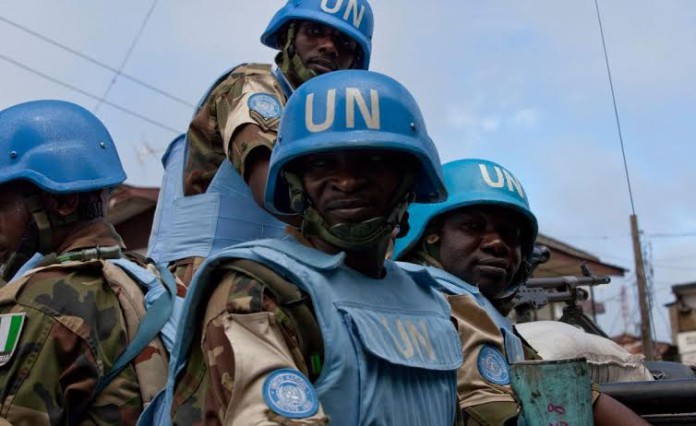
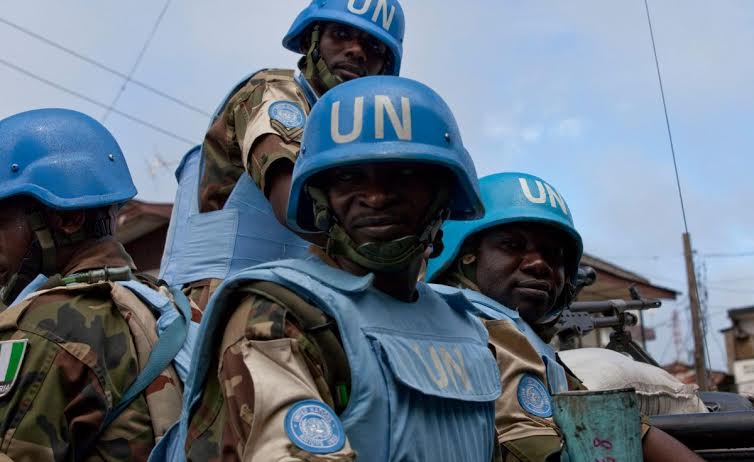
By Faith Karimi, (CNN) – Suspected rebels ambushed a United Nations convoy in the Democratic Republic of Congo on Wednesday, killing two peacekeepers and wounding 13 others.
Four more peacekeepers are missing after the attack in Beni, the United Nations said in a news release. The peacekeepers killed were from Tanzania, it said.
A day earlier, a U.N. helicopter carrying the mission’s commander came under fire from unknown gunmen. It landed safely.
“The U.N. remains committed to taking all necessary actions … to protect civilians and neutralize armed groups in eastern DRC,” the world body said in a statement after the ambush.
A U.N. team is on the ground supporting the local army as it battles Ugandan rebels in the restive eastern Congo. Beni is in the northeastern part of the vast country, not far from the border with Uganda.
The Uganda-based Allied Democratic Forces has attacked villages in eastern Congo and killed residents in recent months, according to the United Nations.
Eastern Congo is still trying to get back on its feet after a conflict left millions dead from 1998 to 2003.
As a result of the instability, armed militants run amok in the region, which is rich in gold and diamonds.
Addis Ababa, Ethiopia
Former Uganda Vice President and Member of the AU Panel of the Wise Ms Speciosa Wandira-Kazibwe, calls for deliberate seminars to be organised for new presidents and their cabinets. This, she argues will help in bringing them up to speed with everyone else on critical local, regional and international priority issues.
She was Tuesday addressing over 60 participants at a one-day seminar on“Strengthening Mediation” organized by ACCORD. The seminar took place at the African Union Headquarters in Addis Ababa.
Wandira further urged the participants to embrace peace building mechanisms as a cheaper option compared to conflict prevention. She underscored the role of non-state actors especially universities, which are responsible for doing the necessary research on structural issues that, either promote peace or fuel conflict. She added that religious institutions should be a permanent feature for ensuring continuity in working with communities for peace building.
AMISOM representative Lydia Wanyoto-Mutende called on all concerned leaders, to clearly define the relationship between protocols and actual situations on the ground in conflict-prone countries. She figuratively drew attention to a woman waking up to bomb blasts and gunshots, and having to carry her baby on her back while running to safety; and ordinary citizens crossing borders to escape conflicts, sometimes without even having a passport or visa, to say the least.
The seminar, was also addressed by other high profile discussants including; Assistant UN Secretary General Taye-Brook Zerihoun, Chair of the Peace and Security Council (month of May), Amb. Amina Diallo, Member AU Panel of the Wise, H.E Edem Kodjo, AU Special Representative Mali/Sahel, H.E Pierre Buyoya, Amb. Bwakira from CMI, and ACCORD Founder Vasu Gounden, among others. Their discussions largely focused on the post-1990 conflict trends and accompanying complex practices and challenges; the nature of existing collaboration between the AU and Regional Economic Communities; the role played by international bilateral and multilateral cooperation and partnerships including those of partners in general and United Nations in particular; and the role of non-state actors in the mediation process.
On the way forward, participants proposed the strengthening of the capacity of hitherto marginalized groups such as women and the youth for mediation; the importance of implementation of agreements that result from mediation efforts, not to mention that this will require additional human and financial resources, among others.
Soon after the birth of her second child, a daughter she named Neema, Tabu Kalama found herself homeless and with no regular income. Ms Kalama had no option but to sleep with her newborn daughter and her 18-month old son in the meagre shelter of palm trees near the beach in Kilifi, in eastern Kenya.
It was June, among the coolest and wettest months there. “I was so worried that the baby would fall sick, and there was nothing that I could do,” Kalama says.
Neema developed a temperature high enough to be fatal for a 3-month-old baby. Ms Kalama had heard about pneumonia and worried that Neema might have this illness.
Pneumonia is the leading infectious cause of death in children worldwide. This disease killed an estimated 935 000 children under the age of 5 in 2013.
Ms Kalama brought Neema to the hospital. After more than a week, including periods when Neema lost consciousness, her baby overcame the illness and was discharged.
Three months later, friends and well-wishers joined together to build the Kalama family a small hut in Kilifi. Today, Ms Kalama ekes out a living by watching over a neighbour’s herd of goats and from additional odd jobs.
Kenya among first to use pneumonia vaccine, PCV-10
When Neema, now 14 years old, fell sick, Kenyan children were not immunized against bacteria that cause pneumonia. In January 2011, following recommendations by the WHO and with the Organization’s technical assistance – plus financial support from Gavi, the Vaccine Alliance – Kenya’s health ministry introduced PCV-10. This “ten-valent” vaccine targets ten bacteria that cause invasive pneumococcal disease, a form of the illness that is frequently fatal.
Kenya was among the first countries in the African Region to introduce PCV, and the first low-income country to use the ten-valent vaccine. Today, newborns nationwide receive the vaccine in 3 doses at 6, 10 and 14 weeks. Neema’s youngest siblings have all received PCV-10.
Kenya’s push to immunize babies against pneumonia is helping the country advance on the 2025 targets of the Integrated Global Action Plan for the Prevention and Control of Pneumonia and Diarrhoea (GAPPD), released by WHO and UNICEF in 2013. The two agencies have recognized that it is not effective to try to prevent and control pneumonia and diarrhoea separately. Pneumococcal vaccine – a key element of the new integrated strategy- had been introduced in 102 countries by the end of 2013, and global coverage was estimated at 25%.
Since PCV-10 was introduced in Kenya, scientists at the Kenya Medical Research Institute (KEMRI) have been studying the impact of the vaccine on child health. Their research, which is supported by the Wellcome Trust and Gavi, found that introduction of PCV-10 in Kenya resulted in an estimated 42.7% reduction in pneumococcal disease episodes and a 6.1% reduction in childhood deaths. 1
Challenges of stopping preventable disease
Unlike Neema and her siblings, many Kenyan children do not live in towns close to clinics or health centres. This means health workers must travel to distant rural areas for immunization drives.
“The key thing is to sensitize the community about the importance of these immunizations,” says Judy Kinya, a clinical officer at the Vipingo Health Centre, an hour’s drive along the coast road south of Kilifi.
Painted in foot-high letters on the wall outside is the centre’s vision: “A nation free from preventable diseases and ill health”. In the shade of the half-walled waiting area, mothers gather with their babies and young children for general health check-ups and new rounds of immunizations.
“These are the ones here who heard the message, and it is true that there are many of them,” says Ms Kinya. “But there are many more out there in the more remote areas, and really to succeed fully with immunization coverage, we need to be able to reach every last one of them.”
“We know that reaching children in remote rural areas and urban slums is the biggest challenge we face as we move forward on closing the immunization gap and giving all children the opportunity to be fully immunized,” says Dr Custodia Mandlhate, WHO Representative for Kenya. “Working closely with WHO, Kenya’s health authorities are striving to meet this challenge.”
Back in Kilifi, Neema has run home from school as the Easter holidays begin. “She and her brother are enrolled in the local primary school, where they trade places at the top of the class,” Ms Kalama says with pride. After the most recent exams, Neema was once again in first place as the school’s top student.
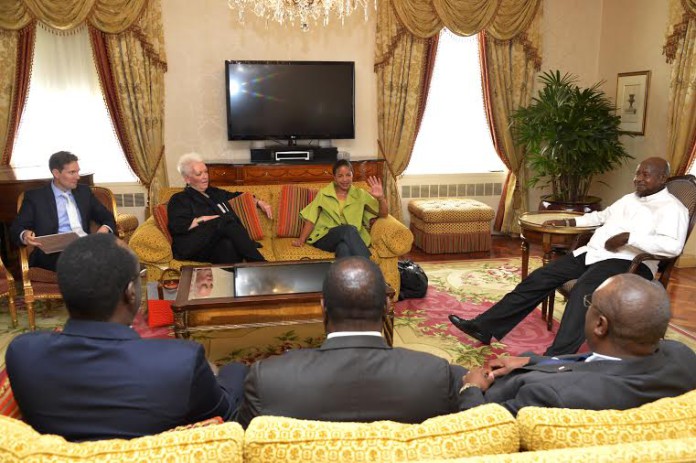
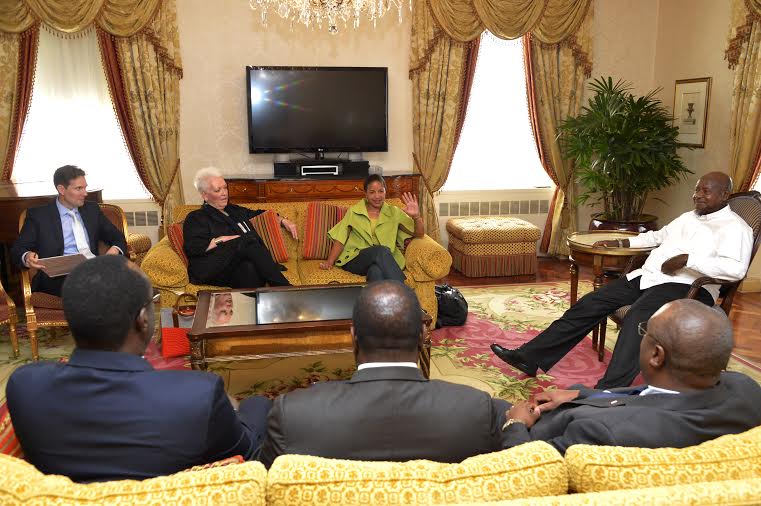
President Museveni and the United States National Security Advisor Susan E. Rice
Museveni, US Security Advisor discuss South Sudan, Somalia
President Museveni and the United States National Security Advisor Susan E. Rice have exchanged views on regional developments and discussed the devastating humanitarian as well as regional economic costs of continued conflict in South Sudan.
The two leaders in a bilateral meeting they held Tuesday at the President’s residence at Waldorf Astoria hotel agreed on the need for the international community and South Sudan’s regional partners to work quickly to achieve peace in the face of the intransigence of the country’s leaders.
They expressed concern over the increasing level of conflict in Sudan, specifically the continued conflict in Darfur and the vicious bombing of civilians in Southern Kordofan and Blue Nile States.
President Museveni and the United States National Security Advisor Susan E. Rice
The two leaders reaffirmed a shared commitment to advancing regional efforts to defeat the Lord’s Resistance Army and continuing cooperation to support the vital work of the African Union Mission in Somalia. They also discussed the important cooperation between the USA and Uganda to counter terrorism and prevent violent extremism in the region.
The meeting was attended by Uganda’s Head of Mission and Permanent Representative to the United Nations Dr. Richard Nduhura and Military Attaché Brig. Silver Kayemba.
President Museveni had earlier received Tanzania President Jakaya Kikwete with whom they discussed issues of regional cooperation. He also met and held a discussion with Angolan Minister of Foreign Affairs Georges Chokoti with whom they discussed matters concerning the Great Lakes region. Angola is the current chair of the International Conference of the Great Lakes Region-ICGLR.
The meeting was attended by the Minister of State for Foreign Affairs. Okello Oryem and Uganda’s Deputy Head of Mission to the United Nations Ambassador Kintu Nyago.
The President also received the Bechtel Corporation Senior Strategic Advisor for Africa Mr. Tom Cargill who was accompanied by Bochtel Global Head of Sustainability Mr Tim Robert Nguye.
Mr. Cargill told President Museveni that his Corporation is interested in investing in East African regional infrastructural development and capacity building for infrastructural sustainability. The President and his guests discussed possibilities of investing in infrastructural development in Uganda, particularly in the construction of railways and hydro electric power stations and in forming partnership with local engineers to sustain their investments.
The President later conducted interviews with the Associated Press and Al Jazeera television networks based in New York.
The Democratic Party (DP) describes the ruling National Resistance Movement as “too” weak to win an election in Uganda.
Democratic Party (DP) spokesperson Michael Kakande told the weekly party press conference, “The president (Museveni) has gone to areas where he has much support and he is now dividing them up into smaller constituencies.” He said this is a plot to manipulate Ugandans.
Last week, media reports suggested that the NRM was dividing up constituencies and 36 of them are in the offing to increase on its member base.
DP Headquarters
On the constitutional amendments being discussed, Kakande said, “The president is so worried about the coming elections that he wants the constitution amended.
Another concern that Kakande rubbished the use of National IDs information to determine who votes. He says many people registered for IDs and almost every eligible Ugandan did.
“So if they are planning to allow people use National IDs to vote which opens the pass to vote rigging. What will the other people who are not interested in voting do? Of course their names are going to be used by machineries to vote”, he argued.
He also said the only way the opposition can bring down the NRM party is by unifying all political parties.