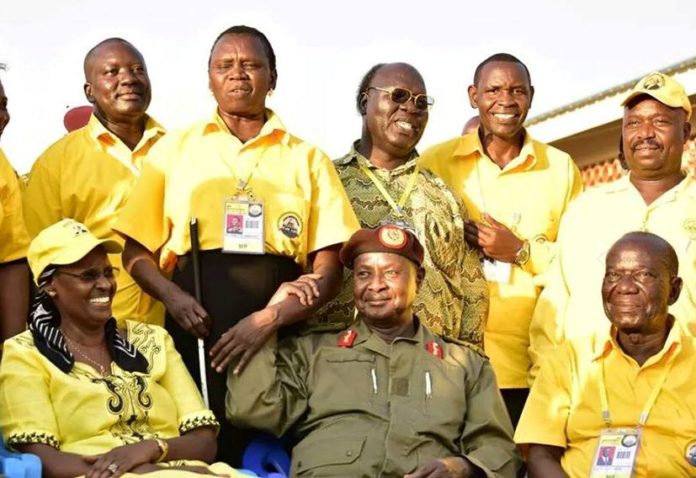
The ruling party, National Resistance Movement’s retreat starting today at the National Leadership Institute in Kyankwanzi will steer away from debating the contentious issue of removing the Presidential age limit.
In recent weeks, there has been a serious push by the NRM for constitutional reforms, which the party stifled last year, and the opposition says the move is a deceptive manoeuvre by the ruling party to muscle through Parliament the lifting of the 75-year presidential age limit. This, they argue, is supposed to pave way for President Yoweri Museveni, who is constitutionally barred from offering himself for presidency again, to stand.
However, Information and ICT minister Frank Tumwebaze insists that the debate on age-limit is not on the retreat agenda.
“The debate about scrapping the Presidential age limit isn’t on the Kyankwanzi Retreat agenda. The time for politicking ended and it is time for business,” Tumwebaze told NBS TV on Monday morning.
“It is not one of the amendments that President Museveni’s new cabinet is interested in but instead like the Prime Minister said, the NRM is always renewing itself and its commitment to Ugandans and deliberate on how to deliver a middle-income status by 2020,” he added.
The week-long retreat to be attended by party MPs, ministers and permanent secretaries aims at charting a course in this term which runs up to 2021, starting with an audit of the NRM failures in the last five years.
On July 4, the Kyankwanzi district NRM conference took the lead and passed a resolution urging its MPs to move a motion in Parliament for the amendment of Article 102 (b) of the Constitution, which caps the maximum age for one to be elected president at 75.
EagleOnline understands that the Kyankwanzi district resolution has been debated by the party’s top policy organ, the Central Executive Committee (CEC) which is chaired by Museveni, the NRM chairman.
The proposal to amend Article 102(b), which caps the maximum age for one to be elected president at 75, was supposed to be part of last year’s amendments but was removed after a stormy cabinet meeting on March 20, 2015.
President Recep Tayyip Erdogan. Reports indicate that 13,000 people detained in the post-coup attempt crack down, 6,000 have been placed under arrest.
Turkish authorities issued warrants for the detention of 42 journalists on Monday, private broadcaster NTV reported.
Well known commentator and former parliamentarian Nazli Ilicak was among those for whom a warrant was issued, NTV said.
Turkish authorities have suspended, detained or placed under investigation more than 60,000 soldiers, police, judges, teachers, civil servants and others in the week since a failed coup attempt.
Of the 13,000 people detained in the purge of people the government says were involved in the attempt, about 6,000 have been arrested, President Recep Tayyip Erdogan said late on Saturday.
Some 37,500 civil servants and police officers have so far been suspended, including many from the education ministry.
On Saturday, Erdogan issued a decree to close 2,341 institutions – including schools, charities, unions and medical centres.
The decree, which local media noted as being the first taken under the powers of a recently-declared state of emergency, also extended the legal time a person can be detained to 30 days.
The rapid pace of arrests has drawn criticism from many of Turkey’s Western allies, who say they see the country going down an increasingly authoritarian road.
Dr. Besigye, Lord Mayor Erias Lukwago and Makindye West MP, Allan Ssewayana.Photo Credit, Daily Monitor.
Makindye Magistrate Court has discounted the disobedience case brought against former presidential candidate Kizza Besigye.
The case of disobeying lawful orders against Besigye and others was dropped and immediately Dr. Besigye said he is contemplating suing government for malicious prosecution.
Dr. Besigye and others were dragged to court by police for failure to adhere to their orders as Besigye and his followers were traveling to the Forum for Democratic Change (FDC) office on Entebbe road.
This is the second case to be dropped by government in less than two months. Last month, government dropped a similar case against the opposition kingpin in a Kasangati Magistrate Court.
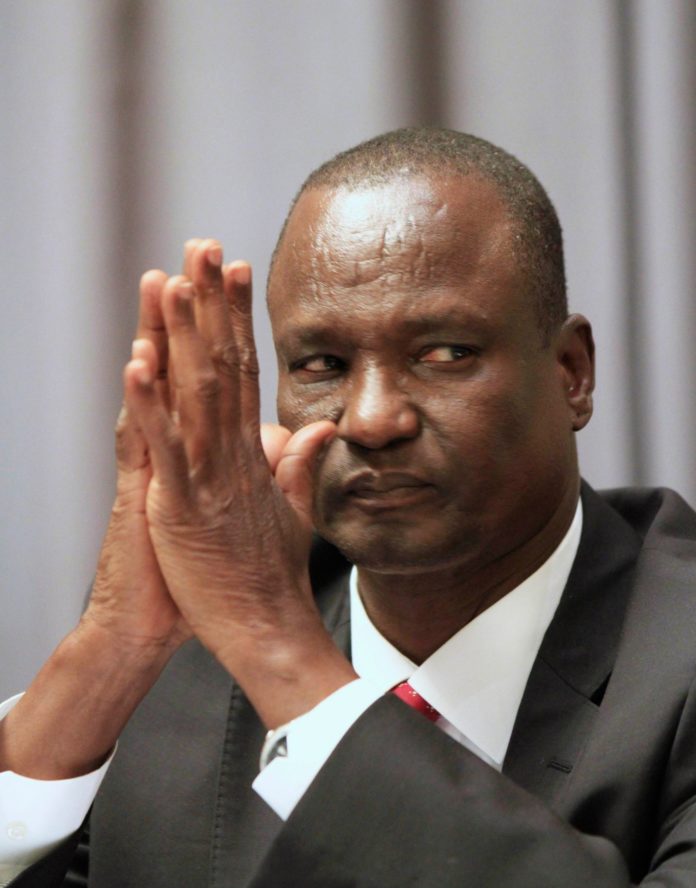
A meeting of SPLM-IO leaders who survived the recent fighting in Juba voted today to make Taban Deng Gai the ‘acting’ first vice president in spite of a directive from SPLM-IO Chairman Riek Machar yesterday removing him.
Machar in a letter yesterday said that Taban Deng has ‘defected’ to the SPLM faction headed by Salva Kiir, therefore he dismissed him from the movement.
The move came after Kiir issued an ultimate to Machar to return to Juba or else face removal from his position as first vice president, and it was clearly aimed at preempting the meeting by Taban’s supporters in Juba today.
Kiir’s officials have been hinting at backing Taban Deng to replace Machar for several days now, also saying Machar’s bodyguards will not be allowed to return back to Juba. Many of them were killed last week in fighting.
According to video of the event now on social media, Ezekiel Lol Gatkuoth, head of external affairs for SPLM-IO, told members at the event that Taban Deng would be the new ‘acting’ vice president until Machar returns to Juba.
“The leadership has nominated General Taban Deng Gai to act as the First Vice President of the Republic of South Sudan. In our resolution also General Taban Deng Gai promised all of us and he will say it to you all, ‘I will be the First Vice President of The Republic of South Sudan and if [Riek Machar] returns, he will step down,” said Ezekiel Gatkuoth.
This move threatens to split the SPLM-IO into two factions, one faction that recognizes Taban Deng as a valid member of the movement and the new first vice president, and the other faction remaining behind Machar.
Today’s meeting was described as a meeting of the SPLM-IO ‘National Liberation Council’, but it is not yet clear how many liberation council members actually attended.
Two of the most senior SPLM-IO members present were SPLM-IO Secretary-General Dhieu Mathok and Deputy Chairman Alfred Lado Gore. This suggests that some of Machar’s own top appointees are backing the move to sideline him at least temporarily until a deal can be reached on his return to Juba.
The African Muzik Magazine Awards has unveiled their nominees list for the 3rd edition of the biggest African music awards in Diaspora. Following the outstanding success of the 1st and 2nd editions, AFRIMMA 2014 and AFRIMMA 2015 respectively; High expectations have hit the roof for this year’s edition set to be held in Dallas on the 15 th of October 2016.
Unlike other awards where few Ugandans are always nominated, the AFRIMMA have seen more of them nominated in various categories.Ugandans will have to compete with some of Africa’s big hitters and the most impressive names on the African music scene in the past calendar year who earned a mention in highly competitive categories with musicians like Wizkid, Vanessa Mdee, Diamond Platnumz and Davido.
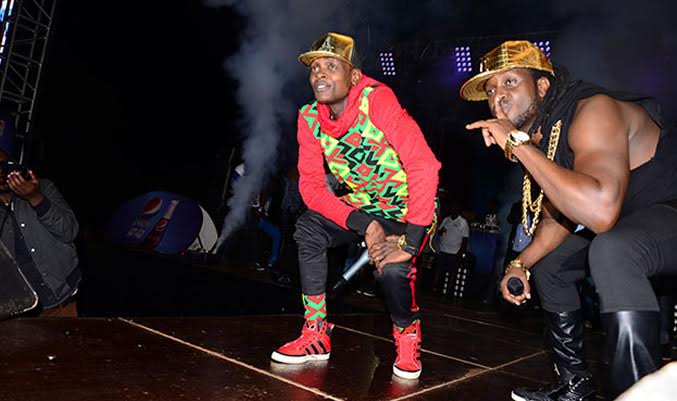
Bebe Cool will battle it out with fellows Eddy Kenzo and Jose chameleon for the Best Male Artist in East Africa plus Diamond Platnumz – Tanzania, Ethiopian Jacky Gosee, Ali Kiba – Tanzania, Sauti Sol – Kenya, and Dynamq from South Sudan.
Sheeba Karungi is in for the Best Female Artist East Africa with Victoria Kimani from Kenya , Vanessa Mdee from Tanzania, Aster Aweke from Ethiopia, Tsedenia Gebremarkos from Ethiopia, Linah – Tanzania, Knowles Butera – Rwanda and Akothee from Kenya.
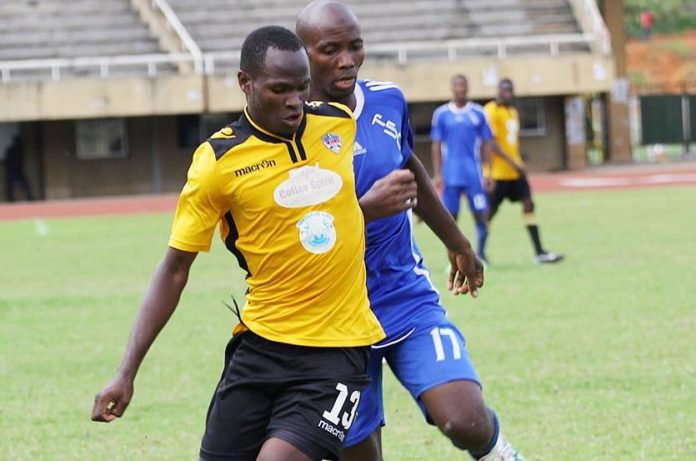
SC Villa have confirmed the signing of Shs12m rated Alex Benzema Kitatta from Uganda Premier League side The Saints FC.
He follows 12 other new players who were unveiled two weeks ago, as Villa look to revamp their squad after a number of outgoings.
Nicholas Ssebwato, Jonathan Mugabi, Misi Katende, Karim Ndugwa, Abdul Ssebuliba, Suleiman Ochero and Isaac Muleme.have all left for pastures new this offseason.
With the club going trophy-less last season, club president Eng Ben Misagga tells players to perform or be fired.
Misagga is also believed to have spent over Shs300m on new signings prior to the start of the 2014/2015 season and he is not afraid to do the same if it’s going to reap rewards next term.
“We are like the Madrid of Uganda. We buy, we don’t groom. I want players who will brand Villa all over Africa and maybe the world in future.”
IN FIGHT WITH EU OVER AMISOM WAGES: Burundi President Pierre Nkurunziza.
Burundi lawmakers called for the release of at least 13 high-school students detained on accusations they defaced images of President Pierre Nkurunziza.
Daniel Gelase Ndabirabe, a ruling party spokesman, said the students could be released and “taught patriotism,” during a session of the East African nation’s parliament broadcast on national television. Opposition coalition leader Agathon Rwasa also backed such a move, he told the assembly.
Schools in landlocked Burundi have seen a wave of alleged vandalism of images of the president in textbooks, with more than 530 students suspended last month.
The country has been rocked by unrest that’s left more than 470 people dead since April 2015, when Nkurunziza decided to stand for re-election, a move his opponents said was unconstitutional.
HOST OF NEW NSSF TV SHOW: Ugandan media celebrity Gaetano Kaggwa
Former Uganda representative to Big Brother 2003, Gaetano Kaggwa, and Sanyu FM presenter Crystal Newman are set to host the NSSF Friends with Benefits show which will air on NTV and Urban TV from September to November.
GAETANO’S CO-HOST: Crystal Newman
The TV show, which is a result of a campaign that NSSF started so as to educate its members and Ugandans on the importance of adopting a saving culture and utilizing their benefits effectively, will feature inspiring stories of NSSF beneficiaries and will air every Sunday.
The stories will show how careful planning and tactful saving can indeed bring dreams to life.
“I am very excited and looking forward to hosting the Friends with Benefits TV show. Ordinary people with special stories having the opportunity to win so much is very inspiring,” Gaetano said.
He previously co-hosted the television show Studio 53, a travel magazine program which ran weekly on MNET with South Africa’s Rosie Motene in the late 2000s and Tusker Project Fame All Stars reality TV show in 2011.
The finalists were required to submit a short story of less than 100 words to a panel of judges who chose the best 20 stories to be presented to the public in a televised show.
The most compelling and best told story among the best 20 will earn the beneficiary Shs30 million at a grand finale that will attract the top CEOs and dignitaries in Uganda in November.
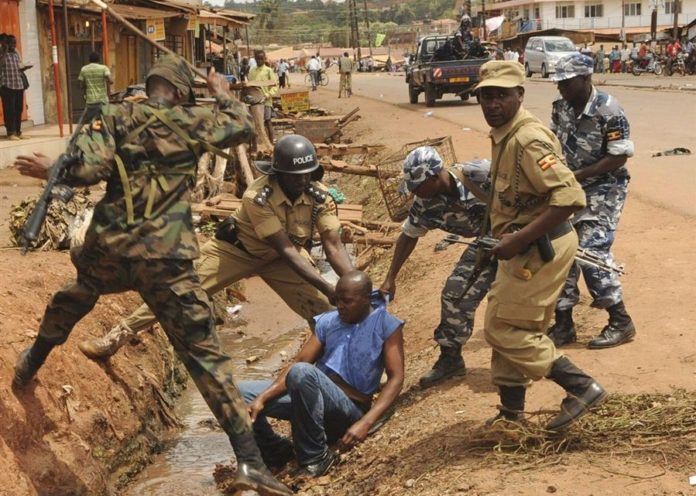
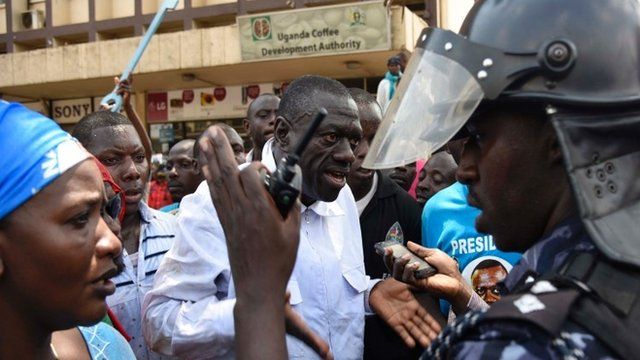
Uganda Police officers rough up a man who was participating in a protest
On Tuesday July 12, 2016 opposition leader Dr Warren Kizza Besigye Kifefe was released from prison on bail after being locked up on charges of treason. Ugandans are now familiar with Dr Besigye’s political style, one that at times leaves his followers and the police on a collision path. Every election year is one of mayhem and chaos, bringing to a standstill so many businesses and operations carried out in Uganda’s capital, Kampala.
Citing electoral malpractice as the main reason for his failure to assume the presidency on four occasions, Dr Besigye at times takes matters in his hands in an attempt to remedy the ills, going even as far as swearing himself in as Uganda’s president-elect despite the results released by the Electoral Commission showing otherwise. This landed him a two month stay in a cold cellar in Moroto and Luzira, where he claims to have escaped several assassination attempts. But even after his release Dr Besigye still remains true to his word and remained defiant and adamant; taunting the police, calling them ‘incompetent’ and further urging his staunch followers to take up arms and rally behind him as he re-embarks on his journey to State House to claim what he believes is rightfully and justly his.
DEFIANT? Supporters of Dr Kizza Besigye engage a police officer
Let us assume there is a girl in Kampala who deems herself a loyal follower of the Forum for Democratic Change leader (Besigye’s opposition party). Let’s call her Rose. On July 12 Rose and millions of others witnessed the release of her party president and to her joy Rose found out she could also see him in person as he was being transported to his home in Kasangati by the Ugandan police. However, Rose’ joy was short lived as the police detail escorting the Opposition leader started hitting anyone in sight, causing many to disperse in frenzy as they feebly tried to escape the beatings.
For Rose and other Ugandans witnessing this attack on FDC supporters, it appeared to have been pre-planned; whether the supporters had catalyzed the attack or not the police were intent on hitting something or someone that day. This for Rose, like any Ugandan familiar with the signature riots and rallies that rotate around Ugandan elections is not new. However, unlike previous clashes with police where measures were implemented in order to restore peace and order, July 12 was a peaceful day that did not necessitate the police to act the way they did. This left many Ugandans who witnessed the brutal footage wondering whether they should brace themselves for the worst in the near future.
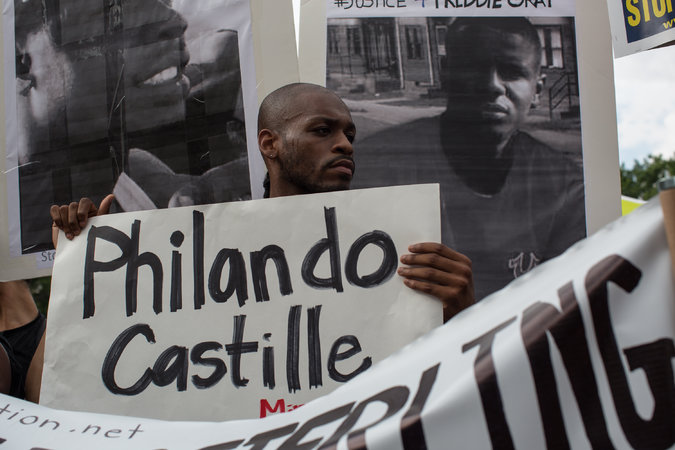
Protesters in the US against the killing of Philando Castillo
Police brutality is a very common occurrence not only in Uganda but also elsewhere, in a country like the United States of America. And in most cases it is a result of miscommunication and misconduct between the deviants and the police that is charged with maintaining peace and order within a state, usually leaving the civilians/deviants with the short end of the stick. Although police brutality often occurs due to lack of better judgment on both sides there are some cases where the public is left baffled at the sheer lack of modesty exhibited by the police when they decide to criminalize many citizens and act as if they were operating in a war-zone. We’ve seen women undressed and their bodies subjected to demeaning and humiliating forms and acts of violence over the years whilst men are beaten and handled callously without any remorse whatsoever, even at times causing death of some in its wake. No one can truly pin-point the reason or cause of such unprofessional and unnecessary behavior; the police force in Uganda is slowly but surely deteriorating when it comes to its public relations skills. However, on a positive note, of recent several police officers have had to answer for their acts of commission or omission.
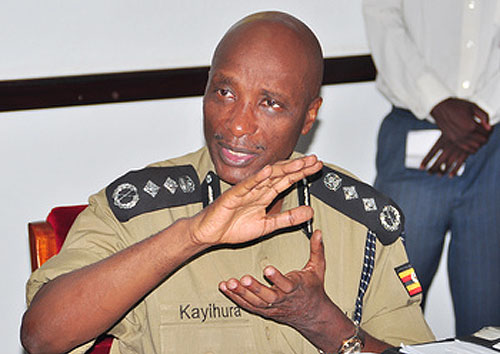
APOLOGISED ON BEHALF OF POLICE FORCE: Inspector General of Police Gen kale Kayihura
On July 14 police chief General Kale Kayihura called a press conference at the police headquarters in Naguru, where he apologized on behalf of the police for the brutality his men exuded towards the citizens of Uganda.
“I want of course to regret any incident that disturbs the public. We are pro-people, we are not anti-people and I don’t want these images that police is against the people,” he said. However, Gen Kayihura also blamed people for the ‘provocation of the force’ and warned Besigye about carrying on with his defiance campaign.
Police brutality can mainly be described as the unlawful use of force by the police and in Uganda this normally happens between a specific group of peoples or gatherings and the police. In Uganda followers/supporters of the opposition parties top the list with numerous encounters causing civil unrest especially during campaign seasons. Meanwhile, in the United States of America, police brutality is commonly expressed between the African Americans and the state police; with the former group growing more concerned about the number of their colleagues dying at the hands of the police. Indeed, given America’s history and its journey from slavery dealings between the African Americans and police still remains a touchy issue; one that can be interpreted negatively at any one moment given any kind of false move.
As was the case in the recent shootings in America that claimed the lives of three African-American males in short order: 18-year old Michael Brown; 37-year old Alton Sterling and Philando Castillo, were all gunned down in a hail of police fire.
And on July 15 22-year old Sapphire Williams and 70 other ‘Black Lives Matter’ protestors were arrested but thanks to today’s social media platforms, the videos depicting these incidents went viral causing uproar across the globe. It is such depictions that have caused many to come together and fight against police brutality and racism. Through such awareness people know the power the police are allowed to wield over citizens and the need for such power to be checked when it comes to dealings between the police and civilians. There must also be measures put in place to ensure that those given this power are not influenced in any way that might give rise to any form of discrimination in the force, affecting the lack of bias that is important at law and in the decision-making process.
That said however, in light of recent history, many have surmised that America is slowly but surely turning into a ‘police state’.
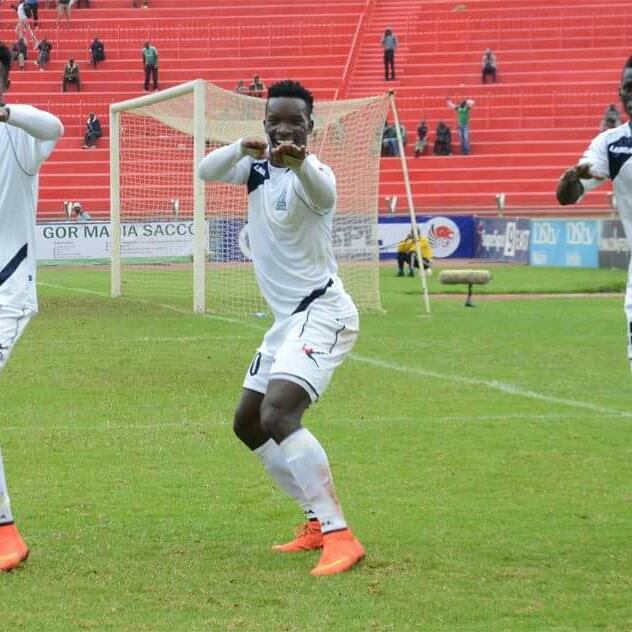
Another continent, another country, yet another fresh start for Khalid Aucho. Less than a day after the Uganda international departed for Scotland to to undergo a two-week trial at top-flight club Aberdeen. The Dons will his sixth club in the space of six years.
Aberdeen could seem like the perfect home for the Jinja bred footballer at the time. Aucho won the Kenya Premier League title last season and was voted the second best midfielder in the competition. He is also a dependable player in the Uganda national team, which is on the verge of securing qualification to next year’s Africa Cup of Nations in Gabon.
The Uganda Cranes midfielder finally arrived in Scotland yesterday and is expected to play for the club’s U20 side in a friendly over the weekend but the man who scouted him from Bombo Military Barracks four years ago while playing for Simba, Charles Obiny who is Tusker FC’s Chief Executive Officer urged Aucho to tone down his emotions as the player seeks to advance his career in Europe.
“Although he is tough, just like Wanyama (Victor), and has what it takes to make it anywhere, he needs to cool his temper. We wish him well,” Obiny told NATION’s David Kwalimwa in Nairobi on Thursday.
Obiny wise words were in response to Aucho’s interview on Wednesday before jetting off at Jomo Kenyatta International Airport.
Aucho revealed how he was happy, or at least he said he was happy five times in the space of about a minute.
“I’m coming tomorrow in the morning so that I can reach Scotland and I am happy to be part of you as a player and as a teammate.
“I’m just happy to be there for you and I’m happy in the way the coach has been talking to me and my agents.
“I am just coming to do my bit and I like the way you have been supporting me and asking everyone about me and I’m happy for it.
“I’m coming to show my best and I’m going to do my best for the team and I’m happy to be part of the team at Aberdeen.