Stanbic Bank
Stanbic Bank
19.2 C
Kampala
Stanbic Bank
Stanbic Bank
Home Blog Page 2123

A night in the life of Tanga Odoi

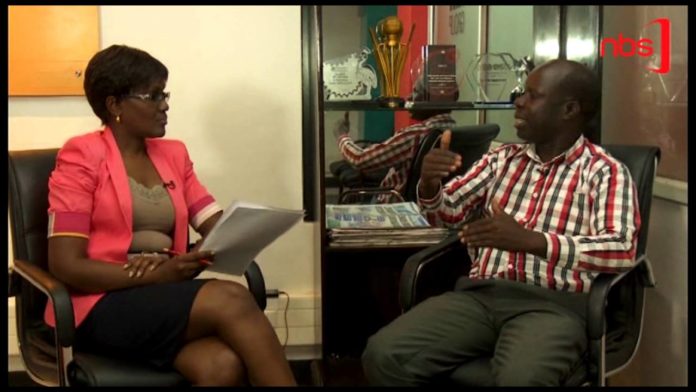
Dr. Odoi during a media interview, photo credit, NBS Television.

TANGA Odoi might be known for his mischievous acts during the National Resistance Movement party elections. But little is known about his life when the sun sets down. When the darkness rises, he is relieved from the pressures of press phone calls and NRM operatives who want ‘math to overshadow luck’ during their nominations for various seats and positions.

Dr.Odoi is known to carry a heavy security detail wherever he is travelling mostly because of the ‘threats’ he fears during the day. But at night he ditches his security because the only threats he faces at night are eyes, ears and cameras.

Tanga Odoi disregards his residence and drives alone to a popular hotel in Kisaasi where he has made special arrangements for his room and entrance. He uses a route through the basement which few guests know of.

He then joins fine young female company in the privacy of one of the rooms. They order for a few drinks which they either drink in a dim lit corner or take to their room upstairs.

He then leaves the hotel with a security aide who comes in slightly later than him. The security aide then hands him his phones and they leave in the same car with the lady. The car is parked swiftly at the front so that no one sees him exit the hotel.

On busy weekends, his car is parked on an access road next to the hotel and Tanga slowly walks to the hotel so that his car is not noticed by the public and the car returns to pick him when he is ready to leave.

Tanga is driven to several posh locations to enjoy finer meals or meet with top NRM executives to discuss what he thinks are important issues.
On many nights, Tanga Odoi is seen returning to this very hotel on an almost daily basis either alone or with a lady. He has turned this into a second home of sorts. One is left wondering whether its thirst for change in sleeping location or thirst for salty tasting juices that has made Tanga Odoi resort to qu

Stories Continues after ad

Two Ugandans killed in Juba, UPDF set to redeploy

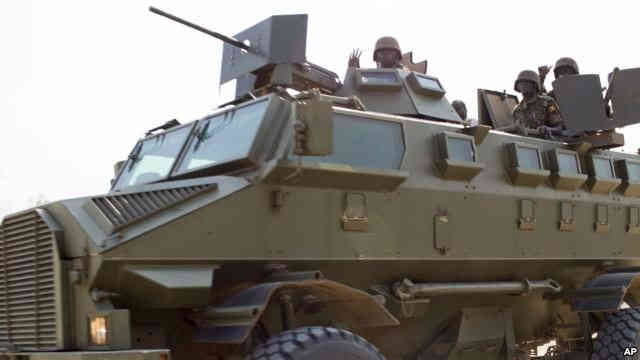
Uganda People's Defense Force (UPDF) soliders in Bor, Jonglei State, South Sudan before they left last year.

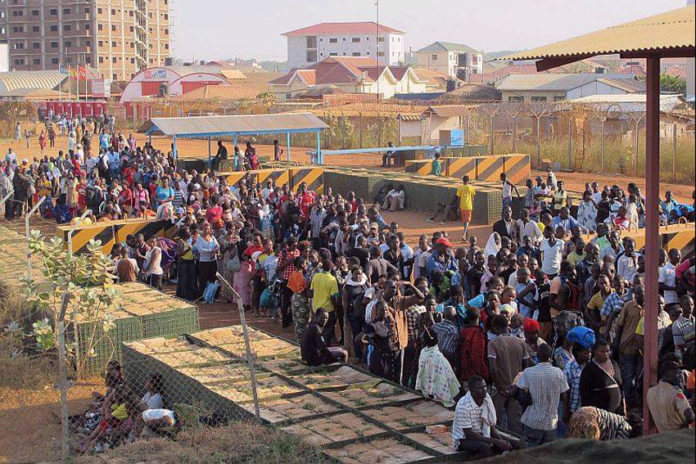
Two Ugandan nationals working in South Sudan’s capital, Juba, have been killed, according to reports.

Their identities are yet to be known but minister of Trade, Industry and Cooperatives Hon. Amelia Kyambadde is expected release a statement about the plight of Ugandan traders in Juba on Tuesday.

Over the past days, hundreds of people have been killed in clashes between forces loyal to President Salva Kiir and those supporting Vice-President Riek Machar.

Ugandan traders, UN compounds and civilians have also been targeted, something the Security Council said could constitute a war crime.

The fighting has stopped flights to and from Juba airport and a fresh UPDF return now seems inevitable.

Meanwhile Uganda Peoples Defence Forces spokesperson Paddy Ankunda has revealed that Uganda will only deploy in South Sudan upon official request from the government.

If Uganda sends its troops in, it will be in line with African Union’s tenet of protecting governments in power in accordance with a country’s constitution.

This comes moments after fighting has broken out again, hours subsequently the UN Security Council called for an end to the violence.

“We’re concerned about situation in South Sudan, given likely repercussions, but that’s all. We’re not deployed there,” Ankunda told NBS TV on Monday.

Uganda hasn’t deployed soldiers in South Sudan yet following heavy gunfire, he insisted but with Ugandans traders and expatriates trapped in the highly volatile youngest African nation and uncertain of what will happen next if the fighting intensifies, UPDF could step in and save the day.

There have, however, been UPDF forces in South Sudan’s Western Equatorial region, where they have been stationed to pursue and combat the Lord’s Resistance Army (LRA) rebels.

EagleOnline however understands that deployment of armed personnel at border with South Sudan was completed on Sunday evening.

Kampala first sent columns of between 2,000 and 3,000 soldiers into its neighbor in late 2013 to prop up the government of President Salva Kiir soon after clashes erupted with troops loyal to South Sudan’s sacked vice president Riek Machar. Most of the troops were posted around South Sudan’s capital Juba.

Ugandan troops voluntarily withdrawal from South Sudan last October because of a key demand of rebels loyal to former vice president Machar during peace negotiations to end the nation’s conflict but opposition faction of the SPLA-IO accused the UPDF of instead taking side in the internal war and prolonging it.

Kiir an acquaintance to Museveni briefly resisted the rebels’ demands, citing a government-to-government agreement between the administrations in Juba and Kampala that necessitated the presence of the Ugandan troops in South Sudan.

Stories Continues after ad

Ministers head to Kyakwanzi for Cabinet retreat

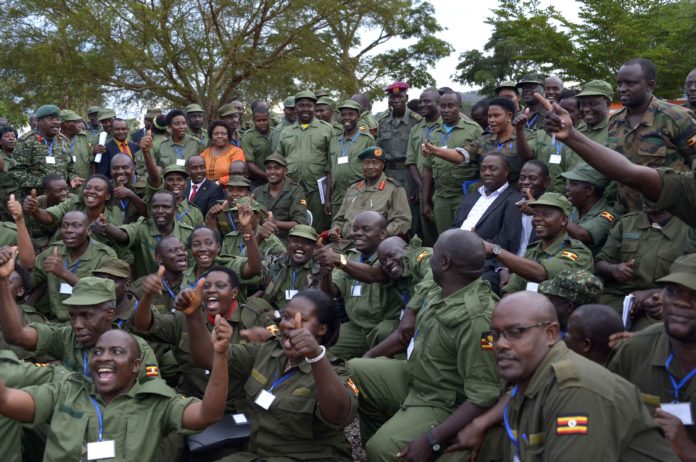
President YK Museveni pose for a group photo with the then Presidency Minister and Resident District Commissioner at a previous retreat.

PRESIDENT Yoweri Museveni will lead his Ministers and top government bureaucrats for a one week retreat at Kyakwanzi.

According to sources within the Presidency, Gen. Museveni wants all ministers and top bureaucrats to   be at per when it comes to the Vision 2020 when Uganda is supposed to attain a lower middle income status.

“It is true, all Ministers, Permanent Secretaries and other senior government officials are going for a one week retreat for harmonization of all policies so that we are able to achieve the president target of our Uganda attaining a middle income country” a source to EagleOnline on request of anonymity.

The retreat starts on July 26, 2016 and will preceded by one of Resident District Commissioners (RDCs) and Chief Administrative Officers (CAOs).

This will be the first of its kind to have ministers at the National Leadership Institute (NALI). It also comes at a time when President Museveni has opposition and independent figures in his cabinet and these will greatly benefit at the retreat since they are likely to be reoriented into National Resistance Movement (NRM) Ideology so as to implement the 2016-2021 NRM manifesto.

Stories Continues after ad

State demands proof that Besigye is 60 years old

Forum for Democratic Change (FDC) former presidential candidate, Dr Kizza Besigye, was on Monday denied bail at High Court in Kampala. Besigye had fronted advanced age as top ground for bail.

Dr Besigye’s lawyer, Ernest Kalibbala told court that the opposition leader’s  advanced age, the fact that he will to comply with bail terms, has a permanent place of aboard, uncertainty on treason trial commencement and that he had complied on previous occasions.

The state, however, objected to Dr. Besigye’s request to be released on non-cash bond saying bail is not automatic and also demanded proof that Dr Besigye is 60 years old.

“Being 60 years old is not an exceptional circumstance for him to be released on bail,” the  Principle State Attorney Florence Akello retaliated infront of Judge Musane.

“He can be cross-examined for confirmation,” Dr Besigye’s lawyer Kalibbala said on State’s request for evidence on client’s age.

State went ahead to insist that the suspect (Besigye) carried on with defiance campaign activities, a total disregard of a court order.

Besigye had presented sureties among them; FDC president Mugisha Muntu, Rukungiri MP Roland Mugume, Budadiri West MP Nathan Nandala Mafabi, Rubaga’s Joyce Sebugwawo and Francis Mwijukye.

Presiding Judge, Masalu Musene, adjourned the bail application until the 12th July when he will make a ruling.

However, Dr Besigye said whether court grants him bail or not, he will be released because treason charges will be dropped. He said the DPP should expedite investigation process.

He was speaking to a team of 14 FDC supporters and leaders from Kabarole District who visited him at Luzira prison on Friday afternoon.

Besigye who is charged with treason, said he wants the law to take its course.

Stories Continues after ad

Ethiopia goes Uganda-style ‘blocks social media’

Internet shutdowns, as happened in Uganda, Congo-Brazzaville and Chad during elections this year, Ethiopia has also decided to block social media sites but for a different reason; during university entrance examinations to prevent students from being “distracted”.

Just like President Museveni insisted that social media was blocked during the election to “stop spreading lies”, in Ethiopia, some end-of-year examination papers were posted online last month forcing the exams to be scrapped.

Facebook, Twitter, Instagram and Viber have been inaccessible in the country since Saturday.

“It’s blocked. It’s a temporary measure until Wednesday. Social media have proven to be a distraction for students,” government spokesman Getachew Reda is quoted as saying.

Prominent Ethiopian blogger Daniel Berhane condemned the move; “This is a dangerous precedent. There is no transparency about who took the decision and for how long. This time…”

Ethiopians are probably also using Virtual Private Networks to get around internet blockades like how Uganda Communications Commision was surprised here.

VPNs get round government censorship by redirecting your internet activity to a computer in a different country, where the blocks have not been imposed.

Stories Continues after ad

When Guinea Bissau beat France-Afrique in an African-European final

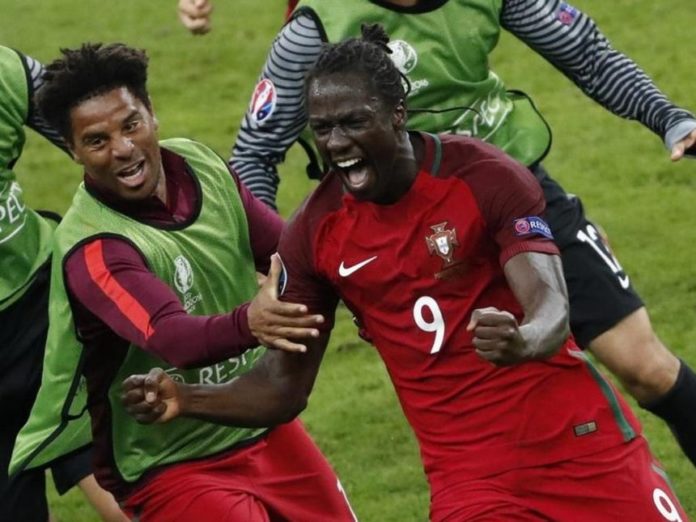
Portugal's Eder celebrates after scoring a goal. Photo/Reuters

Sunday’s Euro 2016 final between hosts France and Portugal was obviously a European affair but it had a distinct African flavour.

Eder, who scored the winning goal for Portugal was born in Guinea-Bissau but brought up in Portugal.

Actually put it this way, France and Portugal’s colonial past was on full display. Eleven of the players in French squad and six of those in the Portuguese team were African “exports”. In all, the children of second generation African emigrants who had been naturalized into the national teams of the two European footballing powerhouses made up 37% of the players in the two squads.

France were the strong favourites. They had home ground advantage and boasted the stronger team, at least on paper, mainly due to the aforementioned African “exports”. Portugal had, after all, finished third in their group.  Then there was also the small matter of history. France had a 10-game winning streak going against Portugal that stretched all the way back to 1975.

In the end, the crop of African “exports” in the French team were denied victory by a player who traces his roots to Guinea-Bissau. Éder , real name Éderzito António Macedo Lopes, was born in Bissau in December 1987. Like teammate Danilo Pereira who was also born in Bissau, Éder moved to Portugal as a child. Following his heroics at the final, his links to Africa were the subject of many Tweets.

Stories Continues after ad

US evacuates Juba embassy staff, Rwandan peacekeepers injured

Civilians take refuge at the UN camp in South Sudan. UN Photo

The United States is evacuating non-emergency staff from its embassy in South Sudan, after an escalation of fighting in the capital that has killed scores including a Chinese UN peacekeeper.

The State Department said the security situation in Juba Sunday had seen a ‘sudden and serious deterioration’, with clashes between government and opposition forces breaking out into “general fighting.”

The United Nations Security Council, which held a closed door meeting in New York Sunday, expressed ‘shock and outrage’ at attacks on civilians and UN compounds, saying they may constitute war crimes.

It called on President Salva Kiir and his rival Vice President Riek Machar to control their respective forces, prevent the spread of violence and genuinely commit themselves to the implementation of a ceasefire and peace agreement.

Fighting first broke out Thursday, with skirmishes between troops loyal to Kiir and soldiers who support his deputy Machar.

Fighting flared again Sunday, with gunfire exchanged outside a UN building, after a lull Saturday when the young country celebrated the fifth anniversary of its independence from Sudan.

“What we may be seeing is a total breakdown of command and control in Juba,” said Kate Almquist Knopf, director of the Africa Center for Strategic Studies. “We need to watch carefully for whether a cycle of reprisal killings by either side begins in the next few days.”

Japan’s ambassador to the UN Koro Bessho confirmed the death of the Chinese soldier. Chinese and Rwandan peacekeepers also sustained injuries. Earlier, South Sudan’s information minister said the government is ‘in full control’ of the capital, Juba, despite the United Nations reporting that the weekend’s deadly violence had carried into Sunday.

Church services were interrupted by fighting between troops loyal to the president and those backing the vice president, but the violence has since subsided, Information Minister Micheal Makuei Lueth said.

Lueth said President Kiir would issue a permanent and unilateral ceasefire before and urged his rival, Vice President Machar, to do the same “because we want to save the lives of the people of South Sudan.”

How many have been killed in fighting between factions loyal to Kiir and Machar is unclear. Though one estimate puts the death toll close to 150, other reports indicate more than 270 have been killed.

Gunfire from ‘heavy weaponry’ was exchanged for much of Sunday outside a UN building on the outskirts of Juba, the U.N. mission to the country said.

The mission sent out a series of tweets at about 8:25 a.m. (1:25 a.m. ET) describing “gunshots” and a “heavily armed exchange” outside a U.N. compound.

The US Embassy issued an alert saying that fighting between government and opposition forces was ongoing at the UN mission’s headquarters, the Jebel area of the city and near the airport.

The UN mission in South Sudan, known as UNMISS, said that 1,000 internally displaced people had fled its protection as violence hit areas near their camps.

“Both UNMISS compounds in Juba have sustained impacts from small arms and heavy weapons fire.”

The United Nations urges all parties to respect the sanctity of the United Nations and condemns any deliberate targeting of United Nations premises and its personnel,” it said in a statement.

The weekend violence erupted when Kiir and Machar were meeting to discuss previous clashes between their forces. Outside the presidential compound where the meeting took place, a gunbattle kicked off.

Pockets of violence broke out Thursday evening, and by Friday, soldiers loyal to Kiir exchanged heavy gunfire with others backing Machar, in a bloody skirmish that left almost 150 people dead by Saturday, according to Machar’s spokesman, James Gatdet Dak.

The Indian Embassy in South Sudan advised its citizens ‘not to panic’ and to stay indoors. Many of the UNMISS staff members are Indian nationals.

“We heard heavy artillery fire at the UN (base), and that continued for about an hour or so and then stopped. It was coming form the outer perimeters of the compound,” said Shantal Persaud, acting spokeswoman for the UN mission.

Helicopter gunships were seen in the sky, and tanks rumbled through the streets. Under the peace deal, both government and opposition troops were stationed in Juba, a plan which many criticized because it put both forces in close proximity.

Flights canceled

Kenya Airways, which operates two flights a day to Juba, said it was suspending all flights to the city because of an ‘uncertain security situation’, while Britain’s Foreign Office advised against all travel to South Sudan, saying ‘the security situation in Juba has deteriorated’ since Friday.

Two weeks ago, fighting in the western city of Wau between government and opposition troops displaced at least 70,000, according to the United Nations.

The country is nearly out of money because its funds come almost exclusively from oil revenue — the value of which has plummeted. People have become desperate. In lieu of payment, government soldiers have reportedly been allowed to rape women, a UN report said.

South Sudan gained independence in 2011 after 98% of the population voted to break away from Sudan. The East African nation, the youngest country in the world, quickly fell into civil war that took on ethnic undertones.

In December 2013, soldiers from Kiir’s Dinka ethnic group tried to disarm Nuer soldiers perceived to be loyal to Machar. Soldiers targeted Nuer civilians in the ensuing fighting, Human Rights Watch says.

The civil war was gruesome — at least 50,000 were killed, more than 2 million displaced, and nearly 5 million people faced severe food shortages. Under a peace deal signed in August, Kiir is the president of the country and Machar is the first vice president, but the fighting hasn’t stopped.


Stories Continues after ad

Serena Williams is the oldest ever Grand Slam champion after record Wimbledon final


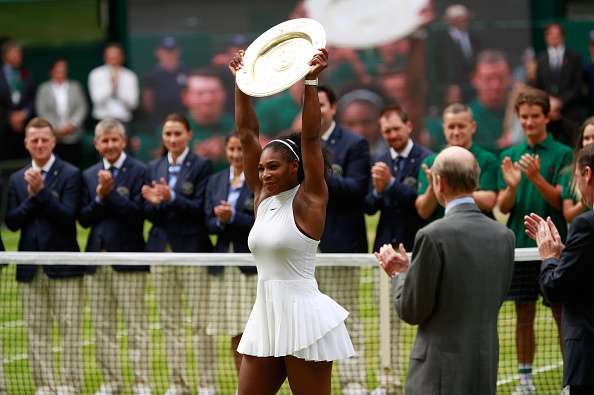
Serena Williams has re-written history at the Wimbledon. The 34 year old American coped with a gusty wind on Centre Court to win 7-5 6-3. She has now won 22 of her 28 Grand Slam finals and also moves level with Graf on seven Wimbledon triumphs, joint second in the open era behind Martina Navratilova’s nine.

Kerber had beaten Williams earlier on in the Australian Open final in January but could not produce another shock.

Right from the start, Kerber showed she was not going to be overawed. Just as she did in Melbourne, she held her ground on the baseline and served smartly to keep Williams off balance.

On a breezy afternoon, the German saved three break points in the second game to hold and received a massive cheer from the Centre Court crowd, who immediately realised they were in for a treat.

It was a match worthy of any final as Kerber, in her first Wimbledon final, pushed her all the way, scrapping for everything and using her outstanding speed to run down everything. But her defeat in Melbourne and most recently in the final at Roland Garros had hardened Williams’ resolve even further and Williams was not to be denied.

Having gone close in each of the past three grand slams and having lost to Kerber in the Australian Open final in January, the 34-year-old American edged a tight first set and then held on in the second to clinch an emotional victory and move within two of the all-time grand slam record of 24, held by the Australian Margaret Court.

But as she has done so many times in her career, she slammed down an ace, with the look on Kerber’s face saying a thousand words. She broke in the next game and then served out flawlessly to love, clinching her place in history with a forehand volley into the open space, before falling flat on her back in celebration.

Stories Continues after ad

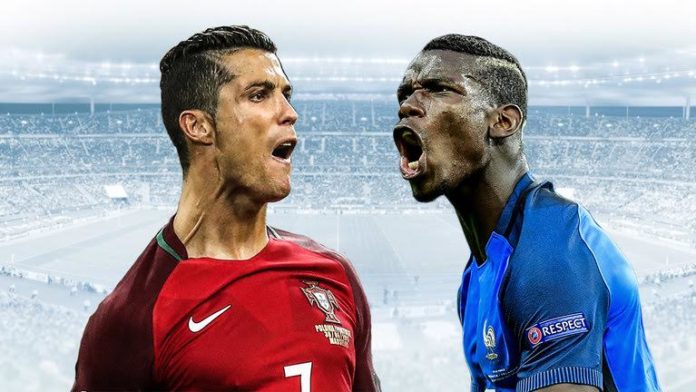
Portugal vs France – host nation aiming for Euro 2016 victory

Portugal will face France at Stade de France in Saint-Denis, Paris on Sunday July 10.

This will be France’s fifth major tournament final. They have won three of their previous four (Euro 1984 and 2000, World Cup 1998), losing their most recent (World Cup 2006).

Didier Deschamps’ side will face Portugal looking to complete a hat-trick of tournament victories on home soil.

With Griezmann once more irrepressible with two goals against Germany, they will be strong favourites to do that.

Portugal had already secured their place in the final on Wednesday night with a 2-0 victory against Wales.

Portugal have lost their last 10 games against France, who in Antoine Griezmann boast the competition’s top scorer with six goals, but Portugal believe they can spring a surprise at the Stade de France.

Portugal are unbeaten in their 13 competitive fixtures under Fernando Santos (winning nine and drawing four). Eight of those nine wins were decided by a single goal.

William Carvalho is likely to return to Portugal’s starting line-up after missing their semi-final with Wales through suspension, while Pepe still struggles for fitness.

The Real Madrid defender sat out Wednesday’s night clash with a thigh injury, and trained alone yesterday in a bid to prove his fitness. Should he miss out in Paris, veteran Bruno Alves will likely start.

For hosts France there are no fresh injury concerns to trouble coach Deschamps, who has named an unchanged XI for the first for last Thursday’s semi-final.


Predicted Line ups

Portugal: Rui Patrício (GK); Cédric, Pepe, Fonte, Guerreiro, William Carvalho, Adrien, João Mário, Sanches, Nani, Ronaldo.

France: Lloris (GK); Sagna, Koscielny, Umtiti, Evra; Pogba, Matuidi; Sissoko, Griezman, Payet, Giroud.

Stories Continues after ad
Fighting erupts inside South Sudan’s Presidential Palace

FILE - In this file photo of Monday, April 26, 2010, former South Sudan Vice President ,Riek Machar, left, President of South Sudan Salva Kiir, arrive during a press conference in Juba, South Sudan. Soldiers loyal to a former vice president attempted to overthrow the government of South Sudan, the country's president said Monday, as sporadic fighting between factions of the military gripped the capital in the latest violence to hit the world's youngest nation.(AP Photo/Pete Muller-File)

HEAVY fighting has erupted inside South Sudan’s Presidential palace as President Salva Kiir allegedly attempted to arrest his first deputy, Riek Machar, official sources have said.

There is heavy fighting going on near the Presidential Palace in Juba as we speak,” James Gatdet Dak, Machar’s spokesperson told Sudan Tribune.

He said the fighting started outside the Palace when President Kiir’s security forces opened fire on bodyguards of the First Vice President, Riek Machar, who was inside the Palace for a presidency meeting

Dak said Machar was called to President Kiir’s office by the President for a Presidency meeting to discuss the clashes which occurred between their forces on Thursday evening.

He said after Machar arrived at the Palace and as the meeting was about to start, heavy shooting started near the Palace.

“I just want to say Dr. Machar is safe under the protection of his bodyguards,” Dak said, without giving more details.

Other sources said the meeting was a setup to lure Machar to the president’s office and arrest him.

The circumstances under which the shooting erupted remain unclear. A presidential source said he heard gunfire and explosions about two blocks away from presidential palace in Juba.

President Kiir has not been seen in public since tension began on Thursday evening, but those in his inner circle said on Friday he was at his residence and had called on the army to restrain.

It was not immediately clear whether the authorities have ordered land and sea borders closed to seal all the exits should situation deteriorate.


Stories Continues after ad