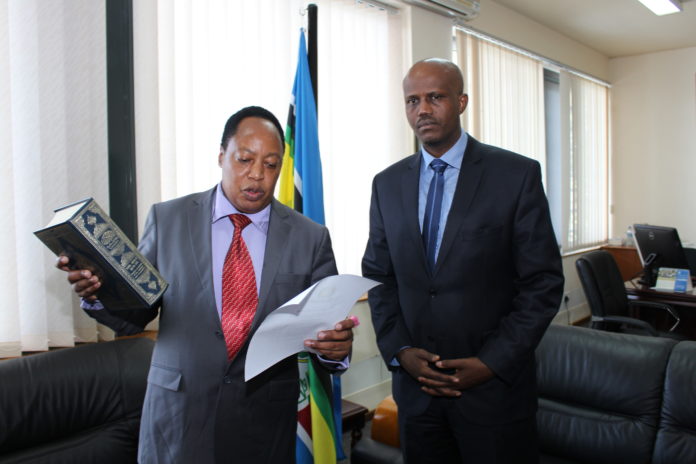
Dr. Matano in grey suit/red tie takes Oath of Allegiance. Looking on is the EAC Secretary General, Amb. Liberat Mfumukeko
The East African Community has endorsed Kenyan national Dr Saidi Ali Matano, as the new Lake Victoria Basin Commission (LVBC) Executive Secretary, replacing Rwanda’s Dr Canisius Kanangire.
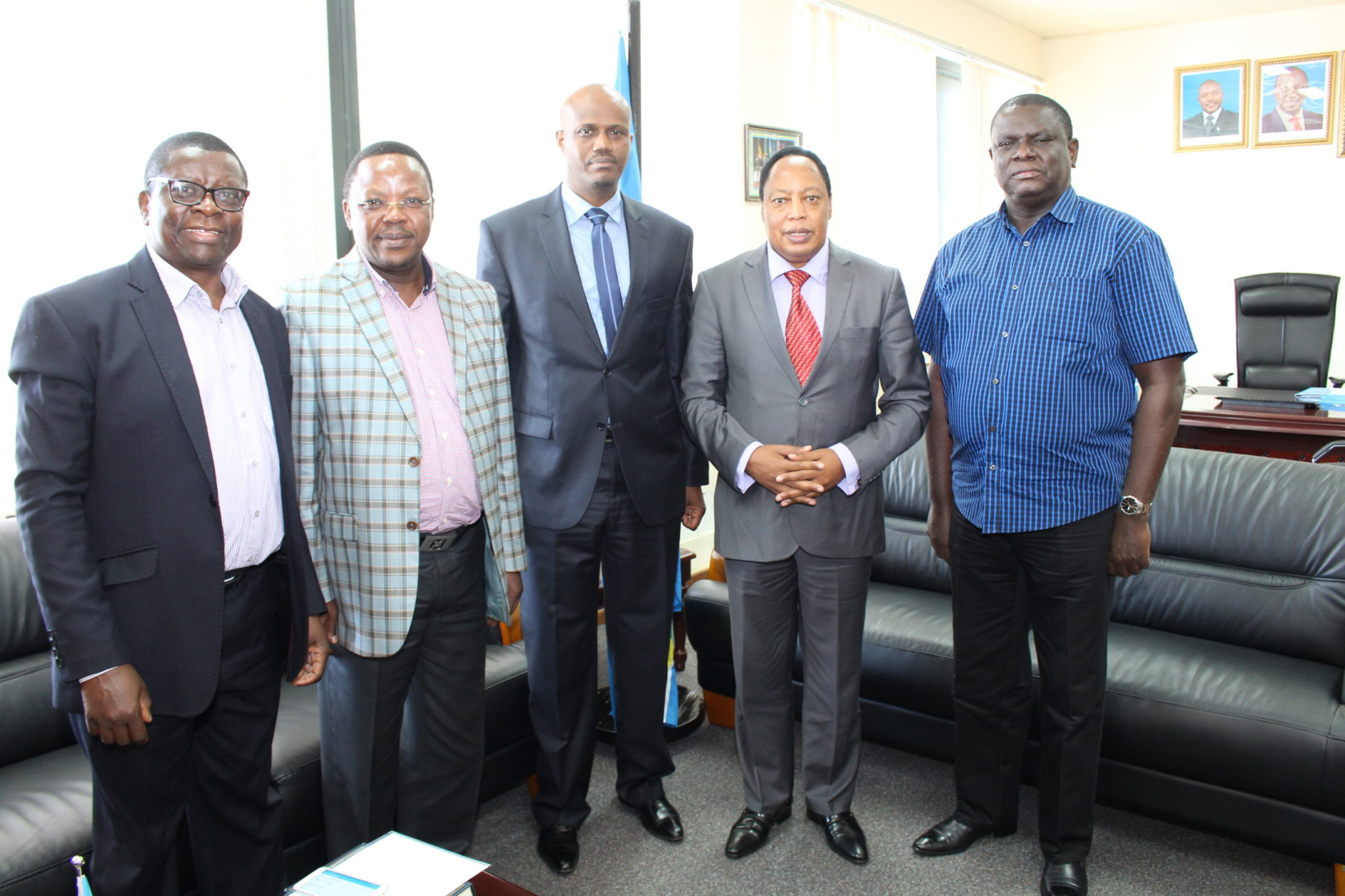
The new LVBC boss Dr Saidi Ali Matano poses for a group photo with EAC staff led by Secretary General Amb Liberat Mfumukeko
At a function presided over by the EAC Secretary General Amb Liberat Mfumukeko at the EAC headquarters in Arusha, Tanzania, Dr Matano took the Oath of Allegiance, witnessed the EAC Director for Human Resource and Administration Mr Joseph Ochwada and other senior staff of the Community.
Dr Matano’s appointment that follows the expiry of Mr Kanangire contract, was endorsed by the 33rd Extra-Ordinary Meeting of the EAC Council of Ministers that took place on May 27, 2016 in Arusha, Tanzania.
LVBC is a specialized Institution of the East African Community responsible for coordinating the sustainable development agenda of the Lake Victoria Basin, with its Headquarters located in Kisumu, Kenya.
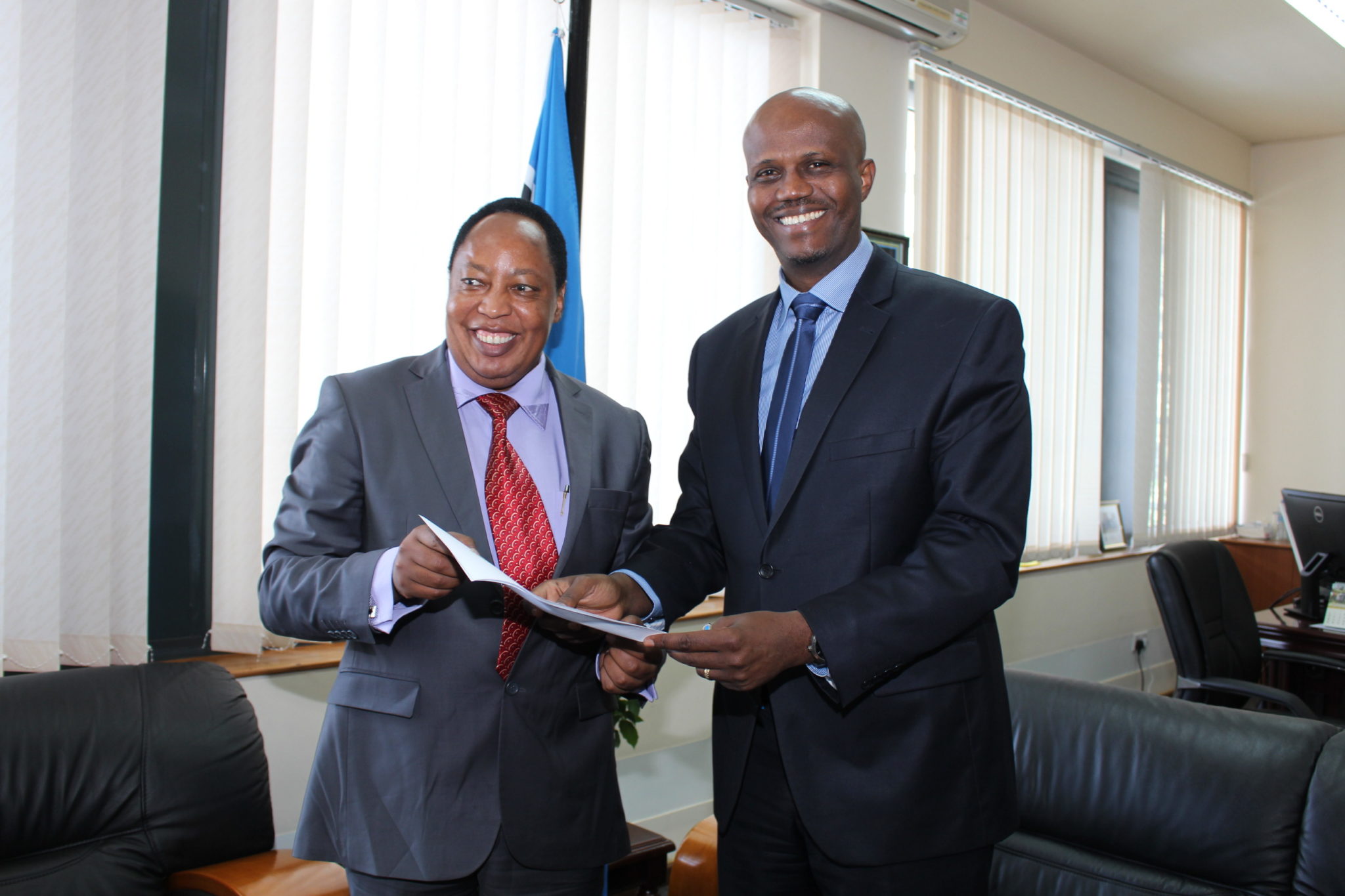
Dr Matano receives the signed copy of the Oath from the Secretary General, Amb Liberat Mfumukeko
Dr Matano was the LVBC”s Programmes and Projects Development Officer. The post of Executive Secretary rotates amongst the five Partner States.
It is not doubt that the Ugandan smartphone market is not an easy one to crack. Many have tried failed but Techno Uganda has by stood out by offering truly innovative smart phone specifications.
They scaled the heights starting with the entry market level and now contending for the high-end with their latest smartphone dubbed to be the best camera phone in Africa
EagleOnline understands that Tecno Mobile Uganda who less than 12 months ago released their flagship mobile phone in the Camon series, the Camon C8, which boasted an unmatched camera quality among other thrilling features is on Wednesday set to launch of the new C-series Tecno Camon C9.
According to Mariam Kigongo, the Kampala Road based firm’s Project and Digital Manager, this product arrived today (Monday) and will be in most phone shops on Wednesday.
“We have done a lot of survey before releasing this new model to the public and we are pleased it will be in market of Uganda on Thursday 23rd June 2016 for purchase,” Ms. Kigongo revealed in a communication.
Design, Specifications, Features & Price
Our in-house ‘techie’ Boses Muhinda contends that the Camon C9 comes with 13MP dual front camera which will be able to capture breath-taking selfie photos and could be the best selfie camera phone to be released in 2016. The image has dual flash which will be the first in the industry.
Camon C9 can be turned inside out. It also means that the back camera will be able to adjust different angles to take pictures. Actually Nigerian blogger Tonia Soares intimated to this website that the C9 can shoot up to a ten-man spread group selfie in a single shoot – no off-frames! All thanks to a masterful lens grinding and coaxial 6P lens technology.
With the current breakups in Uganda caused by lack of privacy when it comes to lovers’ phones, the new C-series Tecno Camon C9 is also anticipated to have a fingerprint recognition scanner embedded just below the rear camera.
C9 is built with a big 5.5-inch display screen with HD resolution of 1920 x 1080 pixels and 267 pixels per inch (PPI). It features the 4G network connectivity and dual sim slot. With the big IPS screen, every color jumps out from the screen, images are more defined and videos sharper. 16:9 aspect ratio increases the width of the view, which makes you watch more comfortably.
Ugandan ladies will mostly love the C9 for not only its good look and big screen but the smartphone hardware. It is also something to boast about featuring the 64bit octa-core processor clocked at 1.7GHz that can keep all their selfie photos and Snapchat videos securely. Added is a 2GB RAM and Android 6.0 Marshmallow which makes it handle tasks quickly, orderly and fully.
The biggest feature that everyone should be looking for in the latest Camon is the competent 3000mAh high-density rechargeable battery that is expected to last long up to 2 days.
Rumour has it that the Tecno Camon C9 will range around UShs 546,000 -560,000 making it one of the most affordable the best budget camera smart phone in the market in 2016.
BASIC FEATURES OF TECNO CAMON C9
Design
Dimensions: 76.84*153.3*7.35mm
Weight: 143g
Display: 5.5 inches, 1920 x 1080 pixels IPS display
Sensors: Iris Scanner. Accelerometer, Proximity
Build: Aluminum Unibody
Colours: Gold. Sandstone Black
Hardware
Processor Type: 64-bit Octa-Core 1.3 GHz
Processor Name: Mediatek MT6753
Graphics Processor: Mali-T720
RAM: 2 GB
Internal Storage: 16 GB
External Storage: MicroSD card up to 128 GB
Camera
Rear: 13 megapixel autofocus camera with LED flash
Preparations have been finalised for the Cabinet of President Yoweri Museveni’s new 80-plus member cabinet to be sworn in tomorrow, with only four nominees rejected for failing to meet the basic requirements.
Parliament last week concluded the vetting of 80 ministers with only 76 making the mark and reports day they will be sworn in on Tuesday during a ceremony presided over by the assigning authority- President Museveni at State House Entebbe.
In the new line-up, Museveni reappointed his Vice President Edward Kiwanuka Ssekandi and Prime Minister Ruhakana Rugunda and maintained Matia Kasaija and Irene Muloni as the important finance and energy ministers respectively.
First Lady Janet Museveni is the new Minister of Education and Sports, while retired Lt. General Henry Tumukunde is Minister of Security.
Frank Tumwebaze has been replaced as Minister for Kampala City by Federal Alliance Party head Betty Kamya. Tumwebaze is named ICT Minister.
The rejected appointees include Ms Harriet Ntabazi, the former Bundibugyo Woman MP, who had been appointed State Minister for Industries.
Works state minister designate Ismael Orot was also rejected on grounds of lack of academic qualifications while Ms Adrian Tibaleka’s (Bunyoro) appointment as State Minister for the Elderly and Disabled was rejected after she failed to convince MPs over whether she qualifies to be a minister as stipulated under Article 113(1).
Ruth Acheng, the former UPC MP for Kole district was dropped by Museveni himself from the cabinet.
Florence Nakiwala [DP] is among the other opposition politicians set to be sworn in in Museveni’s government
The President combined Investment and Privatisation into a single docket and appointed a new minister to the docket, Ms Evelyn Anite, the architect of his sole candidature project.
Many of the new faces were in smaller ministries or as ministers of state.
Available figures show that a Cabinet minister who is also a Member of Parliament earns about Shs25 million monthly and the one who is an ex-officio earns about Shs18 million.
President Museveni also has about 100 advisers who are collectively paid Shs230 million every month, excluding allowances. The number of MPs also increased from 386 to now 428 MPs in the 10th Parliament as a result of the creation of new districts, counties and municipalities.
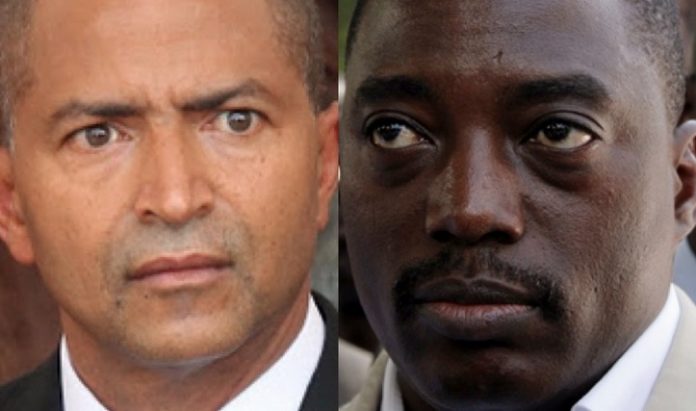
DRC President Joseph Kabila (R) with his challenger for presidency Moise Katumbi (L).
The Democratic Republic of Congo (DRC) could descend into a cycle of electoral violence similar to that seen in Burundi and presidential and legislative polls due in November are likely to be delayed, the United Nations has warned.
A group of senior UN experts put Burundi and the DRC at the top of a list of risks to watch for in the next six months, along with Libya, the La Nina climate phenomenon, and drought in southern Africa.
“The most likely scenario remains delayed elections into 2017, a move which would likely trigger wide political unrest in a situation similar to that of post-electoral Burundi,” they said in a semi-annual report.
With little freedom for democratic opposition and the heavy-handed use of security forces, the risk of violent clashes was high, especially in the capital and in Lubumbashi, home of Moise Katumbi, the leading opponent of President Joseph Kabila.
“The government is likely to limit or shut down mobile networks, restrict the opposition’s rights through legal or violent means and increase intimidation and harassment,” the report said. “Such an outcome would lead to displacement from the capital and translate into several hundred thousand people being affected.”
Displaced opposition supporters were likely to flee into the Republic of Congo, ‘souring an already tense relationship between Brazzaville and Kinshasa’, the report said.
In Burundi, which has collapsed into chaos since President Pierre Nkurunziza pursued and won a third term in office last year, a move his opponents say is unconstitutional, things may get worse, the UN report said.
It said a ‘cycle of high-profile tit-for-tat targeted killings’ of top officials was widening a rift in the army that could produce a bigger conflict between pro- and anti-government forces, fueled by ethnic overtones in the political rhetoric.
Regional and inter-Burundian dialogues were at an impasse, which would further radicalize the opposition, ‘setting the stage for guerrilla warfare, notably in the provinces bordering Rwanda and DRC’.
The UN report, which does not cover the biggest crises, such as Syria, Yemen or South Sudan, aims to alert aid agencies to potential shortfalls in upcoming emergencies.
Its worst fears are not always borne out: last November it warned of a potential coup in Burundi and possible Islamist advances in Mali, which did not come to pass.
The latest report refreshed its view of the risks in Libya, with a warning that the two main political camps could splinter, adding to rivalry between the rival armed groupings, the Misratan brigades and the Libyan National Army, and making a NATO intervention increasingly likely.
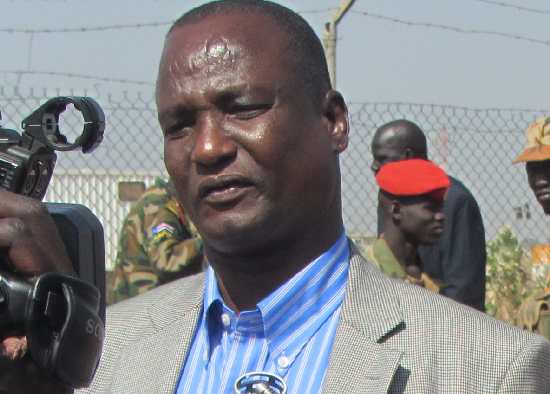
South Sudan Information Minister Michael Makuei Lueth
A strike by South Sudan civil servants over delayed payments has attracted the wrath of government, with information minister Michael Makuei accusing the striking civil servants of collaborating with unknown groups to oust President Salva Kiir’s regime.
“Those who believe that there is a need for regime change are they ones setting all these fires but at the end of the day if it comes to burn, it will burn all of us,”Makuei said, adding that there was no need for strikes due to delays in payment.
Five public university lecturers have been on strike for a month since they put down their tools in May over unpaid wages for three months. On Thursday, judges announced they would stay home and not work from Monday due to unpaid wages, lack of transport, office spaces and lack of detailed security protection to individual lawyers and judges.
They list 29 points that should be addressed by the government before resuming their work, warning that this will paralyze the justice system in the country.
Separately, teachers in Jubek state, formerly Central Equatoria, have warned of possible strikes due to delayed and meager salaries amidst worsening economic situation.
Makuei, however, said the striking civil servants needed to be tolerant of the situation.
“The best thing is that let’s tolerate, face the realities so that we can move forward with our nation,” he said.
According to the minister, the council of ministers’ meeting, chaired by President Salva Kiir directed the country’s finance minister and the Central Bank of South Sudan to address the economic challenges, which the world’s youngest nation currently faces.
The South Sudanese main armed opposition faction of the Sudan People’s Liberation Movement (SPLM-IO), has denied rumours of imminent defection of some of their senior government and party officials in the national capital, Juba.
Rumours have been circulating on social media blogs that a number of senior officials of the opposition group have been planning to defect to join the SPLM ruling party.
SPLM-IO’s former chief negotiator, Taban Deng Gai, who is the newly appointed minerals minister per the nomination of Machar in the transitional government, and Ezekiel Lol Gatkuoth, chairperson of the national committee for external relations, but who has not been appointed to any government portfolio, are alleged to be among the leading potential defectors.
The social media allegations further cited Taban Deng’s disappointment in not being appointed as petroleum minister as the main cause for his anger and possible decision to leave Machar.
Deng resigned from the position as chief negotiator just days after another official, Dak Duop Bichiok, was appointed minister for the petroleum ministry in the transitional government of national unity. Sources said he negotiated with President Kiir’s faction to give petroleum ministry to the SPLM-IO with the hope that he was allegedly going to be the minister.
Also Ezekiel Gatkuoth is said to be unhappy due to not being appointed to a ministerial position.
Deng is said to be moving with the Vice President, James Wani, mobilizing the people in the neighbouring countries such as Kenya and Ethiopia on the terms of President Kiir’s view of the peace process.
But media official in the office of Machar when contacted for comment on the circulating rumour said the allegation was ‘baseless’ although he acknowledged having read such rumours on social media.
“This is a baseless wild rumour,” James Gatdet Dak, press secretary for the SPLM-IO leader said.
“Of course I have read some of these circulated rumours on social media. Some people on social media have even written directly to me, alerting me about the rumour. I have however been telling them not to listen to such rumours created by enemies of peace,” Dak added.
Despite the denial by the SPLM-IO, the ongoing speculations suggest that Taban Deng is being promised the post of the secretary general in the SPLM faction of President Kiir.
Deng, according to sources close to the political alliances in the South Sudanese politics, has been until 2013 a close ally to President Kiir. He switched sides and joined Machar only after he was dismissed from the position of governorship for Unity State.
The former governor then used his senior position as member of the SPLM political bureau to criticize President Kiir, the SPLM chairman, until the December 2013 crisis.
Ezekiel Gatkuoth, a former member of the SPLM liberation council, on the other hand had been against Machar for several years, according to the sources, until 2013 when he was removed from his position as head of South Sudan mission in Washington, United States. He then joined Machar after leaving the group of former detainees in 2014.
In March this year, there was a similar rumour that Taban Deng was consulting with the Jieng Council of Elders (JCE), an informal tribal advisory body for President Kiir, to appoint him as first vice president in case Machar did not return to Juba from Pagak, his former headquarters.
SPLM-IO at the time also dismissed the allegation, which in fact turned out to be a false rumour.
Although the two top rival leaders, Kiir and Machar, have formed a transitional government of national unity, observers however express fears that similar political games that led to the deadly crisis on 15 December 2013 may not be far from repeating themselves.
A number of major provisions in the peace deal have not been implemented and have been behind the schedule. These include number of states and formation of state governments, cantonment of opposition forces across the country and formation of transitional national parliament as well as economic sector reforms, among others.
Even though the transitional government’s presidency weeks ago reached consensuses on how to tackle some of the issues, there has been no operationalization of the mechanisms to implement the agreed matters.
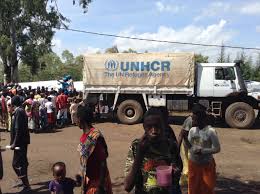
As Kenya plans to close the Dadaab refugee camp, raging conflicts in several African countries including Somalia, South Sudan, Sudan, the Democratic Republic of Congo (DRC) Nigeria and Burundi have left 16 million people as refugees.
According to a report by the United Nation’s refugee agency (UNHCR), titled ‘Global Trends: Forced Displacement in 2015’, the number of African refugees, the highest since the establishment of the UNHCR, represents about a quarter of more than 65 million people around the world who have had to flee their homes due to war, persecution, violence and human rights violations..
This figure, released on the World Refugee Day today, increased by 1.5 million from 2014 and most of the refugees, about 10.7 million of them, were internally displaced persons (IDPs). The remaining 5.2 million were people that fled their home countries. The vast majority of these refugees, roughly 4.4 million, sought refuge in neighboring countries, with Uganda now being home to over 600.000 refugees from South Sudan, Burundi and the DRC among other countries.
‘Like the previous years, the ongoing civil war in Somalia remained a huge factor in the high number of refugees. The simmering conflicts in South Sudan and Sudan were also responsible for putting many people on the run. Burundi descended into chaos after President Pierre Nkurunziza announced he was running for a third term, an election he went on to win. In Nigeria, the Boko Haram crisis drove a higher number of refugees to neighboring countries,’ the UNHCR states in the report.
The main host countries for refugees in 2015 remained Ethiopia and Kenya, where the majority of refugees from Somalia, Sudan and South Sudan have sought refuge. A country that saw a major increase in refugees was Uganda, where many people fleeing fighting in Burundi sought refuge. Also in Cameroon, the UNHCR counted more refugees in 2015 than in the previous year. The Boko Haram crisis on Cameroon’s northwestern border with Nigeria was responsible for the high numbers.
Sudan, South Sudan, and Somalia also belong to the countries hardest hit by the rising number of IDPs. In Nigeria, the number of displaced people within the country compared to 2014 nearly doubled. But within the DRC, more than 700,000 internally displaced persons returned to their hometowns in 2015.
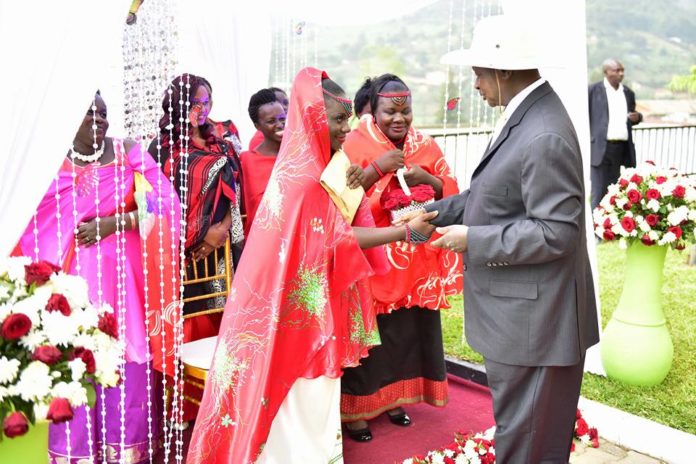
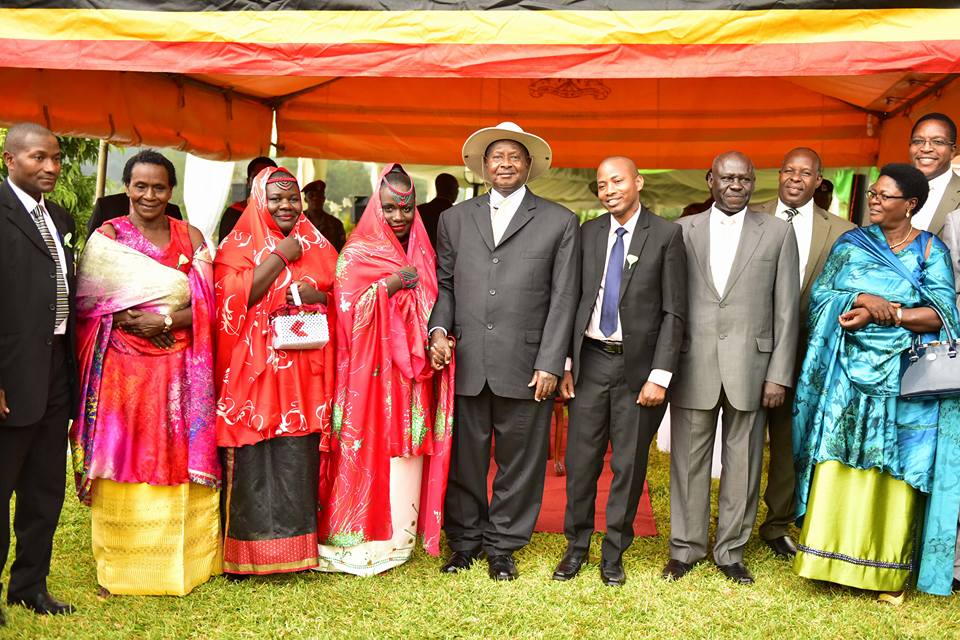
President Museveni left revelers in stitches with his witty speech at the giveaway ceremony of Ms Annette Twebaze to Mr Bright Kamuhanda in Muhanga Town Council in Kabale over the weekend.
A cattle-loving man, Museveni, 71, a father of three officially married daughters was given the task of blessing the young couple in the traditional way – that is, to speculate about what’s going on in marriages today and, ultimately, gives them some wealth to multiply.
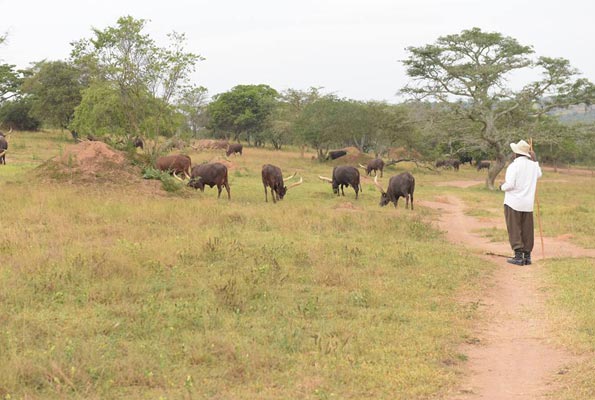
Born in western Uganda to a cattle-rearing family, he has always said he plans to be a herder on his retirement.
And now we know the Kamuhandas are now richer after gave Ms Twebaze a gift (Okushagara) of 10 cows for making her parents happy.
“When a child gets married, it shows that the parents have done a good job raising that child. Marriage is also important because it enables procreation and assures continuity of the human race. It is also vital that when people marry, they build a home and sire children,’ Museveni said.
“I commended the bride and groom for making their parents proud and tasked young people to emulate the industry of their parents. If your parents bequeath you wealth as a youth, work hard to make sure you multiply it,’ he added.
Ms Twebaze is a daughter of Apollo and Vangelista Nyegamahe, a prominent business couple and our committed NRM supporters, while Mr Kamuhanda is son of John and Generous Bashinyora of Kinkizi in Kanungu District.
President Yoweri Museveni walking in the midst of his long-horn cattle and chatting with their herders, wielding a stick and wearing his trademark wide-brimmed hat.
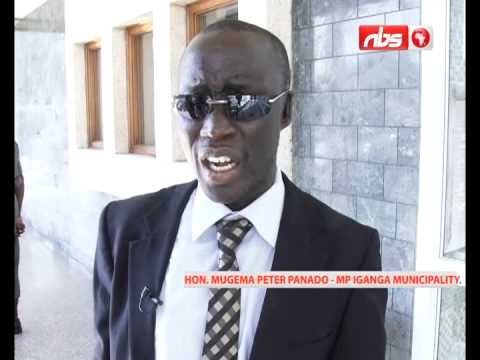
High Court in Jinja has nullified Iganga Municipality Member of Parliament Peter Mugema aka Panadol over allegations of voter bribery.
Mr Mugema becomes the sixth legislator to be kicked out of Parliament but also the fifth National Resistance Movement (NRM) member to exist the August house.
Just in a fortnight the 10th Parliament that hasn’t lasted even a month has seen Busiro South Peter Ssematimba, Lugazi Municipality’s Isaac Ssozi Mulindwa, Budadiri East MP Vincent Woboya, Aruu North’s Lucy Achiro Atim, Luwero woman MP Lillian Nakate Ssegujja and now Mugema
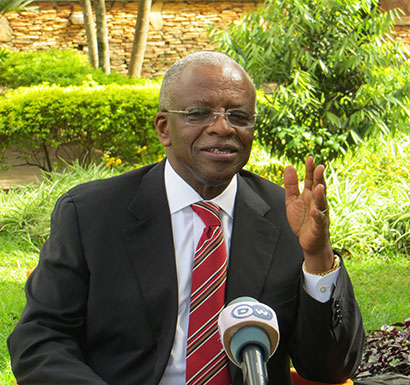
Former Go-Forward Presidential aspirant Amama Mbabazi
Silence, they say, is golden. Well, could that be said of former Prime Minister John Patrick Amama Mbabazi, a man of serious political clout who has not issued any political statement for about four months now.
Mr Mbabazi is famed for having played a big role in the survival of the National Resistance Movement (NRM) for about four decades, beginning in 1973 to September 2015, when he was dropped as Premier.
But known as a suave and reclusive operator, Mr Mbabazi has been silent for the past four months since the February elections, prompting lingering questions regarding his whereabouts and what he has next up on his sleeves.
The elections were won by his erstwhile friend and long time political ally Mr Yoweri Museveni of the National Resistance Movement (NRM), further putting a wedge between the two men who at one point were politically inseparable.
Indeed, while still bosom friends, submissions by the NRM Chairman Museveni usually pointed to the fact that Mr Mbabazi was instrumental in the campaigns to rid Uganda of the various dictatorships, beginning with Iddi Amin’s regime in April 1979 up to January 1986, when the NRM came to power.
At the time Mr Mbabazi had participated in various clandestine operations sanctioned by the NRM, both within and outside Uganda, using different pseudonyms including among others Dr Karyaburo and Ahmed Mbayo.
The smoothness with which he executed these covert missions caught the eye of the guerilla commander Museveni who, in 1986 as President, appointed Amama Mbabazi the first Director General of the External Security Organisation (ESO). Subsequently, he served in various ministries including Justice/Attorney General, Foreign Affairs/Regional Cooperation, Defence and Security. He also served as NRM Secretary General.
Insiders say that during all that time Mr Mbabazi, despite mostly operating in the background, was synonymous with the NRM espionage system, an undertaking carried out through an elusive career chain that was to be brought to a halt in May 2011, when he was appointed the Prime Minister.
Observers intimate that while serving as PM, Mr Mbabazi became ‘exposed’ to Uganda’s political class and the masses, in the process losing his reclusiveness.
Indeed, it would not be long before a member of the political class, Ms Evelyn Anite, burst Mr Mbabazi’s bubble by asking President Museveni to offer himself for the NRM presidential candidature for the 2016 elections.
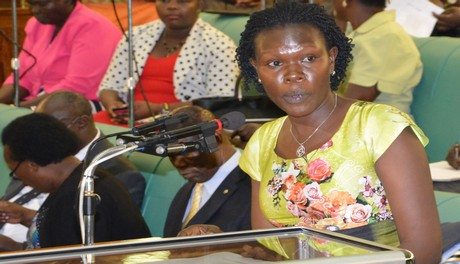
NRM CANDIDATURE PETITIONER: Evelyn Anite
The February 14, 2015 incident at the ruling party’s retreat at the National Leadership Institute (NALI) in Kyankwanzi left Mr Museveni smiling, while a seemingly stoic Mr Mbabazi was left shell-shocked! And, as if to prove his displeasure at Anite’s ‘ambush’ Mr Mbabazi refused to append his signature to the Museveni candidature petition, saying it was premature for the NRM to start discussing the matter. He was wrong; 200 members signed the document, a development that signaled his downward political spiral. Mr Mbabazi swallowed humble pie and signed in at number 201. But the move did not deter his detractors; they followed him to several meetings organised by Mr Museveni, demanding that he apologise for the ‘delayed signing’ and, for not towing the party line in respect to its position regarding the flag bearer. During the meetings Mr Mbabazi protested while Mr Museveni tried to convince Mr Mbabazi’s pursuers that the matter would be sorted out through internal party dispute resolution mechanisms.
That was never to be as in December 2015 Mr Mbabazi was hounded from the position of Secretary General, inevitably ending his 40 year direct association with the NRM. But before the NRM decided to terminate its relationship with Mr Mbabazi, he pulled one of his masterstrokes, announcing that he would stand for presidency, to challenge Mr Museveni and any other contender. The announcement made on YouTube on June 15, 2015 took the political class by surprise!
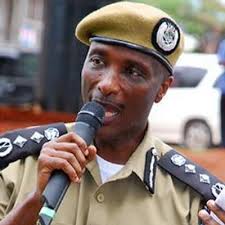
IGP Gen Kale Kayihura
The Mr Mbabazi went ‘viral’, declaring that he would hold his first political consultation rally in Mbale, a hitherto assumed political backyard of the NRM. The Inspector General of Police General Kale Kayihura swung into action, swearing the Mbale consultation rally scheduled for June 19 would take place over his dead body. The rally never took place as Mr Mbabazi was stopped in Jinja, brought back to Naggalama before eventually finding himself at the Kira Road Police Station, from where he was released at about 8pm, without any charges preferred against him. That was the ‘baptism of fire’ for a man who had earlier in 1999 ‘reminded’ then NRM renegade Dr Warren Kizza Besigye Kifefe that the party had a ‘queue’ and that by authoring a dossier that sought to analyse Mr Museveni’s continued stay at the helm of national affairs, Dr Besigye had in effect ‘jumped the queue’.
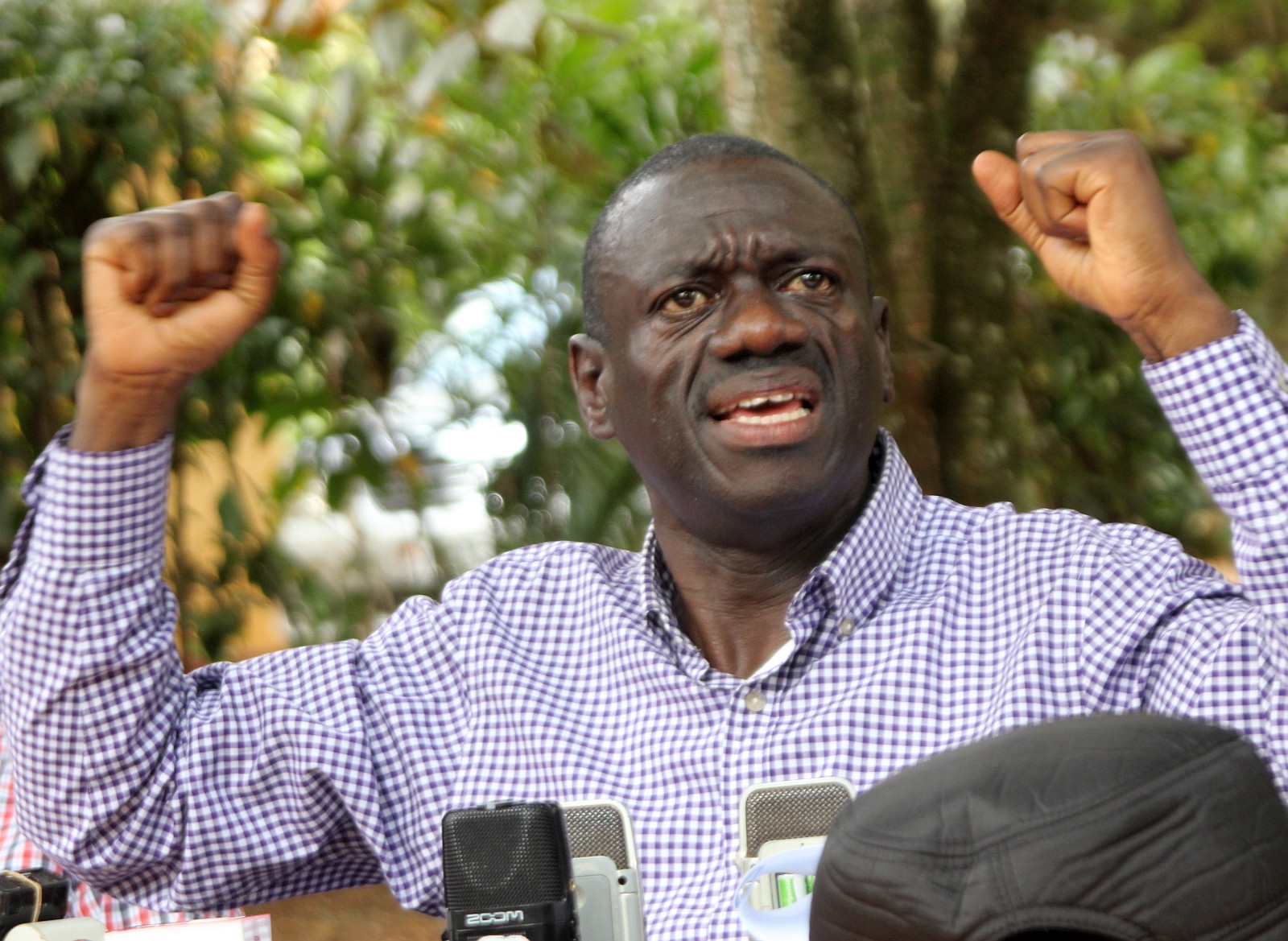
TRIED TO JUMP THE QUEUE? FDC flag bearer Dr Kizza Besigye
But now it was Mr Mbabazi’s time to constructively reflect on the NRM queue, and he declared he would go for the presidency under the banner of the NRM. His pursuers in NRM did not go to bed, insisting that the issue of NRM flag bearer was sealed and that Mr Museveni was the party choice.
Left with little or no option, Mr Mbabazi joined the opposition under the banner of The Democratic Alliance (TDA), where he would come face-to-face with Dr Besigye and a number of opposition figures including Dr Besigye, Maj Gen Mugisha Muntu, Norbert Mao and Olara Otunnu.
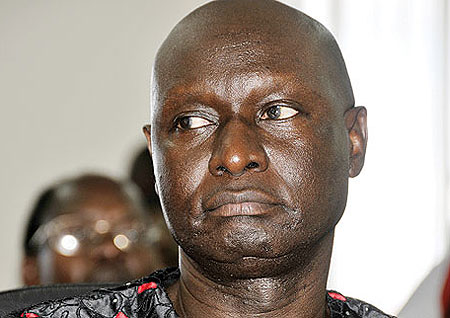
Former UPC leader Olara Otunnu.
The loose association did not stand the test of time, and Mr Mbabazi moved on to form the Go Forward, a new political vehicle that he wanted to help him ascend the presidency.
He then set off to campaign, once again beginning in Mbale where he addressed a huge rally that had mouths twitching in his favour as presidential material. His subsequent campaigns around the country were generally incident-free and even when the election results were announced on February 20, giving him 1 per cent of the entire vote, Mr Mbabazi was stoic.
It is this demeanour that borders on deafening silence that is now disturbing the political class, both in government and the opposition, who would want to know Mr Mbabazi’s next political move.
And this begs the question, are we set to see another episode involving Dr Karyaburo or a certain Ahmed Mbayo, the two imaginary men whose proverbial nine lives always caused ruckus!