Stanbic Bank
Stanbic Bank
19.6 C
Kampala
Stanbic Bank
Stanbic Bank
Home Blog Page 2146

Sudans in oilfield talks

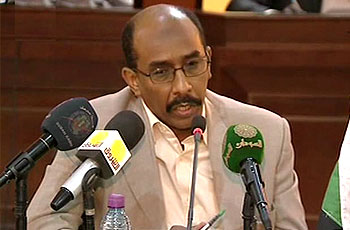
Sudan minister of mining Ahmed Mohamed Sadiq al-Karouri. Photo/sudantribune.com

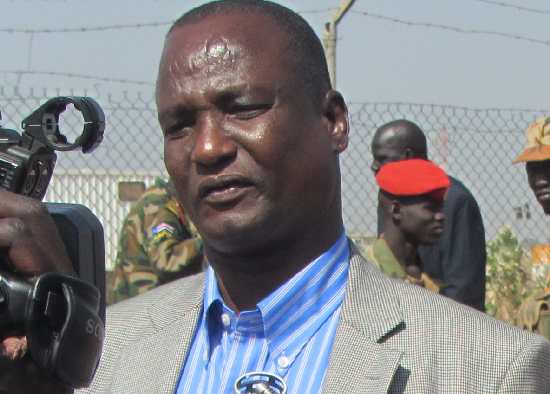
Talks on oilfields between Sudan and South Sudan are on in Khartoum, co-chaired by Sudan’s Minister of Minerals Ahmed Sadiq Al-Karouri and South Sudan’s Minister of Mining Taban Deng.

South Sudan's Minister of Mining Taban Deng
South Sudan’s Minister of Mining Taban Deng

The talks focused on previous memoranda of understanding signed between the two sides and on South Sudan’s desire to be provided with geological information concerning oil fields in the country held by Sudan’s Geological Research Corporation, the technical arm of the Ministry of Minerals.

State media in Sudan said the geological body in Khartoum has valuable geological information about South Sudan, and Minister Al-Karouri said in press statements that Sudan would provide South Sudan with all such information, besides training South Sudanese technical cadres. He also stressed that the coming period will witness full cooperation between the two countries.

Sudan takes a share of oil revenues produced in South Sudan through pipeline fees, providing it with an incentive to see oil production increase in South Sudan.


Stories Continues after ad

Rugunda sails through as PM

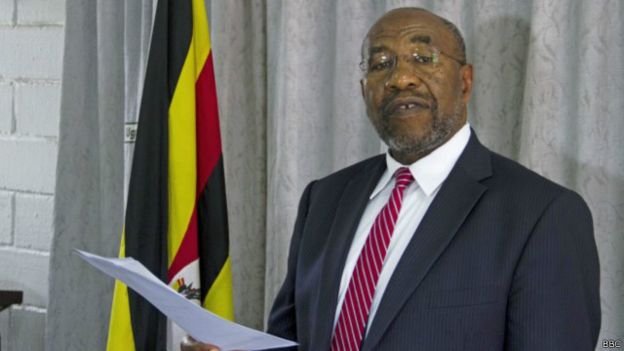
GOVERNMENT TO HELP MOBILISE FUNDS FOR REFUGEES: Prime Minister, Dr Ruhakana Rugunda.

Parliament has approved Dr Ruhakana Rugunda as the Prime Minister.

Under the chairmanship of the Speaker Rebecca Kadaga, two hundred and sixty two (262) MPs voted in favour of Dr Rugunda by show of hands, while three were against his appointment and four abstained from the vote.

Other ministers-designate to be vetted later today include Moses Ali (1st DPM/Leader of Government Business), Ali Kirunda Kivejinja (2nd DPM/ Minister for East African Affairs), Janet Kataha Museveni (Education and Sports), Mukasa Muruli (Public Service), Amelia Anne Kyambadde (Trade, Industry and Cooperatives), Gen Jeje Odong (Internal Affairs), Vincent Bamulangaki Ssempijja (Agriculture,Animal Industry and Fisheries), Matia Kasaija (Finance, Planning and Economic Development), Sam Kahamba Kutesa (Foreign Affairs), Dr Jane Ruth Aceng (Health), and Eng Monica Ntege Azuba (Works and Transport).

Meanwhile, the Speaker of Parliament has said that her office has not received a communication about Hon Peter Sematimba’s ejection from Parliament.

Ms Kadaga was responding to point of order raised by Makindye West MP Allan Sewanyana, who sought to know why Mr Sematimba, the recently court-ejected legislator for Busiro South was in the house.

Stories Continues after ad

Third MP thrown out of Parliament

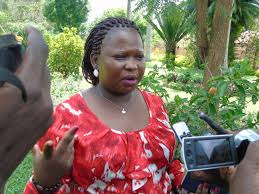
KICKED OUT: Lucy Aciro Otim, the MP-elect for Aruu Constituency who has lost her seat for induiging in electoral malpractices

Lucy Aciro Otim, the Member of Parliament for Aruu Constituency has become the third legislator to be thrown out of the August House.

An Independent candidate in the 2016 elections, Aciro’s fate was earlier today determined by the Gulu High Court, which ruled that the MP indulged in electoral malpractices.

In the race for Parliament Ms Aciro contested against rivals Nabbinson Nock Kidega (NRM), Lawrence Odong (Independent), Bernard Ology Obina (Independent) and Bernard Onen Okeny (FDC).

By press time it was not clear if Ms Aciro would appeal the ruling.

Ms Aciro’s ejection from the 10th Parliament follows that of Busiro South and Lugazi MunicipalityĀ MPs Peter Sematimba and Isaac Mulindwa Ssozi, respectively.

Both Sematimba and Mulindwa Ssozi were kicked out of Parliament for lack of the requisite academic qualifications.

Stories Continues after ad

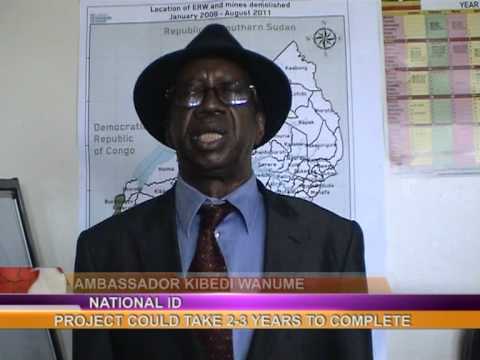
Former Amin Minister Wanume Kibedi is dead

DEAD: Ambassador Joshua Wanume kibedi

Joshua Wanume Kibedi, the former Minister of Foreign Affairs in Iddi Amin’s regime between 1971 and 1973 is dead. Kibedi was a brother to Maryamu Amin, one of the former dictator Amin’s many wives.

According to the deceased’d cousin, Second Deputy Prime Minister Al Hajji Kirunda Kivejinja, arrangements are underway to return the body of Mr Kibedi who died at the St Thomas hospital in London yesterday.

A long time diplomat, Mr Kibedi, a lawyer, served at various Uganda missions abroad including at the United Nations.

Lately, he also served as the Chairman of the Immigration and Citizenship Board.

Stories Continues after ad

Former ANC SG castigates Zuma over legal costs, wants President to step down

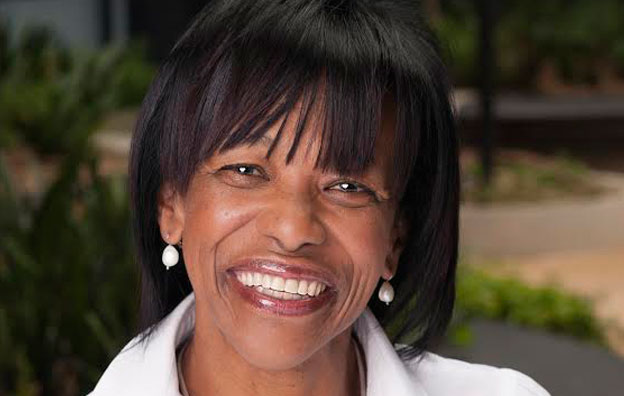
Former ANC Deputy Secretary General Cheryl Carolus

Former ANC secretary generalĀ Cheryl Carolus says that adding up President Jacob Zuma’s legal costs over the past decade, would exceed a billion rand.

Carolus said the president is dividing the ANC more than he is uniting it, and that he should do the right thing by stepping down – adding to the voices of former ANC stalwarts who have called for the same.

Carolus was the ANC deputy secretary general between 1994 and 1997, and served as the acting secretary general of the party between 1997 and 1998.

Carolus said that Zuma is ā€˜capable of good judgement’ and has exhibited such in the past. However, she said that he needs to take a ā€˜step back, and see what he is putting (the ANC) through’.

ā€œHe’s asking branches to look at his misdemeanors, and make decisions on his behalf. The biggest problem…is he is abdicatingĀ responsibility for his own personal wrongs, and making it a national crisis.ā€

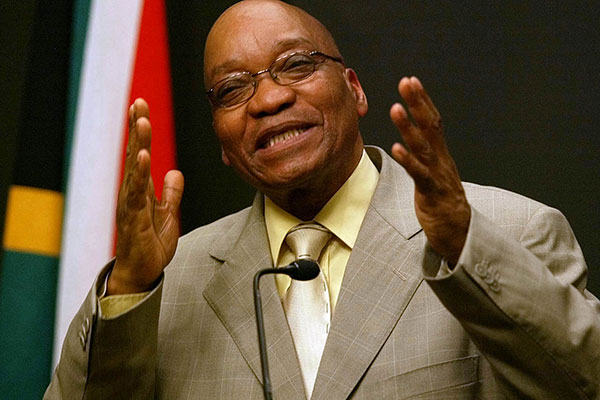
South African President Jacob Zuma condemned the attacks
South African President Jacob Zuma

She said that Zuma is prepared to divide the ANC on something that he has acknowledged he was wrong about. She also believes the president has not apologized sufficiently for the matters he faces.

Carolus said that adding up all the costs of the legal matters Zuma has faced since pre-Polokwane (when he was elected), it amounts to hundreds of millions of rands of taxpayers’ money.

ā€œI’m telling you, it’s over a billion rand, in legal costsā€ Carolus said.

ā€œAll from one person – who should be the most exemplary citizen of this country – who has taken this country into the most divisive period of politics that the country or the ANC has ever seen or imagined.ā€

ā€œThat one individual can divide us – not around policies, not around values, but with misdemeanors that have to do with his own enrichment or benefit – I resent that,ā€ Carolus said.

ā€œThat’s why I asked for him to step aside, and I stand by that. He must allowĀ the ANC to re-find its real purpose and stop wasting all our time and taxpayers money defending him and his misdemeanors.ā€


Stories Continues after ad

WB appoints ā€˜trust agent’ to monitor Somali remittances

DOLLAR BILLS: Remittances to Somalis have been eased

The past two years have seen closure of bank accounts of Somali remittance companies by many banks in the US, UK, Canada and Australia due to the purported risk of money laundering and links to terrorism.

The World Bank started working with the UK in 2015 to develop mechanisms in case of severe disruption of remittances flows between the UK and Somalia, but the Bank is now working with the Federal Government of Somalia to ensure the continued flow of remittances, a critical source of income to people in the Horn of Africa country.

Activities are currently focused on formalizing and improving the transparency and compliance in Somalia’s money transfer business sector, and the World Bank has appointed management consulting firm Abyrint as the Central Bank of Somalia’s (CBS) ā€˜Trusted Agent’ to regulate and supervise money transfer businesses.

Remittances to Somalia support 23 per cent of the GDP and were estimated to reach a total of $1.4 billion in 2015.

Abyrint helps to rebuild institutions and systems, especially finance governance, in failed or fragile states.

ā€œThe deployment of the Trusted Agent is a critical step toward improving supervision and formalizing the money transfer business sector in Somalia,ā€ said Bella Bird, World Bank Country Director for Somalia, Tanzania, Burundi and Malawi.

Abyrint and CBS staff will conduct joint on-site and off-site supervision of registered and licensed remittance companies and work to build capacity within the CBS Department of Licensing and Supervision.

The World Bank is also assisting the CBS to draft and implement new regulations and guidelines for the money transfer business sector, within the new regulatory regime established under the AML/CTF Bill passed in April this year.

Phil Evans, Head of the UK Department for International Development (DfiD) Somalia added: ā€œEnsuring that the Diaspora is able to safely and cost-effectively send money home to families remains vitally important, given the lifeline that money represents for many in Somalia.ā€

Abyrint was selected through a publicly advertised and competitive process.


Stories Continues after ad

Modern medicine is increasing antibiotic resistance

Most Ugandans are probably not losing too much sleep over the topic of antibiotic resistance, but on the other hand, Ugandans are heavy users of antibiotics, so ask yourself what would you do if antibiotics no longer worked.

One of the commonest diagnoses I see at present is ā€˜Bacterial Infection’ for which doctors dole out lots of antibiotics. I generally disagree with such a diagnosis because a diagnosis should also list the actual site of the infection, such as the throat – which is tonsillitis, or the gut, which is gastroenteritis, or the bladder, which is a urinary tract infection.

Healthy people don’t get non-specific bacterial infections: there must be a site where the infection starts. Many of these so called bacterial infections are actually self-limiting minor viral infections for which antibiotics are useless, but doctors still give antibiotics, because it is more satisfying, to both the doctor and the patient, to make a diagnosis for which there is a definite treatment.

In the past, when a patient attended a clinic, he would often be given the diagnosis of ā€˜malaria’ for which he was treated with chloroquine, but due to the widespread administration of chloroquine for many fevers which were not malaria, the parasite was able to develop resistance, and as a consequence chloroquine treatment is no longer effective. Nowadays the treatment of malaria is much more expensive and there is the real possibility that the parasite could develop resistance to the current treatment.

Today the trending diagnosis of ā€˜bacterial infection’, gives doctors the opportunity to prescribe antibiotics, and they usually favour one of the newer antibiotics, which is often given intravenously, hence we see people walking round Kampala with IV cannulas in their hand.

The patient is not only being given a drug he doesn’t need, but the unnecessary treatment is promoting antibiotic resistance.Ā Ā  When antibiotics are necessary, doctors should prescribe them according to a medically agreed hierarchy, known as first line treatment, second line and third line treatment. However the current fashion is to jump straight to the third line treatment, especially when an insurance company is paying. This is poor medical practice.

The emergence of superbugs which are resistant to all antibiotics is now a reality, and although only a few people are affected today, at some point in the future we could all be attacked by superbugs. When this happens we will succumb to simple infections and die, as was the case before the discovery of penicillin.

One should understand that man (homo sapiens) is just one competing species, which occupies this planet. Although man has managed to dominate the earth for a few hundred thousand years, we remain in a state of balance with other organisms such as bacteria, and this balance can be upset by the emergence of widespread antibiotic resistance and the development of superbugs.

In past centuries bacteria were responsible for epidemics such as bubonic plague and killer diseases such as TB, which have wiped out hundreds of thousands of human beings.

Even today tuberculosis remains a major killer, with the emergence of multidrug resistant strains, which are very worrying to global bodies such as the World Health Organization. Until the advent of penicillin people died from simple bacterial infections, but since the discovery of antibiotics we have been able to treat most bacterial infections. Imagine a world where we could no longer overcome bacteria. That is what we are fostering with our widespread inappropriate use of antibiotics.

It is not only doctors who are responsible for these mal-practices, Intensive farming in the western world is using antibiotics in a bid to increase efficiency. Hence antibiotics are finding their way into the soil and into the food chain, which fosters the development of antibiotic resistance. While in this case one cannot point the finger at African farmers, the increasing trend in the widespread inappropriate use of antibiotics in the treatment of the human population is a major contributing factor.

So next time, you are told you have a ā€˜bacterial infection’, ask the doctor if he has carried out a culture and what is the specific infection. Antibiotics may not harm you, but future generations will suffer.

By DR IAN CLARKE

MBChB BAO, DTM&H, MSc, is a physician, missionary, philanthropist, entrepreneur and politician in Uganda. Since May 2011, he has been Mayor of Makindye Division, one of the five administrative units of Kampala Capital City Authority.

Stories Continues after ad

Lugazi’s Mulindwa follows Ssematimba out of Parliament

Isaac Mulindwa Ssozi has lost his seat after a court decision on Monday. (Credit: Eddie Ssejjoba/New Vision)

The High Court sitting in Jinja has thrown out Lugazi Municipality MP-elect Isaac Mulindwa Ssozi over lack of academic qualifications.

His Lugazi Municipality (formerly Buikwe West) rival Dr. Nabatanzi Lugudde accused Mulindwa Ssozi of using different names while being nominated, which is illegal.

According to court, Mr. Mulindwa doesn’t have a Primary Leaving Examinations certificate nor does he have a national ID. Also, court said he used the documents of another person called Hassan Mulindwa, to stand forĀ elections.

Mulindwa Ssozi becomes the second legislator of the 10th Parliament to be ejectedĀ for using fake papers after Busiro South MP-elect Peter Ssematimba, was also thrown out of Parliament over his academic qualifications on Friday.

Stories Continues after ad

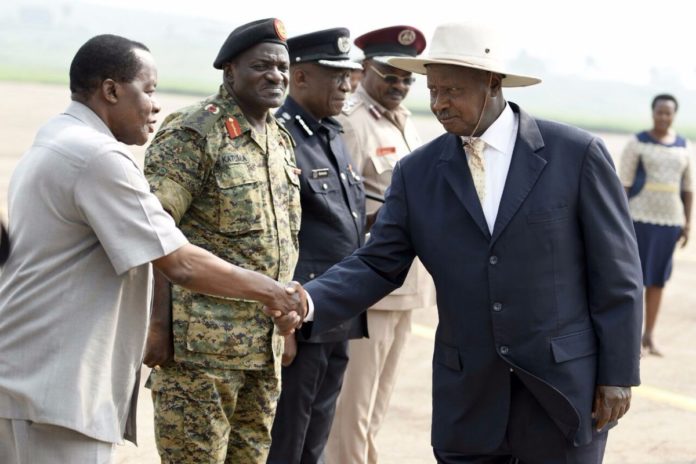
Museveni leaves for ICGLR summit in Angola

PRESIDENT off to Luanda for ICGLR heads of states conference.

PRESIDENT Yoweri Museveni has left for Angola’s Capital Luanda where he will join other leaders attending the 6th Ordinary Summit of ICGLR Heads of State and Government on June 14, 2016.

The Summit is being held under the theme ā€œAccelerating the effective implementation of the Pact and its Protocols for a more democratic and stable Great Lakes Regionā€.

The summit is preceded by the meeting of ICGLR Chiefs of Defence Forces on June 10, 2016 followed by meeting of ICGLR Ministers of Defence on June 11, and ICGLR Ministers of Foreign Affairs on June, 12.Ā 

According to reports, a new Executive Secretary and a Deputy will also be elected during the Conference.

The President was seen off at Entebbe International Airport by the Vice President, Edward Sekandi, Head of Public Service, John Mitala, Chief of Defence Forces Gen. Katumba Wamala, Deputy Inspector General of Police, Okoth Ochola and Deputy Commissioner General of Prisons James Mwanje among others.

Stories Continues after ad
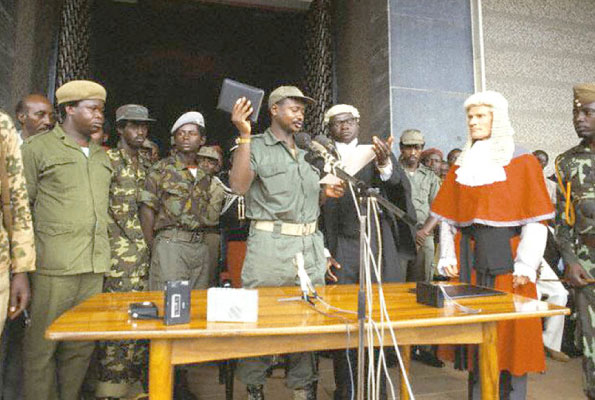
It is time Uganda’s political actors settle for national dialogue

President Yoweri Museveni swearing in in 1986. Observers say he may have to rekindle his political attitude in a bid to enhance national unity and cohesion.

Recent reports of the arrest of several soldiers of the Uganda Peoples Defence Forces (UPDF) across the country for allegedly involving in subversive activities are disturbing.

It is important to remember that the UPDF and its predecessor the National Resistance Army (NRA) were over the years built on the pillars of merit and discipline, something that has been the bedrock of security in Uganda over the past 30 years.

And during that time all Ugandans will recall that the country has been able to register progress in various sectors, notably in human rights’ observations and in economic development.

However, given the allegations of subversion that also include the participation of military personnel, it seems that during and after the contested 2016 elections, some groups of Ugandans including those in the forces have probably become disenchanted, and this is something that needs to be addressed as a matter of urgency.

Against such a background, it is, perhaps, gratifying to note that President Yoweri Museveni has of recent tried to reach out to the political opposition as a means of strengthening national cohesion.

But the president possibly has to go an extra mile to explicitly show Ugandans that enhanced national unity will form the basis for his goal of attaining middle income status by 2020, just a year before his term of office comes to an end after he attains the constitutional age limit of 75 years.

Needless to mention therefore, Mr Museveni needs to constitute a national dialogue involving all political and military actors as a means of consolidating his political participation legacy that spans 50 years, while at the same time also establishing the mechanisms that will pave the way to having a peaceful transfer of power come 2021.

In this quest, perhaps the old approach of broadbasedness has to be rekindled where ordinary Ugandans appreciate the import of national unity vis-Ć -vis their collective aspirations.

Similarly, for the armed forces efforts must be made to revert to the 1980s adherence to military discipline and this may involve the authorities carrying out a multi-pronged review of all the operational practices of the UPDF including among others deployments and promotions, issues that are recipe for disenchantment.


Stories Continues after ad