Stanbic Bank
Stanbic Bank
21.4 C
Kampala
Stanbic Bank
Stanbic Bank
Home Blog Page 2217

Tanzania ‘mini-skirt story’ Editor transferred

The Standard Digital Editor David Ohito

The Standard Media Editor who delivered a blow to African quality journalism by promoting gender stereotyping and sexism by knowingly publishing false stories about women in Tanzania and Eritrea has been moved from his job.

According to Kenyan media reports, Standard Media Group Digital Editor David Ohito, who approved two hoax stories, was moved to another job.

‘Standard Group Digital Editor, David Ohito has tarnished the groups image and overall credibility and has been transferred to Kisumu to ‘put things in order’’, a statement read.

The two stories – the ban on mini-skirts in Tanzania and compulsory polygamy in Eritrea – could have necessitated the action against Mr Ohito.

Tanzania vehemently protested the story, with the Office of President John Pombe Magufuli releasing a statement on The Standard, which was forced to pull out the story.

Eritrea Information Minister Yemane Gebremeskel, was not impressed either and expressed his disgust at the negative light in which Eritrea had been portrayed.


Stories Continues after ad

ADF cited in DRC violence

ADF leader Sheikh Jamil Mukulu. He is currently facing several charges including murder and terrorism.

Despite the capture of its leader Sheikh Jamil Mukulu, Ugandan rebel group, the Allied Democratic Front (ADF), and other renegade groups like the Democratic Forces for the Liberation of Rwanda (FDLR) and the Mai Mai have forced large numbers of people to flee the ‘cycle of misery’ in eastern Democratic Republic of the Congo (DRC), three years after a major rebel offensive was defeated by United Nations and Government forces in North Kivu.

According to the United Nations High Commission for Refugees (UNHCR), the belligerent groups are again targeting the region, ‘rich in minerals but lacking in law and order’, for violence and putting thousands of civilians on the run.

“In the latest major forced mass movement, more than 21,000 people had fled from Miriki village and surrounding areas in North Kivu’s Lubero Territory on 7 January after the killing of at least 14 people in a night raid by suspected Democratic Forces for the Liberation of Rwanda (FDLR),” Leo Dobbs, spokesperson for the UNHCR told journalists in Geneva.

Since November, at least 15,000 people have sought shelter in sites for the displaced run by UNHCR or the International Organization for Migration (IOM). Tens of thousands more are estimated to be living with local families while others have returned to their homes.

“UNHCR is calling on the authorities to ensure security in the areas of return and to facilitate humanitarian access,” said Mr. Dobbs, also underscoring the importance for the authorities to address growing tensions in eastern DRC and scale up support to the newly-displaced.

While the battle between the FDLR and Mai Mai groups has forced thousands to flee home, the ADF, meanwhile, continues to wage a campaign of terror and sporadic attacks and ambushes against the local population and Congolese armed forces in the north of the province.

The UN refugee agency is now providing support by running 31 displacement sites, providing shelter materials, coordinating protection and advocating for their rights.

Mr. Dobbs cited the continuing violence in the DRC as ‘very much a neglected story’, and noted that the UN Office for the Coordination of Humanitarian Affairs (OCHA) earlier this month estimated that 7.5 million people in DRC, or nine per cent of the population, are in need of food and other humanitarian aid after decades of crises.


Stories Continues after ad

Russia opposes sanctions against South Sudan

Russia's Deputy UN Ambassador Petr Iliichev,

Russia said yesterday it was opposed to placing a United Nations arms embargo on South Sudan or blacklisting President Salva Kiir and rebel leader Riek Machar as such moves were not helpful to the implementation of a peace deal agreed by the pair in August.

UN sanctions monitors said in a report, seen by Reuters on Monday, that the UN Security Council should put an arms embargo on South Sudan and sanction the oil-rich country’s rival leaders over atrocities in a two-year civil war.

“(It’s) not conducive, not conducive for the peace process,” said Russia’s Deputy U.N. Ambassador Petr Iliichev, confirming that Kiir and Machar were among several names proposed for targeted sanctions by the UN experts in a confidential annex.

A political dispute between Kiir and Machar, who was once Kiir’s deputy, sparked the civil war. But it has widened and reopened ethnic fault lines between Kiir’s Dinka and Machar’s Nuer people. More than 10,000 people have been killed.

On a possible UN arms embargo, Iliichev said: “For us it’s a no go, the region is already inundated with arms, so what we need is to control the arms that are there.”

Iliichev said it would be hard to enforce an arms embargo on opposition fighters, putting the government at a disadvantage.

The conflict in South Sudan, whose 2011 secession from Sudan had long enjoyed the support of the United States, has torn apart the world’s youngest country. The UN experts said some 2.3 million people have been displaced since war broke out in December 2013, and 3.9 million face severe food shortages.

Kiir and Machar signed a peace deal in August but both sides have consistently broken a ceasefire, while human rights violations have “continued unabated and with full impunity,” the UN experts reported.

U.S. Ambassador to the United Nations Samantha Power said on Thursday that implementation of the peace deal had stalled.

She said the 15-member Security Council would need to look at whether an arms embargo and targeted sanctions could be “a means of stabilizing the situation on the ground or getting the implementation of the agreement back on track.”

This is not the first time Russia is shielding embattled African leaders from facing possible UN sanctions; just last week Mr Iliichev opposed possible sanctions against Burundi leaders including President Pierre Nkurunziza, and the deployment of 5000 AU troops to the troubled country.


Stories Continues after ad

Kiir absent at AU Summit

South Sudan President, Salva Kiir

South Sudan President, Salva Kiir, will not participate in the African Union (AU) annual summit in the Ethiopian capital, Addis Ababa, on Saturday, his office said on Friday.

The continental summit, to be attended by heads of state and government from across Africa, will also discuss the delayed formation of a transitional government of national unity (TGoNU) in South Sudan and the obstacles to the implementation of the peace deal which President Kiir and his rival, Riek Machar, signed in August last year.

President Kiir’s spokesman, Ateny Wek Ateny, said Juba’s team to the AU headquarters will be led by the minister of foreign affairs and international cooperation, Barnaba Marial Benjamin.

“He [President Kiir] is not attending [the AU] summit,” said Ateny when contacted on Friday to confirm Kiir’s trip to Addis Ababa.

“The president is attending to other urgent things here in Juba,” Ateny added.

President Kiir and his former Vice President Riek Machar – who is now leading the SPLM in Opposition – were expected to meet in Addis Ababa in the corridors of the AU summit in order to iron out the difficulties in forming a transitional government.

Ateny declined to delve into details of such commitment that President Kiir is committed to do over the weekend in Juba, despite the seemingly priority AU summit on his country’s future.

South Sudan Ambassador to Ethiopia, Akuei Bona Malwal, confirmed the absence of President Kiir at the AU summit in a separate interview earlier on Friday.

“We decided that he better attends to the business at home and the delegated Nhial Deng Nhial [Chief Negotiator] and the Minister of Foreign Affairs [Barnaba Marial Benjamin] to attend the summit, which is actually a normal practice, and he is not alone,” Malwal said.

He said Kiir was working on formation of transitional government and this made it impossible to participate in the AU summit.

President Kiir last visited Addis Ababa in August 2015 when he attended the final day of peace talks. The president, who did not sign the document, was reportedly prevented from leaving the country in fear of senior generals who had been against the peace agreement.

It is not the first time for President Kiir to avoid attending gathering of world leaders to discuss his country. Last September he failed to attend a United Nations high profile meeting of world leaders in New York to discuss peace in South Sudan.

Observers allude to his skipping the summit as a way to avoid pressure from regional leaders who may call on him to reverse his decision of unilaterally creating 28 states in violation of the peace agreement.

Meanwhile, the leader of the opposition faction, Riek Machar, is said to have been waiting in Addis Ababa for the AU summit and to have that rare opportunity to meet President Kiir over the outstanding issues including the controversial 28 states.

“My chairman, Dr Riek Machar, is in Addis Ababa to participate in the AU summit. This will also be an opportunity for him to meet President Salva Kiir and discuss some sticking points in the implementation of the peace agreement,” Machar’s press secretary, James Gatdet Dak, said when contacted on Friday.

He said there is need for the parties to abide by the peace agreement in spirit and letter and incorporate it into a new transitional constitution based on the existing 10 states.

A transitional unity government, he said, would be formed based on a new constitution drawn from the peace agreement.

Ban ki Moon ‘deeply disappointed’

UN Secretary General Ban Ki-moon Friday said he was ‘deeply disappointed’ and urged the South Sudanese parties to settle the outstanding issues and to form the transitional government.

“I call on all parties urgently to resolve the disputes that are preventing the establishment of the government. The parties must place the interests of their young nation and its people, who have suffered long enough, above their own,” Ban said in a meeting of the African Union Peace and Security Council in Addis Ababa.

The signatories to the peace agreement ending the nearly two year conflict in South Sudan failed to meet the January 22 deadline for the formation of the Transitional Government of National Unity.

The UN Secretary General also called on the African Union and the Inter-Governmental Authority on Development, IGAD, to hold the South Sudanese parties accountable for following through on their commitments.

He reiterated the readiness of the United Nations to lend its full support to the chairperson of the Joint Monitoring and Evaluation Commission (JMEC) President Festus Mogae, the African Union High Representative President Alpha Oumar Konaré, and IGAD, in their efforts to end the suffering of the South Sudanese people.


Stories Continues after ad
Kenyan national arrested for human trafficking

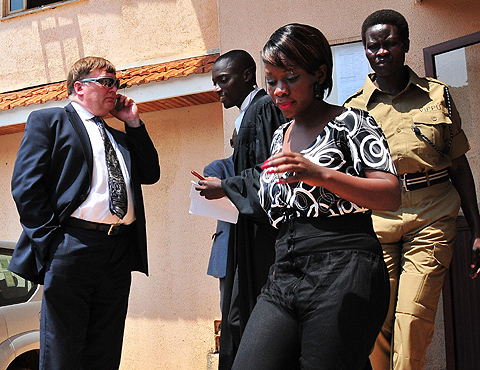
A Kenyan national, Khalima Abdalla, has been arrested in Uganda for human trafficking.

According to a release by the police Deputy Spokesperson Polly Namaye, Ms Abdallah, a resident of Makindye Division in Kampala is suspected of using her company in 2015 to recruit people for the benefit of employment in countries like Saudi Arabia and United Arab Emirates (Dubai) as housekeepers and cleaners, contrary to section 3 (I) of the Prevention of Trafficking Act.

The operation to arrest Ms Abdallah was carried out in partnership with Kyampisi Child Ministries, a local NGO, and cases have been preferred against her and ‘others still at large’.

In the release Ms Namaye said police at the Special Investigations Division (SID) Kireka received communication of sexual harassment, assault, denial of payment and abuse of the girls taken by Ms Abdalla’s company.

Subsequently, 34 girls were intercepted and denied travel to the Middle East, while over 100 passports, ‘fraudulently acquired’, were also confiscated from the office of the suspected traffickers. By press time it was not possible to establish how the passports were acquired.

Meanwhile, According to Kyampisi Childcare Ministries, ‘so many girls that were trafficked are still stranded in the middle east countries’.

In the wake of several complaints related to human trafficking to the Middle East, about a week ago the Minister of Gender, Labour and Social Development Wilson Mukasa Muruli, wrote to the Ministry of Foreign Affairs in Kampala, informing the officials of the cancellation of a labour export agreement signed between Uganda and Saudi Arabia last year.

“You may be aware that the ministry on 7th January 2015 signed an agreement with the Ministry of Labor in Saudi Arabia regarding employment of domestic workers from to Saudi Arabia. The two countries also agreed on a standard employment contract which shall govern the employment in Saudi Arabia of Ugandan domestic workers or household service workers and which shall be followed by all employers and Ugandans in Saudi Arabia,” Muruli’s release to the foreign affairs ministry, states in part.


Stories Continues after ad
Pictorial! Presidential candidates’ campaign rallies

Amama Mbabazi in Mityana

Amama111 mam

Yoweri Kaguta Museveni in Mityana

m74 cv

Kizza Besigye in Ibanda and Kiruhura

Bes-Ibanda1 Besi-Ibanda3

Stories Continues after ad
JUST IN! Lukyamuzi collapses at rally, rushed to hospital

Rubaga South Member of Parliament, John Ken Lukyamuzi has been rushed to Rubaga Hospital after he collapsed at a rally in his constituency.

Lukyamuzi has been admitted after developing complications five minutes into his rally.

By press time, doctors were still diagnosing the vocal legislature. Lukyamuzi is contesting for the Rubaga South seat for the fifth time. He is up against city comedian Kato Lubwama.

Stories Continues after ad
Political parties and social media interaction

NRM Social Media guru Innocent Don Wanyama

In the 21st century, with the rapid rise of new media, the whole world has turned to social media platforms like Facebook, Twitter and others that spring up by day. Society finds life easier as these platforms can help people communicate, relate, market and connect across the globe. And, unlike the ancient mail times, a single post on Facebook in Uganda can be shared all over the world in just 30 minutes. That is just how powerful a tool the Social Media is.

Social media is supported by use of internet and according to a report by the Uganda Communications Commission (UCC), 32.1% of the country’s 35 million people use internet. Of the platforms, Facebook is the most commonly used by Ugandans, with around 1.8 million users by November 2015. Twitter comes in second with about 250,000 users.

Of interest to note however, there has been vigorous activity on both Facebook and Twitter as the country heads to polls next month, with political parties seemingly becoming active out of the blue.

And basing on these particular two platforms, Eagleonline looks at the ‘social media share’ of the main political parties in the country.


National Resistance Movement (NRM)

The ruling party led by Yoweri Museveni carries the biggest portion of social media followers, with around 48,300 Facebook followers and 11,400 twitter followers.

Forum for Democratic Change (FDC)

Led by Maj Gen (rtd) John Greg Mugisha Muntu, this is the second biggest party in the country and has 37,400 Ugandans following it on Facebook and 6,700 Twitter followers.

Democratic Party (DP)

Led by Norbert Mao, the DP is the oldest political party in the country but it has a paltry 1,600 followers on Facebook and zero presence anywhere on Twitter.

Conservative Party (CP)

Led by John Ken Lukyamuzi, the CP has a total of 1,400 Facebook followers with no presence on Twitter.

Go Forward

This is a pressure group formed by former Ugandan premier John Patrick Amama Mbabazi after he cut relations with the NRM party. The Go Forward political organisation has neither a Facebook account nor Twitter handle but its presence on social media is seen by the individual participation of its leader Amama Mbabazi and Communications Director Ms Josephine Mayanja Nkangi. It also possesses various Facebook groups that have between 300 and 1000 members.

Peoples Progressive Party (PPP)

This has about 332 followers on its Facebook page with no Twitter presence.


The Uganda People’s Congress (UPC), JEEMA  and other political parties seemingly lack a presence on social media.


Stories Continues after ad

EALA plans youth representation at the legislative body

A section of the Members of the Public who attended the Plenary Sitting

The youth of the East African Community yesterday received a boost with regional legislators calling out for their full involvement in integration matters. Central to the plank is a call to amend Article 50 of the Treaty for the Establishment of the EAC to create slots for youth in the Assembly even as it reflects fair representation citizens’ diversity. The Assembly also called on all Partner States that are yet to establish National Youth Councils to do so.

The Assembly however states and succinctly so, that lobbying for youth representation at EALA and at National Parliaments/Assemblies should begin at the level of youth organisations’ at the national levels to create the desired reforms.

While still at it, legislators are also advising youth that while their efforts are appreciated, a change of strategy is necessary where they (youth) focus on developing capacities in order to realize aspirations. This is to enable them to register significant gains which lead to gainful recognition they seek at both national and regional levels.

The deliberations sum up the mood of the debate of the Assembly on the Report of the Committee on General Purpose Committee on the petition to advocate for key issues concerning the Youth in the EAC.

The petition was presented to the EALA Speaker by a team of Youth and Deputy Youth Ambassadors appointed during the 3rd EAC University Students debate.  The Youth Ambassadors presented the petition in March 2015 in Bujumbura, Burundi.  The salient prayers of the petition to EALA include calling for establishment of an EAC Youth Council, and advocacy for the operationalization of vibrant National Youth Councils.  The petitioners also make a strong appeal to the Partner States’ National Assemblies to consider reserving slots for youth representation at the national level.

At debate time, Hon Mukasa Mbidde called for the amendment of Article 50 of the Treaty specifically to allow for specific slot(s) to be set aside for youth. Hon Maryam Ussi urged the Secretariat to establish a Youth Desk to handle youth matters that revolve around integration. On her part, Hon Susan Nakawuki affirmed that currently, youth matters were considered a priority of the 3rd Assembly. She however noted that it was important for the structures of youth participation in politics to be harmonized right from the grassroots level to the national and eventually regional level.  The legislator further called on Tanzania to finalise the establishment of its National Youth Council.

Hon Shyrose Bhanji said that youth constituted a percentage of over 60% in the region and said there was need for them to be well represented.

She observed that Rwanda has a special slot for youth and urged other Partner States to follow suit.

Hon Peter Mathuki said the region could do more for the youth and said it may be necessary for them to be granted an Observer Status at the EAC.

In her remarks, the Chair of the Council of Ministers, Dr Susan A. Kolimba lauded the petitioners (East African Community Youth Ambassadors) and re-affirmed that the Council of Ministers was committed to addressing matters facing the youth.
She noted that Regional Youth Councils were greatly dependent on the vibrancy of the National Youth Councils.

“Some of the National Youth Councils are not as vibrant as they ought to be in representing and lobbying for youth Affairs,” Hon Dr Kolimba said.

The Deputy Minister said Parliament of Tanzania had last year passed a law on EAC Youth Council Act, 2015 paving way for the establishment of the EAC Youth Council once the regulations are completed and in place.

The Minister added that a framework for the establishment of the Regional Youth Council is in the process of development and the first meeting of experts to discuss the framework will be convened in the next financial year 2016/17.

Hon Dr Kolimba said that the Children and Youth position at the EAC Secretariat as recommended at the 18th Council of Ministers’ meeting was still pending.

Stories Continues after ad

Uganda gets US$18m for refugees

UN Secretary General Ban ki Moon

Uganda gets US$18m for refugees

Uganda is set to receive US$18 million in humanitarian aid, to assist thousands of refugees who have flocked into the country over the years.

According to a release by the Office of the Coordinator for Humanitarian Affairs (OCHA) signed by Pete Manfield, the United Nations Secretary-General Ban Ki-moon today released US$100 million from the UN Central Emergency Response Fund (CERF) for severely underfunded aid operations in nine neglected emergencies including Uganda.

The funds will enable life-saving help for millions of people forced from their homes in Central and Eastern Africa, those affected by conflict and food insecurity in Libya and Mali, and the most vulnerable and at risk of malnutrition in the Democratic People’s Republic of Korea.

“This funding is a lifeline for the world’s most vulnerable people. It is a concrete demonstration of our shared commitment to leave no one behind,” the release quotes Mr Ban ki Moon as saying.

Some $64 million from the CERF allocation will allow humanitarian partners to respond to the displacement crises in Central and Eastern Africa caused by conflict and violence in South Sudan, Burundi and the Democratic Republic of the Congo, the release adds.

Urgently needed funds will help an estimated 1.7 million refugees, internally displaced people and host communities in Burundi ($13 million), Ethiopia ($11 million), Kenya ($4 million), Sudan ($7 million), Tanzania ($11 million), and Uganda ($18 million).

According to the release, a further $28 million will help relief agencies address the humanitarian needs of up to 350,000 people affected by conflict and food insecurity in Libya ($12 million); and in Mali ($16 million), where an estimated 300,000 people will be assisted, especially in the North.

An allocation of $8 million will support urgent life-saving humanitarian assistance for more than 2.2 million vulnerable people in DPR Korea, including 1.8 million children who need urgent nutrition assistance.

“With so many crises competing for attention around the world many people in need are forgotten. These CERF grants will help sustain life-saving assistance and protection in emergencies where the needs of the most vulnerable communities are alarmingly high but the resources enabling us to respond remain low,” said the Emergency Relief Coordinator, Stephen O’Brien said adding: “I thank our donors for their support to CERF so far in 2016. A strong and well-resourced CERF will help us focus on addressing the most critical needs.”

To date, CERF has allocated almost US$4.2 billion for humanitarian operations in 94 countries and territories.


Stories Continues after ad