Stanbic Bank
Stanbic Bank
17.2 C
Kampala
Stanbic Bank
Stanbic Bank
Home Blog Page 2220

Ugandan kids choir to perform in US


The Ugandan Kids Choir, a group of ten talented Ugandan children, will be performing at the First United Methodist Church in Altus, Oklahoma onFebruary 21.

The Ugandan Kids Choir is a ministry of Childcare Worldwide, an organization dedicated to empowering children in the developing world since 1981.

‘Through child sponsorship, Childcare Worldwide provides children in need with an education that will set them up for future employment and break the cycle of poverty in their lives’, a release states in part.

Members of the Ugandan Kids Choir delight audiences with traditional African songs and dances, and the choir has performed nationwide in the US at churches, schools, at Disneyland and at Qwest Field, home of the Seattle Seahawks.

Megan Di Rienzo, Curator of Education at the San Angelo Museum of Fine Arts says: “All of you have amazing talents, beautiful voices and some serious dance skills. A performance like yours was a once in a lifetime opportunity. We fully support you on your mission to end child poverty.”

Stories Continues after ad

Pope meets Iranian leader

Pope Francis
Pope Francis


Pope Francis has today met Iranian President Hassan Rouhani and asked Tehran to work with other Middle East states to promote peace and stop the spread of terrorism and arms trafficking in the region.

A Vatican statement issued after the meeting spoke of the ‘relevant role Iran is called on to play’ to find political solutions to the problems afflicting the Middle East.

Shi’ite Muslim Iran is the strongest ally of Syrian President Bashar al-Assad, while European countries back his mainly Sunni Muslim opponents in the five-year-old civil war.

Many Western nations accuse Iran of funding various militant groups that they deem to be terror organisations.

Rouhani and the Pope spoke for 40 minutes in the Pontiff’s private study in the Vatican’s Apostolic Palace and then the president held talks with top Vatican diplomats.

The Vatican said the discussions in both cases included ‘the important role that Iran is called on the play, along with other countries in the region, to promote adequate political solutions to the problems that afflict the Middle East, combating the spread of terrorism and arms trafficking’.

Stories Continues after ad
Ugandan ‘Tarantino’ shooting $200 action films set to release own ‘Expendables’

Devoted self-made filmmaker Nabwana Isaac Godfrey Geoffrey (IGG), who shoots ultra-violent action movies in a slum at the cost of about $200 apiece, and has been lovingly nicknamed ‘Uganda’s Tarantino’ by his fans, says his version of ‘The Expendables’ is coming soon.

Nabwana produces, directs, shoots, writes, and edits his films. Wakaliga, a slum in Uganda’s capital, Kampala, is his action set – and it has already been dubbed’Wakaliwood’.

Shot at an average price of $200 US dollars, Nabwana’s films are super-low budget and involve the whole crew in various stages of the process. Some actors play several characters in the same production and wear face masks to look different. Nabwana’s wife has become a pro at special effects: they use condoms filled with water mixed with food coloring to mimic blood. The actors come on set wearing their own clothes and hardly get any pay.

“I like acting because I need to be more famous. Yeah. That’s my dream. So that’s why, you see, I act all the time. The director told me to do anything – I can do,” actor Kizza Mansuri said on the set of one of Nabwana’s movies.

An incredibly productive director, Nabwana shoots a new film roughly every month, then edits everything himself on a computer that he had assembled on his own. He uses software from the internet to create graphics imitating gunfire, blood spills and more complex settings involving helicopters and world landmarks like the Eiffel Tower or Big Ben.

Nabwana’s Ramon Film Productions, which got its name from Rachel and Monica, the grandmothers who raised him, rose to fame with the 2011 blockbuster “Who killed captain Alex?” Its trailer even made it online, subsequently becoming an internet sensation. The plot is hard to follow with all the fighting, but it revolves around the police, drug trafficking and, yes, more fighting. At some stage a decision was made to ditch plastic guns for something more serious, as Nabwana felt the actors needed to feel the weight of “real” ammo. So they started producing their own mock guns from any available spare parts, such ones from a motorcycle. They even created a life-size helicopter prop.

Stories Continues after ad

PICTORIAL! Mpuuga throws Amama Mbabazi surprise birthday party

IMG-20160126-WA0005 IMG-20160126-WA0006 IMG-20160126-WA0008 IMG-20160126-WA0004 IMG-20160126-WA0009

Stories Continues after ad
Uchumi plans Uganda re-entry

Kenyan retail chain Uchumi is considering re-entering the Uganda market and also expanding its operations to countries like Nigeria, Ethiopia and the Democratic Republic of Congo.

The Kenyan giant retail outlet closed shop in Uganda last year, after it posted losses amounting to 3.2 billion shillings ($31.2 million) in 2015, attributed to ‘administrative slips’ blamed on former Chief Executive Officer Jonathan Ciano and Chief Financial Officer Chadwick Okumu.

However, Uchumi’s current CEO Julius Kipng’etich told the company’s shareholders in Nairobi recently that markets were abundant and that the Nigerian retail industry is not so developed and that that points to opportunities.

Kipng’etich also pointed out that in Ethiopia Uchumi started its operations three years ago, and that the company also plans to re enter the Uganda and Tanzania markets, closed due to loss-making a year ago.

Kipng’etich took control at Uchumi, the only publically traded retail chain in Kenya in August, two months after the company’s board let go of Mr Ciano and Mr Okumu and contracted KPMG LLP to lead a criminological review in the midst of ‘administration slips’.

Ciano and Okumu deny any wrongdoing.

Stories Continues after ad

Machar assures Museveni of peace in S. Sudan


President Yoweri Museveni and South Sudan’s Opposition leader, Riek Machar have held a meeting to discuss peace in South Sudan.

“I want to start a new chapter of peace and friendship,” Machar told Mr Museveni, who responded that he was available to support any peace initiatives to stabilize South Sudan.

The meeting took place at the Masindi State Lodge.

The President is camped in Masindi and Hoima where he is campaigning as NRM Presidential flag bearer in the up coming national elections next month.

ss4

Dr Machar, who arrived in the country with his 15 member delegation that included Ms Angelina Teny, the Chairperson of SPLM national committee for Security and Defense, Ambassador Ezekeil Lol Gatkuoth, the SPLM chairperson for the national committee on foreign affairs and Dr Peter Odwok, the SPLM national chairperson for the committee for training and research among others, briefed his host on the progress and steps so far taken to fully implement the negotiated peace process in South Sudan.

ss1

President Museveni and his guest also discussed a number of issues pertaining to the political, economic, security and humanitarian situation in South Sudan as well as the role and mandate of the Inter-Governmental Authority on Development (Igad) in bringing about lasting peace in South Sudan.

President Museveni commended the progress so far made in bringing about peace and stability in South Sudan and the positive response of the two sides.

Dr Machar’s visit comes in the wake of a faltering peace deal agreed upon in in Addis Ababa in August last year, that would pave the way for a unity government with Machar as Vice President and his political organization, the Sudan Peoples Liberation Movement in Opposition (SPLM-IO), getting 10 ministerial posts.

Stories Continues after ad
EU wants Zimbabwe elections to be held under UN observation

The European Union (EU) is reportedly planning to convince President Robert Mugabe’s government to allow United Nations emissaries to observe the 2018 elections.

Diplomatic sources said that Britain was pushing for the adoption of a resolution within the EU to force Zimbabwe to accept UN observers ‘in order to avoid a repeat of the disputes that have characterised previous elections’.

“Britain is concerned about the effects of another contested poll, hence, it is doing everything to try and have the EU as a bloc to persuade Mugabe to accept a UN-supervised or at the very least monitored one in 2018,” a diplomatic source in Harare said.

“In fact, the EU is already supporting Zec (Zimbabwe Electoral Commission) with financial and technical assistance in the build-up to the poll that is expected to be viciously fought, given there is a likelihood that the ruling Zanu PF could field a candidate other than Mugabe.”

Contacted for comment early this week, the British embassy in Harare could neither confirm nor deny the claims.

“It is very important that any future Zimbabwean elections are carried out in compliance with regional and international best practice, and in line with the SADC principles and guidelines, which call for effective domestic and international observation. This has consistently been the UK’s position over a number of electoral cycles,” the embassy said in a statement.

Contacted for comment, Information minister, Christopher Mushohwe said: “I do not have background to these issues in order to make an informed position except for newspaper reports and what you are telling me now. But I will try to check the linkage between these issues of biometric voting, the EU’s technical assistance to Zec and the 2018 elections.”

Mugabe, 91, has already been declared the Zanu PF candidate for the 2018 elections, although there are growing fears that age and failing health could force him to retire earlier than expected.

The EU ambassador to Zimbabwe, Philippe van Damme, was coy when contacted for comment on the issue, saying it was ‘a bit pre-mature’ to talk about the monitoring of an election that is still almost 30 months away.

“Election observation is decided at a later stage and we are looking at the second half of 2017 or early 2018 when the government will invite the international community to have a look at the situation in the country ahead of the elections,” he said yesterday.

He, however, revealed that the United Nations Development Programme (UNDP) late last year had a ‘needs assessment team in Zimbabwe’.

“In October last year, the UNDP had a team in Zimbabwe to assess Zec’s electoral needs. There is a draft agreement that the government is now studying so they will have to make a decision. Once a decision is made, we will expect the government or Zec to call for an all-stakeholders meeting at which finer details should be discussed and agreed upon,” the EU representative said.

“As for the issue of the biometric voting system, it is not up to the EU, but the government and stakeholders in Zimbabwe. Once they agree, there will need to be a budget that can then be supported by international partners. The support from the international community cannot be substitutive.”

Zec chairperson, Justice Rita Makarau confirmed that the electoral management body had received some technical assistance from the UNDP.

“We are still working on modalities of working together, but the UNDP has provided assistance to allow us to hire consultants. It is out of these consultations that we will come up with a project or projects to be funded,” said Justice Makarau.

Asked if these projects could include a biometric voting system for 2018, the Zec boss said: “The consultations will look at voting systems and biometric is just, but one of them.”

Meanwhile, opposition parties have welcomed the demand for the UN to observe the 2018 elections.

“We welcome this especially given the fact that the UN is working with Zec. It is not sufficient, but fundamental. However, we need to know the role of the Executive in the running of elections because there are some decisions that will affect this process and outcomes materially,” MDC-T leader Morgan Tsvangirai said.

People’s Democratic Party leader Tendai Biti said while his party welcomed the call for a UN-supervised election, he did not see Zanu PF agreeing to the demands.

“It is important to understand from the outset that given the history of Zanu PF, we will be naïve to think that they will accept such demands. They will obviously find it very hard to comply,” Biti said.

Stories Continues after ad
Kiir, Machar face sanctions

South Sudan's President Salva Kiir (L) and Vice President-designate Riek Machar Teny commander Riek Machar exchange documents after signing a ceasefire agreement during the Inter Governmental Authority on Development (IGAD) Summit on the case of South Sudan in Ethiopia's capital Addis Ababa


The United Nations Security Council should place an arms embargo on South Sudan, while the oil-rich country’s President Salva Kiir and a rebel leader qualify to be sanctioned over atrocities in a two-year civil war, UN sanctions monitors said in an annual report.

The confidential report by a UN panel that monitors the conflict in South Sudan for the Security Council stated that Kiir and rebel leader Riek Machar are still completely in charge of their forces and are therefore directly to blame for killing civilians and other actions that warrant sanctions.

The 15-member Security Council has long-threatened to impose an arms embargo, but veto power Russia, backed by council member Angola, have been reluctant to support such an action. Russia’s UN Ambassador Vitaly Churkin said yesterday he was concerned that an arms embargo would be one-sided because it would be easier to enforce on the government.

The panel asked the council to blacklist ‘high-level decision makers responsible for the actions and policies that threaten the peace, security and stability of the country’.

The names of the individuals the panel recommend for sanctions in the form of an international travel ban and asset freeze were not included in the body of the report. But a diplomat familiar with the contents said that a highly confidential annex calls for blacklisting both Kiir and Machar.

A political dispute between Kiir and Machar, who was once Kiir’s deputy, sparked the civil war. But it has widened and reopened ethnic fault lines between Kiir’s Dinka and Machar’s Nuer people. More than 10,000 people have been killed.

The panel wrote that ‘there is clear and convincing evidence that most of the acts of violence committed during the war, including the targeting of civilians … have been directed by or undertaken with the knowledge of senior individuals at the highest levels of the government and within the opposition’.

However, they said the government appears to have been responsible for a larger share of the bloodshed in the country in 2015.

‘While civilians have been and continue to be targeted by both sides, including because of their tribal affiliation, the panel has determined that, in contrast to 2014, the government has been responsible for the vast majority of human rights violations committed in South Sudan (since March 2015)’, the U.N.’s panel coordinator, Payton Knopf, told the Security Council sanctions committee on Jan. 14, according to prepared remarks circulated to council members.

The South Sudan mission to the United Nations in New York was not immediately available to comment on the report.

The conflict in South Sudan, whose 2011 secession from Sudan had long enjoyed the support of the United States, has torn apart the world’s youngest country. The UN panel reported that some 2.3 million people have been displaced since war broke out in December 2013, while some 3.9 million face severe food shortages.

The UN report described how Kiir’s government bought at least four Mi-24 attack helicopters in 2014 from a private Ukrainian company at a cost of nearly $43 million.

‘They have been vital in providing an important advantage in military operations, have facilitated the expansion of the war and have emboldened those in the government who are seeking a military solution to the conflict at the expense of the peace process’, according to the report.

Knopf told the council that Machar’s rebels were trying to ‘acquire shoulder-fired anti-aircraft missiles to counter the threat of attack helicopters, specifically citing the need to continue and indeed escalate the fighting’.

Both sides signed a peace deal in August but have consistently broken a ceasefire, while human rights violations have “continued unabated and with full impunity,” the panel wrote.

According to the report, those violations include extrajudicial killings, torture, sexual violence, extrajudicial arrest and detention, abductions, forced displacement, the use and recruitment of children, beatings, looting and the destruction of livelihoods and homes.

The panel said that almost every attack on a village by the warring parties involved the rape and abduction of women and girls and that ‘all parties deliberately use rape as a tactic of war, often in gruesome incidents of gang rape’.

Knopf told the council committee that the human cost of the war was comparable to the conflicts in Syria, Iraq and Yemen relative to South Sudan’s population of 12 million. And he said there was ‘a real risk of even larger scale mass atrocities within South Sudan’.

Stories Continues after ad

30 years later, where are the men who participated in the capture of Kampala?

Today, January 26 2016, marks 30 years since a triumphant rebel outfit, the National Resistance Army (NRA), captured Kampala after a sustained assault on the Uganda National Liberation Army (UNLA) forces.

The EagleOnline retraces some of the instrumental men who were directly responsible for the assault on, and subsequent capture of Kampala City that was led by the Overall NRA Commander Yoweri Museveni.

  1. General Elly Tumwine Tuhirirwe

Tumwine was the first Army Commander in the post-war NRA/M government, and served in that capacity for about two years before he was sent for a course in Russia. Given his post then, Tumwine played an important role in planning and coordinating the attack on Kampala and its subsequent capture.

Gen. Elly Tumwine

On his return from Russia the soft-spoken General was assigned other command roles in the NRA/UPDF, including being one of the 10 UPDF Representatives in Parliament. Gen Tumwine has also served as the Chairman of the General Court Martial, the military court. Gen Tumwine also served as Minister of State for Defence and also had a stint as the Director General of External Security Organisation (ESO).

His first post-war rank attained in 1987 was Major General, one of only three, the others being Maj Gen Salim Saleh and Maj Gen Fred Rwigyema.


  1. Gen Salim Saleh aka Rufu

On this day in 1986 Gen Saleh aka Caleb Akandwanaho Rufu was the Commander of the NRA Mobile Brigade, and coordinated the overall operation that brought Kampala down. His first post-war rank was Major General and he was appointed Army Commander in 1987, replacing Gen Tumwine. Like Tumwine, Gen Saleh has also served in various capacities in the NRA/UPDF and is currently the Senior Presidential Advisor on Defence and Security.

gen._saleh

He is also the overall Coordinator of Operation Wealth Creation (OWC), a government initiative to alleviate poverty. General Saleh at one time also served as Minister of State for Defence and also Finance, in charge of Micro-finance.

  1. Major General Fred Gisa Rwigyema

At the time of capturing Kampala in 1986, Rwigyema was the Deputy Army Commander, also coordinating the attacking NRA forces. On awarding ranks in 1987, he was decorated with the pips of Major General by then Rwanda President Juvenal Habyarimana, a man who loathed Rwigyema’s ethnic group. Rwigyema, who at one time was Minister of State for Defence, died on October 2, while commanding Rwandan refugees in an attack on their home country, from which they had been debarred for close to 30 years.

  1. Commander Fred Mugisha aka Karampenge

Commander Mugisha led the 1st Battalion that attacked the then Lubiri Barracks. Little is known about his subsequent military undertakings in the NRA, but he reportedly died in the 1990s at the rank of Lieutenant Colonel.

  1. Colonel Patrick Lumumba Ruyondo

Lumumba was the Commander of the 3rd Battalion, which stormed the Central Business District (CBD) of Kampala. On awarding ranks in 1987 Lumumba was made Lieutenant Colonel and later promoted to Colonel. He died in Germany in the 1990s and was accorded state recognition. The late Col Lumumba was a son to the former Town Clerk of Masaka Nathan Ruyondo, the gentleman who gave President Museveni a getaway car that took the current president to the jungles of Luwero. He was a brother to among others city businessman Kwame Ruyondo and Doreen Ruyondo.

  1. General David Sejusa (Tinyefuza)

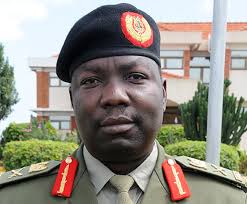
On this day Sejusa was active along the Hoima – Masindi road, blocking any anticipated reinforcements and the fleeing UNLA soldiers. On awarding ranks in 1987 Sejusa was made Brigadier, alongside Matayo Kyaligonza and the late Tadeo Kanyakole. Like most of his colleagues Sejusa has served the army in various capacities including the most recent, the Coordinator of Intelligence Services.

Sejusa

In 2013 he fell out with government after penning ‘a-not-so-good’ dossier on ‘succession’ and later went into exile in the United Kingdom. He returned to Uganda from self-exile in December 2014 and has since associated with the opposition.

He at one time served as State Minister for Defence.

  1. Lieutenant General Ivan Koreta

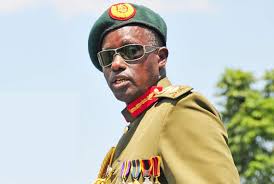
On January 26 1986 Koreta was commanding the 13th Battalion, which combed the southern parts of Kampala like Kawempe and Bwaise. On awarding ranks in 1987 Koreta was made Lieutenant Colonel and served in many capacities in the NRA/UPDF including the Deputy Chief of Defence Forces, deputizing the late General Aronda Nyakairima.

Lieutenant-General-Ivan-Koreta

He one time served as the Director General of the Internal Security Organisation (ISO) and also served as the Chairman of the General Court Martial (GCM). Today Lieutenant General Koreta is Ambassador Designate.


  1. Major General Matayo Kyaligonza aka Blackbomber

At the fall of Kampala, Senior Officer (SO) Kyaligonza commanded the 7thBattalion and then advanced towards Jinja in the East. At the award of ranks in 1987 Kyaligonza was made Brigadier, one of only four, the others being then Brig David Tinyefuza aka Sejusa, Honorary Brig Eria Tukahirwa Kategaya.

Matayo Kyaligonza

Today, Maj Gen is Uganda’s Ambassador to Burundi and also serves as the National Resistance Movement (NRM) Vice Chairman for western region.

  1. Brigadier Julius Chihandae

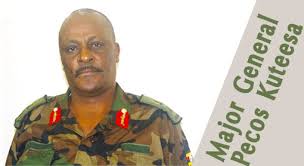
On this day in 1986 Chihandae was commanding the 9th Battalion, operating along the Hoima-Masindi axis. On awarding ranks in 1987, Chihandae was made Colonel, one only of three, alongside Pecos Kutesa and Joram Mugume Kanyaruhara, both now Major Generals. He went into oblivion after allegedly aiding Lt Col Kashillingi flee to Zaire (DRC) but has since been ‘rehabilitated’ and deployed to the Ministry of Foreign Affairs. Not so long ago Chihandae, now a retired Brigadier, served as Uganda’s Military Attaché to Egypt.

  1. Brigadier Peter Kerim

On capturing Kampala Kerim commanded the 19th Battalion, which later advanced till Nebbi in West Nile. At the award of ranks in 1987 Kerim was made Lieutenant Colonel, and he also served the NRA/UPDF in various command capacities. At the time of his death in 2012 Brigadier Kerim was the Deputy Reserve Force Commander.

  1. Colonel Stanley Muhangi

Thirty years ago on this day, Muhangi was commanding the NRA forces that captured Makindye Barracks. On awarding ranks in 1987, Muhangi was made Lieutenant Colonel, but was later promoted to full Colonel, the rank at which he died.

  1. Colonel Samsom Mande

On January 26 Mande was commanding the 15th Batallion. At the time of awarding ranks in 1987 Mande was made Lieutenant Colonel but was later promoted to full Colonel. He fell out with government and fled the country. He currently lives in Sweden but there are claims he plans to return. 

  1. Lieutenant Colonel Ahmed Kashillingi

On this day in 1986 Kashillingi was commanding the 5th Battalion that was operating along Kampala-Entebbe Road. On awarding ranks in 1987 Kashillingi was named Lieutenant Colonel and later became Director of Records in the NRA. During his tenure records office at army headquarters, Republic House, caught fire, destroying crucial documents.

kashilingi

As a result, Lt Col Kashillingi fled the country and went into exile in then Zaire Republic, now the Democratic Republic of Congo (DRC). He was pardoned and returned to a low profile life and is currently attached to the security ministry.

  1. Lieutenant Colonel Jet Johnson Mwebaze

Known as a brave fighter, Jet Johnson Mwebaze was commanding the 29th Battalion on the capture of Kampala in January 26, 1986. On awarding ranks in 1987 he was made a Captain, but was to rise to Lieutenant Colonel, a rank at which he died in 1998 following a plane crash. He was a young brother to former UPDF Army Commander Major General James Kazini Bunanukye.

Stories Continues after ad

Security Council reforms to top AU Summit agenda


The Committee of 10, an Africa-led group including Uganda that wants reforms at the United Nations Security Council (UNSC) has resolved to have the contentious reforms debate as top priority on its agenda at the 26th Heads of State Summit in Addis Ababa between January 30 and 31.

Other members of the group are Equatorial Guinea, Kenya, Libya, Algeria, Sierra Leone, Senegal, Namibia, Zambia and Congo Brazzaville, all of which are supposed to spearhead efforts aimed at securing a veto power status for at least one African country.

The issue of UNSC reforms has attracted a lot of interest in Africa, with most countries calling for the expansion of the most powerful UN arm to accommodate Africa’s interests.

However, the thorny reform issue has met stiff resistance from the five permanent UNSC members: USA, UK, France, Russia and China, prompting almost all the African leaders including AU Chairperson Robert Mugabe, the long-serving Zimbabwe president and his Equatorial Guinea counterpart Teodoro Obiang Nguema Mbasogo, another long-serving ruler, to add their voices.

Outgoing Africa Union Chairman Robert Gabriel Mugabe has said the continental body will among other issues discuss reforms of the United Nations Security Council (UNSC).

Outgoing AU Chairman Mugabe, whose chairmanship of the continental body ends on January 31, weighed in on the matter at a joint press conference with Mbasogo, who was in Zimbabwe for a three-day visit.

“So, on the eve of the meeting of the Africa Union, we saw it fit to discuss what our positions would be in regards to various matters: The issue of the reform of the Security Council and what our position as Africa should be; and that is what we would want to discuss also with others at the African Union meeting in Addis Ababa,” Mr Mugabe was quoted as saying.

Stories Continues after ad