Stanbic Bank
Stanbic Bank
18.4 C
Kampala
Stanbic Bank
Stanbic Bank
Home Blog Page 2220

No salary increment for MPs, Public servants – Museveni

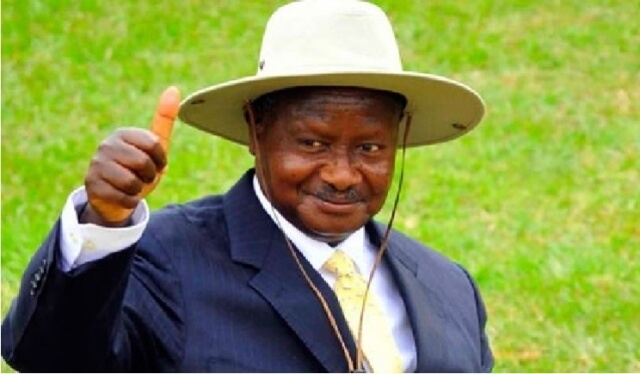
PRESIDENT Museveni addressing the newly elected Mps at Kyakwanzi

President Yoweri Museveni has told the newly elected Members of Parliament that they should not expect a salary increment as it is the norm at the beginning of every new Parliament.

Museveni instead urged MPs to help their country by promoting wealth creation at the household level through production and not through handouts.

“He made it clear to the MPs that there would be no salary increment for public servants including the Members of Parliament. He agreed to meet them in different zones twice in a month to talk about the issues affecting their areas”reads the statement sent by Presidential Press Secretary Linda Nabusayi.

It reads further“He encouraged them to concentrate on helping families and homesteads in creating wealth because it is the most crucial issue that will reduce and alienate poverty in the nation”

He said that household wealth creation is the most crucial issue that will help promote food and income security and also assist legislators themselves to have long political lives.

“Our main focus should be to change the families whether there is a road or not,” he remarked.

He made it clear to the MPs that there would be no salary increment for public servants including the Members of Parliament. He agreed to meet them in different zones twice in a month to talk about the issues affecting their areas. He encouraged them to concentrate on helping families and homesteads in creating wealth because it is the most crucial issue that will reduce and alienate poverty in the nation.

The President told the newly elected MPs currently attending a one-week NRM retreat at the National Leadership Institute in Kyankwanzi, to exploit the NRM manifesto to understand the challenges being encountered and the possible interventions to those challenges.

He informed the MPs that the solution to increased land evictions in the country is for the legislators themselves to get involved and collaborate with Resident District Commissioners (RDC), together with the Vice President, Prime Minister and the Minister for Presidency, so that peasants can settle on their pieces of land peacefully and develop themselves.

He warned that if there were magistrates who collude with the landlords, he would personally talk to the Chief Justice to see that they are dealt with. He strongly urged the MPs to stop sending the peasants to court because they don’t have fees for court proceedings and sessions.


2016-M7-Kyakwanzi2

“The peasants cannot afford court fees, this is the job of MPs and RDCs,” he said.

On Universal Primary and Secondary Education, Museveni said some local elites had started charging fees which the parents cannot afford. He suggested that the solution to the problem is to create village assemblies where the parents, PTAs (Parents and Teachers Association) as well the opposition come to a consensus on whether they can afford to pay the money or not.“The local elites say children cannot study without lunch, all this is being done without discussion, let us discuss it at every village level,” he said.

On the issue of electrification, he said that the party was carrying out the project systematically and that the next move was to take the electrification project to constituencies. He said government had successfully supplied power to almost all the districts, remaining with only four districts.

The President noted that much as government was spending a lot of money on road construction, it is committed to work on the issues of the teacher’s salaries such that the ongoing conflicts can stop. He added that after allocating money for the roads and teachers, the rest of the money would go into NAADS, micro finance, youth, women and innovation funds.

Stories Continues after ad
Broke Uganda FA turns to prayers ahead of uncertain AFCON ties

  • AFCON 2016 QUALIFIERS
  • Burkina Faso Vs Uganda, Saturday 26th March – Ouagadougou (9 p.m in Kampala)

Cash strapped Federation of Uganda Football Associations (Fufa) has given Ugandans another reminder of how the country desperately needs divine intervention by booking prayer sessions with religious leaders allover.

Fufa under Moses Magogo reached out to pastors and Imams who responded in affirmative to their request for a prayer weekend request to the religious groups was Friday 18th -Sunday 20th March as they wait on government to save them or less won’t make the trip West.

“We need a chartered plane if we are to travel to Burkina Faso and back in time for the return leg. And we believe government can come to our aid if that is to be realized, and to enable The Cranes achieve good results but with prayer everything is possible,” Magogo was quoted as saying earlier this week.

Decolas Kiiza, the Fufa Finance director, confirmed that Shs 1.5 billion was needed for those two back- to-back games to cater for the players’ allowances, bonuses and air-tickets all of which they don’t have yet the ties are now less than a week away.

The Uganda Cranes and other players of the same religion will pray from areas designated to FUFA by the religious groups.

“We are glad that our requests have been honoured. We are looking forward to making the National prayers a success. We encourage all Ugandans to pray for the National team-Uganda Cranes,” said Ahmed Hussein Fufa spokesperson.

The Imaam at the National Mosque-Old Kampala Ali Juma Shiwuyo welcomed the idea saying, “It is important to put God ahead of everything. Even if the results turn out to be good or bad, you will look back to God for His decision’ said Imaam Shiwuyo.

Cranes, who visit Burkina Faso on March 26 before hosting the return leg at Namboole on March 29, lead Group D of the qualifiers with a maximum six points. Botswana and Burkina Faso are tied on three points with Comoros last without a point after two games.

Meanwhile, Egyptian referee Ghead Grisha will be the centre official in the first leg helped by fellow countrymen Tahssen Abo El Sadat Bedyer and Ahmed Taha Hossam as first and second assistants with Mahmoud Zakria El Banna is the fourth official.

Stories Continues after ad
EALA lauds Sezibera tour of duty

Outgoing EAC Secretary General Amb Dr Richard Sezibera
 

The East African Legislative Assembly (EALA) has moved a resolution to bid farewell to the outgoing Secretary General of the EAC, Hon Amb Dr Richard Sezibera.

The Resolution moved by Hon AbuBakr Ogle and seconded by Hon Abdullah Mwinyi, recognised the Secretary General for the great service rendered during his tenure of service to the Community.

The Resolution which received support from the whole House, cited a number of achievements in the programs and projects of the EAC during the five year period (2011-2016). Among the achievements are the recent introduction of the international EAC e-Passport, which the Resolution terms a critical milestone in the integration dispensation.

The Resolution also takes cognisance of the fact that Hon Amb Dr Sezibera’s tenure saw the conclusion and ratification of the Monetary Union, which is the third pillar of integration. It also cites Hon Amb Dr Sezibera’s key role in spearheading the granting of financial and administrative autonomy to the EALA and the EACJ, thus laying the foundation to commence on various amendments of the Treaty and the relevant EAC Rules and Regulations.

On matters of trade, the mover said the EAC Secretary General had sustained campaigns to ensure the realization of the Single Customs Territory (SCT) and that it had duly paid off.  Also laudable, a section of the Resolution avers, is the EAC’s infrastructure programme which is set to spur development in the region apart from other parts of the continent in terms of competitiveness thus laying the Standard Railway Gauge and making unprecedented advances in investment of energy.

In order to ensure people centeredness, the Secretary General was instrumental in establishing and sustaining the quarterly Secretary General’s forum with the Private Sector.

In justifying the Resolution, Hon AbuBakr Ogle hailed the Secretary General for the positive areas of integration but also added there were challenges as well during his tenure.

He remarked that the incoming Secretary General was taking over at a critical time for the Community.

Contributing to the debate, Hon Peter Mathuki said the outgoing EAC boss had made significant contribution towards strengthening of the integration process. He remarked that the addition of the Republic of South Sudan in to the bloc was a key deliverable that was facilitated during the tenure of the outgoing Secretary General.

Hon Shyrose Bhanji noted that during the tenure of Amb Sezibera, many deliverables were realised.  We have seen the reduction of NTBs and the Single Customs Territory (SCT) is also a reality.

Hon Martin Ngoga referred to Hon Amb Dr Sezibera’s tenure as one marked by great achievements, while Hon Margaret Nantongo Zziwa said during the tenure of Dr Sezibera, the Members had realised improved welfare. She remarked that the challenges notwithstanding, the achievements of the Secretary General were laudable.

Hon Abdullah Mwinyi and Hon Dr Odette Nyiramilimo heaped praises on Dr Sezibera for the sterling job he had done for the Community.  “The role of been Secretary General is extremely challenging. One must balance interest of the Community and have deep understanding of needs of Partner States,” they said.

Hon Dora Byamukama congratulated the Republic of Rwanda for nominating Hon Amb Dr Richard Sezibera and said he had brought honour to the Partner States and the region.

Last week, Hon Amb Dr Sezibera addressed the House where he delivered the score-card of achievements during his tenure as the bloc’s Secretary General.

Amb Dr Richard Sezibera whose tour of duty at the EAC comes to an end on April 26th, 2015 has had a successful career in public service as a physician, Minister in the Government of Rwanda and as a Member of Rwanda’s Transitional Parliament. He has also served in the Army and as a diplomat.

At the 17th Ordinary Summit of the EAC Heads of State, the Heads of State appointed Mr Liberat Mfumukeko, the outgoing EAC Deputy Secretary General, Finance and Administration as the new Secretary General of the Community with effect from April 26th, 2016.


Stories Continues after ad
Oulanyah defends 2016 elections

Jacob Oulanyah

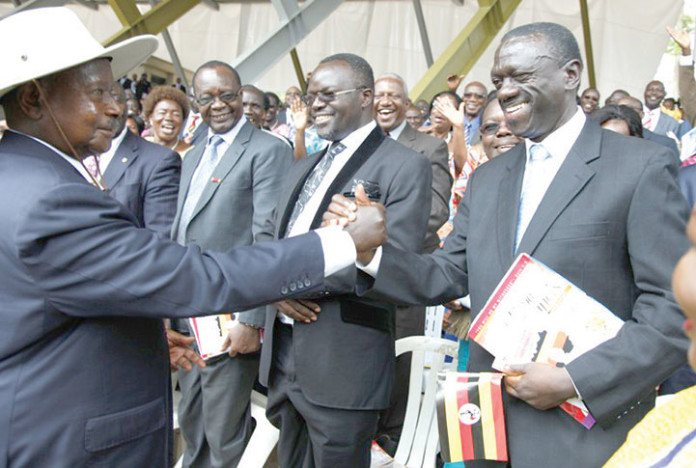
The Deputy Speaker of Parliament, Rt. Hon. Jacob Oulanyah has allayed the fears of Parliamentarians at the European Parliament, on the state of affairs in Uganda following the recently concluded Presidential and Parliamentary Elections in Uganda.

Rt Hon Oulanyah, who led a delegation of four MPs including Hon Sanjay Tanna (Tororo Municipality), Hon Christine Bako Abia (Arua Municipality) and Hon Rebecca Nabbanja, (Kibaale District) to the 41st Session of the African, Carribean Pacific Parliamentary (ACP) Assembly taking place in Brussels, Belgium, from  March 15th – 19th, was responding to a report  of the European Union (EU) and the European Parliament (EP) Election Observer Missions to Uganda for the 2016 General Elections, which was presented to the Committee on Development by the leader of the EU Observer Mission to Uganda, Eduard Kukan.

In his report Kukan highlighted several areas that the observers felt were lacking appropriate explanations, such as the late delivery of voting materials, the restriction of social media platforms, the Electoral Commission  pronouncements before the tallying process was complete and the Uganda Police invasion of the FDC offices immediately after the elections. “Not much of our 2011 recommendations report have been implemented,” Kukan said.

But Hon Oulanyah allayed these fears by stating that the Parliament of Uganda always took electoral reforms very seriously: “I have not known of any elections in Uganda that have not been preceded by reforms,” he affirmed. Oulanyah also responded to the specific questions that the report had listed.

On the allegations of unbalanced media coverage, Oulanyah stated that the media in Uganda was highly diverse and private sector driven. “The Government neither applies censorship and content supervision, nor exercises editorial control, and did not do so during the concluded election,” he explained.

Addressing disenfranchisement of women in politics, Oulanyah reminded the house that Uganda was ahead of many European countries, in its goal to attaining parity.

On the numerous complaints and appeals that had been raised in the report, he outlined the preparedness of the judiciary to handle electoral petitions . “The Courts of Law will determine whether the election results reflected the will of Ugandans,” he said.

Following Oulanyah’s submission, several members raised positive aspects surrounding Uganda. “Your presence here is a testament of the importance that Ugandan people attach to this process.”

Mr Kukan hailed the government for its commitment to a peaceful democratic process. “The country has remained stable in light of Uganda’s strategic position in the Great Lakes area,”he said adding: “We wish to assent that the active role of Uganda in the region is appreciated.”


Stories Continues after ad
NO COUNTRY FOR OLD MEN; Mwesigwa and Koffi surprised

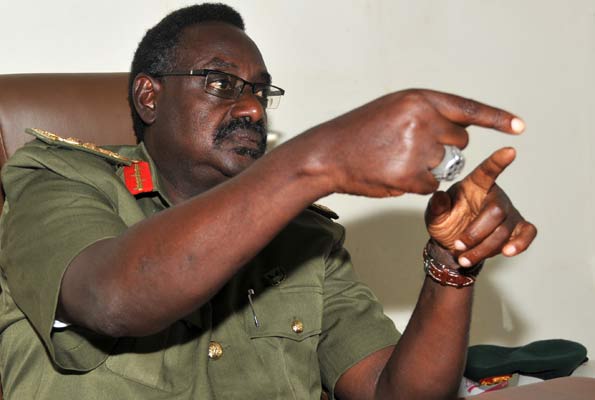
This is a tale of two mature or you would say aging footballers who are gutted after being snubbed by their national teams.

Coach Mulitin ‘Micho’ Sredojevic left ‘forgotten’ skipper Andy Mwesigwa out of the squad to face Burkina Faso just like Stallions coach Paulo Duarte also snubbed his most senior defender in Mohamed Koffi yet both men still think they had enough merit to get kick-abouts  having made their debuts more than 10 years ago.

Mwesigwa’s performance in the 2-0 defeat to Guinea in November 2014, in which he was at fault for both goals, showed of a servant whose legs had seemingly given way despite the heart remaining as passionate. He has not announced retirement and is yet to play competitive football since the aforementioned match.

“I am surprised,” he stated in an appearance on Radio CBS 89.2 on Wednesday night, Mwesigwa who now turns out for Vietnam League side Ha Noi couldn’t hide how he felt about that, “I have never announced my retirement from the national team and am currently active at my club where I am part of a backline that has kept many clean sheets,” he added.

One of the unanswered questions was whether Micho had accorded his former captain (he confirmed Geoffrey Massa as the new captain) the respect he deserves by telling him beforehand what he revealed to the media recently that the defender’s time with the Cranes could be over.

Fast forward to West Africa, the other old man Mohamed Koffi will also not convene for two games. Burkina Faso coach Paulo Duarte has delivered its list of players but there was no place for Koffi on the team.

When asked by Canal Plus in his weekly Talents of Africa, Zamalek player spoke said, ” I was surprised as you, I am one of the elders of the group, it can be done but could still speak I do not know if anyone has an issue with me because I have always given everything for my country.

Cranes, who visit Burkina Faso on March 26 before hosting the return leg at Namboole on March 29, lead Group D of the qualifiers with a maximum six points. Botswana and Burkina Faso are tied on three points with Comoros last without a point after two games.

Stories Continues after ad
SC Villa will endure suffering – coach

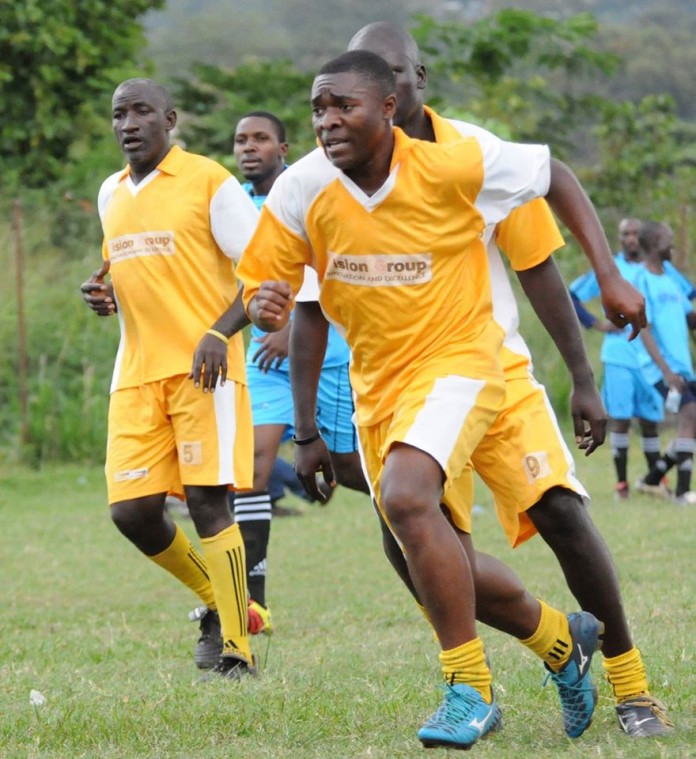
Following their shock and tiresome bus road trip through Tanzania, SC Villa coach Ibrahim Kirya is still adamant that his charges will be up for the task when they face Jeshi La Kujenga Uchumi (JKU SC) in their CAF Confederation Cup return leg on Friday.

The Jogoos are expected to reach Zanzibar later today (Thursday) after two days on the road as they seek to finish off their tie against the Coastal outfit after claiming a 4-0 first leg victory last weekend at Namboole. They actually need to avoid a 5-0 loss to progress to the next round where the winner will take on either Morocco’s FUS Rabat or USL Loum of Cameroon.

Speaking to EagleOnline, Kirya said he is fully aware that the conditions in Zanzibar will be tough for the team but that they are ready to go out there and fight to come back with a good result.

“We know that travelling by road is not easy especially if you a club from Uganda. We are mentally well prepared for it especially the ferry trip Dar es Salaam to Zanzibar. We know that for us to do well we have to forget about most of the problems or challenges we will face and play the game and fight for the results.

“The conditions have been tough but that’s how it is and my boys are ready to finish the job,” Kirya concluded.

The 16 man squad has two goalkeepers, five defenders, eight midfielders and one striker.

Stories Continues after ad

Rwanda keeps trust in locals

Whereas Uganda Cranes coach Micho named a majorly foreign based players for the 2017 Africa Cup of Nations qualifiers double header against Burkina Faso, his Rwandese compatriot Johnny McKinstry has retained most of the players from the squad that reached the quarterfinals of the 2016 African Nations Championship on home soil, as Amavubi are preparing for their double header with Mauritius in Group H.

Gor Mahia defender Abouba Sibomana, Tanzania-based midfield duo Jean-Baptiste Mugiraneza and Haruna Niyonzima, and overseas strikers Quentin Kwame Rushenguziminega and Elias Uzamukunda are the five foreign-based players called up by the Irish manager.

Lying second in Group H on three points, after falling 0-1 to Ghana following an away win in Mozambique with the same scoreline, Amavubi will battle Mauritius at Stade Anjalay de Belle-Vue on 26 March before hosting the islanders in Kigali three days later.

Rwanda will be looking to pocket all six points from this double clash in their bid to qualify for their first AFCON finals since their first and only appearance in the 2004 edition in Tunisia.

Stories Continues after ad

Kayihura transfers Kasese officers

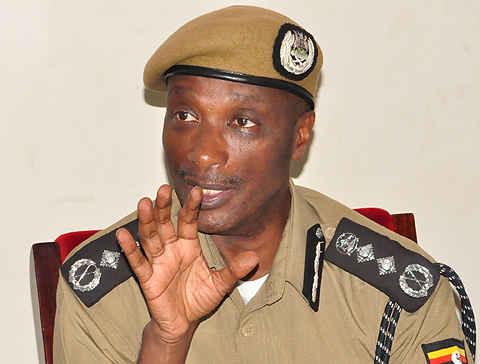
Gen. Kale Kayihura
Former IGP Gen Kale Kayihura who is due for retirement in July.

The Regional Police Commander Rwenzori East Senior Superintendent of Police (SSP) Bob Kagarura, Superintendent of Police (SP) Vicent Mwesigye of Kasese Municipal Division and Assistant Superintendent of Police (ASP) Muhammad Kirumira of Bwera Division have been transferred.

SSP Kagarura moves to Sezibwa as RPC; SP Mwesigye moves from Kasese Municipal Division to Bwera as District Police Commander (DPC), while ASP Kirumira moves to Old Kampala Police Station as DPC.

The three officers from the now troubled greater Rwenzori region are part of a group of 9 officers transferred and appointed by the Inspector General of Police (IGP) General Kale Kayihura, on March 16.

Recently, the Rwenzori region has witnessed violent skirmishes, with police and the army engaging in running battles with stone and stick-wielding civilians, resulting in the one death.

Earlier, six people were killed by unidentified people, while just a day ago the Gombolola Internal Security Officer (GISO) of Buhuhira sub county James Mulhumbira was also attacked by yet to be identified people.

Meanwhile, other officers transferred or appointed include Assistant Commissioner of Police (ACP) Deo Obora, who replaces Mr Kagarura as RPC Rwenzori East; SP Sam Odong moves from Luuka to Kasese Municipal Division; ASP Emmanuel Ochamringa and Jackson Maumbe move to Directorate of Operations at police headquarters as Staff Officers; ASP Sam Suubi moves from Lira to Hima as DPC, while Julius Baganzi was confirmed the DPC of Katwe Police Station.

Stories Continues after ad

Uganda named among Africa’s poorest

Despite the NRM government preaching the gospel of wealth creation for years, Uganda has failed to regain its status as one of the wealthiest countries in Sub-Saharan Africa on a wealth per capita basis.

The 3rd Annual Africa Wealth Report says, people living in Uganda are among the poorest on the continent having on average US$900 each. The amount most public servants are earning.  Uganda was recently ranked number 164th on the list of the world’s wealthiest nations; with an annual GDP per Capital of $ 1460 [as of 2014]; just 21 positions from the bottom.

wealthpercapita

Vote rigging, the lack of respect for ownership rights, violence, absence of press freedom are some of the reasons that have been cited for the Uganda’s country’s collapse and ultimate malaise.

Region wise, while the gap between rich and poor is highest in central Uganda, poverty rates in Uganda’s east range from 27% to 62%.

According to calculations in the report, poverty across Uganda declined from 39% in 2002 to 31% in 2005, mainly in central and western regions, but remained particularly severe in the pastoral areas.

The report says that poor pastoral areas such as Soroti have continued to show “little or no progress in terms of poverty reduction over the past 15 years.”

Press freedom has also been at the centre of the Uganda crisis.

On a brighter note however, Uganda’s construction sector will expand throughout our 10-year forecast period up to 2025, recording 7.1% growth in real terms in 2016 and averaging annual growth of 7.9% over the next five according to the report. Infrastructure related to the development of Uganda’s oil reserves will be the primary driver of this expansion, supported by improvements to the national power supply and regional transport links. Potential investors may be discouraged by the dominance of Chinese firms and allegations of government corruption. The report predicts forecasts of 6.8% real growth over 2016, 7.9% over the next five years and 7.7% over our full 10-year forecast period. Oil production and the associated infrastructure will be the main drivers of industry expansion over the short term.

Commercial vehicle sales will grow 6.6% in 2016 outperforming passenger vehicle sales growth due to Uganda’s infrastructure expansion driven economy. Although private consumption will continue to drive passenger vehicle registrations, imported used vehicles will continue to negatively affect new vehicle registrations.

While Uganda is not doing well overall, the Island country of Mauritius is rising. The country saw the wealthiest individuals in Africa with US$21,700 in wealth per person.

The success of Mauritius has been attributed to secure ownership rights that has seen a large number of wealthy individuals moving there over the past decade.

“Low taxes which encourage business formation and appeal to retirees. Company and personal income tax rates are only 15%, with no inheritance or capital gains tax.”

Stories Continues after ad

Museveni Explains The NRM Revolution And Ideology

President Museveni

In the Book of Mathew Chap: 23:23. it says that: “They left undone what they ought to have done and did that they ought not to have done and there is no truth in them”.  In exact quotation it says:“…Woe to you, scribes and Pharisees, hypocrites! For you pay tithe of mint and anise and cummin, and have neglected the weightier matters of the law: justice, mercy and faith.  These you ought to have done, without leaving the others undone”. Verse 24 says: “….. Blind guides, who strain out a gnat and swallow a camel…”.  All this means that you concentrate on peripheral issues but neglect much more fundamental issues.

That was exactly the problem of Uganda and many parts of Africa prior to the rise of the NRM in the 1960s as part of the Student Movement and also the rise of the other Liberation Movements. Prior to 1862, when the first European, Hannington Speke, came to Uganda, this area was under tribal kings and chiefs ruling over the fraternal but divided peoples of this area.  You had the kingdoms of Bunyoro, Buganda, Nkore, Rwanda and the chiefdoms of Mpororo, Busoga, Lango (Bukiri), Buhaya, Acholi (Gani), etc. On many occasions, these kingdoms and chiefdoms were at war fomented by the myopic and ego-centric kings fighting for looting ─ “kunyaga”. There had been, according to mythology and history, some period of peace, prior to 1500 AD, during the time of the Bachweezi, when much of Nkore, Bunyoro, Buganda, Bukiri, etc, had been united.  However, the Bachweezi dynasty had collapsed and had been replaced by the new dynasties of the Kabakas in Buganda, the Babiito in Bunyoro-Tooro, the Bahiinda in Nkore-Karagwe-Buhaya and the Bainginya in Rwanda.  It is these that were promoting wars among our people.

Our peoples are either similar or linked. Certainly, linguistically, all the interlacustrine Bantu speak, more or less, one language with different dialects. These Bantu dialects have linkages with the Nilotic dialects which, more or less, are one language, so do the Bantu dialects have linkages with the Nilo-Hamitic and the Sudanic languages (Ateso-Akarimojong and Lugbara-Madi). Examples: the Madi word for home is “aku”.  What is the Bantu word for home?  It is “eka” for many of the dialects.  The Lugbara word for syphilis is: “oyaa”.

In some Bantu dialects, the word for syphilis is: “ebihooya”.  The word for daughter in Luo is “nyara”.  Those who speak Bantu dialects know what that word means ─ very much connected with daughter-making. The word for anthem in Acholi is “Lubala”.  The word for clan anthems in Luganda is “Mubala”.

One of the first European visitors to come to Africa, was HM Stanley.  In his Book: “Through the Dark Continent Vol II” on page 3, he wrote as follows: “The Wajiji, Wazinja, Wazongora, Wanyambu, Wanya-Ruanda, Kishakka, Wanyoro and Wanyankori, Wasui, Watuusi, Wahha, Warundi and Wazige; all these tribes are related to each other and their language shows only slight differences in dialect”.

On page 366, of his other Book: “The Rescue of Emin Pasha” he further, says as follows:

“By a gradual rise from Amranda southward we escape after a few miles out of the unlovely plains to older land producing a better quality of timber.  Before we were 100 feet above the lake a visible improvement has taken place, the acacia has disappeared and the myombo, a tree whose bark is useful in native cloth and for boxes and which might be adapted to canoes, flourished  everywhere.  At Bwanga, the next village, the language of the Wahuma, which we had heard continually since leaving Albert Nyanza, ceases and the Unyamwezi interpreters had now to be employed, which fact the skeptical Zanzibaris hailed as being evidence that we were approaching Pwani (the Coast)”.  There you are.

This complete stranger, who had only been to this area two times, could quickly notice that the Bantu dialects spoken between the Ituri Forest and Mwanza in Tanzania were, essentially, one language which he called the “Wahuma” language.  Indeed, many Bahima speak different dialects of the same language.  Stanley had noticed what some people, these days, call Runyakitara language.

However, our ego-centric chiefs were promoting tribal chauvinism, division and wars among these fraternal peoples.  When the foreigners, therefore, came, we could not resist them because we were divided.  By 1900, the old arrangement had been defeated and a colonial one was put in place.  In addition to the old tribal chauvinism that had been being promoted by the kings and chiefs, a new pseudo polarization was added ─ that of religious polarization.  This meant Catholic against Protestant and vice-versa, Christian against Moslem and vice-versa.  This was due to importing into Central Africa the nonsensical conflicts of Europe (Catholics vs Protestants) and the Middle East and the Balkans (the Christian crusaders vs the Moslems).  The conflicts between the Protestants and Catholics in Europe had been called the “Thirty years wars” ─ between 1618 and 1648.

The combined sectarianism of tribalism and religion, reinforced by gender chauvinism, was, therefore, the dominant ideology of the opportunistic political elite by the time of Independence in 1962.  It is this sectarianism and gender chauvinism that could not allow our Independence leaders to build a capable State (Army, Police, Judiciary, Civil Service, etc., etc).  They could also not build wide unity to guarantee peace (obusingye) and stability (obutebekana).  Hence, the unstable, unprincipled political arrangement of the coalition government of UPC and Kabaka Yekka of 1962-64.  It was called: “Omukago”.  It reminds me of The Democratic Alliance (TDA). It soon collapsed, with disastrous consequences for Uganda ─ the 1966 crisis, the 1971 coup detat, the killings of 1966 to 1986.  You could even add the Kony wars and the cattle-rustlers of Karamoja.  They all had linkages with these ideological mistakes.

Some of us had belonged to the old political parties: Democratic Party (DP), Uganda Peoples Congress (UPC) and Kabaka Yekka, formed on the basis of religious and tribal sectarianism; DP for Catholics, UPC for Protestants and Kabaka Yekka for Baganda Protestants.

This was a pseudo-ideology trying to base itself on peoples’ identity rather than people’s interests.  Exploiting identity and eclipsing people’s legitimate interests.  This is when the pre-cursors of the NRM ─ the student study groups, USARF (University Students African Revolutionary Front), etc., came in and started rejecting this pseudo-ideology based on the legitimate interests of the people.  What is primary to people’s prosperity and security: identity or interests?  The real most positive element of human interaction is interests ─ especially prosperity. As a Munyankore, who guarantees your prosperity?  Is it the Banyankore that do so or not?  The answer in the pre-colonial, colonial and post-colonial times is categorical, clear and unambiguous. It is not the Banyankore that guaranteed our prosperity but the other communities (tribes) of Uganda, the Great Lakes and East Africa.

In the colonial times and post-colonial times, I went to school because of Baganda money.  How?  It is the Baganda traders ─ Walusimbi and “Bukyenya” ─ that were buying our cattle during the monthly cattle auctions (at Ntungamo, Rubaare or Kagarama).  That is how Mzee Kaguta got money to pay for my school fees.  Later, these traders were joined by a European, known as  Shear, operating out of Ishaka town, who was buying cattle for Kilembe Mines when it started operating around 1956.  Our cow, Mpuuga ya siina, tossed this white man with its horns and it earned a praise-name (ekikubyo) from Mzee Kaguta for that feat.  He refused to sell it.

Today, the mutual support for our people’s prosperity is much clearer.  The Banyankore are prosperous because the other Ugandans and other Great Lakes people buy their milk, beef and bananas.  The international community buy their coffee, their tea, etc.  Even in the pre-colonial times, Banyankore prosperity was assisted by cloth (emyeenda) from the East African Coast, by ebitooma (embugu) from Kookyi and Buhaya, etc.  They would adorn themselves with emiringa (copper bracelets) from Buleega (Congo).

It is parasites who attempt to eclipse people’s interests with the issue of identity: Hutu vs Tutsi, Cattle-keeper vs Cultivator, Northerners vs Southerners, Christians vs Moslems, Whites vs Blacks, etc., etc.  It is parasites who push these lines.  When such parasites push that line, we have no alternative but to deal with it as we did in South Africa, the Sudan, Rwanda-Burundi or here in Uganda.

Otherwise, the legitimate interest of the people is prosperity and that prosperity is, most of the times, supported by inter-tribal linkages rather than the intra-tribal linkages.  It is the different tribes that buy what we produce rather than our own tribes.  With this realization, the NRM, therefore, evolved, quite early, two principles: patriotism and Pan-Africanism.  Patriotism meant unity within Uganda so as to ensure our prosperity and security.  Pan-Africanism was so as to promote unity in East Africa and Africa in order to guarantee the same prosperity and security even better.  The unity of Uganda, the market of Uganda, is not enough to guarantee our prosperity (buying what we produce) and strategic security (to defend our sovereignty against the imperialists).

The unity of East Africa, the unity of Africa can do these two better than the mere unity of Uganda.

Therefore, the two first principles of NRM became patriotism and Pan-Africanism.  However, to benefit from Pan-Africanism and from Uganda’s unity, the society had to undergo a group metamorphosis ─ a socio-economic transformation.

One cause of parochialism and sectarianism of ideology is a stunted society in terms of socio-economic transformation.  The absence of a productive middle class, national bourgeoisie, compounds the problem of ideological bankruptcy.  You either have a bureaucratic bourgeoisie depending on Government salaries who believe in exclusion rather than inclusion because they stand better chances of getting jobs and promotions with the principle of the “fewer the better” or you have the comprador (agent) bourgeoisie who depend on imports for a livelihood, thereby turning our market into a dumping ground for foreign products and ensure a constant hemorrhage of our forex that continues to enrich external interests and cause economic anaemia to our own country.

The comprador  bourgeoisie, by flooding our markets with foreign products, are supporting the prosperity of the foreigners.  The National bourgeoisie (the manufacturers, the farmers, the exporters, etc), tend to be patriotic and also Pan-Africanist because their interests compel them to look for markets in the region and abroad.

The National bourgeoisie will, however, not grow by itself.  This is where our third principle comes in.  This is the principle of socio-economic transformation.  The NRM  and other reformers before it had to trigger socio-economic transformation that would see our mainly peasant society, with a heavy dose of a petty bourgeois class (civil servants, teachers, etc), metamorphose into a middle-class and skilled working class society.  The middle-class should have a high proportion of the National bourgeoisie (the manufacturers, the farmers, the service providers, the infrastructure developers) and not just traders ─ especially not importers of goods and services that can, more economically, be made here.  This is, indeed, the difference between Europe and Africa.  Around 1400 AD, Europe was a three class society:  the feudalists (aristocrats), the peasants (farmers) and the artisans (black smiths, textile people, carpenters, ceramics people, etc).  By the time of the French Revolution (1789) two new social classes had emerged: the bourgeoisie (middle-class) and the proletariat (industrial, farm and services workers).  Africa in 1400 AD was similar to Europe at that time, with feudalists, artisans and farmers (cattle keepers or cultivators).  Unfortunately, Africa did not go through an industrial revolution (invention of machines).  Hence, by 1900 AD, at the dawn of colonialism, Africa was still a three class society: feudalists, artisans and farmers (peasants).  The colonialists destroyed the feudal class because it was competing with the colonialists for political power and also destroyed the artisan class because it was making goods which colonialism wanted imported from outside ─ plates, spoons, hoes (chillington hoes rather the indigenous enfuka), pangas, etc.  It is only the peasants that survived.  They were, later on, joined by small groups of the petty bourgeoisie in the form of clerks and interpreters and later by petty traders.  It is only now that the national bourgeoisie (the Mulwanas, the Madhivanis, the Methas, the Sudhirs, the Mwebesas, etc), are beginning to emerge.  Those add to our economic strength by producing products that we consume or we export; thereby, ameliorating the hemorrhage on our economy where money flows from here to the outside to our detriment.

Therefore, principle number three of the NRM that enables us to understand the anatomy of the society so that we know the elements that are able to strengthen us and those that can weaken us, the need to understand the proportions of social-economic transformation, is very crucial and unique. It is unique because it is only the NRM that understands the importance of this.

What stimuli did we use to encourage this process?  Apart from peace, we used four other stimuli.  These were: education for all (UPE, USE), liberalization of the economy, improved health (especially immunization) and improved infrastructure (roads, electricity, telephone, the ICT backbone, piped water, safe water in the villages etc). As a consequence of these steps, the literacy rate is now 75%, up from 43% in 1986.  The social base for socio-economic transformation has, therefore, been laid.

We are going to use it to transform the society permanently.  We need correct policy stimuli to do so and I will bring those out later.  Liberalization helped the creation of the middle-class by removing the State (Government) from doing business.  The State used to monopolize the business of hotels, transport, imports, etc.  These sectors are now being manned by the private sector.  This creates efficiency and spreads wealth.

The fourth principle of the NRM is the democracy.  Democracy is clear enough. Ugandan’s democracy, the democracy pushed by the NRM, is much richer than anything, anybody, has attempted to do in the world, other than the ancient Greeks who produced direct democracy, in the City States.  We have empowered women, the youth, the workers, the disabled, the soldiers, etc.  I must,  however, condemn in the strongest terms possible those who pollute our democracy by trying to cheat in any election.  Some of the practices in our Primaries were shameful.  I corrected the few cases I had time to attend to.  These were Kanungu and Namutumba.  In a recent article, I analysed those mistakes.  I do not have to repeat here the contents of that article.  It is attached.

The NRM democracy must be kukyenuura-based through production of wealth and jobs creation.  Kukyenuura means to solve a solvable need.

Having seen the four NRM principles, let us cast a glance at the way forward from where we are today. This is where our quotation, the one we started with, comes in handy:  “They left undone what they ought to have done and they did that they ought not to have done and there is no truth in them”.  This is where the political elites of Uganda and Africa let our people down.  Over the last 50 years, the NRM has identified 10 strategic bottlenecks.  Here below, they are restated.

(i)            ideological disorientation;

(ii)           a weak state, especially the army, that needed restructuring;

(iii)          the suppression of the private sector;

(iv)         the underdevelopment of the human resource (lack of education and poor health);

(v)          the underdevelopment of the infrastructure (the railways, the roads, the electricity, the telephones, piped water, etc);

(vi)         a small internal market;

(vii) lack of industrialization;

(viii)       the underdevelopment of the services sector (hotels, banking, transport, insurance, etc.);

(ix)         the underdevelopment of agriculture; and

(x)          the attack on democracy.

As you can see, we have been handling many of the strategic bottlenecks: ideological disorientation, a weak State, emancipating the private sector, the human resource development (education and health), modernizing the infrastructure, integrating the fragmented  markets, etc, etc.   Hence, we have got a better base than ever before.  We are, therefore, in a position to tackle, step by step, the residual problems and convert Uganda into a middle-income country by 2019 and an upper middle-income country by 2040.

In this term, the first step to take is for all of the political class to remember what it says in the Church of Uganda Prayer Book. It says: “Omuntu omubi kwarihinduka, yareka eby’okushiisha ebi yaakozire, yakora ebiragiro kandi ebihikire n’ebishemeire, aryakiza amagara gye kuza  omukufa”.  In English, it is translated as: “But if a wicked man turns from all his sins which he has committed, keeps all my statutes and does what is lawful and right, he shall surely live, he shall not die”.

Therefore, if the political class repent their sins of being estranged from the legitimate interests of the people, they will have their political lives prolonged.

I am a veteran of fighting poverty and working for socio-economic transformation in Uganda. I started this struggle, in earnest, in the Christmas of 1966 in the Butaka area (Rwakitura, Rushere, Naama, etc).  That effort succeeded and, since 1995, I have been drawing the attention of the political class to that living example.  Like the parable of the sower goes, much of the seeds fell on rocky ground and did not germinate.  In that area, we were able to get the society to go through four steps.  Step one, end nomadism.  Step two, go from subsistence farming to commercial farming.  Step three, do so, with ekibaro, cura, aimar, otita, (calculating profitability).  Then step four, stop land fragmentation through inheritance.  The area is now quite prosperous.  The whole exercise was described in detail in my essay entitled: “From Obwiiriza to Amatafaari”.  However, the political class has refused to learn from that lesson in many cases.  The population in the cattle keeping areas have, however, totally changed.

In Nyabushozi, Kazo, Kashoongyi, Bukaanga, Isingiro, Kabula, Ssembabule, Gomba, Ngoma, Kyenkwaanzi, etc, etc., the cattle keeping communities have shifted from the indigenous long horn cattle to the Friesian dairy cattle ─ selling milk and getting money per day.  In the Government Research stations and also working with some farmers, we also worked out a packaging for the crop areas.  In the 1996 Manifesto, as a sequel to my 1995 poverty eradication country ─ wide tour, we worked out the four acres plan.  Have one acre of clonal coffee, one acre of fruits, one acre of pasture for six zero grazing cows and one acre of food crops (bananas, cassava or Irish potatoes).  Add to these, back yard activities of poultry for eggs, pigs, rabbits, etc. and fish farming where there are wetlands nearby.  It is now 20 years plus when the NRM has been telling you about how to get 68% of our households out of poverty through commercial agriculture as far as those families with land are concerned.  Those with smaller pieces of land than the 4 acres, can also earn good incomes from onions, from tomatoes, vegetables, mushrooms, etc. In the Manifesto, I pledged to enhance the wealth funds: NAADS, Youth, Woman, Micro-finance and the Innovation Fund.

This is the medicine for the ones with small pieces of agricultural land.   Those with big pieces of land have much more flexibility.  They can commercially undertake anything they fancy: maize, tobacco, cotton, sugarcane, beef ranching, fruits, coffee or whatever.  On account of scale, whatever they do, will bring in good income.

Agriculture, however, will not be the only path for socio-economic transformation although it will provide raw-materials for a wide spectrum of industries ─ dairy, beef, textiles, fruits, grain milling, coffee, tea, cocoa, sugar, wood products, tobacco, medicinal herbs, etc., etc.  The other industries will be based on minerals.  These will include: cement in Hima, Tororo, Bugisu and Karamoja; fertilizers ─ Tororo; steel – Tororo, Muko and Kanungu; gold ─ Buhweju, Mubende, Busia, etc, etc; petroleum ─ Hoima; marble ─ Karamoja; copper ─ Kilembe; aluminium ─ Busoga; tin ─ Ruhaama; vermiculite ─ Bugisu; coltan ─ Kisoro; uranium-nuclear energy ─ many places; etc., etc.

Apart from industries based on agriculture and those based on minerals, there are also those based on human skills such as the Kiira electric car, the Kayoola electric bus, the multiple computer applications developed by our computer scientists, etc., etc.

The services sectors are already providing important stimuli for modernization ─ tourism, transport, banking, trading, insurance,  professional services, etc., etc.

Therefore, the future is bright.  We, however, need to provide a conducive policy framework to assist this transformation.  Let us, for instance, take the issue of second-hand clothes, second-hand shoes, second-hand vehicles, etc.  These products came in to keep our people going when our industries collapsed under Idi Amin.  We, however, need to review them because they cause huge hemorrhage of our forex and also cause huge loss of jobs to the outside.  When you produce textiles from our cotton, you create 6 levels of jobs: growing the cotton, ginning the cotton, spinning it, weaving it, tailoring it and printing the colours into the fabric.  The total demand of textiles in Uganda, annually, is 226 millions of metres, worth US$270 million.

If all these textiles are manufactured here, we shall need about 400,000 bales of cotton, each weighing 185 kilogrammes.  All these dollars will remain here and we shall create direct employment of 80,000 people.  A vertically integrated leather industry producing shoes for us, will do the same, taking advantage of our millions of skins and hides.  In Ethiopia, the assembling of cars and motor-cycles rather than importing already built cars has created 160,000 jobs.

There are our groups that have made a livelihood out of importing second-hand clothes, second-hand shoes, second-hand cars, second-hand computers, etc.  We need to discuss with them and assist them to re-orient their businesses.  Why don’t you distribute the locally manufactured goods instead of distributing the foreign goods that kill the jobs for your children?  The logic is not that difficult to understand.

The five wealth and job creation funds will assist those who cannot raise their own capital.  These funds are: the NAADS Fund, the Youth Fund, the Women Fund, the Micro-Finance Fund and the Innovation Fund.  These should be interest free or low-interest loans to those who cannot borrow from banks.  These funds will do three things: First, help us to eliminate the 68% “baroreezi” (spectators) of the homesteads that were identified by the 2002 census as being outside the money economy.  Wealth creation is one area where we do not welcome “abaroreezi” (spectators). I am a fan and spectator for Chameleon, Bebe-Cool, Kusasira, etc.  However, with wealth creation, we must all be players.  No spectators.  Many of the 68% of the homesteads will be converted from subsistence farming to commercial, small scale farming.  This will boost greatly agricultural production and provide a huge amount of raw-materials to the agro-based factories.  Milk is already a good example; so is maize.

Secondly, these wealth and job creation funds will assist our youth groups, women groups to enter and progress forward in the activities of cottage industries (wine-making, wood products, cloth weaving, knitting, etc.), small scale industries (maize-mills, fruit processing, etc.), services and internal distribution (produce buying, oxen fattening, etc).

This money can be used to acquire common user facilities for the youth groups, women groups, etc., or any other relevant machinery.  I have assisted some of the youth groups to start maize-milling operations, animal feeds mixing, etc.

Thirdly, these funds will help our scientists to actualize their inventions ─ the Kiira electric car, Kayoola mini-bus, etc.

Through Foreign Direct Investment (FDI) and the activities of the bigger investors, we shall create bigger units ─ factories for sugar, steel, fertilizers, etc.  As already pointed out above, the sky is now the limit.

The market of Uganda, that of the region and the international market access we have negotiated for with the USA, India, China, WTO and EU, will help us to absorb the huge production consequent to these efforts.  We cannot go wrong.  Africa is the epi-centre for the huge socio-economic transformation that is coming next.  Let us not miss the bus again.

There is, however, one problem that must be dealt with.  This is the corruption of public servants ─ judicial staff, medical personnel, staff dealing with licensing projects, etc. as well as some elements of the political class.  This corruption will be eliminated. There will be no equivocation on this issue.  “Enjokyi, ihakuurwa omuriro” (you use fire to tame aggressive bees).  The way we defeated the indiscipline of the army, is the way we are going to defeat corruption.

I thank you.

Kyankwanzi

Stories Continues after ad