Stanbic Bank
Stanbic Bank
18.2 C
Kampala
Stanbic Bank
Stanbic Bank
Home Blog Page 2226

Orange, Google partner to boost mobile internet across Africa

The Orange logo> Orange announced the partnership with Google

Orange has today announced a new partnership with Google to bring the best of mobile internet across its full African and Middle Eastern (Orange MEA) footprint. By combining the strength of Orange’s mobile network and expertise with Google’s mobile applications, the move offers customers the best of both partners in terms of access and content through an all-inclusive digital communication package.

‘Orange and Google have come together to deliver a package that is tailored to meet the needs of the market. Customers across the Orange MEA footprint will now have access to a range of best-in-class online services including, but not limited to, popular content covering fashion, sport and music, as well as everyday tools such as Google Search YouTube and Google Maps’ a release by African Press Association (APO), on behalf of Orange, states in part.

according to APO, the partnership will address the mass market for Orange in Africa and the Middle East, following Orange’s ongoing success of delivering smartphones across the region.

‘Through an educational campaign, customers will be offered advice to better understand the benefits and direct value mobile internet can bring. Important information will be made accessible, for example, finding answers to questions instantly through Google Search or the ability to locate the nearest health clinic using Google Maps. Languages, such as Arabic, will be supported to enrich the customer experience, with additional languages to be added throughout the year,’ the release adds.

“As the first pan-Africa and Middle East mobile partnership with Google on this scale, we are able to bring direct value to our customers by offering the best access and services to ensure they get the most out of the mobile internet,” says Yves Maitre, Executive Vice President of Connected Objects and Partnerships, Orange. “Through this all-inclusive digital communications package, we are proud to continue our promise to deliver affordable internet access across the region and connect people to what is essential in their lives.”

Richard Turner, Director Android Partnerships for Europe, the Middle East and Africa said: “Today, over three billion people across the world are using the internet to live better, richer lives and create opportunities for themselves and their communities. The driving force behind this growth – particularly in Africa and the Middle East – is smartphones. We are very excited to work with Orange to bring together data services, content and a high quality Android™ device to provide a great experience for first-time or experienced smartphone users.”
The digital communication package is especially well-adapted to youth who have high data usage and want the latest generation smartphone. Customers will receive one of the most competitively priced tariff plans in the region starting at $40, which will consist of a high-specification smartphone and a communication bundle with voice, SMS and data.
The offer will be delivered in a phased approach and will start to roll-out across the full Orange MEA footprint in Q2 this year. The device will launch with the native set of Google services and the goal of the partnership is to develop local services and content over time.

Orange Rise 31 Special Edition, 3G flagship device for Orange MEA

The affordable offer will launch on the Orange Rise 31 Special Edition, a new and exclusive Orange branded 3G device. As the flagship model of Orange’s 2016 smart family line-up for Orange MEA, it will be running on Google’s latest OS Android 6.0 Marshmallow, has a 4-inch screen and comes with the latest version of Orange Experience 8 to ensure a smooth and supportive smartphone experience.

The smartphone is a powerful quad-core product, boasts a high memory package (1GB RAM/8GB ROM) and will provide access to the full suite of Google Apps. Coming with a 3 mega pixel camera with LED flash and a 1500mAH battery, it will be the first Orange customised smartphone to run Android 6.0 Marshmallow at a low-price point.

Stories Continues after ad

EU, Belgium to support EAC

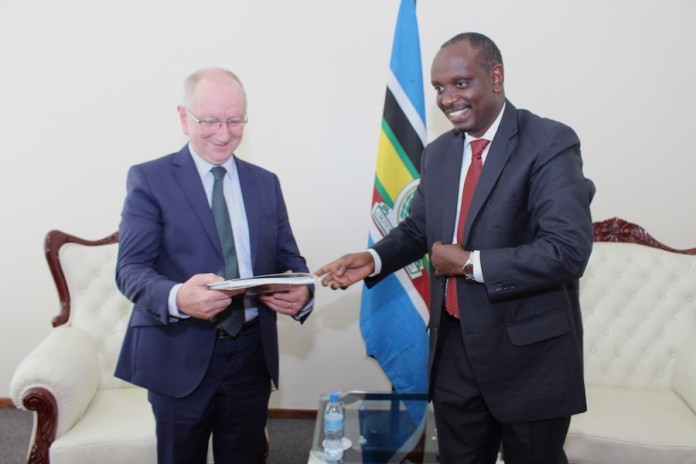
EAC Secretary General Dr Richard Sezibera with the Belgian Ambassador to the EAC, H.E. Paul Cartier, after they held talks on bilateral cooperation between the EAC and Belgium at the EAC Headquarters in Arusha, Tanzania.

The European Union (EU) and Belgian envoys to the East African Community (EAC) have pledged to support the regional body’s activities.

The EU Ambassador to Tanzania and the EAC Roeland van de Geer Paul and his Belgian counterpart Paul Cartier made the pledges as they separately presented their credentials to EAC Secretary General Amb Dr Richard Sezibera, in Arusha, Tanzania.

Amb van de Geer noted that the EU’s assistance to the EAC was broad covering almost all sectors of the integration agenda, reaffirming that the EU would continue providing this support. He urged the EAC to identify and prioritize the areas in which it would require increased support from the EU.

Amb Sezibera and Amb van de Geer agreed to hold bilateral talks to re-examine the cooperation framework between the EAC and the EU with the goal of making improvements, with technical teams from both sides exploring areas for future cooperation.

Amb van de Geer conveyed the EU’s condolences to the EAC and the family of the late Ms. Isabelle Wafubbwa, the Principal Political Affairs Officer, at the Community who passed on recently. He described Ms. Wafubbwa as having been instrumental in cooperation between the two regional economic communities especially in the field of political integration.

On his part Ambassador Cartier said his country was keen on strengthening her relations with the Community, by being part of the solution to various challenges facing the EAC.

In his remarks, Dr Sezibera thanked the Belgian government for her offer of additional support to the EAC, adding that a framework of agreement for cooperation will be developed between Belgium and the Community.

The Secretary General hailed Belgium for her contribution to the Partnership Fund, which has enabled the EAC to undertake programmes and projects in various sectors.

Stories Continues after ad

Minister Opendi to lead campaign against infertility stigma in Uganda

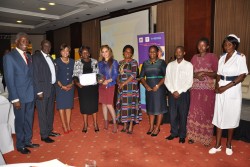
Group photo with Fertility patients and Minister of Health , Sarah Opendi and Hon. Betty Amongi, MP

Merck, a leading science and technology company, has announced the appointment of the State Minister for Health Sarah Opendi, as the ambassador of “Merck More Than a Mother” campaign in Uganda in recognition for her support and efforts to reduce the stigma of infertility and raise awareness about the condition in the country.

The announcement was made at the launch of its second “Merck More than a Mother” campaign in Africa and for the first time in Uganda as part of the Merck Capacity Advancement Program.

Minister Opendi said the country was happy to partner with reputable and innovative companies like Merck.

“We believe that improving access to regulated and equitable fertility care is important, but it is even more important to intervene to decrease stigmatization and social suffering arising from this condition” she said at the launch.

The campaign was first implemented in Kenya in 2015 and will be implemented this year in Uganda, in collaboration with the Ministry of Health, Africa Fertility Society (AFS) and the Uganda Women Parliamentary Association, and progressively rolled-out in more African countries.´

The campaign will provide training for embryologists and education for healthcare providers and will also support governments to define policies to improve access to safe and effective fertility care, address the need for interventions to reduce stigmatization and social suffering of infertile women and raise awareness about male infertility and the necessity for a team approach to family building among couples. Themed “Together we can create a culture shift”, the “Merck More than a Mother” social media campaign will challenge the social and cultural perception of infertile women in Africa. Moreover it will raise awareness about male infertility, prevention of infertility and infertility management at large.

“In some cultures, childless women still suffer discrimination, stigma and ostracism. As such, a central difficulty associated with infertility is that it can transform from an acute, private distress into a harsh public stigma with complex and devastating consequences. An inability to have a child or to become pregnant can result in being greatly isolated, disinherited or assaulted. This may result in divorce or physical and psychological violence. Therefore this campaign is very important for Africa since it aims to define interventions to reduce the stigma and social suffering of infertile women across the continent,” said Rasha Kelej, Chief Social Officer, Merck Healthcare.

Dr. James Olobo-Lalobo, Vice-President of Africa Fertility Society stressed: “Through this historic campaign, Merck More than a Mother’, we will challenge the perception about infertile women, their roles and worth in society, both within and beyond the medical profession in order to achieve any systemic shift in the current culture of gender discrimination in the context of fertility care.”

Through this campaign Merck, a pioneer in reproductive health, will address together with local stakeholders, the key challenges that are associated with resource-constrained settings such as prevention of infertility, education and self-development, regulation of assisted reproductive technology (ART) and in-vitro fertilization (IVF), geographic barriers, reproductive rights and over-population and limited resources arguments.

Dr. Oladapo Adenrele Ashiru, President of Africa Fertility Society explained: “In Nigeria where I practice, infertility is caused by infections in over 85% of women, like in the rest of Africa, compared to 33% worldwide which emphasizes the importance of prevention programs in Africa. Therefore our partnership with Merck is very essential to address this sensitive topic for the first time in the continent”. “We are going to host this important campaign in Nigeria and many other African countries this year,” he added.

Hon Joyce Lay, Member of Parliament and ambassador of the campaign in Kenya, has joined hands with Uganda Ministry of Health and Uganda Women Parliamentary Association to raise awareness about male infertility. “In order to improve access to safe and effective fertility care, a discussion with the relevant authorities will be needed to discuss the strengthening of infertility services, education, auditing, regulation, community awareness and the need to integrate them in programs which already exist in the local health infrastructure,” Ms Lay emphasized.

At the launch event, Merck awarded Berna Amulen, a Ugandan woman, who openly shared her story of stigmatization and suffering for being infertile. The award was in recognition of her courage in creating awareness and sharing her devastating experience so that no other woman would suffer the same.


Stories Continues after ad

EAC Presidents to discuss South Sudan admission

Swedish Ambasador to the EAC Katarina Rangnitt holdstalks with the EAC Secretary General Amb Dr Richard Sezibera

The 17th Ordinary East African Community (EAC) Heads of State Summit is scheduled for February 29, in Arusha, Tanzania, with top on the agenda the consideration of reports by the EAC Council of Ministers on the negotiations on the admission of the Republic of South Sudan into the Community.

Other issues to be discussed include Sustainable Financing Mechanisms for the EAC, the EAC Institutional Review, and Council reports on: the Model, Structure and Action Plan of the EAC Political Federation; Implementation of the Framework for Harmonized EAC Roaming Charges; Modalities for Promotion of Motor Vehicle Assembly in the region and Reduction of the Importation of Used Motor Vehicles from Outside the Community, and; the Promotion of the Textile and Leather Industries in the region, and stopping importation of Used Clothes, Shoes and Other Leather Products from outside the region.

The Summit is also expected to deliberate on a report by the Council on the verification exercise for the admission of the Republic of Somalia into the EAC.

The Heads of State are expected to launch the new International East African e-passport (electronic-passport) during their meeting.

The Summit will be preceded by a meeting of the EAC Council of Ministers that will take place

Meanwhile, Sweden has pledged to continue supporting the East African Community integration process, with
the Swedish Ambassador to Tanzania and the EAC Ambassador Katarina Rangnitt, saying cooperation among the five EAC Partner States was crucial to relations between Sweden and East Africa.
Amb Rangnitt was speaking when she presented her credentials to the EAC Secretary General, Amb Dr Richard Sezibera at the EAC Headquarters in Arusha, Tanzania.
Sweden has over the past nine years disbursed generous financial support amounting to 7,225,155 Swedish Kroner (US$851,676) to the EAC, monies that have been channeled through the EAC Partnership Fund.
Welcoming the Swedish envoy, Amb Dr Sezibera thanked Sweden for her support to the Community over the years noting that the Swedish support has been used for among other things the negotiations of the Economic Partnership Agreements between the EAC and the EU as well as boosting the health sector in the region.
Amb. Sezibera said the Partnership Fund has been used to finance not just the activities of the EAC Secretariat but the Community’s specialized institutions such as the Lake Victoria Basin Commission and the Inter-University Council of East Africa.
The Secretary General briefed Amb. Rangnit on the progress of the EAC integration saying the Community had made many achievements since the signing of the Treaty for the Establishment of the EAC on 30th November, 1999.
Amb. Sezibera said the EAC was seeking to ensure that the regional airspace was a unified territory throughout East Africa.

“As we increasingly become an effective Customs Union on the ground, we shall have to do the same for East Africa’s Airspace,” he said, adding that you cannot have a Customs Union on the ground only.

The Secretary General said the Community requires a lot of support to facilitate trade in services noting that significant progress had already been recorded in the free movement of goods as enshrined in the Common Market Protocol.

He pointed out other achievements as the reduction of Non-Tariff Barriers to the free movement of goods, the convertibility of the Partner States national currencies and cooperation in the development of infrastructure.

“Our Infrastructure programmes are largely on track. Many of the One Stop Border Posts have been completed, and are being operationalized. I congratulate the Partner States for ratifying the One Stop Border Bill, and the Axle Weight Control Bill. This puts our Community in good stead to strengthen the operations of our Customs Union,” he said.

He disclosed that the EAC Heads of State Summit had agreed on a 10-year Infrastructure Development Strategy which among other things lays emphasis on public-private partnership investments in railways, roads, ports and energy in the region.

Amb Rangnitt was accompanied by Mr Ludvig Bontell, the Political and Commercial Affairs attaché at the Swedish Embassy in Dar es Salaam.

Stories Continues after ad

AU presidential mediation team for Burundi

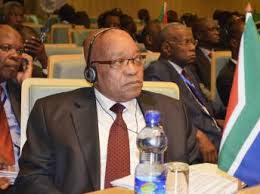
South Africa President Jacob Zuma at the African Union Summit, 2016. Zuma will lead a five-man team to Burundi

Five African Presidents designated by the African Union to find a lasting solution to the escalating political standoff and violence in Burundi are expected in the country between February 25 and 26.

According to media reports South Africa President Jacob Zuma is expected to lead his counterparts: Muhammad Ould Abdel Aziz of Mauritania; Macky Sall of Senegal; Ali Bongo Ondimba of Gabon and Hailemariam Desalgn of Ethiopia ‘to assist with addressing the political situation’.

Burundi descended into unrelenting violence last year, following the announcement by President Pierre Nkurunziza, that he would seek another term in office after the expiry of a ten-year tenure, enshrined in the country’s Constitution.

The visit of the AU presidential team that was tasked by the 25th Africa Union Summit of the Heads of States in early February will follow that of UN Secretary General Ban Ki-moon, who arrived in the strife-ravaged country today and is expected to hold talks with President Nkurunziza tomorrow. Nkurunziza has already rejected plans by the African Union to send peacekeepers to ease tensions in the Great Lakes nation, which diplomats fear is sliding toward another civil war.

More than 400 people have been killed since April when Nkurunziza said he would run for a third term, a move opponents dismissed as unconstitutional and sought to prevent by staging street protests.

And now both the United Nations and the African Union are under intense pressure to halt the violence that has engulfed Burundi a decade and a half after the country’s belligerent opponents signed a peace agreement in Arusha, Tanzania in 2000.


Meanwhile, three people were today killed in gun and grenade attacks in Burundi, just hours before the arrival of Ban Ki-moon, who is trying to end the bloodshed over President Nkurunziza’s disputed re-election.

No group has claimed responsibility for the attacks but the government says there are now three rebel outfits fomenting violence, including two made up of renegade soldiers.

The opposition also accuses government troops of arbitrary arrests, disappearances and extra-judicial killings.

Stories Continues after ad

Pioneer buses off city roads

Pioneer buses at Namboole Stadium after they were ordered off the roads

Pioneer buses that operate from the city to the suburbs of Bweyogerere, Luzira and Mutungo-Biina are today off the city roads.

Early today, when the Eagleonline visited their main loading centre at the Constitutional Square, the orange-coloured buses were not lined up, with some of their spaces instead occupied by the green-coloured Awakula Ennume, another fleet operating under the defunct Uganda Taxi Operators and Drivers Association (UTODA).

By press time it was not possible to establish the cause of the Pioneer bus absence or when the buses would resume operations but commuters alluded to the long-standing monetary stand-off between the bus company, the Kampala Capital City Authority (KCCA) and the Uganda Revenue Authority (URA).

Efforts to get comment from the KCCA Spokesperson Peter Kaujju and his deputy Kalumba were futile by press time.

The fragile relationship between the Pioneer Easy Bus Limited (PEBL), KCCA and the Uganda Revenue Authority (URA) can be traced back to the introduction of the buses on the city roads in 2012, when the tax body and the city authorities expressly cleared the buses to operate on their designated routes without completing registration, following a strike by taxi operators against a monthly fee of Shs120.000 levied by the KCCA.

However, in the ensuing period there developed some financial and contractual misunderstandings between the three organisations, leading to the suspension of the PEBL commuter operations.

Then, the tax body was demanding Shs8 billion from PEBL, and had threatened to auction of about Pioneer 100 buses.

Meanwhile, earlier at inception the bus company had also encountered problems when authorities in Mukono and Kira Sub County petitioned Parliament to suspend the operations of PEBL, in a bid to pave the way for the sharing of the monthly revenues with Mukono, Kira and the KCCA.

Stories Continues after ad

Juba wants referendum over ‘new states’

South Sudan Information Minister Michael Makuei Lueth

The South Sudan government has come out with a proposal seeking to conduct a referendum to determine the number of states through which the country should be governed in a move which is not provided for in the peace agreement it signed with opposition factions in August last year.

Speaking at a public briefing over the weekend in the national capital, Juba, information and broadcasting minister, Michael Makuei Lueth, said the government would not revoke the decision of the president to create more states unless a nationwide referendum is conducted to determine the number of states.

The government official spokesperson was reacting to criticism at the Sunday occasion by Ismail Suleiman, the Secretary General of the Communist Party in South Sudan, who questioned the basis of the creation of 28 states.

According to Suleiman, the government should revoke the creation of more states and return the country to be governed through 10 states which are constitutionally recognized by the agreement and 2011 transitional constitution.

“If you look at how this issue of 28 states came out, you see that nothing was followed. There were no criteria used. Some people just decided to go to the president and told him to create more states and he did it because these are the people who are close to him,” said Suleiman.

“But that is not how the country should be run. He is not the president of individuals. He is the president of the whole country and when there is something to be done for the country, the whole nation should be consulted so that the views of the people are heard because this is about their affairs. It is not about individuals,” he further charged.

But in an attempt to defend the decision of the president, minister Lueth claimed the decision was made because it was a popular desire and the government was now ready to allow the people to decide on the number of states they wanted.

The minister claimed that the government led by President Salva Kiir and armed opposition of SPLM-IO led by Riek Machar were on the same page on creation of more states but differed on the number of states to be created.

“We have to be very clear. The SPLM-IO had not dropped its proposed 21 states as it is claimed by others. When the SPLM-IO members of the advance team came to Juba, they sent the list of 21 members going to 21 states. If the SPLM-IO talks of 21 states and the government created 28 states, then all of us have agreed on the creation of states,” Lueth explained.

“We only differ on the number but opened for increment and this can be done through participation of the people. There will need to be a referendum so that the people themselves decide at the referendum the number of states they want,” he said.

Lueth added that if they decide to increase the number or reduce then that will be decided by the outcome of the referendum, adding that he believes the people will demand for more states.

During the peace negotiations in Addis Ababa, SPLM-IO proposed creation of 21 states based on 21 old colonial districts with their historical boundaries. The government however refused creation of more states, saying it was not time to create more states or to establish federal system of governance.

However, 39 days after signing the August 2015 peace agreement based on the 10 states, the government unilaterally decreed the creation of 28 states. The decision attracted condemnation from opposition and international community which called for the government to suspend their operationalization until a boundary commission agrees on the number of states and their boundaries.

According to a communiqué released by IGAD, which mediated the peace agreement, if the parties will not agree on the number of states, they will revert to the 10 states.

However, there is no provision for a referendum in the peace agreement.


Stories Continues after ad

Ban Ki Moon expected in Juba Thursday

UN Secretary General Ban Ki Moon is expected in the South Sudan capital, Juba, Thursday, his second visit since the country gained its independence in 2011.

Ban’s visit comes as implementation of the peace agreement signed last August between President Salva Kiir and his former vice president, Riek Machar, is proceeding only slowly.

Machar, the South Sudan Vice President designate, has reportedly said he will only travel to Juba to form a national unity government when nearly 3,000 of his troops and police are in the capital, with a further 1,200 police deployed to Bor, Malakal and Bentiu.

South Sudan’s information minister, Michael Makuei, said the government would update the UNSG about the efforts being made in the implementation of the agreement up to this moment. He also added that the SG will be informed ‘about the role of the United Nations Mission in the Republic of South Sudan (UNMISS) and what they are doing’.

“The government of the Republic of South Sudan highly welcomes the visit of the Secretary General because this is where he will get the real facts on the ground. It seems very clear he is expressing his disappointment but it seems it’s not clear to him who is responsible for the delay in the implementation of the agreement,” Makuei added.

He also said another condition being made by Machar is there must be conducive atmosphere in Juba before his return to the capital but hastened to add that the vice-president designate is not the one to determine when conditions are conducive in the capital.


Former Botswana president Festus Mogae, who is chairperson of the Joint Monitoring and Evaluation Commission – the head of an international group monitoring South Sudan’s peace process – told the UN Security Council last Friday he will propose security arrangements to spur the return of rebel leader Machar as vice president.

Mogae said the return of Machar is a critical step to launching a national unity government that would eventually deal with South Sudan’s rising violence and ‘humanitarian catastrophe’.

Mogae also told the UN Security Council a deadly attack last week on a UN peacekeeping compound where civilians had taken refuge in Malakal, the capital of oil-producing Upper Nile state, demonstrated the continuing violence in South Sudan.

He also pointed to a worrying escalation of fighting in Western Bahr El Ghazal and Western Equatoria.

Mogae said the large deployment being requested by Machar does not comply with a prior agreement on security arrangements.

“I plan to offer a compromise proposal on security arrangements for Juba sufficient to ensure security for Dr Machar to return, and which would consequently allow for the formation of the transitional government,” Mogae said.


Stories Continues after ad

This is a creeping military coup-Besigye


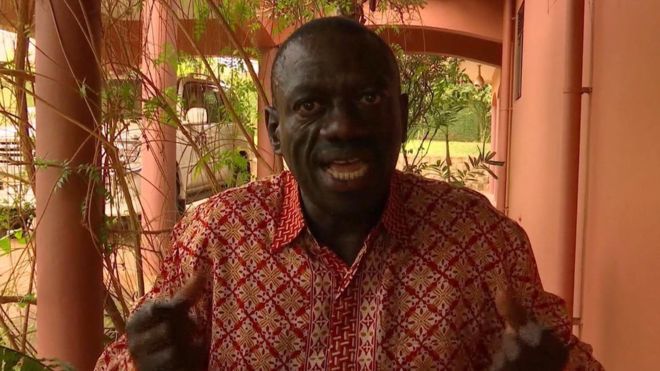
Kizza Besigye took 35% of the vote

The main opposition leader in Uganda, Kizza Besigye, has rejected the result of Thursday’s elections, in which President Yoweri Museveni won a fifth term of office.

Mr Besigye, under house arrest since Friday, said Ugandans had seen “the most fraudulent electoral process”.

He described the poll as a sham and a creeping military coup.

President Museveni, in power for 30 years, received nearly 61% of the votes, with Mr Besigye taking 35%.

Foreign observers say the poll was conducted in an atmosphere of fear and intimidation.

While praising the “remarkable determination” of Ugandans to vote, EU chief observer Eduard Kukan said the governing National Resistance Movement’s “domination of the political landscape distorted the fairness of the campaign”.

The election has been marred by sporadic violence and opposition allegations of electoral fraud, with social media sites and messaging apps blocked.

‘Military coup’

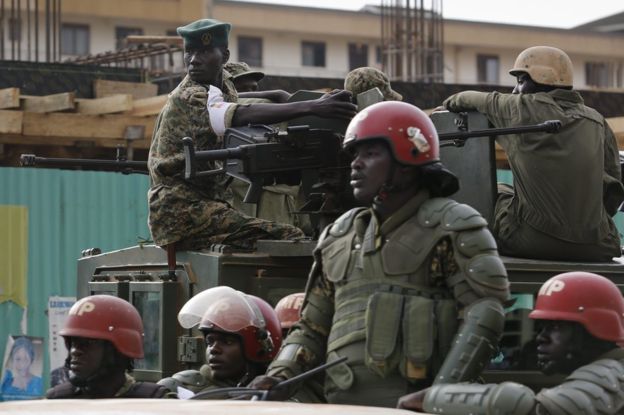
Security forces have been deployed in Kampala

“Today I am under house arrest,” Mr Besigye said in a statement.

“My home is sealed off and I am not allowed to leave. Nobody is allowed to access my home. I am also under some kind of electronic blockade. I am unable to access any form of internet service in my house.

“Generally, the regime is baring its bloodied fangs and claws for all to see. This has not been an electoral process. This is a creeping military coup.”

It was the fourth time Mr Besigye, candidate for the opposition Forum for Democratic Change, had taken on President Museveni.

The two men were once allies, with Mr Besigye serving as Mr Museveni’s personal doctor when they were guerrilla fighters.

He was placed under house arrest ostensibly to stop him announcing his vote score unilaterally.

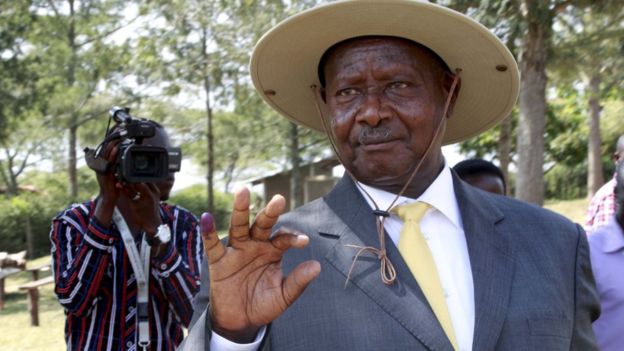
President Yoweri Museveni won a fifth term

Mr Museveni seized power in 1986 and is credited with restoring stability to Uganda. However, critics say he has become increasingly authoritarian.

The next closest challenger to Mr Museveni, former Prime Minister Amama Mbabazi, is also reportedly under house arrest.

The National Resistance Movement put out a statement celebrating the win, saying Mr Museveni’s opponents had “failed to offer any alternative”.


Stories Continues after ad

Museveni meets Obasanjo, Banda after elections


M7-Obasanjo

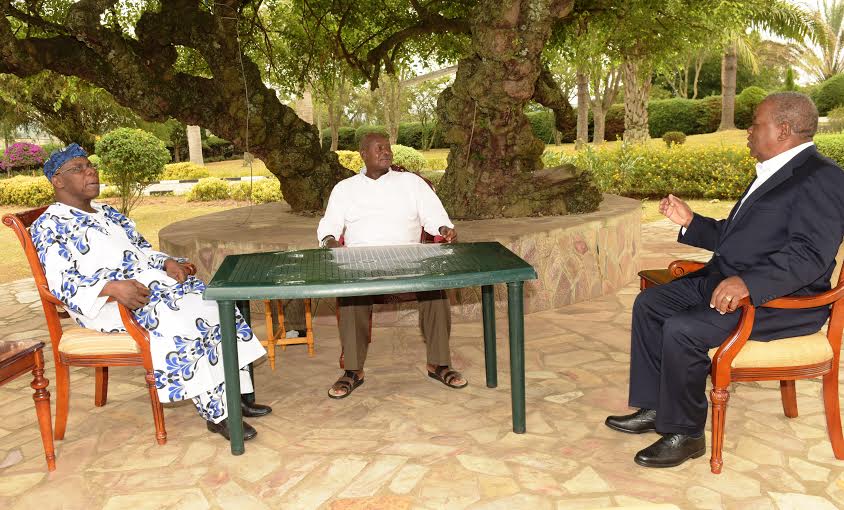
President Yoweri Museveni has met former Presidents Olusegun Obasanjo of Nigeria and Rupia Banda of Zambia at his country home in Rwakitura.

The two former heads of state are part of a panel of International Observers led by the Head of the EAC team and former Tanzania President, Mr Ali Hassan Mwinyi who is also in Uganda to monitor the both presidential and parliamentary elections.

M7-Obasanjo1

According to a press release from Ms Linda Nabusayi, the Presidential Press Secretary,Just as the two leaders arrived for the meeting,last evening, the Electoral Commission announced the Presidential results at exactly 4pm sending neighbouring villages into celebrations. The President paused to inform his guests that the celebrations were a result of the announcement by the EC of election results.


Stories Continues after ad