Stanbic Bank
Stanbic Bank
20.6 C
Kampala
Stanbic Bank
Stanbic Bank
Home Blog Page 2228

Presidential Debate still on – Ogoola

Ogoola speaking at a press conference at the Inter Religious Council (IRC) headquarters in Kampala earlier today


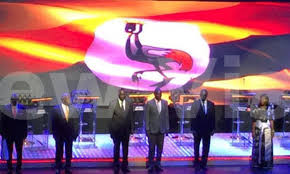
Retired judge Justice James Ogoola Munange has confirmed that the much-anticipated 2016 Presidential debate will be held on Friday as scheduled.

Addressing a press conference at the Inter Religious Council (IRC) headquarters in Kampala earlier today, Ogoola said the debate will not be cancelled due to the absence of some candidates.

“We are on for Friday; we are like a plane, we will take off with whatever passengers on board,” Justice Ogoola said, adding that “as far as we are concerned no candidate has told us of withdraw from the debate.”

He added that all participants will be availed with the research findings that the organisers, the IRC, had invited delegates from countries that have held debates before to help and advise.

“All candidates will receive surprise questions and the people of Uganda will know how their candidates react to surprise,” Ogoola said.

His remarks come at a time when most Ugandans speculated that the presidential debate will not be held. Last week two of the front runners, National Resistance Movement (NRM) candidate Yoweri Museveni and Forum Democratic Change (FDC) flag bearer Dr Warren Kizza Besigye pulled out of the debate claiming they did not have time.

Several prominent Ugandans have weighed in on the matter with FDC flag bearer’s wife Winnie Byanyima and former Uganda Investment Authority (UIA) boss Dr Maggie Kigozi, rooting for the debate to take place even without the two candidates.

In a related development Justin Kasule Lumumba, the Secretary General of the ruling NRM, has said that the party candidate Yoweri Museveni will not participate in the debate because of his busy campaign schedule.

“Let them change or accept the person we send to articulate our party interests,” Ms Lumumba was quoted as saying early today.

There are 8 candidates taking part in the February 18, 2016 elections, and the remaining six have confirmed participation in the debate.

Stories Continues after ad
FIFA fires Secretary General Valcke

FIFA Secretary General Jerome Valcke speaks as he attends a news conference during his visit to the southern city of Samara, one of the 2018 World Cup host cities, Russia, June 10, 2015. REUTERS/Maxim Zmeyev/Files

FIFA said on Wednesday it had fired Secretary General Jerome Valcke amid alleged corruption involving World Cup ticket sales, one of many scandals surrounding football’s governing body.

“The FIFA Emergency Committee decided, on 9 January 2016, to dismiss Jerome Valcke from the position of FIFA Secretary General with immediate effect,” Zurich-based FIFA said in a statement without giving a reason for the dismissal.

Valcke was once one of the most powerful men in FIFA and responsible for ensuring that preparations for the last two World Cups, in South Africa and Brazil, were completed in time.

An ethics investigation into the case recommended a nine-year ban for the Frenchman, former right-hand man to FIFA President Sepp Blatter who himself has been banned for eight years.

Last week FIFA’s ethics judges announced they had opened formal proceedings against Valcke, who has denied wrongdoing in the past.

Valcke was placed on leave by FIFA in September following the allegations and initially suspended for 90 days in October when the ethics committee started its investigation. That suspension was extended for another 45 days last week and a ban from all football activities remains in effect.

The secretary general’s duties will continue to be carried out by Acting Secretary General Markus Kattner, FIFA said.

Valcke has now been sacked twice by FIFA. He joined the organisation in 2003 as marketing director but was fired in December 2006 for his part in botched sponsorship negotiations with credit card firms MasterCard Inc and Visa Inc.

His case has been overshadowed by the turmoil which has engulfed FIFA in the last year, with criminal investigations into the sport in both the United States and Switzerland.

Altogether, 41 people and sports entities, including top FIFA officials, have been indicted by U.S. prosecutors for offences including corruption, fraud and money laundering.

Stories Continues after ad
Fastjet CEO steps down


Fastjet Chief Executive Director, Ed Winter has decided to step down but will remain in the post until a successor is appointed and stay on in an advisory capacity for an agreed period to assist with the handover of responsibilities and ensure an orderly transition.

Headhunters will be appointed to start the search for a new CEO and assist the board’s nomination committee to identify suitable candidates.

Chairman Colin Child said: “Over the past four years, Ed has made significant and sustained progress towards Fastjet’s goal of becoming Africa’s first true low-cost pan-African airline. Despite being confronted with numerous challenges, Ed has succeeded in successfully opening hubs in Tanzania and Zimbabwe, providing multiple domestic services, and has won international rights to fly from Uganda, Tanzania to South Africa, Zambia, Zimbabwe and Malawi.

Recent approval to operate flights to and within Kenya is also a major step forward in growing the airline’s route network.

“The board is enormously grateful to Ed for his leadership and expertise in launching fastjet and the pivotal role he has played in Fastjet’s development. He leaves with our very best wishes.”

Winter said: “I feel privileged to have had this unique and exciting opportunity to lead an incredible team in changing the face of African aviation. I am particularly pleased to have achieved the very significant launch of flights to Kenya this week, a milestone that I believe signals a major change in Fastjet’s ability to grow.

“We have built a great platform from which the Company can achieve its vision of being the first significant pan-African low-cost airline. Following four intensive years of work and overseas travel, I am looking forward to spending more time on my other personal and professional interests. Once the handover process is complete, I look forward to watching Fastjet’s continued progress.”

Stories Continues after ad
Uganda’s LRA kidnaps dozens in CAR


Lord’s Resistance Army rebels killed a villager and abducted dozens during two weekend raids in a remote diamond-producing area of Central African Republic, local residents and officials said.

The incidents represent the largest kidnapping by the Ugandan rebel group – headed by notorious warlord Joseph Kony – in recent months in the former French colony, which is also reeling from years of inter-religious bloodshed.

The LRA, known for massacring and mutilating civilians as well as abducting children to serve as fighters and sex slaves, raided a mine near the village of Diya, around 600 km (370 miles) east of the capital Bangui,on Saturday.

“In the first abduction, they kidnapped 10 people. Six were freed. The others are still with them. In the second abduction, around 20 people were taken and are still with the attackers,” said local government official Herve Omere Fei-Omona.

He said one person was also killed and a vehicle was burned during the attacks.

News of the kidnappings emerged on Tuesday due to the raids’ isolated location and Central African Republic’s poor communications infrastructure, made worse by violence between Muslims and Christians that has split the former French colony.

Local residents said the gunmen wore uniforms and did not speak French or the national language, Sango.

“Those kidnapped went to sell their products at the market in Diya and were kidnapped in order to carry what the LRA had looted in the village,” said local humanitarian worker Gaston Gazale.

After a military crackdown by Kampala, the LRA left Uganda about a decade ago and its fighters have roamed across lawless parts of Democratic Republic of Congo, South Sudan and Central African Republic ever since.

The United States has backed Ugandan-led regional military efforts to defeat the rebels, who are now believed to number just several hundred battle-tested fighters in addition to Kony and other leaders wanted by the International Criminal Court.

However, despite some progress, notably the surrender of senior commander Dominic Ongwen last year, the LRA continues its attacks on civilians.

Stories Continues after ad

US kid raises money for Uganda girl’s bladder surgery


A seven-year old kid in the United States has raised money to help in the surgery of one Allimeda, a Ugandan girl suffering from exstrophy, a condition where the bladder is outside the body.

Mick Hullinger, also suffered from the condition and was successively operated. He was touched by the girl’s situation after hearing that her parents had abandoned her. Hullinger started raising the funds in August last year; he raised all the funds needed for the surgery alone.

It was not possible to establish the amount of money raised by master Hullinger but the operation will be carried out on Friday at the Muljibhai Patel Urological Hospital, Nadiad, India by a team of 10 doctors from across the world.

Dr Mahesh Desai, director of the hospital, said Allimeda’s bladder is put inside the body after making a cavity in the pelvic area.

A US-based activist, head of Association for the Bladder Exstrophy Community, Pamela Block, notes that “it is inspirational for a kid who suffered bladder exstrophy helping another with the same condition.” Polly too adopted a girl from China whose bladder was outside her body.

Ms. Block says they opted for Indian hospitals because they are cheaper compared to other hospitals.

Bladder exstrophy is a condition that occurs in one out of seventy thousand people.


Stories Continues after ad

New S. Sudan cabinet members to be unveiled tomorrow

South Sudan cabinet


Parties to the South Sudan peace agreement signed in August 2015 willon Thursday for the first time reveal names of national ministers they have nominated to compose the membership of cabinet for a transitional government of national unity, the Joint Monitoring and Evaluation Commission (JMEC) announced.

In meeting with participation of all parties to the peace agreement chaired by JMEC chairman, former President of Botswana, Festus Mogae, the parties also agreed to allow unimpeded humanitarian access to all parts of the country.

The government, SPLM in Opposition (SPLM-IO), former detainees and other South Sudan political parties selected their respective ministerial portfolios last week. The exercise, seen as a breakthrough in implementing the peace agreement, was done through consensus.

The parties have not yet nominated their officials who will fill the selected positions of institutions, but this would now happen on Thursday.

“The Parties committed to naming their ministers for the Transitional Government of National Unity (TGoNU) by 14 January 2016, and that the TGoNU would be formed by 22 January 2016, as provided for in the implementation calendar issued earlier by JMEC,” said a statement from JMEC extended to Sudan Tribune on Tuesday.

“Additionally, the parties committed to the expeditious convening of the Strategic Defence and Security Review Board, to begin the vital process of security sector reform and transformation provided for in the Agreement on the Resolution of the Conflict in the Republic of South Sudan,” the statement added.

TGoNU will run for thirty months as a coalition government before elections will take place at the end of the transitional period in 2018..

JMEC added that the transitional government of national unity will be sworn in on 22 January, 2016.

Former vice-president and first vice-president designate, Riek Machar, is expected to return to the national capital, Juba, for formation of the government. It however remains unclear whether his forces will be deployed in the capital for his security before his arrival.


Stories Continues after ad

Kadaga roots for greater legislative independence in the Commonwealth

Speakers and Presiding Officers have been tasked to ensure they uphold the independence of their respective legislatures against interference from other organs of state.
Addressing the 23rd conference of Speakers and Presiding Officers of the Commonwealth in Kota Kinabalu, Malaysia, Uganda’s Speaker of Parliament Rebecca Kadaga noted that the operations of legislative institutions in most of the Commonwealth countries have been suffering due to the interference by the judicial process. 
‘’The organs of the State are different and have independent specified functions.  It is within the power of the legislature to exercise all functions conferred upon it. There are functions conferred on the Judiciary and the Executive by the Constitution which they are expected to perform in accordance with the Constitution,’’ Rt Hon Kadaga said.
Kadaga, who was contributing to a Keynote address on parliamentary privilege by the Speaker of the National Assembly of Zambia, Justice Dr Patrick Matibini, reiterated that the effective functioning of democracies depends heavily on the duty of the Speakers to remind MP of the powers and privileges that govern them.
The Speaker of the Rwanda National Assembly, Donatille Mukabalisa, re-echoed the need for Parliament to exercise its mandate without the fear of interference from political parties and the Executive.
The Speakers however, cautioned that even with Parliamentary privilege in place, it is also a duty for the MPs to protect the general interest of the nation and public.
Meanwhile, conference participants resolved to help MPs participate in plenary debates without fear of being sued or prosecuted.
Stories Continues after ad

Kenya steps up heat against evangelicals


The Kenyan government has turned the heat on evangelical churches in the East African country.

Through a raft of proposals that require all religious bodies to register and for preachers to have police clearance Attorney General Githu Muigai, said last week he would hold public consultations on the matter before drafting of the legislation.

The proposals include among others, all preachers having to undergo theological training at a reputable seminary; certification from the Ethics and Anti-Corruption Commission that clergy are not corrupt and, for foreign pastors to have a work permit and a recommendation from their government. Also, all religious institutions would also be required to submit their statements of faith to a government-backed body for examination.

According to the media, the proposals seem to target self-proclaimed Christian prophets and faith healers whose influence is growing, as well as Muslim preachers who promote extremism in a country where militant Islamist group al-Shabaab is active.

But the evangelical churches are up in arms against the proposals, with the Evangelical Alliance of Kenya condemning the move and saying it is aimed at stopping the growth of the evangelical churches.

“Registration of churches was stopped since 2014. We believe this is meant to stop evangelism and growth of the church since other societies are being registered freely,” said EAK chairman Bishop Mark Kariuki.

The EAK said it would launch a campaign to obtain three million signatures to block the government from enforcing the proposals, and Bishop Karuiki warned that the EAK would urge its followers not to vote for the government in elections next year if it implemented the proposals.

“2017 is very close and we will not hesitate to use those [voter] cards,” He said.

However, Anglican Church of Kenya cleric Bishop Beneah Salah welcomed the proposals as an attempt to end the ‘commercialisation’ of religion, and said government intervention was needed because the church was not in a healthy state.

“Horrible things are happening in the church today. There is a lot of commercialisation of the gospel with this prosperity gospel,” he is quoted by the media as saying.

“Perhaps God is using the state to punish the church as he did in the past, where he used kings or nations to discipline the church,” he added.

The head of the tiny Atheists in Kenya group, Harrison Mumia, said the government had a responsibility to protect desperate Kenyans from faith healers who took advantage of them.

Christians form the majority in Kenya, while Muslims are the second-largest group.

Their main body, the Supreme Council of Kenya Muslims, was also opposed to the proposals, warning they could violate ‘freedom of worship and amount to a clampdown on religious institutions’.

The Catholic Church – the largest Christian denomination in Kenya and to which President Uhuru Kenyatta belongs – has not yet commented on the proposals.

in Kenya

in a related development, last week Kenya’s Communications Authority published new broadcasting regulations which will ban preachers from soliciting money on air.


Stories Continues after ad

Half of S Sudan children not in school

The children of Martha Nyacong, who attends an adult learning session in a UNICEF supported school in the POC, walk to school with UNICEF school bags in Bor, capital of Jonglei State in South Sudan Wednesday, Dec. 3, 2014. The UNICEF supported school opens in the afternoons and the teachers volunteer to take adult literacy classes.

More than half of children in war ravaged South Sudan are not in school, the highest proportion in any country, UN children’s agency Unicef has said.

Niger is a close second, with 47% unable to attend school, followed by Sudan (41%) and Afghanistan (40%) and according to Unicef, some 24 million children of more than 109 million living in nations at war are not in school worldwide.

In South Sudan government forces have been battling rebels for the past two years, but according to Unicef, even before the conflict began 1.4 million children were already missing class.

Since the war broke out in December 2013, more than 800 schools have been demolished and more than 400,000 children had to abandon their classrooms, the agency said.

Only one in 10 South Sudanese students who enter school finish primary education amid a shortage of facilities and trained teachers, said Phuong T Nguyen, Unicef’s chief of education for South Sudan.

“There is a very, very low budget from the government to the education sector,” she said, adding: “It is not holding steady and we see a decline.”

Enrolment went up from under 30% after South Sudan became independent in 2011, but the war and a lack of school buildings and qualified teachers have slowed the growth, a South Sudanese official was quoted by the media as saying.

Stories Continues after ad

Odongo replaces Bukenya as UNEB boss

Mathew Bukenya [L] Outgoing and Odongo {R] Incoming UNEB Executive Secretary

Uganda National Examination Board has replaced long serving Executive Secretary Mathew Bukenya.

UNEB board named Bukenya’s deputy in charge of secondary Dan Nokrach Odongo as the incoming Executive Secretary.

Mr Bukenya has been heading Uneb for the last 17 years but his position had been advertised in 2013 amidst reports that President Yoweri Museveni had verbally ordered its renewal for another term. The then Uneb Chairman Fagil Mandy had decided to carry on with the recruitment process which met resistance from the Ministry of Education top officials.

Mr Bukenya retired as an accountant in Uneb after clocking 60 years but was recalled in 1997, after a year in retirement to act as secretary.

Eagle Online, has seen a copy of the letter written by Education Minister Jessica Alupo to UNEB chairperson, Prof. Mary Okwakol in which she acknowledges receiving her letter on the same matter.

Maj. Alupo was replying an earlier letter written by Prof. Okwakol presenting Dan Nokrach Odongo as the best candidate for the job. Okwakol in her letter did indicate that “Mr Odongo” emerged the best in interviews after beating other candidates.

Stories Continues after ad