Stanbic Bank
Stanbic Bank
17.8 C
Kampala
Stanbic Bank
Stanbic Bank
Home Blog Page 2237

Museveni hails URA on fighting sub-standard goods

Kisoro5

  • Popes visit was blessing, campaigning for NRM is a joy

President Yoweri Museveni has has urged Ugandans to join hands and declare the year 2016, a year of prosperity and of building a strong foundation to secure Uganda’s future.

In a New Year message, the President called on Ugandans to love one another, celebrate our diversity and resist division and stay united to achieve greatness.

“If we love one another, celebrate our diversity, resist division and stay united, we will achieve greatness. Let us all join hands and declare the Year 2016 to be our year of prosperity. The year of building on the strong foundation we have laid to secure Uganda’s future. I wish you a happy and prosperous New Year,” he said

The President who later addressed a press conference at Kisoro State Lodge said he was happy about two this in 2015; the Pope’s visit and the fact that he is campaigning happily for the NRM party.

“The Pope came here, I was not excited but I was happy. His Holiness came here and blessed my people and also blessed me. This is one of the exciting campaigns for the NRM in 2015 especially in the countryside. At the rallies people turn up in large numbers that I find it hard to exit from the next rally. You see these people walking on foot in large numbers. This is because of the small contribution we have made for our country,” he said.

President Yoweri Museveni who is currently in Kisoro soliciting for votes has urged Ugandans to join hands and declare 2016 a year of prosperity, building on strong foundation that has been laid in order to secure the country’s future.

On political lies, Museveni said people aspiring to be public leaders and yet tell lies are bad news for the country.

“Telling lies is worse for the country. A president is next to God you just don’t go around telling lies. When you say you want to be President, but just go around telling lies, that is not good for the country. When I hear people saying veterans are not yet paid, yes I know it, I’m a veteran myself. Why didn’t you pay veterans at one go? It’s because we had to get electricity,” he said.

On whether he received an invitation to the Presidential debate, the President said his staff have not informed him about it.

“I don’t know. My staff have not told me about it (presidential debate suggested by interreligious council). I have four rallies a day, I don’t know about the time. Debating! I have no problem with debating, because I was president of the debating society in 1965,” he said.

On election violence, the President said government will not tolerate civilian to civilian violence.

“The state is there, it should be there to discipline those indiscipline people. When I’m moving around I see FDC people making signs to me, I do this (Thumbs up) to them. Just settle down convince your people. If they vote for you or not just wish them luck,” he said.

On the fight against corruption the President said it will be fought by integrity hunting.

“The Permanent Secretaries should be the watchdog. Initially I didn’t interfere because I thought the system would sort itself.  In KCCA you don’t know how much trouble I took to put Musisi, ooh, ooh, ooh. It was a war with Mayor Lukwago, the councilors, but now you can see the change in Kampala,” he said.

The President said the Uganda Revenue Authority Executive Director Doris Akol was fight a war on sub-standard products.

“The country had been turned into a cheap market of all sorts of useless things from abroad. When the shilling was losing value it was because of importation of all sorts of things. Imagine someone importing hair. My daughters, all this hair you import from abroad is for what? You’re killing our market with some other people’s goods which are not being taxed,” he said.

President Museveni said that the strategic goals of the people of Uganda and their African brothers and sisters should be, prosperity and strategic security. He pointed out that the prosperity aimed at is through production and not through parasitism.

He highlighted NRM achievements especially from 2006 when government resisted spending on consumption in favor of development and wealth creation. He said through prioritization,

the NRM government has been able to implement special programs like roads, electricity, education and health as well as successfully  implementing immunization program among others.

He castigated presidential aspirant like Kiiza Besigye who chose to visit a hospital not yet rehabilitated and lying to the public and not pointing out the many other hospitals that the NRM government has rehabilitated.

Stories Continues after ad

Uganda to become middle-income country by 2019- Museveni


Uganda will become a middle income country in the next five years and an upper middle income country by 2040, President Yoweri Museveni has said.

In an end of year message to Ugandans, Mr Museveni said his government had prioritized six key areas which will spur development and these include defence and security; health with emphasis on immunization; universal education with skills training; roads; electricity and information communication technology (ICT).

‘The UPDF has ensured total peace in the whole country by defeating Kony, defeating ADF and disarming the Karimojong warriors.  There is now total peace in the whole length and breadth of Uganda’ Mr Museveni said of defence and security.

On economic integration the President noted that through regional blocs like the EAC and COMESA had contributed to the sustained development under the NRM government since 1986, with a consumer market of 150 million and 400 million people created in the two economic blocs, respectively.

‘When we talk of prosperity, we are talking of prosperity through production and not through parasitism.

It is this realization by the NRM and its precursors that the most fundamental legitimate interest of the people is prosperity that led us to evolve the principles of patriotism and Pan-Africanism’ Mr Museveni wrote in 13-page message.

Enumerating the key developmental indices Mr Museveni said there would be a government secondary school in all the 1500 sub counties; a technical school in every constituency and professional colleges at the regional and national level.

Further, the President noted, that the literacy rate had risen from 43 per cent in 1986 to 75 per cent today, with 11 million people attending all levels of education including university education, which today has seen the emergence of 32 universities, up from only one (Makerere University) in 1986.

On roads, Mr Museveni stated that 20 major roads across all regions of the country would be tarmacked in the next five years, adding that progress has already been registered with some of the roads. He also said the Standard Gauge Railway (SGR) would be constructed to ease transportation in the EA region.

On agriculture, Mr Museveni urged Ugandans to avoid land fragmentation, and instead focus on irrigation and the use of fertilisers to boost production through both large and small scale commercial farming.

‘I, again, advise Ugandans to stop dividing the land and the wealth as a consequence of inheritance and only divide the net income from the land and the wealth (after removing costs) among the beneficiaries. As we wake up to the importance of commercial agriculture, we shall discover the need for irrigation,’ he noted.

He however, decried the low consumption and absorption levels of the products, giving an example of milk and maize. Of the two billion litres of milk produced annually in Uganda, only 800 litres are consumed, while only one million tonnes of maize, out of 4 million tonnes produced annually are absorbed in the region, he stressed.

Mr Museveni also noted that the country would soon have a cheaper and better supply of electricity to boost the much-needed industrialization drive, following the completion of the Karuma and Isimba Hydro electricity projects, which will sell a unit at US cents 5 and 4.8, respectively.

‘With increased supply of affordable electricity, we are on the verge of large-scale industrialization, starting with value addition to all our agricultural product and minerals.  Our people are now educated and can run manufacturing enterprises.  With the expanded Innovation Fund, we shall support as many of our groups, mainly youth or women, to process as much of our agricultural products as is necessary,’ the president underscored, and disclosed that on completion of the Ayago dam the country would produce 4356 megawatts of electricity by 2035.

Other sectors of interest that will boost development, he said, are oil and gas exploration; safe and piped water distribution; youth skilling; service delivery and tourism.

Full message below.

Fellow Ugandans,

I greet all of you and congratulate you on finishing 2015 and wish you a prosperous 2016. I extend condolences to the families who lost their dear ones in the year that is just ended.

The UPDF has ensured total peace in the whole country by defeating Kony, defeating ADF and disarming the Karimojong warriors.  There is now total peace in the whole length and breadth of Uganda. 


The strategic goals of the Uganda people and their African brothers and sisters should be: “prosperity and strategic security”. When we talk of prosperity, we are talking of prosperity through production and not through parasitism. 

It is this realization by the NRM and its precursors that the most fundamental legitimate interest of the people is prosperity, that led us to evolve the principles of patriotism and Pan-Africanism.

In pursuit of the need for the prosperity of our people, the NRM stands for patriotism within Uganda (rejecting sectarianism of religion or tribe and gender chauvinism) and for Pan-Africanism in Africa. 

With economic integration, in search of prosperity, we aim at the formation of the common market of the whole of Africa.  We have already succeeded in the resurrection of the EAC and the formation of COMESA. Uganda will become a middle-income country by 2019 and an upper middle income country by 2040.

The ultimate security means the ability to guard our Sovereignty by, if necessary, defeating any aggressor on the globe.   The guaranteeing of our sovereignty should not depend on anybody else except ourselves and some like-minded allies of similar interests and a common destiny, if necessary.

We always talk of transformation – Society moving towards a middle-class and skilled Working Society.

NRA has been fighting against the disorientation of failing to prioritize and trying to be everywhere and ending up being nowhere.  Trying to do everything and ending up doing nothing. Where we successfully resist such disorientation, we make good progress.  Since 2006, we started resisting the mistake of spending on consumption before we spend on development and wealth creation. We were also able to prioritize among priorities.


As for the roads, by combining our own funds and some limited funds from outside, I am in a happy situation to inform the Ugandans that all the major roads will be tarmacked in the next five years or less.

These are: 

Moroto-Nakapiripirit; Ishaka-Kagamba; Mpigi-Kanoni; Kanoni-Sembabule-Villa-Maria; Musita-Lumino-Busia; Olwiyo-Gulu; Gulu-Acholibur; Acholibur-Musingo; Mukono-Kayunga-Njeru; Mukono-Kyetume-Katosi; Mubende-Kakumiro-Kagadi-Ndaiga; Mbarara-Kikagate; Tirinyi-Pallisa-Kumi; Hoima-Kigoroobya-Biiso-Wanseko; Masindi Port-Apac-Lira-Kitgum; Kapchorwa-Bukwo-Suam; Mbale-Maghale-Lwakhakha; Rukungiri-Kihihi-Ishasha; Atiak-Moyo; Moroto-Kotido-Kaabong; etc., etc.

Some of the above mentioned roads are already completed, some are on-going and others will be commenced on later.  It is unprecedented in the history of Uganda to have so many roads being worked on at the same time and most of them being funded by the Government of Uganda. 

With the railway, we are going to build a Standard Gauge Railway either with a soft loan from China or, later, using our oil money.  The ICT backbone has been done with a loan from China.

On the side of human resource development, we have gone far.  The immunization has stopped our children from dying young.  The infant mortality rate is now 54 per 1000 live births. It used to be 156 per 1000 born alive babies in 1986. 

On my advice and strong insistence, the NRM Parliamentary Caucus and Cabinet, following the Conference of Statistics House in 2006, prioritised six areas: Defence and Security; Health, especially immunization; Education, including the innovation of UPE, USE and UPET – i.e. mass education as opposed to elite education; the roads; electricity; and ICT. 

Our line since 2006 was: “spend something everywhere but spend decisively in some sectors”.  As a consequence of this, we boosted the budget for the roads from 398 billion shillings (2005/06) to the current level of 3,442 billion shillings (2015/16). The budget of energy from 178 billion shillings (2005/06) to 2,858 billion shillings (2015/16); the budget of Education from 634 billion shillings (2005/06) to 1,360 billion shillings; the budget of Health from 510 billion shillings (2005/06) to 1,328 billion shillings (2015/16); the budget of Defence from 350 billion shillings (2005/06) to 1,565 billion shillings, etc., etc.  Yet the budget of water is still 547 billion shillings (2015/16); Agriculture and NAADS is still 815 billion shillings (2015/16); the Ministry of Gender, including the money for the Elderly, the Youth fund etc. is still 153 billion shillings; the money for restocking and cattle compensation is still 20 billion shillings (2015/16); and the money for veteran pensions is 70 billion shillings (2015/16). 


On account of prioritization, we are delivering on the infrastructure. By building Karuma, Isimba and a number of small mini-hydros, our generation capacity will, by 2020, stand at 1,974 megawatts compared to the 60megawatts of 1986.  With Ayago, our generation capacity will go to 4,356megawatts, by 2035. 

Our petroleum plan is to build a 60,000 barrel per day, refinery, expandable to 120,000 barrels per day.  Apart from getting our own petroleum, diesel and kerosene for aviation fuel, the residuals will feed the petro-chemical industries so as to produce plastics, fertilizers (again, but from another source) and pharmaceuticals.


Some of the oil will be exported through the pipeline.  Even if we are to sell only 120,000 barrels per day, according to a price of US$60 per barrel, that will give Uganda an additional income of about US$ 3 billion.  This money will be dedicated to infrastructure, science innovation and some of the high level science education institutions.  It is considerable.  We have been doing so much with so little.  What will happen now that we are getting quite abit of additional money?


On the side of education, phenomenal achievements have been realized.  About 11 million Ugandans are now in schools – primary, secondary, tertiary and university.  The literacy rate has risen from 43% in 1986 to 75% today. We now have a total of 1,078 government secondary schools in each of the 971 sub-counties.  In the next five years, we are going to have a Government secondary school in all the 1,500 sub-counties of Uganda.

However, literacy and numeracy must be accompanied by technical skills.  We are, therefore, going to build a technical school per constituency in addition to some professional colleges at national and regional levels.


Pursuing mass education as opposed to elite education, we have increased classrooms in permanent materials from 40,440 in 1986 to 104,906 today; we recently repaired 648 secondary schools and built 132 brand new secondary schools; we have expanded University Education from one university in 1986 (Makerere) to 32, both government and private universities today; and we are expanding technical and vocational training. 


Right from the resistance days, we realized that without the industrialization of our country, the future was bleak if not doomed.  For many decades, Uganda has been losing money and jobs to the outside countries such as UK in the past and to China today. 

A kilogramme of ginned cotton sells at US$.1.37.  The same kilo turned into yarn sells at US$ 3.  That yarn woven into fabric sells at US$5; and the final garments from the original one kilo of lint cotton, would sell at US$ 8-10.  Therefore, by selling only lint cotton (i.e. after ginning), we are losing the spinning jobs, the weaving jobs, the printing jobs and the tailoring jobs, apart from getting only US$1.37 out of a total of the eventual value of US$.10.   What is true of cotton is true of coffee, oil seeds, copper, gold, etc.  This is the modern slavery that must be ended. 

By, correctly, prioritising infrastructure, we are now able to support our manufacturers – local or foreign sourced.  I am glad the power from Karuma will be 5 US cents per unit.  The one from Isimba will be 4.8 US cents per unit.  Unfortunately, the one from Bujagali has been 10.1 US cents per unit.

By ensuring peace and developing infrastructure, we have also laid the basis for the developing of our huge services sector.  Our huge and incomparable tourism sector, starting at the very low base of 47,000 visitors in 1986 and bringing in only US$ 6.5million dollars per annum, now attracts 1.4 million visitors per annum and earns US$ 1.4 billion per annum. 

I am told that there has been a slow-down of tourists because of the ignorance in the West, US and Europe, where the Ebola outbreak in West Africa scared tourists from coming to Africa. Our tourist authorities should inform all and sundry that Uganda is a World Leader in combating Ebola. 

These factors should be put out clearly by those concerned. The other services such as Banking, Insurance, the Professional services, etc., are developing well.  Indeed, the sector is growing at the rate of 5.3% per annum.

On the issue of ending the bottleneck of market fragmentation caused by colonialism, with the support of our brothers and sisters in the EAC and COMESA, we have created a market of 150 millions in the EAC and 400 millions in COMESA.

Indeed, the surplus of our milk production (2 billion litres while the consumption in Uganda is only 800 million litres) or maize (4 million tonnes while consumption in Uganda is only 1 million tonnes), is being absorbed in the region.

Uganda is very well endowed for agriculture.  Strangely, however, many of the families in agriculture have been living in poverty, just on account of ignorance, mainly, complicated by problems of poor leadership and some parasite arrangements in some parts of the country. 

I congratulate all Ugandans because when I fly over Uganda nowadays, I notice a spirit of Okusiimuka, Kuzukuka, Co (Acholi), Okwenyu (Ateso), Akenyun (Karamoja), Enga-oduasi (Lugbara), all of which mean “waking up”. What do I mean by “waking up”? The “waking up” I am talking about is more and more Ugandan families entering small scale commercial farming with “ekibaro”, “Cura”, “Otita”, “Aimar” ─ i.e. with the aim of maximizing financial returns per acre as we have been recommending to you ever since 1995.

On the issue of land fragmentation, I, again, advise Ugandans to stop dividing the land and the wealth as a consequence of inheritance and only divide the net income from the land and the wealth (after removing costs) among the beneficiaries (Abasika, abahunguzi, okakare, olewange).

As we wake up to the importance of commercial agriculture, we shall discover the need for irrigation.  Where will the water for irrigation come from if we have dried the swamps?  This is what we discovered in Kabale with the apple grower in Rukiga County. 

The swamps can be used economically by the people that are near them but in an eco-friendly way such as fish farming which can be done on the periphery of the swamps. Fish farming is much, much more profitable than the other forms of agriculture and yet we can, then, preserve the swamp, the water, the bigugu, etc. 

Value addition is very crucial as already pointed out under industrialization. Through research, we have already developed improved seeds and breeding stock. 

Some Ugandan families had joined commercial coffee growing in the colonial era, different from the traditional coffee for chewing.  Indeed, Uganda has been producing 4 million bags, of 60 kgs, per annum for a long time. 

Out of this, Uganda earns US$ 400 million per year.  The NRM is now, however, up-scaling the industry of coffee to new heights. 

We have improved seeds for coffee, maize, cotton, beans, millet, etc. as well as dairy cattle, goats, pigs, poultry, etc.

We gave freedom to the private sector to operate, reinforced it by privatizing Government companies and liberalizing marketing, not to forget the return of Asian properties.  The only impediment to the private sector operations is corruption by Government officials. 

With increased supply of affordable electricity, we are on the verge of large-scale industrialization, starting with value addition to all our agricultural product and minerals.  Our people are now educated and can run manufacturing enterprises.  With the expanded Innovation Fund, we shall support as many of our groups, mainly youth or women, to process as much of our agricultural products as is necessary.

Production of maize in 1986 was 200,000 tonnes per annum.  It is now 4 million tonnes.  Much of this maize needs to be processed into flour for human consumption and into animal feeds (for chicken, pigs, etc., etc.).  Milk production in 1986 was 200 million litres per annum.  It is now 2 billion litres per annum.  There is some processing capacity but we need more processors. 

Industrialization will not only be based on agricultural products or minerals.  It will also be based on human skills in the form of light and heavy engineering (e.g. manufacturing spare parts of automobiles and, eventually, manufacturing heavy duty equipment).  Our scientists have already started with Kiira electric car as well as pick-ups and other vehicles.  They are just awaiting funding from the Innovation Fund.  At the small artisanal scale, I used the Najeera youth group to show what can be done in the cities for the youth. 

Skilling the youth has already started.  We are intensifying the effort by the plan to build a technical school in each constituency.  We already have a total of 57 technical and 42 vocational schools. 

Safe water for drinking now covers 73% for the urban population and 65% for the rural population.  We need to cover the other 23% for the urban and 35% for the rural population. I have directed the Ministry of Water to simplify the formula for providing the drinking water to the people.  Initially, it should be one borehole per village.  The villages are 60,000, including the town ones.  We already have 105,000 boreholes.

The towns and trading centres with piped water are 1,100 with a combined population of 8.2 million people.  By this systematic method, we are going to cover everybody in Uganda by supplying them with safe-water in the next 10 years.  Uganda, however, must also move from rain-fed agriculture to irrigation agriculture. 

The use of fertilizers in Uganda is very low.  The use of fertilizers in the USA is 132 kgs per hectare; in the EU, it is 150 kgs per ha; in India it is 157 kgs per ha; in China, it is 364 kgs per ha; in Latin America (Brazil), it is 175 kgs per ha; however, in Uganda, it is 2.5 kgs per ha. 

How much more shall we achieve if fertilizers, NPK, are used?  The sugarcane growers use fertilizers.  We shall help the tea growers to use fertilizers in the coming financial years.  Fortunately, we are building our own fertilizer industry for phosphates at Sukuru hills. Our oil and gas in Mwitanzigye will give us the Nitrogen.  We only need to get the potassium from South western Uganda-Katwe area- to complete the circle of NPK (Nitrogen, phosphorous and potassium).

Conclusion

If we love one another, celebrate our diversity, resist division and stay united, we will achieve greatness. Let us all join hands and declare the Year 2016 to be our year of prosperity. The year of building on the strong foundation we have laid to secure Uganda’s future.

I wish you a happy and prosperous New Year.


Stories Continues after ad
CAR holds polls

Djotodia,


Voting got off to a slow start Wednesday in key presidential and parliamentary elections in the Central African Republic, which people hope will usher in stability after years of sectarian bloodshed.

Snaking queues had formed outside polling stations in the capital Bangui by 0600 GMT, when voting was due to start, but many of them had yet to open two hours later.

Among the areas affected by the delays was the flashpoint PK-5 district of the capital Bangui, where ballot papers and voters’ lists had yet to arrive at some polling stations.

Despite the glitches, the enthusiasm of voters was undimmed.

“We will change the destiny of the country. But this time the will of the people must not be hijacked,” said a Philippe Bodo, a voter in Bangui’s second district.

The vote follows a referendum on constitutional change that was backed by 93 percent of voters, reflecting the popular desire for a return to normal life.

Three men are seen as front-runners in a race with 30 presidential candidates. All three are experienced politicians who have held senior government posts. One comes from the small Muslim minority.

UN chief Ban Ki-moon on Tuesday called for peaceful and credible elections, saying the fact that two million people had registered to vote was a “clear demonstration of the population’s engagement to exercise their democratic franchise.”

An 11,000-strong UN peacekeeping mission was working to boost security and prevent “any possible disruption to the election process,” he added.

Violence has grapped the mineral-rich but dirt-poor country since long-serving president Francois Bozize was ousted in March 2013 by a mainly Muslim rebel alliance, the Seleka, which installed Michel Djotodia, the first Muslim head of state of a mostly Christian country.

Djotodia quit in January 2014 after disbanding the Seleka, but attacks on Christians by rogue Muslim forces led to brutal reprisals against Muslim districts by “anti-balaka” (“anti-machete”) militias from Christian communities.

Thousands were slaughtered in a spiral of atrocities that drove about one in 10 of the population of 4.8 million to flee their homes, in a country that has been wracked by unrest since its 1960 independence from France.

Christians and Muslims alike came forward on a massive scale to ensure their names were on the electoral roll and collect their voters’ cards, many saying they never again wanted to hear gunfire or other manifestations of violence.

The vote, originally due to have been held on Sunday, was postponed by three days for logistical and security reasons.

Despite the presence of 11,000 UN and French peacekeepers, large chunks of the country remain out of bounds, either under the control of rebel chieftains or bandits.

At least 1,800 candidates are running for a place in the 105-seat National Assembly, but by the weekend, the National Elections Authority (ANE) had not cleared a valid final roster for the parliamentary polls.

Two of the three men leading the presidential race were prime ministers under late president Ange-Felix Patasse: Anicet Georges Dologuele and Martin Ziguele, who are both Christian.

The third, Abdoul Karim Meckassoua, is a Muslim. He served Bozize from 2003-13 in successive posts, including as foreign minister.

Up to the end of campaigning late Monday, candidates were handing out cash and T-shirts in Bangui and in remote provinces for those who could afford to use aircraft instead of navigating gutted roads.

The three previous presidents are barred from standing again: former Bangui mayor Catherine Samba Panza, who has overseen a political transition, as well as Bozize and Djotodia.

Bozize and Djotodia are both in exile and both face UN and US sanctions linked to the recent violence.

The Central African Republic’s own security forces — the army, the police and the paramilitary gendarmerie — have begun to patrol areas where tension remains high between ex-Seleka and anti-balaka elements.

National troops have also been deployed in the troubled PK-5 Muslim enclave in Bangui, where ex-Seleka hardliners killed five people for wanting to vote on referendum day.


Stories Continues after ad

Al Shabaab leader surrenders

Al-Shabaab

A Somali military commander has said a senior Al Shabaab leader surrendered to SNA forces in Diinsoor town in Somalia’s southern Bay region.

Col Abdirahman Sheikh Mohamed identified the militant leader as Mohamed Ibrahim Dhubow who has been in Al shabaab ranks before taking his decision to surrender to Somali national army in Diinsoor town.

Ibrahim Dhubow is being held at Somali Government troops’ base in Dinsor town and is likely to be transferred to National Intelligence and security agency (NISA) prison in Mogadishu for interrogation.

Meanwhile, the general secretary of National Union of Somali Journalists (NUSOJ) Omar Faruk Osman survived an attempt on his life in a Mogadishu drive-by-shooting.

According to an eyewitness, unknown gunmen travelling in a minivan blocked Osman’s way and sprayed car with bullets as he entered the main office NUSOJ at Taleh area in Mogadishu.

At least three people – Osman’s bodyguard and two pedestrians were wounded in the attack, witnesses said.

Stories Continues after ad

Nkurunziza threatens to fight AU peacekeepers

Burundi president Pierre-Nkurunziza


Pierre-Nkurunziza
Pierre-Nkurunziza

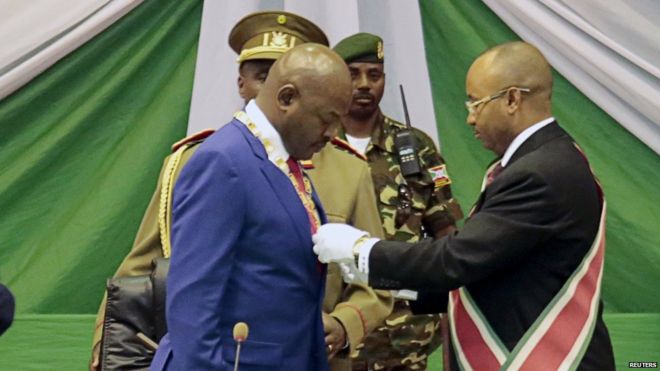
Burundi’s President Pierre Nkurunziza threatened on Wednesday to fight any African Union peacekeepers imposed on his country, in his most confrontational comments yet on a mounting political crisis.

The African Union said this month it was ready to send 5,000 peacekeepers to protect civilians caught up in months of violence, invoking for the first time powers to intervene in a member state against its will.

“Everyone has to respect Burundi borders,” Nkurunziza said in comments broadcast on state radio.

“In case they violate those principles, they will have attacked the country and every Burundian will stand up and fight against them … The country will have been attacked and it will respond,” he said, in his first public response to the AU plan.

Other government officials have already said any peacekeepers arriving without Burundi’s permission would violate its sovereignty.

More than 220,000 have fled since the crisis erupted in April, triggered by President Nkurunziza’s bid for a third term.

Opposition groups took to the streets saying he was violating constitutional term limits. But he pointed to a court order allowing his campaign and was re-elected in a disputed July vote.

A failed coup, continued clashes and gun attacks in the central African nation have unsettled a region where memories of the 1994 genocide in neighbouring Rwanda are still raw.

Stories Continues after ad

South Sudan Governors sworn in

South Sudan President, Salva Kiir
South Sudan President, Salva Kiir presided over the swearing in ceremony.

South Sudanese President Salva Kiir swore in governors for the country’s restructured 28 states as rebels said the move violates an August pact that seeks to end the oil-producing nation’s two-year civil war.
The president in October decreed a rise in the number of states from 10, altering boundaries, names and regional capitals. The slow enactment of the peace agreement won’t stop the government from going forward with its own development plans, Kiir saidTuesday at the swearing-in ceremony in the capital, Juba.
Tens of thousands of people have been killed and over two million forced from their homes since South Sudan’s war erupted in in December 2013. Under the August deal, rebel leader Riek Machar will return as Kiir’s deputy for a 30-month transitional period leading to elections.
The leader of a 150-strong rebel team that recently arrived in the city, Taban Deng Gai, warned that the reorganization of territories conflicted with the deal that was signed on the basis of 10 states. “Anyone who wants 28 states should wait for the permanent constitution-making,” he told reporters Tuesday in Juba. The European Union and the so-called troika, comprising the UK., US and Norway, voiced similar concerns in October.
Kiir told the new governors there was no contradiction. “The agreement is in place and we are implementing it,” he said. “So please, you support this agreement and tell people in the states to support it,” welcome the rebel delegates “and protect their security.”

Stories Continues after ad

Police seals off three beaches over Boxing Day mass deaths

Police have sealed off Aero, Spennah and Lido beaches declaring them scene of crime. 13 bodies were retrieved from the shores of Lake Victoria.

It is believed that 50 are still missing. The bodies are thought to be part of the people, who had gone to the beaches during the festive season, Police publicist, Fred Enanga during the press briefing today said the three beaches are to remain closed as the owners and Entebbe Municipal Council are to help with investigations.

“Entebbe Municipal Council Management will help us find out whether these beaches were compliant with the set guidelines as per their licenses.

Police under the Criminal Investigation and Intelligence Department (CIID) is carryout investigations to find out what exactly happened Enanga also revealed that relatives of 10 people were identified and bodies have been handed over for burial while three bodies are still unclaimed.

Stories Continues after ad

Burundi: consensus needed to build peace

It is refreshing to know that the belligerents from Burundi were meeting in Uganda yesterday for talks aimed at restoring sanity in the tiny central African country, whose countrymen and women have been at war with themselves since it gained Independence from Belgium in 1962.

More interesting, the talks chaired by the EAC appointed mediator President Yoweri Museveni, were graced by four former presidents: Jean Batiste Bagaza, Pierre Buyoya, Sylvester Ntibatunganya and Domitien Ndayizeye, signifying the willingness of the Barundi to be part of the crafted peace process.

With the exception of Ndayizeye, the other three lorded it over an ethnically divided country, with the Hutu and Tutsi not reading from the same script of national unity.

So, seeing the four former presidents huddle in Entebbe alongside other Burundi delegates signifies one of the first steps towards finding that hitherto elusive solution to the spiraling violence that has claimed the lives of over 400 people since April this year.

Unfortunately, the talks reportedly began on a low, with the Government side demanding that ‘coup plotters’ be ejected from the meeting.

It is not clear whether some of the four former presidents are part of the alleged coup plotters but, for obvious reasons this demand by the government side was untenable, because dialogue can only take place between two opposing sides, with the other parties playing the mediatory role. And, in any case, we must accept that the so called coup plotters are part of the opposition, meaning any meaningful talks should have room to accommodate them.

That noted, at this point in time it might be safe to impute that the violence in Burundi has not yet taken on an ethnic dimension; meaning the task for the parties involved in the negotiations, to agree on the political differences, is simpler.

So, as the teams head for another round of talks in Arusha, Tanzania, next year, let focus be fixed on a consensual approach that will re-ignite the spirit of peace, co-existence and national unity in Burundi.

We wish all those involved in the deliberations a Happy New Year.

Stories Continues after ad

Kiir urged to appoint women to cabinet

South Sudan President Salva Kiir


Kiir
Kiir

The leader of the South Sudan opposition Peoples Liberal Party (PLP) Peter Mayen Majongdit has asked President Salva Kiir to appoint women to his new cabinet, expected to be announced early next month.

Majongdit’s reaction comes in the wake of President Kiir appointing 28 men as Governors of all the newly created states, in contravention of a constitutional provision that provides for women to occupy 25 per cent of public offices.

“The selection [of state governors] does not guarantee the constitutional provisions of 25% allocated by both the [transitional] constitution [of South Sudan, 2011] and the ruling party SPLM constitution for female representation in all level of government,” said Majongdit in a press statement.

According to media reports, the outspoken opposition leader called on SPLM party secretary general Jemma Nunu Kumba and other SPLM women caucus members as well as female lawmakers to ‘voice for the rights of woman and ensure that the party constitution is respected by guaranteeing female representation in the new created states’.

“Women must speak for themselves. I know the country has female cadres and leaders that can manage some states,” Majongdit said and urged the SPLM, and the armed opposition SPLM-IO to respect the role women play in peace-building.

Last week, President Kiir appointed governors for the 28 new states he created in October after increasing them from 10, a viewed as a setback to the peace deal signed with the SPLM –IO in August based on the 10 states.

The national alliance of 18 opposition political parties condemned the appointment of state governors, which they described as a violation of the accord to end the conflict.

In a related development the SPLM – IO Secretary for Foreign Affairs has urged President Kiir to rescind his appointment of the Governors, saying it contravened the peace deal signed in the Ethiopian capital Addis Ababa in August.

“Our position has been very clear. We have an agreement signed on the 17thand 26th of August 2015, and the agreement clearly states that there will be only 10 states in South Sudan for the next three years. So creating 28 states is basically not in line with the agreement that we have signed. So we are basically stating clearly that President Salva should stick to the implementation of the agreement which says 10 states for the next three years,” Ezekiel Lol Gatkuoth said.

But Gatkuoth’s assertions have been watered down by South Sudan foreign minister Barnaba Marial Benjamin, who said president Kiir’s move was in line with the constitution.

South Sudan, a country of about 12 million people, got Independence from its northern neighbor in 2011, but just three years into the new government cracks emerged between President Kiir and his vice Riek Machar Teng, culminating in a civil war in December 2013.

Since then tens of thousands have been killed and over two million have been displaced, prompting the intervention of regional stakeholders under the eight-country Intergovernmental Authority for Development (IGAD).

Stories Continues after ad

Another Ethiopian journalist arrested

Getachew Shiferaw

Ethiopian authorities have arrested Getachew Shiferaw, the Editor-in-Chief of online newspaper Negere Ethiopia, a publication allegedly affiliated to the opposition.

The arrest of Shiferaw on Friday follows that of Fikadu Mirkana, a news anchor at the state-run broadcaster Oromia Radio and TV who was arrested last week.

Media reports indicate that the arrest of the two comes in the wake of protests over a plan by the authorities to expand the Ethiopian city Addis Ababa, which campaigners say will displace hundreds of thousands.

 Getachew Shiferaw
Getachew Shiferaw

According to media reports Negere Ethiopia is affiliated with the Blue Party, an opposition movement that has campaigned for greater political openness in Ethiopia. The newspaper was forced to suspend its print edition a year ago, and now is distributed via social media. The outlet covers political trials, including proceedings against opposition politicians and journalists, co-founder of the Zone 9 blogging collective Soleyana S. Gebremichael told CPJ. It reported on calls by the Blue Party and the Oromo Federalist Party for a public demonstration to be held, but for which authorities denied permission.

The arrests have been condemned by the Committee to Protect Journalists (CPJ) which has called upon the authorities in Ethiopia to release the two journalists.

“Ethiopia prides itself on development, but economic growth is a hollow achievement if the public does not enjoy fundamental human rights such as the right to receive and share information and divergent viewpoints,” CPJ’s Africa Program Coordinator Sue Valentine said of Shiferaw. “Authorities should immediately release Getachew Shiferaw, drop all charges against him, and allow journalists to do their jobs,” she added.

Authorities have cracked down on the demonstrators as well as clamping down on critical and independent voices in the press. At least five protestors have been killed and hundreds arrested, according to news reports.

Shiferaw was arrested by federal police on December 25 while walking to his office in Addis Ababa in the morning, and is being held at Maekelawi, the main federal police investigation center, where political detainees have been tortured or ill-treated, according to a 2013 report by Human Rights Watch.

He appeared Saturday in court, where police were granted permission to hold him for 28 days for interrogation, after which he is likely to be charged under the Anti-Terrorism Proclamation.

Ethiopia’s broadly worded anti-terrorism law passed in 2009 criminalizes any reporting that authorities deem encouraging to groups and causes the government labels as terrorists, including banned political opposition groups.

The director general of Ethiopia’s Government Communications Affairs Office, Getachew Reda, did not immediately respond to emailed questions from CPJ.

Separately, authorities in Ethiopia have summoned five members of the Zone 9 blogging group – Soleyana, Abel Wabella, Natnail Feleke, Atnaf Berhane,and Befekadu Hailu – to appear in court on December 30. The bloggers were acquitted of terrorism charges in October, and the prosecution is appealing their acquittal, Soleyana, who was tried in absentia, told CPJ.

Befekadu is still facing charges of “incitement of violence through writing.” The Zone 9 bloggers were honored with CPJ’s 2015 International Press Freedom Award in November.

Ethiopia is the third worst jailer of journalists on the African continent, with at least 10 behind bars on December 1, CPJ’s 2015 prison census shows

Stories Continues after ad