Stanbic Bank
Stanbic Bank
19.7 C
Kampala
Stanbic Bank
Stanbic Bank
Home Blog Page 2239

MoneyGram taps into Nigeria’s $21b annual remittance market

A man conducts business at a MoneyGram site in Essen, Germany. By the end of the year, MoneyGram said it also expects to roll out a mobile version of its website to make it easier for customers in the U.S., the U.K, and Germany to send money. // Byline: MoneyGram International // Submitter: Pete Johnson // 12092012xBIZ
A man conducts business at a MoneyGram site.

MoneyGram has announced it is the first money transfer company to offer customers in France, Germany, Ireland, Italy and Spain a way to send money to most personal Nigerian Naira bank accounts within minutes.
“This is a significant milestone for us. With the addition of Nigeria, MoneyGram now offers bank account deposits through our network into five of the world’s largest remittance receive markets — Nigeria, China, India, Mexico and the Philippines,” says Herve Chomel, MoneyGram’s regional vice president for Africa.

“Account deposit is a fast and secure way to send and receive funds between loved ones and we are proud to offer the service for our customers in Europe and Nigeria.”
Customers can send money to most of the personal accounts held at banks that are members of the Nigeria Inter-Bank Settlement System network including First Bank, UBA, Ecobank, Fidelity, and Zenith Bank from MoneyGram agent locations in western Europe.
‘This marks an important innovation for the remittance industry in Nigeria.  By integrating into the Nigerian Inter-Bank Payment System, MoneyGram customers are able to send money into most bank accounts in Nigeria, almost in real time. Receivers do not have to undertake any action as the funds are automatically deposited into their account and can be accessed via ATM’s or online, without the constraint of a physical over-the-counter visit’ a release by the Africa Press Organisation (APO), states.


Stories Continues after ad

CPJ calls for release of Ethiopian journalist

Fikadu Mirkana.
Fikadu Mirkana.
Fikadu Mirkana.


The Committee to Protect Journalists has urged authorities in Ethiopia to release news anchor Fikadu Mirkana.

Fikadu, who works for the state-run broadcaster Oromia Radio and TV, was arrested at his Addis Ababa home on Saturday morning.
CPJ could not determine the reason for Fikadu’s arrest. It comes as Oromia Radio and TV has, in recent weeks, covered protests against a plan to expand the Ethiopian capital, in a move that campaigners say would displace hundreds of thousands of farmers. Dozens of protesters have been killed during clashes with police during the unrest in the regional state of Oromia, according to Human Rights Watch.

“Journalists have a vital role to play in ensuring the flow of information, both from the Ethiopian government and also, critically, from those who will be affected by its decisions,” said CPJ Africa Program Coordinator Sue Valentine in New York. “We call on authorities to release Fikadu Mirkana immediately.”
It is not clear where Fikadu is being held and neither his family nor his lawyers have been allowed access to him, an Addis Ababa-based journalist, who has spoken with Fikadu’s family and who requested anonymity for fear of retribution, told CPJ.

The Ethiopian authorities in Addis Ababa and the Ethiopian embassy in Nairobi did not immediately respond to CPJ’s request for details about Fikadu’s arrest.

In recent weeks, the Ethiopian government has used anti-terror rhetoric against campaigners, with the communications minister, Getachew Reda, branding them ‘terrorists’ and ‘demonic’, according to a column by Awol Allo, a fellow in human rights at the London School of Economics and Political Science, published Saturdayon Al-Jazeera’s website. This language usually presages a crackdown on dissenters, the column said.

Media reports indicate that protests in Oromia, a region that stretches across central Ethiopia and is home to a third of the country’s population, have affected at least 30 towns and prompted the arrest of more than 500 people since mid-November.

Ethiopia is the third largest jailer of journalists on the African continent, with at least 10 behind bars on December 1, CPJ’s 2015 prison census shows.


Stories Continues after ad

Somalia bans celebrating Christmas, New Year

, Sheikh Mohamed Khayrow and the Vice Chairman of the Supreme Religious Council (SRC), Sheikh Nur Barud made the announcement.


Somalia’s Federal Government has banned Christmas and New Year celebrations in the capital Mogadishu, saying the celebrations are not Islamic.

Director General of Somalia’s Ministry of Religious Affairs, Sheikh Mohamed Khayrow and the Vice Chairman of the Supreme Religious Council (SRC), Sheikh Nur Barud Gurhan made the announcement on Tuesday at a press conference in the Somali capital Mogadishu.

“All events related to Christmas and New Year celebrations are contrary to Islamic culture, which could damage Aqidah (faith) of the Muslim community,” Sheikh Kayrow was quoted as saying by the media.

‘’All security forces are advised to halt or dissolve any gatherings. There should be no activity at all,’’ he added.

“We Islamic scholars are warning against the celebration of such events which are not relevant to the principles of our religion. Such events give also al-Shabaab to carry out attacks,’’ Sheikh Gurhan, the SRC deputy chairman, said.

The announcements by the minister and religious cleric come in the wake of fears that the Al Shabaab could strike during such festive days like happened last year, when members of the Islamic extremist group launched a deadly attack on the African Union (AU) force headquarters in Mogadishu during a Christmas party, killing 12 Ugandan soldiers and other foreign nationals.


Stories Continues after ad

US Embassy condemns election violence

Independent Electoral Commission Chairman, Eng Badru Kiggundu
Independent Electoral Commission Chairman, charged with overseeing smooth elections.


The United States embassy in Uganda has spoken out against the violence that seems to be gaining currency in the ongoing campaigns for the 2016 general elections.

‘The US Embassy notes with concern what appears to be an increasingly tense campaign environment in the lead up to the 2016 elections in Uganda,’ the Embassy wrote in a statement released on December 22.

The US Embassy reaction comes in the wake of violent clashes in Ntungamo and in Omoro County in Northern Uganda, where scores of people were hurt.

‘Several recent campaign-related events, including the violence at Ntungamo and its aftermath, have the potential to undermine the potential for a free, fair and peaceful election. We urge all parties to exercise restraint, uphold the rights of all Ugandan citizens, and commit to resolving differences through peaceful dialogue,’ the release adds.

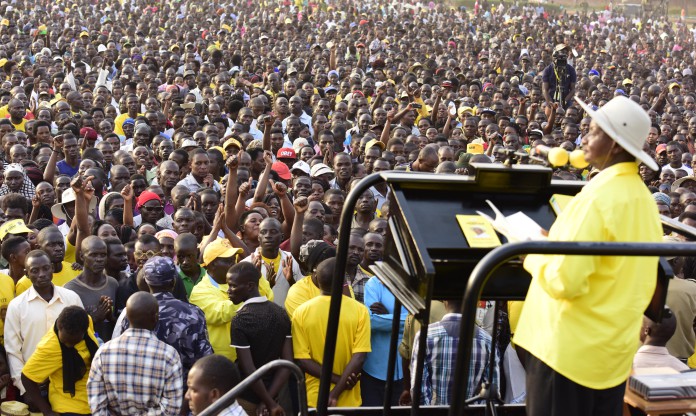
Following the Ntungamo debacle, President Yoweri Museveni weighed in and warned that those involved in the attacks against the National Resistance Movement (NRM) supporters in the south western Uganda town would face his wrath.

Subsequently, about two dozen ‘Go Forward’ supporters of presidential aspirant John Patrick Amama Mbabazi have been arrested.


Stories Continues after ad

Referendum UK joins US in criticising Rwanda over By Our Reporter

UK Africa Minister James Duddridge.


UK Africa Minister James Duddridge.


The United Kingdom has joined the United States in criticizing Rwanda over the way the East African country handled its just-concluded Referendum on amending the Constitution to allow President Paul Kagame become eligible for a third term.

According to a release on December 21, 2015 by the UK Africa Minister James Duddridge, his country is concerned about the ‘constraints on political space and the media in the run up to the Referendum’ held on December 18 and 19, for the Diaspora and home voters, respectively.

‘I acknowledge the broad participation of the Rwandan people in the referendum and its outcome. However the way in which it was conducted has damaged Rwanda’s international reputation. The short timeframe between the announcement of the referendum and the vote did not allow sufficient time for voters to consider and debate the proposed changes and for the case for and against to be made. A copy of the revised constitution was only made available less than one day ahead of the referendum, Mr Duddridge wrote, and added that” ‘it is vital that issues of such importance are debated freely and without fear’.

Citing the UK’s contribution to Rwanda’s economic development and stability, Mr Duddridge says Rwanda ‘is rightly held in high regard at home and overseas’.

He however, pours cold water on the developments attained so far, arguing that the change of Constitutions to benefit incumbent leaders (like Kagame) is recipe for disaster.

‘The UK believes that a leader who willingly cedes power and enables a peaceful and democratic transition will always be held in high regard by both their people and the rest of the world. Changing the constitution for the benefit of the incumbent risks serious damage to long-term stability and Rwanda’s reputation as a world leader’ Mr Duddridge wrote, noting that ‘the Referendum and the elections in 2017 mark a critical juncture in Rwanda’s history’.

Over the past few months Rwanda has been under global lens following a nationwide agitation by the citizens for Parliament to amend Article 101 of the Constitution that mandates a President of Rwanda to serve two-seven-year terms.

As a result, the Parliament and Senate debated and upheld the peoples’ demands to amend the Constitution before calling for a Referendum on the issue.

The Referendum held last week returned an overwhelming Yes verdict of 98 per cent, clearing the last hurdle for a possible Kagame presidency up to 2034.


Stories Continues after ad

Sudan ‘backs’ Burundi over AU roop rejection

Sudanese state minister for foreign affairs Kamal al-Din Ismail.

The Sudan government appeared to be siding with Burundi in its clash with the African Union (AU) over the latter’s decision to send a peacekeeping force to quell a growing wave of violence that is widely feared to develop into full blown ethnic killing.

The development follows a meeting between President Pierre Nkurunziza and the Sudanese state minister for foreign affairs Kamal al-Din Ismail, who had sought to get Burundi’s support for Sudan’s candidate in the bid for the Secretariat of the International Conference on Great Lakes Region (ICGLR).

According to the deputy spokesperson at the Burundian presidency Jean Claude Karerwa, Mr al-Din Ismail promised to support the Burundi government against any attempt to impose any decision that could ‘disrupt peace and security’ in the country because, he said, “sending troops in a country itself troop contributor is paradoxical”.

Sudan, whose President Omar Bashir was indicted by the International Criminal Court (ICC) for genocide, war crimes and crimes against humanity, engaged in an almost similar dispute with the United Nations on sending peacekeepers to Darfur but eventually backed down to allow them under certain conditions.

Last week the AU decided to create a 5,000-strong peacekeeping mission that would be deployed to Burundi with a six-month renewable mandate, prompting Burundi to reject the move amid ‘breach of sovereignty’ claims.

The move by the African bloc is unique as it stated that it will send the force even against Burundi’s avowed position, a power that is derived from Article 4 of the AU charter.

Under that article, the AU has the right to intervene in a member state ‘in respect of grave circumstances, namely: war crimes, genocide and crimes against humanity’.

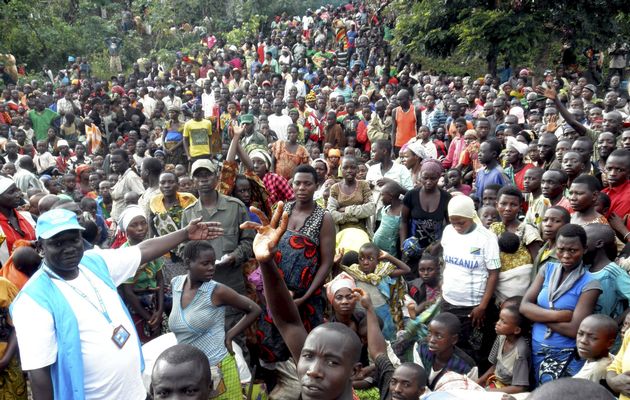
Hundreds of people have been killed since last April when President Nkurunziza decided to run for a third term which he eventually won.


Stories Continues after ad

Somalia to hold elections in 2016, says UN envoy

Amb. Nicholas Kay
Amb. Nicholas Kay
Amb. Nicholas Kay


Somalia is one of the six African countries expected to hold presidential elections next year, a top UN diplomat overseeing its transition has said.

According to media reports, the outgoing representative of United Nations Secretary General in Somalia Nicholas Kay, said the troubled Horn of Africa country has stabilised and is now ready to hold both presidential and parliamentary elections, with those elected committing to respect a four-year term.

‘Somalia is no longer a failed state but a recovering fragile country’ Mr Kay was quoted saying, adding: ‘The country in the past two-three years has come together quite significantly. It is both politically stable and developed as well’.

Somalia, alongside Uganda, Ghana, Lesotho, Zambia and South Sudan, the latter a country which gained Independence and appointed its first President Salva Kiir Mayardit in 2011, are expected to go to the polls in 2016.

However, in June this year Somali President Hassan Sheikh Mohamud had ruled out the possibility of holding a vote with public participation in 2016, citing security challenges stemming from the Islamic insurgency led by the Al Shabaab, an offshoot of Al Qaeda.

Then, opposition parties in the war-ravaged country charged that his UN-backed government was taking advantage of poor security to extend its mandate through postponement of elections.

But President Mohamud’s position seems to not to resonate well with Mr Kay, who avers that the Islamic extremist insurgents will not succeed in undermining the progress being made in Somalia.

Kay, the top UN diplomat on Somalia, also says the political leaders of the country are currently engaging in political dialogue and negotiations with each other.

“These are not armed warlords fighting each other on a clan basis,” Kay said, adding:”They are presidents of interim regional administrations who are more willing to sit and talk than use a barrel of a gun. In so, they are contributing to peace in the country, not to the fragmentation of the state as in the old days.”

Somalia has been torn by decades of conflict since the 1991 ouster of long-time dictator Siad Barre by warlords who then turned on each other. Somalia had transitional administrations from 2004 but it did not have a functioning central government until the 2012 election of President Hassan Sheikh Mohamud.

In 2012, Somali elders were tasked with naming the parliament since no election could be held, given the insecurity occasioned by Al Shabaab around the country.

Somalia’s Parliament then elected a new president but analysts criticized the system.

“Some elders allegedly nominated uneducated and objectionable individuals, some sold seats to highest bidders, and others even nominated their own family members,” the International Crisis Group said then.


Stories Continues after ad

British EU exit could lead to UK break-up, warns Hague

Former Foreign Secretary William Hague.


Former Foreign Secretary William Hague.

The United Kingdom could disintegrate if Britons vote to leave the European Union as it would give succour to the cause of Scottish nationalists, former Foreign Secretary William Hague said on Wednesday.

Hague, a former leader of Prime Minister David Cameron’s Conservative Party and considered to be a Eurosceptic, said he would back Britain remaining in the bloc despite his own great misgivings about the EU when an in/out referendum is held before the end of 2017.

“We will have to ask, disliking so many aspects of it as we do, whether we really want to weaken it, and at the same time increase the chances, if the UK left the EU, of Scotland leaving the UK,” Hague wrote in the Daily Telegraph newspaper.

Hague spoke out after Cameron met fellow European leaders in Brussels last week to try to drum up support for his reform of Britain’s relationship with the EU.

Critics in his party, which has been deeply divided over Europe for decades, say his negotiations are likely to achieve little of any substance, with former Defence Secretary Liam Fox saying on Sunday it was time to “end the pretence” that Europe would change to accommodate Britain.

Hague said despite the EU’s many failings, it provided stability for fragile democracies in central Europe and it would not be in Britain’s interests for the bloc to fall apart with such volatility in the Middle East and the world economies.

He said Scottish nationalists, who strongly support staying in the EU, would use a vote for exit as grounds to hold another referendum on independence, something Scots rejected by 55-45 percent in September last year.

Hague said a second vote in such circumstances would be too close to call.

“To end up destroying the United Kingdom and gravely weakening the European Union would not be a very clever day’s work,” Hague said. “So, even as a longstanding critic of so much of that struggling organisation, I am unlikely in 2016 to vote to leave it.”


Stories Continues after ad

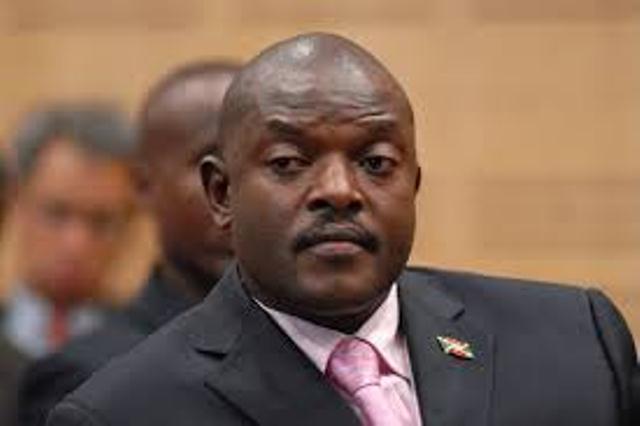
‘Burundi ready for talks’, says Nkurunziza envoy

Pierry Nkurunziza


Pierry Nkurunziza
Pierry Nkurunziza

The Burundi government is ready to hold talks with all the political players involved in the country’s crisis, a senior government official has said.
Reverien Ndikuriyo, the Burundi President’s Special Envoy made the disclosure yesterday, while meeting the East African Community (EAC) Chairman and Tanzania President John Magufuli.
Ndikuriyo, who is also the Burundi Senate Speaker, led President Pierre Nkurunzinza’s delegation to the talks held at the State House in Dar es Salaam, where the two parties held talks over the political impasse in the tiny central African country.
In a statement quoting Foreign Affairs, Regional East African and International Cooperation Minister Dr Augustine Mahiga, Burundi said it had accepted the ongoing dialogue led by the Ugandan President Yoweri Museveni over the crisis.
“President Magufuli held talks with his Burundian counterpart President Nkurunziza and the latter acknowledged readiness to participate in the peaceful dialogue,” Mahiga said in a statement.
He added: “I have been tasked to issue information across all foreign affairs ministers in the region over the discussion slated to start December 28, in Uganda. Uganda will be coordinating the meeting.”
Meanwhile, during the meeting with the EAC chairman, Burundi expressed dismay over the decision by African Union to deploy peacekeeping troops in Burundi.
Mr Ndikuriyo told President Magufuli the government was optimistic the political impasse in the region can be addressed through peaceful talks.
Burundian Parliament has so far discarded the decision by the AU Security Council, saying the situation has not reached a point of no return similar to the 1994 Genocide in Rwanda.

The envoy told the president the situation was not so bad, but there is fear that the AU and European Union are under the influence of the United Nations to deploy peace keeping forces.

“Burundi has 6,000 peace keepers in Somalia, 1,000 in Central Africa. It’s their interest to bring peace and will be the last to disturb and bring conflict similar to the killings of civilians in Kimbari,” the foreign affairs minister said.
Following the discussion, President Magufuli urged Burundi to open doors for peaceful dialogue, and allowing members of the African Unity to deploy peaceful talks mission the country.
Magufuli also tasked Dr Mahiga to go to Burundi and find out why Burundians were fleeing their country. He said the tour to Burundi would be helpful in the peaceful dialogue slated for later this month in Uganda.

Stories Continues after ad

Date for Museveni-Besigye debate set

Outgoing Archbishop of Church of Uganda, Stanley Ntagali
Ach Bishop of Church of Uganda, Stanley Ntagali

The first-ever live telecast of a presidential debate under the multi-party dispensation will be held at the Serena Hotel on January 15, 2016.

The disclosure was made today while announcing the TV debate that is jointly organised by the Inter-Religious Council of Uganda, the Media Council of Uganda and Civil Society with support from the United Nations Development Programme (UNDP) and The Elders Forum of Uganda (TEFU).
The function was attended by among others the Archbishop of the Church of Uganda His Grace Stanley Ntagali; TEFU chairperson retired Justice James Ogoola, the Overseer of the Born Again Faith (BAF) Pastor Joseph Sserwada and Joshua Kitakule, the Secretary General of the Inter-Religious Council.
According to the organisers, the two-hour presidential debate to be held under the theme, ‘Working Together for Peace and Violence Free 2016 General Elections’, will feature all the eight candidates that were cleared by the Independent Electoral Commission (IEC) to contest for the presidency in 2016.
‘The main goal the debate is to provide an impartial space for all the eight candidates to sell their agenda to Ugandans and commit to a peaceful free and fair election,’ a December 23 release by the organisers state, adding that a team of professional will moderate the debate.
Writing about the expectations of the debate Justice James Ogoola, the Chairperson of TEFU, noted: ‘the debate will take place at a neutral venue, over the course of two or so hours. We plan for high quality television production, moderated by a high caliber team of highly qualified media professional. The aim is to match the quality of the presentation to the quality of the event and the candidates involved.’
The candidates expected to feature on the debate include Yoweri Museveni of the National Resistance Movement (NRM); Dr Warren Kizza Besigye of the Forum for Democratic Change (FDC); John Patrick Amama Mbabazi of the Go Forward team; Dr Abed Bwanika of the Peoples Development Party (PDP); Maj Gen (rtd) Benon Buta Biraro of the Farmers Party of Uganda (FPU) and Independent candidates Prof Venansius Baryamureeba, Faith Maureen Kyalya Walube and Joseph Mabirizi.
‘The candidates will get to discuss a range of national, regional and global issues and give the viewers the opportunity to make an informed decision on the polling day’ the release adds.
Under the NRM Uganda adopted the multi-party dispensation in 2005 and since then the country has held two presidential elections, in 2006 and 2011.

Stories Continues after ad