Stanbic Bank
Stanbic Bank
19.7 C
Kampala
Stanbic Bank
Stanbic Bank
Home Blog Page 2240

Besigye attacks Monitor over poll results

Dr.Besigye addressing the press conference at his Kasangati residence about the poll.


Dr.Besigye addressing the press conference at his Kasangati residence about the poll.

Forum for Democratic Change (FDC) presidential aspirant Dr Warren Kizza Besigye has lashed out at the Monitor newspaper for publishing a poll showing that candidate Museveni was leading.

According to the poll results carried in the Daily Monitor newspaper of December 18, 2015, candidate Museveni commands a 59.9 per cent lead, something Dr Besigye, who was rated at 20 per cent, vehemently disputes.

‘That poll, to my knowledge, is rubbish’, Dr Besigye said adding: “Museveni is a hopeless minority at the moment in terms of popular support. The Aga Khan is burying his paper,’ he wrote adding: “Managing the media’ through doctored polls will not solve Museveni’s unpopularity problem this time.”

He further said that the poll results are ‘made up’ and that those carrying out polls are being escorted by government officials.

This is the second time in less than a year that the Daily Monitor has come under fire from the opposition over polls indicating that Mr Museveni was the leading candidate for the 2016 elections.

Early this year global market research firm Ipsos carried out a poll commissioned by The Daily Monitor and results showed that if elections were held then candidate Museveni would emerge winner with 57 per cent of the vote, prompting vitriol from the opposition.

However, Daily Monitor management contends with the poll results. The paper through its Nairobi parent company, Nation Media Group sourced Infotrak to conduct the research.

President Museveni who also the poll revealed that would win with 60 per cent,   yesterday rejected results of the same  opinion poll. Museveni instead says  he will win with 80 per cent as contrary to the  60 per cent if elections had been held between December 6-9.

Infotrak, conducted the research between  December 6-9 and found that out of 1,500 voters sampled, 59.9 per cent indicated they would back Mr Museveni’s bid for a fifth term-with the FDC flag bearer, Dr Kizza Besigye coming second with 20.9 per cent support.


Stories Continues after ad

Jose Mourinho agrees Man United deal to replace Louis van Gaal after Chelsea sacking

JOSE MOURINHO has agreed a five-year deal to replace Louis van Gaal as Manchester United boss, according to sensational reports from Europe.

Mourinho was sacked as Chelsea boss last Thursday after the champions spiralled out of the control.

The Blues lost nine of their opening 16 Premier League games and Mourinho had admitted the top four was out of reach.

He also claimed his players had betrayed him and his methods following the defeat to Leicester.

But he may not be out of work for long with Van Gaal under huge pressure after going six games without a win at United.

Express Sport understands Van Gaal’s future is being considered with reports suggestingVan Gaal faces the sack if United lose their next match.

They face Stoke – and former striker Mark Hughes – on Boxing Day before Chelsea on December 28.

The fans at Old Trafford chanted Mourinho’s name during the 2-1 defeat to Norwich on Sunday and have grown frustrated with Van Gaal’s methods.

United dropped out of the top four – overtaken by Tottenham – with the club still reeling from their Champions League exit.

On Saturday Mourinho released a statement insisting he wanted to return to the dugout as soon as possible.

“During his career, José has sometimes chosen to leave a club, but only at Chelsea has the club decided that he should leave,” Mourinho’s statement read.

“Each time represents for him the end of a cycle, and the opportunity to start a new one. José hopes that his future after Chelsea this time will be as successful as when he left the club in 2007.

“He will not be taking a sabbatical, he isn’t tired, he doesn’t need it, he is very positive, and is already looking forward.

“Because of his love of football, you will see José at football grounds working and supporting friends.

“He will not be attending any high-profile games because he wants to discourage any speculation about his future.

“José will remain living in London and hopes he and his family will be given the opportunity to do this privately.”

“José will not speak about his current situation for the foreseeable future. He asks the media to respect this decision.”

And reports in Spain, from Fichajes, claim he has already agreed to take the reins at Manchester United after they pull the trigger on Van Gaal.


Stories Continues after ad

Amama dares Museveni over ‘Ntungamo arrests’

Mr Mbabazi’s remarks come in the wake of the violent clashes that pitted his supporters against those of the National Resistance Movement (NRM) in Ntungamo last week.


Presidential aspirant John Patrick Amama Mbabazi has castigated the arrest of his supporters and said that his political outfit will vouch for their release.

Mr Mbabazi’s remarks come in the wake of the violent clashes that pitted his supporters against those of the National Resistance Movement (NRM) in Ntungamo last week.

Following the clashes, President Museveni weighed in on the matter, saying government would arrest Mr Mbabazi’s supporters, the alleged masterminds of the chaos.

“Thugs attacked NRM supporters. They are being rounded up because they attacked Ugandans and they will pay very dearly. I am a free person and you come and attack me like that idiot whom I saw [on TV] beating people with clubs. He will regret. We shall smash all that little nonsense which some people who don’t see far thought would help them,”Mr Museveni said at a press conference in Mbale yesterday.

Mr Mbabazi’s remarks come in the wake of the violent clashes that pitted his supporters against those of the National Resistance Movement (NRM) in Ntungamo last week.

This prompted Mr Mbabazi to say the Go Forward team would follow the law to have those arrested, released.

‘We will follow the law as always (to get out people out). We will apply for Habeas Corpus,’ he said.

Taking a swipe at President Museveni over the arrests he added: “It’s only the court’s of law that can declare anyone criminal. No one else. Who are you to declare anyone criminal?”

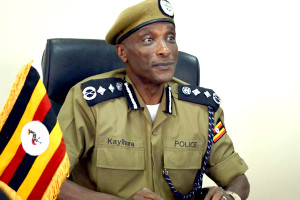
On the arrests, Mr Mbabazi said that police chief Gen Kale Kayihura was acting on orders of his boss, Mr Museveni.

“Those who are blaming Kayihura don’t know how things work. Kayihura wouldn’t do anything unless ordered by M7,” he wrote before castigating the use of force.

‘Using force has never worked anywhere in the history of mankind. It doesn’t last,” he was quoted as saying.

He also accused the police of selectively applying the law.

“Have you heard any of those who wanted to burn my car or who threw stones at my car being arrested”? Mr Mbabazi asked.

Efforts to contact police spokesman Fred Enanga over Mr Mbabazi’s remarks were futile by press time.

Meanwhile, Mr Mbabazi said he has ‘gone back to the drawing board to see how to manage a campaign full of violence and abuse of state authority’ and also urged the Electoral Commission to guide the electoral process.

‘The EC ought to assert itself to manage this election otherwise we will take them as having failed’ he said, adding: “I don’t think the Electoral Commission has done enough,” he said.

Stories Continues after ad

Blatter, Platini get 8 year ban


An ethics tribunal of scandal-plagued FIFA has today banned Sepp Blatter and Michel Platini for eight years saying they had abused their positions over a 2 million Swiss francs payment made to Platini.
The sentence against the two most powerful men in football stunningly highlighted the troubles faced by the world’s most popular sport where billions of dollars have been invested in recent years.
Blatter, 79, and Platini, 60, were “immediately” banned from all football activity. Blatter’s career is now almost certainly over while Platini’s hopes of taking over FIFA are all but finished.
Blatter, FIFA’s president since 1998, was fined 50,000 Swiss francs ($50,000/46,300 euros). Platini, the head of UEFA, Europe’s governing body and a FIFA vice president, was fined 80,000 Swiss francs.
A statement by the court said both showed “abusive execution” of their powers.
FIFA had looked into a two million Swiss francs payment authorised by Blatter to Platini in 2011. They said it was for work as a consultant carried out between 1999 and 2002.
While the FIFA court dropped corruption charges against both men, it said both were guilty of a conflict of interest.
It said there was “no legal basis” for the payment in an oral agreement between the two officials in August 1999.
“Neither in his written statement nor in his personal hearing was Mr Blatter able to demonstrate another legal basis for this payment. His assertion of an oral agreement was determined as not convincing and was rejected by the chamber.”
The court said “Mr Blatter’s actions did not show commitment to an ethical attitude, failing to respect all applicable laws and regulations as well as FIFA’s regulatory framework to the extent applicable to him and demonstrating an abusive execution of his position as President of FIFA”.
Platini was also found to be in “a conflict of interest”.
The judgement was even more damning of the French football legend than for Blatter.
“Mr Platini failed to act with complete credibility and integrity, showing unawareness of the importance of his duties and concomitant obligations and responsibilities.
“His actions did not show commitment to an ethical attitude, failing to respect all applicable laws and regulations as well as FIFA’s regulatory framework.”
The court said Platini was also guilty of “demonstrating an abusive execution of his position as vice-president of FIFA.”
Blatter and Platini were provisionally suspended in October after Swiss prosecutors started a criminal investigation into the 2011 cash transfer.
Blatter is under criminal investigation and Platini is being treated as between a suspect and a witness.
Both strongly deny any wrongdoing. Blatter spent eight hours before a FIFA court last Thursday while Platini boycotted his hearing saying he had been “condemned” in advance.
At the time of the 2011 payment, Blatter was campaigning for a fourth term as FIFA president. Platini later supported his former mentor but has since turned against him.
Blatter and Platini can challenge any ban at a FIFA appeal tribunal, the Court of Arbitration for Sport, and even in a Swiss civil court.
Blatter would be fighting for his reputation. For Platini, the ban rules him out of the FIFA election to be held onFebruary 26.
The deadline for candidates to be registered and pass an integrity check is January 26.
With FIFA’s reputation in tatters after the arrest of several top officials, Blatter announced four days after winning re-election to a fifth term in May that he would stand down and call a new election.
Seven FIFA officials were arrested in a luxury Zurich hotel two days before the election congress.
Now US authorities have charged 39 football officials and sports business executives over more than $200 million in bribes for football television and marketing deals.
Swiss prosecutors are in parallel investigating FIFA’s management and the award of the 2018 and 2022 World Cups to Russia and Qatar.
Facing pressure from governments and the International Olympic Committee for major reforms, there are currently five candidates to take over FIFA: Asian football head Sheikh Salman bin Ebrahim al-Khalifa of Bahrain, South African politician and tycoon Tokyo Sexwale, former FIFA vice president Prince Ali bin al Hussein of Jordan, UEFA general-secretary Gianni Infantino and Jerome Champagne, a former FIFA assistant general secretary from France.
Stories Continues after ad

Machar group for Juba

The advance team of the armed opposition faction of the Sudan People’s Liberation Movement (SPLM-IO) under the leadership of former vice-president, Riek Machar, is expected in the South Sudan capital Juba later today.
According to media sources the first group of the advance team will leave Pagak to Juba through the airport in Gambella town, the regional capital of the western Gambella region of the neighbouring Ethiopia, from where they will be airlifted.
“The first group of the advance team of SPLM/SPLA (IO) comprising 150 cadres will arrive in Juba on Monday, December 21,” confirmed James Gatdet Dak, official spokesman of the opposition leader, Riek Machar, in a statement to the media on Sunday.
“They will be led by the Chief Negotiator, General Taban Deng Gai,” he said.
He said a remaining number of 459 to make a total of 609 will follow on different dates before the end of the year.
Dak said the first group that will mainly compose of members who will be participating in meetings of various institutions established under the peace agreement, including their support staff.
He also said a number of senior military generals from the military council of the opposition army will also be among the first group.
In Juba, Akol Paul Kordit, who is the spokesman of the national committee set up by the government to receive and accommodate the advance team also confirmed that the team will arrive today.
The government’s national committee for the reception of the advance team is chaired by the minister of finance and economic planning, David Deng Athorbei.
The arrival of the team had been cancelled many times in the past due to disagreements between the government and the opposition faction.
While the SPLM-IO wanted the over 600 to return to Juba and other states in order to mobilize the populations in support to the full implementation of the peace deal, the government wanted less than 50 of them, saying the ‘huge number’ constituted a security risk, resulting to the delays.
However, with this week’s intervention of the chairman of the Joint Monitoring and Evaluation Commission (JMEC), Festus Mogae, former president of Botswana, who is tasked with the responsibility to oversee the implementation of the peace agreement, the government finally accepted to receive the number.
Upon arrival at Juba airport, the team will hold a press conference, then move to the mausoleum of late Dr. John Garang to pay respect, and then visit the SPLM House before finally going to their hotels where they will be accommodated.
The parties are now expected to jump-start the implementation of the first phases of the peace agreement including deployment of joint integrated forces in Juba, constitutional amendment, selections of ministerial portfolios and designated ministers and additional members to the national parliament as well as formation of a transitional government of national unity by 22 January 2016.
Meanwhile, Rebecca Nyandeng de Mabior, wife of late SPLM leader John Garang de Mabior recently returned to South Sudan after spending two years in exile in Kenya, following the outbreak of war in her country in December 2013 and her subsequent fallout with the government of President Salva Kiir Mayardit.
Stories Continues after ad

DRC militia chiefs to complete ICC sentences in home jails

Two former Congolese militia leaders have been transferred from the Netherlands to a prison in the Democratic Republic of Congo (DRC).
Thomas Lubanga and Germain Katanga are the first ICC convicts to be allowed to serve sentences in their home country.
Former warlord Lubanga is serving 14 years for his crimes, while militia chief Katanga is due to be released in 2016.
The ICC says it will help supervise their imprisonment in the DRC.
Lubanga and Katanga “have both expressed a preference to serve their respective prison terms in DRC, their country of origin”, the court said in a statement.
Their detention in the DRC must conform to international norms on the treatment of prisoners, it said.
Lubanga was once one of the most feared rebel leaders in the gold-rich northeastern Ituri region of the DRC.
He was found guilty of abducting children as young as 11 and using them to fight his battles.
Katanga was convicted for his involvement in a bloody massacre that left hundreds of villagers dead.
Last month, the ICC cut Katanga’s 12-year prison term after he voiced regret and for good behaviour.
But Lubanga’s request for early release was rejected by the ICC as “unjustified”.
The ethnic conflict in Ituri between 1999 and 2003 is estimated to have killed 50,000 people.
Stories Continues after ad

Joy of campaigning for the NRM IN 2015

#Musevenicampaigns1


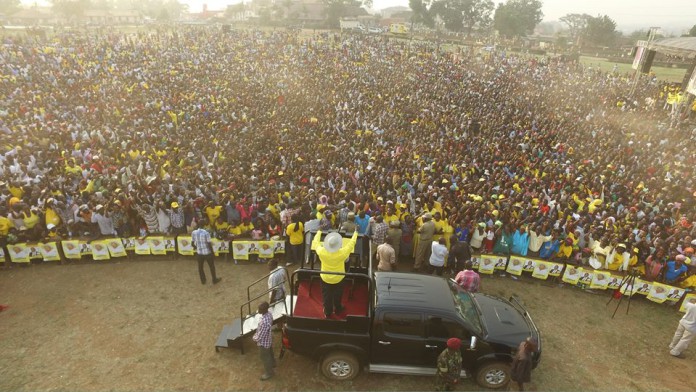
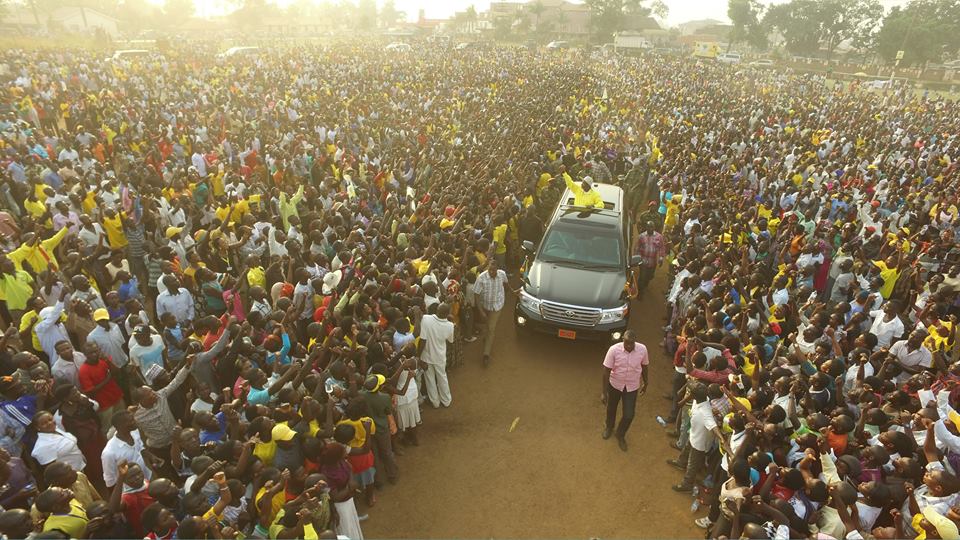
I would like to inform the reader that by today, the 15th December, 2015, I have addressed 104 constituency rallies out the of the total of 290 constituencies.  This is in 48 districts of the 112 districts of Uganda.  What is remarkable is that almost all these rallies are characterized by two factors.  They are massive and, most of them, celebratory.  In some of them, the population regards them as normal consultation meetings where they take opportunity to complain against NAADS/OWC, complaining about bad roads, Uganda Wildlife Authority (UWA) excesses, the floods and water logging of the soil, the fisheries staff that extort money from the people, etc., etc.

Except for Maracha West, Bobi and Acholibur, the rest of the rallies were massive: 50,000, 100,000 or even 200,000 per each of these rallies according to my visual estimation.  Used to addressing soldiers’ barazas, I have got a good eye for assembled numbers.  The other smallish rallies were at Kamion and Tapac for special reasons.  The minority Ik have got a small constituency of 3,000 voters out of a population of 6,000.

In the 1960s I read a book by a certain European referring to them as the “disappearing tribe of Africa”.  Now, thanks to the NRM, they are 6,000 and have their own small constituency.  Then there are the Tepeth of Mount Moroto.  They are with 11,000 voters.  Again, they now have peace, some schools, health centres and their own constituency for the first time.  All the 3,000 Ik voters and the 11,000 Tepeth voters must have turned up from what I gathered.  Their rallies were, therefore, a good yardstick for the other bigger rallies, re-enforcing my comparative visions of the soldier barazas ─ a battalion is 736 persons, etc.

Why are these rallies good natured and celebratory?  It is, mainly, because of the current policies of the NRM, starting with 2001, of prioritizing defence, electricity and roads.  Right from 1986, we had prioritized Health and Education.  You go to Zirobwe, there is electricity; Makulubita, there is; Wabinyonyi, there is; Amolatar, there is; Koboko, there is; Yumbe, there is; Moyo, there is; Namukora, there is; Padibe, there is; Lagoro, there is; etc., etc.  You go to Karamoja, there is electricity; there is electricity in Abim, Amudat, Moroto, Napak, Matany, Nakapiripirit etc., etc.  Only Kotido and Kaabong are not yet connected; but they will soon be because the money is there.

When you come to Teso, it is the same story except for Kapelabyong, Toroma and Dakabela.  The plans, however, for connecting them are in place.  Sebei is connected all the way to Kween and Bukwo ─ although the Bukwo lines are not yet fired because they are still being installed.  Bugisu, it is the same story. Muyembe, the hilly Bulegeni, Budadiri, Bulucheke, Manafwa, Namisindwa, Magale, Buumbo, Lwakhakha, etc. etc., are all electrified.  This is not to forget Bukoonde and Budadiri whose residents had to withstand strong down pours to listen to my address.  As for Mbale town, a sea of people waited for us until we came well after 5:00p.m.

It is not just the electricity, mainly funded by the Government of Uganda (GOU), it is also the tarmac roads, again, mainly funded by the GOU.  The tarmac road has reached Koboko and Oraba.  The other one has reached Atiak and Nimule.  Olwiyo-Gulu-Kitgum-Musingo is being worked on. Bwaise-Kafu-Karuma-Gulu is being reconstructed. Moroto-Nakapiripirit-Muyembe-Mbale is being tarmacked.  Kapchorwa-Bukwo-Suam is being funded by the African Development Bank (ADB) together with the road on the Kenya side.  So is Mbale-Magale-Lwakhakha with a branch to Manjiya.  The Mbale Municipality roads are being tarmacked.  The Tororo-Mbale-Soroti road has just been completed.  Brand new markets have been completed in

Gulu, Lira, Mbale, Jinja, etc. ─ offering improved workplaces for our market people.

The 5 star secondary schools, part of the 611 funded by a World Bank loan and the African Development Bank (ADB IV) constructed or reconstructed by the Ministry of Education, are in evidence here and there: Mbale SS, Masaba SS, St. Catherine SS – Lira, Teso College Aloet – Teso, Nabumali High School – Mbale, Sacred High School – Gulu, St. Joseph College – Ombachi, Metu SS – Moyo, St. Aloysius Nyapea – Nebbi.

It is the peace and these projects, unprecedented phenomena of development and transformation in the history of Uganda, that have fired up our people. Our people now require little mobilization.  They respond spontaneously most of the time – walking in big throngs to the rally sites and back.  Some bicycling or using the scores and scores of Piki Pikis (boda bodas).

How did the NRM manage to achieve all this development?  One, by 1997, we had caused the minimum recovery that Uganda needed so badly.  With that recovery, growth has been steady, the lack of good infrastructure (electricity and roads) notwithstanding.  The rate of growth has been 7% per annum for the last 30 years.  This has enabled our tax collection to improve from Uganda Shs. 5 billion in 1986 to 13,000 billion shillings, today.

Although I normally keep aloof from interfering in the workings of the collective leadership, not even attending Cabinet meetings most of the time, when I deem it vital for strategic reasons (political, cultural, economic or security), I put my foot down in spite of the difficult Constitution introduced in 1995 that eroded the Powers of the President with misguided concepts of pseudo-democracy.  I did this on the issue of the return to the Asians of their properties that Amin had stolen; on the Ranches restructuring in the Ankole – Masaka area; on the return of the cultural institutions; on the privatization of the parastatals; on the reduction of the size of the army; on the cutting of 23% from all the ministries to fund defence in 2001 so as to defeat Kony and the cattle-rustlers; and on the prioritization of the expenditure on the roads and electricity in 2006.

To the credit of my colleagues in the Government and the Party, when I put forward these very strong reasons, an exercise that is, sometimes, tiresome, they, sometimes, agree and we move positively as we have done on the points I have quoted above.

It is, therefore, some of the moves quoted above that are responsible for the good mood one finds in the country today. In particular, the 2001 decision to enhance the defence budget and the prioritization of expenditure on the roads and electricity. These three moves saw the budget of Defence move from 350 billion shillings (2005/06) to 1,400 billion shillings (2015/16); that of Energy (electricity) moved from 178 billion shillings (2005/06) to 2,858 billion shillings (2015/16); and that of Works (roads) moved from 398 billion shillings (2005/06) to the current level of 3,442 billion shillings (2015/16).  It is these moves that have fired up the people’s enthusiasm.

Being sincere and open minded, when they see what has been done, they know that even what is not yet done, will be done. It is just logic and honesty.

Some of our opponents, in vain, try to use our successes against us by misinforming the public. In particular, they try to use the phenomenon of more youth in our population and more graduates that are not employed or are not employable on account of the courses they did in the university. The population of Uganda has surged from 14 million in 1986, to 38 million today. Why? It is because of the NRM health programmes, especially the immunization against the 13 killer diseases.

These are: Polio, Whooping cough, tetanus, measles, tuberculosis, diphtheria, influenza, Pneumonia/Meningitis, Hepatitis B, diarrhea, cervical cancer, mumps and German measles. It is not just the immunization. Even other health programmes have been put in place. How has Uganda managed to nip in the bud the three outbreaks of Ebola (Gulu, Bundibugyo and Kibaale) and Marburg (in 2007 ─ Kamwenge, 2012 ─ Kabale-Ibanda-Kampala, 2014 ─ Kampala)?

There are still gaps such as the need for more pay for the health workers, the institutional houses for the health workers, etc., etc.  However, there are so many tremendous successes such as the immunization programme, the building of 930 new Health Centre IIIs since 1986, the building of 193 new Health Centre IVs, the repairing of 13 district hospitals and the building of 3 new hospitals.  This is what has caused the increase of the population and improved the life expectancy from 43 years to 58.7 years.  Therefore, the youth the opportunists talk about, are NRM youth.

The NRM has not only supported their survival, but has also educated them.  Hence, the large number of graduates, many of whom did not get jobs.  This, however, is not a disaster.  It is a half done job.  Would it have been better for the youth to remain illiterate so that there are no unemployed graduates?

These unemployed graduates and other school leavers can be retooled and they will be retooled.  Secondly, they can be and they are being assisted to employ themselves and employ others.  We just need to prioritize the livelihood funds as we did the funds for the roads, the electricity, defence, etc.  All the 5 funds are already there but they are not enough.  These are:  NAADs-OWC; the Youth Livelihood Programme; the Women Fund; the Micro-finance Fund; and the Innovation Fund.  The graduates, employed or otherwise, will join the private sector rather than joining the bureaucracy as self-employed persons.  That is why in the financial year 2013/2014, I started the Youth Livelihood Programme.  It was actually, initially, for those graduates. I saw it as compensatory support to the families that had supported our children through private sponsorship in the Universities.  My reasoning was that if the graduate cannot get a job, let us help him or her to create self-employment.  When the fund went to Parliament, the MPs altered it and said that it should be for all the Youth.  That is no problem.  They are all tasks that need to be done. Having prioritized for the electricity, the roads, the defence, the immunization, the education, the ICT, let us now also prioritize for the livelihood funds, the five of them.
Meanwhile, the Ministry of Education has been working on the change of the Curriculum so that science and technical education is emphasized early enough and taught differently. This is to cope with the paradox of unmanned jobs such as the 2,202 doctor jobs, 19,675 Nurses and Midwifery jobs, 18,000 Engineer jobs.  These jobs are there but they have no doers because there are no Ugandans qualified in them.  As the Private Sector expands, many more such jobs will be available.  How many engineers are required for an upper middle income country like Malaysia?  The number is 87,000. How about South Korea? The number is 148,000.  That is why in 2005, I directed that 70% of Government scholarships must go to Scientists.

There are those who talk about jobs for our youths in not a serious manner.  The NRM, by working on peace, on electricity, on the roads, on the railway, on the ICT backbone, on education, on health, is laying a base for job-creation.  The Services sector is already employing 426,910 people.  The Industrial sector is already employing 142,289 persons.

Since we have worked on electricity, the factories are flooding in.  Witness the factories springing up in Namanve, Mukono-Jinja road, the Matugga area, the Luwero-Nakaseke road of Sanga, the Industrial Estate at Kapeeka, the Industrial Estate

at Kaweweta, the Industrial Estate at Sukulu hills (Tororo), the new cement factory in Karamoja, the new milk factories in the Mbarara area etc., etc.  Electricity was the problem.  With electricity, we are now moving on our point no. 5 in the NRM ten points programme – building an economy that is integrated, independent and self-sustaining.  The population understands this when one explains to them.  Hence, the positive attitude.  Anybody serious and not malicious knows that the numerous problems Uganda had could not be solved at one go.  One by one, makes a bundle (Kamwe Kamwe nugwo muganda).

Above, I have, mainly, talked about the tarmac roads.  We also have a solution for the murram roads.  We have arranged to buy 733 pieces of equipment from Japan. This will give each district an extra grader (they already have one each from China), a wheel-loader, a road compacter, a water bowzer and two tippers.  There are 18 zones (the former colonial districts of independence).  Each of these will have a bull-dozer with its own low-loader to move it around so as to back-up the district.  With this equipment, the districts will be able to work on the roads themselves without the need for tendering which has been full of corruption and over-pricing.

Hence, it has been a joy really to campaign for the NRM in 2015.  I feel the enthusiasm and love of the people.  Having to address 4 rallies a day and also have other smaller meetings, I do not get enough time to address all the issues.  However, this pleasant campaign has helped us to be in touch with our people following the unprecedented development strides being made on the ground, the remaining challenges notwithstanding.

I salute the people of Uganda.  We are unstoppable.  We are doing all this without our oil money.  What will happen with our oil money?  This is why the NRM leaders need to rise to the occasion and expunge ego-centrism.  Individuals do not cause changes.  It is the Party that has caused those changes.  Be humble and subordinate your ambitions to the plans of the Party.  Do not be dishonest.  Be truthful.  Even when you are disappointed by the dishonest, work for the Party loyally.  The truth will come out.

Uganda is not disappearing today. We have been victims of unfairness in the past and even today when we are falsely accused. The truth, however, always comes out.

I thank you.

CHAIRMAN NRM, PRESIDENT OF THE REPUBLIC OF UGANDA AND PRESIDENTIAL FLAG-BEARER FOR THE NRM PARTY


Stories Continues after ad

Uganda intelligentsia to debate Burundi crisis

WANTS KAYIHURA CERTIFICATE REVOKED: Former ESO boss David Pulkol
PICTURED: Pulkol
PICTURED: Pulkol

Three prominent Ugandans will on Monday, December 21 lead a debate on the ongoing Burundi crisis at the Makerere University Main Hall.

Former Minister and External Security Organisation boss David Pulkol, former Political Intelligence chief at State House Charles Rwomushana and legal scholar and prominent city lawyer Edgar Muvunyi Tabaro will take the participants through the Burundi crisis, with guidance on the possible measures to reverse the worrying situation.

Having been senior intelligence chiefs both Pulkol and Rwomushana are knowledgeable about conflicts in the Great Lakes Region, while Mr Tabaro has vast knowledge about the goings-on in the region and also has lectured law at the Uganda Christian University in Mukono.

Contacted on phone today Mr Tabaro said the debate was aimed at opening and strengthening the channels for dialogue in regard to the Burundi crisis.

‘The debate has many aspects and we as members of the Makerere University (Convocation), the oldest institution of higher learning, want to open and widen debate on the hostilities in Burundi,” Mr Tabaro said.

He added that there were high expectations of a positive outcome from their initiative.

‘Some of the invitees are people who interact with different western embassies that have taken a stand on the processes there and they run counter to the state of violence. In fact they are part of the processes for trying to find a peaceful resolution,” Mr Tabaro disclosed.

The initiative by the trio comes in wake of grumbles by several East Africans, who have castigated the EA regional leaders for not doing enough to stop the mayhem in Burundi which has claimed about 400 lives and sent hundred of thousands fleeing across the borders to the neighbouring states.

‘Edgar Muvunyi Tabaro, David Pulkol and Charles Rwomushana make the best panel of analysts you can get on the Burundi crisis. Hopefully they are consulted’, wrote one Jimmy Odoki Acellam on his Facebook wall.

Stories Continues after ad

Kenya releases list of 10 deadly Al Shabaab terrorists

Al-Shabab has been intensifying attacks in Kenya

The Kenyan government has released a list of the 10 most wanted and deadly Al Shabaab terror suspects.

The government says the suspects, who have a bounty of Kshs2 million each on their heads, were involved in attacks at Mpeketoni and at the Kenya Defence Forces (KDF) bases in Lamu.

According to media reports Mohamed Ali Mohamed, Somali citizen Abdi Fatah Abubakar and Suleiman Mohamed Awadh are wanted for his participation in the 2014 Mpeketoni attacks, while Issa Abdalla Ahmed is wanted for disappearing from his home in Malindi and joining Al Shabaab insurgents.

Others on the list include Omar Patroba Juma, Abdifathah Abubakar Abdi, Anwar Yogan Mwok, Mohamed Ali Ahmed and Ismail Mohamed Shosi.

Over the past few years Kenya has been hit by a wave of terror attacks occasioned by the Al Shabaab, the most notable being the July 2013 attack on the Westgate Mall where 67 shoppers were killed and the April 2015 attack on the Garissa University where 147 students were killed.

Stories Continues after ad

Burundi peace talks to resume in Kampala

KAMPALA: Following a series of high-level meetings and deliberations on the crisis in Burundi, fighting groups in the tiny and impoverished country will meet in Kampala on December 28 to discuss the current deadly political unrest that has left hundreds of people dead.

Defence minister, Dr Crispus Kiyonga, who has been facilitating the talks on behalf of President Museveni said on Saturday that 14 groups including the ruling party, opposition parties and civil society would attend the talks.

“This is to announce that the dialogue on the Burundi crisis will resume under the facilitation of His Excellency Yoweri Museveni, the president of the Republic of Uganda,” Dr Kiyonga said at a press conference in Kampala.

President Museveni was appointed to mediate the Burundi talks by the East African Community in July and Minister Kiyonga said ‘wide ranging consultations’ have been taking place since then.

But last week the US Assistant Secretary of State for African Affairs Linda Thomas-Greenfield, while appearing before a US Senate panel, said that the Ugandan leader’s campaign for re-election next year has ‘very much distracted’ him from his assigned role as EAC mediator of the Burundi crisis.
Ms Greenfield later met President Museveni on Wednesday at State House Entebbe to discuss the thorny issue.
Burundi has been embroiled in a crisis since April this year, when President Pierre Nkurunziza announced he was running for a third term as President

Stories Continues after ad