Stanbic Bank
Stanbic Bank
27.7 C
Kampala
Stanbic Bank
Stanbic Bank
Home Blog Page 2248

Ugandan farmers urge UN agency to sever ties with Bidco

The Bugala Farmers Association has called on the United Nations Development Programme (UNDP) to sever its ties with Bidco Africa, a Kenya-based edible oil producer accused of land-grabbing, human rights violations and environmental disasters in Uganda, Kenya and Tanzania.

Over 100 farmers lost their land to Bidco when, in partnership with the local government, the company deforested more than 7,500 hectares (18,500 acres) of rain forest and smallholder farms on Bugala Island on Lake Victoria to make way for one of the largest palm oil plantations in Africa.
In a petition delivered to the UNDP Kampala office on January 28, the Bugala Farmers Association called on the UNDP to investigate the organisation’s recent announcement that Business Call to Action (BCtA), a UNDP offshoot, concluded an agreement with Bidco Africa.

“For those who know the real business practices of Bidco Africa and its CEO Vimal Shah, the embrace by BCtA of Bidco Africa is a tragedy for smallholder farmers and a major stain on the reputation of UNDP,” the petition says.

The petition cites Bidco Africa’s failure to comply with court orders to compensate the farmers for their land; the company’s labour practices in Uganda, Tanzania and Kenya; alleged tax evasion in Kenya; and the deforestation of land for its palm oil production in Uganda. The deforestation has become so bad that the World Bank, originally a sponsor of the project, had to withdraw its support.

“The Bugala Farmers Association calls on UNDP and its senior leadership to examine the morally questionable association of such a distinguished UN organisation with such a blatant violator of human rights that is Bidco Africa,” the petition says. “The evidence of Bidco Africa’s poor business practices is well documented, and UNDP must immediately disassociate itself with such a company.”

The petition continues: “Bidco Africa, which claims to adhere to the U.N. Global Compact, is in fact in violation of all U.N. Global Compact principals, from human rights to protection of the environment. Against the backdrop of such repeated violations, the UNDP/BCtA’s partnership with Bidco Africa is a violation of UNDP’s core mission and principals.”

When the farmers presented their petition at the UNDP office in Kampala, security officers blocked them at the compound gate and confiscated video filmed by accompanying media. UNDP officials refused to meet the farmers, and suggested that the petition – which is addressed to UNDP Administrator Helen Clark – could only be delivered at the organisation’s headquarters in New York City. Only after a four-hour wait was the petition officially received by a UNDP receptionist in Kampala.

In addition to Administrator Clark, the petition is addressed to Peter Liria, Chief Ethics Officer, Director of the Ethics Office; Abdoulaye Mar Dieye, Director Regional Bureau for Africa; and Mila Rosenthal, Director of Communications; among others.

The UNDP has not responded to the farmers’ petition since it was presented on January 28.


Stories Continues after ad

Bad leadership is costly, Museveni tells jubilant supporters

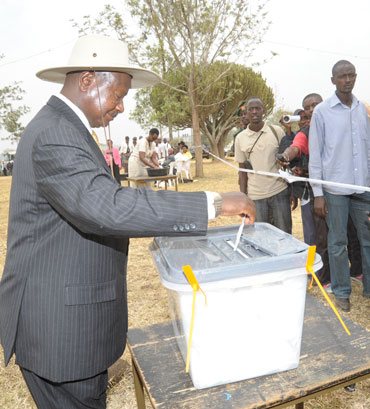
Museveni casting his vote

President-elect Yoweri Museveni has told jubilant supporters in Kiruhura district to take their electoral mandate seriously and urged them to continue supporting the NRM party for the country to fast-track its development process.

“Don’t play with your electoral mandate. Politics is not something to joke with because bad leadership is costly. Don’t just vote your friend but stick to your party, the Movement, because we must keep with the people of the same ideology, thinking and plan if we are to develop Uganda,” he said.

The President said under the Movement government, the message is the same and consistent; ‘emphasizing national unity which created the base for developing Uganda’.

“Any one propagating sectarianism is an enemy of the Movement and Uganda. The People of Uganda have for centuries lived together in harmony and complimented each other in their way of life exchanging goods and services like food, defense materials and medicine so why should anyone today try to divide them in order to gain political capital. Such a person should be avoided, detested and exposed,” he said.

Museveni, who was accompanied by his wife and Karamoja Affairs Minister Janet Kataha Museveni, was last evening speaking at a victory rally by supporters at Kiruhuura district headquarters to celebrate the victory of the Movement in the February 18th Presidential and Parliamentary elections and also to congratulate the President who hails from the same district upon his re-election as the President of Uganda for the next five years.

He commended the electorate of Kiruhura for overwhelmingly voting for him and the Movement with a 91% majority vote and also for sending only NRM members of parliament to the National Parliament which he said, showed not only their love and trust in the Movement government but also the fact that the electorate in the district was politically mature and united.

He appealed to them and the other districts in the country to do the same in the upcoming local council elections so as to strengthen the Movement and enable her work and cement the national gains Uganda has registered in the last three decades.

He re-assured the people of Uganda that no one can disrupt the hard earned peace ushered in by the NRM and urged the citizens to exploit it by working to get rid of house hold poverty.

Mr. Museveni commended the people of Kiruhura for adhering to the government message to fight poverty through modern agriculture especially dairy farming but appealed to them to modernize it further by planting modern cattle pasture, stopping overstocking and engaging in zero grazing where land has largely been fragmented.

He also advised them to diversify their income and engage in growing of coffee, fruits and poultry farming. He also cautioned them against land fragmentation, which he said posed a big danger to the future of agriculture as well as the future of the coming generations.

The President warned the Youth about the danger posed by HIV/Aids whose prevalence rates and new infections are on the increase in most parts of Uganda.

“You the youth should avoid cheap temptations because they are temporary. You should have discipline and know the importance of health. I am 71 years old but I have managed to address over 300 rallies in just 100 days without any problem because I have handled my life properly. It’s not wise to squander the life God gave to you because it’s a precious gift and parents need to play their part and advise their children to lead a healthy and disciplined way,” he said.

Museveni urged parents to be honest to their children about their way of life because you are their number one councilors failure of which you would have neglected your God given duty” he said.

Mrs. Janet Museveni on her part commended the people of Kiruhura for keeping the promise and voting the Movement overwhelmingly.

“We came here to campaign I asked you whether you will vote the Movement and you promised me so, which you have done and I must thank you whole heartedly for being trust worthy and keeping the promise and standing for the Movement” she said.

Nyabushozi Member of Parliament Fred Mwesigye said that the National Resistance Movement is the only regime that has brought hope to the country in Uganda’s history.

He also said that President elect Museveni is a God-sent messenger of transformation because God works through people and asked Ugandans to render him all the support he needs to accomplish his God given mission.


Stories Continues after ad

Tomorrow is public holiday

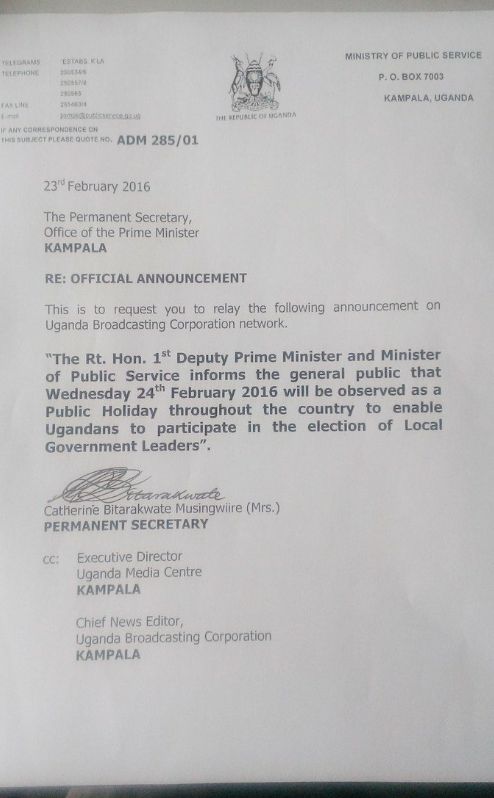
PM's letter declaring Public Holiday

The Uganda Government has declared tomorrow, February 24, a public holiday throughout the country.

In a statement signed by Mrs Catherine Bitakwate, the Permanent Secretary of the Office of the Prime Minister (OPM), indicated that this is to enable Ugandans to participate in the election of local government leaders.

Mayors, local council heads and councilors are set to be elected tomorrow countrywide.

Last week Uganda had two public holidays just a day apiece; one on February 16 in commemoration of the day the former Archbishop of Uganda Janan Luwum was killed by former President Idi Amin Dada, and another on February 18 when the country held the Presidential and Parliamentary elections.

Stories Continues after ad

Gen Sejusa denied bail again

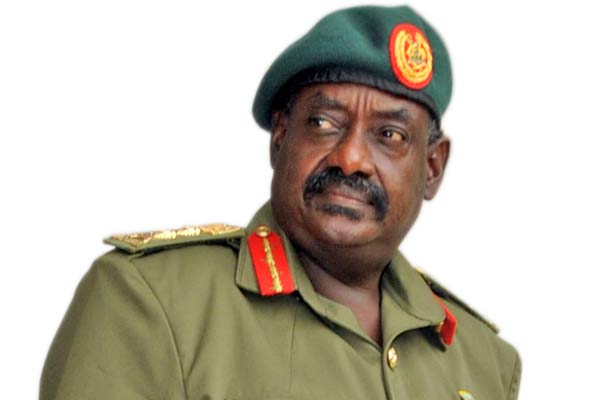
Gen David Sejusa

General David Sejusa has been denied bail by the Military Court today, and sent back to Luzira Maximum Security Prison.

Sejusa, who had asked for bail through his lawyers led by Mr Ladislaus Rwakafuuzi on grounds of advanced age, was denied bail by the court chaired by Maj Gen Levi Karuhanga, who said the renegade General was likely to tamper with the justice process.

In the previous hearing Sejusa had informed court that he could not handle the harsh prison life and that he was the only breadwinner for his family. He also said that he had no criminal record but court did not grant him bail.

And today Maj Gen  Karuhanga denied Gen Sejusa bail on grounds that he would interfere with investigations given the fact that he is a high ranking officer. He also added that he (Sejusa) is required to present an officer at the rank of General of the UPDF to stand as his surety.

He then set March 11 as the date on which Gen. Sejusa’s bail application will be heard.

The state alleges that that Gen Sejusa breached the law as a serving UPDF officer when he attended Democratic Party activities at the party headquarters and other political rallies against the warning of the Chief of Defence Forces. The law bars army officers from participating in politics.


Stories Continues after ad

Zimbabwe reviews elimination of death penalty

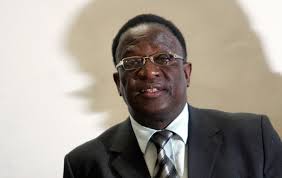
Zimbabwe Vice President Emmerson Mnangagwa

Zimbabwe is making significant strides towards the elimination of the death penalty from its statutes as demonstrated by the removal of all women and persons aged below 21 from facing the death sentence, Vice President Emmerson Mnangagwa has said.

Addressing delegates attending the 9th International Meeting of the Ministers of Justice in Rome, Italy yesterday, Vice President Mnangagwa said he was positive that Zimbabwe will soon abolish capital punishment.

He said he survived death penalty during the Rhodesian regime and knows “the tribulations faced by those on death row”.

“The legislative history of Zimbabwe in so far as the death penalty is concerned demonstrates that the country is making significant strides towards the elimination of capital punishment,” said VP Mnangagwa.

“The exclusion of all women and the increase of the minimum age of execution from 18 to 21 years under the current Constitution of Zimbabwe is a positive step towards the abolition of the death penalty.”

Under the old Constitution, only pregnant women and persons below the age of 18 were exempted from the death penalty.

“A lot of criticism has been levelled against the country to the effect that these constitutional provisions, instead of promoting gender balance under the criminal justice system, are actually discriminatory against male offenders,” said VP Mnangagwa.

“This discriminatory provision was maintained at the referendum after realisation by the majority that the most heinous and ruinous offences were actually at the instigation of the males than females.”

VP Mnangagwa said as leaders in Government, they noted the concerns raised and will address them at the opportune time.

“Surely, we will not hesitate to expunge capital punishment from our laws,” he said.

VP Mnangagwa said the Ministry of Justice, Legal and Parliamentary Affairs had launched campaigns to educate people about the new Constitution and emphasis was on the abolition of the death penalty.

He said Zimbabwe was very aware of, and committed to its obligations under the various international human rights instruments she has ratified and acceded to, adding that steps have been taken to ensure the national law was in conformity with international human rights norms.

“The country underwent the peer review process under the auspices of the UN Human Rights Council, wherein it accepted most of the recommendations to improve the human rights situation,” said VP Mnangagwa.

“One such recommendation it accepted was in relation to the abolition of the death penalty.

“The country also accepted the recommendations to consider ratifying the Second Optional Protocol to the International Covenant on Civil and Political Rights and to take measures to abolish the death penalty.”

VP Mnangagwa said the objective of the criminal justice system was now increasingly being viewed from a rehabilitative point of view than from an incarceration and retributive perspective.

“Having survived the death penalty myself, I know the tribulations faced by those on death row,” he said.

“The moment a sentence is pronounced that you are going to die by hanging, the whole world collapses on you,” he said adding that, “The death penalty is, in fact, a flagrant violation of the right to life and dignity.”


Stories Continues after ad

Vaginal Ring effective in HIV prevention among women – Report

The Vaginal Ring

Vaginal Rings have been proven to reduce HIV infection among women, researchers have established.

According to findings presented at a press briefing at the Conference on Retroviruses and Opportunistic Infections (CROI) in Boston by U.S based organisations: the International Partnership for Microbicides (IPM) and ASPIRE, trials of a vaginal ring that slowly secretes an antiretroviral (dapivirine) drug into the vagina found it reduced infections by about 30%.

The research involved a total of 4500 women aged between 18-45 in Uganda, Malawi, South Africa, and Zimbabwe, and experts from both organisations noted that the findings were ‘enormous victories’.

“The good news is the trials provide a consistent finding: The ring provided modest protection,” said Mitchell Warren, who heads AVAC, a nonprofit organisation in New York City that advocates for HIV prevention.

The ASPIRE trial found 27% efficacy overall, while the second trial—called The Ring Study—found a 31% efficacy. However, it was revealed that the ring was not so effective for women aged 18 to 21, with only 15% protection in the Ring Study and no protection  at all for ASPIRE’s first trial.

Experts attributed the low protection percentage to younger women not wearing the ring for the entire 28 days between each study visit. They noticed levels of dapivirine—which go down each day that the rings are used—were higher in some used rings than others. Greater protection occurred when there was less dapivirine left.

However, the ring was effective in women over 21 years, with over 56% protection in the ASPIRE trial and 37% in The Ring Study.  No serious safety concerns were recorded in either study.

Each study—held in parallel to speed up regulatory approval—cost an estimated $72 million. In the near future researchers hope to test higher levels of the drug—or more potent antiretrovirals—in vaginal rings. They also plan to make the product more appealing to women by combining anti-HIV drugs with contraceptive hormones, which are already sold worldwide in vaginal rings. It is anticipated that each ring initially will sell for about $5.


Stories Continues after ad

Machar group insists on 10 state demand

SPLM-IO spokesperson James Gatdet Dak

The South Sudan main armed opposition faction led by the first vice president designate, Riek Machar, has said the country will revert to the 10 states as provided for in the August 2015 peace agreement should the opposing parties fail to agree on the number of states to be created, an official said.

According to the armed opposition faction of the Sudan People’s Liberation Movement (SPLM-IO) spokesperson James Gatdet Dak, the creation of 28 states by the government of President Salva Kiir Mayardit was not necessary and had no legal backing.

“The peace agreement has been signed based on the constitutionally recognized 10 states at the time of signing in August 2015,” Dak said when contacted on Sunday as to whether the SPLM-IO would approve the referendum proposal from the government.

He added: “Also the recent IGAD communiqué has called for establishment of an inclusive boundary commission with membership of all the parties to the peace agreement. The commission will determine the number of states and basis for their creation within one month from formation of a Transitional Government of National Unity. In case of disagreement the parties will revert to the 10 states as simple as that.”

The development comes in the wake of government spokesman, Michael Makuei Lueth, saying on Sunday that government wants a referendum to determine the number of states, adding that Juba will not revoke the presidential decree that created the 28 states until the outcome of the referendum.

But Gatdet Dak  said the peace agreement did not provide for referendum to be conducted in determining the states, challenging the government for what he said had been its ‘fluctuating positions’ in their approach to the states of the country.

Dak further reminded that the government rejected their proposal to create 21 states based on colonial districts when the parties were negotiating in the Ethiopian capital, Addis Ababa, and never came up with a counter-proposal of the number of states. They never mentioned their desire to create 28 states so that the parties could discuss it during the negotiations, he added.

He also said the government did not consult the people or ask for a referendum first when it suddenly decreed 28 states in the name of ‘popular demand’ five weeks later after President Salva Kiir had signed the peace agreement based on the 10 states.

The opposition official further said it was unnecessary to hold an expensive nationwide referendum in the face of the political and economic crisis in the country, adding it would not only be a misplaced priority or further obstacle to the implementation of the peace agreement, but also an ‘unnecessary burden’ on the people of the country with a collapsing economy.

According to Dak, the best course of action is for the government to abide by the peace agreement and the recent IGAD communiqué.

Meanwhile, the alliance of 18 South Sudanese political parties led by Lam Akol, the former detainees and the international community have also urged President Kiir to suspend the creation of the states until the parties come to a consensus, saying the decision has contributed to the inter-communal violence in the country.

Stories Continues after ad

Orange, Google partner to boost mobile internet across Africa

The Orange logo> Orange announced the partnership with Google

Orange has today announced a new partnership with Google to bring the best of mobile internet across its full African and Middle Eastern (Orange MEA) footprint. By combining the strength of Orange’s mobile network and expertise with Google’s mobile applications, the move offers customers the best of both partners in terms of access and content through an all-inclusive digital communication package.

‘Orange and Google have come together to deliver a package that is tailored to meet the needs of the market. Customers across the Orange MEA footprint will now have access to a range of best-in-class online services including, but not limited to, popular content covering fashion, sport and music, as well as everyday tools such as Google Search YouTube and Google Maps’ a release by African Press Association (APO), on behalf of Orange, states in part.

according to APO, the partnership will address the mass market for Orange in Africa and the Middle East, following Orange’s ongoing success of delivering smartphones across the region.

‘Through an educational campaign, customers will be offered advice to better understand the benefits and direct value mobile internet can bring. Important information will be made accessible, for example, finding answers to questions instantly through Google Search or the ability to locate the nearest health clinic using Google Maps. Languages, such as Arabic, will be supported to enrich the customer experience, with additional languages to be added throughout the year,’ the release adds.

“As the first pan-Africa and Middle East mobile partnership with Google on this scale, we are able to bring direct value to our customers by offering the best access and services to ensure they get the most out of the mobile internet,” says Yves Maitre, Executive Vice President of Connected Objects and Partnerships, Orange. “Through this all-inclusive digital communications package, we are proud to continue our promise to deliver affordable internet access across the region and connect people to what is essential in their lives.”

Richard Turner, Director Android Partnerships for Europe, the Middle East and Africa said: “Today, over three billion people across the world are using the internet to live better, richer lives and create opportunities for themselves and their communities. The driving force behind this growth – particularly in Africa and the Middle East – is smartphones. We are very excited to work with Orange to bring together data services, content and a high quality Android™ device to provide a great experience for first-time or experienced smartphone users.”
The digital communication package is especially well-adapted to youth who have high data usage and want the latest generation smartphone. Customers will receive one of the most competitively priced tariff plans in the region starting at $40, which will consist of a high-specification smartphone and a communication bundle with voice, SMS and data.
The offer will be delivered in a phased approach and will start to roll-out across the full Orange MEA footprint in Q2 this year. The device will launch with the native set of Google services and the goal of the partnership is to develop local services and content over time.

Orange Rise 31 Special Edition, 3G flagship device for Orange MEA

The affordable offer will launch on the Orange Rise 31 Special Edition, a new and exclusive Orange branded 3G device. As the flagship model of Orange’s 2016 smart family line-up for Orange MEA, it will be running on Google’s latest OS Android 6.0 Marshmallow, has a 4-inch screen and comes with the latest version of Orange Experience 8 to ensure a smooth and supportive smartphone experience.

The smartphone is a powerful quad-core product, boasts a high memory package (1GB RAM/8GB ROM) and will provide access to the full suite of Google Apps. Coming with a 3 mega pixel camera with LED flash and a 1500mAH battery, it will be the first Orange customised smartphone to run Android 6.0 Marshmallow at a low-price point.

Stories Continues after ad

EU, Belgium to support EAC

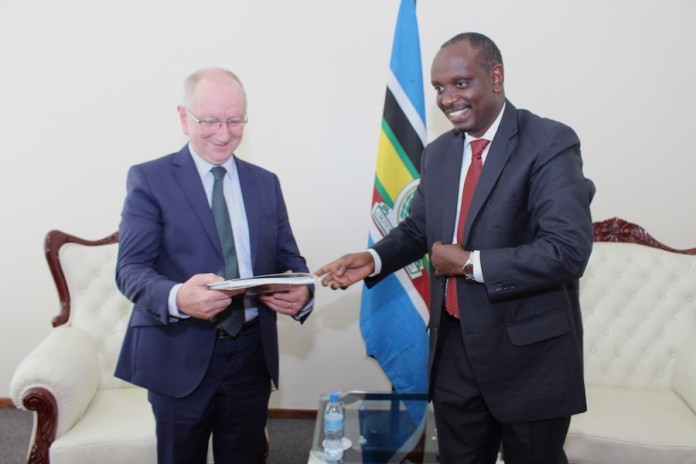
EAC Secretary General Dr Richard Sezibera with the Belgian Ambassador to the EAC, H.E. Paul Cartier, after they held talks on bilateral cooperation between the EAC and Belgium at the EAC Headquarters in Arusha, Tanzania.

The European Union (EU) and Belgian envoys to the East African Community (EAC) have pledged to support the regional body’s activities.

The EU Ambassador to Tanzania and the EAC Roeland van de Geer Paul and his Belgian counterpart Paul Cartier made the pledges as they separately presented their credentials to EAC Secretary General Amb Dr Richard Sezibera, in Arusha, Tanzania.

Amb van de Geer noted that the EU’s assistance to the EAC was broad covering almost all sectors of the integration agenda, reaffirming that the EU would continue providing this support. He urged the EAC to identify and prioritize the areas in which it would require increased support from the EU.

Amb Sezibera and Amb van de Geer agreed to hold bilateral talks to re-examine the cooperation framework between the EAC and the EU with the goal of making improvements, with technical teams from both sides exploring areas for future cooperation.

Amb van de Geer conveyed the EU’s condolences to the EAC and the family of the late Ms. Isabelle Wafubbwa, the Principal Political Affairs Officer, at the Community who passed on recently. He described Ms. Wafubbwa as having been instrumental in cooperation between the two regional economic communities especially in the field of political integration.

On his part Ambassador Cartier said his country was keen on strengthening her relations with the Community, by being part of the solution to various challenges facing the EAC.

In his remarks, Dr Sezibera thanked the Belgian government for her offer of additional support to the EAC, adding that a framework of agreement for cooperation will be developed between Belgium and the Community.

The Secretary General hailed Belgium for her contribution to the Partnership Fund, which has enabled the EAC to undertake programmes and projects in various sectors.

Stories Continues after ad

Minister Opendi to lead campaign against infertility stigma in Uganda

Group photo with Fertility patients and Minister of Health , Sarah Opendi and Hon. Betty Amongi, MP

Merck, a leading science and technology company, has announced the appointment of the State Minister for Health Sarah Opendi, as the ambassador of “Merck More Than a Mother” campaign in Uganda in recognition for her support and efforts to reduce the stigma of infertility and raise awareness about the condition in the country.

The announcement was made at the launch of its second “Merck More than a Mother” campaign in Africa and for the first time in Uganda as part of the Merck Capacity Advancement Program.

Minister Opendi said the country was happy to partner with reputable and innovative companies like Merck.

“We believe that improving access to regulated and equitable fertility care is important, but it is even more important to intervene to decrease stigmatization and social suffering arising from this condition” she said at the launch.

The campaign was first implemented in Kenya in 2015 and will be implemented this year in Uganda, in collaboration with the Ministry of Health, Africa Fertility Society (AFS) and the Uganda Women Parliamentary Association, and progressively rolled-out in more African countries.´

The campaign will provide training for embryologists and education for healthcare providers and will also support governments to define policies to improve access to safe and effective fertility care, address the need for interventions to reduce stigmatization and social suffering of infertile women and raise awareness about male infertility and the necessity for a team approach to family building among couples. Themed “Together we can create a culture shift”, the “Merck More than a Mother” social media campaign will challenge the social and cultural perception of infertile women in Africa. Moreover it will raise awareness about male infertility, prevention of infertility and infertility management at large.

“In some cultures, childless women still suffer discrimination, stigma and ostracism. As such, a central difficulty associated with infertility is that it can transform from an acute, private distress into a harsh public stigma with complex and devastating consequences. An inability to have a child or to become pregnant can result in being greatly isolated, disinherited or assaulted. This may result in divorce or physical and psychological violence. Therefore this campaign is very important for Africa since it aims to define interventions to reduce the stigma and social suffering of infertile women across the continent,” said Rasha Kelej, Chief Social Officer, Merck Healthcare.

Dr. James Olobo-Lalobo, Vice-President of Africa Fertility Society stressed: “Through this historic campaign, Merck More than a Mother’, we will challenge the perception about infertile women, their roles and worth in society, both within and beyond the medical profession in order to achieve any systemic shift in the current culture of gender discrimination in the context of fertility care.”

Through this campaign Merck, a pioneer in reproductive health, will address together with local stakeholders, the key challenges that are associated with resource-constrained settings such as prevention of infertility, education and self-development, regulation of assisted reproductive technology (ART) and in-vitro fertilization (IVF), geographic barriers, reproductive rights and over-population and limited resources arguments.

Dr. Oladapo Adenrele Ashiru, President of Africa Fertility Society explained: “In Nigeria where I practice, infertility is caused by infections in over 85% of women, like in the rest of Africa, compared to 33% worldwide which emphasizes the importance of prevention programs in Africa. Therefore our partnership with Merck is very essential to address this sensitive topic for the first time in the continent”. “We are going to host this important campaign in Nigeria and many other African countries this year,” he added.

Hon Joyce Lay, Member of Parliament and ambassador of the campaign in Kenya, has joined hands with Uganda Ministry of Health and Uganda Women Parliamentary Association to raise awareness about male infertility. “In order to improve access to safe and effective fertility care, a discussion with the relevant authorities will be needed to discuss the strengthening of infertility services, education, auditing, regulation, community awareness and the need to integrate them in programs which already exist in the local health infrastructure,” Ms Lay emphasized.

At the launch event, Merck awarded Berna Amulen, a Ugandan woman, who openly shared her story of stigmatization and suffering for being infertile. The award was in recognition of her courage in creating awareness and sharing her devastating experience so that no other woman would suffer the same.


Stories Continues after ad