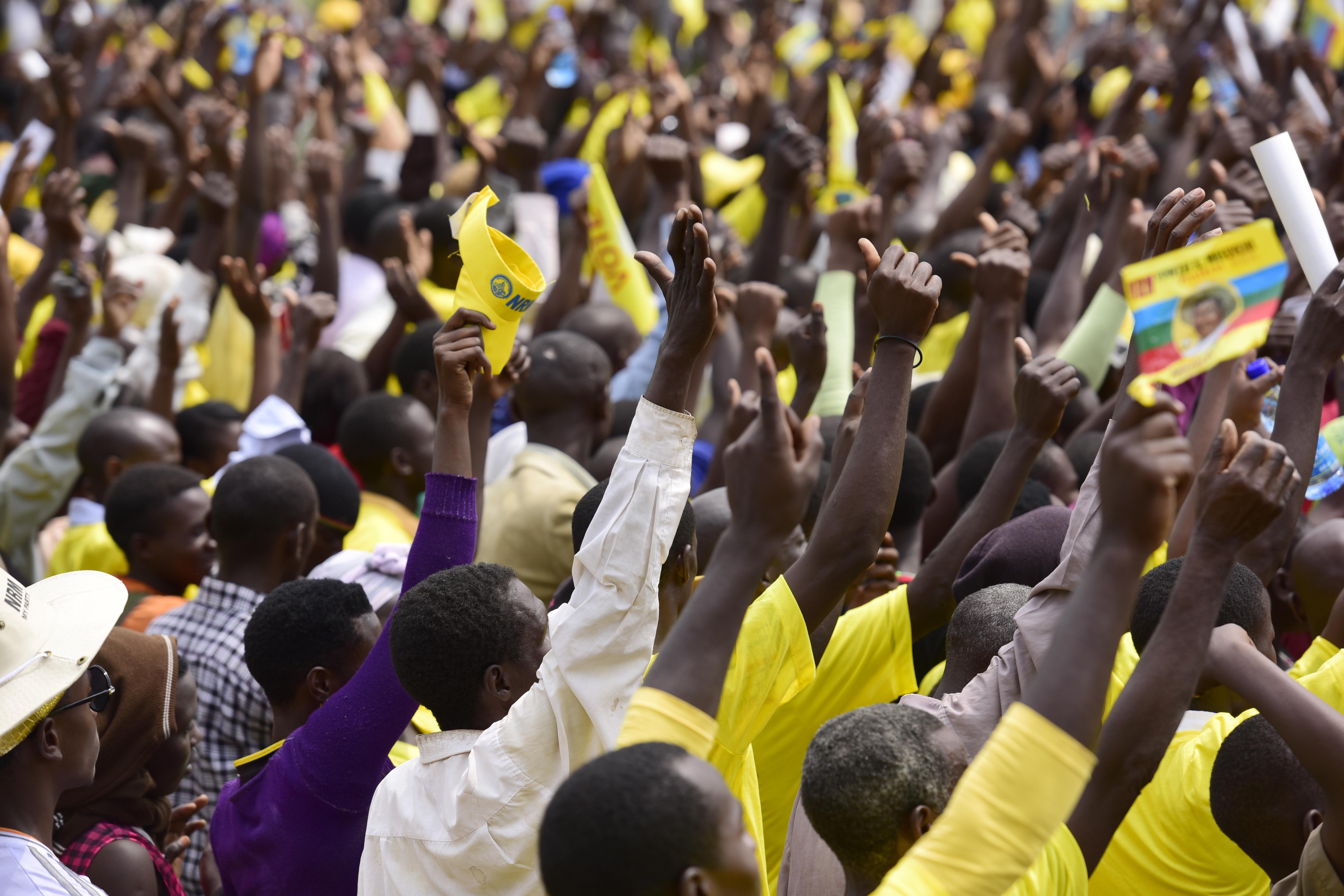
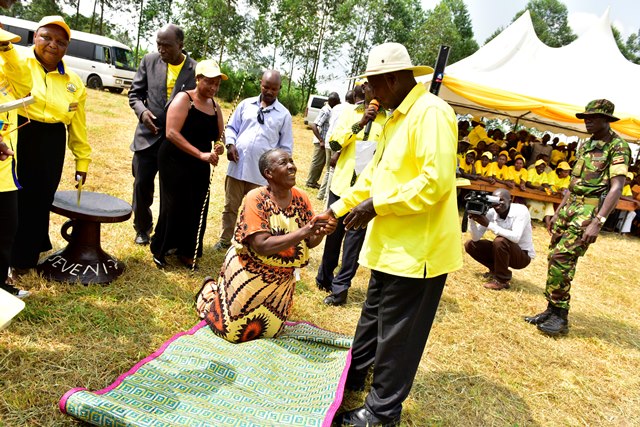
Supporters of Kizza Besigye listening to him in Kamuli.
Presidential aspirants today continued with their countrywide campaigns with Forum for Democratic Change flag bearer Kizza Besigye promising to eradicate poverty in Busoga while Amama Mbabazi of the Go-Forward warning land grabbers in Bunyoro region of dire consequences under “his” regime.
“Poverty levels have remained high for the last 30 years and poverty has eaten people and Busoga is the headquarters of it because Busoga has been clapping for long” Besigye said.”
Adding “I heard that mzee Kirunda Kivejinja has been named Deputy Prime Minister again but you will find that people of Bugweri are still drinking dirty water”
While Mbabazi who was addressing his supporters at Bunyoro Sports Club grounds in Hoima said “Your land was given for free and stand up for it and I warn those that grab your land that time is up”
Go-Forward contender Amama Mbabazi welcomed by his supporter at Bunyoro Sports Club grounds.
In Lira, Independent candidate Venansius Baryamureeba promised quality education if elected president next year. He also took a swap at President Museveni and Mbabazi saying their time is up as they have nothing to offer.
“Museveni is in his 70s and his brother Mbabazi is in his late 60s and I would like them to retire. The quality education we had in the 60s is never the same and I would like it to comeback to this country” Prof. Baryamureeba said.
Maj. Gen. Benon Biraaro who campaigned in Tororo and Malaba areas told his supporters that it was time up for his fellow bush comrade, Yoweri Museveni because there was nothing new to offer.
“Even the one who dances well gets off the stage; America has been ruled by five presidents whereas Uganda is under one man. The other day, I saw him in Nebbi talking with force that he still needs more” Gen. Biraaro said.
President Yoweri Museveni who is also the NRM party Presidential flag bearer has urged the Ugandan electorate to vote out opposition politicians especially members of parliament who spend most of their time and energies criticizing the government and opposing government development programs.
He said such politicians even fail to follow up and supervise their constituency’s development demands that have left the areas they represent very undeveloped.
The President who is in the West Nile Region to converse support for the National Resistance Movement in the coming elections was this afternoon addressing a campaign rally at Aninia primary school in Terego West constituency in Arua district.
Responding to the call by the residents of Terego West to have electricity extended to their constituency, the President said that as a national leader he plans for the entire country and it was a duty of the different leaders to follow up on the implementation of the different development in the areas they represent.
“As a leader at the top I plan and avail the resources but it’s the duty of your leaders to follow up on the implementation and where it’s badly done or not done at all. But you elect opposition Members of Parliament whose duty is just to criticize what government has done, oppose government programs without supervising or presenting their constituent’s demands to government. How can power be taken to Yumbe and Moyo and not in Terego which is in Arua. Am going to act like an MP and bring the electricity,” he said.
Museveni urged the people of Arua to vote for the National Resistance Movement noting that its leadership has a known track record that is development oriented, promotes national unity and treats all citizens equally no matter their religion, gender or tribe.
“Movement is always looking for the merits in individuals not their religious orientation, tribe or gender because politics is about things on earth while religions, gender and tribe are God’s works. If you build a road, school or extend power to an area it benefits everybody irrespective of his tribe, religion or gender and that’s the political orientation of the movement” he said.
On education, he urged all Ugandans to support the successful implementation of the UPE and USE programs for the good of the country’s future and do away with the levying of fees in UPE and USE schools.
“You know that poor parents can’t afford school fees so let all of us parents, teachers and the government speak with one voice because my worry is that our children will miss education and once they miss education they will be a national problem in future” he said.
Museveni said that the recent decision by the National Resistance Movement to provide sanitary pads to school going children in government school is meant to better the education environment of the girl child and reducing their school dropout rates.
“Am bothered about sanitary pads because I want my grand children to remain in school and attain education but also the traditional methods used especially in the villages have health risk and government had to intervene at least in schools” he said.
On unemployment, the President said that government will provide free technical education to graduates that have failed to get jobs and equip them with skills that will enable them to employ themselves. He also said that people needed to make good use of the NAADS programs and engage in profit oriented commercial agriculture and get rid of poverty in their homes.
Museveni described opposition politicians as learners in the art of managing society who think that you can do all things at the same time and stressed that if you attempted to do everything simultaneously you may deliver nothing, the reason NRM has been prioritizing in implementation of government programs.
The Mauritius Commercial Bank (MCB) is hosting 50 top executives representing 37 African banks at the week-long 2015 Africa Forward Together conference which opened on Sunday November 15 at the five-star Long Beach Resort.
Africa Forward Together is an annual event organised by MCB since 2009 to showcase its ‘Bank of Banks’ initiative, which aims at positioning MCB as a regional platform offering bundled banking and financial industry capabilities to its counterparts.
According to a release sanctioned by MCB and distributed by the Africa Press Organisation (APO), bankers attending the Africa Forward Together event get first-hand knowledge of MCB’s human expertise and technological capabilities while exploring collaboration possibilities that could allow them to boost their services through outsourcing in Mauritius.
‘Over the last few years, an increasing number of African banks have teamed up with MCB to serve their customers better and more efficiently. Some have managed to offer new services to their customers in record times without investing heavily in technology or human resources. Others have discovered opportunities to expand their businesses through intelligent collaboration with one of Africa’s leading banks,’ the release states in part.
“This is where MCB fits in. We have been there before as we have gradually worked our way up. We have the experience; the expertise and the technology to assist these banks move forward and climb the next steps. And our pricing is extremely competitive so it makes the value proposition even more exciting,” says Raoul Gufflet, Deputy Chief Executive of MCB.
Established in 1838, MCB is reportedly the largest bank in East Africa and the 18th biggest on the continent, with a presence in Mauritius, South Africa, Kenya, Seychelles, Madagascar, Maldives, Mozambique, Réunion, Mayotte and France.
I will begin by paraphrasing retired Tanzanian President Jakaya Mrisho Kikwete’s piece of advice to his fellow African leaders: what one has failed to do in ten years, one will never be able to do even if given more years.
Quite telling for a man who has relinquished power at a remarkably tender age of 65.
Africa is the poorest continent and, despite most countries attaining Independence over 50 years ago, only a handful of those South of Sahara can lay claim to good governance and, relative and sustained economic growth. In this group we have countries like South Africa, Seychelles, Mauritius, Ghana and Botswana.
The other African countries seem to be at crossroads, having failed to find answers to their persistent problems, among them poverty, disease, ignorance and poor governance, all basic ingredients for instability and war.
This pathetic situation has been compounded by a new plague, the ‘Third Term’, an endemic political scourge that has morphed into the sporadic change of individual countries’ Constitutions to enable rulers cling onto power.
The President of Congo Dennis Sassou Ngwesso has just had his country’s Constitution changed to allow him run for a third term in office, while President Pierre Nkurunziza changed Burundi’s Constitution to allow him run for a third term in office.
President Joseph Kabila is attempting to change the Constitution of the Democratic Republic of Congo, to allow him serve a third term.
In Rwanda, efforts are underway to change the country’s Constitution to allow Paul Kagame serve a third seven-year term when he current mandate ends in 2017.
In Uganda the Constitution was changed about a decade ago to allow President Yoweri Museveni serve a third term (currently he is serving his fourth term), while in Zimbabwe it is just the norm for President Robert Gabriel Mugabe to stay on till he answers to the Almighty’s call. And the story just goes on and on!
So, what has gone wrong with Africa? I will just focus on Burundi, a country whose citizens have known little about human freedoms since the tiny and one of the poorest countries in the world got Independence from Belgium in 1962.
Until ten years ago the current President Nkurunziza was himself a rebel leader, fighting against regimes he said were hell-bent on denying the people of Burundi their inherent freedoms.
However, despite being in power for a decade (and still counting), Nkurunziza has failed respect the citizens’ rights and freedoms. Worse still, he has also failed to transform his country and propel it from being the second poorest country in the world!
And because of such dismal performance, many Barundi thought it wise that the man take a break, so that the country re-orients itself under a different leadership. But Alas! This was not to be and now the tempo in his country has risen to genocide proportions, courtesy of his protégé, Senate President Reverien Ndikuriyo.
At this point, it is worth making reference to one of the most significant statements made by Zeid Ra’ad Al Hussein, the United Nations High Commissioner for Human Rights (UNCHR), a man who has dedicated his services to humanity and one who wakes up every day of his life to ‘fight’ for human rights and human dignity.
‘And yet, astonishingly, the authors of the crimes themselves, and their supporting communities, will always believe their actions were somehow necessary, even if they knew they were also wrong. Indeed, every individual, political party, association, ethnic, sectarian, or national group, or government discriminating and inflicting violence on others, believes that when doing so they are excused, or absolved, by circumstance or history.’
Those words were said by Al Hussein said during a speech he made in Geneva, as the High Commissioner for Human Rights in 2014.
I have made reference to Al Hussein because he was one of the people who served under the UN in former Yugoslavia, one of the most dangerous flashpoints of the 20th century, alongside Rwanda and Cambodia.
And what happened to that Yugoslavia of yesteryears under Marshall Josip Broz Tito for 37 years is instructive as an eye-opener for the rulers of Africa today.
Just like many of Africa’s ‘strongmen’ ruling today, Marshall Tito’s Yugoslavia in the early 1940s enjoyed political and economic stability, with the ‘strongman’ at one time being heralded as ‘the greatest man in the world today’ by American Actor and Film Director Orson Welles.
Indeed, both at home and elsewhere Marshall Tito was viewed as the embodiment of a stable and prosperous nation, yet in actual fact he was just another ineffective ruler surviving on debauchery and intrigue; a passing cloud whose death in 1980 would lead to one of the world’s most brutal ethnic and religious wars between the Orthodox Christians and Muslims in Croatia, Serbia and Bosnia.
As observed earlier, many African countries are either on the verge of becoming ‘failed states’ or are facing tumultuous situations because of the ‘longevity’ in power desired by their respective rulers; Africa’s replicas of Yugoslavia’s Marshall Tito.
Poignantly, many Africans have lived to rue what is happening in Somalia where Mohammed Said Barre ruled for 22 years; Libya where Muammar Gadhafi ruled for 42 years, in Egypt where Hosni Mubarak ruled for 30 years; in Cameroon where Paul Biya has ruled for 33 years; in Zimbabwe where Robert Mugabe has ruled for 35 years and in Angola where Jos Eduardo dos Santos has ruled for 36 years.
Interestingly, all the countries mentioned above are still third world countries. It is a shame but Africans trudge on, most living on less than a dollar a day.
It is against such a background, that Africa frees itself of all the ‘third termers’ because they have failed to add any value to governance and economic development. Period.
The Mauritius Commercial Bank (MCB) is hosting 50 top executives representing 37 African banks at the week-long 2015 Africa Forward Together conference which opened on Sunday November 15 at the five-star Long Beach Resort.
Africa Forward Together is an annual event organised by MCB since 2009 to showcase its ‘Bank of Banks’ initiative, which aims at positioning MCB as a regional platform offering bundled banking and financial industry capabilities to its counterparts.
According to a release sanctioned by MCB and distributed by the Africa Press Organisation (APO), bankers attending the Africa Forward Together event get first-hand knowledge of MCB’s human expertise and technological capabilities while exploring collaboration possibilities that could allow them to boost their services through outsourcing in Mauritius.
‘Over the last few years, an increasing number of African banks have teamed up with MCB to serve their customers better and more efficiently. Some have managed to offer new services to their customers in record times without investing heavily in technology or human resources. Others have discovered opportunities to expand their businesses through intelligent collaboration with one of Africa’s leading banks,’ the release states in part.
“This is where MCB fits in. We have been there before as we have gradually worked our way up. We have the experience; the expertise and the technology to assist these banks move forward and climb the next steps. And our pricing is extremely competitive so it makes the value proposition even more exciting,” says Raoul Gufflet, Deputy Chief Executive of MCB.
Established in 1838, MCB is reportedly the largest bank in East Africa and the 18th biggest on the continent, with a presence in Mauritius, South Africa, Kenya, Seychelles, Madagascar, Maldives, Mozambique, Réunion, Mayotte and France.
I will begin by paraphrasing retired Tanzanian President Jakaya Mrisho Kikwete’s piece of advice to his fellow African leaders: what one has failed to do in ten years, one will never be able to do even if given more years.
Quite telling for a man who has relinquished power at a remarkably tender age of 65.
Africa is the poorest continent and, despite most countries attaining Independence over 50 years ago, only a handful of those South of Sahara can lay claim to good governance and, relative and sustained economic growth. In this group we have countries like South Africa, Seychelles, Mauritius, Ghana and Botswana.
The other African countries seem to be at crossroads, having failed to find answers to their persistent problems, among them poverty, disease, ignorance and poor governance, all basic ingredients for instability and war.
This pathetic situation has been compounded by a new plague, the ‘Third Term’, an endemic political scourge that has morphed into the sporadic change of individual countries’ Constitutions to enable rulers cling onto power.
The President of Congo Dennis Sassou Ngwesso has just had his country’s Constitution changed to allow him run for a third term in office, while President Pierre Nkurunziza changed Burundi’s Constitution to allow him run for a third term in office.
President Joseph Kabila is attempting to change the Constitution of the Democratic Republic of Congo, to allow him serve a third term.
In Rwanda, efforts are underway to change the country’s Constitution to allow Paul Kagame serve a third seven-year term when he current mandate ends in 2017.
In Uganda the Constitution was changed about a decade ago to allow President Yoweri Museveni serve a third term (currently he is serving his fourth term), while in Zimbabwe it is just the norm for President Robert Gabriel Mugabe to stay on till he answers to the Almighty’s call. And the story just goes on and on!
So, what has gone wrong with Africa? I will just focus on Burundi, a country whose citizens have known little about human freedoms since the tiny and one of the poorest countries in the world got Independence from Belgium in 1962.
Until ten years ago the current President Nkurunziza was himself a rebel leader, fighting against regimes he said were hell-bent on denying the people of Burundi their inherent freedoms.
However, despite being in power for a decade (and still counting), Nkurunziza has failed respect the citizens’ rights and freedoms. Worse still, he has also failed to transform his country and propel it from being the second poorest country in the world!
And because of such dismal performance, many Barundi thought it wise that the man take a break, so that the country re-orients itself under a different leadership. But Alas! This was not to be and now the tempo in his country has risen to genocide proportions, courtesy of his protégé, Senate President Reverien Ndikuriyo.
At this point, it is worth making reference to one of the most significant statements made by Zeid Ra’ad Al Hussein, the United Nations High Commissioner for Human Rights (UNCHR), a man who has dedicated his services to humanity and one who wakes up every day of his life to ‘fight’ for human rights and human dignity.
‘And yet, astonishingly, the authors of the crimes themselves, and their supporting communities, will always believe their actions were somehow necessary, even if they knew they were also wrong. Indeed, every individual, political party, association, ethnic, sectarian, or national group, or government discriminating and inflicting violence on others, believes that when doing so they are excused, or absolved, by circumstance or history.’
Those words were said by Al Hussein said during a speech he made in Geneva, as the High Commissioner for Human Rights in 2014.
I have made reference to Al Hussein because he was one of the people who served under the UN in former Yugoslavia, one of the most dangerous flashpoints of the 20th century, alongside Rwanda and Cambodia.
And what happened to that Yugoslavia of yesteryears under Marshall Josip Broz Tito for 37 years is instructive as an eye-opener for the rulers of Africa today.
Just like many of Africa’s ‘strongmen’ ruling today, Marshall Tito’s Yugoslavia in the early 1940s enjoyed political and economic stability, with the ‘strongman’ at one time being heralded as ‘the greatest man in the world today’ by American Actor and Film Director Orson Welles.
Indeed, both at home and elsewhere Marshall Tito was viewed as the embodiment of a stable and prosperous nation, yet in actual fact he was just another ineffective ruler surviving on debauchery and intrigue; a passing cloud whose death in 1980 would lead to one of the world’s most brutal ethnic and religious wars between the Orthodox Christians and Muslims in Croatia, Serbia and Bosnia.
As observed earlier, many African countries are either on the verge of becoming ‘failed states’ or are facing tumultuous situations because of the ‘longevity’ in power desired by their respective rulers; Africa’s replicas of Yugoslavia’s Marshall Tito.
Poignantly, many Africans have lived to rue what is happening in Somalia where Mohammed Said Barre ruled for 22 years; Libya where Muammar Gadhafi ruled for 42 years, in Egypt where Hosni Mubarak ruled for 30 years; in Cameroon where Paul Biya has ruled for 33 years; in Zimbabwe where Robert Mugabe has ruled for 35 years and in Angola where Jos Eduardo dos Santos has ruled for 36 years.
Interestingly, all the countries mentioned above are still third world countries. It is a shame but Africans trudge on, most living on less than a dollar a day.
It is against such a background, that Africa frees itself of all the ‘third termers’ because they have failed to add any value to governance and economic development. Period.
3rd Deputy Prime Minister and Minister of East African Affairs;
President Yoweri Museveni has made changes in his cabinet and thereby appointing Mzee Kirunda Kivejinja as 3rd Deputy Prime Minister and Minister of East African Affairs replacing the departed Eriya Kategaya while Michael Werikhe has been named State Minister for Industries replacing his Dr James Mutende who passed on in September. According to State House statement, Bukedea Woman Member of Parliament, Rose Akol is to replace departed Gen. Aronda Nyakairima as Internal Affairs Minister.
Both Werikhe and Kivejinja has served as State Minister of Energy and 3rd Deputy Prime Minister before they were dropped.
Minister of State for Industry.
“President Museveni has made new Ministerial appointments:
1. Mr. Kirunda Kivejinja – Rt. Hon. 3rd Deputy Prime Minister and Minister of East African Affairs;
2. Ms. Rose Akol – Minister of Internal Affairs;
3. Mr. Werikhe Kafabusa – Minister of State for Industry.
The appointments have been forwarded to Parliament for approval.
‘It is not accepted that you are a homosexual and an openly gay man’
Robert Kityo has been taken to a deportation centre after his latest attempt to claim asylum was refused by the Home Office Jon Super
A gay Ugandan-born asylum-seeker is facing deportation to his homeland where homosexuality is illegal after immigration officials decided he had “failed to prove” his sexuality.
Robert Kityo, who lives in Manchester, was taken to a deportation centre after his latest attempt to claim asylum was refused by the Home Office. A decision letter sent by officials acting on behalf of Home Secretary Theresa May said: “It is not accepted that you are a homosexual and an openly gay man.”
The decision came even though more than 30 people including Dr David Walker, the Bishop of Manchester, and leaders of LGBT groups in the city, sent letters in support of Mr Kityo’s claim. More than 1,900 people have also signed a petition calling for him to be allowed to remain in the UK.
The 35-year-old Christian volunteers with a number of LGBT groups including Manchester’s Lesbian and Gay Foundation. He is also a member of a number of church groups including a fellowship for gay Christians.
Dr Walker said in his letter: “I would say he has a well-founded case for asylum here in the UK.”
Mr Kityo fears he could be killed if he is sent back to Uganda, where homosexuality is illegal under a 1950s penal code that prescribes jail for those found guilty of homosexual acts.
The Anti-Homosexuality Act was overturned by the country’s Constitutional Court last year, but human rights campaigners fear it could be re-enacted. Mr Kityo told The Independent: “I’m very scared. I’m a gay man and in Manchester I am able to be who I am. I have made many friends here who accept me and love me. But I’m frightened that I will be killed if I am sent back to Uganda. It isn’t safe to be a gay man in Uganda.”
Mr Kityo arrived in the UK in 2011 on a student visa and claimed asylum the following year. He said his partner in Uganda had been jailed for being gay and a warrant had been issued for his arrest if he returned. But an immigration judge dismissed Mr Kityo’s claim on appeal in 2013 and said he did not believe he would face persecution.
Solicitors acting on Mr Kityo’s behalf sent new submissions in September this year and asked for the case to be re-considered. But Home Office officials said in their new decision letter: “Most of the people who have written the letters and statements appear to have known you only since 2014. This undermines your case for being an openly gay man.”
Mr Kityo was released from a deportation centre at Manchester Airport at the weekend after being told by the Home Office that it wanted to take a further look at his case. His legal team are continuing to fight for him to remain in the UK.
The Home Office said it could not comment on individual cases but added: “The Chief Inspector of Borders and Immigration last year praised our guidance and training on handling sexual orientation claims, stating that it was clear and concise.
“We worked closely with organisations such as Stonewall, the UK Lesbian and Gay Immigration Group and the UN High Commissioner for Refugees to develop this training, which is now mandatory for our caseworkers.”
I am writing to clarify certain distortions I have been reading since the KCCA amendment bill was tabled on the floor of parliament.
First; is the issue of the minister for Kampala not making regulations that will guide the conduct of mayoral elections and second; is the question of why table the amendment bill now?
Regulations for any law are always intended to operationalize its provisions that may not have been written in detail. The regulations come in to give clarity on procedure and practice of how the provisions of a certain law will be implemented.
In this case therefore, I could not make the said regulations when the law they were meant to operationalize had a lot of provisions that were lacking and needed review. Instead I had to undertake a process of amending the law which many other stakeholders including Parliament were rightly calling for. Regulations alone cannot cure the effects of bad law. The solution is to amend the law and cure the lacunas and ambiguities sustainably.
Section 82(1) of the KCCA Act which provides for those regulations states;
“The Minister may, by statutory instrument, make regulations for the better carrying into effect of the provisions of this Act.
Notwithstanding the generality of subsection (1), the Minister may make regulations for— -Prescribing an area within the Capital City to be the central business district;
-Prescribing particulars to be contained in the quarterly summary reports of procurements and disposals made by the Capital City Contracts Committee;
-The election of representative of professional bodies;
-In consultation with the Electoral Commission, regulating the election of Lord Mayor and Deputy Lord Mayor;
-The election of representatives of professional bodies;
-On recommendation of the Police Authority, regulating the Metropolitan Police Force;
-The reporting procedure of Contracts Committee;
-The delegation of powers of Contracts Committee;
The Minister shall, as soon as practicable after the publication of a statutory instrument made under this section, cause the instrument to be laid before Parliament.”
Looking at the phrasing of section 82(1) above, one can clearly see that even the requirement of making regulations by the minister is not a mandatory one which clearly tells it all, that the law indeed requires review. The amendments I am proposing therefore, and which have been approved by cabinet, are meant to cure such lacunas like on procedure for elections and in many other provisions of the same law. Can the electoral commission therefore, in the circumstances conduct the mayoral elections without the said regulations? That is a Matter for the Attorney general to advice.
Broadly why are we amending the KCCA Act law?
In 2005, Article 5 of the Constitution was amended to reflect the special status of Kampala as the Capital City of Uganda, which means that Kampala ceased to be a district under the Local Government system, and that the Capital City was therefore to be administered by the Central Government. That provision is in the constitution and it’s supreme. Any other law made under the same constitutional provision must not contradict it or attempt to undermine the spirit of the constitution framers in as far the administration of Kampala is concerned.
The objective of the aforesaid constitutional amendment was to introduce reforms to the governance of the Capital City in a bid to address the numerous issues that Kampala faced at that time, for example poor transport infrastructure, traffic congestion, uncontrolled developments, flooding, unregulated transport industry, illegal street trading, corruption, poor service delivery etc…
In order to give effect to the new status of Kampala under Article 5 of the Constitution, Parliament enacted the Kampala Capital City Act, 2010 which came into force on the 1st of March 2011. The provisions of the Kampala Capital City Act 2010 prescribe, among others, the administration of Kampala by the Central Government, the establishment of the Kampala Capital City Authority (hereinafter referred to as the KCCA) as the governing body of the city, the composition of the Authority, election, removal and powers of the Lord Mayor, Deputy Lord Mayor and members of the Authority.
In as much as the Capital City has experienced significant reforms under the administration of Kampala Capital City Authority, there is inadequacy in the aspect of governance, which has, to a great extent, impeded the smooth operation of KCCA.
Since 25th November 2013,
KCCA has run without a Lord Mayor following his removal by the Authority Councilors using the power given to them under section 12 of the KCCA Act. The removal has since been a subject of contestation in the courts of law and debate in Parliament, the media and other public fora. While the removal of The Lord Mayor is provided for in the same law, there was no provision for who and how the functions of the removed lord mayor will be performed in both his/her absence and that of the deputy Lord Mayor. The law should never be made to create an absurdity. This is what partly the amendment seeks to cure.
The KCCA (Amendment) Bill, 2015 which is a culmination of two years of preparation intends to strengthen and streamline the governance of the city, by drawing clear lines of distinction between roles of policy makers and administrators. The apparent fusion of roles has also contributed largely to the governance problem.
The amendments will also; enhance the current provisions in the law, providing for the Metropolitan Physical Planning Authority to engender better planning in the Greater Kampala Metropolitan Area; remove the borrowing limit of the KCCA as long as any such borrowing is compliant with the Public Finance Management Act; and to correct the latent errors and ambiguity in composition of the Authority/Council and nomenclature of institutions and offices.
I have been reading online with consternation the behavior of my colleagues in the Opposition and some sections of the media in the last three days following the tabling of the Bill for the First Reading. These colleagues of mine including the former Lord Mayor, Erias Lukwago are now raving and ranting about the Bill as if it pertains to a person in the name of Erias Lukwago. This Bill like I have stated hereinabove deals with matters to do with general governance questions in accordance with the Constitution of the Republic of Uganda. Let us not misrepresent the bill before even telling the public about its contents as was the case with the land amendment bill some years back.
Assurance made to Parliament by leader of government business
The amendment bill is not just work of one night. It has been a process. In December 2014, the Right Honourable Prime Minister made an assurance to Parliament of Government’s intention to deal with the governance question in Kampala through amendment of the law. He was overwhelmingly supported not to mention the one month deadline the speaker gave him to have the amendment bill presented. This call by Parliament to have the law amendment had been re-echoed by many other legitimate stake holders of Kampala. It is therefore dishonest on the part of my colleagues in the Opposition to state that this was an after-thought following Erias Lukwago’s decision to stand for the Lord Mayor position in Kampala. That is false. Whether Lukwago stands or doesn’t, streamlining the governance framework of Kampala capital city remains our noble duty.
The other inaccurate claim, I have heard is that this Bill is about disenfranchisement of the people of Kampala. I would like to reassure the people of Kampala and Uganda at large, that this is not the case. To disabuse the notion being peddled, I would like to make a couple of comments.
The issue of disenfranchisement is overstretched by the naysayers. The Council presided over by the Lord Mayor or Division Mayor is no different from the Parliament of Uganda. Currently, the Lord Mayor and Division Mayors perform the role of a Speaker in the Council. They convene and chair council meetings as their main function. This is different from the set-up of the district council where a separate speaker is elected from the councilors to head council and not the LC5 chairperson. The LC5 chairperson heads the executive committee. In the case for Kampala, The Lord Mayor has no executive of a government to form and so is the chairperson and head of council. What then is wrong with having the lord mayor elected by the same legislative council he/she chairs just like it is for the national parliament? Can we say that the people of Uganda are disenfranchised because they don’t vote for the speaker of parliament through adult suffrage?
The rationale behind the proposal of changing the mode of election of the lord mayor and all other division mayors is for purposes of ensuring that the mayor and the deputy remain accountable to the Council that they chair, just like in the case of Speaker and Deputy Speaker of Parliament who are elected by Members of Parliament. Besides, the law already vests the same Councils with authority to remove a Lord Mayor or Division Mayor. These Councilors are products of an electoral process conducted from the grassroots. Ugandans do not convene at Parliament to elect a Speaker or Deputy Speaker. Their representatives in form of Members of Parliament elect the Speaker and Deputy Speaker. Where then is the disfranchisement?
The other distortion to this debate is the claim that the Central Government is targeting Erias Lukwago and wants to strip him of his powers. The powers vested in a Lord Mayor are not personal and nothing is changing substantially with the proposed amendments. In fact, if the proposal of having the Lord Mayor elected by the councilors is rejected and instead a separate position of speaker for the council is created in the law as some stake holders I consulted had suggested, then the real powers of The Lord Mayor will indeed be stripped since he/she will no longer be the one to convene and chair council. He will only be an ex-official member of council. We are however not proposing this in the amendments but it’s another feasible option many other stake holders had mooted.
The amendments therefore, cannot be targeting a man called Erias Lukwago. The law was never made for Him. Erias Lukwago just like any other person is entitled to aspire to become a Lord Mayor. However, what any person aspiring to be lord mayor needs to be reminded about is that he/she is not the primary administrator of the Capital City. The Central Government does so as per the Constitution. The Lord Mayor and the council administer it on delegation by the central government. Central Government policy therefore takes precedence. That is why the minister responsible for the capital city is given veto powers under section 79. This is what Erias Lukwago has never appreciated, but it’s the bitter truth.
By and large, the amendment bill if passed into law is intended to improve the City and enhance the operations of the Greater Kampala Metropolitan Area from a physical planning perspective and generally bring about integrated planning in the face of rapid urbanization. It is generally for the common good of all Kampala people.
The amendments therefore should be looked at broadly. Focusing them on one political individual is wrong. The mode of election being proposed is not only for the office of The Lord Mayor. Division Mayors too shall also be affected. The amendments will further build synergies among the local authorities and Government agencies in physical planning development.
Whereas the Kampala Capital City Act, 2010 provides, in Section 21 for establishment of a Metropolitan Physical Planning Authority (MPPA), the law does not prescribe its character whether as a body corporate or not, and does not provide for its secretariat or financing. Yet its (MPPA) establishment is very urgently needed for purposes of harmonizing the broad development of Kampala and its neighbors. Without integrated planning in the metropolitan area, Kampala city will slowly develop into a dangerous bubble waiting to burst. These are some of the fundamental issues the amendments are focusing on as opposed to the claim of targeting one person.
Fortunately, the bill is now before parliament. Whoever has issues with our proposals and/or has better alternatives to offer, can go and table them before the committee for inclusion in the bill. We however need urgently to rise above political sentiments and start thinking about Kampala as our Capital City with a special status granted by the Constitution. Its image therefore, is our mirror as a nation. It defines who we are. Some of us have chosen to stand firm in the face of provocation, intimidation and character assassination from those opposed to the various reforms we have been making. We however get encouraged when we hear some people acknowledging the positive changes. We shall remain focused to those positive changes and commit to do more. You can’t make a good omellet without breaking some egg shells. That is why for us in Kampala it has been struggle but for good causes and it’s been worth fighting.
I thank you.
Frank K. Tumwebaze (MP)
Minister for the Presidency and
Kampala Capital City
NRM candidate YK Museveni campaigning in Rhino park Arua.
NRM Presidentila Candidate YK Museveni campaigning in Rhino park Arua.
President Yoweri Museveni who is also the presidential candidate for the National Resistance Movement has scoffed at opposition politicians for telling lies about national development programs.
He said the NRM found a collapsed economy, revamped it and developed the country by prioritizing the major sectors of national development including roads, electricity, education and health among others, the opposition continue to criticize NRM pointing to the undone projects yet all development programs can’t be done at the same time.
Museveni who is currently in the West Nile region to converse for support for the his party was speaking at a rally he addressed at Ajogolo primary school in Rhino Camp sub-county Lower Madi county Arua district.
He urged Movement mobilisers and supporters to counter the opposition lies by explaining to the electorate the size of the national budget, what has been done and the need to prioritize while handling national programs.
“The opposition politicians are liars, they point at the undone and say that all development programs should be done at the same time yet they know that it’s impossible. They oppose God because even God the Almighty took six days to create the world. By prioritizing some sectors the Movement has managed to do a lot and the undone will be done,” he said.
On education, Museveni said there is need for a national dialogue on the implementation of Universal Primary and Secondary education. He said that whereas his view is that the children of the poor should receive free education, some school teachers continue to levy fees in UPE and USE schools.
“What I want is free education for all children of the poor. If the money being allocated is not enough we can increase it but have real free education for our children. If you are rich you can take your child to the schools of the rich” he said.
He pledged to extend electricity to Rhino Camp sub-county and appealed to the population to make good use of the different government programs such as the National Agricultural Advisory Services, the youth livelihood program, the micro-credit support, the newly introduced women fund and work to get themselves out of poverty.
He particularly urged them to engage in commercial agriculture that is profit oriented as opposed to subsistence agriculture if they are to raise their incomes and get rid of poverty.
FDC Presidential Candidate, Kizza Besigye starts on his campaigns in Busoga region. He is seen here disembarking on ferry. Photo credit. NTV-Uganda