Stanbic Bank
Stanbic Bank
19.3 C
Kampala
Stanbic Bank
Stanbic Bank
Home Blog Page 2258

South Sudan threatens to close pipeline

South Sudan’s Petroleum and Mining ministry says it may be forced to shut down its oil fields in Upper Nile state and turn off the oil pipeline, should the Sudanese government reject a request to lower its oil transit fees.

“We are left with no option at the moment rather than to shut it down because it’s not feasible. We cannot sell the oil at loss,”the ministry said in a memo sent to Sudan’s Ministry of Petroleum and Mining.

South Sudan, according to a negotiated agreement, pays Khartoum up to $25 per barrel for its crude oil transported through Sudanese territory.

Juba’s letter requesting the Sudanese Petroleum and Mining Ministry to reconsider its transit fees comes in the wake of changes in global oil prices.

The price of crude oil is currently at $29 dollars per barrel in the international markets.

Presently, South Sudan is producing oil at 160,000 barrels per day, despite a decline in its oil production due to the violent conflict that engulfed the young nation, killing thousands and displacing nearly two million people.

Meanwhile, a Sudanese official said Khartoum would not change terms of the agreement for the transportation of South Sudan’s oil across its country.

In a statement, Sudan’s Finance minister, Badr al-Din Mahmoud, said the transit fee for South Sudan’s oil is of two parts, citing the $ 9.5 as transit fee and $15 as a transitional financial arrangement, agreed after South Sudan seceded from Sudan.

“That makes a total of 24.5 U.S Dollars per barrel,” said Mahmoud, further stressing that South Sudan’s oil transit fee was bound by an agreement signed in September 2013 and that it was not amended or re-negotiated.

Following a recent visit to Khartoum, South Sudan’s foreign affairs minister, Barnaba Marial Benjamin said his trip explored restarting discussion on oil transit fees, currently at $24 per barrel, despite global reductions in oil prices.

“The reality of the fact is that the production of the oil is down. We are producing about 165,000 barrels a day and on top of that there is drop in the oil prices,” Marial told reporters in the South Sudan capital, Juba.

“There is economic reality in which both countries of course through ministries of petroleum are going to discuss that issue,” he added.

South Sudan, experts say, now receives less than $5 per barrel when transit charges paid to Sudan are deducted and oil exploring companies are paid.

Stories Continues after ad
Kenya carries out air strikes against Al Shabaab

Kenya’s military carried out air raids on al-Qaeda-linked militants in southwestern Somalia after an attack on an African Union military base January 15 in which the Islamists said at least 100 Kenyan soldiers died.

The Kenya Defence Forces used both land and air forces in response to the attack on the El Adde base in Somalia’s Gedo region near the Kenyan border, Samson Mwathathe, the head of Kenya’s military, said in a statement published on the Ministry of Interior’s website. The operation is ‘delicate’ because some Kenyan soldiers have been captured and are being used as human shields, he said.

“As we speak right now our troops are engaging the terrorists,” Mwathathe said. “We have information to the effect that some soldiers are being used as human shield and we will not allow any further casualties.”

Al-Shabaab, an Islamist militant group that has been fighting Somalia’s government for a decade, said it killed more than 100 Kenyan soldiers and captured 12 others in the Jan. 15 attack. If the death toll is confirmed, it would be the highest number of casualties Kenya’s military has suffered in a single incident since its troops invaded southern Somalia in October 2011.

The African Union is still verifying the number of casualties and Kenyan authorities haven’t specified how many of its soldiers died.

The El Adde attack was carried out by suicide bombers using improvised explosive devices on vehicles and “the soldiers affected by the attack are a company size force,” Defence Secretary Raychelle Omamo said in a separate statement on the Ministry of Interior’s website.

In the U.S. military, a company has 100 to 200 soldiers, according to the U.S. Army’s website.

In a related development, the air raid that started on yesterday is not an isolated case; in April last year, the Kenyan military carried out airstrikes against the Al Shabaab militants following the attack on Garissa University College in which 147 students were killed.

Stories Continues after ad
We have captured Kenyan troops Al-Shabaab

Deadly Al-Shabaab in one of camps in Somalia

Somalia’s al Shabaab Islamist group said on Sunday it had captured some Kenyan soldiers during an attack last week on military bases in western Somalia near the Kenyan border.

The group, which did not say how many soldiers were held after Friday’s assault in Ceel Cadde, also said in a statement that more than 100 Kenyan soldiers were killed, revising up the number from the more than the 63 dead it had previously claimed.

Kenya has not given casualty figures beyond saying both sides sustained casualties. But a top Kenyan commander said on Sunday the army was conducting “search and rescue” operations without specifically saying if those it was looking for were captured.

“Mujahideen fighters … stormed the Kenyan base in the early hours of Friday morning, killing more than 100 Kenyan invaders, seizing their weapons and military vehicles and even capturing Kenyan soldiers alive,” al Shabaab said in a statement.

The African Union’s AMISOM force, which includes Kenyans, along with Somali troops have driven al Shabaab from major strongholds in Somalia in a wave of offensives.

But the group still controls some rural areas and frequently launches attacks saying it wants to drive out the “invaders”.

Kenyan Defence Minister Raychelle Omamo said Kenya was striking back and would pursue the attackers. She spoke to reporters at a Nairobi airport where four wounded soldiers arrived back for treatment.

“This attack will not rest unanswered,” she said. “We have engaged the perpetrators decisively and remain in full pursuit of them.”

General Samson Mwathethe, chief of the defence forces, said Friday’s attack struck the Somali National Army base and an AMISOM base that was located in the same place. The attackers used vehicles packed with explosives and suicide bombers.

The minister said the attack was launched against a company-size force of soldiers, without making clear if this was the size of the Kenyan contingent in the area or the mixed force. A military company can range between 80 to 250 soldiers.

“Our priority now is to make sure that we conduct the search, rescue and recovery for the ones who are not in the camp but are elsewhere. We are trying to search for them, rescue them and recover them,” Mwathethe said without saying if they were captured.

The general said he would not release details for security reasons. “We have engaged the enemy and severely degraded him,” he added.

Al Shabaab often cites higher figures for death tolls than those given by officials, who usually play down the numbers. There was no independent death toll.

Al Shabaab said the attack was in retaliation for the Kenyan “invasion of Muslim lands”.

President Uhuru Kenyatta has repeatedly said he would not be coerced into withdrawing Kenyan forces from Somalia, saying the troops are protecting Kenya.


Stories Continues after ad
US says it is concerned about next month’s elections

John Kirby

The United State has issued a press statement saying it is concerned about the forthcoming elections as the electoral environment is deteriorating.

The statement signed by John Kirby, the Spokesperson, Bureau of Public Affairs at the State Department list numerous use of excessive force by police, intimidation and arrest of journalist as some of the issues that have led to deteriorating environment.

“The United States is concerned that the electoral environment in Uganda is deteriorating in the run-up to national polls next month.  Numerous reports of the police using excessive force, obstruction and dispersal of opposition rallies, and intimidation and arrest of journalists have contributed to an electoral climate of fear and intimidation, and raise questions about the fairness of the process.”

According Jotham Talemwa, the Spokesperson of the Independent Electoral Commission of Uganda, there shouldn’t be worry because everything is moving on well.

“Nobody should lose sleep as we are working with all candidates and in fact the allegations are untrue because we allocate similar resources across board. All candidates have security and they are allocated same time and where there are complaints we have addressed them”

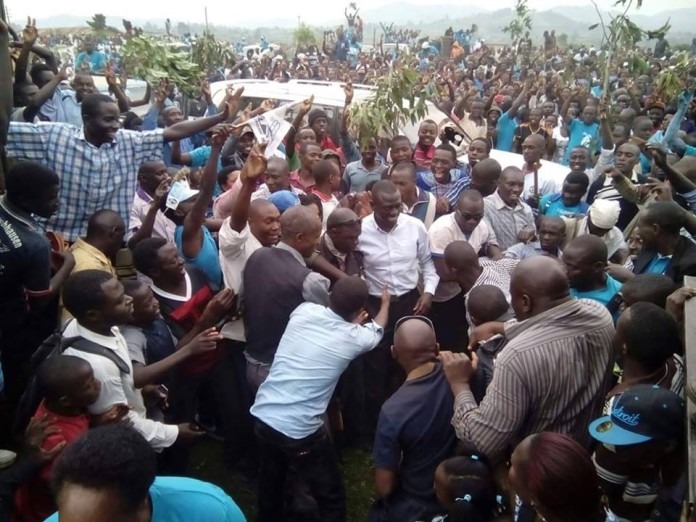
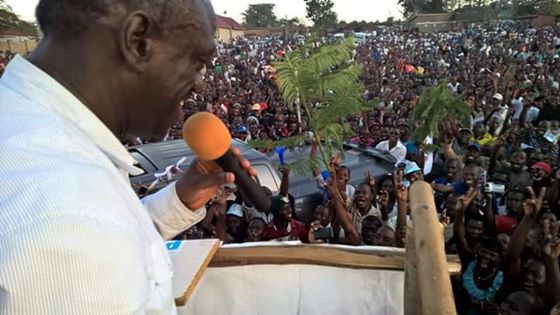
Mr Kirby in the statement further appealed to the presidential candidates in the race to desist from inflammatory rhetoric’s as it could incite violence. Last year supporters of Independent candidate Amama Mbabazi and those of President Museveni fought in the Ntungamo district an incident that left the country in fear that the campaigns could easily turn chaotic as we head to the polls on Feb 18, 2016. Another similar incident did occur in Gulu when supporters of Deputy Speaker Jocab Oulanyah who is vying for his Omoro County took the venue that had been reserved for Forum for Democratic Change (FDC) flag bearer Dr Kizza Besigye and when the two camps came together, violence broke out which left journalists beaten and cameras destroyed.

“We also underscore the need for all candidates and their campaigns to refrain from inflammatory rhetoric that could incite violence” adding   “We note with particular concern the reports that Christopher Aine, an opposition campaign aide, has disappeared”

The statement dated January 15, further says free and fair elections depend on all Ugandans being able to exercise their right to assemble peacefully, express their opinions, and participate in the electoral process free from intimidation and abuse. They also depend on government institutions and security forces remaining neutral, defending the rights of all people and protecting all parties equally.  “We call on the government, civil society, and political parties to do their part to ensure a peaceful, transparent and credible electoral process.”

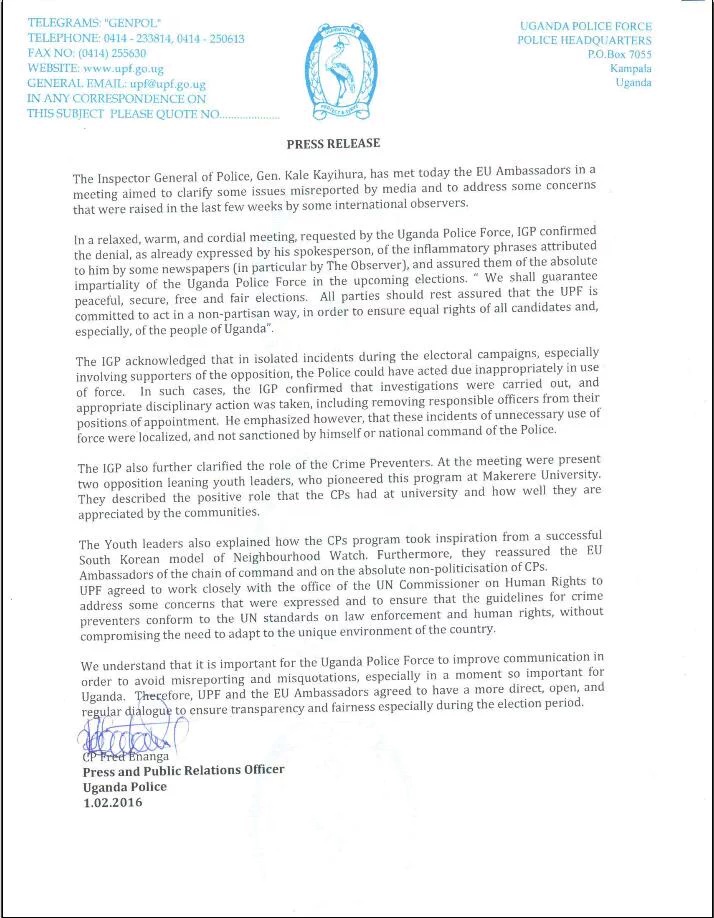
When contacted for a comment on the statement, Police publicist, Fred Enanga said the matters in the statement are not worrying at as police is mandated to provide security. Enanga said the complaints of intimidation and using excessive force, obstruction and dispersal of opposition rallies are false.

“Out of the 7000 candidates, we have had issues with only eight candidates who didn’t follow the EC guidelines especially on the issue of time but there has a media propaganda trying to depict police as a partisan force” Enanga said.

Adding “They should get the real picture on ground instead of relying on propaganda”

Enanga said that apart from incidents of some presidential candidates wanting to visit public institutions like hospitals and schools where, they clashed with police, there hasn’t been any problem with campaigns.


Stories Continues after ad
Elections will be free, fair and without violence, Museveni assures EU team

President Museveni shares a light moment with the Chief Observer of the European Union Election Observation Mission Eduard Kukan (C) as EU head of delegation to Uganda Kristian Schmidist (R) and EU deputy observer Mari.
  • Those worried about crime preventers want to commit crime

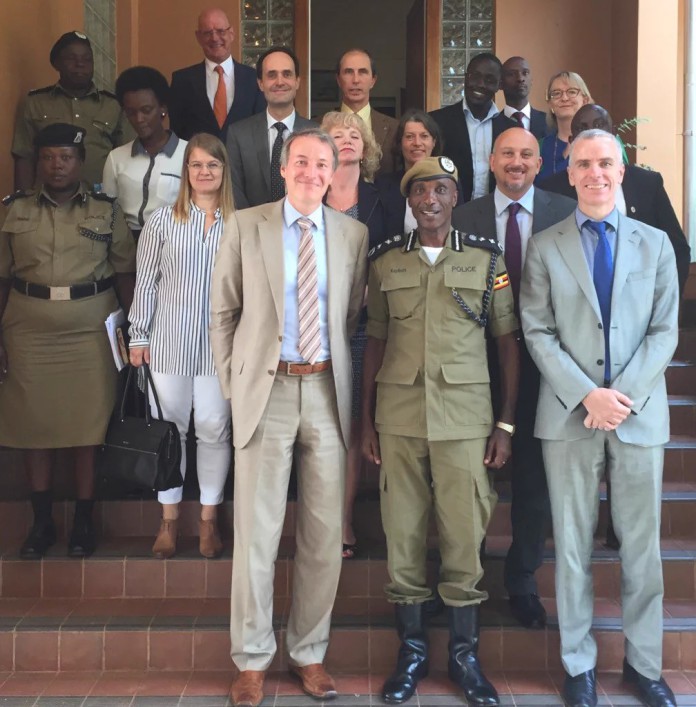
President Yoweri Museveni has assured the European Union election monitoring team in Uganda that the upcoming national elections will be free, fair and will be conducted without any form of violence.

The President met the European Union election monitoring team led by their team leader and chief observer Mr. Eduard Kukan who called on him at his country home in Rwakitura in Kiruhuura district. The delegation was accompanied by the European Union head of delegation in Uganda Mr. Kristian Schmidt.

President Museveni who took the delegation through the history of elections in Uganda right from the independence time told the delegation that the National Resistance Movement has done a lot to ensure that the electoral process in Uganda is free, fair and transparent right from the first election held under the NRM to elect the constituency assembly delegates in 1993.

He said that unlike in the past elections, new measures to ensure that elections are free and fair were introduced, such as using of a single ballot box for all candidates, counting, tallying and announcing of votes at the polling station on the same day and having agents of all candidates countersign on the results declaration forms before ballots are taken.

The President stressed that the electoral measures implemented, the country’s electoral process has greatly improved but admitted that there remain a few challenges.

He for example, noted that in some areas the electoral process depends on the vigilance of the electorate and noted where the citizens are not vigilant criminals engage in multiple voting, while others vote when they are not on the register and also engage in many other electoral offences.

The other challenge the President admitted was the struggle to computerize the voters register so as not to depend on human beings who may sometimes be part of the rigging process.

He said that although the government is making some stride to computerize the register for easy identification of voter and the transmission of results, there are reports of some groups of criminals working underground to interfere with the computerized process to disrupt the election but noted that they have already been detected and reported and the police is investigating the matter.

He assured the European Union observer team that there can’t be any violence during the election or post election process in Uganda because the elections will be held in a convincingly free and fair environment that does not warrant violence but stressed that if any one attempts to perpetuate violence, the state of Uganda is strong enough and well equipped to handle such a situation.

On the role of crime preventers in the country, the President said that the crime preventers are a group of citizen volunteers that contribute to community policing.

“They are not armed and they are just in their communities like a reserve and I think whoever is worried about them wants to commit crimes against Ugandans” he said.

The President assured the European Union delegation that Uganda was set to transform into a middle income country in the coming decade and will be a first world country in 30 years if not interrupted.

The President, the head of the European delegation in Uganda and the European Union election observer team also discussed the political situation in Burundi and efforts to bring about lasting peace in the East African country.

Stories Continues after ad
NRM must focus on future of our prosperity as a nation, Museveni tells women’s league

President Yoweri Museveni who is also the National Chairman of the National Resistance Movement has urged Movement leaders at all levels and supporters to always work for the unity of the people of Uganda noting that one of the major problems in Africa has been the failure by African leaders to unite the African people so as to work for the common good of the continent.

“The Movement must focus on the future of our prosperity as a nation and make it a sin to even whisper any form of sectarianism because what is important is not identity but our common interests” he said.

The NRM chairman made the appeal last evening while meeting the National Resistance Movement Women’s League at his country home in Rwakitura, Nyabushozi county in Kiruhuura district.

_DSC7619

Museveni who was flanked by the First Lady and Minister for Karamoja Affairs Janet Museveni said that the African leaders, even before colonialism, failed to unite the Africans and were constantly at war instead of uniting the people to work for the common cause of the continent. He said that became worse with coming of colonialist who divided Africans even more and colonized them.

He expressed disappointment however, that even the post independence leaders did not do much to unite Africans and instead in most cases divided them on tribal and religious basis making the continent more polarized.

The NRM Chairman urged the NRM Women’s League leaders led by their National Chairperson Mrs. Lydia Wanyoto Mutende to work for national unity and shun anybody who promotes sectarianism of any kind.

“ You as Movement Women leaders should not tolerate any one who promotes sectarianism and attempt to disunite Ugandans, not even whispering a sectarian word should be tolerated. Just tell them off that you are evil, shortsighted, satanic and against the interests of Uganda” he said.

????????????????????????????????????

Museveni urged the Movement Women’s League to take the message of poverty eradication to the masses noting that poverty in the country is the major challenge the country is faced with.

The President noted that if all Ugandans were involved in production especially in commercial agriculture, the population would raise their earnings and get rid of poverty. He said that as the population gets out of poverty the other problems such as unemployment would also be overcome.

He further said that the Movement will devote a lot of energies on skilling Ugandans noting that the major cause of unemployment in the country is having an elite population that lacks practical skills to produce goods and services.

In her remarks, Mrs. Museveni commended the NRM Women’s League for being true mothers of Uganda and leading the campaign of the NRM, which is centered, on national unity, peace and prosperity.

“NRM is the only party that stands for unity and peace and it has worked hard for peace which has made Uganda the island of peace in the region. And am happy that the mothers of Uganda have stood up and are firm to safe guard this peace,” she said.

Mrs. Lydia Wanyoto Mutende on behalf of the women’s league commended the President and the NRM government for emancipating women of Uganda and said that it was the reason the women of Uganda greatly support the Movement.


Stories Continues after ad

Justice Sebutuuro appointed chief inspector of courts

Supreme Court jugde, Justice Augustine Sebutuuro Nshimye (JJC) has today been appointed chief inspector of courts.

In a statement signed by chief justice, Bart Katureebe, this appointment is to take effect from 13th January, 2016.

Justice Augustine is a former member of parliament of Mityana  south and former Mityana district NRM chairperson Mityana district, a post he resigned from after being appointed as a supreme court judge in September this last year.

In the past, Justice Augustine has come under fire for being an NRM sympathizer. In August 2013, lawyers of the expelled NRM MPs demanded that he quit a case against them accusing him of being a promoter of the ruling party.

Stories Continues after ad

Al-Shabab seizes African Union base in Somalia

Al-Shabab militants have overrun an African Union military base outside the southern Somali town of el-Ade.

The Islamist group says it has taken “complete control” of the AU camp and killed more than 60 Kenyan soldiers.

Residents told the BBC that al-Shabab had raised its flag at a camp for Kenyan troops and said insurgents had paraded bodies through the town.

But Kenya’s army spokesman said it was a nearby Somali base that was stormed and Kenyan troops counter-attacked.

The number of casualties on both sides was not known, Kenyan military spokesman Col David Obonyo said in a statement.

He told the BBC that reports of high Kenyan casualties were “normal propaganda from al-Shabab”.

Kenya contributes more than 4,000 troops to the 22,000-strong AU force that is in Somalia helping the UN-backed government battle al-Shabab, which is part of al-Qaeda.

An el-Ade resident told the BBC by phone that he had heard a loud explosion at about 05:30 local time (02:30 GMT), followed by heavy gunfire.

“We then saw an al-Shabab fighter in the town. We also saw Kenyan soldiers who were fleeing from the camp.

“At the moment the camp is in the hands of al-Shabab. We can see military cars burning and dead soldiers all over the place. There are no civilian casualties but most people have fled the town.”


Analysis: Tomi Oladipo, BBC Monitoring Africa security correspondent

Al-Shabab is keen to stress – both to the foreign forces in Somalia and would-be defectors within its ranks enamoured by so-called Islamic State – that it is a force to be reckoned with.

It is true that the group exaggerates the scale of its attacks but whether or not the death toll from el-Ade attack is as high as claimed, the African Union mission (Amisom) will have to recognise it still has a long way to go to gain full control of the country.

It says a lot for the insurgents to be daring enough to strike at the heart of an African Union base and engage troops in hours of combat.

They have done this before – in two major attacks targeting the Somali military last year, dozens of Burundian troops and Ugandans soldiers were killed.

Despite these setbacks, Amisom has achieved a lot recently by managing to push al-Shabab out of many parts of southern Somalia.


An al-Shabab official told the BBC that its fighters had attacked the base after morning prayers, starting with a car bomb before storming the facility.

“We took control of the base after one hour of fierce fighting,” he said.

“We counted 63 Kenyan bodies inside the base. The other Kenyan troops have run away into the bush and we are hunting them down.”

He said the militants were confiscating 28 of 31 military vehicles inside the camp and all arms and ammunition.

The two military bases – one for Somali troops and the other for AU soldiers – neighbour each other on the outskirts of el-Ade, which is in Gedo region, about 380km (240 miles) west of Mogadishu.

Al-Shabab was ousted from the capital, Mogadishu, in August 2011, but still has a presence in large areas of southern Somalia and often stages attacks across the country.

Stories Continues after ad

Lawyers ask ICC judges to throw out Ruto case

DP-William Ruto


Lawyers for Kenyan Deputy President William Ruto have asked judges to throw out charges against him at the International Criminal Court, saying witness withdrawals had left the prosecution’s case in tatters.

Ruto, present at the hearing in The Hague, faces crimes against humanity charges stemming from the ethnic violence that followed Kenya’s 2007 presidential election in which 1,200 people died.

The ICC has suffered a number of setbacks in its Kenya cases, the highest-profile dossiers on its docket. Prosecutors withdrew charges against President Uhuru Kenyatta last year, saying witness withdrawals had left them without a case.

Ruto’s lawyers argued the withdrawal of six prosecution witnesses left prosecutors making allegations unrelated to their assertion that he conspired to drive opposition supporters from their homes. “The foundations of the case are gone,” Karim Khan said. “Every last one of them.”

Prosecutors no longer alleged that planning meetings took place at which financial, military and political backers coordinated attacks under Ruto’s leadership, he said.

Prosecutors argued earlier this week that there was still sufficient evidence to proceed with the case.

Acquittal would leave Ruto freer to campaign as Kenyatta’s running mate in the 2017 presidential elections, placing him in a strong position to run for the presidency in 2022. Prosecutors have blamed their difficulties in the Kenya cases on widespread intimidation and bribery of their witnesses, especially since Kenyatta and Ruto won the 2014 election.

Set up 13 years ago to hold the powerful to account for the gravest international crimes, the ICC has handed down just two convictions at a total cost of more than a billion euros and has struggled to bring powerful office-holders to The Hague.

Judges have criticised prosecutors for relying excessively on easily-discredited witness testimony and neglecting circumstantial and forensic evidence.

Stories Continues after ad

Media to swarm debate

Hundreds of radio stations and about a dozen TV stations, both local and foreign, will this evening camp at the Serena Hotel in Kampala to air and broadcast the first-ever presidential debate in Uganda.

According to media reports 200 radio stations and 11 TV stations will cover the much-awaited debate, expected to feature seven of the eight candidates vying for Uganda’s top seat, come February 18, this year.

Those expected to participate in the debate that is being organised by the Inter Religious Council of Uganda (IRC-U) in conjunction with the Elders Forum include the Forum for Democratic Change (FDC) flag bearer Dr Warren Kizza Besigye, Go Forward candidate John Patrick Amama Mbabazi, the Peoples Democratic Party candidate Dr Abed Bwanika and the Farmers Party candidate Maj Gen (rtd) Benon Biraro Buta. Others are Independent candidates Prof Venansius Baryamureeba, Pastor Joseph Mabirizi and Faith Maureen Walube Kyalya.

By press time it was not clear whether the other candidate, Yoweri Museveni of the National Resistance Movement (NRM), would attend but his party had intimated that he had a busy campaign schedule.

Recently, one of the organisers, Elders Forum representative retired Justice James Ogoola Munange said the debate would take place irrespective of the number of candidates participating.

“We are on for Friday; we are like a plane, we will take off with whatever passengers on board,” Justice Ogoola was quoted as saying.

Stories Continues after ad