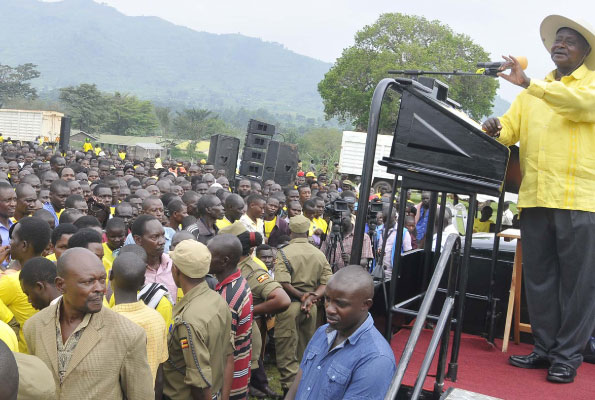
I would like to inform the reader that by today, the 15th December, 2015, I have addressed 104 constituency rallies out the of the total of 290 constituencies. This is in 48 districts of the 112 districts of Uganda. What is remarkable is that almost all these rallies are characterized by two factors. They are massive and, most of them, celebratory. In some of them, the population regards them as normal consultation meetings where they take opportunity to complain against NAADS/OWC, complaining about bad roads, Uganda Wildlife Authority (UWA) excesses, the floods and water logging of the soil, the fisheries staff that extort money from the people, etc., etc.
Except for Maracha West, Bobi and Acholibur, the rest of the rallies were massive: 50,000, 100,000 or even 200,000 per each of these rallies according to my visual estimation. Used to addressing soldiers’ barazas, I have got a good eye for assembled numbers. The other smallish rallies were at Kamion and Tapac for special reasons. The minority Ik have got a small constituency of 3,000 voters out of a population of 6,000.
In the 1960s I read a book by a certain European referring to them as the “disappearing tribe of Africa”. Now, thanks to the NRM, they are 6,000 and have their own small constituency. Then there are the Tepeth of Mount Moroto. They are with 11,000 voters. Again, they now have peace, some schools, health centres and their own constituency for the first time. All the 3,000 Ik voters and the 11,000 Tepeth voters must have turned up from what I gathered. Their rallies were, therefore, a good yardstick for the other bigger rallies, re-enforcing my comparative visions of the soldier barazas ─ a battalion is 736 persons, etc.
Why are these rallies good natured and celebratory? It is, mainly, because of the current policies of the NRM, starting with 2001, of prioritizing defence, electricity and roads. Right from 1986, we had prioritized Health and Education. You go to Zirobwe, there is electricity; Makulubita, there is; Wabinyonyi, there is; Amolatar, there is; Koboko, there is; Yumbe, there is; Moyo, there is; Namukora, there is; Padibe, there is; Lagoro, there is; etc., etc. You go to Karamoja, there is electricity; there is electricity in Abim, Amudat, Moroto, Napak, Matany, Nakapiripirit etc., etc. Only Kotido and Kaabong are not yet connected; but they will soon be because the money is there.
When you come to Teso, it is the same story except for Kapelabyong, Toroma and Dakabela. The plans, however, for connecting them are in place. Sebei is connected all the way to Kween and Bukwo ─ although the Bukwo lines are not yet fired because they are still being installed. Bugisu, it is the same story. Muyembe, the hilly Bulegeni, Budadiri, Bulucheke, Manafwa, Namisindwa, Magale, Buumbo, Lwakhakha, etc. etc., are all electrified. This is not to forget Bukoonde and Budadiri whose residents had to withstand strong down pours to listen to my address. As for Mbale town, a sea of people waited for us until we came well after 5:00p.m.
It is not just the electricity, mainly funded by the Government of Uganda (GOU), it is also the tarmac roads, again, mainly funded by the GOU. The tarmac road has reached Koboko and Oraba. The other one has reached Atiak and Nimule. Olwiyo-Gulu-Kitgum-Musingo is being worked on. Bwaise-Kafu-Karuma-Gulu is being reconstructed. Moroto-Nakapiripirit-Muyembe-Mbale is being tarmacked. Kapchorwa-Bukwo-Suam is being funded by the African Development Bank (ADB) together with the road on the Kenya side. So is Mbale-Magale-Lwakhakha with a branch to Manjiya. The Mbale Municipality roads are being tarmacked. The Tororo-Mbale-Soroti road has just been completed. Brand new markets have been completed in
Gulu, Lira, Mbale, Jinja, etc. ─ offering improved workplaces for our market people.
The 5 star secondary schools, part of the 611 funded by a World Bank loan and the African Development Bank (ADB IV) constructed or reconstructed by the Ministry of Education, are in evidence here and there: Mbale SS, Masaba SS, St. Catherine SS – Lira, Teso College Aloet – Teso, Nabumali High School – Mbale, Sacred High School – Gulu, St. Joseph College – Ombachi, Metu SS – Moyo, St. Aloysius Nyapea – Nebbi.
It is the peace and these projects, unprecedented phenomena of development and transformation in the history of Uganda, that have fired up our people. Our people now require little mobilization. They respond spontaneously most of the time – walking in big throngs to the rally sites and back. Some bicycling or using the scores and scores of Piki Pikis (boda bodas).
How did the NRM manage to achieve all this development? One, by 1997, we had caused the minimum recovery that Uganda needed so badly. With that recovery, growth has been steady, the lack of good infrastructure (electricity and roads) notwithstanding. The rate of growth has been 7% per annum for the last 30 years. This has enabled our tax collection to improve from Uganda Shs. 5 billion in 1986 to 13,000 billion shillings, today.
Although I normally keep aloof from interfering in the workings of the collective leadership, not even attending Cabinet meetings most of the time, when I deem it vital for strategic reasons (political, cultural, economic or security), I put my foot down in spite of the difficult Constitution introduced in 1995 that eroded the Powers of the President with misguided concepts of pseudo-democracy. I did this on the issue of the return to the Asians of their properties that Amin had stolen; on the Ranches restructuring in the Ankole – Masaka area; on the return of the cultural institutions; on the privatization of the parastatals; on the reduction of the size of the army; on the cutting of 23% from all the ministries to fund defence in 2001 so as to defeat Kony and the cattle-rustlers; and on the prioritization of the expenditure on the roads and electricity in 2006.
To the credit of my colleagues in the Government and the Party, when I put forward these very strong reasons, an exercise that is, sometimes, tiresome, they, sometimes, agree and we move positively as we have done on the points I have quoted above.
It is, therefore, some of the moves quoted above that are responsible for the good mood one finds in the country today. In particular, the 2001 decision to enhance the defence budget and the prioritization of expenditure on the roads and electricity. These three moves saw the budget of Defence move from 350 billion shillings (2005/06) to 1,400 billion shillings (2015/16); that of Energy (electricity) moved from 178 billion shillings (2005/06) to 2,858 billion shillings (2015/16); and that of Works (roads) moved from 398 billion shillings (2005/06) to the current level of 3,442 billion shillings (2015/16). It is these moves that have fired up the people’s enthusiasm.
Being sincere and open minded, when they see what has been done, they know that even what is not yet done, will be done. It is just logic and honesty.
Some of our opponents, in vain, try to use our successes against us by misinforming the public. In particular, they try to use the phenomenon of more youth in our population and more graduates that are not employed or are not employable on account of the courses they did in the university. The population of Uganda has surged from 14 million in 1986, to 38 million today. Why? It is because of the NRM health programmes, especially the immunization against the 13 killer diseases.
These are: Polio, Whooping cough, tetanus, measles, tuberculosis, diphtheria, influenza, Pneumonia/Meningitis, Hepatitis B, diarrhea, cervical cancer, mumps and German measles. It is not just the immunization. Even other health programmes have been put in place. How has Uganda managed to nip in the bud the three outbreaks of Ebola (Gulu, Bundibugyo and Kibaale) and Marburg (in 2007 ─ Kamwenge, 2012 ─ Kabale-Ibanda-Kampala, 2014 ─ Kampala)?
There are still gaps such as the need for more pay for the health workers, the institutional houses for the health workers, etc., etc. However, there are so many tremendous successes such as the immunization programme, the building of 930 new Health Centre IIIs since 1986, the building of 193 new Health Centre IVs, the repairing of 13 district hospitals and the building of 3 new hospitals. This is what has caused the increase of the population and improved the life expectancy from 43 years to 58.7 years. Therefore, the youth the opportunists talk about, are NRM youth.
The NRM has not only supported their survival, but has also educated them. Hence, the large number of graduates, many of whom did not get jobs. This, however, is not a disaster. It is a half done job. Would it have been better for the youth to remain illiterate so that there are no unemployed graduates?
These unemployed graduates and other school leavers can be retooled and they will be retooled. Secondly, they can be and they are being assisted to employ themselves and employ others. We just need to prioritize the livelihood funds as we did the funds for the roads, the electricity, defence, etc. All the 5 funds are already there but they are not enough. These are: NAADs-OWC; the Youth Livelihood Programme; the Women Fund; the Micro-finance Fund; and the Innovation Fund. The graduates, employed or otherwise, will join the private sector rather than joining the bureaucracy as self-employed persons. That is why in the financial year 2013/2014, I started the Youth Livelihood Programme. It was actually, initially, for those graduates. I saw it as compensatory support to the families that had supported our children through private sponsorship in the Universities. My reasoning was that if the graduate cannot get a job, let us help him or her to create self-employment. When the fund went to Parliament, the MPs altered it and said that it should be for all the Youth. That is no problem. They are all tasks that need to be done. Having prioritized for the electricity, the roads, the defence, the immunization, the education, the ICT, let us now also prioritize for the livelihood funds, the five of them.
Meanwhile, the Ministry of Education has been working on the change of the Curriculum so that science and technical education is emphasized early enough and taught differently. This is to cope with the paradox of unmanned jobs such as the 2,202 doctor jobs, 19,675 Nurses and Midwifery jobs, 18,000 Engineer jobs. These jobs are there but they have no doers because there are no Ugandans qualified in them. As the Private Sector expands, many more such jobs will be available. How many engineers are required for an upper middle income country like Malaysia? The number is 87,000. How about South Korea? The number is 148,000. That is why in 2005, I directed that 70% of Government scholarships must go to Scientists.
There are those who talk about jobs for our youths in not a serious manner. The NRM, by working on peace, on electricity, on the roads, on the railway, on the ICT backbone, on education, on health, is laying a base for job-creation. The Services sector is already employing 426,910 people. The Industrial sector is already employing 142,289 persons.
Since we have worked on electricity, the factories are flooding in. Witness the factories springing up in Namanve, Mukono-Jinja road, the Matugga area, the Luwero-Nakaseke road of Sanga, the Industrial Estate at Kapeeka, the Industrial Estate
at Kaweweta, the Industrial Estate at Sukulu hills (Tororo), the new cement factory in Karamoja, the new milk factories in the Mbarara area etc., etc. Electricity was the problem. With electricity, we are now moving on our point no. 5 in the NRM ten points programme – building an economy that is integrated, independent and self-sustaining. The population understands this when one explains to them. Hence, the positive attitude. Anybody serious and not malicious knows that the numerous problems Uganda had could not be solved at one go. One by one, makes a bundle (Kamwe Kamwe nugwo muganda).
Above, I have, mainly, talked about the tarmac roads. We also have a solution for the murram roads. We have arranged to buy 733 pieces of equipment from Japan. This will give each district an extra grader (they already have one each from China), a wheel-loader, a road compacter, a water bowzer and two tippers. There are 18 zones (the former colonial districts of independence). Each of these will have a bull-dozer with its own low-loader to move it around so as to back-up the district. With this equipment, the districts will be able to work on the roads themselves without the need for tendering which has been full of corruption and over-pricing.
Hence, it has been a joy really to campaign for the NRM in 2015. I feel the enthusiasm and love of the people. Having to address 4 rallies a day and also have other smaller meetings, I do not get enough time to address all the issues. However, this pleasant campaign has helped us to be in touch with our people following the unprecedented development strides being made on the ground, the remaining challenges notwithstanding.
I salute the people of Uganda. We are unstoppable. We are doing all this without our oil money. What will happen with our oil money? This is why the NRM leaders need to rise to the occasion and expunge ego-centrism. Individuals do not cause changes. It is the Party that has caused those changes. Be humble and subordinate your ambitions to the plans of the Party. Do not be dishonest. Be truthful. Even when you are disappointed by the dishonest, work for the Party loyally. The truth will come out.
Uganda is not disappearing today. We have been victims of unfairness in the past and even today when we are falsely accused. The truth, however, always comes out.
I thank you.
CHAIRMAN NRM, PRESIDENT OF THE REPUBLIC OF UGANDA AND PRESIDENTIAL FLAG-BEARER FOR THE NRM PARTY
Stories Continues after ad