Stanbic Bank
Stanbic Bank
24.9 C
Kampala
Stanbic Bank
Stanbic Bank
Home Blog Page 2265

UN wants Al Shabaab financiers brought to book

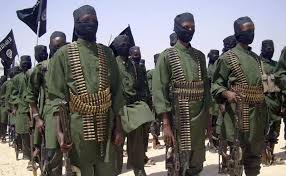
Al-Shabaab Militants conducting training.

The United Nations Security Council (UNSC) has called for increased vigilance to blacklist and punish the financiers of terror group Al-Shabaab.

The stance adopted by the UNSC comes in the wake of occasional attacks by Al-Shabaab, with the two most recent attacks involving the killing of several dozen Kenyan soldiers serving under the Africa Union Mission to Somalia (Amisom) and another one at a popular beachside restaurant in the Somali capital Mogadishu, which left about 20 people dead and injured.

‘The Council (also) paid tribute to the response of the Somali security forces to these attacks, and underlined the need to bring perpetrators, organisers, financiers and sponsors of such reprehensible acts of terrorism to justice; … those responsible for these killings should be held accountable,’ the Council stated.

Previously, there have been efforts aimed at curbing the proliferation of terror funds, and last year Kenya ordered the suspension of tens of money transfer companies with links to Somalia.

Meanwhile, in a related development Michael Keating, the Special Representative of the Secretary-General, has condemned the attacks, which were perpetrated against a people attending a wedding party and a graduation celebration.

“This latest atrocity by Al-Shabaab is very deliberately intended to intimidate Somali civilians,” said SRSG Keating, adding: “We will do everything possible to ensure that al-Shabaab does not succeed in its desperate attempts to frustrate the hopes of the Somali people.”

Early this week the Al Shabaab raided the Kenyan Defence Forces (KDF) Amisom base at El Adde and later claimed it had killed about 100 KDF soldiers.

In response, the KDF carried out several sorties (air strikes) and later announced it had killed Mwalimu Janow, the alleged El Adde attack mastermind.


Stories Continues after ad

Uganda faces El Nino threat – WHO

Ugandans have been warned to prepare for El-Nino such as this one.

The El Niño phenomenon that started last year poses a health threat to at least 60 million people in seven high-risk developing countries including Uganda.

According to the World Health Organisation (WHO), other countries that will be affected include Ethiopia, Lesotho, Kenya, Papua New Guinea, Somalia and Tanzania, whose collective financial request for support has reached US$76 million.

As a result, the WHO and its partners predict a major global increase in health consequences of emergencies this year due to El Niño.

“From Ethiopia to Haiti to Papua New Guinea, we are seeing the damage from El Niño, and we believe the impact on public health is likely to continue throughout 2016, even after El Niño winds down,” said Dr Richard Brennan, Director of WHO’s Emergency Risk Management and Humanitarian Response Department, in a press release.

El Niño is a warming of the central to eastern tropical Pacific Ocean which affects rainfall patterns and temperatures in many parts of the world but most intensely in the tropical regions of Africa, Asia-Pacific, and Latin America which are particularly vulnerable to natural hazards. According to a new report by WHO, severe drought, flooding, heavy rains and temperature rises are all known effects of El Niño that can lead to food insecurity and malnutrition, disease outbreaks, acute water shortages, and disruption of health services. The health implications are usually more intense in developing countries with fewer capacities to reduce the health consequences.

The current El Niño from 2015 to 2016 is predicted to be the worst in recent years, and comparable to the El Niño in 1997-1998 which had major health consequences worldwide. In Eastern Africa, as a result of the El Niño in 1997-1998, WHO found that rainfall patterns were unusually heavy and led to serious flooding and major outbreaks of malaria, cholera and Rift Valley Fever.

Meanwhile, the WHO expects more countries will seek financial support to respond to El Niño effectively. Part of the response will be to provide additional health services to those in need, such as increased surveillance and emergency vaccination.


Stories Continues after ad

Nkurunziza backs Museveni for Burundi talks

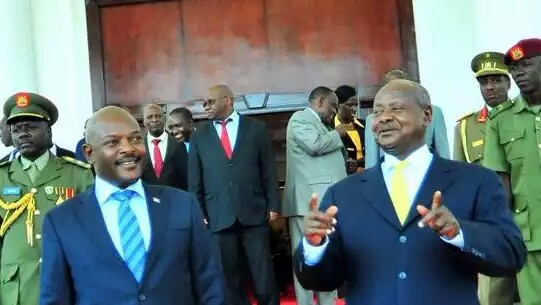
Presidents Nkurunziza and Museveni. The two were some of the 'first' African presidents to send congratulatory messages to US-President-elect Donald Trump.

Embattled Burundi President Pierre Nkurunziza has expressed confidence in his Ugandan counterpart Yoweri Museveni, to continue chairing the mediation efforts in his strife-stricken country.

Addressing the press shortly after meeting with a 15-man UN Security Council delegation, Mr Nkurunziza said Museveni understands the problems of his country. “We told (the Security Council) that he is somebody who knows very well the problems of Burundi,” Nkurunziza was quoted as telling reporters.

In June last year President Museveni was appointed by the East African Community (EAC) to mediate between the warring factions in Burundi, which have previously held meetings in Uganda. However, Mr Museveni’s tenure as mediator has faced challenges from different actors, prompting the US to call for a change the stewardship of the talks and venue to Arusha.

Meanwhile, the US to the United Nations Ambassador Samantha Power has said little was achieved during the two-hour meeting with Mr Nkurunziza in Gitega, on the outskirts of the capital Bujumbura. It is the council’s second visit to Burundi in less than a year.

“In this meeting we did not achieve as much, frankly, as I think we would have liked. But we never give up, the cause of peace in Burundi is too important to give up,” Ms Power told reporters after the meeting.

The meeting came a day after rebels in the tiny African state raised the stakes in the crisis by declaring a general who led a failed coup in May as their leader, deepening concerns that Burundi is sliding back into conflict after its ethnically charged civil war ended in 2005.

On Thursday the rebel group, FOREBU, announced that it was now commanded by the former intelligence chief, General Godefroid Niyombare. The group said it welcomed international mediation but also called for Burundians to support their fight against Nkurunziza.

But Ms Power has made it clear that the Council wants to see more dialogue and an enhanced UN presence in Burundi.

Nkurunziza’s re-election for a third term sparked the crisis, which has raised fears of an ethnic conflict in a region where memories of Rwanda’s 1994 genocide remain fresh.

The government insists there is no ethnic bias, but opponents say districts of Bujumbura where many Tutsis live – and which were also hotbeds of protest against Nkurunziza last year – have been targeted with some Tutsis singled out.

The UN estimates the death toll at 439 people but says it could be higher. More than 240,000 people have fled abroad.

“This development shows why the UN Security Council is concerned about the risk of a downward cycle of violence,” British UN Ambassador Matthew Rycroft said.

Burundi’s government has accused neighboring Rwanda of supporting a rebel group by training and arming Burundian refugees recruited on Rwandan soil. Nkurunziza raised those accusations again on Friday with the Security Council. “The threat is not from within Burundi, it comes from outside,” he told the council. “The Rwandan government must be told to stop.” Rwanda has previously dismissed the allegations.

“We’ve expressed concern about the allegations of external interference … and it’s very important that nobody support armed opposition groups no matter what they assess the history,” Power said.

Meanwhile, Nkurunziza has persistently rejected the deployment of an African peacekeeping force, saying the troops would constitute ‘an invading force’.

The contentious issue that also seems to have put the West, Russia and the African Union in conflicting positions is expected to be a focus for an AU summit at the end of January.

“It’s not peacekeepers that the Burundians need. What they need is to increase their own capacity, especially their police capacity,” Russia’s Deputy UN Ambassador Petr Iliichev said.

“Maybe what we need is some kind of policing mission, either advisors, either trainers or maybe formed police units that will be deployed in Bujumbura … from the African Union or the UN,” he said.

Regional Western diplomats say the government has set too many conditions about who can attend talks to make them meaningful. They also say rebels may believe they can make more gains through force of arms than at the negotiating table.


Stories Continues after ad

Mogae takes on Mugabe over gays

Festus Mogae

Former Botswana President Festus Mogae has urged Zimbabwe leader Robert Mugabe to accept and respect gay rights.

Mogae was responding to reports that some African leaders were of the view that gay rights were un-African, after they applauded Mugabe when he declared at the UN 70th  General Assembly that Africans were not gay.

“In my long interaction with LGBT [lesbian, gay, bi-sexual and trans-sexual] groups and extensive research, I have come to the realisation that we are limited in our knowledge and must be open to new discoveries. I have been converted; I used to hold the same beliefs as my counterparts. President Mugabe has said that he hates homosexuals and is on record as saying they are worse than pigs and dogs. That is still his position,” a tough-talking Mogae said before accusing Mugabe of self-aggrandisement and a raft of other human rights violations.

‘Stop hiding behind sovereignty, while abusing people,’ Mogae said in a recent interview with a United Nations online magazine, Africa Renewal, adding: “Sovereignty has limits like any other right. A leader cannot kill and harass his people and hide behind sovereignty. A true leader does not kill, but protects his people.”

The fire-spitting Mogae, who is a business partner of Zimbabwe second Vice-President Phelekezela Mphoko in the Choppies Supermarket group, also accused Mugabe and his Zanu PF administration of ‘thinking they are more important than his country’.

“We still have leaders in Africa who think they are indispensable, larger than life and more important than their countries. That must stop. If a leader loses control, the world will and should intervene to save the people,” Mogae said.

Mogae, who was recently in Zimbabwe for the official opening of a Choppies Supermarket in Chitungwiza by Mugabe, further said the Zimbabwean leader should dump ‘outdated beliefs’.

“While I admit that the West often push their agendas on Africa, which we must be wary of, I also believe we must, as Africans, admit that the world is changing and we must move with the times,” he told the magazine, and added: “This means often abandoning some of our long-held convictions about life, if the need arises.”

Reacting to Mogae’s attacks, Information, Media and Broadcasting Services Minister Christopher Mushohwe said he had read the interview but that no mention had been made of Mr Mugabe’s name.

“I read it, he did not mention the President by name, but if indeed he was referring to President Mugabe, it is unfortunate. He said it while he was in America, maybe he wanted to please the New Yorkers. Why does he wait to be in America to say it? Why not say it while he is in Africa? He was here a few days ago, why didn’t he say it? If he couldn’t do it here, he could have said it while in Botswana. That is the problem with most African leaders, they think if they are in Europe, they are Europeans, if they are in America, they are Americans.”

Botswana has remained a lone voice in the region against Mugabe’s perceived excesses including gay rights abuse, demanding a return to legitimacy and respect of human rights in Zimbabwe, much to the chagrin of the veteran Zanu PF leader.

Current Botswana President Ian Khama has also clashed with Mugabe on several occasions on various issues.

Gay rights remain a contentious issue in Southern Africa with South Africa being the only country to recognise homosexual marriages.


Stories Continues after ad

Museveni is not worth US$13billion-Saleh

Gen Salim Saleh

Senior Presidential Advisor on defence Gen. Caleb Akandwanaho aka Salim Saleh has refuted claims that president Yoweri Museveni is worth US$13billion.

Gen. Saleh who is also the young brother to President Museveni wrote on Ugandans At Heart (UAH) Facebook group rubbishing the allegations by one of the members on the forum that Mr Museveni was worth US$13.

“Mukulu Semuwemba, This platform is a useful tool for sharing ideas. I want to state that the President of Uganda does not have assets worth even 13 billion Uganda Shillings so when I see US$13 billion being suggested on the platform, I wonder how this impression can be corrected.” Gen Akandwanaho wrote.

Last year President Museveni said despite being one of the least paid Presidents in Africa, he is a rich man because of what he earns from Agriculture. Museveni is considered one of the largest cattle keepers and traders in the country.

“Your President is one of the least paid on the continent. Although I earn little from your government, I’m a rich man from agriculture. When I tell you that commercial agriculture is wealth, am telling you what I know,” he said.
Mr Museveni referring to a report by the Africa Review that compiled and analyzed salaries of African leaders to try and see the relationship between those in power and the governed.


Last year similar allegations were made by a Nigerian magazine that ranked him among the richest president but its findings were dismissed as their sources of the allegation were unknown.

Stories Continues after ad

Govt bans recruitment of maids to Saudi Arabia

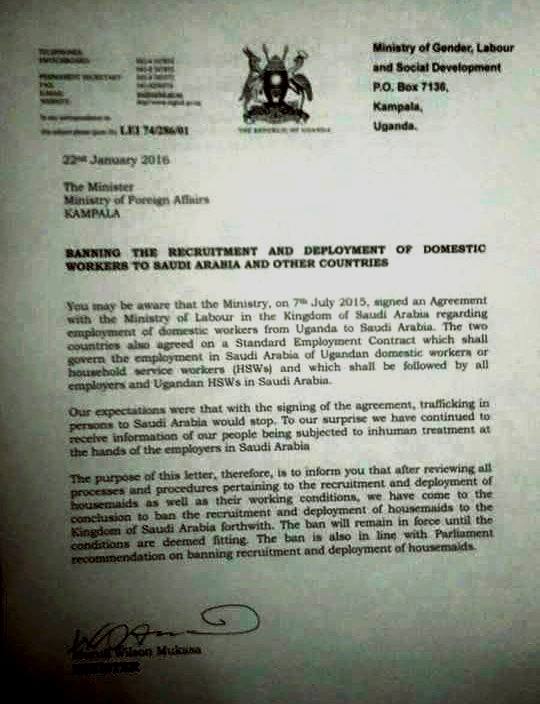
The government has banned the recruitment and deployment of domestic workers to Saudi Arabia ‘and other countries.’

According to a January 22 letter to the Ministry of Foreign Affairs and signed by the Minister of Gender, Labour and Social Development Wilson Mukasa Muruli, the Saudi government had breached its contractual obligations in regard to an earlier agreement on the maids, signed between the two countries.

“You may  be aware that the ministry on 7th  January 2015 signed an agreement  signed an agreement with the Ministry of Labor in Saudi Arabia regarding employment of domestic workers from to Saudi Arabia. The two countries also agreed on a standard employment contract which shall govern the employment in Saudi Arabia of Ugandan domestic workers or household service workers and which shall be followed by all employers and Ugandan in Saudi Arabia,” the release copied to the foreign affairs ministry, states in part.

The Ugandan authorities state that their expectations were that with the signing of the agreement, trafficking in persons to Saudi Arabia would stop.

However, this has not been the case as there have been continuous reported cases of breach of agreement, the release adds.

“To our surprise we have continued to receive information of our people to inhumane treatment at the hands of employers in Saudi Arabia,” reads the statement.

“The purpose of this letter therefore, is to inform you that after receiving all processes and procedures pertaining to the  recruitment and deployment of house maids,  as well as their working conditions, we have come to the conclusion to ban the recruitment and deployment of house maids to the Kingdom of  Saudi Arabia  forthwith,” wrote the Ugandan authorities.

The Ugandan authorities further add that ban will remain in force until the conditions are dimmed fitting.

The Uganda government further clarified that the ban is in line with Parliament’s recommendation on banning recruitment and employment of maids to foreign countries.

This issue of exporting maids for labour is contentious and this is the second time in less than a year that the government is banning the export of Ugandan maids to work in the Middle East, where they are reportedly mistreated.

In January last year, the Uganda Parliament endorsed a motion to ban the travel of domestic workers to Arab countries following a heated debate in which legislators criticised the government for encouraging foreign companies to export young girls for work as domestic workers.

Stories Continues after ad

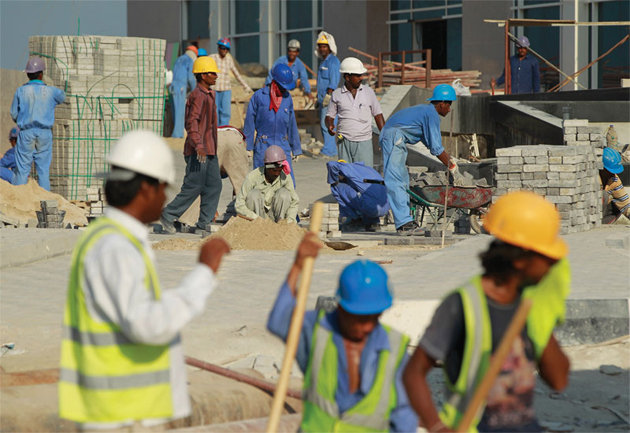
UK companies to pay levy for non-EU labour immigrants


Bosses should pay an annual charge of £1,000 for every skilled worker brought in from outside Europe, migration advisers have told the government.

The Migration Advisory Committee report said the proposal could raise £250m to go towards helping train British-based workers in UK firms.

It also suggested raising the minimum salary threshold for skilled workers coming to the UK by £9,200, to £30,000.

Ministers are concerned about the rising number of ‘Tier 2’ migrants.

There are also concerned about companies’ reliance on them to fill shortages in the labour market.

As such, the government asked the Migration Advisory Committee – the independent public body which advises it on migration issues – to investigate possible changes to Tier 2 visa requirements.

Currently, those wanting to work in the UK must be offered a starting salary of £20,800. There are some higher thresholds specific to individual roles.

In 2014, 151,000 skilled workers and their dependants arrived in the UK or were allowed to stay on.

The committee said raising the salary threshold to £30,000 would have excluded almost 28,000 people in 2014 – or about 18% of the total.

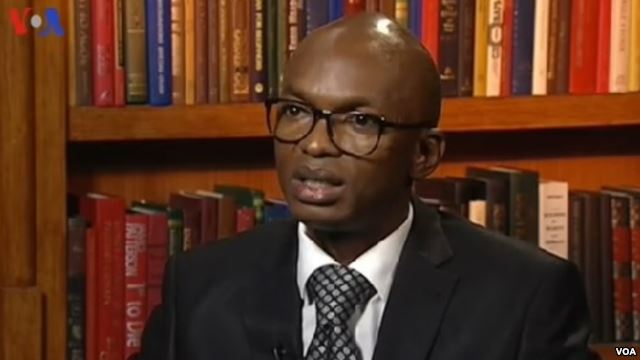
likely to be among those affected if the salary threshold rises to £30,000

The committee ‘strongly’ supports the introduction of the so-called Immigration Skills Charge to incentivise employers to reduce their reliance on migrant workers and encourage them to invest in training British workers.

The committee also recommends tightening the rules on intra-company transfers – overseas staff working for the same company in the UK – which have risen ‘very rapidly’ in recent years.

Professor Sir David Metcalf, committee chairman, said: “Skilled migrant workers make important contributions to boosting productivity and public finances, but this should be balanced against their potential impact on the welfare of existing UK residents.

“Raising the cost of employing skilled migrants via higher pay thresholds, and the introduction of an immigration skills charge, should lead to greater investment in UK employees and reduce the use of migrant labour.”

Businesses should be ‘content’ that £30,000 was a reasonable figure and the £1,000 charge would be put back into good UK firms, such as Rolls Royce, he said.

Skills shortages

Neil Carberry, of the business lobby group, CBI, said businesses agreed that training British-based people to do jobs where there were shortages was the long-term solution.

“But the question’s more complex than that,” he said adding:”we live in a global economy, we have short-term skills shortages, but we also have multi-national companies who frankly can base work in different countries and we want it to be attractive for these big companies to come and invest in the UK and create jobs here.”

The immigration skills charge is separate to the apprenticeship levy, due to be enforced in April 2017, which is payable by all medium and large companies.

In a related development, if an UK immigration law drafted in 2012 is followed through, non-EU workers living there and earning less than £35 000 a year may face deportation in less than 3 months.

Four years ago in 2012, the UK government’s Home Secretary Theresa May announced plans to introduce immigration rules to restrict UK immigration.

The rules are still scheduled to be enforced come April 2016, and will require non-EU workers to be earning above £35 000 a year if they have been in the UK for 5 years or more, to qualify for staying on.

If not, they will be deported.

This immigration rule has been met with some resistance and the Home Secretary has been called upon to re-think the new rules which have been labelled as discriminatory.

This especially since the average UK income is £26 500 per annum.

In a bid to halt deportation due to the law, an UK Parliament petition has been set up. Only British citizens are allowed to sign the petition.

Stories Continues after ad

Burundi delegation to attend second public hearing

the Burundi delegation will be led to the Monday, January 25 hearing by Ambassador Alain Aimé Nyamitwe


After snubbing the first public hearing on the deteriorating human rights and humanitarian situation in Burundi, the government has now confirmed it will send a delegation to the second public hearing of a petition filed at the EALA by the Pan African Lawyers Union (PALU).

According to an EALA release, the Burundi delegation will be led to the Monday, January 25 hearing by Ambassador Alain Aimé Nyamitwe, Minister in Charge of Foreign Affairs and International Cooperation, who will make submissions at the public hearing workshop.

Other members of the delegation include Alain Guillaume Bunyoni, Minister of Public Security; Léontine Nzeyimana, Minister to the Office of the President responsible for East African Community Affairs and Mr Gélase Ndabirabe, spokesperson of the Ruling Party CNDD–FDD.

Others are Mr Augustin Nzojibwami, leader of the SANGWE PADER Party, Leader of the FNL Party Mr Jacques Bigirimana, leader of the UPRONA Party, Ms Concile Nibigira and the leader of the Coalition of Parties (COPA), Mr Jean de Dieu Mutabazi.

The Chairman of the Regional and Conflict Resolution Committee, Abdullah Mwinyi said the Monday public hearing is also open to other stakeholders interested in attending, upon prior arrangement.

The EALA Regional Affairs and Conflict Resolution Committee (RACR) initially called for the public hearing workshop on January 13-16th, 2016 to review the petition by PALU submitted to EALA in November 2015.

However, the Assembly received a letter dated January 8 from the Government of Burundi, indicating their unavailability on the proposed dates but reiterating the desire to participate in the workshop after January 18, 2016.

Meanwhile, at the first public hearing an oral petition was made on behalf of the six petitioners by the PALU Chief Executive Officer, Don Deya.

On the second day the Workshop listened to the contributions from other invited stakeholders comprising of the representatives of Civil Society Organisations and the opposition parties in Burundi.

Once finalised, the RACR shall retreat and prepare its Report which will be forwarded to the Assembly for deliberations at 4th Meeting of the 4th Session which commences in Arusha on Monday, January 25, 2016 through to February 5, 2016.


Stories Continues after ad

The Ugandan ‘leg billionaires’

In Uganda it is almost impossible to become a billionaire, not least when you are just under 20 years.

But one man has so far defied the odds, joining the billionaire club at just 19, after he signed one of the biggest transfer figures in Ugandan football history: US$400,000 to join Standard Liege, a top flight team in Belgium.

Slightly over four years ago Farouk Miya was struggling, like any other Ugandan student grappling with high school studies. Two years later, he probably did not have enough money to cater for his day-to-day needs as a second year student at Kyambogo University. But one thing stood out for him: he was determined to change his life. He took to football, playing for Sports Club (SC) Vipers, where he made a mark as a reliable striker, catching the eyes of the football technical bench of the Uganda senior team, The Cranes. The rest, as they say, is history!

And last year the player, commonly referred to as ‘Muyizzi Tasubwa’, loosely translated as ‘a hunter who never misses his target animal’, was called up for debut national duty, representing Uganda at the U23 tournament at the All Africa Games in Congo Brazzaville.

Billionaire footballer ‘Muyizzi Tasubwa’ has so far scored 12 goals in his international appearances, including one away goal in a friendly match against the dreaded Super Eagles of Nigeria at the Akwa Ibom Stadium, Iyo.

And, during the Africa Nations Championship qualification matches played against Tanzania and Sudan, as Cranes Captain Miya never disappointed, scoring at least a goal in every match. The highly-talented player also scored 3 goals in two matches against Togo in the 2018 Fifa World Cup qualifications, and has also been instrumental in wins against Ethiopia, Zanzibar, Rwanda and Malawi.

Not surprising therefore, that Standard Liege came calling, in the process making him join the envable ranks of Ugandan footballers who have made it on the global stage.

Over the years so many Ugandans have played professional or semi-professional football and among the first were Tom Lwanga and Hassan Biruma, who played semi-professional football in the Middle East in the 1980s. Then came the ‘Tier 2’ players that included stylist Jackson Mayanja aka Mia Mia, who played for Egyptian top flight team El Masry, and the prolific Majid Musisi, the first Ugandan to play professional football in any European league after he signed for French club Stade Rennes at US$180,000, then a record signing for any Ugandan player. In 1997 Musisi moved to Turkish side Bursaspor for US$ 1 million, making him also the most expensive player in Ugandan history. A four-time league top scorer and two-time Footballer of the Year awardee, Musisi died in December 2005 aged 38.

Then in ‘Tier 3’ there are the likes of David Obua, Dennis Masinde Onyango, Ibrahim Sekagya and Emmanuel Okwi.

About four years ago Obua, who plied his professional trade in Europe with Hearts of Oak in the Scottish league, was able to put up a two-storey mansion in Uganda valued at US$500,000, a huge amount by any standards. Obua has since gone into oblivion, only to resurface last week with news that he is enrolling for a Trainers’ course.

However, his colleague and former Cranes long-serving Captain Sekagya so far seems the most successful billionaire footballer Uganda has ever produced. He cut his international footballing career with an Argentine team, and later moved to Austria where he played as Centre Back with top rate Bundesliga club, Red Bulls Salzburg. Sekagya then moved to the US in 2013, where he played for the Red Bulls team of the Major League Soccer (MLS) in New York. Sekagya retired from football in February last year and was taken on as a Trainer at the Red Bulls team where he earns a salary of about US$129. 999, making him one of the highest paid Ugandans currently living anywhere in the world.

Sekagya, whose love for expensive rides among is almost unrivalled, has driven cars like the Range Rover Vogue, Audi S6 and Audi T7, both estimated at US$160,000, and has reportedly invested in real estate in Austria and at home.

Another billionaire Ugandan footballer, goalkeeping ace Onyango plies his trade with Mamelodi Sundowners of South Africa, a team he joined in 2011. Born in 1985, the towering 1.85 metres goalie has a running contract with his club, estimated at over US1 million and runs up to 2018.

Then there is temperamental player Emmanuel Okwi, who started his playing career in 2009. The 23-year old Okwi, who played for home teamsSports Club (SC) Villa and Simba, currently plies his trade with Sønderjysk Elitesport in Denmark, where he moved in 2015.

Before the move to Denmark Okwi had played professional football for a number of African clubs including Tunisian club Etoile du Sahel where he moved for a record fee of US$300,000, but he later abandoned the club acrimoniously and moved to Young Africans (Yanga) of Tanzania.

Other players who have previously made it to the US and other European top leagues where they earned in dollars include Charles Livingstone Mbabazi at St Patrick’s Athletic Club in Ireland, Augustine Nsumba with IBV in Iceland, Martin Kayongo Ssebuliba in Sweden; Alex Kakuba at Estoril Praia in Primeira Liga of Portugal where he moved in 2014 and Henry Kalungi, who plays for Charlotte Independence in the US; Mike Sserumaga at Helsingborgs in Sweden; Hassan Mawanda at Kardemir Demir Çelik Karabükspor and Suat Altın İnşaat Kayseri Erciyesspor in Turkey.

Stories Continues after ad

NTV banned from Museveni’s rallies

Nation Television popularly known as NTV has been banned from covering President Yoweri Museveni rallies.

Eagle Online has reliably learnt that President Museveni effected the directive yesterday.

NTV-Uganda is ranked number one on the local scene and is seen a leading news Television among the mushrooming television. However, the station has been accused by government of biased reporting in favour of the opposition.

Stories Continues after ad