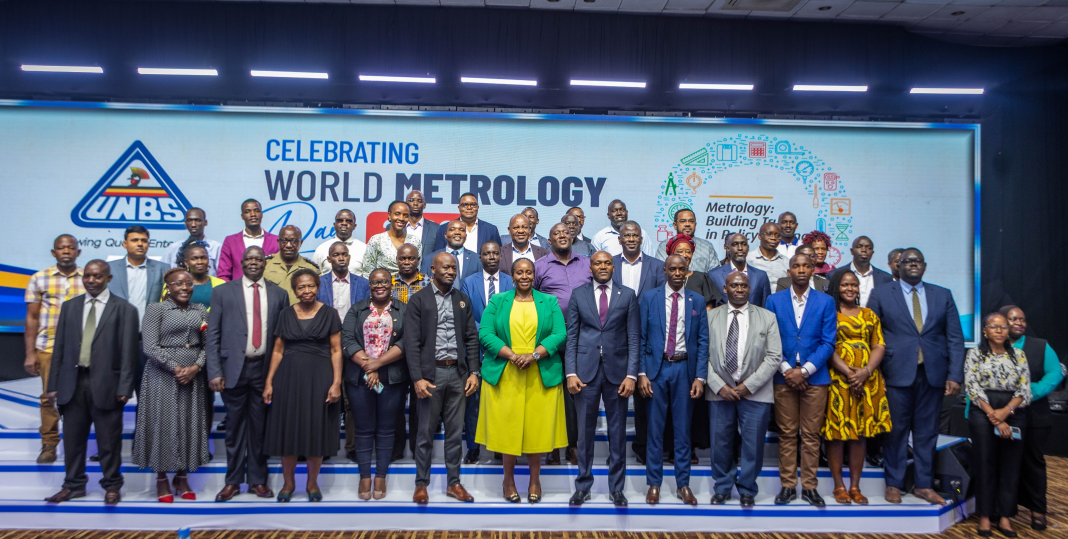
The Uganda National Bureau of Standards (UNBS) has joined the global community in commemorating World Metrology Day, highlighting the critical role of accurate measurement in promoting fair trade, safeguarding consumers, and strengthening evidence based policy making across key sectors of the economy.
Speaking during the commemoration, UNBS Executive Director Uganda National Bureau of Standards Eng. James Kasigwa said metrology, the science of measurement, remains a foundation for Uganda’s socio economic transformation, cutting across health, agriculture, energy, infrastructure and industrial development.

“Metrology remains central to Uganda’s development agenda because it underpins fairness in trade, safety in services and efficiency in production systems. Without accurate measurement systems, you cannot build trust in markets or ensure quality in service delivery,” he said.
Kasigwa noted that in many informal markets, goods are still sold without standardized measurement systems, a practice he said continues to disadvantage consumers and undermine trust in commercial transactions.
“When goods are sold without standard measurements, the consumer is disadvantaged and trust in the market is reduced. Strengthening measurement systems is therefore essential in promoting fairness, accountability and efficient markets,” he said.

In the health sector, he emphasized the importance of properly calibrated medical equipment, warning that inaccurate instruments can lead to misdiagnosis and prolonged treatment, ultimately affecting patient safety and increasing pressure on the health system.
“Uncalibrated medical devices can lead to misdiagnosis and unnecessary long term treatment. This affects patient outcomes and places a burden on the entire health system,” he said.
On the energy sector, Kasigwa stressed the importance of precision in fuel measurement, saying accurate systems are necessary to ensure consumers receive correct quantities while safeguarding national resources, especially as Uganda develops its oil and gas industry.
“In the petroleum sector, accuracy is not optional. Consumers must receive exactly what they pay for and the country must be able to account for its resources properly,” he said.
He also pointed to the infrastructure sector, particularly road construction and engineering works, where strict measurement standards are necessary to ensure durability, safety and value for public investment.
“Strict adherence to measurement standards in construction ensures quality, safety and long term value for public infrastructure. Without precision, you risk weak structures and loss of public funds,” he said.
In agriculture, Kasigwa highlighted the role of metrology in reducing post-harvest losses, especially aflatoxin contamination caused by improper moisture levels in stored grains, noting that simple tools can significantly improve food safety and productivity.
“Simple tools such as moisture meters can make a big difference in improving food safety and reducing post harvest losses. Proper moisture control is key in preventing aflatoxin contamination and improving market value,” he said.
He further noted that metrology will play an increasingly important role in the Fourth Industrial Revolution, where emerging technologies such as artificial intelligence, automation and electric mobility depend heavily on precision and reliable data systems.
Kasigwa added that global evidence shows countries that invest in national quality infrastructure, including standards, measurement systems and certification frameworks, achieve stronger economic growth and competitiveness.
“Countries that invest in strong measurement systems improve competitiveness and unlock industrial growth. This is an investment that pays back through efficiency, trade and innovation,” he said.
He called for stronger collaboration between government, regulators, academia and industry to ensure that all regulatory frameworks are anchored in reliable measurement systems that support innovation, fairness and sustainable development.
UNBS reaffirmed its commitment to strengthening Uganda’s metrology systems as a cornerstone for consumer protection, industrial growth, and the country’s broader development agenda.