The Bank of Uganda has maintained the Central Bank Rate at 9.75 percent, citing rising inflation risks linked to the ongoing conflict in the Middle East even as Uganda’s economy continues to register strong growth.
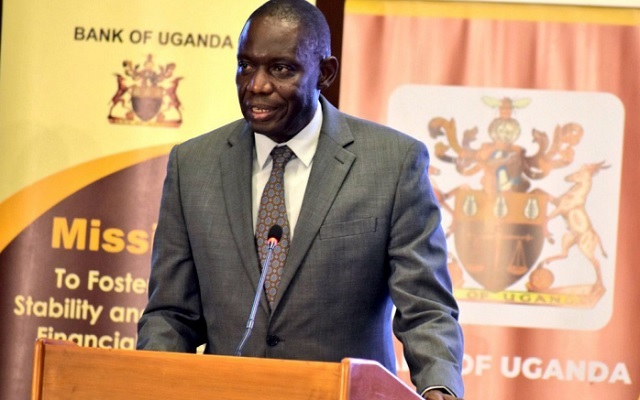
Announcing the decision on Thursday after a meeting of the Monetary Policy Committee held on May 14, Governor Michael Atingi-Ego said the current monetary policy stance remains appropriate despite mounting pressure from higher global oil prices and increased uncertainty in the global economy.

“The Committee assessed that, although risks arising from the conflict in the Middle East could exert upward pressure on inflation, the current monetary policy stance remains appropriate and well aligned with prevailing macroeconomic conditions,” Atingi-Ego said in the Monetary Policy Statement for May 2026.
The decision means borrowing costs are expected to remain relatively stable in the short term as the central bank seeks to keep inflation under control while supporting economic expansion.
According to the statement, inflation remained below the Bank’s medium term target of 5 percent over the 12 months to April 2026, reflecting what officials described as the continued effectiveness of monetary policy.

Annual headline inflation averaged 3.4 percent while core inflation averaged 3.5 percent during the period.
However, the central bank warned that the escalation of conflict in the Middle East has significantly increased global oil prices, creating uncertainty for economies worldwide, including Uganda.
In April 2026, headline inflation rose slightly to 3.0 percent from 2.8 percent recorded in March, largely driven by increases in energy, fuel and utilities costs. Core inflation also edged up from 2.9 percent to 3.0 percent, while inflation for other goods remained unchanged at 2.0 percent.
“There is a strong likelihood that the oil price shock will continue to transmit through the economy in the near term, leading to increases in the prices of other goods and services,” Atingi-Ego noted.
The Governor added that month on month core inflation rose to 0.5 percent in April from zero in March, signalling that higher fuel prices are beginning to spread across the broader economy.
Although the Bank said it is still too early to fully determine the magnitude and persistence of the oil shock, officials cautioned that sustained increases in fuel prices could generate broader second round inflationary pressures affecting transport, manufacturing and household spending.
The Monetary Policy Committee has consequently revised the near term inflation outlook upwards.
Based on assumptions that global oil prices have peaked and could gradually decline to pre conflict levels by 2027, the Bank projects core inflation to range between 5.0 percent and 5.3 percent over the next 12 months before stabilising around the medium term target later on.
“Risks to the inflation outlook remain elevated,” the statement said.
The Bank warned that a prolonged Middle East conflict could trigger larger and more persistent increases in global oil prices, worsening inflationary pressures both globally and domestically.
The statement further revealed that the Uganda shilling depreciated by about 5.4 percent between February and April 2026 due to geopolitical tensions and volatility in global financial markets.
Officials warned that tighter monetary policy by central banks in advanced economies could place additional pressure on the shilling and increase imported inflation.
Adverse weather conditions were also highlighted as a major threat to agricultural production and food prices.
On the downside, the Bank said weaker global growth associated with prolonged geopolitical tensions could dampen domestic demand and moderate inflationary pressures.
The central bank also noted that favourable weather conditions could improve agricultural output and ease food prices, while heightened uncertainty among households and businesses may reduce spending and weaken economic activity.
Despite the global challenges, the Bank of Uganda said Uganda’s economy remains resilient and continues on a positive growth trajectory.
“Real economic growth strengthened in the first half of FY2025/26, supported by broad based improvements across the agriculture, industry and services sectors,” Atingi-Ego said.
Economic activity expanded by an average of 6.7 percent during the first two quarters of the financial year, driven by strong household consumption and rising private investment.
High frequency indicators of economic activity continue to point to resilience in private sector activity, signalling sustained economic expansion, according to the Monetary Policy Committee.
The Bank maintained its economic growth projection for FY2025/26 at between 6.5 percent and 7.0 percent, while medium term growth is projected to average around 8.0 percent, supported by stronger exports and increased business investment.
While acknowledging that higher global oil prices could increase household and business costs, the central bank said Uganda could also benefit from improved export earnings as the country advances towards commercial oil production.
“Over the medium term, economic growth is projected to average around 8.0 percent, supported by stronger export growth and increased business investment,” Atingi-Ego said.