Senior forensic pathologist Sylvester Onzivua has told the High Court that forensic evidence surrounding the death of businessman Henry Katanga strongly points to suicide and not murder by his wife, businesswoman Molly Katanga.
Appearing before Justice Rosette Comfort Kania as the first defence witness in the high-profile murder trial, Dr Onzivua described the prosecution’s theory as scientifically weak and “extremely slim and highly unlikely.”

“To me, the possibility that this case is a homicide is extremely slim and highly unlikely. The postmortem forensic evidence in this case points to suicide unless proven otherwise,” Dr Onzivua testified.
The veteran forensic expert further told court that the evidence instead supports a homicide-suicide scenario in which Henry Katanga allegedly assaulted his wife before shooting himself.
“The blood splatter pattern is consistent with the facts that the deceased battered the victim then sat on the bed and shot himself,” he said.

The case stems from the death of Henry Katanga at the family’s residence in Mbuya, Kampala, in November 2023, an incident that dominated national headlines because of the family’s prominence in Uganda’s business circles.
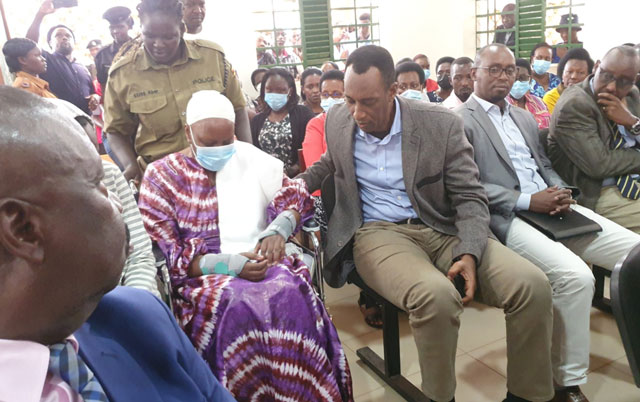
Following the incident, Molly Katanga was charged with murder together with her daughters and a domestic worker, accusations the family has consistently denied.
In earlier proceedings, Justice Kania ruled that Molly Katanga had a case to answer, partly relying on prosecution evidence claiming that Henry Katanga was shot on the left side of the head and that the bullet exited through the right ear.
The state argued that because Henry Katanga was right-handed, it would have been difficult for him to shoot himself using the left side of the head, thereby strengthening the murder case against his wife.
However, Dr Onzivua directly challenged that conclusion and told the court that the postmortem findings relied upon by the prosecution were fundamentally flawed.
“This is a very dangerous postmortem report that could not have passed peer review in any serious institution,” he said.
Court proceedings began with heated exchanges between defence lawyer Elison Karuhanga and Chief State Attorney Jonathan Muwaganya over which copies of the postmortem report the witness should rely on.
The disagreement forced Justice Kania to temporarily halt proceedings and summon both legal teams to her chambers for more than two hours before the hearing resumed.
When court reconvened, Dr Onzivua presented a detailed 50-slide PowerPoint presentation explaining the science of gunshot wounds, bullet trajectories and forensic pathology.
Using postmortem photographs of Henry Katanga’s body, the forensic expert walked the court through the differences between entry and exit wounds, arguing that state pathologists wrongly interpreted the bullet trajectory.
According to Dr Onzivua, the bullet entered through the right ear and exited through the left side of the head above the ear, directly contradicting the prosecution’s version that the bullet travelled from left to right.
He explained that the right side of the head displayed all known characteristics of a close-range bullet entry wound, including blackening from gunpowder residue, tearing caused by explosive gases and a smaller true entry hole.
“A comparison of the right and left ear shows blackening on the right and none on the left,” he testified.
“On the contrary, the external features of the wound on the right side are those of an entry gunshot wound.”
He further criticised the state pathologists for allegedly failing to properly document what he described as the “small true entry wound” inside the right ear.
“There’s a small true entry wound inside there that my colleagues did not document,” he told court.
During examination by Karuhanga, Dr Onzivua explained that blackening caused by gunpowder deposits is a classic indicator of an entry wound.
“When you see blackening, you know you are dealing with an entry wound,” he said.
He also dismissed the prosecution’s conclusion that the left-side wound was the entry point, arguing that it lacked essential forensic characteristics associated with close-contact gunshot wounds.
“There’s no tattooing, no blackening, no muzzle imprint on a close contact bullet entry wound. So how would they have called this an entry wound in the absence of blackening, tattooing or muzzle imprint? There’s no scientific basis for calling the wound on the left an entry wound,” he testified.
Dr Onzivua further challenged the prosecution’s interpretation of the wound dimensions, saying the measurements taken from the right ear were scientifically inaccurate and insufficient to support claims that it was the exit wound.
“The true dimensions of the skull defect on the right side were not taken and there is therefore no scientific basis to call it an exit wound,” he said.
The forensic expert also relied on crime scene findings to reinforce his conclusions.
He pointed to a bullet mark found on the ceiling and damage to a mosquito net, arguing that both indicated the bullet travelled upward after discharge.
“The bullet mark through the mosquito net and on the ceiling indicates that the bullet travelled upwards after being fired,” he testified.
He added,“The wound on the left side of the head is higher than that on the right side and this confirms that the bullet travelled from right to left.”
According to Dr Onzivua, had the prosecution’s version been correct, the bullet trajectory would likely have left markings on the floor rather than the ceiling.
The courtroom session occasionally grew tense as the prosecution attempted to challenge aspects of the testimony.
At one point, State Attorney Muwaganya objected to Karuhanga’s line of questioning, accusing him of putting words into the witness’s mouth during discussion of gunpowder residue and blackening around the right ear.
Despite lengthy questioning, the prosecution had by the close of the session not significantly shaken the scientific basis of Dr Onzivua’s conclusions.
The testimony will determine whether prosecutors can sustain the murder charges against Molly Katanga and her co-accused.
The trial will at the High Court in Kampala with continuation of Dr Onzivua’s cross examination before Justice Kania.