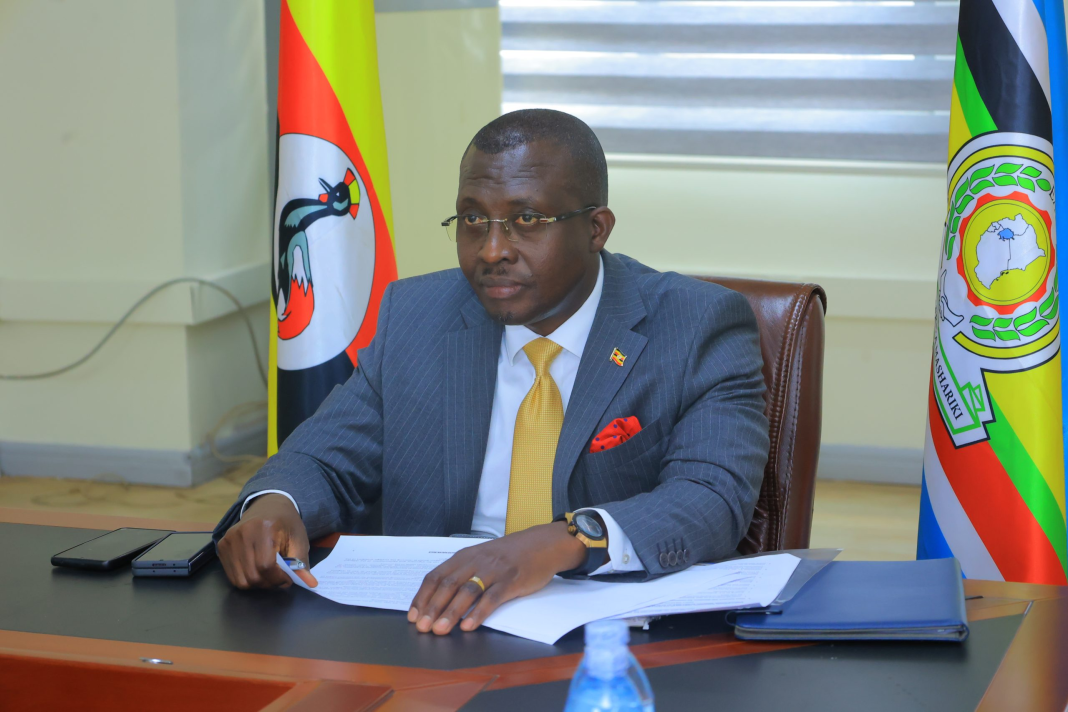
Outgoing State Minister for Foreign Affairs for Regional Cooperation John Mulimba has called on Chief of Defence Forces Muhoozi Kainerugaba to establish a secure and transparent office where Members of Parliament, parliamentary staff and members of the public can freely disclose information related to corruption involving former Speaker Anita Among and other government institutions.
Mulimba made the remarks while commenting on the ongoing anti-corruption investigations within Parliament and other state institutions. He argued that many MPs and parliamentary workers possess critical information but have been living in fear and frustration, making it difficult for them to openly cooperate with investigators.

“People are now feeling free to volunteer information because there is now some ease. Several Members of Parliament have been suffering in silence and carrying a lot of pain. What is happening now has encouraged people to start opening up,” Mulimba said.
The minister said the ongoing crackdown on corruption should be supported by all Ugandans, especially those within Parliament who may have firsthand information regarding abuse of office, bribery and misuse of public resources.
“I want to open the Pandora box and tell the nation that all of us must support the security forces in this ongoing crackdown on corruption. Those who have information about what is going on in Parliament, especially Members of Parliament and workers in Parliament, should come out and speak,” he said.

Mulimba urged Gen Muhoozi to establish what he described as a professional reporting bureau that can safely receive sensitive information from insiders without intimidation or interference.
“I think Gen Muhoozi should open up a bureau where people can discreetly and safely offer information voluntarily. But I do not think this issue should remain discreet anymore because corruption has become a matter of public concern. People should work transparently and openly give information,” Mulimba said.
According to Mulimba, several individuals inside Parliament already possess detailed information concerning corruption networks, procurement deals, and misuse of funds, but lack confidence in existing reporting systems.
“What I know is that people have a lot of information. There should be another means through which members of the public, particularly those within Parliament, can easily access security agencies and give the information they have,” he added.
Mulimba however said Parliament is not the only institution facing problems of corruption and financial influence, turning his attention to the recently concluded National Resistance Movement party elections.
He alleged that huge amounts of money were openly distributed during the campaigns, with some officials from the NRM Secretariat allegedly moving with vehicles loaded with cash to influence voters and local political structures.
“That is not the only area where there is rot. We have just concluded the 2025 to 2026 elections, and we saw people moving with bullion vans of money. You would find somebody moving with three vehicles, and one of them is full of cash. Someone simply removes Shs100 million and throws it at people. What kind of politics are we running? What kind of economy are we building? ” Mulimba said.
The outgoing minister warned that the increasing monetisation of politics is creating anger among ordinary Ugandans and weakening confidence in democratic processes.
“This is what is compelling Ugandans to express a lot of anger. People are seeing money being spent recklessly during elections while the country is struggling economically,” he said.
Mulimba further revealed that he personally became a target after openly criticizing the handling of issues surrounding former minister Persis Namuganza, saying powerful individuals allegedly mobilised enormous sums of money to defeat him politically.
“Because I stood up and said it was wrong for somebody to become a complainant, prosecutor and judge in their own case during the Namuganza matter, a cartel sat and agreed to follow me into my constituency,” he said.
The minister claimed that during the final week of campaigns in Samia Bugwe County, approximately Shs7bn was allegedly injected into the constituency to influence voters against him.
“In the last week of my elections, Shs7bn was brought into that small constituency. Known supporters of mine were bribed with between Shs5m and Shs10m,” Mulimba noted.
He further claimed that ordinary voters were also given cash handouts on polling day, with some receiving Shs100,000 while others allegedly received Shs50,000 depending on local political arrangements.
“The ordinary voters were given money on voting day. Some got Shs100,000 while others who were less fortunate received Shs50,000,” he said.
Mulimba questioned the source of the money being spent during elections, arguing that the country risks normalising corruption if accountability is not strengthened within public institutions and political structures.
“Where is all this money coming from? This is happening because corruption has been allowed to grow infinitely and people now feel free to misuse public resources,” he asked.
Security agencies continue investigations into corruption linked to Parliament and officials close to former Speaker Anita Among. Investigators have so far searched offices linked to the Clerk to Parliament and several residences of parliamentary officials in Kampala as part of the ongoing probe into procurement deals and alleged misuse of public funds.
During the operations, security officers reportedly impounded Among’s Rolls-Royce from her Kigo residence and confiscated documents, electronic devices, and financial records believed to be important to the investigations. More parliamentary officials are expected to be questioned as the crackdown widens.