Stanbic Bank
Stanbic Bank
18.4 C
Kampala
Stanbic Bank
Stanbic Bank
Home Blog Page 2305

US gives $9m to support refugees in Uganda

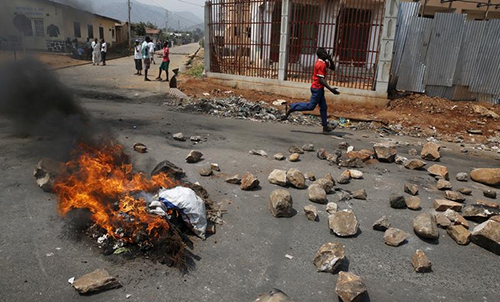
A man runs past a burning barricade on a rock strewn street in Bujumbura's Niyakabiga district on Presidential election day in Burundi, July 21, 2015. A policeman and an opposition official died in violence marring the start of Burundi's presidential election, already hit by opposition boycotts and protests over President Pierre Nkurunziza's decision to run for a third term. REUTERS/Mike Hutchings - RTX1L6Z1


The United Nations World Food Programme (WFP) on Tuesday received a contribution of US$9 million from the United States Agency for International Development (USAID) to provide food assistance for more than 320,000 refugees living in Uganda.

“This generous contribution has arrived just in time, as a funding shortfall was threatening to force WFP to reduce rations for refugees, including the new South Sudanese arrivals,” said acting Country Director Michael Dunford in a press release.

“Those cuts will not be necessary now, and we are extremely grateful to USAID for its lifesaving support for people fleeing conflict in neighbouring countries and seeking refuge in Uganda.”

Dunford said WFP will use the funding, received through USAID’s Office of Food for Peace, to purchase more than 13,000 metric tons of cereals and beans within Uganda for more than 300,000 refugees.

The support will also allow WFP to provide cash to 20,000 refugees in areas where markets are able to meet the demand. As well as meeting the immediate food needs of refugees, cash assistance has the added benefit of allowing some flexibility for the refugees to buy nutritious foods that may not be part of WFP’s food basket and to manage their household food resources themselves.

This contribution brings USAID’s 2015 WFP support to refugees in Uganda and extremely vulnerable populations in Karamoja to an estimated US$26 million.

Uganda currently hosts more than 490,000 refugees, mostly from the Democratic Republic of Congo (DRC), South Sudan and Burundi and roughly two-thirds of the refugees in Uganda depend on WFP to meet their basic food needs.

WFP’s assistance for refugees is closely coordinated with the Government of Uganda through the Office of the Prime Minister, the United Nations High Commissioner for Refugees (UNHCR) and stakeholder NGOs.

Stories Continues after ad

PwC global revenue hits US$35bn


PricewaterhouseCoopers International has reported global gross revenue of US$35.4 billion for the fiscal year ended on 30 June 2015, representing a 10% increase.
“The global business environment remains challenging, with a continuing patchy economic picture, geopolitical issues creating uncertainty for business and fierce competition in the professional services market.  Despite these challenges the PwC network performed exceptionally well in FY15 with growth of 10%, pushing revenues over the US$35 billion mark for the first time,” PwC Chairman Dennis M. Nally said.

He noted that over the last eight years the company had recruited good brains, enhanced services, made key acquisitions like Booz and Company and, also established new products like data analytics.
“Technology is transforming all aspects of our lives and every business, so we are working in alliances with market leaders such as Google and others, to bring the latest and best technology thinking to our clients.
“The PwC brand has been acknowledged as the strongest professional services brand in the world and this reputation is built on the energy, enthusiasm and quality of our 208,000 people and their commitment to working with all of our stakeholders to build trust and to solve important problems,” Mr Nally added.
Meanwhile, PwC enjoyed double digit growth in the Middle East and Africa with revenues up 16%.
According to Hein Boegman, CEO of PwC Africa, the global firm expects increasing growth in the emerging markets in the next few years. “We embarked upon an ambitious investment strategy in Africa in 2012 to build PwC into the leading network in Africa, which is paying dividends. We have invested substantially in the region and our people, and are firmly embedded in the local communities. Our practice in Africa with its over 10,000 staff members is a strategically important asset in the PwC Global network,” Boegman said and noted that Africa’s potential is encouraging.

“We clearly see the opportunity in Africa is huge for a number of reasons. For instance, the level of political democracy has improved significantly over the past 20 years and in the past five years we have seen the discovery of oil & gas reserves in countries such as Mozambique, Tanzania, Ghana and Angola,” he said and added: “We have great confidence in the future of Africa and are investing heavily in talent and skills development to ensure that we have the right people in the right place to continue to provide value for our clients in the years ahead.”
The South African firm recently appointed Dion Shango as the Southern Africa CEO role with effect from 1 July 2015.  Shango, a South African citizen, is the first African black to be appointed in this role within PwC. PwC South African Board Chair, Shirley Machaba, was elected to the PwC Global Board – the first female black partner to be elected to the Global Board. “This bears testimony to our commitment to diversity and inclusion, which are also key focus areas for our global firm,” adds Boegman.

Stories Continues after ad

EAC trains community radio journalists


A three-day media workshop sponsored by the East African Community (EAC)-United Nations Educational, Scientific and Cultural Organization (UNESCO) is currently underway in Arusha, Tanzania.

The workshop for community radio journalists is organised by the EAC Community Media Network (EACOMNET), and has attracted 35 participants from the five EAC Partner States of Burundi, Kenya, Rwanda, Tanzania and Uganda.

Addressing participants on the opening day Ms. Zulmira Rodrigues, the UNESCO Representative to Tanzania said her organization would support community media initiatives in the EAC region.

She noted that the UNESCO-supported community radios are the main source of wide-ranging information for rural, marginalized and indigenous communities.

“UNESCO through its support has further significantly contributed to ensuring quality broadcasting, ethical programming and inclusive content to include all groups – men, women, the youth, persons living with disabilities and persons living with albinism – to actively participate in key processes for democracy, peace and development,” said Ms. Rodrigues.

Officially opening the workshop, the EAC Deputy Secretary in charge of Finance and Administration Mr Liberat Mfumukeko, said the Community attaches great importance to the role of the media promoting awareness in the EAC integration.

“We have directed the Corporate Communications and Public Affairs Department to come up with a strategy to involve community radio stations in the Partner States in our outreach and advocacy programmes in the next Financial Year. With this strategy in place, we shall work and engage with you more closely,” said the Deputy Secretary General.

The workshop is being facilitated by community media experts from the Sarojini Naidu School of Arts and Communication, University of Hyderabad, India, led by the UNESCO Chair on Community, Professor Vinod Pavarala, assisted by Prof. Vasuki Belavadi and Dr Kanchan K. Malik.

Stories Continues after ad

Kikwete to bid EALA members ‘farewell’

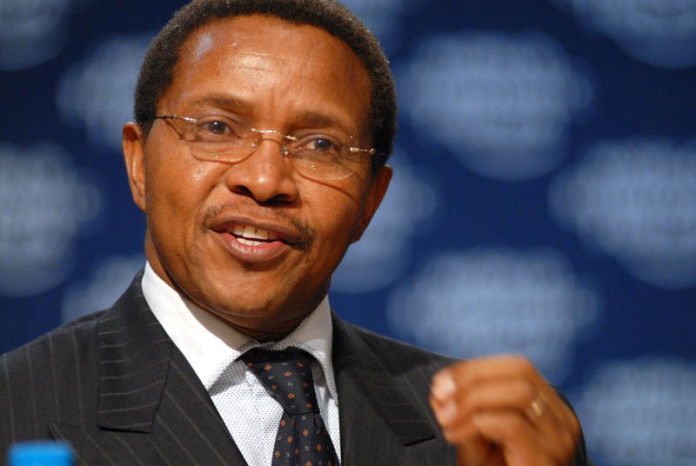
Photo © Eric Miller/World Economic Forum 2006 emiller@iafrica.com Jakaya Kikwete


Tanzanian President Jakaya Kikwete will make his last address to the East Africa Legislative Assembly (EALA) 4thsession currently sitting in the Kenyan capital, Nairobi.

According to EALA Speaker Dan Fred Kidega, the outgoing President, who is also the chair of the Summit of the EAC Heads of State, will address the EALA members on October 13, about two weeks away from elections in his country to be held on October 25.

Kikwete’s mandate as President of Tanzania comes to an end this month, after he has served a two-five year term.

Meanwhile, during the two-week session, the EALA will among other assignments, debate the EAC Electronic Transactions Bill 2014; the EAC Forest Management and Protection Bill 2015 and the EAC Disaster Risk Reduction and Management Bill 2015.

“We further expect to hold consultations with a number of other stakeholders during our stay here to inform the work of the Assembly to carry on with its mandate of legislation, representation and oversight. The involvement of East Africans in the process is fundamental given the fact that integration is very much ‘a people centred process’”, Speaker Kidega said and added that since he became Speaker in 2014 the EALA has passed seven Bills and seven Resolutions, and also adopted 13 reports.
The Speaker also lauded members of the 70th United nations General Assembly (UNGA), a forum at which the newly-introduced Sustainable Development Goals (SDGs) were adopted.
‘Last month, EALA benefited from a 4 day training on the Sustainable Development Goals (SDGs) thus preparing the Assembly for the big task ahead of oversight and possible legislation around sustainable development,’ Kidega said and also hinted at polls’ process in the EAC region, where Tanzania and Uganda will hold presidential elections in 2015 and 2016, respectively.


‘Another key area we as a Parliament are keen on – concerns that of elections in the region.  The United Republic of Tanzania is headed for its polls on October 25, 2015 while Republic of Uganda is expected to hold a similar exercise in the first quarter of 2016. Our appeal to the Partner States is to ensure elections are held in a credible manner and that such processes fall within the ambits of constitutionalism and electoral laws’ he said, before imploring the media to ensure effective and objective reporting.


The Speaker also said there is need to prioritise peace and security in the EAC region, in light of the threats occasioned by the Al-Shabaab insurgents.

‘We need to fast-track the ratification of the Peace and Security Protocol in the region to anchor the architecture and also operationalize joint activities that ensure a peaceful region.  So far, Uganda, Rwanda and the United Republic of Tanzania have ratified the Protocol.  When the region has peace, then there is unrivalled development and progress,’ he added.


Earlier today Kenyan President Uhuru Kenyatta addressed the 2ndmeeting of the 3rd Assembly of EALA, whose sessions at the National Assembly in Nairobi will end on October 15.

Stories Continues after ad

EU tops investor ‘dual citizenship destination’

Several investors including many from Africa prefer taking a second citizenship in the European Union countries because of the opportunities availed there.

James Bowling, the Chief Executive Officer of Monarch & Co International, experts in residency and citizenship investment programmes, says most of those interested in securing dual citizenship can benefit from five major areas: lifestyle and financial hedging, unrestricted travel, tax breaks and family security.

Bowling’s disclosure comes ahead of the Investment Agenda, a forum where leading investors and other stakeholders will converge in Johannesburg on October 20 to assess the ‘prevailing economic and political environment in Africa and its impact on investment in 2016’.

The theme for this year is ‘No man is an island’ and according to Bowling, the countries that offer the best residency or dual citizenship packages for investors include Antigua & Barbuda, Cyprus, Grenada, Malta, Mauritius, Portugal, St Kitts & Nevis, the UK and the USA.

“In light of this conference, Monarch & Co International emphasizes the value of dual citizenship, especially for Africans wishing to take advantage of the opportunities within the continent and abroad. Holding the passport of another country can open opportunities for business, education, healthcare and visa-free travel for investors and their families,” Monarch & Co International says in an October 5 release by the Africa Press Organisation (APO).

The company says that only around 1% of the world’s population has two or more passports, ‘making dual citizenship an exclusive privilege’.

“While in the past it was only possible for people to attain dual citizenship through their ancestry or emigration, many countries have now made it possible for applicants to gain residency or citizenship through various investment programmes without ever having to emigrate,” the release adds.

Stories Continues after ad

Gen. Bamuze did not die from State House

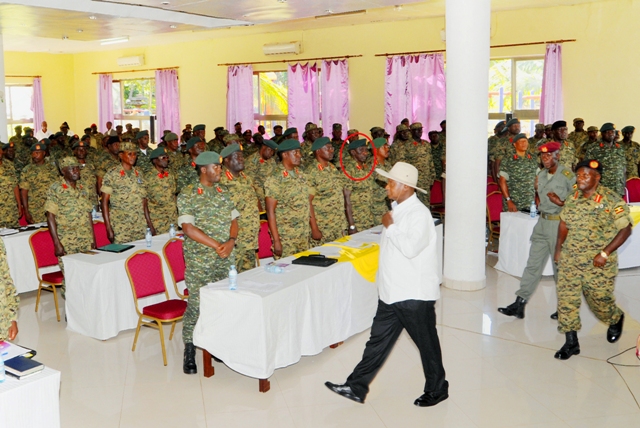
Bamuze during the meeting at bwebajja


There have been misleading reports on Social Media and in the Monitor Newspaper under the headline “Bamuze collapses, dies” in which they quote a relative as having said the fallen Major General Ali Bamuze missed a step, fell and vomited blood before collapsing in State House, Entebbe.

This is to clarify that Gen. Bamuze had no scheduled appointment and was not anywhere near State House and could therefore not have collapsed there.

Bamuze during the meeting at bwebajja

Gen. Bamuze was however part of the UPDF officers who attended an Operation Wealth Creation meeting organized by the Commander of Defence Forces (CDF) Gen. Wamala at J&M Hotel in Bwebajja along Entebbe Road. The meeting was addressed by President Yoweri Museveni.

Gen. Bamuze collapsed shortly after the President had left and was immediately rushed to Nakasero Hospital. He was pronounced dead on arrival.

The UPDF who are handling this matter will brief the press on the postmortem report at an appropriate time.

Stories Continues after ad

Sixteen companies issued with bidding documents for oil exploration


Government has issued 16 companies with bidding documents for oil exploration.

Nineteen had applied when government put out a request for qualification stage.

According a press release by ministry of energy, the bidding documents comprise of Request for Proposal, Model Production Sharing Agreement 2015 (MPSA), Model Confidentiality Agreement for sale of data, Petroleum (Exploration, Development and Production) (Data Sale) Regulations 2014 and Petroleum (Exploration, Development and Production) (Data Sale) (Amendment), Regulations 2015.

Dr. Kabagambe Kalisa, Permanent Secretary of the Ministry of Energy & Mineral Development (MEMD), says the issuance of the bid document marks the commencement of the Request for Proposal stage which entails bidding and competitive process of the licensing round.

He adds that the bidding and competitive process will close on 15th January 2016 with submission of bids.

“Government will evaluate the bids, negotiate with successful bidders, sign Production Sharing Agreements and award exploration, development and production licenses thus marking the end of the licensing round,” explained the Permanent Secretary.

The successful companies are; African Global Resources (JV comprising of Telconet Capital Limited, RT-Global Resources LLC and JSC Tatneft), Russia,  Petrica Energy AS, Norway,Energy Limited, Australia,Oranto Petroleum International Limited, NigeriaTullow Uganda Operations Pty Limited, Ireland, Rift Energy Uganda Limited, Canada,African Exploration Venture (JV comprising of Rapid Africa Energy Pty Limited and Africa Energy SA Corp)South Africa.

Others include; Niger Delta Petroleum Resources Limited, Nigeria, Glint Energy, LLC, USA, Oil and Natural Gas Corporation Videsh Limited, India, SASOL Exploration and Production International Limited, South Africa, Brightoil Petroleum (Uganda) Limited, Hong Kong/China,Petoil (Uganda) Limited, Turkey, Swala Energy (Uganda) Limited, Australia, Waltersmith Petroman Oil Limited, Nigeria,MDC Oil and Gas Holding Company, LLC, United Arab Emirates.

The six biddable blocks comprise of the Ngassa (410 Km2) in Hoima District, Taitai & Karuka (565 Km2) in Buliisa District, Ngaji (895 Km2) in Rukungiri and Kanungu Districts, Mvule (344 Km2) in Moyo and Yumbe Districts together with Turaco (425 Km2) and Kanywantaba (344 Km2) in Ntoroko District.

Uganda discovered commercial quantities of oil in 2006, with the oil in place estimated at 3.5 billion barrels. It’s not clear when production will start as the year has kept being changed.

Stories Continues after ad

James Mutende, The humble hardworking Minister

RIP! James Mutende [NET Photo]


 Kampala: He always wore his necktie tight to the neck, his suit spotlessly pressed. A tradition he probably picked from Busoga College Mwiiri.

Just last week, he drove into grand imperial hotel, his car draped in campaign posters with ‘vote Mutende’ slogans.

He was planning to contest again for Mbale Municipality. However, he was found in bed unresponsive and pronounced dead at Nsambya hospital. As we write this, the cause of death is yet to be known.

James Mutende joined government in 2011 as a junior minister for industry and an ex-officio in Parliament, a position he held till the time of his death.

He was a regular attendant of plenary, always coming in earlier than most of his cabinet friends albeit rarely contributing to debate as is the case with the majority of cabinet ministers.

He has been described, by his Mbale politics colleagues, as hardworking, honest a committed servant, with great dignity, who gave his all to perform his duties and responsibilities. He was also known to be honest and a man of great dignity.

“I first met him in Mwiri when he was in senior three while I was in senior one and when I was joining University he was in third year and so we have been great friends and I will miss him a lot,” Nandala Mafabi (Budadiri West) said, adding that he was “indeed a man of principle.

“I always joked with him. He is used to call me a small boy because of my small size, and I used to call him big boy,” he said. Mutende was actually smaller compared to Mafabi.

Simon Mulongo (NRM, Bubulo West) remembers him as a well-groomed gentleman and academician.

“He was more of a technical person than political. He was never a selfish person and was not a person who used every means to get what he wants.

“In him we have lost a very resourceful person both to the people of Mbale and the country as a whole,” he said.

Mutende was instrumental in drafting the NRM manifesto and helping to build party structures in Mbale.

According to Mulongo Mutende leaves behind the legacy of construction of the industrial park in Mbale, a feat he achieved after talking to the President who provided money for acquisition of land and compensation of affected people

Leader of Opposition in Parliament Hon. Wafula Oguttu said Mutende was humble, social, and never indulged in dubious actions like many politicians of our time.

“Mutende was free from any corruption scandal right from his days at the National Investment authority to his appointment as Minister,” says Wafula.

Mutende comes from a family of distinguished technocrats and politicians. His father Michael Mutende was the first Ugandan Town Clerk of Mbale Municipality, from 1964 until 1974.

His uncle James Francis Wapakhabulo was Uganda’s foreign minister at the time of his death in 2004.

A holder of a PhD in economics he was one of the three most highly educated ministers in Museveni’s current government.

He was born in Mbale in 1962. He attended locals schools before joining Busoga College Mwiri . In 1984, he joined Makerere University where he studied Veterinary Medicine graduating in 1988.

In 1999, he graduated with a Master of Business Administration. He received a Doctor of Philosophy in Economics from New School University in New York.

He began his career as a teaching Assistant at Makerere University in 1987, during his final undergraduate year, continuing in that until 1989.

He joined national politics when he contested for Mbale Municipality Member of Parliament seat only to be defeated by Jack Wamayi Wamga. In 2011, he again contested and was still defeated by Jack Wamayi Wamanga before being appointed Minister of State for Industry.

By the time of his death, he was seeking to contest for Mbale Municipality Member of Parliament seat on the NRM ticket. Four children and wife, Lydia Wanyoto, survive him.

May his soul Rest in Peace.

Stories Continues after ad

Gen Bamuze is dead

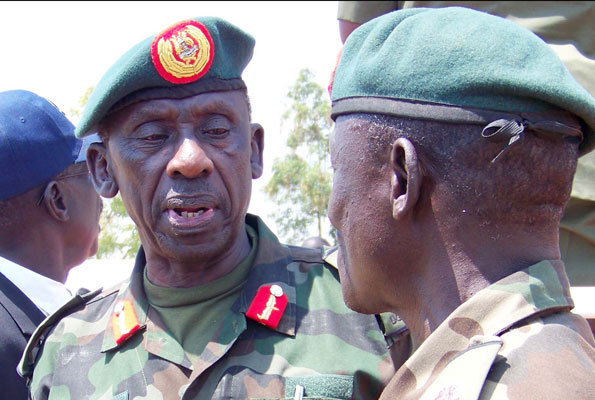
RIP! Bamuze

Maj Gen Ali Bamuze, the former commander of the Uganda National Rescue Front (UNRF) II rebel group, on Sunday night collapsed and died in State House, Entebbe. Details to follow.

RIP! Bamuze
RIP! Bamuze
Stories Continues after ad

Breaking News: Minister Mutende dead 

RIP! James Mutende [NET Photo]

Breaking News: Minister Mutende dead 

Richard Wanambwa

Junior minister for industry James Mutende is dead. He was 53.

According to a family member, Mutende was found unresponsive in bed at his Makindye home.

Mutende replaced the late James Wapakhabulo in Mbale municipality before losing the seat to  FDC’s Wamanga Wamai. He was former deputy director Uganda investment authority. He was also a key member of 2011 and 2016 manifesto task force.

RIP! James Mutende [NET Photo]
More to follow.

Education Background

He was born in Mbale, on 26 February 1962. After attending local schools, he was admitted to Busoga College Mwiri, an all-boys boarding secondary school near Kakira in Jinja District. He graduated from Mwiri, with the Uganda Certificate of Education in 1980 and with the Uganda Advanced Certificate of Education in 1983. In 1984 he was admitted to Makerere University to study veterinary medicine, graduating in 1988 with the degree of Bachelor of Veterinary Medicine. In 1999, he was awarded the degree of Master of Business Administration, also by Makerere University. Later, in 2005, he received the degree of Doctor of Philosophy in Economicsfrom New School University in New York City


Stories Continues after ad