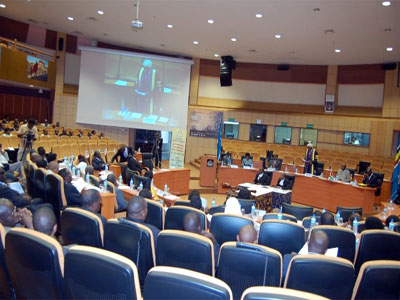
The use of Kiswahili in East Africa has got a shot in the arm, as members of the East African Legislative Assembly (EALA) are currently undergoing a capacity building course in the widely spoken language, ‘to shore up their efforts in sensitising the citizens in the region’.
At the five-day workshop, the EALA members will also focus on the Medium Term Expenditure Framework (MTEF) and auditing in a bid to strengthen the oversight function of the assembly.
According to the EALA, its committees on accounts and general purpose, called for the enhancement of capacities in order to improve on their oversight role.
“As the integration deepens and specifically with the Common Market Protocol in effect, it is important for all EAC citizens to speak Kiswahili to avoid lagging behind. It is also expected to serve as an important tool in forging the much awaited Political Federation in the region“,EALA Speaker, Rt. Hon Daniel Fred Kidega said adding that Kiswahili is “a key uniting factor for the region and in strengthening the integration process.”
Kiswahili is the lingua franca of the Community as envisaged under Article 137 of the EAC Treaty, with a Kiswahili Commission established as an institution of the EAC and is based in Zanzibar.
“As an Assembly, we also have no choice but to perfect our Kiswahili. Already many of us are quite comfortable with Kiswahili, but this is no excuse for we need to be articulate, knowledgeable and fluent if we are to fully sensitise the citizens of this great region“,the Speaker added.
The government has secured land to resettle about 1000 families in the disaster-prone areas of Bulambuli district. According to the Office of the Prime Minister the overall number planned for relocation is 5000.
For long most of the hills and low-lying areas of the Elgon region have been deathtraps in waiting, with the landslides of Bududa in March 2010 in which an estimated 100 people died, providing yet the most unforgettable incident in recent times.
Unfortunately, records have indicated that most residents have ‘historical attachments’ to these risky places and are wary of being relocated, even at the risk of losing their lives.
Indeed, some of the recalcitrant residents even argue that the soils in these areas are of high quality, providing an enabling environment for them to feed themselves and also sell off the excess produce. But this type of thinking is sketchy, and should not be entertained.
So, as the Office of the Prime Minister moves to carry out the relocation, there is necessity to educate the populace about the dangers of not agreeing to the plan.
For instance, the residents should be told that in the event that floods or landslides occur, their farming activities will be disrupted and that even their ‘valued’ cash and food crops will be destroyed.
Then there is also the issue of health hazards, with possible outbreaks of water-borne diseases like malaria, bilharzia and diarrhea, which impact negatively on the financial position of the area residents, who have to pay for health services.
The residents should also be encouraged to avoid destroying the environment and instead adopt measures like planting trees and digging trenches, activities which are essential in mitigating the effects of the disasters.
In all these efforts, the Uganda Red Cross Society and other humanitarian agencies can come in handy.
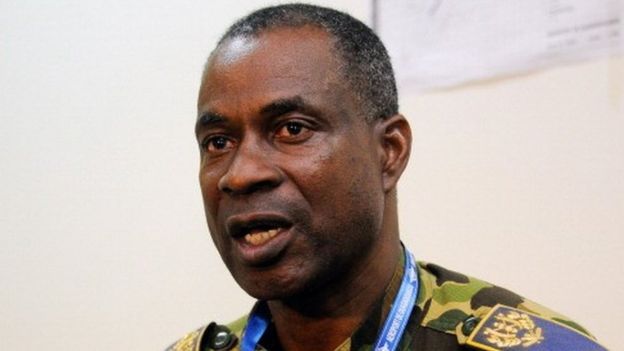
New Coup leader Gen Diendere has dissolved the interim government.
New Coup leader Gen Diendere has dissolved the interim government.
Presidential guard officers in Burkina Faso have seized power in a coup, with reports of more than 10 deaths amid protests in the capital, Ouagadougou.
A close ally of former President Blaise Compaore has been named the country’s new leader, state television reports.
French President Francois Hollande condemned the coup in the former French colony.
Those killed were shot dead by presidential guard forces in the capital, a civil society group said.
The claim by the influential Balai Citoyen group could not be independently verified.
Other reports said protesters had been assaulted and detained.
The coup leaders have imposed a night-time curfew across the West African state, and have ordered the closure of land and air borders, AFP news agency reports.
People have taken to the streets to protest against the coup.
‘Sequestrated’
The headquarters of Mr Compaore’s Congress for Democracy and Progress (CDP) party were ransacked in Ouagadougou as news of the coup spread, it adds.
Mr Hollande called for the immediate release of interim President Michel Kafando and Prime Minister Isaac Zida, who were detained at a cabinet meeting in the president palace on Wednesday.
Their transitional authority was due to hand power to a new government after elections on 11 October.
It is one of the world’s poorest countries – its main export is cotton
A former French colony, it gained independence as Upper Volta in 1960
Capt Thomas Sankara seized power in 1983 and adopted radical left-wing policies – he is often referred to as “Africa’s Che Guevara”
The anti-imperialist revolutionary renamed the country Burkina Faso, which translates as “land of honest men”
Mr Compaore took power in the coup that killed Mr Sankara, and ruled for 27 years, until he was ousted last year following street protests
People in Burkina Faso, known as Burkinabes, love riding motor scooters
It is renowned for its pan-African film festival, Fespaco, held every two years in Ouagadougou
Mr Compaore was ousted in a popular uprising last year after 27 years in power, and is currently in exile.
He was accused of committing widespread abuses, and trying to change the constitution to extend his term in office.
Some of his key allies had been barred from contesting the election.
A statement issued by the coup leaders said the West African state would be led by Gen Gilbert Diendere, Mr Compaore’s former chief-of-staff.
An earlier announcement on state television said wide-ranging talks would be held to form a new interim government that would organise “peaceful and inclusive elections”.
Transitional parliamentary speaker Cheriff Sy said the move was “clearly a coup”.
He said the presidential guard had “sequestrated” the interim government, and he urged people to protest on the streets.
“We are in a resistance situation against adversity,” My Sy added.
The elite presidential guard has been trained, in part, by the US. It is the most powerful armed group in Burkina Faso and often disrupted the activities of the transitional government as it tried to cling to the privileges it enjoyed under Mr Compaore’s rule.
It is seen to be close to him, and is not popular on the streets. So its seizure of power could be a recipe for serious violence.
The transitional government might have made two mistakes – preventing politicians loyal to Mr Compaore from running in next month’s elections and allowing the Reconciliation Commission, formed to heal wounds after the end of his authoritarian rule, to release a report calling for the presidential guard to be disbanded.
Some argue that a newly elected president would have had greater legitimacy to take such action.
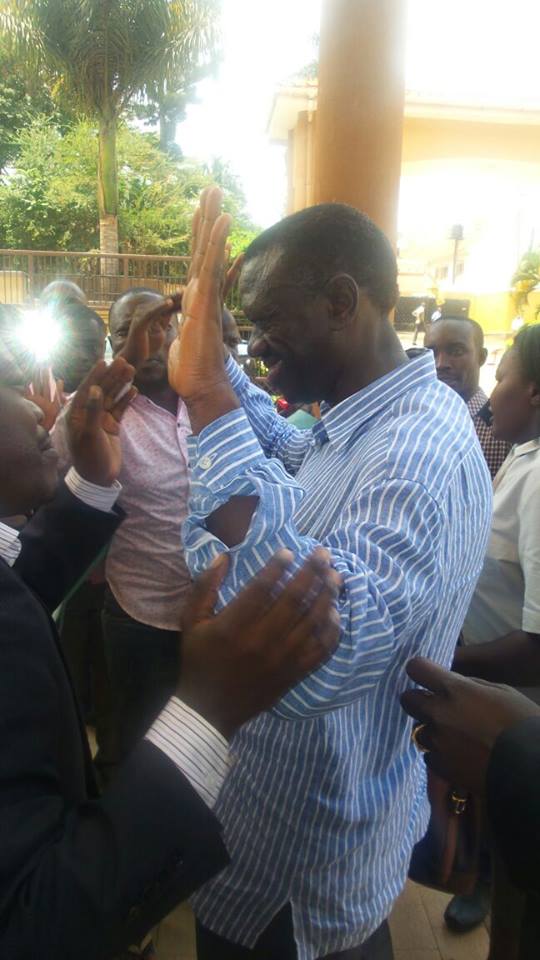
Dr Besigye trying to calm his supporters at Silver Springs hotel in Bugolobi this evening.
Dr Besigye trying to calm his supporters at Silver Springs hotel in Bugolobi this evening.
Opposition Forum for Democratic Change (FDC) flag bearer for presidency Dr Warren Kizza Besigye has been forced to abandon a meeting he was engaged in with officials of The Democratic Alliance.
According to sources, Besigye was called out of the meeting by his staunch supporters including MPs Geoffrey Ekanya, Odonga Otto and Hassan Kaps Fungaroo among others, and whisked away to the FDC party headquarters in Najjanankumbi, where he was asked to brief them on the developments at the TDA headquarters in Naguru.
This follows fears that the TDA has bent backwards and made decisions that seem to favour another opposition challenger, Amama Mbabazi.
Indeed, party theorists have hinted at money changing hands, allegedly to Dr Besigye’s detriment.
FDC party faithfuls asking Dr.Besigye to return the party and run as its flag bearer.
Mbabazi (Independent), Dr Besigye (FDC), former Vice President Prof. Gilbert Balibaseeka Bukenya (Independent) and Norbert Mao (Democratic Party) have been cleared by the TDA to contest for presidency under its banner, but by press time today it had emerged that Mbabazi and Dr Besigye were the choice contestants of members attending a retreat at the Silver Springs hotel in Bugolobi, a Kampala plush suburb.
Prof. Bukenya, a former Vice President, Mbabazi, a former Prime Minister and Secretary General of the National Resistance Movement (NRM), and Dr Besigye have their political roots partially attached to the ruling party, but while Mbabazi joined the opposition TDA recently, after the summit members endorsed his candidature last week, while Dr Besigye has opposed the current government under President Yoweri Museveni since 1999.
TDA members thrown into disarray after the fracas.
Besigye has also run for presidency against Museveni three times, losing in the three elections, albeit with him claiming the elections were not free and fair or rigged for that matter. For Prof Bukenya, he fell out with the ruling NRM in 2011.
Meanwhile, the TDA is set to announce the joint opposition flag bearer tomorrow, amid speculation that Mbabazi has emerged the choice candidate of the loose alliance that seeks to end Museveni’s nearly 30-year presidency.
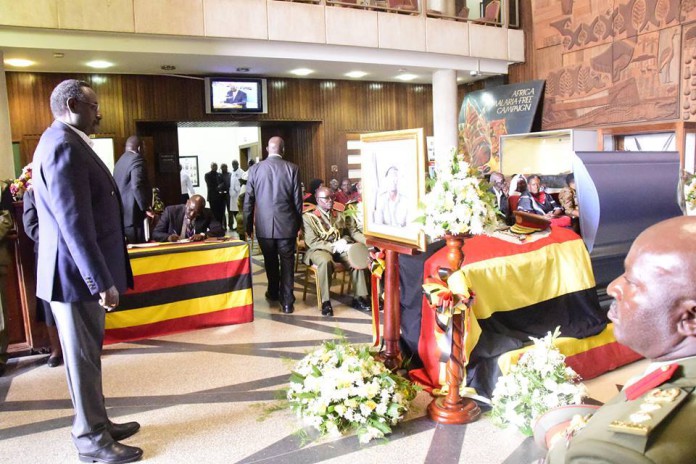
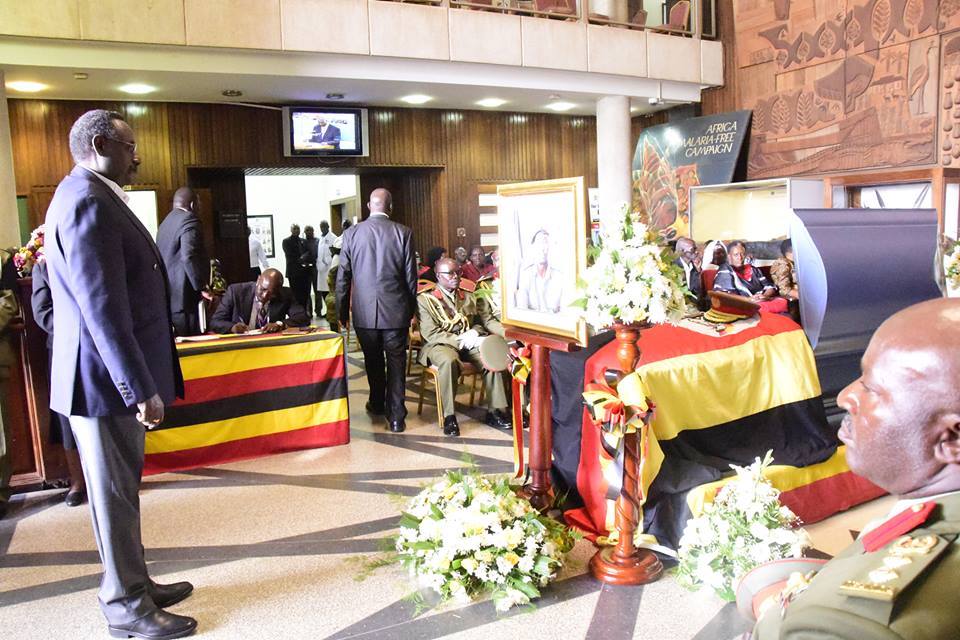
Gen. David Sejusa paying respect to his late comrade, Gen Aronda Nyakairima at Parliament.
Gen. David Sejusa paying respect to his late comrade, Gen Aronda Nyakairima at Parliament.
Defence Minister announces more tests to ascertain cause of death
Although the ministry of health has announced heart attack as the cause of Gen Aronda Nyakairima’s death, more tests will be carried out on some of his body parts
While eulogizing the 56-year-old former army Commander and Internal Affairs Ministers, Dr Crispus Kiyonga, the Minister of Defence said that although government is contented with the pathology report released by the Ministry of Health, some fluids and body party will
still be examined.
“We want to remove any possibility of suspicion and that is the reason we have decided to do more examination in case something was missed,”he said.
Kiyonga eulogized Aronda as a selfless and disciplined “son of Uganda” who should forever be remembered by Ugandans for the contribution he made to the country.
“Death makes a mistake when it picks the young ones when the old ones are there. I think this has been a mistake that death has made. We should struggle to continue with what Aronda fought for instead of inciting the public on social media,” he said.
The Chief of Defence Forces (CDF), who also worked with him while fighting rebels in West Nile, Katumba Wamala described him a workaholic and focused army officer whose death has left a big gap in the institution.
“We will miss you Gen. Aronda. To the family, although he has not left any material wealth, he has left a name. That name will open doors for you and you will never suffer,” he said.
The Leader of Opposition Wafula Oguttu, praised the late as a corruption and scandal free government official who dedicated his life to serving the country and bringing about development.
However, Mr Wafula used the eulogy platform to call for the withdrawal of government forces from South Sudan and Somalia.
“We have been fighting wars for the last thirty years. We have been involved in too many wars. Let us recall our army from Somalia and South Sudan”.
Gen. Aronda died last weekend aboard an emirates aircraft en route to Uganda as he was returning from official duties in South Korea.
Aronda, who is being given a state funeral, lay in state at Parliament foyer before being eulogized by the whole House. He will be laid to rest on Sunday at his ancestral home in Rukungiri after a national official ceremony at Kololo tomorrow.
Deceased Minister of Internal of Internal Affairs General Robert Aronda Nyakairima died of acute heart failure due to blocked vessels.
Uganda Police Pathologist Dr Philip Byaruhanga and the Uganda Heart Institute Director Dr John Omagino made the revelation today, at the Media Centre in Kampala.
Gen Aronda, who also served as the Chief of Defence Forces (CDF) of the Uganda Peoples Defence Forces (UPDF) died last Saturday as he returned from a working visit to South Korea, and his body was yesterday brought back from Dubai, where it had been preserved since his death.
Earlier, family members and a team of Ugandan medical personnel led by the Uganda Peoples Defence Forces Director of Medical of Services Dr James Makumbi, left for Dubai to make preparatory arrangements pending the return of the deceased General’s body.
Today the General’s body is lying in state in Parliament before being taken to Kololo Ceremonial Grounds for prayers after which the body will be taken to his ancestral home in Rukungiri for burial on Sunday.
Meanwhile, the EAC Secretary General Dr Richard Sezibera has sent a message of condolence to President Yoweri Museveni over Gen Aronda Nyakairima’s death,reports Jonathan Kamoga.
In the message sent early today Dr Sezibera mourned “the passing of a great son of Uganda and a towering figure of our time who has left an indelible imprint on the history of Uganda”.
Amb Sezibera noted that the late General Aronda played a big role in deepening the EAC integration process in regard to the implementation of the Memorandum of Understanding (MoU) on Cooperation in Defence in the Community, while serving as Uganda’s Chief of Defence Forces.
“Together with his fellow Chiefs of Defence Forces from Kenya, Tanzania, Rwanda and Burundi, the late General Nyakairima worked so hard through the Sectoral Council on Cooperation in Defence to ensure that the MoU is implemented to the letter,” Dr Sezibera said.
Through the MoU, the SG said the EAC Partner States have continued to pursue an elaborate programme of activities of confidence building among the Defence Forces such as Joint Operations, Technical Assistance, Visits and Exchange of Information, Cultural Exchanges and Sports Competitions, to enhance a spirit of comradeship among the Armed Forces in the region.
The MoU, which has now been upgraded into a Protocol, lays emphasis on unity, peace, stability and strength to defend the region’s common interests.
“The entire East African Community and I share with Your Excellency, the bereaved family and the government and people of Uganda, the feelings of great loss at this moment of deep sorrow,” concludes the message.
L-R: Mr. Austin Makini, CEO Trinity Group, Mr. Fabio Di Stefano from the EU, Chair MOAT Dr. Mengi, Rev Canon Godda, Mr. Owora R. Othieno
The Secretary General of the East African Community Dr Richard Sezibera has urged the media fraternity in Tanzania to build peace and social consensus as the country prepares for the forthcoming general elections slated for October 2015.
The Secretary General, who was on Wednesday 16 September participating in a two-day Tanzania Media Peace Forum 2015 convened by the Media Owners Association of Tanzania (MOAT), Trinity Group East Africa, and the EAC Secretariat at the Julius Nyerere International Convention Centre in Dar es Salaam, said during the electioneering period, the media in Tanzania is expected to build peace, social consensus and cohesion, without which democracy is threatened.
Amb Sezibera, who was represented by his Head of Corporate Communication and Public Affairs Department, Mr Richard Owora Othieno, said: “it will be unfortunate if the media in Tanzania take the path of fanning flames of discord by taking sides, reinforcing prejudices, muddling the facts and peddling half-truths during the electioneering period”.
L-R: Mr. Austin Makini, CEO Trinity Group, Mr. Fabio Di Stefano from the EU, Chair MOAT Dr. Mengi, Rev Canon Godda, Mr. Owora R. Othieno
He urged the media to shape public opinion responsibly and not to be influenced and manipulated by different interest groups in the society. “You are expected to promote democracy by among other things, educating voters, protecting human rights, promoting tolerance among various social groups, and ensuring that the government is transparent and accountable. Please don’t sow fear, division and violence which will lead to democratic decay”, asserted the EAC official.
In his keynote address, Dr. Reginald A. Mengi, the Executive Chairman of IPP Limited and Chair of Media Owners Association of Tanzania (MOAT), commended the EAC Secretariat and the Trinity Group East Africa for bringing together the representatives of various stakeholders to appreciate their different critical roles in deepening democracy in Tanzania.
Dr. Mengi reiterated that for a long time Tanzania had been a haven of peace, a situation, which has given the country international applause and that, the peace is a huge national asset and guarantees the country’s unity and national security.
“If we create and breed social instability, our existing peaceful co-existence will vanish at a great loss to all Tanzanians and the nation, and it will be very hard to re-organize and restore it,” he noted.
Dr Mengi also cautioned the media on reporting what candidates and their campaigners say while looking for votes. “Newsrooms, online portals, radio and television producers, should report stories and developments that aim to promote peace and national unity,” he advised.
A representative of the Head of the European Union Delegation in Tanzania, Mr. Fabio Di Stefano said the role of the media during elections cannot be underestimated and that development partners were ready to support the Tanzanian people during the general elections.
Rev. Canon Thomas Godda, the Executive Director of the Inter-Religious Council for Peace Tanzania and Mr. Tom Ndahiro, former Head of Department of Civil and Political Rights in the Rwanda National Human Rights Commission shared their views on the role of the media in democracy and peace building.
Information is power, or so the adage goes. One of the cardinal benefits of democracy and good governance is the ability for any citizen to freely participate in the affairs and activities of his/her country and this should obtain in a situation where there is freedom of speech, association and the freedom to think or imagine, otherwise called creativity. These are all tools of human endeavor and that is why they should be respected by all and sundry because they lead to an ‘informed society’.
Indeed, in a situation where you have an informed society, the people make tangible and sustained decisions regarding their political, social and economic lives, in essence reflecting on their destiny and that of generations to come.
This is the very reason why countries like the USA boast of being Independent for over 200 years; the citizens there share the verve of dignified continuity of their country. However, in most third World countries, much as we have the verve, we seem to lack sound thoughtfulness on how to achieve that desired goal. Normally, there should be consistent platforms for explaining the methods that can lead to the realization of national objectives and individual aspirations. This inevitably raises the critical issue of the citizens’ need to know and official communication.
It should be noted that in the wake of the death of General Aronda Nyakairima, the state officials charged with making communication to the satisfaction of the populace seeming displayed lack of coordination. This is not good as all sorts of speculation are flying around.
Indeed, Government hires communications experts for all its ministries, statutory bodies and agencies and these should endeavor to ensure that they plug any information vacuums with true, accurate and timely information, and in the process help the citizens to make informed decisions and utterances.
However, if the task becomes onerous, at times it is imperative for the experts from the different line institutions to meet first and only talk after harmonizing a position.
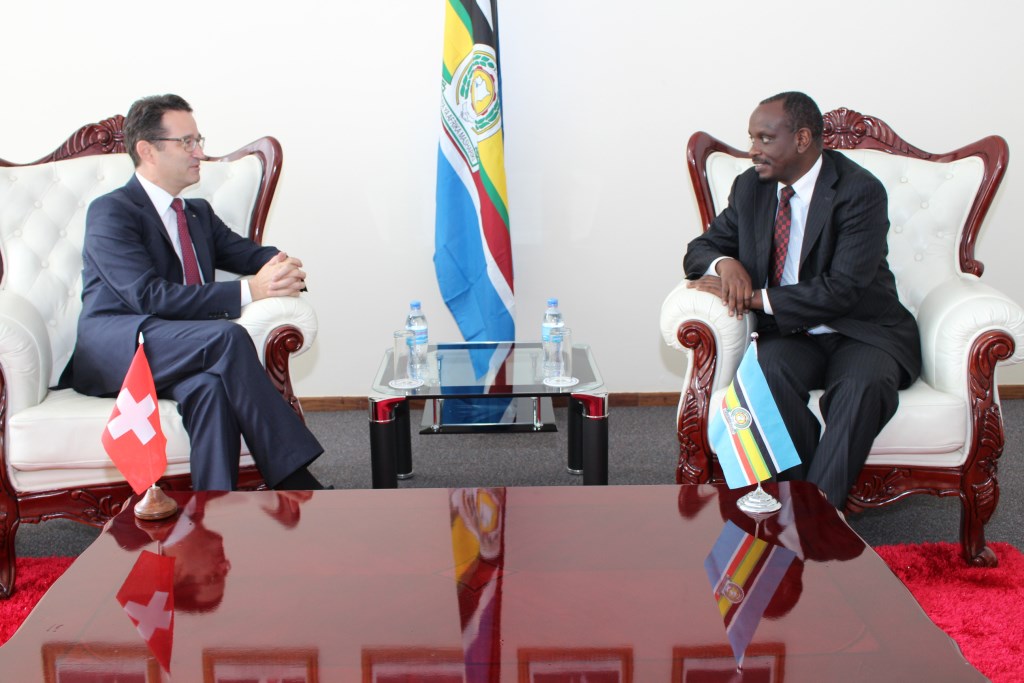
The Swiss Ambassador to the EAC Arthur Mattli (left) confers with the EAC Secretary General, Dr Richard Sezibera, after the envoy presented his credentials to the Secretary General.
The East African Community Secretary General Dr Richard Sezibera, received credentials from the Ambassador and Representative of Switzerland to the EAC, Mr. Arthur Mattli.
Speaking at the function, Amb Mattli said his government is committed to deepening its cooperation with the EAC and urged the regional body collaborate with Switzerland in the area of vocational training which he noted has been his country’s key to economic growth.
“Switzerland’s secret to economic growth is vocational training. We have the smallest country in Europe which is also the least populated and the lowest education per capita in terms of university graduates in Europe. However, we have the highest level of patents and innovations.
The Swiss Ambassador to the EAC Arthur Mattli (left) confers with the EAC Secretary General, Dr Richard Sezibera, after the envoy presented his credentials to the Secretary General.
This shows that you need not have the highest number of university graduates in order to innovate,” Amb Mattli said.
Amb. Mattli said that vocational training in Switzerland is through public-private partnerships, adding that education must be meaningful to any economy.
“Lessons must be practical so innovations start very early. Investors want skilled people, not just people entering the job market,” he said, adding that for vocation training to be taken seriously, artisans must be given as much respect as highly educated people.
He also noted that the EAC had made significant achievements including promoting regional trade and infrastructure development, adding that Switzerland was keen on providing support to drive the integration process forward. The Swiss envoy said his country was following the integration process closely and urged the EAC to engage the youth in their projects so that they can embrace the idea of regional integration.
In his remarks, Amb. Dr. Sezibera said the youth were a critical target for the EAC and disclosed that the Community had appointed youth ambassadors who were doing an excellent job promoting the integration process.
The SG said the Community’s Education Department was currently working on framework for vocational training in the region which would address issues of training, qualifications and certification.
He, however, expressed concern that most Partner States had moved away from vocational training towards university education which is more academic rather than being practical.
Dr Sezibera urged Switzerland to consider supporting the EAC through the Partnership Fund, a basket fund which he said had enabled the Community to make significant achievements in various sectors.
The Secretary General also called for Swiss support in upcoming negotiations between the EAC and the European Free Trade Area.
Meanwhile, the EAC Secretary General also received credentials from the Turkish Ambassador, Ms Yasemin Eralp, at the EAC Headquarters in Arusha, Tanzania.
Present at the function were EAC Deputy Secretaries General, Dr Enos Bukuku (Planning and Infrastructure) and Mr Liberat Mfumukeko ( Finance and Administration), and Mr Peter Kiguta, Director-General (Customs and Trade).