Stanbic Bank
Stanbic Bank
28 C
Kampala
Stanbic Bank
Stanbic Bank
Home Blog Page 2334

Developed infrastructure to boost religious tourism – President

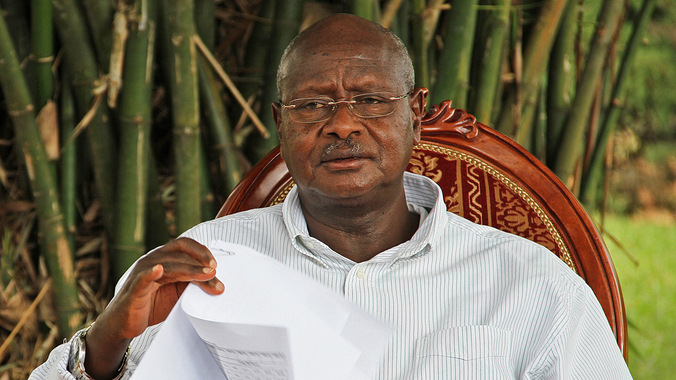
President Yoweri Museveni has said that Africa and Uganda in particular will become a centre of gravity for the Catholic Church if religious infrastructure like the Uganda Martyr’s shrines are developed.

“If we develop religious infrastructure and strengthen our faith, Uganda and Africa will become a centre of gravity for the Church’’ he said.

The President said this will enable Christians and those who are hungry for faith to take spiritual refuge in these centers to renew their faith. He said all the Uganda Martyrs centers will be developed in order to attract more pilgrims to the country.

The President was yesterday speaking at a fundraising dinner held at the Sheraton Hotel in preparation of the visit of His Holiness Pope Francis to Uganda. The funds raised will go towards the reconstruction of Namugongo and Munyonyo Martyrs Shrines.

The Catholic Church requires Shs 7.5 billion to complete the first phase of the Martyrs Shrine at Munyonyo and Shs 45 billion to complete the first phase of the Shrine at Namugongo.

Twenty four Martyrs were killed for their faith in Uganda. Twenty-two were beatified by Pope Benedict XV on June 6 1920 and canonized by Pope Paul VI on October 18 1964. The other 2 martyrs were speared to death in Paimol, Gulu in October 1918. They were beatified by Pope John Paul II on October 20, 2002. Government declared June 3 every year in honour of the Martyrs and this year the President contributed Shs400 million and also launched the Mobile Money platform for the people to contribute towards the project.  Over Shs.1.3billion was raised in cash and pledges.

“If 12 million Ugandans contributed Shs. 5000 each, it will be more than what is needed for the construction of the shrines. Namugongo and Munyonyo will be centers of heroism once they become developed,”  Mr Museveni said.

He said while the killing of the Martyrs was unfortunate, it was an opportunity for Uganda’s heritage because it has watered the growth of the Church.

“Since this is part of our heritage now, it has watered the growth of the Church and by so doing, also watered political freedom in Uganda. This is part of our history, part of our culture and part of our characteristics in Uganda,’’ he said.

The President said the circumstances under which both the Uganda Martyrs and Heroes were killed was similar because Uganda Martyrs were killed for refusing to denounce their faith while the Uganda Heroes refused to betray the freedom fighters.

The President noted that by refusing to denounce faith, the Martyrs made themselves special, unique and uncommon which is appreciated by the world and urged Ugandans to use this heritage to benefit the church, faith and Uganda.

He said government has given the Catholic Church Shs 20 billion in compensation for their land at Entebbe International Airport and will provide another Shs. 10 billion to compensate for the land at Munyonyo. He also said the government will upgrade the roads leading to the Namugongo Shrines.

The Archbishop of Kampala Archdiocese, His Grace Cyprian Kizito Lwanga thanked the President for inviting the Pope and said Namugongo is one of the most popular tourist attractions in the region with more than one million Pilgrims every year.

The Chairman organizing committee, Prof Emmanuel Tumusiime Mutebile who is also the Governor Bank of Uganda said the Pope’s visit will be a national event and they need a befitting environment to welcome him. He said the money will go towards constructing the sites that the Pope will visit and to improve strategic facilities to host the Pilgrims throughout the year. He said this has the potential to promote Uganda as a tourist destination and called upon Ugandans to contribute generously towards the construction of the Shrines.

Stories Continues after ad

Turning flower gardening into an income-generating activity

Exif_JPEG_420
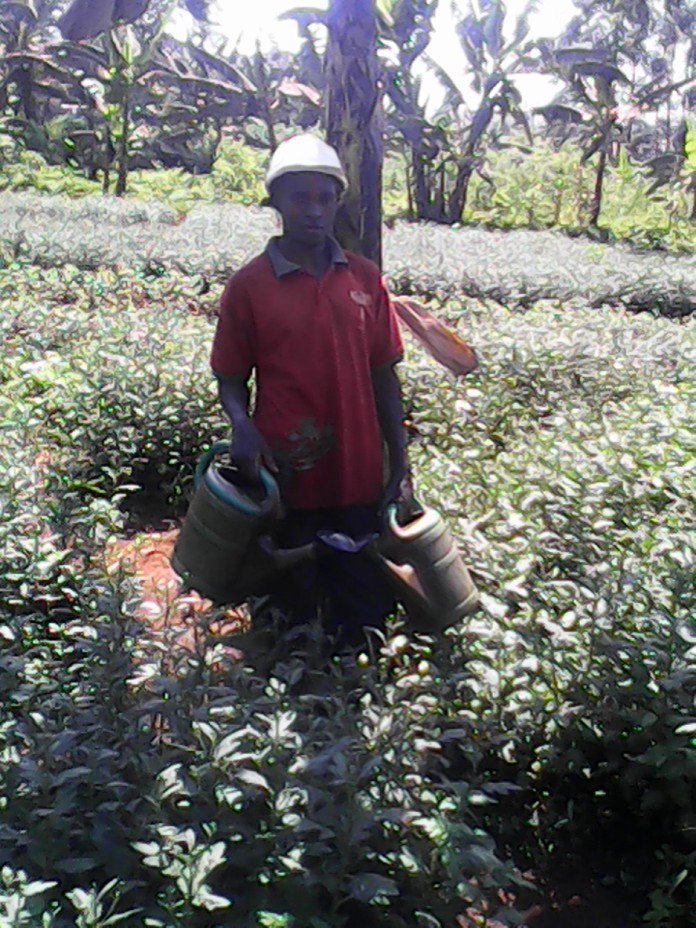
Mr Ntahukuluta at his flower garden

‘Cheap things are usually expensive’ so the adage goes. But also ‘big things’ can be churned from small things.       As American clergyman and social reformer Henry Ward Beecher once noted: ‘flowers are the swiftest thing God ever made and forgot to put a soul into’, Joseph Mwambali Ntahukuluta has tried to discover the secret behind the growing of flowers.

Locating his flower gardening project along Ntinda – Nakawa road, Mr Ntahukuluta decided to plant more than seven different types of flowers with different colors, on a less than an acre of land.

According to Mr Ntahukuluta, four months into his trade, different clients started approaching him for flowers. “This made me improve on my ability and I had to put in more effort in order to get market;  I never expected it, he narrates.

And now twenty years later, the business has expanded, with his clients now including florists from the city, decorators for parties, offices and homes.

“I charge one thousand shillings for each bunch and I sell more than 150 bunches of flowers every four months, Mr Ntahukuluta says.

From his project he has managed to buy a plot of land and constructed his own house. He has also managed to start up a shop as a side business as well as providing employment to other people.

Despite of the good returns he enjoys from the project, Ntahukuluta still complains of undesirable challenges like drought which gives him the hard task of watering the flowers twice a day.

Also, since his business is near the road, dust covers the flowers, changing their natural appearance, most especially the white flowers. He also has to buy pesticides to spray the flowers and prevent them from being attacked by pests.

Stories Continues after ad

Akena out of TDA flag bearer race

UPC's Jimmy Akena hails from the Lango-Northern Region.

The Uganda People’s Congress (UPC) president Jimmy Akena will not contest for The Democratic Alliance (TDA) flag bearer for the 2016 general elections.

According to the UPC, if the TDA accepts its terms, the party will field contestants for all other political posts right up to Parliament.

Speaking at a press conference at the party headquarters at Uganda House in Kampala today, UPC Administrative Secretary Mr Higenyi Kemba emphasized that it will only sign the TDA protocol on condition that their terms are met.

Among the terms the party wants is the ‘natural selection’ of area Members of Parliament according to their strength in an area instead of being selected by a TDA committee.

“We want the natural policy of strength to sort out the parliamentary seats, but TDA under the candidates committee will not choose for UPC; if they agree to those terms, we shall sign,” Mr Higenyi said.

He said his party would join the TDA in order to strengthen opposition to the ruling NRM party in 2016.

“We shall engage the TDA in order to field a formidable presidential aspirant for the opposition,” Mr Kemba said adding: “We as a party agree that we need to pull unified efforts against NRM.”

Meanwhile, the UPC also asked the TDA disregard any deal signed with the ‘former party president’ Olara Otunnu.

“Mr Otunnu did not sign at the time other political parties were signing because he needed authority from the National Council which had not sat for a long time, but he later went backdoor and signed on our behalf which is out of our Constitution,” Mr Higenyi said.

Of recent the UPC has been embroiled in a leadership wrangle that has pitted Jimmy Akena and Olara Otunnu, at times drawing in Mr David Pulkol.

In May this year the three men ran for the UPC party presidency, and Akena, who is also the Lira Municipality MP, was declared winner, a result contested by Dr Otunnu, who cited rigging and intimidation.

Akena is son and ‘political heir’ to founding UPC leader Apollo Milton Obote and his ascendency to the party presidency completed a family ‘hat trick’ after his mother Miria Kalule Obote also led the ‘Independence Party’ between 2005 and 2010.

In 2006 Miria Obote stood for Uganda’s topmost office but lost to incumbent president Yoweri Museveni. She has since gone into ‘political retirement’ but her son Jimmy Akena and daughter-in-law Betty Amongi, the Member of Parliament for Oyam South are active UPC members.

Stories Continues after ad

Democracy should play within the human rights guidelines

The East African Region is awash with presidential and parliamentary elections. Uganda is soon opening campaigns, Burundi has just concluded her controversial polls, Rwanda and Tanzania are all set for similar exercises.

In the past, these elections have caused death, permanent injuries and displacements to thousands of citizens. Still fresh in our minds is the fact that the recent Burundi polls set an ugly example that many of her citizens are now refugees in the neighbouring countries.

These elections should not be times when tension is high but time when the people exercise their right to elect a leader of their choice without intimidation or coercion.

In Uganda, it is now clear the incumbent President Yoweri Museveni will be contesting against other candidates Rtd Col. Dr Kizza Besigye, his former Prime Minister JP Amama Mbabazi and others who may come up. Previous campaigns have been punctuated and laced with scenes of violence by the contesting camps against their rivals.

The Uganda Police Force and to an extent the military have been complacent in this as previous human rights reports have labeled them worst state agencies in rights observance. It’s a trying time for the two agencies to come clean during the “political storm.”

Already the image of the UPF is in the spotlight for going hard on the opposition supporters and ‘favouring’ those who support the regime.

The 2016 polls must be clean, free and fair. The media and the citizens must not be persecuted for accurate reporting and supporting a candidate of their choice, respectively. The media should give equal space to all candidates and report real issues. The campaign manifestoes should be made clear as a basis for the citizens to take an informed decision.

What the Ugandans want is how the new government will address and fix the economy, the ailing healthcare system, the poor education standards especially under the Universal Education and poverty across the country.

It’s also important that unlike in the previous elections, where politicians have been riding on petty gifts like soap, salt, money and sugar to elect a leader, the voters should look at how a candidate promises to turn Uganda into a better nation free of poverty, disease and illiteracy.

The writer is a Lecturer at IUIU – Kampala Campus 

Stories Continues after ad

Humanitarian crises victims’ messages reach 500.000 social media enthusiasts

More than half a billion Facebook and Twitter feeds were saturated with real-life stories from survivors of humanitarian crises as part of a massive digital storytelling campaign launched by the United Nations and partners in the name of inspiring the world’s humanity.

The campaign, launched last week, leverages the collective power of individuals to inspire a greater sense of global citizenship using the power of social media. Users are asked to turn their social media feeds into storytelling platforms to spread awareness of humanitarian crises in countries like Syria and Afghanistan.

“On this World Humanitarian Day, I urge everyone to show solidarity as global citizens by signing up to the #ShareHumanity campaign,” said UN Secretary-General Ban Ki-moon, at a special event on the eve of World Humanitarian Day, commemorated on August 19.

“By donating your social media feeds for just one day you can promote humanitarian action and help to give a voice to the voiceless by sharing their stories of crisis, hope and resilience,” he added.

At the event, humanitarian leaders, media and celebrities joined together to generate a critical mass of support for #ShareHumanity. Australian singer-songwriter Cody Simpson, Malian-French singer-songwriter Inna Modja, and Colombian music superstar, Juanes, inspired the audience with their performances.
Tonight is also a celebration of the values and principles that drive our actions: the humanitarian instinct to support people in need,” said UN Humanitarian Chief Stephen O’Brien.
The UN Secretary-General also paid tribute to the 120 humanitarian aid workers who lost their lives in 2014 in the service of helping others.

World Humanitarian Day commemorates the day in 2003 when 22 UN workers were killed in a bombing of the UN offices in Baghdad.
In a related development, Humanitarian Outcomes, a team of research and policy experts that advises humanitarian aid agencies and donor governments,

has established that 329 aid workers were victims of violence in 27 countries.

The countries most affected include Afghanistan, Syria, South Sudan, the Central African Republic (CAR) and Pakistan.

Meanwhile, more than 100 million people in countries across the world need urgent life-saving humanitarian aid, with nearly 60 million people now forcibly displaced. This is a crisis of forced migration on a scale not seen in the post-World War era, in which a displaced person will remain, on average, displaced for 17 years.
These growing humanitarian needs and finding better ways to respond to them are the impetus behind the Secretary-General’s World Humanitarian Summit, to be held in Turkey in 2016 – his ambitious global call to action to reduce human loss and suffering from humanitarian crises. He kicked off the official countdown to the Summit by revealing a massive virtual clock at the event and pressing a symbolic button. The global gathering of world leaders from government, business and communities will be held in Istanbul in May – just 278 days away.

Stories Continues after ad

Buganda and Kooki should co-exist in Uganda

The Katikiro of Buganda Charles Peter Mayiga has unveiled plans to travel to Kooki County, for the etoffaali programme.

Under a century-plus old arrangement, Kooki and the Buganda Kingdom are supposed to enjoy fraternal relations, with the former subordinate to Buganda but enjoying semi-autonomous administrative responsibilities.

The Buganda Kingdom had almost similar arrangements with the Baruuli of Nakasongola and the Banyala in Kayunga but persistent suspicions among the above-mentioned groups have cast these relationships in bad light.

Needless to say therefore, there have been times when the country has witnessed uncalled-for verbal exchanges, mostly when officials from Buganda plan to visit those areas occupied by the Bakooki, Baruuli and Banyala.

And indeed, the information seeping through this time round is that the hereditary Chief of Kooki, the Kamuswaga, has distanced his administration from all the activities related to the visit of the Katikiro. And this is worrying. Why?

Because of the bickering taking place ahead of the planned visit, one cannot be sure that the Kamuswaga’s words might not kick off frenzied action among his people, something that will make the Katikiro’s visit untenable even for the security personnel deployed to counter any would-be ugly scenes.

According to the Kamuswaga, he has not been officially informed of the planned visit by the Katikiro and sadly, the Buganda Kingdom Spokesman Dennis Ssengendo just brushes off the concerns raised by the Kamuswaga, with arguments that all that going on is legal.

It is important to realize that Kooki recognizes that it is part of the Buganda Kingdom. Of importance too is the realization that under the laws of Uganda both the Kingdom of Buganda and Kooki are recognized as distinct cultural entities and this means that they must be accorded the respect that accrues to them, as enshrined in the Constitution.

And, this begs the question: what is wrong with officially informing the Kamuswaga if any such move would help sooth the tensions that are being created by two parties?

Both Buganda and Kooki must mutually co-exist in Uganda.

Stories Continues after ad

‘Female Viagra’ approved by US drug agency

Experts have said the effects of the libido-enhancing drug are "modest"
Experts have said the effects of the libido-enhancing drug are “modest”


The US Food and Drug Administration (FDA) has approved a libido-enhancing drug for women that has been dubbed “Female Viagra”.

Flibanserin, a drug produced by Sprout Pharmaceuticals, recently passed an FDA advisory committee meeting.

The pill is designed to assist premenopausal women regain their sex drive by boosting levels of certain brain chemicals.

The drug has been criticised as having marginal effects.

Versions of the pill, which will be marketed as “Addyi”, have been submitted for approval in the past but never passed.

It was rejected by the FDA twice for lack of effectiveness and side effects like nausea, dizziness and fainting.

Women taking the drug reported between half and one more sexually satisfying event per month – results experts admitted were “modest”.

Originally the drug was produced by German company Boehringer Ingelheim. Sprout bought the drug from that company after it was turned down by the FDA.

Documents from the 4 June FDA advisory meeting describe the drug’s purpose as “treatment of hypoactive sexual desire disorder (HSDD) in premenopausal women”.

Women would take it each night.

A doctor would have to determine whether a woman seeking the pill was suffering from a disorder characterised by a lack of sexual fantasies and desire, causing the woman distress.

Currently, there is nothing on the US market approved for treatment of HSDD or another condition, female sexual interest/arousal disorder (FSIAD).

“This condition is clearly an area of unmet medical need,” the FDA documents said.

Sprout only has 25 employees. Large pharmaceutical companies like Pfizer, Bayer and Proctor & Gamble have all studied female sexual desire disorder treatment but abandoned plans to pursue it.

Sprout’s CEO, Cindy Whitehead, told AP they would promote Addyi carefully.

“We would never want a patient who’s not going to see a benefit to take it and tell everyone it doesn’t work,” she said.

Lobbying by Sprout Pharmaceuticals was backed by the women’s rights group Even the Score, which has accused the FDA of gender bias by approving a number of drugs treating erectile dysfunction in men without passing an equivalent for women.


Stories Continues after ad

Athletics: Sebastian Coe elected IAAF president

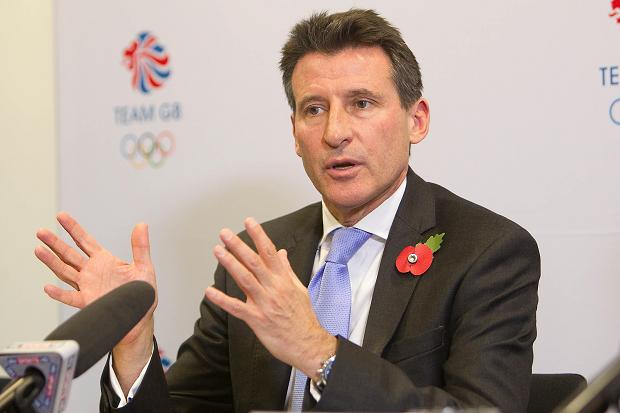
Lord Coe proposed the creation of an independent panel to address the issue, while Bubka wanted a "very deep study" to look at introducing tougher sanctions for cheats.
Lord Coe proposed the creation of an independent panel to address the issue, while Bubka wanted a “very deep study” to look at introducing tougher sanctions for cheats.


Former Olympic 1500m champion Sebastian Coe has been elected president of athletics’ governing body, the IAAF.

The sport’s 214 federations cast their votes in Beijing to decide who should lead the sport, which is dealing with the fall-out from a series of doping allegations.

The UK’s Lord Coe succeeds Senegalese Lamine Diack, 82, who has led the IAAF for 16 years.

The other contender was Ukrainian Olympic pole vaulter Sergey Bubka.

Lord Coe’s initial term will be for four years.

He won 115 votes from the voting members that make up the International Association of Athletics Federations, with Bubka receiving 92.

The two-time 1500m Olympic gold medallist praised the organisation for how the contest was conducted, saying it was “fought according to sound judgement throughout”.

He said his win was the “second biggest and [most] momentous occasion of my life” after the birth of his children.

“Delighted and humbled by the confidence shown in me by the IAAF family – thank you, now the hard work begins,” he tweeted  shortly after the result.

Both Coe, 58, and Bubka, 51, who won Olympic pole vault gold in 1988, had pledged to reform athletics in their manifestos.

They both said they wanted the sport to appeal to a wider audience and attract younger people.

However, the anti-doping agenda began to dominate the election following a series of harmful allegations.

Lord Coe proposed the creation of an independent panel to address the issue, while Bubka wanted a “very deep study” to look at introducing tougher sanctions for cheats.

Last year, the IAAF launched an investigation into claims that 99% of Russian athletes were doping .

Then earlier this month, The Sunday Times and German broadcaster ARD/WDR alleged an “extraordinary extent of cheating” by athletes after they obtained blood test data from 5,000 athletes between 2001 and 2012.

And the IAAF was accused of blocking a study which indicated a third of top athletes admitted cheating. The governing body later denied obstructing it.

Lord Coe has claimed the reports alleging widespread doping were a“declaration of war” on his sport.

The election was held just three days before the 2015 World Championships get under way in Beijing.


Stories Continues after ad

South Sudan: Sides trade accusations after deal falters

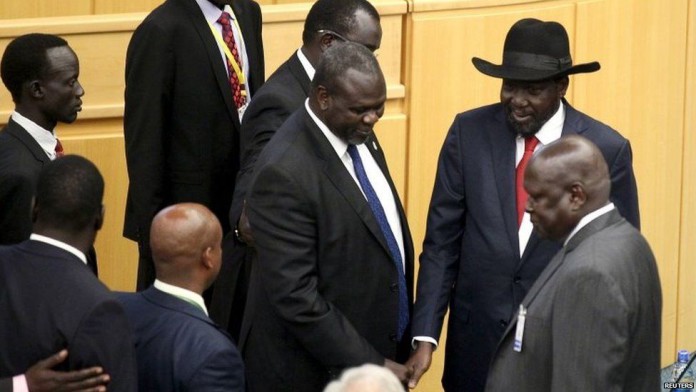
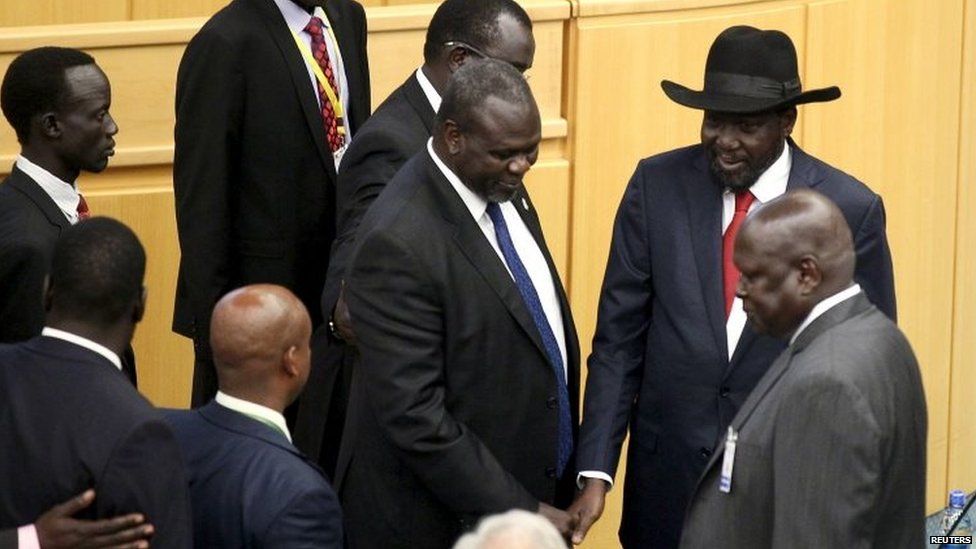
The fate of the peace deal now hangs in the balance.


The fate of the peace deal now hangs in the balance.


Rebels have accused South Sudan’s government of resuming military attacks, a day after President Salva Kiir failed to sign a peace deal aimed at ending the civil war.

Rebel leader Riek Machar said the government had chosen war over peace.

But Mr Kiir’s chief negotiator said the deal was a sell-out that could not be implemented as the rebels are split.

A key issue is thought to be a proposed power-sharing deal which could see Mr Machar return as vice-president.

The deadline for a peace deal expired on Monday night, and South Sudan’s warring parties may now face international sanctions.

Tens of thousands have died and more than two million have been displaced since fighting broke out in the young state in 2013.

South Sudan’s elusive peace:

  • At least seven ceasefires agreed and broken since conflict started in December 2013
  • Nearly one in five South Sudanese displaced by the current conflict, from a total population of 12 million
  • Former rebel leader Salva Kiir became president of South Sudan, the world’s newest state, when it gained independence in 2011
  • South Sudan has been at war for 42 of past 60 years

Five obstacles to peace in South Sudan

The sides traded accusations about who was responsible for an attack in the town of Pageri, near the border with Uganda, early on Tuesday.

Military spokesman Philip Aguer said rebel accusations were “lies” and blamed them.

At Monday’s summit in Ethiopia attended by regional powers and international mediators, South Sudan’s government initialled a draft agreement, but requested a further 15 days before signing in full. Mr Machar did sign it.

UN Secretary-General Ban Ki-moon urged Salva Kiir to sign up and cease hostilities, saying he was “deeply pained by the horrendous suffering of South Sudanese civilians”.

The US was “deeply disappointed” that President Kiir’s government had “yet again squandered” an opportunity to bring peace by refusing to sign the agreement, a statement from US National Security Adviser Susan Rice said.

“The US deplores this failure of leadership,” it added.

A Ugandan spokesman said his government knew how hard it was to achieve peace “especially when the belligerents have big egos and… put their personal egos above national interests”.

“We can only continue to mediate, to encourage every side to realise that their country is superior to every one of them individually,” Shaban Bantariza said, quoted by Reuters news agency.


Stories Continues after ad

Global media companies seal data deal

GeoPoll, the world’s largest mobile survey platform, and Kantar Media, a global leader in media and marketing insights, announce their collaboration on a joint product, Kantar-GeoPoll Media Measurement (KGMM).  This product builds on GeoPoll’s existing media measurement service by adding Kantar Media’s research expertise and technology tools to GeoPoll’s unique mobile data collection methods.

This announcement comes following the forming of a strategic partnership between GeoPoll, Kantar Media, and TNS Global. This is the first joint product between the three companies, who plan to release additional joint offerings in the coming months.

GeoPoll released its media measurement service in June 2014, becoming the largest provider of overnight audience data for TV, radio, and print in Africa. In the past year, GeoPoll has built on its flagship product by adding tools for media planning and post-campaign evaluation, allowing brands and agencies to assess the performance of their advertisements in almost real-time. The joint product with Kantar Media will refine the mobile data methodology that GeoPoll has used to collect daily audience data.

“We are very pleased to partner on Kantar-GeoPoll Media Measurement. GeoPoll’s method of collecting audience data through mobile surveys, which do not require a data connection, is a big step forward for  audience research in a diverse continent such as Africa. With Kantar Media’s vast experience in research methodology, we believe this new product will change the media planning landscape in Africa,” said Jennie Beck, Global Director, Kantar Media.

James Eberhard, CEO of GeoPoll, added “Over the past year, clients have used GeoPoll’s media data to view audience shifts in real-time, assess the performance of their advertisements, and monitor viewership of one-off events including the World Cup.  KGMM will further disrupt the marketplace by bringing a reliable, real-time solution to audience measurement that has been vetted by researchers at both GeoPoll and Kantar Media.  We look forward to adding extra capabilities to the product and expanding into additional countries in the coming years.”

KGMM is currently available in Ghana, Kenya, Nigeria, Rwanda, Tanzania, and Uganda.  The service runs off of GeoPoll’s multi-modal survey platform, which sends surveys to a database of 200 million users via SMS, voice, and mobile web.


Stories Continues after ad