Stanbic Bank
Stanbic Bank
19.8 C
Kampala
Stanbic Bank
Stanbic Bank
Home Blog Page 2338

Poll shows Museveni leading in 2016 race

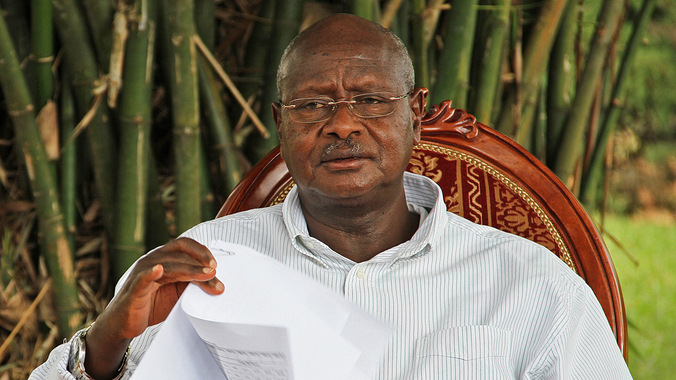
President Museveni.

76 per cent want term limits reinstated

A recent survey has indicated that President Yoweri Museveni is leading in the presidential race for the 2016 elections.

The 62-page survey dubbed ‘Measuring the national political temperature ahead of the 2016 elections’ has placed Museveni ahead of the presidential pack with 54 per cent, followed by Colonel Dr Kizza Besigye with 19 per cent, while former Prime Minister and National Resistance Movement (NRM) Secretary General John Patrick Amama Mbabazi is in third position with 12 per cent.

The survey carried out by Research World International (RWI), fielded 2320 randomly-selected respondents, both male and female aged between 17 and 24, from 120 parishes of 72 sub counties in 48 districts across Uganda.

According to the survey, carried out between July 11 and 26, over 50 per cent of the respondents of the 1221 young women and 1099 young men were unemployed, 98 per cent had registered for the national IDs, while 76 per cent said they wanted the term limits reinstated.

According to the survey, 45 per cent of the respondents do not trust the Electoral Commission to hold credible elections, while 49 per cent said they don’t trust the Uganda Police.

The respondents singled out poverty, corruption, unemployment, roads and the education systems as the leading constraints, with the majority saying government was not doing enough to combat corruption.

Asked about the candidates they knew, 100 said they know Museveni; 96 per cent know Dr Besigye; 83 per cent know Amama Mbabazi; 79 per cent know Olara Otunnu; 77 per cent know Norbert Mao; 76 per cent know Mugisha Muntu, while the least known candidate was Professor Venasius Baryamureeba with 25 per cent. Seventy four per cent of the respondents said they knew about Professor Gilbert Bukenya, while 46 per cent said they knew about Jimmy Akena.

Also, 82 per cent of 1408 respondents interviewed on party preference said they would vote for the NRM, while 13 per cent said they would vote for the Forum for Democratic Change (FDC).

Meanwhile, of 1155 respondents, 38 per cent said they would like the NRM to have a new leader. The respondents also said that in the absence of Museveni on the ballot paper as NRM flag bearer, 39 per cent would vote for Amama Mbabazi; 18 per cent would vote for Janet Kataha Museveni; 11 per cent would vote for Rebecca Kadaga, while 8 per cent said they would vote for Ruhakana Rugunda and Muhoozi Kainerugaba. Also, 8 per cent are undecided, while 5 per cent said they would vote for Museveni’s brother General Salim Saleh (Caleb Akandwanaho).

According to the survey, 94 per cent of the respondents said they intend to vote in the 2016 elections, while those who don’t want to vote said that they doubted the credibility of the elections; were not interested in politics; didn’t know their polling stations; were tired of the same contestants, while others lack national IDs.

Also, a majority of those interviewed in the western and northern regions said they received bribes in the 2011 elections, with 59 per cent of those bribed saying they voted for the very candidates who gave out the bribes.

The survey was sponsored by NTV, Uganda Governance Monitoring Platform and the Great Lakes Institute of Strategic Studies (GLISS).

It is important to note that Gallup polls in Uganda are usually controversial, with ‘disadvantaged’ candidates claiming the pollsters are biased.

In one such survey last year, a leading media house came under severe attack by some politicians and civil society activists after it published results indicating that President Museveni was the leading contender for the 2016 elections.

This time round, there are also reports that the RWI survey is being criticized and contested by those it did not rate favourably, despite prominent opposition figures Dr Patrick Wakida and Godber Tumushabe reportedly featuring in the survey’s production.

Stories Continues after ad

EA military games kick-off

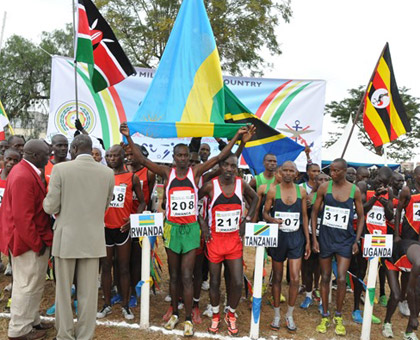
The defence forces of the EAC partner states have today started competing in the 9th Edition of the East African Military Games and Cultural Event slated for August 15 to 26 at the Mandela National Stadium in Kampala.

The event, themed One People One Destiny through EAC Military Games and Cultural Event 2015, will involve over 500 participants representing the various services of the defence forces of the EAC partner states.

According to a release, the games will involve the disciplines of athletics (Cross-country Race), boxing, football, netball and handball.

‘The East African Military Games and Cultural Week is an annual event instituted since 2005 when the first edition was held Kampala, Uganda. The second edition of the games was held in Nairobi Kenya in 2006. The objective of the Military Games is to contribute to building confidence among the EAC Defence Forces under the EAC Memorandum of Understanding on Co-operation in Defence Matters’ the release states in part.

The Secretary General of the EAC Dr Richard Sezibera said the games would enhance regional cooperation.

“When the people perceive that our defence forces are working together, carrying out joint exercises and engaging in sports activities that project mutual trust and confidence, they inevitably garner higher levels of confidence in the East African Community project at both economic and political dimensions. Indeed, our common security future is best guaranteed by the moulding of an East African soldier and a unified territorial defence system,” Dr Sezibera was quoted as saying ahead of the games.

He added: “the success of the Exercise will widen and deepen the long established cooperation among the Defence Forces of the Partner States and also enhance the process of fast tracking the integration process”.

The Partner States of Burundi, Kenya, Rwanda, Uganda and Tanzania are holding the Military Games under the East African Community Memorandum of Understanding (MOU) on Cooperation in Defence Matters which has specific provisions for Sports and Cultural co-operation as well as joint military exercises, among other joint activities intended to build confidence and esprit de corps among the EAC Defence forces.

The EAC Memorandum of Understanding (MoU) on Co-operation in Defence Matters was signed in 1998 and revised in 2001 and has now been upgraded into a Protocol.

Stories Continues after ad

Germany to avail US$78m for EAC health sector

The Federal Republic of Germany will invest 30 million Euros in the EAC health sector to support vaccination and health supply chain management.

According to a release, part of the funds, 20 million Euros, will be used to procure vaccines against different diseases in the EAC, expected to benefit about 300 million children, while 10 million Euro will support the establishment of the EAC Regional Centre of Excellence for Health Supply Chain Management in Kigali.

The programme will be implemented in collaboration with the global vaccination alliance (GAVI) and this new commitment will bring Germany`s contribution to regional immunisation programmes with the EAC to 60 million euro since 2012.

Mrs Gudrun Grosse Wiesmann, Director Sub-Saharan Africa at the German Federal Ministry for Economic Cooperation and Development, also announced the willingness of Germany to provide an additional 3 million euros (3.3 million USD) in technical assistance for the region`s crisis response capacity, out of special funds for 2016 with a view to strengthen the pandemic preparedness in the EAC.

“Our support underlines that Germany wishes to further strengthen the long-standing and deep relationship it maintains with the East African Community in order to contribute to the well-being and prosperity of its citizens,” Ms Wiesmann said.

The EAC Deputy Secretary General Dr. Enos Bukuku the assistance helps EAC countries stem the spread of infectious diseases and improve accessibility of health products throughout the region.

And, speaking about the upcoming bilateral negotiations on development cooperation with the EAC in September 2015 Ms Weismann disclosed that Germany is willing to support the EAC in the fields of regional economic integration, health and water resource management, by making available an additional 37 million euros for projects in these fields.

Stories Continues after ad

US flag raised over reopened Cuba embassy in Havana

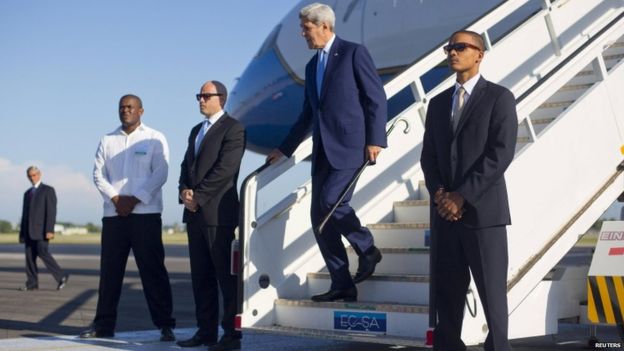
Secretary of State John Kerry is the highest level US official to visit Cuba in more than 70 years.


Secretary of State John Kerry is the highest level US official to visit Cuba in more than 70 years.


The US has reopened its embassy in Cuba more than 54 years after it was closed, in a symbolic step signalling the warming of ties between both countries.

John Kerry, the first US Secretary of State to visit Cuba in 70 years, presided over the ceremony in Havana.

The US flag was presented by the same US marines who brought it down in 1961.

Mr Kerry said the US administration wanted to lift the trade embargo on the island – something that the Republican-controlled US Congress has blocked.

In an open letter on Thursday, former Cuban leader Fidel Castro said the US owed Cuba millions of dollars because of its 53-year-long embargo.

Mr Kerry described the hoisting of the flag as a “historic moment” speaking during the ceremony on Friday.

But he also warned that the US would not stop pressing for political change in Cuba.

“The people of Cuba would be best served by a genuine democracy, where people are free to choose their leaders,” he told a crowd of hundreds gathered outside the embassy building.

Mr Kerry said Congress will not lift the economic embargo if there is no movement on issues of freedom of conscience.

At the scene – Jon Sopel, BBC North America editor

Diplomacy is the cold and rational pursuit of national interest. But twice I saw John Kerry wipe his eye at the end of his speech at the American embassy.

The handing over of the flag by three old men who 54 years ago as young marines took it down; the US army band striking up the national anthem; the Stars and Stripes hoisted once more – this could never be seen as just cold diplomacy at work. There was emotion.

On both sides. US-Cuban relations are entering a new era, and though there will be difficulties ahead and fresh misunderstandings, for those who had brought this restoration of diplomatic relations about, today was one to savour in the Caribbean heat.

In the past, he conceded, US policies have not led to democracy. “Cuba’s future is for Cubans to shape,” he added.

Mr Kerry and his Cuban counterpart, Bruno Rodriguez, later announced the setting up of a joint commission to oversee a return to full relations.

Cuba reopened its embassy in Washington last month.

Cuban leader Raul Castro and US President Barack Obama agreed to restore ties in December last year.

While trade and travel restrictions have been relaxed, the Republican-led US Congress has not lifted the trade embargo the US imposed on the communist-run island in 1960.

Mr Kerry’s visit to Cuba drew criticism from several leading Republicans, including presidential candidate Jeb Bush who said it was “a birthday present for Fidel Castro – a symbol of the Obama administration’s acquiescence to his ruthless legacy”.

He and Marco Rubio, another presidential contender and Cuban-American senator in Florida, also criticised the US secretary of state for not inviting Cuban dissidents to the ceremony. Mr Kerry said he was due to meet dissidents at a private event later on Friday.

Cuba says relations will be fully restored only once the embargo is lifted.

  • Castro survived over 600 assassination attempts to become the longest serving non-royal leader of the 20th Century
  • In 1959 he took power in the Cuban Revolution after several years of guerrilla warfare in the mountains
  • The CIA sponsored an unsuccessful invasion by 1,500 Cuban exiles at the Bay of Pigs in 1961. Castro took personal charge of the defensive operation
  • In 1962 the Cuban Missile Crisis brought the world to the brink of nuclear war
  • 125,000 Cubans emigrated to the US in the Mariel Boatlift in 1980
  • In 2008 Castro stepped down from power and handed over the reins to his younger brother Raul.


Three veteran marines who lowered the US flag in 1961 returned to watch it hoisted in Cuba once again.


How did Fidel Castro keep a grip on power for so long?

Fidel Castro’s letter was published in state newspaper Granma to mark his 89th birthday.

In it, Mr Castro said Cuba was committed to “good will and peace in our hemisphere” but added: “We will never stop fighting for the peace and welfare of all human beings, regardless of the colour of their skin and which country they come from.”

Fidel Castro led his country from the Cuban Revolution, in 1959, until 2006, when he stood down because of undisclosed health problems.

He passed on power to his younger brother, Raul, who embarked on a number of economic reforms.

The US has reopened its embassy in Cuba more than 54 years after it was closed, in a symbolic step signalling the warming of ties between both countries.

John Kerry, the first US Secretary of State to visit Cuba in 70 years, presided over the ceremony in Havana.

The US flag was presented by the same US marines who brought it down in 1961.

Mr Kerry said the US administration wanted to lift the trade embargo on the island – something that the Republican-controlled US Congress has blocked.

In an open letter on Thursday, former Cuban leader Fidel Castro said the US owed Cuba millions of dollars because of its 53-year-long embargo.

Mr Kerry described the hoisting of the flag as a “historic moment” speaking during the ceremony on Friday.

But he also warned that the US would not stop pressing for political change in Cuba.

“The people of Cuba would be best served by a genuine democracy, where people are free to choose their leaders,” he told a crowd of hundreds gathered outside the embassy building.

Mr Kerry said Congress will not lift the economic embargo if there is no movement on issues of freedom of conscience.

Venezuelan and Bolivian Presidents Nicolas Maduro (left) and Evo Morales (centre) visited Fidel Castro in Cuba on his birthday.


At the scene – Jon Sopel, BBC North America editor

Diplomacy is the cold and rational pursuit of national interest. But twice I saw John Kerry wipe his eye at the end of his speech at the American embassy.

The handing over of the flag by three old men who 54 years ago as young marines took it down; the US army band striking up the national anthem; the Stars and Stripes hoisted once more – this could never be seen as just cold diplomacy at work. There was emotion.

On both sides. US-Cuban relations are entering a new era, and though there will be difficulties ahead and fresh misunderstandings, for those who had brought this restoration of diplomatic relations about, today was one to savour in the Caribbean heat.

In the past, he conceded, US policies have not led to democracy. “Cuba’s future is for Cubans to shape,” he added.

Mr Kerry and his Cuban counterpart, Bruno Rodriguez, later announced the setting up of a joint commission to oversee a return to full relations.

Cuba reopened its embassy in Washington last month.

Cuban leader Raul Castro and US President Barack Obama agreed to restore ties in December last year.

While trade and travel restrictions have been relaxed, the Republican-led US Congress has not lifted the trade embargo the US imposed on the communist-run island in 1960.

Mr Kerry’s visit to Cuba drew criticism from several leading Republicans, including presidential candidate Jeb Bush who said it was “a birthday present for Fidel Castro – a symbol of the Obama administration’s acquiescence to his ruthless legacy”.

He and Marco Rubio, another presidential contender and Cuban-American senator in Florida, also criticised the US secretary of state for not inviting Cuban dissidents to the ceremony. Mr Kerry said he was due to meet dissidents at a private event later on Friday.

Cuba says relations will be fully restored only once the embargo is lifted.

  • Castro survived over 600 assassination attempts to become the longest serving non-royal leader of the 20th Century
  • In 1959 he took power in the Cuban Revolution after several years of guerrilla warfare in the mountains
  • The CIA sponsored an unsuccessful invasion by 1,500 Cuban exiles at the Bay of Pigs in 1961. Castro took personal charge of the defensive operation
  • In 1962 the Cuban Missile Crisis brought the world to the brink of nuclear war
  • 125,000 Cubans emigrated to the US in the Mariel Boatlift in 1980
  • In 2008 Castro stepped down from power and handed over the reins to his younger brother Raul.

How did Fidel Castro keep a grip on power for so long?

Fidel Castro’s letter was published in state newspaper Granma to mark his 89th birthday.

In it, Mr Castro said Cuba was committed to “good will and peace in our hemisphere” but added: “We will never stop fighting for the peace and welfare of all human beings, regardless of the colour of their skin and which country they come from.”

Fidel Castro led his country from the Cuban Revolution, in 1959, until 2006, when he stood down because of undisclosed health problems.

He passed on power to his younger brother, Raul, who embarked on a number of economic reforms.


Stories Continues after ad

Three Africans found critically ill in car’s hidden compartments in Spain

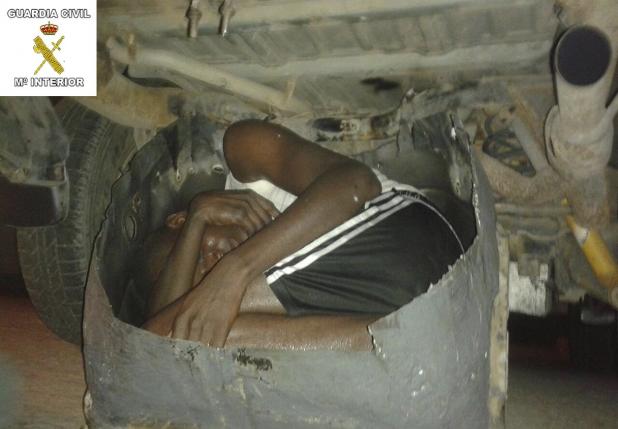
A young African man, who squeezed into tiny hidden compartment in a car to try to enter Spanish North African city of Melilla, is seen in this handout picture released by Spain's Interior Ministry August 14, 2015.


A young African man, who squeezed into tiny hidden compartment in a car to try to enter Spanish North African city of Melilla, is seen in this handout picture released by Spain's Interior Ministry August 14, 2015.
A young African man, who squeezed into tiny hidden compartment in a car to try to enter Spanish North African city of Melilla, is seen in this handout picture released by Spain’s Interior Ministry August 14, 2015.


Three young African men who squeezed into hidden compartments in a car to enter a Spanish territory in North Africa were found in critical condition by border police, the Spanish government said on Friday.

Photos released by the Interior Ministry showed one of the migrants curled up in the spare wheel well of the vehicle, which had been turned into a hidden compartment. Two others were found in another false bottom built into the car.

They could not stand and could barely breathe because of the cramped space, heat and exhaust gases, the ministry said. They recovered after being given emergency treatment.

The three – two from Guinea and one from Ivory Coast, aged from 18 to 25 – were found on Wednesday when border police at a crossing between Morocco and the Spanish enclave of Melilla grew suspicious and searched the car.

The 39-year-old Spanish driver of the car was arrested, accused of a “crime against the rights of foreign citizens”, the ministry said in a statement.

African migrants are taking increasingly desperate measures to try to reach Europe. Thousands have died making the voyage across the Mediterranean. Last week, a Moroccan man suffocated while being smuggled to Spain in a suitcase stowed in the boot of a car.


Stories Continues after ad

Powerful voices of the 1970s and 1980s long gone or silent: Part 4

Matia Kasaija

In 1980, Matia Kasaija was elected to Parliament, aged 36. Earlier, he had been the State Minister of Labour.  From 1981 until 1986, he served as a member of the External Wing of the National Resistance Movement/Army (NRM/A) and, between 1987 and 1990, he served as the Executive Director of the Departed Asians Property Custodian Board, a government parastatal that was charged with safeguarding the property expropriated from the Asians who were expelled by Idi Amin in 1972.

From 1998 he served as the Deputy Director for Mass Mobilization at the National Resistance Movement Secretariat. He was elected to the Eighth Parliament in 2006 and appointed Minister of State for Internal Affairs in June the same year. In the national elections of 2011, he was re-elected and appointed as the State Minister of Finance in charge of Planning.

And, in March this year Kasaija was appointed full finance minister replacing Maria Kiwanuka.

Matia Kasaija

Baguma Isoke

Baguma Isoke from Buyanja County, Kibaale district and was one time State Minister for Lands. He did a lot of lobbying for President Museveni in the volatile Bunyoro region especially Kibaale district where there are many absent landlords. He is currently a chairman of Uganda Land Commission.
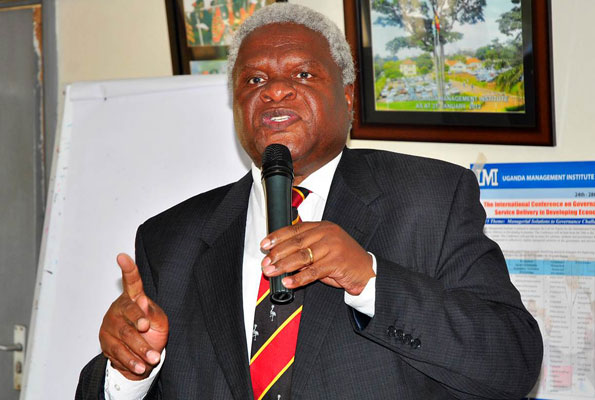
Brian Isoke

Prof Patrick Rubaihayo

Professor Patrick Rubaihayo was the Member of Parliament for Mbarara Central and the Minister of Agriculture and Fisheries during Milton Obote’s second regime, from 1980 to 1985.

Jack Sabiiti

Jack Sabiiti is an academic turned politician and he lectured at Makerere University between 1983 and 1985, and also worked as Under Secretary/Accounting Officer in the Ministry of Finance.

He joined national politics as Constituent Assembly Delegate for Rukiga County and in 2001 he joined Parliament representing Rukiga.

JackSabiti

Sabiiti once belonged to Museveni’s National Resistance Movement before joining the Parliamentary Advocacy Forum (PAFO), a group of Parliamentarians that attempted to form resistance against Museveni in 2004. It was later incorporated into Forum for Democratic Change and recently when the party held its delegates conference, Mr Sabiiti contested for the post of vice chairperson western region but was defeated by Francis Mwijukye.

Dr James Rwanyarare

He was a long time serving Chairman of the Uganda People’s Congress (UPC) Presidential Policy Commission.

He disagreed with Mrs Miria Obote after the demise of her husband Dr Apollo Milton Obote, and joined a UPC breakaway faction led by Patrick Rubaihayo, former UPC National Chairman. However the faction was suppressed and eventually Dr Rwanyarere went into retirement.


Dr Ezra Nkwasibwe

He hails from the Rukiga county of greater Kigezi and was health minister in the Obote II government, from 1980 to 1985.

ezra kwasibe

Nuwe Amanya Mushega

Nuwe Amanya Mushega is a law graduate of the University of Dar es Salaam, from where he left for Makerere University, becoming an Assistant Lecturer at the Faculty of Law. In 1974 he obtained a Masters and became a Lecturer in the Faculty of Law at the University of Zambia in Lusaka. He returned to Makerere University in 1979 as a Lecturer and continued in that capacity until 1981.

In the same year Mushega joined the National Resistance Movement/Army (NRM/A) of Yoweri Museveni where he rose to the post of National Political Commissar. He also served in various ministerial roles in the ministries of defence, local government, education, and public service. During that time, he also served as the Member of Parliament representing Igara East in Bushenyi District.

amanya1

In 2001, he was appointed by the EAC heads of state to serve a five-year term as Secretary General of the East African Community (EAC).He later disagreed with President Museveni over his continued stay in power and subsequently joined the Forum for Democratic Change(FDC). He was promoted to the rank of Colonel, and retired from the UPDF.

Augustine Ruzindana

Augustine Ruzindana holds a Bachelor of Commerce degree, obtained from University of East Africa, Nairobi. He also has a Diploma from Helsinki School Economics and has worked as a teacher, banker and political activist especially against the dictatorial regime of Amin since 1971.

ruzindana1

During the 1980s Ruzindana worked in Barclays Bank and Grindlays Bank, and later, from 1986 to 1996, served as Uganda’s first Inspector of Government. In 2001, Ruzindana became Member of Parliament for Ruhama county but fell out with the NRM  in 2005 and joined the newly formed Forum for Democratic Change.  He lost the Ruhama seat to Mrs Janet Kataha Museveni in 2006 and is currently in retirement. He however, runs a regular Column in the Daily Monitor newspaper.

Eriya Tukahirwa Kategaya

A lawyer and politician, Kategaya was part of Museveni’s Front for National Salvation (FRONASA), a group of Ugandan exiles in Tanzania who eventually helped topple Idi Amin in 1979. In 1980, he was one of the founder members of the Uganda Patriotic Movement, headed by Museveni.

When Museveni launched the guerrilla struggle against the Milton Obote II administration (1981 – 1985), Kategaya served in the ‘External Wing’ of the National Resistance Movement/Army (NRM/A). He was a honorary Brigadier of the National Resistance Army (NRA) from 1987 holding army number RO-002 although he never served in any military position as he was all the time serving in other high-ranking civil capacities that included being Deputy Prime Minister, National political Commissar and Minister at different times.

In 2003 Kategaya, then serving as Internal Affairs Minister, famously fell out with President Museveni when he opposed moves to have the Constitution amended to remove presidential term limits.

Eriya

And in May 2003, he was dropped from Cabinet, along with other ministers like Miria Matembe and Sarah Kiyingi, who had opposed the removal of term limits.

After he was sacked, in 2004 Kategeya joined the Forum for Democratic Change (FDC), while attending to his private law practice with JB Byamugisha Advocates.

After the 2006 elections Kategaya reconciled with Museveni and he was appointed to the posts of Deputy Prime Minister and Minister for East African Affairs.

RO 002 Kategaya died in March 2013 in Nairobi, where he had been hospitalized for a while.


Philimeon Mateke

Philemon Mateke was born in 1943 in Kisoro, and graduated from Makerere University with a Bachelor of Arts.

He later did a Masters and Doctorate at Makerere, specializing in history. He also worked as a Lecturer in the Department of History at Makerere University from the late 1960s until the late 1970s. During the Obote II regime, from 1980 until 1985, he served as the State Minister for Education. A member of the Uganda People’s Congress prior to 1986, he crossed to the National Resistance Movement (NRM), and served in the de facto parliament, the National Resistance Council, from 1989 to 1996. In the 2006 election, he was elected unopposed as the Chairman of Kisoro District Council (LC5). In 2011, at the end of his five year term, he retired, until he was named State Minister for Regional Affairs on March 1 this year.

One of his daughters, Sarah mateke, is the incumbent Woman MP for Kisoro.

Mateke

Prof George  Wilson Kanyeihamba

To many Ugandans George Wilson Kanyeihamba  needs no introduction; he holds a PhD in law from the University of Warwick. Prof Kanyeihamba participated in the 1970s anti-Amin activities, and has since 1980 served in various political positions, at different times, under different regimes.

However, in 1997 he was appointed to the Supreme Court bench, where he served for 12 years before retiring in November 2009.

A highly principled man, Prof Kanyeihamba was one of the three Supreme Court Justices who ruled that there were irregularities in the election of President Yoweri Kaguta Museveni in 2006. He also served at the African Court of Justice but lost his re-election bid, a development  analysts link to his decision regarding the 2006 election petition by Dr Kizza Besigye, challenging the victory of Museveni.

Kanyeihamba

Kanyeihamba has always had a love/hate relationship with the NRM government as he is always unpredictable in his judgment. At his retirement, he was the only Judge with a PhD in the country and is admired by many for his intellectual strength.

He is also the Chancellor of Kampala International University and Kabale University.


Justus Byagagaire

He was a Minister in Iddi Amin’s regime and in 1977 he was killed in Mbarara.

Festo Kivengere

Born 1919, Kivengere was an Anglican Bishop who played a significant role in a Christian revival in southwestern Uganda. He was one of the Christian leaders who were targeted by Amin’s brutal regime and fearing for his life, he fled to exile in 1973.

The author of I Love Idi Amin, Bishop Kivengere returned to Uganda after Amin’s downfall in 1979 and was to continue with active ministry until his death in 1988.

Festo Kivengere

One of his daughters, Hope Kivengere, at one time served as Presidential Press Secretary to President Museveni.

Stories Continues after ad

UCC releases list of the 2015 Uganda Film Festival nominees

Uganda hosted Nigerian actress Patience Ozokwor at the launch of the Uganda Film Festival 2014.

The Uganda Communications Commission has released a list of the 2015 nominees for the annual film festival awards.

A Uganda Film Festival Initiative (UFFI) awards jury set up by the Commission that comprises of film experts from all over Africa and Europe has completed the nomination exercise, with 16 actors and actresses making the cut.

The experts include: Mr Leonce Ngabo (Burundi), Ms Barbel Mauch (Germany), Sister Dominic Dipio (Uganda), Mr Faustin Misanvu (Uganda) and Mr Femi Odugbemi (Chair, Nigeria), while the actors are Jakirah Suudi, Michael Wawuyo, Ronnie Lugumba and Robert Kyagulanyi Ssentamu aka Bobi Wine. Others are Fausta Nanziri, Damalie Orishaba, Aaliyah Nanfuka, Rahmah Kadara, and Hellen Lukoma.

The nominees for Best Actor include  Hassan Mageye, Farooq Mutebi,Hassan ’Spike’ Isingoma, Alex Kakooza  and Ronnie Lugumba, while those for Best Actress are Nisha Kalema, Faridah Kuteesa Farsee, Deyby Wadsen and Fausta Nanziri.

The opening ceremony is slated for August 24, 2015 at the Kampala Serena Hotel and highly acclaimed screen writer and film producer Mr Michael Gozzard best known for films like Pride and owner of Pennlyn Productions in Los Angeles, will grace this years’ Festival as the main trainer.

Winners of the Uganda Film Festival Initiative will get a fully paid trip to an international film festival, a scholarship to attend a short film course and a set cash prize to help finance the producer’s next film project.

On behalf of UCC, the jury has announced the following as official nominations for awards in the following categories:

STUDENT FILM 

AFRICAN CHILD

THE THIEF

REVELATION

IF I COULD I WOULD

K-FREE

BEST SCREENPLAY

HOUSE ARREST

AKATTIRO – THE DEATH CORNER

CALL 122

THE BODA BODA THIEVES

THE TAILOR

SHORT FILMS

KYOSIGA’S DREAM

WALK WITH ME

IN REAUTY

A DOG STORY

MY LAND

BEST COSTUME

THE CURSE 1870

GALZ ABOUT TOWN

THE TAILOR

EVIL MOTHER

AKATTIRO – THE DEATH CORNER

ANIMATION    

DREAM UG 2050

MALARIA

SUPER HUMAN

CHINA BODA

BEST SOUND

HOUSE ARREST

THE BODA BODA THIEVES

THE TAILOR

HANGED FOR LOVE

DOCUMENTARY

BILALI’S STORY

KING OF THE ROAD

THE BIRTH

BODA BODA

HALF A DOLLAR

BEST CINEMATOGRAPHY

HOUSE ARREST

THE TAILOR

THE BODA BODA THIEVES

HANGED FOR LOVE

BEST SUPPORTING ACTOR

Jakirah Suudi (In House Arrest)

Michael Wawuyo (Boda Boda Thieves)

Ronnie Lugumba (Hanged For Love)

Robert Kyagulanyi Ssentamu aka Bobi Wine (Situka: Rise To the Plate)

BEST SUPPORTING ACTRESS

Fausta Nanziri (The Tailor)

Damalie Orishaba (Galz about Town)

Aaliyah Nanfuka (My Rising Sun)

Rahmah Kadara (Akattiro – The Death Corner)

Hellen Lukoma (Situka: Rise To the Plate)

BEST ACTOR

Hassan Mageye (The Tailor)

Farooq Mutebi (Call 112)

Hassan ’Spike’ Isingoma (The BodaBodaThieves)

Alex Kakooza (My Rising Sun)

Ronnie Lugumba (Hanged For Love)

BEST ACTRESS

Nisha Kalema  (The Tailor)

Faridah Kuteesa Farsee (House Arrest)

Deyby Wadsen (Hanged For Love)

Fausta Nanziri (Galz about Town)

BEST POST-PRODUCTION

THE BODA BODA THIEVES

HOUSE ARREST

AKATTIRO – THE DEATH CORNER

THE TAILOR

BEST FEATURE FILM

THE TAILOR

THE BODA BODA THIEVES

HOUSE ARREST

AKATTIRO – THE DEATH CORNER

CALL 112


Stories Continues after ad

Punish the ‘road works leeches’

Just as the country tries to come to terms with the saga involving the Mukono – Kyetume – Katosi road, we are again being treated to another scam, the Kawempe – Kafu road, which the Auditor General John Muwanga says was shoddily done.

Over the past few years the government has emphasized the issue of infrastructure development, injecting trillions of shillings in road construction.

This money was channeled through the Uganda National Roads Authority, the organization that is now under scrutiny by way of a Commission of Inquiry.

Indeed, there have been some disturbing monetary and procedural issues that have surfaced, enough to lend support to the earlier clean-up carried out by the new Executive Director Allen Kagina.

In the Kawempe – Kafu saga, the construction cost Shs250 billion, only for the AG to unearth some anomalies almost ten years after the works began.

Needless to mention therefore, most of the UNRA officials (former) who have appeared before the Commission have left a putrid trail, with obvious signs of mismanagement of road construction projects, abuse of office and corruption hanging in the room that houses the probe team; little wonder then that Justice Catherine Bamugemereire even ‘ditched’ her ‘judicial etiquette’ to lambast one witness who had called her ‘aunt’ during the proceedings.

It is such irritable actions by Ugandan public sector workers that has almost brought our economy to its knees.

And we don’t need to be reminded that the Ugandan economy is not doing so well partly because of infrastructural deficiencies including the bad road network that has made the transportation of goods nightmarish.

Lastly, it is imperative to know that good roads help ease transport, which in turn reduces the cost of doing business, leading to the provision of reliable and affordable goods and services, which are some of the key ingredients of social transformation.

So, those who take part in the shoddy road works deserve to be severely punished because they qualify for the title ‘economic saboteur’.

Case adjourned.

Stories Continues after ad
Powerful voices of the 1970s and 1980s long gone or silent: Part3

ENVOY: Former defence minister Dr. Crispus-Walter-Kiyonga


yoweri Museveni

Yoweri Kaguta Museveni

Yoweri Museveni was born in 1944 to Amos Kaguta and Esteri Kokundeka in the western District of Kiruhura, formerly Mbarara.

He attended Kyamate Elementary School, Mbarara High School, Ntare School and Dar es Salaam University, graduating with a degree in political science. In 1970, Museveni joined government during the Obote 1 regime.

When Major General Idi Amin seized power in the 1971 coup, Museveni fled to Tanzania and was later to participate in the war efforts that helped topple Amin in 1979.

In 1973, Museveni formed the Front for National Salvation (FRONASA) in 1973.

In 1980 Museveni stood for parliament and lost to Sam Kahamba Kutesa of the Democratic Party (DP).

After losing the elections, on February 6 Museveni led a group of 27 armed men to the jungles of Luwero, where they fought a five-year war that culminated in victory for the National Resistance Movement/Army (NRM/A) in January 1986, after the overthrow of General Tito Okello Lutwa, who had been in power for only six months. Museveni then formed a broad-based government that included different political actors but notably excluding the Uganda Peoples’ Congress (UPC) and functionaries who had served in the Idi Amin and Tito Okello Lutwa’s government.


Samson Kisekka

Samson Babi Mululu Kisekka

A politician and medical practitioner, Dr Samson Babi Mululu Kisekka was born in 1912.

He studied at King’s College Buddo and later joined Makerere University School of Medicine and became a doctor.

In life, Dr Kisekka was known as a hard-working statesman, an advocate of mixed farming, which activities covered horticulture and dairy farming. As a politician, he supported an end to ethnic tensions and a government without corruption.

He also played a big role in the anti-Obote activities carried out by the National Resistance Movement (NRM) External Wing, at one time acting as the outfit’s international spokesperson.

After the ouster of the Tito Okello Lutwa government in 1986, Dr Kisekka was appointed the Prime Minister of Uganda under the NRM government and he served in that capacity for 5 years. In 1991 he was appointed Vice President, serving in that office up to 1994, when he was made Senior Presidential Advisor.

He died at a hospital in London in 1999, aged 87 and was survived by a widow Mary Kisekka and children. His wife Mary passed on early this year.


Sam Kahamba Kutesa

Sam Kahamba Kutesa

Born in 1949, Sam Kahamba Kutesa hails from western Uganda and holds a degree of Bachelor of Laws obtained from Makerere University and a Diploma of Legal Practice obtained from Law Development Center (LDC).

In 1980, Kutesa was elected as Member of Member of Parliament (MP) for Mbarara North Constituency on the Democratic Party ticket, serving in that capacity up to 1985. He also served as Attorney General from 1985 to 1986, under the Tito Okello Lutwa government.

Between 1994 and 1995, he was the Constituent Assembly Delegate (CAD), participating in the drafting of the 1995 Uganda Constitution. He was elected MP for Mawogola County in 2001 and was re-elected in 2006 and 2011.

He was Minister of State for Investment from 2001 to 2005, moving to foreign affairs to date.

Currently, he is the Mawogola MP and a member of the ruling NRM.

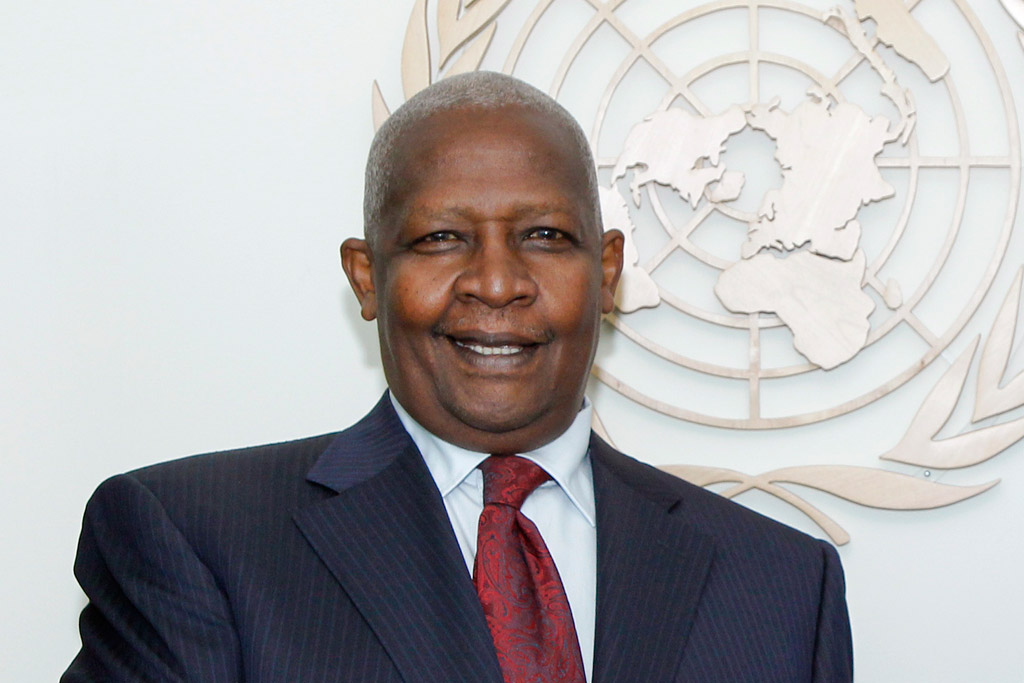
In 2014 when Africa was due to hold the presidency of thesixty ninth session of the United Nations Assembly, theAfrican Union Executive Council unanimously chose Kutesa to become the UNGA Chairman, a position he relinquishes in September this year.

In 2011 Kutesa was involved in controversy when he was accused in a parliamentary investigation of receiving kickbacks from Irish oil firm, Tullow Oil. There were calls by MPs for Kutesa to resign along with the other accused ministers/MPs, but a lawyer, Severino Twinobusingye, managed to successfully sue the Attorney General and halt the proceedings and to block the calls for resignation. He was eventually found to be innocent.

Strong family ties

In 2002 Kutesa lost his first wife Jennifer Nankunda Kutesa, a relative of Ugandan First lady Janet Kataha Museveni. Kutesa’s daughter Charlotte is married to first son brigadier Muhoozi Kainerugaba.

Crispus Walter Kiyonga

Crispus Walter Kiyonga

Dr Crispus Walter Kiyonga was born in western district of Kasese   in 1952.  He attended Nyakasura School andKings College Budo, joining Makerere University in 1973 for a degree, Bachelor of Medicine and Bachelor of Surgery (MBChB) in 1978. He also holds a Masters of Health sciences (MHS), obtained in 2004.

Kiyonga first came to the political limelight in 1980 when he was elected Member of Parliament for Bukonjo on the Uganda People’s Movement ticket, the only one to win a seat on the UPM platform.  He supported the National Resistance Movement (NRM), during their struggle against the second Milton Obote regime, from 1981 until 1986.

In 1986 when the NRM assumed power he became Minister of Cooperatives and Marketing. He has also worked as Minister at Finance, Internal Affairs, Health, President’s Office and Defence between 1986 and 2015.

Between 1992 and 1994, Kiyonga left the government temporarily to serve as a Consultant with the World Bank and the African Development Bank. He returned to active politics in 1994 when he was elected to the Constituent Assembly that made 1995 Constitution. He continues to represent his constituency, Bukonjo County West, in Parliament, a constituency he has continuously represented since 1980.


Stories Continues after ad
UCU, Uganda Martyrs among 12 African universities to teach new Masters Degree in public policy

Kenya's Chief Justice, Dr Willy Mutunga, officiated at the launch.


Kenya's Chief Justice,  Dr Willy Mutunga, officiated at the launch.
Kenya’s Chief Justice, Dr Willy Mutunga, officiated at the launch.


The course, the first of its kind in Africa, prepares students for careers in diverse fields

Nairobi-Kenya-Public policy practitioners and students in Africa now have a chance to study a specialised masters’ course offered in twelve universities, and uniquely designed to meet the continent’s needs, which was launched in Nairobi, Kenya today.

The Master of Research and Public Policy (MRPP) has been developed over the last three years through collaboration between the Partnership for African Social and Governance Research (PASGR) and 12 African universities.

The course, the first of its kind in Africa, prepares students for careers in diverse fields, including: government, universities, think tanks, research organisations, civil society organisations, media and development agencies.

The course content was developed by academics from the partner universities, with input from scholars from respected European public policy institutions.

It equips students to identify and address national developmental challenges and issues that affect people in their daily lives, such as security, management of natural resources, hunger, HIV/AIDS and women’s empowerment.

Students taking up the two-year full time course have a choice of two career pathways: Research and Policy Practice.

“The Research option familiarises students with the use of data to undertake policy research or pursue advanced scholarship, while Policy Practice equips students to use research to influence, inform or shape public policy,” said Prof Tade Akin Aina, the Executive Director of PASGR.

He added “MRPP is one of the key pillars of our community of practice and thought working together to build excellence in research, training and higher education for public policy in Africa”.

The launch event in Nairobi was presided over by Kenya’s Cabinet Secretary for the National Treasury, Mr Henry Rotich, and the Chief Justice, Dr Willy Mutunga. Other dignitaries at the event were: The deputy chair of the Education Committee in the Kenyan Parliament, Hon Julius Kibiwott Melly, vice chancellors and academics, and PASGR Board member Amb Prof.Judith Bahemuka.

It was also attended by students already enrolled in the programme, researchers and policy practitioners from NGOs, development partners and PASGR staff.

Speaking before officially launching the programme, Mr Rotich noted that effective public policy could only be a reality if the people in charge possessed a deep understanding of the challenges that face Africa, based on solid and credible research.

“Having seen the course content of this new programme, I have no doubt the MRPP will contribute towards efficient, effective and transparent public policy,” he said.  Drawing from his personal experience while beginning his postgraduate studies, Mr Rotich expressed his intent to lead a public service fellowships initiative through which students could seek funding to undertake the MRPP.

The programme has already been rolled out in eight universities where 150 have enrolled, with the first cohort set to graduate next year. It is being offered in Egerton and Maseno universities in Kenya; University of Dar es Salaam and Mzumbe in Tanzania; Jos, and Ibadan universities in Nigeria; and Ugandan Christian University and Uganda Martyrs University.
As he launched the programme, Kenyan Chief Justice Dr Willy Mutunga stated that research was key to identifying African interests, and that the continent’s interests should in turn inform Africa’s relations with the West.

Prof. Aina thanked the partnering universities for their diligence and contribution to the realisation of the programme.

“The MRPP is working, thanks to the efforts of everybody who has been there throughout the journey — my predecessor, the Steering Committee and PASGR colleagues,” he said.  “For us at PASGR, the MRPP is special as one of the key pathways to building the next generation of public policy leaders and researchers in Africa”.

Academics and students who spoke during the launch gave accolades to the new programme, observing that it was already transforming teaching and learning at the universities.

They were full of praise for the innovative pedagogy, which embraces interactive teaching approaches, such as simulations, debates, role-plays and project-based learning, field experience and case studies.

Founder universities

The twelve founder universities are:  University of Dar es Salaam, University of Ghana, University of Ibadan, University of Lagos, University of Jos, Egerton University, Maseno University, Mzumbe University, Uganda Christian University, Uganda Martyrs’ University, University of Sierra Leone and University of Botswana.

Course structure and delivery

The MRPP is a full-time two-year programme covered in four semesters, including field experience and thesis preparation.

The programme entails five courses in each of the two semesters during the first year. This is followed by a long break for field experience in a policy or research institution during which students refine research ideas and start data collection. In the second year, three courses are offered, while the rest of the time is devoted to thesis development.


About PASGR

The Partnership for African Social and Governance Research (PASGR) is an independent, non-partisan pan-African not-for-profit organisation established in 2011 and located in Nairobi, Kenya.  Currently engaged in more than 12 African countries, PASGR works to enhance research excellence in governance and public policy that contributes to the overall wellbeing of the citizens.

In partnership with individual academics and researchers, higher education institutions, research think tanks, civil society organisations, business and policy communities both in the region and internationally, PASGR supports the production and dissemination of policy relevant research; designs and delivers suites of short professional development courses for researchers and policy actors; and facilitates the development of collaborative higher education programmes.


Stories Continues after ad