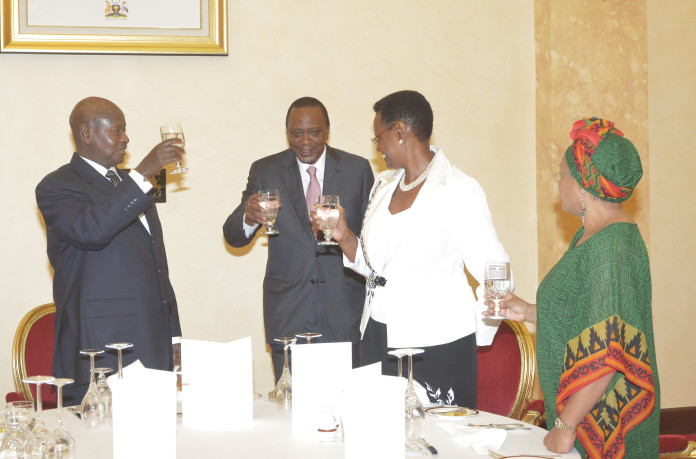
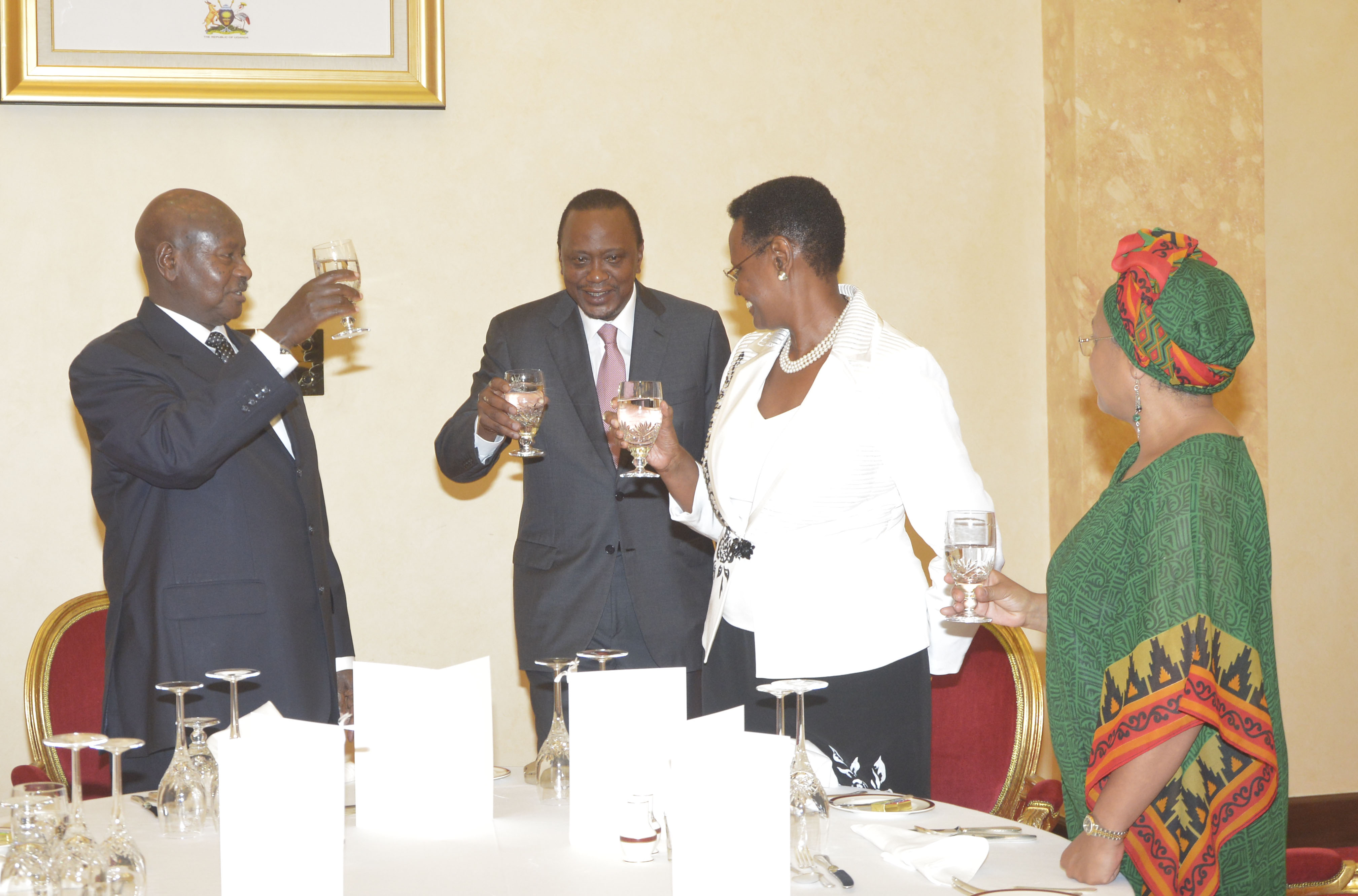
President Yoweri Museveni has warmly welcomed Kenya’s President Uhuru Kenyatta and his wife Margaret Kenyatta to Uganda, saying their visit will put more speed on what the two governments are doing to maximize the regions prosperity.
Museveni and his wife, Janet Museveni yesterday hosted their guests to a state dinner at State House, Entebbe. President Uhuru is in Uganda on a three day state visit at the invitation of President Museveni.
Museveni said Uganda has worked with Kenya, Tanzania, Rwanda, and Burundi to resurrect the idea of shared prosperity through the East African Cooperation. He commended the former Kenyan President Daniel Arap Moi for the idea of East African Community that is still maintained and that has expanded to include other countries in the region.
“When we talk about the East African cooperation, we are talking about shared prosperity,” he said.
He thanked Kenyatta for ensuring that clearing of container goods in transit from Mombasa to Kampala has now reduced to three days from 18 days.
“We are working together on modernizing the railway to make it faster. When our efforts are concluded, the containers will be here in one day,” he said.
He said because of challenges in the region the governments of Uganda and Kenya are working together to ensure security stability in Somalia and in South Sudan.
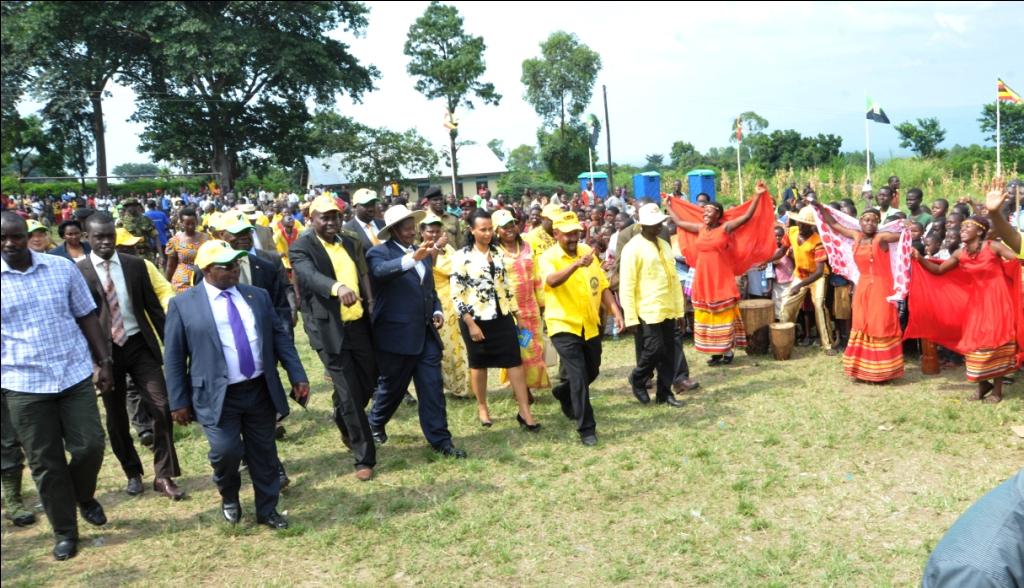
President Museveni and his guest President Uhuru arrive for dinner.
On his part, President Kenyatta said there can be no lasting prosperity in Kenya or Uganda if our brothers and sisters in the region do not share the same prosperity.
He said that Kenya and Uganda are making progress which they want to fast tract and make it as inclusive as possible adding, that is why they are here to see how they can share ideas, opportunities and resolve together the problems that they confront.
“We are safer and stronger when we are together. The boundaries that separate us are boundaries that were not created by us,” he said.
He said all their ambitions as leaders, is to see how they can tear away those boundaries and go back to the days when their people were working together and were common problems were shared and resolved.
President Kenyatta is accompanied by The Minister of Foreign Affairs and International Trade, Amb. Amina Mohamed, Cabinet Secretary Henry Rotich (National Treasury); Minister for Defence Raychelle Omamo; and the Minister of Health James Macharia.
Today, President Kenyatta will tour the Quality Chemical Industries in Luzira and later address the Ugandan business community and Kenya’s diaspora.
Today Monday, President Uhuru will address Uganda’s Parliament and later hold a joint press conference with his host.
President Kenyatta, President Museveni, President Omar Bashir of Sudan and Ethiopian Prime Minister Hailemariam Desalegn will meet under the auspices of IGAD to discuss the latest developments in South Sudan.
The Kenyan government has given money-transfer and remittance company Dahabshiil a clean bill of health.
Issued in the Kenya Gazette, Dahabshiil Kenya has officially been removed from the government’s list, published earlier this year, of people and businesses who were to be investigated in order to ensure they had no links to terrorist groups or activities.
According to a release by the Africa Press Organisation (APO), the Cabinet Secretary for the Interior and the Co-ordination of National Government Joseph Ole Nkaissery confirmed that Dahabshiil Kenya has shown cause why it should not be listed as a specified entity, as it abides by all stipulated conditions for licensed remittance providers active in Kenya.
‘The authorities have now completed a comprehensive review of Dahabshiil Kenya’s operations, policies and practices. They are satisfied that the company complies fully with the law, and operates strict anti-money laundering and counter-terrorism financing practices,’ the release states.
“The formal delisting absolutely clears Dahabshiil Kenya of any wrongdoing. The Kenyan authorities are fully satisfied that Dahabshiil Kenya has noinvolvement whatsoever with the funding of terrorist organisations and complies fully with all international regulations and industry best practice.
“The Dahabshiil network operates in 126 countries, including Kenya, the UK and the USA, and we respect and comply with the laws of each and every country. Our services provide a vital lifeline for people to feed, educate and otherwise help their families and loved ones, and to run businesses, thus creating jobs,” the Chief Executive Officer of Dahabshiil Group, Abdirashid Duale, said.
The delisting follows the Central Bank of Kenya’s move to lift the suspension on Dahabshiil Kenya in June after it had suspended the operations of all licensed remittance providers on April 7, 2015.
According to the release Dahabshiil makes significant contributions to the Kenyan economy; it helps create hundreds of thousands of jobs, either by providing direct employment, or by enabling the transfer of investment funds, which creates more jobs, and further helps reduce poverty.
Dahabshiil also supports communities in the countries it serves, including Kenya and it invests 10% of its profits in humanitarian and community regeneration projects, including building schools, hospitals, and providing safe drinking water, the release adds.
Former British Wimbledon champion Andy Murray’s wife Kim Sears is expecting, with close friends and family said to be privy to the information.
Murray and Sears are expecting the baby to arrive in February and it is assumed that Kim, 27, has recently had her 12-week scan, with the baby due in February, The Sun reported Friday.
Murray and Sears married in April this year and currently live in Surrey with their two dogs. They were engaged in November last year and have been in a long-term relationship for a decade.
The 28-year-old joins fellow superstars Roger Federer and Novak Djokovic, who are also married with young children. Federer famously has two sets of twins with wife Mirka, while Djokovic and Jelena Ristic welcomed their son Stefan into the world last November.
The world’s third ranked tennis star also broke the news to firmly star mum Judy fairly months after she was dreaming of being very active granny.
Sources further revealed that 55 year old tennis coach and Andy’s brother Jamie married to Venezuelan actress Alejandra Gutierrez are delighted.
Murray fans were speedy to congratulate the couple after news of the pregnancy was reported, tweeting him their best wishes.
I have been told that the Fort Portal – Kasese road is in that poor state because it was poorly done due to corruption and we have to reconstruct it after such a short time. This is unacceptable,” he said.
President Yoweri Museveni has expressed concern at the high level of corruption in the works ministry especially the road sector. He said that road contractors collude with government officials and then do shoddy work without sanction.
The President who was on a one day working visit in Kasese to promote the wealth creation campaign made the remarks yesterday at a public rally at Kyarumba sub-county headquarters in Bukonjo East county.
He said shoddy works have led to most of the roads being worn out before their expected life span, noting that as a result of corruption, the country did not get value for the trillions injected in thre raod sector as contractors continuously colluded with government officials to do shoddy work..
“I have been told that the Fort Portal – Kasese road is in that poor state because it was poorly done due to corruption and we have to reconstruct it after such a short time. This is unacceptable,” he said.
The President said he appointed a strict woman, Allen Kagina, to head Uganda National Roads Authority and that she asked him to appoint a judicial commission of inquiry which he did to bring the culprits to book.
“What is important for people to know is that whoever ate government money will have to pay it back on top of being punished in accordance with the law,” he said.
The President said that government has allocated 6.6 million shillings for the construction of a new and permanent bridge on River Nyamwamba which was washed away by the recent floods in the area.
He said the National Resistance Movement government has registered success in several sectors because of cohesive and strategic planning that prioritizes the most important sectors of the economy such as peace, roads, energy and human resource development.
“Many people have advocated for salary increase at the expense of infrastructure development but we had to be firm and resist the pressures because infrastructure developments have long term benefits to the economy,” he said.
The President assured Ugandans that their security is guaranteed because of the support offered by the citizens to the UPDF.
“I want to thank Ugandans for supporting the UPDF because you are the source of our army’s strength and I can assure you national peace is guaranteed,” he noted.
On education; the President said that due to different interventions and programmes, the national literacy rate is now at 78% and added that government had embarked on a programme of skilling Ugandans so as to create jobs.
Speaking about health service delivery, the President said that government was immunizing all children against 13 diseases including survival cancer and hepatitis B but warned the population against promiscuity that has seen a rise in new HIV/Aids infections.
“As citizens your duty is to safeguard your lives, work to get out of poverty, promote peace and safeguard that peace by voting wisely and voting NRM that will guarantee that peace,” he said.
He noted that to overcome poverty Ugandans especially in rural areas needed to engage in modern agro production, adding that the reason UPDF officers were sent to all constituencies of Uganda was to supervise the wealth creation programme.
President Yoweri Museveni has said that the National Resistance Movement (NRM) government has successfully ensured peace and security around the country.
He said government has also accomplished the construction of several tarmac roads including the one from Malaba at the Kenyan border to Lamia at the Congo border and urged Ugandans to exploit the infrastructure for income generation and poverty eradication.
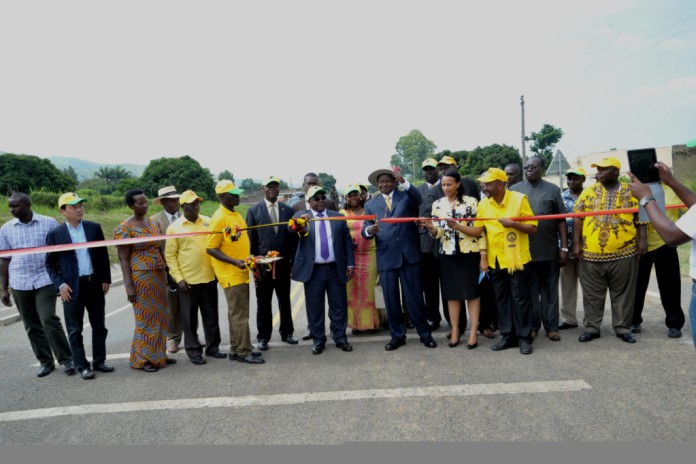
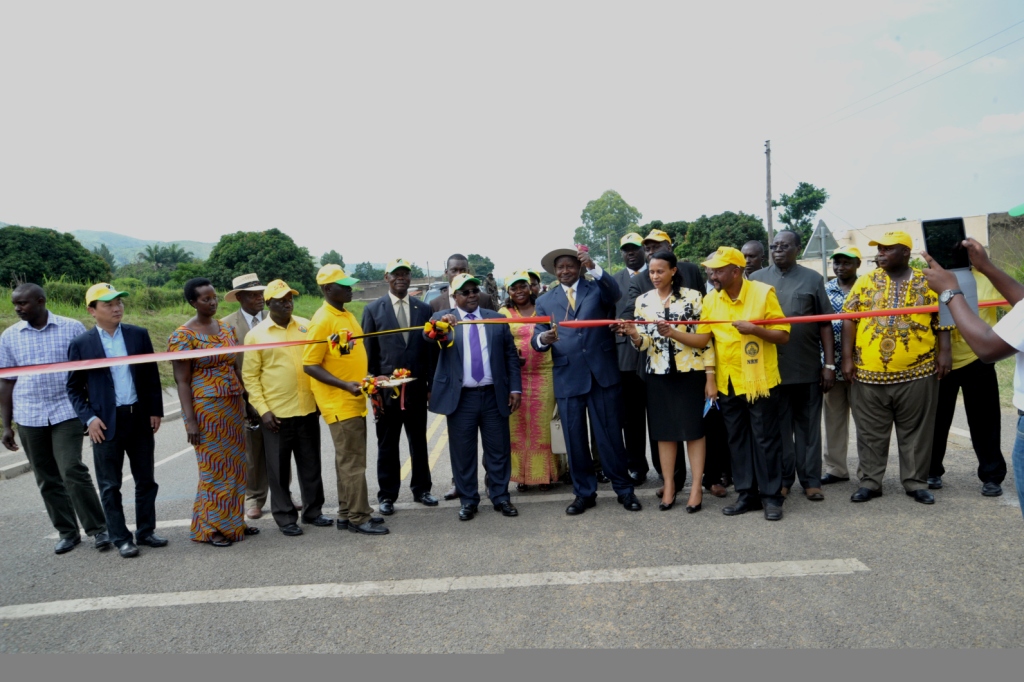
Museveni was yesterday speaking at the ceremony of commissioning the 104km Fort Portal – Bundibugyo – Lamia road, constructed at Shs226 billion, funded jointly by the Africa Development Bank (ADB) and the government of Uganda.
President Museveni also said the UPDF had defeated the Allied Democratic Forces (ADF) who later fled to the Democratic Republic Congo where they have caused mayhem.
Further, he said government had provided improved health services and ensured a successful immunization programme, adding that several schools had also been built in Ntoroko and Bundibugyo districts, enabling children to go to school.
“We have developed the infrastructure, improved health and education among other things. You, the wanainchi have three duties to fulfill; eradication of poverty from your homes, caring for your health and voting for NRM,” he said and urged Ugandans to engage in commercial agricultural production for improved incomes.
On empowering the youth, the President said that Government’s plan is to provide skills that create employment and wealth.
The Executive Director of Uganda National Roads Authority Allen Kagina appealed to local leaders and the community to protect road assets, saying newly installed road signs are being vandalized thereby endangering motorists.
Ntoroko Woman MP Jennifer Mujungu, saluted President Museveni for the building of Fort Portal – Bundibugyo road assured him of support as the sole presidential candidate for NRM in the 2016 General Elections.
Jinja-based Premier League side Sadolin Paints football club has named Simon Kirumira as its new head coach.
Kirumira’s appointment comes after Federation of Uganda Football Association wrote to Sadolin Paints, requesting to be availed with details of Dutch coach Van De Walt whose credentials for the post were reportedly lower than those approved by the governing body, FUFA.
Kirumira holds a Confederation of African Football (CAF) coaching licence and takes charge of the club, reportedly after a series of successful negotiations between the coach and the club management.
“We have debated all the fundamentals and coach Kirumira has settled for a two year contract. He will be supported by two people, Samadu Musafiri and Van De Walt as he awaits his copies from a coaching course he is undertaking in Europe,” said Sadolin Paints Chief Executive Officer (CEO) Saidi Kakuuku
During the previous season Sadolin Paints finished in 12th position with 37 points.
Museveni later commissioned a government funded six classroom block and a library at Bwera Secondary School.
Museveni later commissioned a government funded six classroom block and a library at Bwera Secondary School.
An integrated Africa will ensure a bigger market for Uganda’s produce and make the African continent and its people prosperous,
President Yoweri Museveni has said
“The government has already addressed most of the challenges including infrastructure development, health and education. We need to engage in commercial agriculture to improve incomes. The remaining challenge is integration of Africa. We have already moved forward with Kenya, Tanzania, Uganda, Rwanda and Burundi and we are now one market,” Museveni said yesterday while addressing Kasese residents at Bwera Secondary School, Bwera subcounty in Kasese.
The President, who was on a one day working tour to promote operation wealth creation, urged the people of Kasese to engage in modern agro production for food security and improved incomes.
He noted that with integration of Africa the issue of markets for our products will be sorted adding that South Sudan had already applied to join the EAC while the Democratic Republic of Congo may join for the region to enjoy a wider market. He stressed the need for the common market saying that without it the country would be stuck with surplus produce especially milk and fruits among others.
On youth unemployment, Museveni said government will now focus on skills development by increasing the number of technical schools at the sub county level. He said graduates will be empowered with job creation skills to improve their incomes and cautioned them against reckless lifestyles.
Museveni later commissioned a government funded six classroom block and a library at Bwera Secondary School.
The Defense Minister Dr Crispus Kiyonga commended the President and the government for the development programmes that have transformed the region.
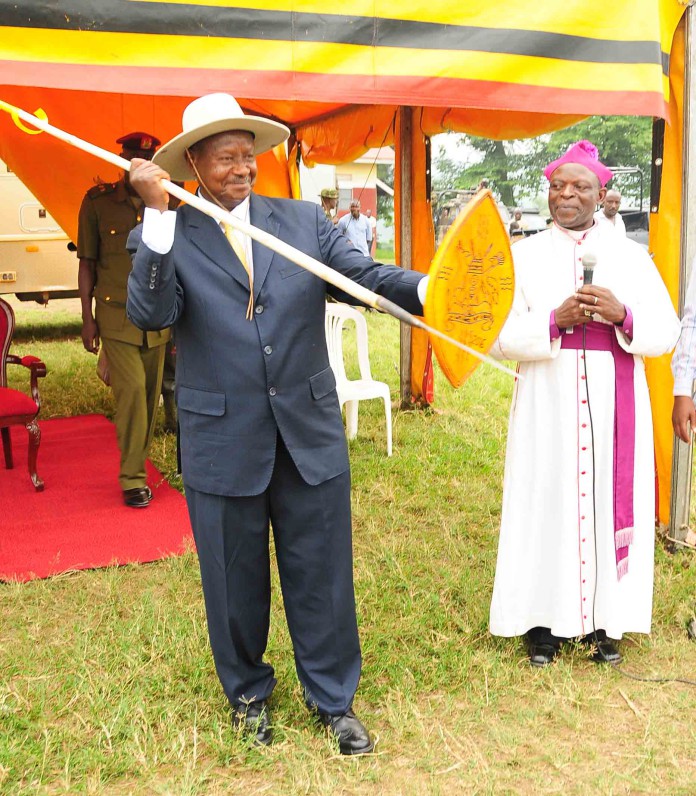
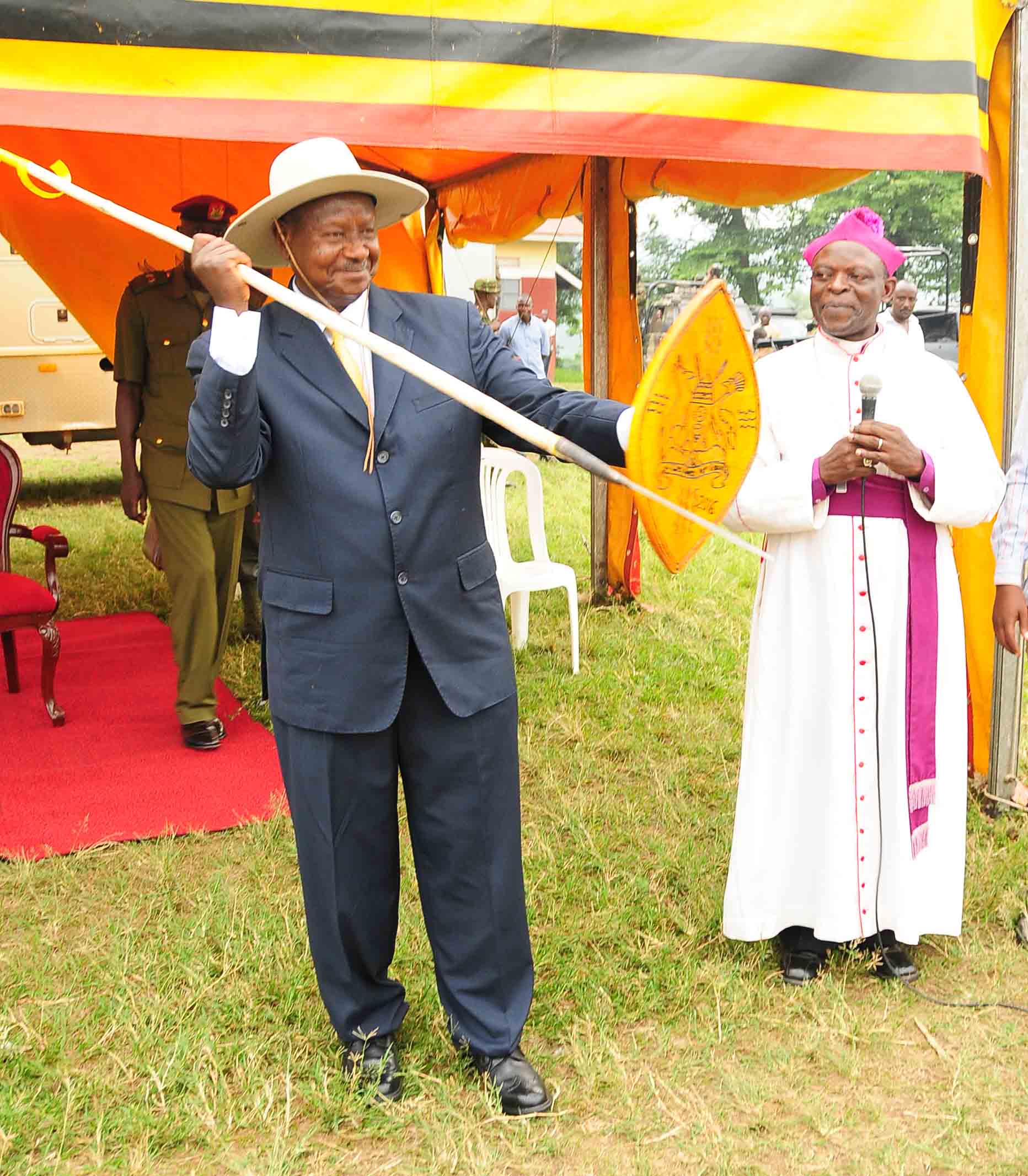
The Bishop of South Rwenzori Diocese Jackson Nzerebende Tendo presented a spear and shield to the President as a sign of defense and protection for the country.
By last week some schools had started sending pupils and students home, one week ahead of the official closing date set by the Ministry of Education and Sports.
According to the Ministry of Education of and Sports calendar, children are supposed to be at school for a period of about ninety days. It is, therefore, unfair for some schools to cut short the term and send children home a week before the date set by government.
Indeed, this is not only unfair to the pupils and students but also to the parents and guardians. For the pupils and students it affects them in a way that they may not be able to complete covering what is supposed to be handled in a given term. For the parents and guardians, there is no value for the money they pay in terms of fees since the services that their children pay for are cut short.
It seems the schools which are in the habit of doing this aim at saving the money that they should have otherwise spent in terms of feeding, electricity, water, stationery, medical bills and other costs while the children are at school.
So, in order to curb this behavior, the Ministry of Education and Sports officials should act very fast to rectigy the anomaly and Inspectors of Schools must ensure that they visit schools to ensure that school activities carry on up to the very last day of closure set by government.
The excuse by school directors and headmasters that when children finish examinations, they can be sent home and then return later to collect report cards is a lame one and unacceptable. Not only is it inconveniencing to the children but also an extra cost to the parents.
There must be a standard date for all the schools in the country to begin and close and serve the children with assessment report cards.
This would lead to uniformity among different schools all over the country because at the end of the day the pupils and students sit for the same national examinations
The only man to rule for two mandates at different times
The only man to rule for two mandates at different times
As a country, Uganda’s political life dates back to 1900 when Sir Henry Hamilton (Harry) Johnston signed the Buganda Agreement in 1900. Since then Uganda, which was christened the ‘Pearl of Africa’ by former British Prime Minister Sir Winston Churchill, has had several political figures who have in one way or the other played a role in shaping the destiny of one of the world’s most tumultuous countries.
In four-narration series the Eagleonline brings you ‘Voices that are gone or are totally silent if still alive’, beginning with the 1960s.
Edward Muteesa II
Edward Frederick William David Walugembe Mutebi Luwangula Mutesa was born on 19 November 1924, the fifth son of Kabaka Daudi Chwa. He studied at Kings College Budo and ascended the throne in 1939, when he was 15. In 1953, Mutesa was deposed and exiled in the United Kingdom, where he stayed until 1955.
Mutesa was to become the first President
of Independent Uganda in 1962, with Apollo Milton Obote as his Prime Minister. The two were later to fall out in what is today called the Mengo Crisis of 1966. Later Obote abrogated the Constitution in 1967 and abolished monarchies in Uganda.
He died in exile in 1969 and President Iddi Amin ordered for the return of his remains. Kabaka Mutesa is survived by several children among them the current Kabaka Ronald Muwenda Mutebi and Prince David Wassajja.
Dr. Apollo Milton Obote
The son of a tribal chief of the Lango ethnic group, Milton Obote was born in Akokoro village in Apac District in 1925.
He went to Busoga College Mwiri, where he was admonished and sent home for wearing brown shoes yet native students were supposed to wear black shoes.
Stubborn and rebellious to the hilt, Obote was expelled from Makerere University College. After the suspension, Obote was to return with a pair ofLugabire (sandals made out of old tyres), claiming his father had ‘used all his money to buy the pair of brown shoes’ he had earlier brought to school.
He was ‘pardoned’ and completed secondary school at Mwiri, after which he joined Makerere University College, where he also led a strike (over ‘bad’ food) that brought his educational journey to an end.
He then settled full time for politics, becoming Executive Prime Minister in 1962. In 1963 Uganda became a Republic and in 1966 Obote attacked the Lubiri, the seat of Buganda Kingdom, forcing Kabaka Mutesa II to flee to exile in the UK. He later abolished the kingdoms and in 1967 he abrogated the Constitution.
In 1969, there was an attempt on Obote’s life and a state of emergency was declared in the country. Then, in January 1971, Obote was overthrown by the army while he was in Singapore to attend the Commonwealth Conference, and Amin became President.
The only man to rule for two mandates at different times, Obote made a comeback in 1980 and ‘won’ elections under the banner of the Uganda People’s Congress (UPC). However, his second stint as president was marred by accusations of military brutality, after current president Yoweri Museveni and other militants like Andrew Kayira of Uganda Freedom Movement (UFM), Fred Nkwanga of the Freedom and Democratic Movement of Uganda (FEDEMU) Gen Moses Ali of Uganda National Rescue Front (UNRF) ‘went to the bush’ to fight his government. But it wasn’t the militants who overthrew his second regime; rebellious soldiers of the Uganda National Liberation Army (UNLA) led by then Brigadier Bazilio Olara Okello ousted the UPC government on July 27, 1985. Subsequently, Obote fled to exile in Zambia and later died in a South African hospital in October 2005, aged 79.
Obote is survived by a widow, Miria Kalule Obote (sister to former minister Lawrence Kalule Settala) and five children including current UPC President Jimmy Akena.
Grace Ibingira
Born on May 23, 1932 in Ibanda, Ankole, Grace Ibingira studied at Mbarara High School [1942-1950], King’s College Budo, [1951-1953],University of Wales [1955 – 1958] and the University of London. He was a member the Legislative Council in 1960 and was re-elected MP for Ankole West in 1962.
A founding member of the Uganda Peoples Congress (UPC) Ibingira designed Uganda’s national flag.
He was the Minister of Justice [1962-1966], Minister of State in the Prime Minister’s Office in charge of Public Service [1964-1966] and Secretary-General of UPC [1964-1966]. A one-time close political ally of Prime Minister/President Dr Apollo Milton Obote, Ibingira fell out with his boss and was imprisoned in 1966 together with among other ministers Balaki Kirya, Dr Emmanuel B Lumu and Mathias Ngobi.
When Obote was overthrown by Amin, Ibingira was named the Permanent Representative to the UN, where he served from August 1971 to 1974. He was a key political player in Uganda politics in the 1960s and was a close ally to Milton Obote. He died in the late 80s.
Al Hajji Ali Akbar Adoko Nekyon
A cousin to former President Apollo Milton Obote, Ali Akbar Adoko Nekyon was born in 1931. He has witnessed a number governments come and go. A lawyer, Adoko Nekyon Member of Parliament for Lango South East, and also served in Milton Obote’s post-Independence cabinet as Minister Information and Broadcasting between 1962 and 1967.
During Amin’s time Nekyon fled to the United Kingdom, where he practiced law.
In the 1980s he briefly returned to the country but was to go back in exile in the UK where he died of cancer in.
Brigadier Shaban Opolot
Born in Namausi Nakaloke, Shaban Opolot joined the army in 1945 under the Kings African Rifles (KAR), rising through the ranks to become the first army commander of the Uganda Army, appointed to the post in 1964.
He fell out with Obote over the differences the latter had with Kabaka Edward Mutesa, and in October 1966 Opolot was dismissed from the army and detained under the emergency regulations.
Joshua Luyimbazi Zake
The Masaka Central Member of Parliament in the Legislative Assembly, Joshua Luyimbazi Zake was the first Minister of Education in 1962.
Dr. Emmanuel Lumu
A Member of Parliament for Kyadondo North, Dr Emmanuel Lumu served as Minister for Health in the first post-independence government.
Lawrence Kalule Settala
Kalule Settala was the Member of Parliament representing Mengo South East and was appointed Minister for Works and Labour in the first post-Independence cabinet. A brother-in-law to Dr Obote, Kalule Settala at one time also worked as Minister of Finance and as Minister for Local Government.
John W Lwamafa
Born in Kigezi John Lwamafa was a Minister in the first post-Independence government.
Cuthbert Obwangor.
He was Member of Parliament for Teso East and Minister for Regional Administration in the first post-Independence government.
Mathias M. Ngobi
The first minister of Agriculture and Cooperatives, Mathiuas Ngobi was also the Member of Parliament for Busoga South. He later fell out with Obote and was imprisoned in Luzira from 1966 t0 1971 when Amin took power.
Wilberforce Wilberforce Nadiope
Sir William Wilberforce Nadiope was Kyabazinga of Busoga at the time of independence and the first Vice President of Uganda (1963-1966). His grandson is the current Kyabazinga William Wilberforce Kadhumbula Gabula Nadiope IV.
Basil Bataringaya
His political journey started when he served as the Guild President of Makerere Univerity College from 1955 to 1956. He was Democratic Party Member of Parliament for Ankole District. But after falling out with then DP boss Benedicto Kiwanuka, Bataringaya switched sides and Obote appointed him to serve as the Minister Local Government in the first post-Independence cabinet. After the overthrow of Obote in 1971 Bataringaya retreated to his village in Igara County, Bushenyi district. At the age of 42. he met his death at the hands of Amin’s soldiers on September 18, 1972.
AL Hajji Abubaker Kakyama Mayanja
‘A man of all seasons’ is the phrase that best describes Abu Mayanja. While still a student at Makerere University College, Mayanja became the first Secretary General of Uganda National Congress, a political organization formed by Ignatius Kangave Musazi. Because of his political activities, Mayanja was expelled from Makerere in 1952. At the behest of Kabaka Mutesa II, Mayanja later joined Cambridge University where he read History.
The first Ugandan Muslim to get a degree, Mayanja later enrolled for a law course from 1955 to 1957 at the Honourable Society of Lincoln’s Inn.
He later went to the United States of America on a Leadership grant and returned to Uganda in February 1960.
In 1961 Mayanja was appointed a Minister of Education in the Buganda government and also participated in the Lancaster House Conference in London prior to Uganda’s independence from Britain on October 9, 1962. Abu Mayanja is the only known politician who served in all post-Independence governments. He died in November 2005 aged 76.
Ben Kiwanuka
He was elected President General of the Democratic Party in 1958, and organized the party to win majority votes in 1961 legislative elections, making him the first Chief Minister in the Uganda.
However, in March 1962 DP lost elections to an alliance of Obote’s UPC and Buganda’s Kabaka Yekka.
Benedicto Kiwanuka was imprisoned by Obote’s government in 1969, but was one of 55 political detainees released by Amin immediately after the 1971 coup. Later Amin appointed him as the first Ugandan Chief Justice in June 1971. The two fell out and Kiwanuka was killed in 1972, after soldiers dragged him out of his chambers at the High Court in Kampala.
Boniface Byanyima
Mzee Boniface Byanyima hails from the western district of Mbarara and unitl a few years ago was the National Chairman of the Democratic Party. He is father in law to Forum for Democratic Change former president Dr Warren Kiiza Besigye Kifefe, husband to fiery politician and international civil servant Winnie Karagwa Byanyima. Said to be in his 90s, Mzee Byanyima stays at his country home in Ruti, Mbarara.
Daudi Ochieng
Born in 1925, Daudi Ochieng belonged to the Acholi ethnic group. His father Rwot Lacito sent him to King’s College Budo, and later on attained a Bachelors degree in Agriculture from Aberyswyth University. He was a close friend to Kabaka Mutesa II and one of the architects of the alliance between Kabaka Yekka and the UPC, the alliance that formed the first government after independence in 1962. As MP, Ochieng pinned both Obote and then Army Commander Idi Amin for stealing minerals from the Congo, something that put him at loggerheads with Obote and Amin. He died in June 1966 at the age of 41.
Felix Kenyi Onama
He was appointed as Minister of Works and Labour in the first post-independence government. He also served as Minister of Defense in the Obote I government.
John K Babiiha,
He hailed from from the Western District of Kabarole and was specially elected Member of Parliament. He was Minister for Animal Industry and Fisheries and later served as Vice president in the Obote I government from 1967 to 1971 when Amin captured power. He died in 1982 and was buried at his home in Kibimba village in Fort Portal. Alex Ojera
He was Minister for Infromation and Broadcasting during the Obote I government, and was killed by Amin’s soldiers in 1972.
Balaki Kebba Kirya
Kirya was born in 1924 in Petete in Bukedi currently Palisa district. He served as a soldier in the King’s African Rifles (KAR) before joining politics under the Uganda National Congress, where he was in charge of the Mbale branch. Kirya, one time an MP representing Bukedi, was also one of the architects of the UPC/Kabaka Yekka Alliance and was rewarded with the cabinet post of Minister without Portfolio immediately after Independence. Two years later Obote appointed him Minister for Water and Mineral Resources but the two were to fall out, with Kirya later being arrested and detained in Luzira prison without trial.
In 1971 he when Amin came to power, Kiirya was released but fled to exile in Kenya when Amin started killing some of Obote’s former ministers.
Unfortunate for Kirya, he was abducted from exile in 1982, and Obote again imprisoned him on allegations of involvement in rebel activities. He was charged with treason and was in prison until the Okellos captured power in July 1985
And when Museveni and his National Resistance Army (NRA) captured power in January 1986, Kirya was appointed security minister in the Office of the President in March 1986. He died in the mid 90s was buried in his home village.
The Port Management Association of Eastern and Southern Africa (PMAESA) and the African Media Initiative [AMI] have agreed to work together to raise awareness on the maritime economy through media related activities.
The agreement was made following a visit by PMAESA Secretary General Ms Nozipho Mdawe and Head of Communications Mr George Sunguh to the AMI headquarters in Nairobi.
The PMAESA delegation met the AMI management team including Mr Eric Chinje, Chief Executive Officer; Mr Wangethi Mwangi, Senior Adviser and Mr Meredith Beal, Technology Advisor.
The meeting discussed possible areas of synergy between the two organizations in raising the profile of the maritime economy and related activities on the continent.
‘Knowledge of the sector remains extremely low in Africa and the dissemination of information on the maritime sector has been a challenge as few journalists understand the sector’ a release by PMAESA states in part.
AMI CEO Chinje noted that the maritime sector would create jobs for Africans and also enhance international trade.
“The public needs to be informed about opportunities that abound in the Blue Economy and about harnessing the potential of Africa’s seas and oceans,” the release adds.
During the meeting Ms Mdawe informed the AMI team of the forthcoming PMAESA annual conference to be held between 15th and 19th November in Dar es Salaam, Tanzania, to discuss ‘Port Strategies for Harnessing the African Blue Economy and Investment Options’.
She said the blue economy could be the next frontier to help alleviate poverty in Africa if properly harnessed.
PMAESA is an intergovernmental agency founded by the United Nations Economic Commission (UNECA) in 1973 to harmonize seaport and maritime activities in 21 countries within the Eastern and Southern Africa and is headquartered in Mombasa, Kenya.
The member countries include: Angola, Burundi, Comoros, Djibouti, Ethiopia, Eritrea, Kenya, Madagascar, Malawi, Mozambique and Mauritius.
Others are Namibia, Reunion, Rwanda, Seychelles, South Africa, Sudan, South Sudan, Tanzania, Zambia and Zimbabwe.
AMI on the other hand is a pan African effort aimed at providing the continent’s private and independent media owners and practitioners with the tools they need to play an effective role in their societies. AMI was founded after a research done under the auspices of BBC World Service Trust and UNECA and is included in the 2005 G8 Gleneagles and Commission for Africa recommendations.