Veteran Golfer Kabuye will look to reclaim his title
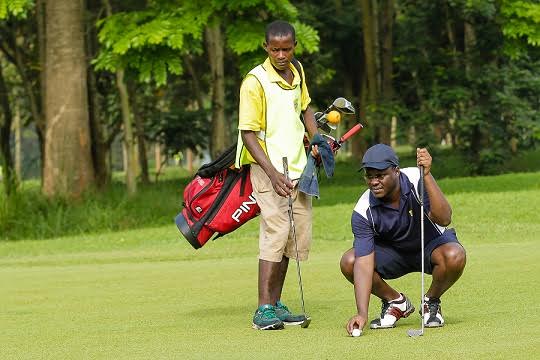
Veteran Golfer Kabuye will look to reclaim his title (courtesy photo)
Strong field of golfers are expected to tee off for the 2-day 2015 Tororo Cement Golf Open edition this weekend.
Golfers from all over golf-clubs in the country and guests from Kenya (Mumias, Kakamega, Eldoret and Kitale in Western Kenya) will battle the course in Eastern Uganda at the par 72, 9-hole picturesque course.
Scratch golfer, Gerald Kabuye easily over came a strong field of over 80 golfers returned the best gross score of 149 (145 nett) over the 2 day tourney to take the overall prize last year.
The Annual event that is organised by Tororo Club and is sponsored by Tororo Cement with the professional players expected to play in the two day tournament with 5 million shillings as they kitty for the event.
Dennis Angugo carded an amazing score of 147 to top the other 14 professionals that included Kenyan top professional, Dismas Ndiza.
The ladies’ category, Lugazi golf clubs’ Ritah Mukasine will look to defend her crown, last year she returned a total gross score of 185 over 36 holes to emerge winner for the overall prize.
It will be a perfect build up for golfers from various regions in the country ahead of the much anticipated Castle Lite Inter Region golf tournament that will be held at the par 71 Entebbe Club in Entebbe next weekend.
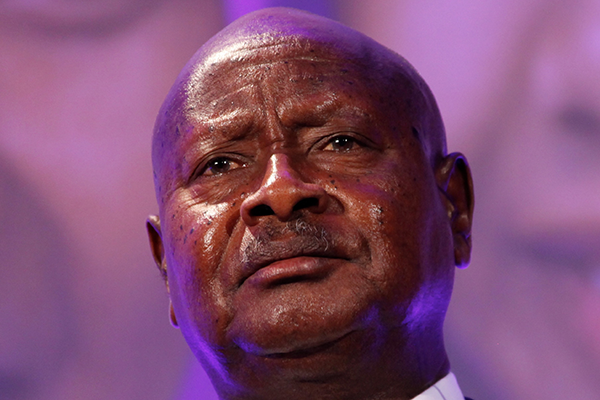
Kampala-Government will not privatize Uganda Development Bank but will instead capitalize it to give lower loan interest rates to Ugandans, President Yoweri Museveni has said.
“UDB will not be privatized, will instead be capitalized for development. We have already put money in UDB and we shall put more money Shs500 billion in 2017 so that bank can lend to farmers, manufacturers at interest rate of 5 percent.” Mr Museveni at the State of the Nation address.
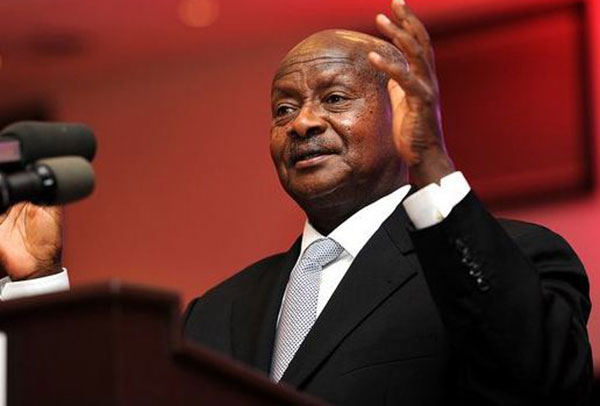
Museveni was giving his State of Nation Address at the opening of the 5th session of Parliament at Serena Hotel Conference Centre in Kampala.
Museveni said the country has been able to sustain itself since 2006 because the National Resistance Movement (NRM) government has prioritized among priorities.
Infrastructure
“We have boosted the Ministry of Works from Shs374 billion to Shs3328 billion today by denying ourselves elsewhere and put it here. By concentrating on Ministry of Works, you can see the results. I enjoy driving comfortably sleeping. I was only disturbed between Nebbi and Pakwarch.”He said
Adding “I need an inquiry and I have put a young lady and whoever ate that money has to explain.”
“The road between Tororo and Mbale and Soroti had become a problem but the other day I was there I just had to sleep. The other day I was in Kisoro and you saw what we have done.” he said noting that this was a decision the NRM took in 2006 and Ugandans are now seeing the benefits.
The President said when all power generation projects are complete; the country will have a capacity of 4360 mega watts of electricity. He however noted that there “small” mistakes that were done in the Energy sector.
Museveni said the earlier agreements in the Bujagali project in which a unit of electricity was to cost US$4.9 cents rose to US$10.1 Cents but was quick to add that the government would find cheaper money to re-finance and have the project developers paid.
He added that on completion of all the power projects, the cost of power generation from Karuma will be at US$5 cents, Isimba US$4.8 Cents and Geo-thermal at US$8 Cents. Museveni also said manufacturers will not pay for power exceeding US$5 Cents while other users will pay slightly higher.
He also said only four districts out of 112 districts are without power but towns like Nwoya and Buvuma will be connected to the power grid by 2016 and 2017 respectively.
Security
The president said there is total peace in the country. He observed that it’s only the rampant murders, tax envision, corruption and other crimes in the country. He said CCTV cameras will be put up first in Kampala and other urban areas to make it difficult for criminals to operate in towns.
“One of them (methods to curtail crime) we have done is the computerization of the National Identity cards. When we add cameras, we shall expedite the process of getting these criminals.”
“Otherwise Uganda is one of the most peaceful countries in the World. Managing the crowds in Namugongo (on Martyrs Day) was not as simple as one would think. It’s one reason we should assist Police to do their work with ease”
Speaker
Meanwhile the Speaker of Parliament Rebecca Alitwala Kadaga urged the Cabinet to carry out early submission of bills as they require time for consultations before being debated.
She also complained of absenteeism and lack of quorum by Members of Parliament due to demands from the public to attend funerals and social events in their respective constituencies. Kadaga urged the president to help the public understand the role of an MP.
“Once elected, the work of a Member of Parliament is in Kampala. This is not to stop members going to their constituencies but it must be understood.”
Kadaga reminded the MPs that they are on duty until May 2016 and should attend House business despite the elections due in February 2016.
KAMPALA: President Museveni appeared bullish about the state of the country’s economic, social and political state, in his State of Nation Address delivered today evening at the Kampala Serena Hotel.
In his address to the last session of the ninth parliament, Mr Museveni pointed out key priorities, infrastructure development, Energy and Defence and Security which he said were key in Uganda’s lead forward to becoming “a middle class income in the coming years.”
His confidence comes barely a week to the reading of next financial year’s 2015/2016 budget on June 11th which is expected to detail how government plans to spend the Shs24 trillion that was approved by parliament last week on Friday.
In a roughly 1 hour and 40 minutes address presented with humour and laced with anecdotes that included attacks MPs whom he accused of wasting time on what he termed as peripheral issues and leave out the core issues that affect Ugandans and “poor investors”, the president exuded optimism and said Uganda was on a steady path to growth.
He however, intentionally sidestepped discussing politics, saying “matters concerning politics should be handled in accordance with constitutional provisions.”
Defending drown envelopes
Cresting the fifth address in his fourth term, the president also made a strong case for the practice of handing out brown envelopes to voters. He said handing out brown envelope was a wrong practice, but when accosted by opposition MPs on whether he is walking the talk, he said he does hand out envelopes because he is President.
“My sister Cicila Ogwal, [Opposition Chief Whip] here is saying that I am the one who has brought the bad culture by giving out envelopes. But I am president, you are not president…,” he said as congregation burst out in laughter.
“Those envelopes, I really find it difficult. I am a president, and I live in Kampala. I come once in the rural area. The people will not see me for another five years,” he noted “And according to most of those people’s cultures, I am a Madit [a big person in Acholi]. I have to give them something.”
Address in bits
The President says the government will support value addition to ensure that the country is liberated from the slavery of exporting raw materials. He explains that copper from Kasese will be taken to Cable Corporation of Uganda to turn it into cable that is ready for the market. The sugar factory in Amuru, according to Museveni, has been delayed by some MPs which is abuse of power.
He says the global demand for milk is 625 million metric tonnes which means that if each rural household had six cows, Uganda would get millions of dollars from supplying such huge markets. He says coffee production is being promoted to reach the country’s target of getting $1. billion from coffee exports from the current $400 million.
Security is now assured in the entire country. He says the pending problems to handle are murder, corruption, tax evasion, money laundering among others. He says police is defeated because they are still using rudimentary methods of investigating crime. He says all major towns in Uganda will have CCTV cameras to improve security. He says the computerised identity card project is part of the effort to reduce crime and expedite investigations.
After handling roads and electricity, effort will be channeled to supporting scientific research and innovation in Uganda.
He says other dams like Ayago, will be constructed when the money from oil starts coming in. This, he says will give Uganda a capacity of 4,356 megawatts. He says Uganda now generates 1,974 megawatts. He, however, says this is very small compared to countries like UK that produce 55,000 megawatts. In 1986, Uganda’s generation capacity was 60 megawatts.
President Museveni says many leaders over the years concentrate on peripheral issues and fail to address the core issues, which has affected development. Without foreign aid, he says, Uganda has been 1,627 kilometres of electricity transmission line since 2006. He says 328 million dollars were used to start the construction of Isimba and Karuma power dams without waiting for money from Chinese companies.
KAMPALA: Police has revealed today an ivory contraband worth Shs5 billion was intercepted at Entebbe International Airport on Sunday in transit to Singapore through Turkish Airlines.
Police spokesperson Fred Enanga told journalists the contraband weighing Shs740 Kilograms was intercepted by the Aviation Police, hidden in six boxes. The ivory was detected using the airport radiography machines shortly after being cleared.
“We are looking for the clearing agent who is on run after the cargo was intercept with hopes that he will reveal the company or individuals behind the smuggling of this Ivory,” Mr Enanga said.
The ivory, according to Mr Enanga, worth Shs54 billion ($1.8 million) is believed to have been passing through Uganda possibly from Tanzania.
Civil Aviation officials said they were looking into the matter; how the ivory was cleared before being detected.
This is the second time this year Police is bursting ivory smuggling at the airport. In February ivory contraband worth shs1 billion was seized at the airport en route to Asia
The development also comes on heels of an ongoing wide ranging investigation by the Inspector General of Government (IGG) of the police, airport and Uganda Wildlife officials over the recent increase in ivory smugglings.
Last year unknown people broke into a Uganda Wildlife Authority (UWA) store and took off with ivory worth Shs10 billion seized from various operations.
The United Nations last year in June raised a red flag about ivory seizures in Uganda, Kenya and Tanzania which it said accounted for 80 percent of what was seized around the world. The reasons exacerbating ivory trade, the UN said, are weak governance and poverty.
Masaka- A man claiming to be a Uganda Peoples Defence Forces soldier is being held by police in Masaka on charges of obtaining money by false pretence.
The 35 year old Ezia Kanuuni aka Muhwezi reportedly conned retired High Court Judge Justice Vincent Kibuuka Musoke of twelve million, eight hundred and fifty thousand shillings, claiming the Judge’s deceased daughter, Sofia Namutebi, had left him in charge of a herd of cattle, which herd he wanted to beef up using the said sum.
Kanuuni, who claimed he was attached to Kasajjagirwa Army Barracks, was arrested on Monday and according to the officer charge of Masaka police station Moses Kakiryo, he will be charged with obtaining money by false pretence and impersonation under reference number CRB/1287/2015.
This was after Justice Kibuuka Musoke, a resident of Matanga village, Mukungwe Sub County , made a statement at police, giving details the details of Kanuuni’s theft.
“The suspect came at my place of residence in Matanga and lied to me on the project of herds of cattle my daughter left to him” reads part of Justice Kibuuka Musoke’s statement.
He further asserts that Kanuuni introduced himself as a UPDF soldier, and friend to the late Namutebi and the man then asked for the said 12 million, the subject of the charges the suspect now faces. “I gave him the money without inspecting the location of the project, but whenever I called him on his phone, he would tell me that he was on duty in Mbale and other districts but later, I learnt that he was fraudster,”. The retired Judge further asserts.
But Kanuuni has denied the charges, insisting the Judge could not have given big sums of money to someone he doesn’t know.
Meanwhile, Brig. Joseph Ssemwanga, the UPDF Commander in Masaka said there are no records indicating that Kanuuni belongs to the Kasajjagirwa barracks.
There is emerging information that the combined opposition in Uganda has this morning started the process of finding a joint flag bearer for the 2016 elections.
Information trekking in is that the selection process is being carried out in Nairobi, Kenya. It is not clear why the opposition has opted for a foreign capital for this all important event, but fingers are being pointed at fear of possible infiltration by NRM moles, intimidation and other challenges that might stifle the holding of a peaceful assembly.
Whether this process delivers for the opposition the desired effect, there are concerns that the Opposition is divided. And, given that any opposition is regarded as a Government in waiting, it is pertinent that they show a level of cohesion that will leave the citizens in no doubt about their capacity to run the affairs of state.
But Alas! This is not to be, if one considers that most of the opposition parties seem to be in disarray.
The oldest political organization in the country, the Democratic Party, the Uganda People’s Congress and the Forum for Democratic Change are all embroiled in internal power struggles that might have the notorious effect of denying them a clear shot at ruling Uganda.
And one can say that the opposition has learnt nothing from Uganda’s electioneering processes, and possibly forgotten everything that can bring them to power, because these internal power squabbles in the opposition date back a long way, they can be traced to the 1996 elections, the first time the opposition failed to field a joint presidential candidate, with each party thinking it had the capacity to take on Yoweri Museveni and the NRM.
But since they are in Kenya, they can possibly reach out to members of the former National Rainbow Coalition, NARC, which managed to pull off the challenging issue of fielding a joint presidential candidate. That candidate was none other that Mwai Kibaki, who ousted long serving Kenyan president Daniel Arap Moi.
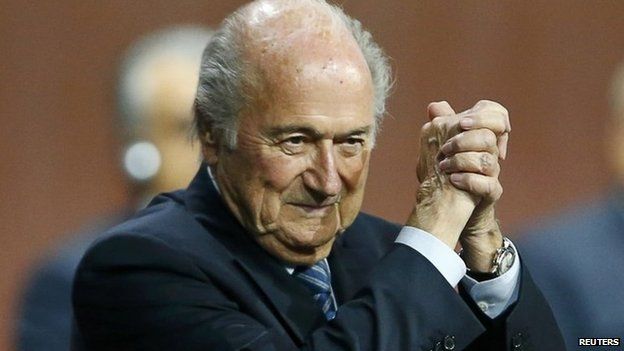
Sepp Blatter was close to tears as he urged the staff to "stay strong"
Sepp Blatter was close to tears as he urged the staff to “stay strong”
Fifa president Sepp Blatter has been given a 10-minute standing ovation by some 400 staff as he returned to its Zurich headquarters a day after announcing he was to step down.
Reportedly close to tears, he urged his “fantastic team” to “stay strong”.
Mr Blatter stood down just days after he was re-elected, amid a corruption scandal engulfing world football.
Mr Blatter reportedly addressed staff in the same hall in which he announced he was resigning a day earlier.
He emphasised the reform work that Fifa now needed to undertake.
Director of communications Walter de Gregorio told the BBC that reform of Fifa’s executive committee was key and that members should undergo integrity checks.
He said it was not right for the president to say he was unable to monitor all of the executive committee members all of the time.
Mr Blatter had made those comments as he responded to the arrest in Switzerland last week of seven senior Fifa members – including two vice-presidents – as they awaited the Fifa congress, arrests that precipitated the latest crisis.
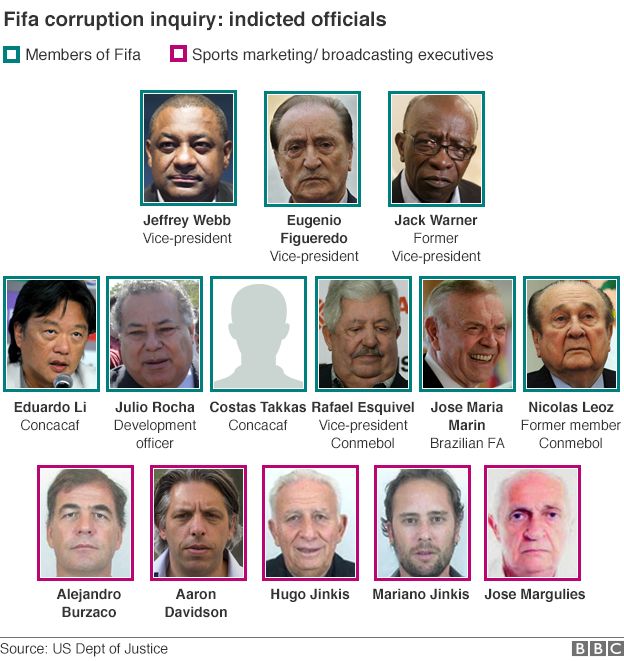
They were detained as part of a US prosecution that has indicted 14 people on charges of racketeering and money laundering. The US justice department alleges they accepted bribes and kickbacks estimated at more than $150m (£97m) over a 24-year period.
US officials quoted in the New York Times also said on Tuesday that Mr Blatter, 79, was under investigation as part of the inquiry. They said they hoped some of the Fifa figures charged would help to build a case against him.
Despite the arrests and the indictments last week, Mr Blatter was re-elected Fifa president two days later.
However on Tuesday, Mr Blatter said it appeared his mandate “does not seem to be supported by everyone in the world of football”.
He said he would continue in his post until an extraordinary congress was called to elect a new president. It is expected to take place between December 2015 and March 2016.
One outgoing Fifa vice-president, Jim Boyce, told BBC Northern Ireland he did not think Mr Blatter would be found guilty of corruption but that the president should have dealt with “criminals” in his organisation earlier.
A separate criminal investigation by Swiss authorities into how the 2018 and 2022 World Cups were allocated is also under way.
Australian football chief Frank Lowy said in an open letter on Wednesday that the race to win the 2022 bid, which was awarded to Qatar, was “not clean” and that he had shared what he knew with the authorities.
South African Sports Minister Fikile Mbalula has meanwhile launched a passionate defence of the country’s integrity over its hosting of the 2010 World Cup.
US officials allege South Africa paid a $10m bribe in exchange for support for its 2010 bid from Mr Warner and several other members of the North, Central American and Caribbean Association Football (Concacaf).
Mr Mbalula denied South Africa had paid a bribe, saying the money in question was above board and went towards an approved programme to support football among the African diaspora in the Caribbean.
Mr Mbalula railed against those who sought to be “world policemen”, adding “we believe in multilateralism not unilateralism”.
He added: “It is for the British and the Americans to fight their battles and… we’ll never be part of the vested interests. We have fought colonialism and defeated it and we still fight imperialism and we will fight it whenever it manifests itself.”
The Fifa official named by the New York Times and other media as the person responsible for the transfer of the $10m, secretary general Jerome Valcke, on Wednesday denied any wrongdoing.
“I have nothing to blame myself for and I certainly do not feel guilty so I do not even have to justify my innocence,” he told the France Info radio station.
Analysis: Richard Conway, BBC Sport, Zurich
Sepp Blatter’s key advisers cut dejected figures last night as their boss announced he was stepping aside.
The air of despondency in Zurich contrasts sharply with that in the rest of Europe. English Football Association chairman Greg Dyke and others who have pushed for reform rejoiced at the news that the man who has controlled Fifa with an iron grip since 1998 was finally going.
The question now turns to who will replace Sepp Blatter. What sort of Fifa will the winner inherit if the promised radical reforms take place? What next for the World Cup hosts Russia and Qatar?
Unless the electoral process changes dramatically, Asian and African countries will once again be the power brokers.
Given anti-European sentiments amongst many nations in those continents, the winner will need to be acceptable to all sides.
With Prince Ali of Jordan backed by Uefa, could he now return and claim the Fifa crown he was denied by Sepp Blatter last Friday?
How has Fifa changed the game of football you play and watch? What are the good and bad things that have happened under Sepp Blatter? Emailhaveyoursay@bbc.co.uk with your stories.
If you would be happy to speak further to a BBC journalist, please include a contact telephone number.
Thousands of Christians on Wednesday flocked Namugongo martyrs shrine for prayers in commemoration of 45 Ugandan Christians killed on orders of the king of Buganda for their conversion and devotion to Christianity beliefs over 130 years ago.
The 45 Christians killed between 1885 and 1887, have now become martyrs and their lives are celebrates by pilgrims from all over the world
At least 2,000 pilgrims from Tanzania attended the service. Others travelled from Rwanda, Kenya, Malawi, Nigeria, Kenya, Tanzania and DR Congo and Europe.
Security was tight as the army and police deployed heavily around the player venue and the roads leading to Namugongo shrine.
President Museveni was the Chief Guest, who promised to rehabilitate the shrine and upgrade the road from Kireka and Namugongo.
Mr Museveni took advantage of the event to tell worshippers that his government would not heed demands by public servants to have their salaries increased. He said government prioritise infrastructure development
“People did not know the value of roads, railways and electricity. Some want salary increments. Others want to construct roads. But infrastructure must come first before salary increments.” He said.
Last month, teachers were on strike demanding a 10 percent increment and government promised it would gradually increase their salaries.
Wafula Oguttu, The Leader of Opposition in Parliament
Kampala-Uganda’s opposition parties and civil society leaders on Wednesday left for Nairobi, Kenya to discuss a possibility of fielding a coalition presidential candidate against the ruling party in 2016 elections.
The Leader of Opposition in Parliament, Mr Wafula Oguttu told Eagle Online the conference is going to discuss “a wide range of issues affecting the opposition,” but said the main item on the agenda is the “modalities” of agreeing on having one candidate for the forthcoming elections.
“Yes, I am going to be part of the meeting and yes, a coalition candidate is one of the major issues for discussion” Mr Oguttu said.
However, the former FDC President, Kizza Besigye told Eagle Online he wasn’t aware of the meeting because he had not been invited.
“I don’t know whether I am on the list or not. I haven’t received the invitation and I am not aware[of the meeting].”
In response to why Dr. Besigye was not attending, Mr Oguttu said: “I don’t know. But what I can say is that most opposition leaders are going to attend”
Earlier, the former Assistant Bishop of Kampala Diocese, Dr. Zac Niringiye said the meeting was going to discuss “a peaceful transition from Mr Museveni to another leader”.
“Who says it is only opposition? this is a meeting of all those opposed to the Museveni regime and our focus now is to have a peaceful transition from Museveni” he said.
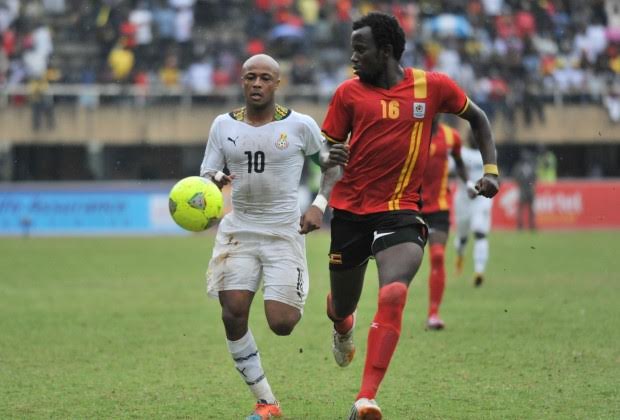
KCC FC head coach Abdallah Mubiru has said his players suffer no distress ahead of their Uganda Cup final in Ntungamo on Saturday.
While travelling in a separate car from the main squad (in a club bus), David Obua, Savio “Ginola” Kabugo & Joseph Ochaya were involved in nasty accident at Nekongolero, about 30Kms to Mbarara town on Tuesdayevening.
“The players have overcome the incident and we’re set for the cup final,” Mubiru noted.
Obua & Ochaya escaped unhurt while Kabugo was rushed to Lyantonde hospital were he spent a night but he’s been discharged this morning (Wednesday) though with mild chest pains.
Kabugo has been slowly recovering from a shin surgery on both of his legs and he’s yet to make a debut for KCC since his switch from SC Victoria.
KCC FC players stare at the vehicle that was involved in accident
KCC will play a friendly game with Mbarara United this evening (Wednesday) as the team acclimatizes to the conductions in western part of the country ahead of the cup final.
KCC FC is set to play SC Villa in the 41st edition of the Uganda Cup at Kyamate play grounds in Ntungamo on Saturday, both clubs have won the Uganda Cup 8 times a piece.