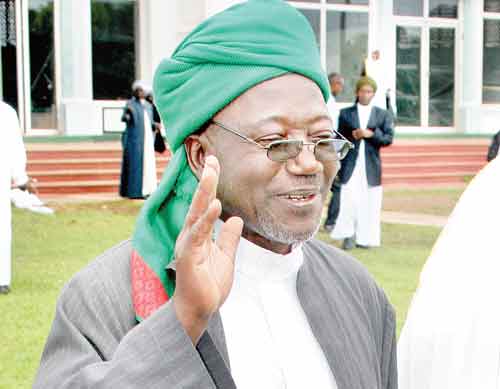
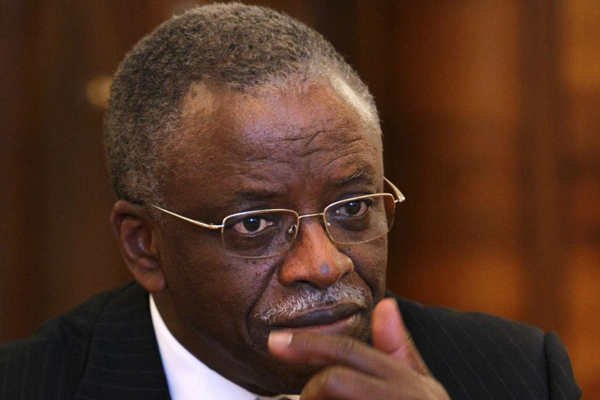
The remains of the Supreme Mufti Sheik Zubair Sowed Kayingo arrives at Entebbe International Airport aboard Kenya Airways.
Kayongo, passed on Thursday Morning at Agha Khan Hospital in Dar es Salaam in Tanzania. According to the Muslim leadership in Kibuli, the body is being taken straight to his home in Kiteezi, Wakiso district.
At 12.30pm the body will be taken to Kibuli Mosque for prayers and thereafter for burial. He will be laid to rest at his ancestral home in Buswa, Kiboga district at 4.30pm.
Among the high profile persons to send their condolences are the Kabaka of Buganda Ronald Muwenda Mutebi and religious leaders across the religion divide.
The Prime Minster Dr Ruhakana Rugunda today issues another statement on the ban on Buveera following the Wednesday cabinet meeting.
Rugunda said in the statement that Cabinet discussed and agreed that the implementation on the ban of, “plastic carrier bags of 30 microns and below continues while consultations are held to discuss the handling of other types of polythene carrier bags.”
The statement comes as the campaign to end the use of polythene carrier bags being implemented by NEMA, the Country’s Environment watchdog entered day two.
See below is the statement
Friends: I informed you that consultations on the effective implementation of the ban on polythene carrier bags were ongoing. Today, I wish to share with you CABINET decision on the matter as follows:
After consultations on the issue of the ban of polythene carrier bags popularly known as Buveera, Cabinet yesterday 15th of April 2015 discussed the matter and decided as follows:
1. Implementation of the ban in respect to plastic carrier bags of 30 microns and below continues while consultations are held to discuss the handling of other types of polythene carrier bags.
2. An Inter-Ministerial Committee has been set up to examine the matter further to conclude the consultation process, and prepare a Cabinet Paper within 30 days for the consideration and decision of Cabinet. The Committee comprises of: Ministers of Trade, Industry and Cooperatives; Water and Environment; Agriculture, Animal Industry and Fisheries; Finance, Planning and Economic Development; together with the National Environment Management Authority (NEMA); Uganda Manufacturers’ Association; and Kampala City Traders’ Association (KACITA).
3. Manufacturers and distributors have been directed to establish polythene collection centres across the country and intensify public sensitization on polythene waste management.
4. The ban applies to the importation, local manufacture, sale or use of polythene carrier bags. This ban excludes polythene packaging materials for the following purposes: agriculture; industrial use; medical use; research and science; sanitation; construction material; and exports. It also excludes polythene packaging materials for foodstuffs such as bread, milk and other groceries.
A woman takes a blood test. Vaccines are a great way to prevent many serious infections
A woman takes a blood test. Vaccines are a great way to prevent many serious infections
A Uganda Sickle Surveillance study conducted on 93,316 individuals across the country has found that the sickle cell burden is lower in HIV positive Infants.
The Early Infant Diagnosis (EID) study which was flagged off in February last year predicted that amongst HIV positive infants, 5.1 were normal, 5.0 had the trait and 3.0 had the disease.
Amongst HIV negative infants, the study discovered that 94.9 were normal, 95.0 had the trait and 97.0 had the disease.
This study was conducted by the Division of Hematology and Global Health Center Cincinnati Children’s hospital, Makerere University, CPHL Sickle Cell laboratory and the Ministry of Health.
A man takes a blood test. Vaccines are a great way to prevent many serious infections
Out of the total of 93,316 screened; 664 had the disease, 12,283 have the trait, 79,943 were normal and 426 were variant. The study discovered that Northern and Central regions had the highest values of the Sickle Cell disease.
Of the 112 districts subjected to study, 14 districts contain 47% (312 out of 664) of the sickle cell disease. These districts are Kampala, Gulu, Lira, Jinja, Tororo, Luweero, and Wakiso, Apac, Iganga, Mayuge, Buikwe, Oyam, Masaka and Masindi.
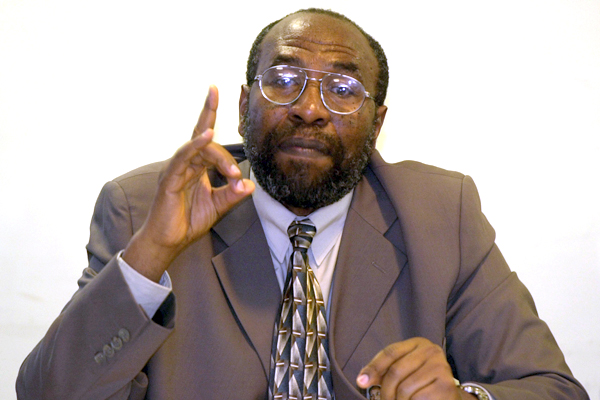
It is from these findings that Professor Grace Ndeezi from the Department of Pediatric and Child Health- Makerere University College of Health sciences suggested that screening of the disease should mainly focus on these highest burden regions.
The Minister of Health for Primary Health Care, Sarah Opendi, acknowledge that this survey has come at the right time when government had limited knowledge on the Sickle Cell disease and was operating on old statistics.
“We cannot plan and allocate resources without data. These results have availed us with enough data to come up with a Sickle Cell control strategy,” Opendi said.
These study findings were revealed during a scientific conference on the Sickle Cell Burden in Uganda at the senate building Makerere University and later crowned by the free national Sickle Cell screening exercise at the University’s freedom square.
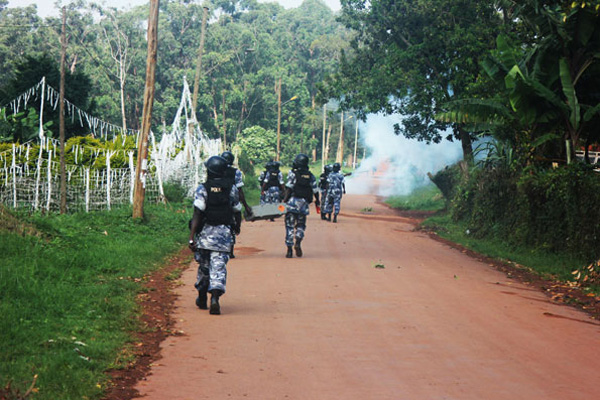
Police fire teargas to disperse rowdy Kyambogo students
Police fire teargas to disperse rowdy Kyambogo students
The highly anticipated Kyambogo vs Makerere University Football League game didn’t take place as students from both sides turned violent.
In a game that police was lowly deployed, students demanded reinforcement to no avail. Match officials were thus escorted off the Kyambogo football pitch.
The impatient students from both sides invaded the grounds were a scuffle erupted. Students in possession of Stones and sticks hurled them against each other. Two students were injured in the process and were rushed to Kyambogo medical centre for treatment.
Police fired in the air to bring order but instead worsened the situation as running battles began. Police reinforcement arrived with teargas and more personnel. Students from both camps blamed each other for the violence.
The Makerere football team, still stranded in the pitch with some fans got police escort outside the University only to land into the ambush of the now violent Kyambogo students. They hurled stones at the players but where interjected by police teargas and bullets.
During the last edition, the game at the same University was abandoned after the visitors invaded the pitch at half time.
It’s up to the court of arbitration to decide on what action will be taken.
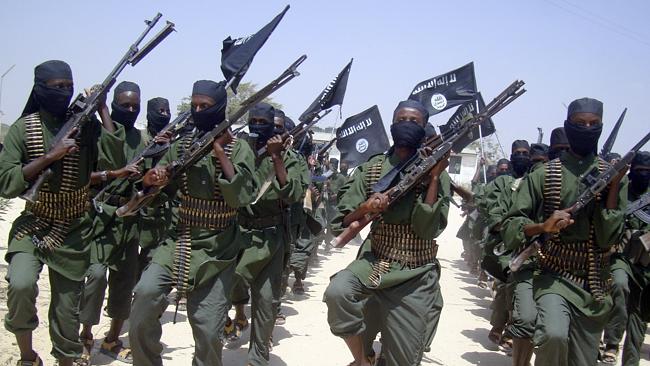
2011 Al-Shabab fighters march with their guns during military exercises on the outskirts of Mogadishu, Somalia. Source: AP
2011 Al-Shabab fighters march with their guns during military exercises on the outskirts of Mogadishu, Somalia. Source: AP
Somalia’s Islamist al-Shabab militants are recruiting heavily in north-eastern Kenya, according to evidence gathered by the BBC.
The BBC reports that the recruitment marks a new tactic for al-Shabab, underscoring fears voiced by Kenyan intelligence services and MPs.
In one town alone, the BBC has learnt of 26 young men whose disappearance was reported to police because they were suspected to have joined the militants.
Al-Shabab attacked a Kenyan university two weeks ago, killing 148 people.
The attack at Garissa was the deadliest yet on Kenyan soil by the militants. One of the gunmen was a Kenyan national.
Al-Shabab’s recruitment of fighters in Kenya’s own backyard marks a change of tactic for al-Qaeda’s affiliate in East Africa.
The BBC has learnt of scores cases of missing young men in the north-eastern town of Isiolo, who later admitted in phone calls to their parents that they had joined the Islamist group.
Only half of those cases have been reported to the police because of fears of reprisals. There are similar concerns in other parts of the country.
As part of the Kenyan government’s efforts to enlist the help of the Muslim community to fight the radicalisation of Kenyan youth, an amnesty has been offered to young Kenyan men who have been lured into joining al-Shabab.
But one of the most powerful Muslim leaders in the country, Sheikh Abdullahi Salat, warned that widespread mistrust of the security services in Kenya threatens to frustrate investigations.
He claimed that corruption within the police, military and intelligence services was likely to hamper attempts to hunt down al-Shabab.
But the Kenyan government, whose anti-insurgency campaign has focused largely on military efforts across the border in Somalia, have described the allegations as a “diversion”.
“Do not forget, through all the years; those who have gone through the gates of Makerere. Give them the pride, give them the joy; oh to remember the gates of Makerere…”
That is a stanza in the Makerere University anthem, the late David Ojok’s parents, family, friends and other alumni of the great institution can no longer attach meaning to ever since the gruesome murder of Ojok at Nkrumah hall on Sunday April, 12th.
According to the guild information minister, Davidson Ndyabahika, Ojok graduated with a Bachelor’s degree in Soft-ware engineering in January this year and owned an internet café in a suburb around the university commonly known as Kikumi-kikumi.
Little did he know that the institution which turned out as his education vine-yard would ultimately be the place he meets his death in the most unimaginable manner.
“From the information I have gathered from the students, it is alleged that Ojok often went to Nkrumah to watch soccer. On the day of his demise, it is still alleged that he had gone to demand money from a student who owed him,” Ndyabahika said.
However, when Marvin Mutunji, the newly appointed chairperson saw him, he asked Ojok for identification which he did not have.
“The students told me that when Mutunji over questioned him, Ojok decided to run. This provoked students to run after him and some started shouting thief. The result was his tragic death in the hands of a mob,” Ndyabahika said.
This sad story which has taken rounds on mostly social media still sends a chill down the spine of everyone who reads it. How can university students be capable of committing such an injustice on mere suspicion?
Adeke Anna Ebaju, a former guild president of the great institution also testifies of how she survived injury under the culture of “solidarity”.
“Just as any convoy would, we were moving around campus during campaigns speaking to students. But when we reached Lumumba hall, we were stoned. We had to turn back and save our lives,” Adeke said.
Similar incidents happened during this year’s guild campaigns. Gangs from rival camps fought and some of these exchanges resulted into injuries and bloodshed. All in the name of candidate support solidarity.
Is Makerere slowly developing a murdering culture?
Before it was pulled off the Makerere University Students’ Guild Facebook page, this is how a post by Humble Derick Wagooli, that gathered 24 likes on 12th April at 11:35 pm read;
“HAHAHAHA for us we don’t joke… another thief killed at the mighty Nkrumah hall today at 10:30. EHH NKRUMAH OYEE?? Eh activists oyee?? .. Feeling thankful”
The university guild president, Bala David Bwiruka, had this to say about the gruesome act;
“While culture and solidarity are very essential anthropologically, it is also not true that murdering is a culture at Makerere. This kind of solidarity that joins people to commit atrocities is evil and as leaders, we condemn it.”
Ndyabahika denies accusations that the entire students’ body is violent. He refers to the mob that killed Ojok as few ill-mannered isolated cases who will be arrested face the law.
“The solidarity culture is not dangerous. I don’t think we have dangerous culture in Makerere. It only gets bad when it goes extreme and some of the behaviors are intolerant. All these halls have had culture since they were established and I am sure it is important because it binds students together,” Ndyabahika said.
This is what a third year student of Journalism and Communication at Makerere University, John Blanshe Musinguzi posted on his Facebook page on Wednesday;
“That awkward moment when you don’t want to be identified as a Makerere University student. Today, I am planning to visit an office in town. My University identity card will be my entry ticket. I am just thinking, what if am asked; were you among those who lynched that innocent lad???!! Alas!!!”
The Supreme mufti of Uganda, Sheik Zubair Kayongo, has passed away this Thursday Morning at Agha Khan Hospital in Dar es Salaam in Tanzania.
Sheikh Kayongo who has been heading the parallel Kibuli-based Muslim administration was appointed de facto mufti in January 2009 by a College of Eminent Sheikhs.
Kayongo’s profileSheik Kayongo was born in Bbaale, Kayunga district to the late Hajji Sowedi Kayongo.He studied at Katuumu Muslim School in Luweero district and later at Lamu Muslim College in Kenya. He started teaching Islamic studies in 1955.Served as a deputy Mufti to Sheik Luwemba in the 1980s. He also held the same post under Sheik Ahmad Mukasa when he was leading a faction based at Kibuli Mosque.A member of the Uganda Muslim Supreme Council’s college of sheiks.He is close to the Buganda Kingdom leadership at Mengo and heads a conflict resolution committee of one of Buganda’s clans, the Kobe. He has residences in Kiteezi, on Gayaza road in Wakiso district and Lwamata in Kiboga district.
The more ex-premier Amama Mbabazi maintains grave-like silence, keeping his cards closer to his chest, the more he leaves his supporters guessing on his next move -with some now questioning whether he ever harbored genuine political ambitions or whether his plans have been neutralized once and for all.
A long-simmering dispute between Mbabazi and President Museveni- his decades-long ally, was slowly laid bare beginning with the October 2014 closure of the National Bank of Commerce and the subsequent passing of a resolution endorsing Museveni as the party’s sole candidate in 2016.
The resolution by and large caught Mbabazi flat-footed. He has since remained mute-occasionally insisting that he cannot run against Museveni while also occasionally saying he will announce his next move at the right time.
His youth troops have been scattered by Museveni’s stick and carrot approach; today they are holed up in Luzira on charges of abuse of [NRM] office, tomorrow they are hobnobbing with the President in his luxury vehicles traversing his upcountry farm in Kisozi on another day.
But as Mbabazi drags his feet over his next move, the NRM is not resting on its laurels as this week it released its roadmap to 2016-stating that nominations for Presidential candidates will take place on October 5 and 6 while Parliamentary candidates will be nominated on November 9 and 10.
His one bargaining chip is the NRM voters register which the party has been fighting over with his daughter-Nina Mbabazi over a Shs 6b.NRM will thus undertake fresh registration of voters to compile a new voter’s register at a higher cost than giving Nina’s Shs 6b.
And with the release of the Roadmap-the ball is in Mbabazi’s court; make or break time. But how will Mbabazi play the ball?
The Roadmap come amid a warming up between Mbabazi and top Opposition politicians.
He has also been in talks with top Opposition politicians. Founding Forum for Democratic Change President Kizza Besigye and Democratic Party president Norbert Mao have both admitted in interviews to having met pro-Mbabazi elements.
The Eagle Online understands FDC President Maj Gen (rtd) Mugisha Muntu has also conferred with Mbabazi.But sources close to the General say he is very skeptical with anything Mbabazi.
But with Mbabazi finding it a tall order convincing his newly found peers in the Opposition that he is marketable to the electorate, Mbabazi is likely to content with stepping in the plate of his erstwhile comrades in the ruling party.
Mbabazi’s not-so-beautiful past with the NRM have thickened the hearts of Opposition faithful to him being on the ballot. Besigye enthusiasts think he formed the thinking caps of regime functionaries that fiddled with the results in the 2001 race. Mbabazi was also the legal cook of unfriendly legislations-with an eye on Opposition political activities. They have never buried that hatchet.
He will thus be willing to begrudgingly throw his weight behind an Opposition candidate.
The army has warned the former Coordinator intelligence agencies, Gen David Sejusa for making controversial political statements.
Gen Sejusa, who returned from exile in December last year in London, held a meeting on Tuesday with the opposition Democratic Party and called for boycott of the 2016 general elections if the proposed electoral reforms are not implemented.
But the army spokesperson, Lt Col Paddy Ankunda said Gen Sejusa would not be allowed to continue making political statements since he is still a serving army officer.
“We will consult with the Commander-in-Chief over the issue because this is indiscipline,” Ankunda said.
The opposition has proposed a number of electoral and constitutional reforms including allowing Ugandans in the diaspora to vote and review the recruitment of electoral commissioners.
Currently, the incumbent president appoints members of the commission, which the opposition says the current is unfair. But government has been opposed to some reforms like reviewing of recruitment of commissioners.
Col Ankunda said they would consult President Museveni and decide on the fate of the maverick military who has applied to retire from the from military and join politics but the army has been noncommittal about his request to retire.
Col Ankunda gave the warning to Gen Sejusa at the decoration ceremony of two army officers, James Mugira and Nakibus Lakara in Mbuya, the Military Headquarter. The two officers were promoted to the rank of major general on Saturday.
Gen Sejusa said if Museveni ignored the calls for reform, the opposition could be justified to boycott the elections. He, however, said an election boycott would still favour Museveni.
Packing for customers on major shopping malls and supermarkets in the Kampala city remained a challenge as the directive from the Prime Minister to post pone the implementation of polythene bags (buveera) ban hit a snag.
Many of these shopping centres opted to the use of paper bags and empty boxes to pack the commodities and other items. However, the ban brightened business for some people who quickly adjusted and rushed into making paper bags that sold out like hotcakes.
National Environment Management Authority issued a public notice with effect from 15th April to ban the use of Polythene bags. Despite the numerous efforts to implement bans against buveera since 2012, all have been in vain.
The campaign aims at protecting the environment from pollution as well as promoting good health habits. The cooks in congested areas of down town that use polythen bags to cover food do not know about the health dangers associated with that.
One of the managers at Mega Supermarket, who only revealed his identity as George said, “We are waiting for the government’s final meeting with NEMA officials.”
He further expressed concern about the immediate action as unfair since they still have many Buveeras in stock. “The buveeras are worth Shs50 million because the small ones are sold at Shs8000 and big ones at Shs3500 a pack. We need a grace period for like a period of 3 months so that the stock gets out quickly and an alternative put in place for paper bags,” said George.
However this comes as good news to some youth that have been involved in making paper bags to earn a living. John Luswata, who makes paper bags and crafts to customers, sees this as an opportunity to broaden his market besides the supermarkets. “Some customers will want bags that are reusable to use in the markets than having to buy one all the time,” Luswata said.
The PM adjourned the campaign after he met up with Representatives of Uganda Manufacturers’ Association (UMA) and Kampala City Traders’ Association (KACITA) on Tuesday to discuss on the welfare of businesses at the moment. However NEMA defied this and went ahead to kick start the campaign.