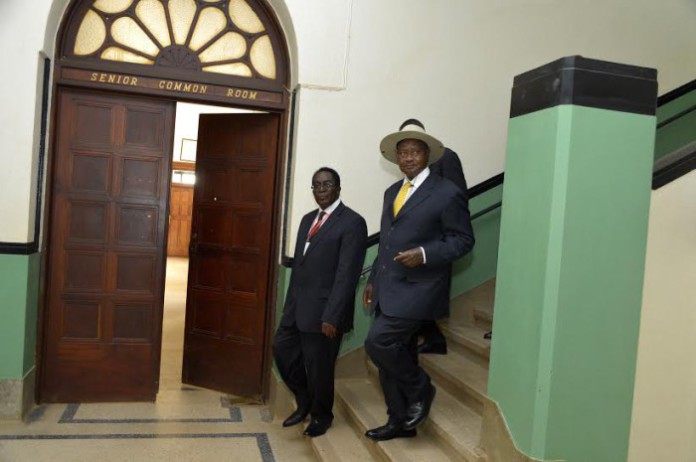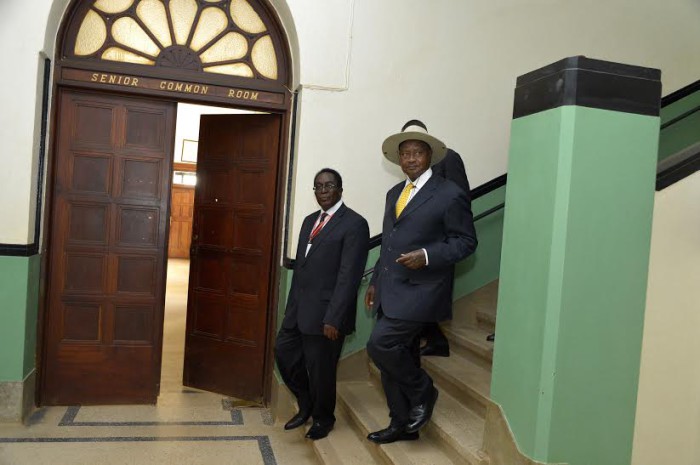
President Museveni has promoted Brigadiers James Mugira and Nakibus Lakara to major general.

President Museveni has promoted Brigadiers James Mugira and Nakibus Lakara to major general.
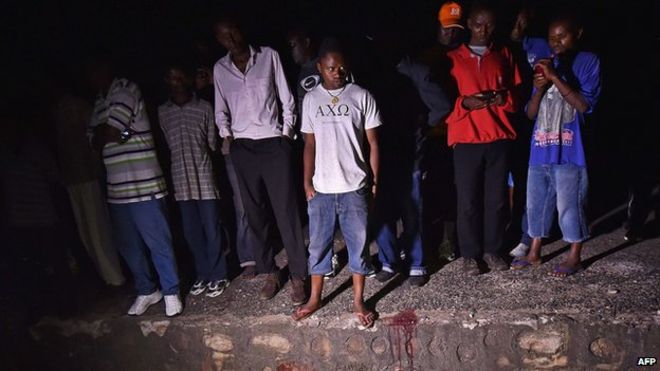
A third year student succumbed to injuries following a stampede at the University of Nairobi’s Kikuyu Campus Sunday morning after a power transformer exploded.
According the university’s Vice Chancellor Prof Peter Mibithi, 141 others were admitted to hospitals, 99 of them at the Kenyatta National Hospital (KNH) one at Karen Hospital and 37 at Kikuyu Hospital.
The students jumped from their hostels to the ground floors after the 4 am incident in which they mistook the explosion from the transformer for a terrorist attack.
Some students jumped from the sixth floor of their hostels. “The explosion from the transformer went off and there was a succession of the same for about 20 seconds that made many of the students think it was Al-Shabaab who had attacked,” said a student who said he survived with a scratch in the face. Police who visited the students said the students scampered for safety after the 4 am incident.
Some of the students were having a party at that time. At KNH, parents and friends of the students thronged there to visit their loved ones. Officials said the students had broken limbs and cuts.
Some of the students said avoided using the main entrance in getting out and opted to jump out through the windows because they believed the “attackers” were there.
Emergency services were mobilized to ferry the students to the hospitals. It came a week after terrorists raided Garissa University and killed 148 people in a siege.


Today Mengo, the official seat for the Kabaka of Buganda was a scene of a sea of roaring crowds, elite athletes, amateur runners and charity fundraisers to create one of the most memorable birthday celebrations for Kabaka Ronald Muwenda Mutebi II.
The marathon used as a curtain raiser ahead of the 13th April birth day of the Kabaka geared at fundraising for Fistula patients.
The marathon was flagged off by the Kabaka at about 7:20am. “Commemorating the birth of Kabaka Ronald Muwenda Mutebi 60 years ago, the Kabaka Birthday Run is one of the most inspirational road races in the country. This year’s running has ‘special meaning’ as it caps a variety of activities marking the 60th birthday for the Kabaka of Buganda,” said Charles Mayiga, Buganda Prime minister With over, 60,000 spectators flocking to the palace grounds to cheer on over 20,000 runners, is an atmosphere that few races are able to match.
The course its self is a relatively long one with sites like Kabaka’s lake, Bulange, Kasubi tombs ,Rubaga and Namirembe cathedrals and the Uganda Museum every turn, culminating in a spine tingling home stretch along Bulange lane .The race attracted the best runners from the country ,musicians ,artists ,politicians and people from the corporate world.
“The marathon was organized to honour the memory, celebrate life of Kabaka Ronald Muwenda Mutebi, and proceeds from the run are to sustain fistula patients. The event isn’t about running, but about life,” said Prince Wassajja.
For Catherine Nagawa a fistula patient, attending the Kabaka birthday marathon made her feel lively. Her brother Joseph recommended the race during her treatment for fistula Christine endured after giving birth to her child. “You are already going through the ultimate test of endurance” her brother told her. “Next to that, the marathon is a piece of cake”
Not fairly. Finishing the marathon was the second hardest thing Christine had ever accomplished.
“I am still afraid of the marathon,” Sandra Walusimbi an elite runner from Airtel, told me as she was training for 21 mile race. Even for professionals, the marathon is a humbling experience, its distance unpredictably torturous on the body and mind. The run was in categories of five, 10 and 21 kilometers.
Mrs. Walusimbi used her fear to motivate her. As a child she always ran in defiance of limits others imposed on her.
For Fred Balunywa, a financial analyst running with a T-shirt emblazoned with the words: “Kabaka’s Birthday Run 2015, Happiness continues” said that, Kabaka Birthday Run helps him reinvent himself and improve his image and health.
Grace Nakku who is nurse at Nsambya Hospital appreciated the Buganda Kingdom for organizing such event which according to her will help to create awareness regarding fistula. Alice Mwebaze, a recovering fistula patient and mother of three was grateful for the marathon. Throughout the race she felt buoyed by the crowd and knew she was back on the right path. “I feel like a superstar, at the beginning.
I thank Buganda management for the preparations and awareness created about the disease. The lessons from the marathon are enduring, and variations,” Ms Alice said. For her fistula is deadly and expensive disease to cure, and all other competitors, the finish line didn’t just represent an ending, but rather these themes replay every year in mothers and champions, recovering patients and average runners who are anything but.
The marathon was sponsored by Airtel, CBS, Bukedde, and MAAD advertising Agency and many others.
rzalwango@eagle.co.ug


While many journalists turned up for Uganda National Journalism Awards 2015 at Golf Course Hotel on Wednesday with adrenaline running wild like for a 13-year-old girls about to break her virginity, Andrew Mwanguhya was grinning like an Indian betting firm manager on a weekend of upsets. The Early Bird was quick to deduce two reasons: First, the Monitor sports reporter was assured of winning, and secondly, if he did not win, he had already won.
It was all in the date. The sultry, nippy and and ‘hippy’ date Mwanguhya turned up with for the award was worth more than the plaques and Shs2.5 million The African Centre for Media Excellence was awarding winners.
Such was the night that while many ran their lips dry, mouths bitter and tongues sour, The Love Dre, as Mwanguhya is known by his close friends, was in his own cloud despite seeing the sports journalist of the year award go to an unknown reporter from Arua.

The Love Dre drove home in his sleek Altezza sports car with Shs1 million cash prize for the runner-up accolade, but The Early Bird is not sure the guy even arrived with the money, let alone the certificate–he probably lost them while paying attention to his love. As the pictures show, the sultry date was more than imaginations can coin in the bathtub on a lonely night when armed with Geisha soap.
Could this be the riddle to explain why the guy has stubbornly remained single? Has he been waiting for this bird?
Meanwhile, The Early Bird was quick to snoop around for the scent of the cologne the date was wearing to find clues as to her identity. We are told that the chick is called Kashaija and is a dropdead that causes jams around Mubs and Nakawa quiet often. We are yet to find out if Kashaija is a student or not.
Surely, with such an item by your side, what is a mere ACME award? The Love Dre was surely the happiest loser of the night.


Makerere University students today jammed Kampala streets in in a peaceful demonstration in solidarity with the over 147 students killed in last week’s attack on Kenya’s Garissa University by the Al-Shabab militants, a terror group in the region.
The students who were provided with Police security headed to the Kenya High Commission to deliver their condolence message.
Holding placards with messages of unity and denouncing terrorism on innocent students, the students marched from their university to the High Commission on Acacia Avenue.

KAMPALA: The deputy Inspector General of Government (IGG), George Bamugemereire, has directed the National Agricultural Advisory Services (NAADS) board of directors and executive director to immediately fix the mess related to illegally recruiting staff to fill various positions.
Justice Bamugemereire in his report of investigations of illegal recruitment at NAADS which was issued today directed the board to relieve Henry Aggrey Bagiire, the chairperson, the role of chairperson of finance and administration committee to avoid a situation of conflict of interest.
He also directed the board to immediately advertise the positions of executive assistant and office messenger, internally so they can be filled on the “principles of meritocracy, transparency, fairness and competition as provided for in the NAADS Human Resource Policies and Procedures Manual.”
The ombudsman’s recommendations are premised on an investigation which followed complaints that in filling out the positions in the lean structure, the Board advertised the jobs starting with Zonal officers whom it successfully filled in a transparent and fair manner.
However, when the Board in the same spirit advertised, shortlisted and commenced the interviews for the shortlisted candidates for the NAADS Secretariat positions, the Minister of Agriculture Tress Bucyanayandi, abruptly halted the process and instead issued new guidelines to the Board which were to be applied in respect of appointment of specified individuals to certain positions.
It was also alleged that the Board kept on shifting its position as regards the candidate profile and qualification requirements for some positions in the new lean structure advertised in a manner that was meant to favor some candidates that applied for the positions.
The complaints were received following a Cabinet directive that the NAADS) secretariat be restructured into a lean organization with a single spine structure, the Ministry of Agriculture, Animal Industry and Fisheries together with NAADS Board restructured the organization but that the process of filling vacancies at the new NAADS Secretariat was marred with irregularities.
In the report, Justice Bamugemereire, said investigations revealed that the board delegated its Finance and Administration Committee which is also ironically chaired by the board chairman Mr Bagiire to come up with job descriptions for the newly approved positions following the restructuring.
The investigations also revealed cases of influence peddling of the recruitment process to fill job positions.
The IGG also directed the NAADS executive director Dr. Samuel Mugasi to “ensure that all Board records are securely kept and further ensure that all Board and Board committee minutes are approved and signed.”
See full report below
HQT 51/01/2015
2nd April 2015
The Chairperson
NAADS Board of Directors
KAMPALA.
REPORT ON INVESTIGATIONS INTO THE ALLEGED IRREGULARITIES IN THE FILLING OF POSITIONS AT THE RESTRUCTURED SECRETARIAT OF THE NATIONAL AGRICULURAL ADVISORY SERVICES ORGANIZATION
The Inspectorate of Government received a complaint wherein it was alleged that following a Cabinet directive that the National Agricultural Advisory Services (NAADS) Secretariat be restructured into a lean organization with a single spine structure, the Ministry of Agriculture, Animal Industry and Fisheries (MAAIF) together with NAADS Board of Directors (hereafter referred to as “the Board”) restructured the organization but that the process of filling vacancies at the new NAADS Secretariat was marred with irregularities.
In particular, it was alleged that:
The Inspectorate of Government investigated the complaint and made the following observations and findings:-
10.We find that so much water has already flowed under the proverbial bridge but the situation is not entirely hopeless since no appointments have been made as yet. We find that the integrity of the resourcing process can be salvaged by rolling back the recruitment process and picking up the resourcing from the point just before the Minister’s intervention. Therefore we recommend that the resourcing strategy adopted by the Board do proceed as earlier planned.
11.It is observed that there is evidently poor record keeping at the NAADS Secretariat as it was found quite cumbersome to retrieve records concerning even recent events. It is also noted that there is a habit of keeping unsigned Board and Committee minutes by the NAADS Secretariat. It is further observed that the ED is an ex-officio member of the Board who is also its Secretary. It is therefore the duty of Dr. Mugasi the ED to ensure that minutes of the Board are properly kept, which duty he was not performing with diligence.
In view of the findings and observations above, we recommend as follows:-
A copy of the detailed report of the investigation is attached for your further information and implementation. Please give us an update of actions taken to implement the report within 60 days from the date of this report.
George Bamugemereire
DEPUTY INSPECTOR GENERAL OF GOVERNMENT
c.c The Hon. Minister
Ministry of Agriculture, Animal Industry and Fisheries
c.c The Permanent Secretary
Ministry of Agriculture, Animal Industry and Fisheries
c.c The Executive Director, NAADS Secretariat
The April 2 release of a revised roadmap by the Electoral Commission sent jolts within the ranks of the Opposition Forum for Democratic Change (FDC) as party officials quickly met and re-adjusted their
programme lest they would be found napping.
The FDC National Executive Committee convened on the April 1(Wednesday) and resolved to fast-track its electoral calendar by scrambling up a Road Map for the election of grass root structures. A follow-up NEC meeting yesterday [Thursday] endorsed the programme. Top on the agenda at the Najjanakumbi April 1 meeting was a concern that the Electoral Commission might playing around with the Road Map
as a ploy to catch Opposition parties off-guard-effectively stacking the odds in favor of the ruling party.
But the meeting resolved that there is no time for finger pointing -and resolved to kick-start a process to elect grass root structures that will in turn constitute electoral colleges.
And the elections will kick off on April 15 in the Teso and Bukedi sub-regions to kick into motion a process that will ultimately end with the election of a Presidential flag bearer for the 2016 elections
at a delegate’s conference whose date remains undecided.
According to the Road Map sent to party officials, between April 15-22, elections will begin in the Teso sub-region .Bukedi, Rwenzori and West Nile sub-regions will also hold elections during the same period.
Western Uganda will follow with elections in the West Ankole districts of Ntugamo, Bushenyi, Buhweju, Rubirizi, Mitooma and Sheema between 29th April-6th May. East Ankole taking Mbarara, Ibanda, Kiruhura and Isingiro will also conduct the same period.Bunyoro and Tooro regions will also conduct polls during the same period.
Buganda region will also vote during the last months of April period while Kampala (taking the five divisions) votes between May 10-May 17. Elections in the Sebei, Acholi and Karamoja sub-regions will be
between 10th-17th May.
All National Executive Committee(NEC) offices- are up for grabs save for the party presidency as Major General (rtd)Mugisha Muntu’s term expires in 2017-having been elected in 2012. The term of office of
the FDC NEC expired in February 2013 but no fresh elections have been held due to resource constraints and internal disagreements.
Elections will begin from the village, parish, sub-county, county up to district levels. Key among the posts to be filled at these levels are Treasurer, General Secretary, Secretary for information and
publicity and Secretary for mobilization and election.
The Forum for Democratic Change delegates conference in December last year voted to shift from the polling area branch system – where the local structure was built around the polling stations – to a new
system where structures are built in line with villages-as part of a wider strategy to strengthen the local bases.
Only card holding members of the party will be eligible to vote-as the party seeks to raise money by selling cards at Shs1000.But some party officials are wary that the ruling party might infiltrate FDC ranks just by buying party cards.
cninsiima@eagle.co.ug

Uganda is in the unenviable place of being among few countries in the world where no leader has ever peacefully handed the reins of power peacefully to another leader!
During the 29-year Museveni/NRM rule, four general elections have been held and a fifth one is supposed to be only months away. Understandably, there is already a lot of jostling in the ruling NRM junta and in the “opposition” political formations.
While most of the jostling seems to be over selection of candidates for the election, the real elephant in the room is the lack of credibility of the anticipated 2016 elections and the realistic options available to citizens.
STATE OF ELECTIONS:
The Supreme Court of Uganda, in spite of severe interference by the Executive, made a categorical and unanimous ruling in 2006, that the presidential election was not free or fair. The story of why it wasn’t cancelled is, of as much interest for intellectuals, as it is for criminal investigators.
In 2011, all presidential candidates, save for the incumbent, rejected and denounced the outcome of the elections. Any recourse to the courts of law (through an election petition) was considered to be a futile exercise. It was resolved that the “Court of Public Opinion” would be resorted to instead.
Many parliamentary election petitions were lodged in courts and, indeed, many election results were overturned and by-elections held or a different winner simply declared. At least one petition is still undetermined in courts of law, more than 4 years after the previous election!
In 2013, political parties and Non Governmental Organisations (NGOs) launched a national campaign, whose main thrust was to generate a consensus on the electoral reforms that would engender free and fair elections.
The broadest representation of community formations in each of 15 regions of the country participated in deep and intense discussions on the essential electoral reforms. These included representatives of the ruling NRM junta at various levels.
Eventually, a National Consultation was held in Kampala in November 2014 (at Hotel Africana) to crystallise the national demand for electoral reforms. In spite of an attempt by the ruling NRM junta to stop its leaders from participating in this crucial meeting, many NRM leaders from the regions and the national level participated fully.
Seventeen points were crystallised as forming the essential reforms, without which, the elections of 2016 cannot be free or fair. The resulting document was appropriately named a Uganda Citizens’ Compact on Free and Fair Elections.
This was promptly delivered to the Speaker of parliament and other relevant offices of the Executive, including the President’s Office.
During the year-long campaign for free and fair elections and, especially, during the National Consultation meeting, it was anticipated that the NRM junta would not be receptive to the demand for fundamental electoral reforms. There were good reasons for the scepticism.
In 2009, the Inter-party Cooperation (IPC) presented to government a comprehensive proposal of electoral reforms, including proposed bills for amending the Constitution and the various electoral laws.
These were shelved until some months to the 2011 elections when the junta presented its bills for amending the electoral laws. Some of the minor amendments in the IPC proposals that did not go to the heart of the election management system were adopted.
It was argued then that the far-reaching proposals could not be considered because, among other things, there wasn’t enough time to implement such changes ahead of the scheduled 2011 elections.
Election observer reports on 2006 elections, notably, by Uganda Joint Christian Council (UJCC), Commonwealth, and EU, pointed out the need to have electoral laws emended well ahead of elections. The Electoral Commission itself had strenuously demanded for electoral reforms well ahead of the next elections, to no avail. This had also been the case in the 2001 elections!
The pattern of aversion to free and fair election on the part of the NRM junta is crystal clear and understandable- it’s for self-preservation! This was the reason why the l8th and last Article of the Citizens’ Compact was reserved for the steps to be taken to ensure the implementation of Compact.
A Citizen’s Task Force was set up; and, the Coordinating Team (CT) of the Campaign for Free and Fair elections, together with the Convener’s of the National Consultation, were tasked to establish a mechanism that will ensure the full implementation of the Compact.
The main thrust of the mechanism that will ensure implementation of the compact envisages citizens’ mobilisation, organisation and actions challenging the current system of election management.
THE DILEMA:
It’s now a maximum of 11 months to the next polling day and a maximum of 7 months to the nomination day (according to the Constitution) for the next general elections. Yet, up to now, no electoral reform proposals have been presented to parliament for debate!
In the meantime, the controversial Electoral Commission has published another “roadmap” for the next election! Update of the National Register begins 7th April and ends 30th April 2015; nomination of candidates for Village Youth, PWDs and Elder persons is slated for 5th-16th June 2015; display of National Register 2nd-22nd June 2015; nomination of presidential candidates 5th and 6th October 2015 etc.
This is clearly a desperate attempt by the controversial EC to undertake the election processes in the absence of relevant electoral laws!
CONFUSION EMERGING OVER PRIORITIES:
Unfortunately, it increasingly appears that some political leaders in the campaign for free and fair elections are either unsure or uncommitted to the primacy of the full implementing the Citizens’ compact ahead of the next election.
Some have even suggested that those insisting on full implementation of the Compact are, in effect, calling for a boycott of the 2016 elections! The published EC “roadmap” seems to have spurred many political actors into focussing on getting candidates and campaigning for the next election, regardless of its credibility!
It’s also increasingly purveyed that as long as there is a single opposition candidate, the opposition will win the next election (entirely organised by the Junta itself) and that the Junta will bow out of government!
This is the situation that the NRM junta would be hoping for: another round of sham elections- organised, controlled and delivered on the Junta’s terms!
This is no time for confusion on the part of political actors. It’s a very critical time in the history of our beleaguered country: to make a break from the vicious cycle of rigged elections and violence to peaceful change of government, through free and fair election.
WHAT NEEDS TO BE DONE:
It’s a time to offer citizens the leadership they need to ensure the full implementation of the Compact on Free and Fair elections. As pointed out earlier, this entails three processes:
It has been suggested by some political leaders that there are two separate but complementary tracts: On the one hand, preparing political parties for the elections; while on the other, is the struggle for electoral reforms. How do you prepare for an election whose credibility you don’t seek to influence?
Preparations for the next elections cannot be separated from the struggle for credible free and fair elections, unless one cares less for the outcome! It’s one indivisible struggle.
TIMEFRAME FOR IMPLEMENTING REFORMS:
As pointed out above, the lateness in considering and implementing electoral reforms is deliberate and self-serving on the part of the NRM Junta. According to the Constitution, polling day must take place before 12th March 2016.
It’s a given that even if Parliament considered and approved the essential electoral reforms now, there would simply be no time to restructure the affected institutions and electoral processes to bring them in line with the new order ahead of the next election.
The NRM Junta and its “sympathisers” would then argue, as they did before, that only limited reforms, which won’t interfere with the election “roadmap” and timetable be considered.
This is another test for the pro-democracy organisations and activists. Again, such ploys should not create an opening for confusion on our part. The objective of ensuring the implementation of the Citizens’ Compact on Free and Fair elections must be maintained. The struggle for that objective must be unrelenting.
If credible, free and fair elections cannot be realistically held before 12th March 2016 as expected under the Constitution, then the cure lies in the management of the politics.
The rational and equitable way out would be to negotiate for a transitional government that would manage the processes after the NRM Junta lapses on 12th May 2016. After all, the Junta has demonstrated beyond any doubt that it’s the main obstacle to free and fair elections!
MANAGING A TRANSITION TO A DEMOCRATIC DISPENSATION:
Regardless of how the NRM Junta is succeeded, it will be necessary to undertake transition programs that will restructure the State to make it’s institutions independent and competent. The NRM Junta integrated itself into all State institutions, such that, there’s no NRM outside the State. The lowest State institutions, Local Councils I &II, are still a direct vestige of the, so called, Movement System!
The critical tasks for the transitional administration would be three:
CONCLUSION:
Let’s not be vague, it’s EITHER A CREDIBLE, FREE AND FAIR ELECTION or NO ELECTION! Achieving either will take considerable commitment and effort on the part of all pro-democracy activists.


Students hold vigil in memory of 147 students that were killed by Alshabab terrorists
KAMPALA – It was a somber mood last night as over 200 Makerere University students converged at University’s main building to mourn and remember the lives of over 147 Garissa University students that were killed by Alshabab terrorists. The students lit candles while some carried placards that denounced the attacks.
The chairperson Makerere University Kenya Students Association (MUKESA) Christopher Mwangi, condemned the killings.
“An attack on Kenyan students is an attack on the entire globe,” said Mwangi “We strongly condemn the attacks.”
He also called upon Makerere students to be vigilant and report any suspects to the police. “I beg the students to be vigilant, alert the police officers in case of any suspicion.”

The Prime Minister Makerere University Guild council, Derrick Odur who was one of the mourners also criticised the Garissa attacks. “An attack on Garissa is also an attack on us,” said Odur. The Garissa attacks happened to fellow students and it can happen to us in Uganda too, we highly condemn the attacks and students should be vigilant,” he said. .
It was a quiet event and all students shared the same feelings about the attacks. Jackson Kariuki Namu, a Kenyan Mass Communication student said he saw no reason why Alshabab attacked innocent students. “Attending this mass, I just feel moved. I don’t see any reason why someone should take innocent lives.”
Mugizi Jason, a student pursuing is bachelors in Records and Archives Management also blamed the attackers saying that what Alshabab did was against Islamic values. “It’s a cowardly act that must be denounced in all manners possible.” “
Makerere University 40,000 students but only 200 students attended the vigil. Christopher Mwangi, the chairperson MUKESA attributed the low student turn up to students being busy and because it was time for tests.
“The students thought the vigil would be held in the Freedom Square but that was cancelled, and they are having lectures,” said Mwangi. Mugizi Joram says the students are to blame since they are so money minded. “If the organising committee had promised money, this place would be full of students,” he said. He also cited negaive attitude toward gatherings as a reason for the low turn up. “Students have a bad attitude towards gatherings, they think they will be tear gassed.”

Makerere University students will hold a peaceful march on Friday to the Kenyan Embassy in Nakasero in solidarity to remember and the 147 lives that were lost in the Garissa attacks.
On 2 April, gunmen stormed Garissa University College in Garissa, a town in the North Eastern pronvinnce of Kenya. 700 students were held hostage by the Alshabab terrorists. All the non Muslim hostages were killed by the gunmen. Making it the deadliest attack in Kenya since the 1998 United States embassy bombings. The Garissa attacks are the second deadliest overall with more casualities that the 2002 Mombasa attacks, the 2013 Westgate shopping mall attack, the Nairobi bus bombings, the 2014 Gikomba bombings, the 2014 Mpekotoni attacks and the Lamu attacks. The Kenyan government launched a massive manhunt with a US$215,000 20,000,000Kshs) bounty for Mohamed Mohamud also known as Dulyadin, the man believed to have orchestrated the Garissa attacks.
amayemba@eagle.co.ug
KAMPALA: The Inspectorate of Government (IG) Mukono regional office Wednesday afternoon arrested the Koome police CIID, Sgt e Amzatta Birende for soliciting a bribe.
Koome is an island on Lake Victoria, in Mukono district.
According to a statement from the spokesperson of the IG, Ms Ali Munira, Sgt Birende solicited a bribe of Shs 1,000,000 to release a suspect who had been arrested for dealing in premature fish.
However, when officers from the IG checked the police registry, they discovered that he “had written a different charge of attempted murder of police officer.
“The bribe that Sgt Birende solicited was to prefer a lesser charge on the suspect.”
Ms Munira, added the arrest also comes on heels of numerous complaints of bribery and fraud against the the officer
He is due to appear in the Anti-Corruption court Thursday afternoon.
editorial@eagleonline.co.ug